Biden remembers it all and tells it all that is all too quite ‘gorgeous’
CHRIS ENLOEFebruary 06, 2021 Paul Morigi/Getty Images for World Food Program USALike Blaze News? Get the news that matters most delivered directly to your inbox.SIGN UP
Simon & Schuster announced this week that one of its imprints will publish a forthcoming memoir from Hunter Biden, the son of President Joe Biden.
The announcement came just weeks after the publishing house backed out of moving forward with the publication of a book from Sen. Josh Hawley (R-Mo.).
What are the details?
Simon & Schuster announced on Thursday that Gallery Books, an imprint of publishing house, will publish a book from Hunter Biden in April titled, “Beautiful Things.”
The book “details Hunter’s descent into substance abuse and his tortuous path to sobriety,” according to a press release.
The book received advanced praise from novelist Stephen King, who gushed over the book.
In AA we say it doesn’t matter if you come from Yale or jail, all addicts are the same. In his harrowing and compulsively readable memoir, Hunter Biden proves again that anybody—even the son of a United States President—can take a ride on the pink horse down nightmare alley. There are plenty of memoirs about the Three Rs (rum, ruin, and redemption), but there are sections in this one that stand out with haunting clarity. Biden remembers it all and tells it all with a bravery that is both heartbreaking and quite gorgeous. He starts with a question: Where’s Hunter? The answer is he’s in this book, the good, the bad, and the beautiful.
Hunter Biden has been in news headlines routinely since 2019, facing scrutiny for his overseas business dealings in Ukraine and China.
“I learned yesterday for the first time that the U.S. Attorney’s Office in Delaware advised my legal counsel, also yesterday, that they are investigating my tax affairs. I take this matter very seriously but I am confident that a professional and objective review of these matters will demonstrate that I handled my affairs legally and appropriately, including with the benefit of professional tax advisors,” Hunter Biden said in a statement, which was released by the Biden-Harris transition team.
What is the background?
One day after the deadly violence at the U.S. Capitol on Jan. 6, Simon & Schuster cancelled the publication of Hawley’s book, claiming the Republican lawmaker played a “role” in inciting the violence.
After witnessing the disturbing, deadly insurrection that took place on Wednesday in Washington, D.C., Simon & Schuster has decided to cancel publication of Senator Josh Hawley’s forthcoming book, THE TYRANNY OF BIG TECH. We did not come to this decision lightly. As a publisher it will always be our mission to amplify a variety of voice and viewpoints; at the same time we take seriously our larger public responsibility as citizens, and cannot support Senator Hawley after his role in what became a dangerous threat to our democracy and freedom.
In response, Hawley vowed to sue Simon & Schuster.
Fortunately for Hawley, Regnery Publishing, which is known for publishing conservative titles, announced they would publish Hawley’s forthcoming book.
In 1924, King Camp Gillette—the inventor of the disposable razor blade—coauthored a book with Upton Sinclair, the progressive journalist famous for triggering the pure foods movement after publishing The Jungle, a muckraking account of the meat-packing industry. Sinclair was lending his writing talents to Gillette in the hopes of offering a more persuasive case for an idea that Gillette had been advocating since his first book, The Human Drift, published thirty years prior.
Gillette’s idea, which he formulated long before he founded his razor blade company, was to bring about a socialist utopia by means of a giant corporation. Their corporation would vertically integrate to control the production process from the point of extracting the raw materials to the distribution of the product to consumers, while ensuring equality of wealth and working conditions among its members. Essentially, the idea was that economies could more easily be centrally planned through the use of enormous corporations enjoying grants of monopoly privilege.
Murray Rothbard, however, disputed this idea in two ways. First, large corporations have the same problems as states when it comes to economic calculation. So corporations do not solve the problem of central planning. Rothbard also disputed Gillette’s vision of the corporation itself. Gillette employed a theory of the corporation—a theory later described more fully by Walter Lippmann in The Good Society—that corporations were government grants of privilege to enterprises that produced a public good. But Rothbard contended corporations were merely “free associations of individuals pooling their capital.”1 The divide between Lippmann and Rothbard, in fact, reflects the two prevailing theories of the corporation that guided nineteenth-century jurisprudence.
The legal realities of corporations have changed significantly over time. The apparent plausibility of Rothbard’s theory and Lippmann’s theory has changed over time as well.
The Corporation as an Agent of Government
After the American Revolution, individual states began chartering corporations at an historically unprecedented rate. The bulk of these charters were granted to transportation and finance companies (turnpikes, canals, banks, insurance, and eventually railroads). Over the first half of the nineteenth century, though, manufacturing and mining businesses also enjoyed wider access to the corporate form of organization. At this time, the prevailing theory of the corporation was Lippmann’s theory. The traditional idea was that to provide a public service, corporations need significant capital, and a grant of monopoly privilege ensures profit so that these corporations can attract the necessary investors. This is the “grant” theory of the corporation, reflecting the protectionist view of mercantilist economics.
At this time, corporations were seen as agents of the government. They were regulated through their charters, which legislatures had to approve through the same process used to pass legislation, and the charter could be revoked at any time. When John Marshall wrote the majority opinion for Dartmouth College v. Woodward in 1819, after the state tried to revoke the college’s original charter, which had been granted by George III, he ruled that corporate charters were contracts that, once granted, could not be altered or rescinded. Although he chipped away at the regulatory authority legislatures had over corporations chartered in their states, Marshall’s opinion gave a formal legal expression to the grant theory of the corporation.
Shortly after this ruling, a wave of democratic populism led to the expansion of suffrage. Voting rights were no longer tied to property ownership. Historians like to focus on the continued restriction of the franchise by the categories of race and gender, but this fails to appreciate how pathbreaking it was to abandon class as criterion for voting. The newfound political influence of a significant portion of the population led to the election of Andrew Jackson to the presidency (1829) and ushered in a wave of political reforms at both the state and federal levels of government.
The Democratization and Privatization of the Corporation
The democratic mood of the Jacksonian majority brought attention to the issue of corporate privilege that the grant theory of the corporation embodied. The United States, by this time, had more corporations than any other country in the world (though it was not yet the dominant form of business organization), and the Jacksonians waged war against the monopoly privileges that state governments conferred upon these corporations.
The result was an underappreciated American innovation: the general incorporation law. The first such law for manufacturing enterprises was introduced in New York in 1811, but the Jacksonian movement ushered in a wave of general incorporation laws that continued through the century. Today, we take it for granted that to form a corporation we can simply fill out a document (you can now do this without even leaving your house, thanks to the internet). But in the 1820s, this idea was truly revolutionary. Instead of businessmen lobbying for corporate privileges, which predictably led to favoritism to protect government cronies and enrich politicians, people no longer needed the sanction of their legislatures to incorporate their businesses.
The spread of general incorporation laws was an uneven process, and the early statutes were highly restrictive. Over time, as states competed to attract businesses and prevent capital migration to other states, general incorporation laws expanded and liberalized. The Jacksonians also gave ideological fuel to these changes through their sustained criticism of monopoly privilege, ushering in the free-banking era through the extension of general incorporation laws to financial enterprises. By the mid-1870s, general incorporation laws were dramatically more liberal, standardized, and accessible than they had been fifty years prior. Many states had also amended their constitutions to prohibit special charters entirely, but even in the states that still granted special charters, general incorporation had become the most common process of establishing a business.
It was in this environment that the legal theory Rothbard espoused displaced the grant theory of corporations. The “association” or “partnership” theory held that, as Rothbard suggested, corporations were merely voluntary associations of investors pooling their capital. It was under this theory that the Supreme Court in Santa Clara County v. Southern Pacific Railroad, ruled that corporations are “persons” in the eyes of the law and are therefore protected by the Fourteenth Amendment. In this view of the corporation, which libertarians frequently agree with, the rights of the corporation are derived from the rights of the individual corporators. It is worth noting, however, that Southern Pacific was not a product of market competition; it was a nationally incorporated railroad that enjoyed special privileges and subsidies granted by the federal government.
This new doctrine helped facilitate the liberalization of corporation laws that eventually culminated in the New Jersey general incorporation laws of the 1880s, which gave legal sanction to holding companies—corporations that own stock in other corporations. This facilitated the budding merger movement, in which companies consolidated into trusts to regulate competition and stabilize prices (more specifically, to prevent prices from falling due to competition). But voluntary combination meant that corporations lacked any teeth to enforce anticompetitive agreements. So corporate leaders turned to the government in what was essentially an attempt to return to the mercantilist era of rent seeking, monopoly privilege, and strict regulation of trade.
When Adolf Berle and Gardiner Means published their landmark book, The Modern Corporation and Private Property, in 1933, they brought attention to the concerning growth in influence that corporate executives had. As they note, “the modern corporation…placed the wealth of innumerable individuals under the same central control.”2 Their study ushered in a wave of scholarship examining this problem, virtually all guided by the assumption that corporate leaders were essentially ideological libertarians whose personal interests naturally compelled them to oppose any government intervention in the economy, backed by the powerful influence of the capital from dispersed investors that they controlled.
This is often true in the case of smaller corporate entities. But when it comes to large corporate enterprises (i.e., “big business”) it appears that the old notions are winning when it comes to the view that large corporations are a sort of “public” entity.
The Triumph of the Progressive View of Corporate America
The traditional narrative of this history is one of selfish businessmen lobbying against government regulation but ultimately facing defeat at the hands of the heroic Progressives, who were enemies of corporate wealth. But as Rothbard and a handful of revisionist historians such as Gabriel Kolko have noted, the reality was quite the opposite.3 Business leaders and Progressive reformers happily jumped into bed with each other. King Gillette, in his proposal for bringing about a socialist utopia through a monopoly corporation, reflects both sides of this partnership. Rather than being anticorporation, Progressives are better understood as “corporatists,” seeing the consolidated corporation as the answer to competitive capitalism and “selfish” individualism. Corporate leaders saw federal economic regulation as a mechanism to protect their position in the economy by reducing economic competition.
The first attempt to return to mercantilism was to pass a federal incorporation law, undermining the competition between states that decentralized governance encourages. Businessmen as prominent as John D. Rockefeller and James J. Hill supported the effort to pass a federal incorporation law. But when this law failed over disagreement about specific provisions, businessmen and Progressive activists turned to regulatory mechanisms such as the Federal Trade Commission (FTC). These efforts peaked during the New Deal, when President Roosevelt signed the National Industrial Recovery Act, which invited the heads of the largest companies in every industry to Washington to fix prices and write regulations that would be enforced against their small competitors.4 Although the Supreme Court overturned this law, the practice it introduced survived in various forms, as is evident today by the corporate presence in Washington, DC.
Historians have been remarkably complicit in perpetuating the myth of laissez-faire businessmen commanding the influence of stockholder capital to fight against government regulation. Kim Phillips-Fein, for example, in Invisible Hands: The Businessmen’s Crusade against the New Deal, tells the story of corporate executives working to overturn FDR’s policies. But the characters in her narrative consist almost entirely of pundits and intellectuals, such as William Buckley Jr., Ayn Rand, F.A. Hayek, and Ludwig von Mises (and her description of Mises’s writings as “political texts” suggests she never opened any of them).5 The myth of corporate libertarians vs. heroic Progressives persists, because left-wing academics and journalists never bother to test their assumptions against the evidence.
In reality, the concern over the concentrated influence of corporate special interests that Berle and Means articulated is valid, but not because corporate special interests will prevent economic regulation, but because they consistently agitate for it. Little has changed in the past century. Corporate executives continue to agitate for favorable regulations, contrary to the media narrative, as we see in Big Tech’s support of net neutrality and, most recently, calls from hedge fund managers for government intervention in the stock market after millions of small investors drove up the stock of GameStop. Patrick Newman recently posed the question, “Are we on the cusp of a new Progressive Era?” I would suggest that the Progressive Era never really ended.
Republicans on the House Administration Committee sent a letter to Acting Sergeant-at-Arms Timothy Blodgett on Friday requesting the fine, arguing Pelosi should have to abide by the new rule that she pushed to implement.
“Yesterday, at approximately 9:59 am, multiple members observed the Speaker of the House entering the House Chamber without completing security screening,” the Republicans wrote on Friday.
“What was observed was a clear violation of House Resolution 73 and you are required by House Rules to impose this fine. Please inform us once the fine has been assessed,” they added. “We look forward to a prompt response to this inquiry.”
Blodgett responded by telling the members that he has not received a complaint from the Capitol Police about a violation by Pelosi.
“Only the USCP can determine whether an individual has failed to complete security screening as only the USCP has sufficient training to determine compliance with USCP screening procedures. I have directed that the USCP produce and provide unusual incident reports on any individual who fails to complete security screening without exception. I have not received any unusual incident report from the USCP concerning the Speaker of the House.”
Pelosi’s office referred The Hill to Blodgett’s response.
House Democrats voted this week to impose a $5,000 fine for first offense and $10,000 for the second for members who fail to comply with the new screenings.
The magnetometers were brought in by top Democrats last month in response to the deadly insurrection at the Capitol on Jan. 6 when a mob of former President Trump’s supporters attempted to prevent the certification of President Biden’s Electoral College victory.
Many Republicans criticized the move to install the metal detectors, arguing the threat was coming from outside the building – not members. Several GOP lawmakers opted not to abide by the new rule, leading Democrats to pass the measure implementing penalties for those who bypass the screening.
GOP Reps. Louie Gohmert (Texas) and Andrew Clyde (Ga.) were issued fines earlier Friday.
Fox News cancels Lou Dobbs’ nightly business show, Lou Dobbs Tonight
Dobbs was a staunch supporter of President Trump, and was recently named in the Smartmatic defamation lawsuit.
Fox News has canceled Lou Dobbs’ show on the Fox Business Network, Lou Dobbs Tonight, and will replace him with a group of rotating hosts.
Dobbs’ show, which has been on since 2011, has been the highest rated show on Fox Business, and had higher ratings than its competition on CNBC.
Dobbs was a staunch defender of President Trump. He was also among the defendants named in Smartmatic’s $2.7 billion defamation lawsuit filed this week against the Fox Corp. The suit also named Judge Jeanine Pirro, Maria Bartiromo, Sidney Powell and Rudy Giuliani. It alleges that they all spread lies that the company had been involved in rigging the outcome of the 2020 presidential election.
A Fox News spokesperson said of Dobbs’ cancellation, “As we said in October, Fox News Media regularly considers programming changes and plans have been in place to launch new formats as appropriate post-election, including on Fox Business – this is part of those planned changes. A new 5 p.m. program will be announced in the near future.”
According to the Los Angeles Times, which was first to report this story, Dobbs is unlikely to return to the network but at this time he is still under contract.
Facebook permanently bans pro-gun group without explanation: Report
In another concerning example of Big Tech censorship of conservatives, Facebook reportedly removed a pro-Second Amendment group’s page from its platform this week without providing an explanation.
What are the details?
Philip Van Cleave, president of the Virginia Citizens Defense League, an active gun-rights advocacy group in the commonwealth, told the Washington Free Beacon that the group’s page suddenly disappeared on Tuesday without any note from the tech giant.
In a statement, Facebook acknowledged the removal, calling its decision final, but made no mention as to why the action was taken.
“This was correctly actioned and we will not be republishing,” Facebook spokeswoman Kristen Morea said. According to the Free Beacon, Morea “declined to elaborate on the decision.”
Facebook confirmed the action to The Blaze, noting that the page was removed and administrators were disabled for violating the company’s Community Standards. A Facebook “group” operated by VCDL remains active on the platform. Facebook added that its removal of the page came after employees re-reviewed their original action to remove violating content found on the page.
According to Van Cleave, the group reportedly used its Facebook page primarily to organize events and communicate with members about legislative initiatives, such as to raise awareness about Democratic Virginia Gov. Ralph Northam’s controversial 2020 gun control agenda and to mobilize efforts for “Lobby Day,” an annual pro-gun driving demonstration.
What else?
However, the group’s resistance efforts may have been interpreted much differently by some in the media. In a recent article published by the Guardian, VCDL appeared to be lumped into a large group of guns rights supporters that the news outlet said were “openly discussing violent resistance and civil war.”
In the article, VCDL was characterized as “a local pro-gun group that’s politically to the right of the National Rifle Association” that served as “the main driver” of the state’s the sanctuary movement. The movement pushes for local municipalities to act as sanctuaries for gun owners from national or state laws that are thought to impede upon citizens’ Second Amendment rights.
Van Cleave was quoted in the article as saying, “I’m telling you, people that have never committed a crime, that are law-abiding, and pay their taxes, do everything right, don’t even have a speeding ticket, are saying, ‘I’m not giving up my guns.'”
Anything else?
The no-explanation ban issued by Facebook against VCDL may foreshadow similar bans against other conservative organizations, Van Cleave told the Free Beacon.
“If they did this to us, it’s just a matter of time,” he said. “I think we’re a high-profile group and that’s why we got singled out. Those who aren’t as high profile as we are, I’m sure they’re on the chopping block next.”
Van Cleave claimed neither he nor the group ever advocated violence or were involved with protesting the 2020 election results.
[Note: In a 2009 article, Lew Rockwell lists the problems with government mandates on private use of mobile phones. Observant readers will note the “public safety” arguments against the freedom to use phones as we choose are essentially the same as current claims that “public health” is a justification for dictating daily habits and behavior. ]
We all want freedom for ourselves, but many people have doubts about the way others might use their own freedom. Under these conditions, the state is there to help. Get enough people to favor enough restriction, and the state is good to go, administering every aspect of life from its smallest to its largest detail.
Every day presents more cases, but the most recent case is stunning. It turns out that 97% of people polled support a universal ban on texting while driving. Half of those surveyed say that the penalty should be as severe as that for drunk driving. Among these, how many do you suppose do text and drive but don’t want to admit it to the pollster? Probably plenty. And yet I couldn’t find a single online defense of the practice anywhere on the web.
The truth is that it is not necessarily unsafe to text behind the wheel. It all depends on the situation. If you are in a traffic jam, and are late to an appointment, the ability to text can be a lifesaver. Or if there are no cars around, you might be able to risk it. On the other hand, it would probably be a mistake to attempt this doing 80 mph around slower traffic on a freeway.
How can we know the difference between when it is safe and when it is not? The principle applied on American roads is that the driver himself makes that decision. If this principle didn’t make sense, there would be no way that the roads themselves could work at all.
Think of this the next time you are in a big city zooming around curves and between lanes along with thousands of others, doing top speeds. Here we have 4,000-pound hunks of steel barreling down the road without aids other than a dotted yellow line on the road. These are real-life death machines in which one wrong move could cause a 100-car pileup and mass death. We do it anyway.
What’s remarkable is not that there are so many wrecks. The miracle is that it works at all and that, for the most part, people get to where they are going. And consider too the demographic behind the car: old, young, abled, disabled, experienced, inexperienced. Some people have a facility for driving and others do not. Some people have spatial agility and others do not.
How does it all work? Don’t tell me that it is due to central planning and the police. The police aren’t driving every car and controlling every wheel. Our human volition on the road and the decisions we make that affect other drivers are nearly 100% our own.
And yet it works. Why? The reason is that it is not in anyone’s interest to get in a crash. It is in everyone’s interest to get to where one is going in one piece and to do it efficiently. Roll together tens of thousands of people with the same broad goal and you get spontaneous cooperation. Something that people normally think could not work does in fact work. Looked at from that angle, the orderliness we see on the roads is a general expression of the capacity for human society to work in the context of self-interested individualism.
Now think of this poll showing a widespread opposition to texting while driving. I submit that you would get similar results from a poll that asked people about the right to drive:
Do you support or oppose the right of everyone to own 4,000-pound heaps of steel and control them completely and autonomously at top speeds in the midst of thousands of other citizens whose lives could be in danger with so much as a slight flick of the wrist to the right or left?
That question could elicit nearly 100% negative results. We generally trust our capacity to manage ourselves but we do not trust the capacity of others to manage themselves. And we surely don’t believe that society can generally function well under conditions of freedom. Even though we live in the midst of spontaneous order and use its brilliance every day (grocery store, the world wide web, restaurants, housing developments), we don’t really understand it.
Or how about this one:
Do you support the right of anyone over a certain age to buy and consume as much hard liquor as he wants, even to the point of drinking himself into a life-threatening stupor, neglecting the kids, wrecking family life, and killing brain cells that cannot be replaced?
Probably most people would say no. And yet this is precisely the reasoning behind Prohibition, which most people today regard as a terrible error. Today, we supposedly realize that the social cost of the right to drink hard liquor was greater than the supposed benefit we receive from enforcing Prohibition.
So it is with texting and driving. There are times when it is safe. There are times when it is not safe. The only ones who can really know the difference are the people behind the wheel. These people already enjoy the freedom to talk to passengers, to fiddle with their stereo, to drive following an exhausting jog, to drive while distracted with anxieties over work and marriage, to pray or sing in the car, and do many other things that seem like a distraction from the goal at hand. Somehow it all works, and there is a lesson here. You can count on more order to emerge from trusting freedom than you get from attempting to micromanage people’s lives.
Now, the libertarians among us might point out that these roads are publicly owned and that this is the core source of the problem. Under privately owned roads, there might be intense restrictions on what you can and cannot do and these might be part of the contract you make with the road owner.
The market would take care of the rest. If an owner were too restrictive, drivers would take other routes. If they are too lenient, their insurance premiums would rise and they would pay too high a price. The resultant rules of the road would be a result of this careful calibration, tested constantly by the forces of supply and demand.
Under the existing rules of private roads, we see no evidence of a crackdown on texting. Maybe it would come in the future, but at least there would be a market test. When a rule fails in private markets, the rule is changed.
But it is different with government. No matter how preposterous the rule, it stays and stays, regardless of whether it works to accomplish its end. And there can be no question that a crackdown on texting is coming. Obama has already banned texting while driving for federal workers. A bill that would deny federal funds to states is flying through the Senate. Look for a nationwide ban in the coming months.
The ban says, You don’t know what is good for you so you must be forced to do what the government thinks is good for you. The ban gets support because people generally think that while they are responsible and good at calibrating what is safe and unsafe, others are not. Through this method, all freedoms could be abolished.
Docs Suggest Activity Logs of Incidents Overwritten
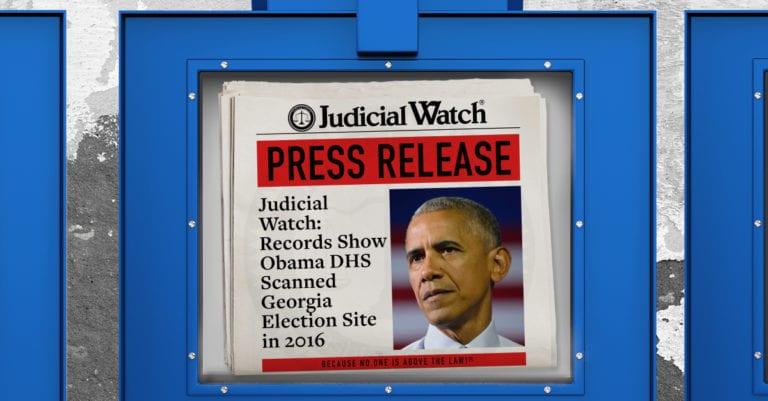
(Washington, DC) Judicial Watch announced today that it received 243 pages of records from the Department of Homeland Security (DHS) that show the Obama administration’s scanning the election systems of Georgia, Alaska, Oregon, Kentucky and West Virginia in 2016. This activity prompted a letter from then-Georgia Secretary of State (now Governor) Brian Kemp to then-DHS Secretary Jeh Johnson accusing DHS of, “an unsuccessful attempt to penetrate the Georgia Secretary of State’s firewall.”
The records were produced in response to Judicial Watch’s Freedom of Information Act (FOIA) request, which asked for all records related to reported cyberattacks against the Georgia secretary of state’s information network involving DHS, including investigative reports, memoranda, correspondence and communications between October 1, 2016, and February 14, 2017.
The minutes of a DHS “Enterprise Security Operations Center” (ESOC) meeting indicate that on November 15, 2016, at 8:43 a.m. a “scanning event” occurred. The “‘scanning’ event was the result of a FLETC [Federal Law Enforcement Training Center] user’s Microsoft Office Discovery Protocol sending a packet with the OPTIONS flag to the Secretary of State of Georgia site.”
The minutes notes that the Enterprise Security Operations Center “has received requests from NCCIC [DHS’s The National Cybersecurity and Communications Integration Center] and MS-ISAC [Multi-State Information Sharing and Analysis Center] to investigate other states that have seen ‘suspicious’ activity.”
The minutes note that Kemp accused DHS of conducting illicit scans on at least February 2, February 28 and May 23, 2016, as well.
DHS notes in the minutes that they were working with Microsoft to determine what happened: “Microsoft and the ESOC with the assistance of FLETC, were able to confirm that the user non-maliciously copied and pasted elements of the website to an excel document, which triggered the HTTP ‘OPTIONS’ request.”
A “Microsoft E-Mail Statement (Unofficial Statement to ESOC)” was included with the minutes. The email stated, “After looking at the data I do not see requests that look malicious in nature or appear to be attempting to exploit a vulnerability.”
A chart of “Current Open Vulnerabilities” for the period November 30, 2016, through December 12, 2016, noted that DHS had identified a total of 1,227 cyber vulnerabilities within DHS components, including five “High” severity ones at FEMA.
In a “Shift Pass Down Report – Sunday Night Shift – December 18, 2016” describing one of the State of Georgia incidents, DHS identifies that it originated, “from a FLETC-based Physical Security Contract Manager.”
DHS identifies activity originating from them in Alaska, Oregon, Kentucky and West Virginia.
In a “State of Alaska update,” the report notes, “Confirmed this activity was a NPPD [DHS’s National Protection and Programs Directorate] employee investigating twitter reports of compromise on an AK Election System, as part of his normal duties.”
A “State of Oregon update,” indicated that “Oregon Secretary of State inquired why they observed the same DHS IP reported by GASOS visiting their website. After engaging with DHS, Oregon agreed there was nothing suspicious and closed the investigation.”
A “State of Kentucky update” said, “Normal web traffic from DHS.”
A “State of West Virginia update” also said “Normal web traffic from DHS.”
In a December, 16, 2016, email exchange between DHS officials regarding a “Preliminary update on GASOS [Georgia Secretary of State]” an official notes there were at least 10 other “timestamps” in which “we have identified different components who have caused the same traffic as the FLETC user.” The log lists incidents involving FEMA, ICE-CIS and FLETC occurring between Feb. 2, 2016 and Sept. 12, 2016.
The email sender adds, “At this time, we cannot validate users with ease for these past timestamps due to DHCP and the lack of Authentication logs.”
Acting Principal Deputy Chief Information Officer, Jeanne Etzel replies to him, “When this gets published in the 4:00, don’t say ‘lack of logs’ say something about logs are maintained for xx days and the events in question occurred xx days ago therefore our logs are overwritten per our standard retention policy.”
Another official, unidentified, then forwards the exchange to unknown officials saying, “FYI. Please use the lens of Press Release and senior leaders.”
In a December 9, 2016, email, Director of DHS Cybersecurity Operations, Boyden Rohmer emailed an unidentified Chief of the Justice Security Operations Center at the Justice Department about “some claims by the State of Georgia that we’ve been scanning their website,” noting that when he pulled their logs over a three hour period, “we see that we have about 1800 similar requests.”
In an email exchange on December 8, 2016, sent to a DHS official, from a CBP CSOC [Customs and Border Protection/Cyber Security Operations Center] official indicated that the same CBP IP address that scanned the Georgia Secretary of State election systems also “previously was reported to us by Princess Cruise Lines” but “ESOC [DHS’s Enterprise Security Operations Center] assesses that the CBP computer was just doing normal web browsing to Princess Cruise Lines.”
The email continues, “ESOC assesses that the CBP computer was just doing normal browsing to Georgia’s Secretary of State office on Nov 15 as well.”
The CBP cyber security official then asks the DHS ESOC official for clarification of certain questions, such as “In both instances, who made this assessment that all of this activity was just ‘normal browsing’?” and “Please define ‘normal browsing’ as it is referenced in the text highlighted above.”
“The Obama DHS was caught scanning the Georgia Secretary of State’s website in 2016 and these documents show that details about the controversy may have been ‘overwritten,’” stated Judicial Watch President Tom Fitton.
In January 2017, the DHS Inspector General wrote to Kemp, saying that an investigation into his allegations was in progress and asking for web and network logs, as well as any other evidence that indicated the DHS attempted to breach Georgia’s system.
In July 2017, the DHS Inspector General reported to the House Committee on Oversight and Government Reform “that DHS employee interactions with the Georgia systems were limited to routine searches for publicly available information on the state’s public website and that none of the web pages visited were related to elections or voters.” And stated: “The investigation was conducted by employees in OIG’s specially trained Digital Forensics and Analysis Unit.”
Judicial Watch is a national leader for cleaner elections.
In September 2020, Judicial Watch released a study revealing that 353 U.S. counties had 1.8 million more registered voters than eligible voting-age citizens. In other words, the registration rates of those counties exceeded 100% of eligible voters. The study found eight states showing state-wide registration rates exceeding 100%: Alaska, Colorado, Maine, Maryland, Michigan, New Jersey, Rhode Island, and Vermont. The study collected the most recent registration data posted online by the states themselves. This data was then compared to the Census Bureau’s most recent five-year population estimates, gathered by the American Community Survey (ACS) from 2014 through 2018. ACS surveys are sent to 3.5 million addresses each month, and its five-year estimates are considered to be the most reliable estimates outside of the decennial census.
In 2018, the Supreme Court upheld a voter-roll cleanup program that resulted from a Judicial Watch settlement of a federal lawsuit with Ohio. California settled a federal lawsuit with Judicial Watch and last year began the process of removing up to 1.6 million inactive names from Los Angeles County’s voter rolls. Kentucky also began a cleanup of hundreds of thousands of old registrations last year after it entered into a consent decree to end another Judicial Watch lawsuit.
In 2020, Judicial Watch sued North Carolina, Pennsylvania, and Colorado for failing to clean their voter rolls, and sued Illinois for refusing to disclose voter roll data in violation of federal law. Judicial Watch has several open records requests pending over the conduct of the 2020 election.



 © Greg Nash GOP lawmakers call for Pelosi to be fined over new screenings






 fox files
Written
on 6.February.2021.