The Truth Is Out There

Archive for February, 2021

Title IX Will Become a Vehicle of More Injustice


joe biden vowed to put a “quick end” to the Trump administration’s Title IX regulations and return to Obama-era ones at universities. If this happens, the sexual misconduct hearings will be deeply impacted. These “trials” judge whether those accused of sexual misconduct are innocent or guilty. The Obama-era hearings expressed social justice standards that greatly favored an accuser; the Trump-era ones were closer to the Western tradition of due process. The hearings remain a major battleground in the culture war.

Universities are the wellspring of social justice and of the “warriors” who have carried the leftist ideology into the streets and every American institution. With the 2020 riots, the average person now appreciates the threat that social justice poses to traditional Western values such as due process. No compromise is possible between the two world views.

What is the heart of the conflict? Social justice rests on three dogmatic assertions. Gender and race define every individual; discrimination against oppressed races and genders defines America; all social inequality, such as pay differentials, is the result of systemic discrimination. Justice requires skewing society’s law and policies to favor “oppressed” groups in order to forcibly redistribute wealth, status, and opportunities to them from privileged ones—most notably white males. Traditional Western values are individualistic, not collectivistic; every person possesses the same human rights to the same degree, all of which spring from the fundamental right of those who are peaceful to live without interference. Individuals define their own character and are responsible for their actions. Justice means respecting everyone’s equal right to person and property and providing remedy when those rights are violated.

People now associate social justice with street-gang activism or shrill accusations of racism and sexual abuse. But many cultural changes that arrive on campus and flow inevitably into society do so quietly. They come from behind-the-door meetings and obscure organizations that forge policy, such as ATIXA (Association of Title IX Administrators) and Title IX campus compliance offices. These agencies are the bureaucracy of social justice, and ATIXA is a cautionary tale about what happens in the bureaucratic shadows. It is happening right now.

Under the Trump administration, Secretary of Education Betsy DeVos pushed back some of the most damaging aspects of social justice at universities. Campus sexual abuse hearings became a key cultural battleground with the Obama administration’s notorious 2011 “Dear Colleague” letter; it prioritized the rights of accusers by denying due process to those accused. It did not have the force of law, but it had the force of funding; schools that did not comply could lose their federal money, including student loans, upon which almost all universities depend.

The outcome was predictable. Kangaroo courts denied basic rights like the presumption of innocence to an accused; the accused were overwhelmingly male. On the basis of flimsy evidence and biased procedures, young men (and some women) were found guilty and confronted the destruction of their reputations, careers, and futures. Those who sued the universities frequently won or settled out of court. But the hearings rolled on. DeVos returned some basics of due process to the procedures, including the right of an accused to know the exact charges against him and to view the evidence—niceties that were often withheld.

Social justice advocates reacted with fury. In an article entitled “Betsy DeVos Restores Due Process, Dems Freak Out,” National Review described the reaction of Democrats. Catherine E. Lhamon, chairwoman of the US Commission on Civil Rights, warned that DeVos was “taking us back to the bad old days, when it was permissible to rape and sexually harass students with impunity.” In other words, due process was seen as a blank check for men to rape. (Lhamon has been tapped to serve as the deputy director of the Domestic Policy Council for Racial Justice and Equity in the biden administration.) The biden campaign platform itself stated, “The Trump Administration…is trying to shame and silence survivors” by giving “colleges a green light to ignore sexual violence and strip survivors of their civil rights.”

Now a woke regime has returned to campus justice. Whatever happens will offer a window into how mainstream justice may evolve in the coming years. And ATIXA offers a window into the dynamics.

ATIXA is influential. Indeed, it is currently drafting what may be the next Title IX bill. ATIXA is “a professional association for approximately 5,500 Title IX coordinators, investigators, and administrators,” (as of January 18, 2021). It has the mission of “helping to advance gender equity in schools and colleges”; since 2011, it has trained and certified “more than 7,250 Title IX Coordinators and more than 23,550 Title IX investigators.” ATIXA’s job might seem to be the facilitation of whatever laws and policies are on the books, but it adamantly resisted implementing DeVos’s changes.

The College Fix documented one example. DeVos required the training materials used by Title IX administrators to be posted. This allowed an accused to access the rules and procedures by which he would be tried. ATIXA president Brett A. Sokolow has a history of covertly resisting such regulations. In a January 15, 2020, op-ed for Inside Higher Education, he advised: “About 20 to 25 percent of the (new Title IX) regulations are potentially very detrimental…and we will need…to work within those requirements, challenge them in court or find clever work-arounds” (emphasis added). Sokolow tried to work around posting training materials by claiming they were copyrighted and not able to be shared. The College Fix’s interpretation: “ATIXA will sue colleges for following a legally binding regulation.” Sokolow backed down, however, when the Department of Education’s Office of Civil Rights (OCR) noticed and doubled down on its demand.

Passive-aggressive obstruction is no longer necessary. A memorandum to ATIXA listserv members in early January 2021 commented, “Dear Members….The Senate will now be in Democrat control.” A lobbying firm was duly engaged, as Sokolow now considers new Title IX legislation to be “a realistic possibility”; it is an endeavor in which ATIXA wants to take a leadership role. “Our initial thoughts include the promulgation of a model Title IX Restoration Act (TIXRA, naturally),” he writes, to show “how Title IX should be reshaped by the biden administration and Congress to best serve the field and the goals of sex/gender equity.” (Sex/gender equity is not clearly defined.)

Sokolow’s memo gives lip service to “due process”—a term that appears with scare quotes around it. Elsewhere, a poll of “ATIXA Title IX experts” offers a more concrete sense of the looming danger to due process. JD Supra reported on the poll in an article by Sokolow entitled “biden Is President-Elect. Can We Just Ignore the Title IX Regulations Now?“ The new woke hearings should include:

  • Relief from direct cross examination by an advisor
  • Removal of nonsensical exclusionary/hearsay rule regarding “statements”
  • Revocation of the confusing rules on relevance v. directly related evidence
  • Two ten-day review periods likely collapsed into one period
  • Formal complaint requirement will be reversed
  • Hearing requirements for at-will employees will be limited
  • Hearings only required when some form of separation is on the table, and the definition of hearing will be broader and less formal
  • Mandated dismissal of Title IX complaints removed
  • Broad retaliation protections rolled back, especially as applied to respondents
  • Removal of any necessity for two processes

In short, the woke campus hearings would discourage direct cross-examination, allow hearsay, loosen rules of evidence, be conducted quickly, and bypass the need for a formal complaint…the denial of due process would be policy. This despite the fact that, as Sokolow stated in a phone interview, “Probably 40 or 50% of allegations of sexual assault are baseless. There are a lot of cases where someone says they were incapacitated, but the evidence doesn’t support that they weren’t able to make a decision.” A “model” Title IX bill is currently being drafted by ATIXA and will be circulated the “to Congress and biden Administration.” An earlier draft entitled “ATIXA Submission to the ED ART on Title IX 12.18.2020” that was submitted to biden’s education transition team hints at the content. The hints are confusing, however. The bill endorses biden’s progressive approach while stating, “a return to…the 2011 DCL (Dear Colleague Letter) or maintaining the status quo of the 2020 regulations would not be supported by ATIXA’s 6,000 practitioner members.” In short, there is pushback from the membership. Also, a mountain of complaints and lawsuits have proven expensive in time and money.

Therefore “ATIXA seeks a balanced approach that honors the rights of all parties in the Title IX resolution process.” So far, so good. The same hearing standards would seem to apply to all participants regardless of gender or race. Yet, elsewhere, the submission commits to “focusing broadly on the impacts that Title IX work can and should have on the LGBTQIA+ community [and] on people of color.” There is a tension between the two statements.

Moreover, an accused’s due process rights are directly attacked. The right of cross-examination, for example, would be restricted to spare an accuser distress; “if cross-examination is required in a jurisdiction [where the campus is located], it is sufficient to have party-proposed questions submitted to and then posed by the neutral, impartial decision-maker,” presumably appointed by the university. The right of direct examination by the accused or his advocate would be denied. (Nothing is said about jurisdictions in which courts do not require the cross-examination.) Currently, if a witness refuses to submit to cross-examination, his or her statements during the investigation are not considered at the hearing. ATIXA wants this rule to be “revisited,” because “it’s too drastic, is too complicated for laypersons to apply, has no litigation equivalent, and takes away the discretion of the recipient to appropriately assess relevance and credibility.” Why “laypersons” are holding court-like hearings when the basics of due process and court procedure are too complicated for them to understand is not addressed.

Elsewhere, the clarity of ATIXA’s recommendations is chilling. For example, “ATIXA supports universal application of the preponderance of the evidence standard….Existing regulations permit a choice of standards.” Preponderance of the evidence means that if a hearing believes a rape complaint to be supported by 50.01 percent of the evidence, the accused is “guilty” and open to expulsion or other common punishments.

All in all, a prediction in the JD Supra article seems half correct. “If we had to prognosticate, we’d guess that fairly early on, the biden administration will rescind the 2020 regulations, and implement another new Dear Colleague Letter/Q&A style approach.” BUT the new Title IX is likely to be a new Obama-style DCL approach that is tweaked to avoid the legal pitfalls visited on the 2011 one. I disagree; withdrawing the 2020 regulations will not be a quick process.

The DeVos administration did not use a DCL or other guidelines to impose its regulations. It went through the arduous Administrative Procedure Act notice-and-comment process, which is why it was not enacted until 2020; the process and obstructionist tactics made it take that long. To rescind DeVos’s regulations requires the same long slog through bureaucracy and Congress. This alone makes new regulations unlikely before 2022 at the earliest.

ATIXA and Title IX may seem arcane to those not on campus or without a loved one who is. But the incredible bias and injustice embedded in earlier sexual misconduct hearings was integral in promoting a social division that borders on hatred. Close attention must be paid to the social justice measures on campuses, because they are part of the ideology promoting street riots, increased violence and hostility between groups. College administrators and professors have actively stoked hatred between the genders and the races for decades. And now society reaps a whirlwind.

WHAT SAY EVERYONE TWEET OR CONTACT THIS SPORT’S BITCH SHANNON SHARPE AND GIVE HER YOUR THOUGHTS. PEACEFULLY OF COURSE.


‘How mighty white of him’: Tom Brady exudes ‘height of white privilege’ for not discussing past Trump support, sportswriter says

Tucker Carlson: Bank of America secretly handed over private customer data to the FBI following Capitol riot


Fox News host Tucker Carlson claimed in a bombshell report Thursday night that Bank of America, the nation’s second-largest bank serving more than 60 million people, secretly surveilled customers considered to be persons of interest following the Jan. 6 riot at the U.S. Capitol and handed over their private information to federal investigators.POLL: What scares you the most?

Carlson reported on air Thursday that his team exclusively obtained evidence that “in the days after the Jan. 6 riot at the Capitol, Bank of America went through its own customers’ financial and transaction records” at the request of federal law enforcement investigators, searching its databases for “people who fit a specific profile.”

The profile went as follows, according to Carlson: “1. Customers confirmed as transacting, either through bank account, debit card, or credit card, purchases in Washington, D.C. between 1/5 and 1/6. 2. Purchases made for Hotel/Airbnb RSVPs in DC, VA, and MD after 1/6. 3. Any purchase of weapons or at a weapons-related merchant between 1/7 and their upcoming suspected stay in D.C. area around Inauguration Day. 4. Airline related purchases since 1/6.”

During the probe, Bank of America eventually identified 211 customers who met the “thresholds of interest” and proceeded to turn those customers’ information over to investigators without their knowledge or consent.

FBI investigators reportedly used the information to interview at least one of the unsuspecting customers, although that person was eventually cleared of any wrongdoing.

“Imagine if you were that person,” said Carlson. “The FBI hauls you in for questioning in a terror investigation, not because you’ve done anything suspicious, but because you bought plane tickets and visited your country’s capital. Now they’re sweating you because your bank, which you trust with your most private information, has ratted you out without your knowledge. Because Bank of America did that, you are being treated like a member of Al Qaeda.”

When Carlson’s team reached out to Bank of America, the bank responded without denying the claim.

“We don’t comment on our communications with law enforcement. All banks have responsibilities under federal law to cooperate with law enforcement inquiries in full compliance with the law,” the statement reportedly said.

A Bank of America spokesperson gave the same exact response to the Washington Examiner.

Carlson suggested that while Bank of America’s actions are certainly troubling, they may also be illegal. A relevant law on the books is 12 U.S.C. 3403, a federal law that protects the confidentiality of financial records. Though the law does appear to allow banks to tip off government authorities to information that “may be relevant to a possible violation of any statute or regulation.”

The question becomes, what constitutes information relevant to a crime?

“Does buying a muffin in Washington, D.C., on Jan. 5 make you a potential domestic extremist?” Carlson asked. “According to Bank of America, yes. Yes, it does.”

Biden’s “Not Trump” Foreign Policy Puts America Last


Photo: Gage Skidmore

Biden’s “Not Trump” Foreign Policy Puts America Last

President Joe Biden lays out today his foreign policy priorities. At the moment, they seem to be characterized by one principle: Not Trump.

Donald Trump opposed the Chinese Communist Party’s “people’s war” against this country and its “genocide” against Uyghur Muslims. Will a President Biden, deeply compromised by the CCP, return to the Obama practice of engaging, and appeasing, Beijing?

Mr. Trump brought “maximum pressure” to bear against Iran’s nuclear ambitions. Team Biden seems determined to return to the Obama policy of engaging, and appeasing, the mullahs in Tehran.

President Trump persuaded Latin American nations to prevent hordes of illegal immigrants from coming here. President Biden appears intent on jettisoning such cooperation and welcoming the coming caravans.

The Biden approach certainly can’t be characterized as “America First.” If this President puts America last, our national decline will be his lasting legacy.

DON’T YET THINK IT’S A CONSPIRACY HUH


Facebook removes page of international disease experts critical of COVID lockdowns

Secret Shadow Campaign Behind The 2020 Election Exposed


A weird thing happened right after the Nov. 3 election: nothing.

The nation was braced for chaos. Liberal groups had vowed to take to the streets, planning hundreds of protests across the country. Right-wing militias were girding for battle. In a poll before Election Day, 75% of Americans voiced concern about violence.

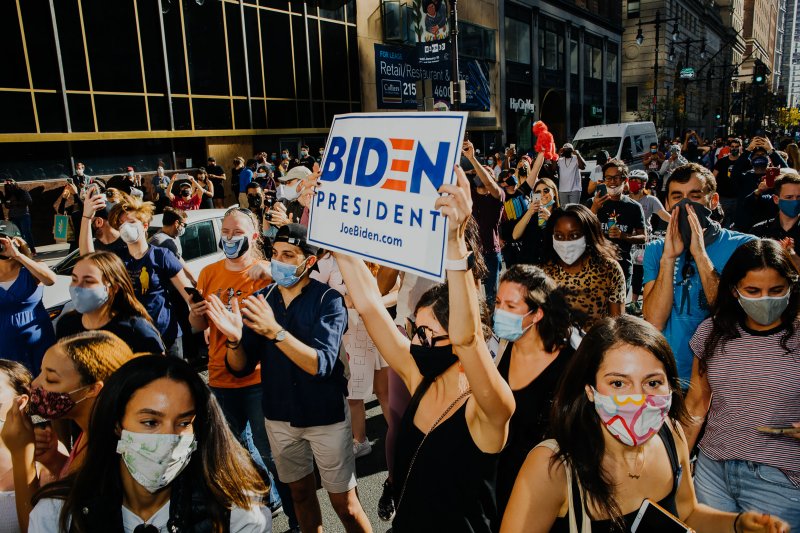
Instead, an eerie quiet descended. As President Trump refused to concede, the response was not mass action but crickets. When media organizations called the race for Joe Biden on Nov. 7, jubilation broke out instead, as people thronged cities across the U.S. to celebrate the democratic process that resulted in Trump’s ouster.Reactions Throughout the U.S. After Biden Wins Presidential Race in Unprecedented ElectionSharePlay Video

A second odd thing happened amid Trump’s attempts to reverse the result: corporate America turned on him. Hundreds of major business leaders, many of whom had backed Trump’s candidacy and supported his policies, called on him to concede. To the President, something felt amiss. “It was all very, very strange,” Trump said on Dec. 2. “Within days after the election, we witnessed an orchestrated effort to anoint the winner, even while many key states were still being counted.”

Trump was right.

There was a conspiracy unfolding behind the scenes, one that both curtailed the protests and coordinated the resistance from CEOs. Both surprises were the result of an informal alliance between left-wing activists and business titans. The pact was formalized in a terse, little-noticed joint statement of the U.S. Chamber of Commerce and AFL-CIO published on Election Day. Both sides would come to see it as a sort of implicit bargain–inspired by the summer’s massive, sometimes destructive racial-justice protests–in which the forces of labor came together with the forces of capital to keep the peace and oppose Trump’s assault on democracy.

The handshake between business and labor was just one component of a vast, cross-partisan campaign to protect the election–an extraordinary shadow effort dedicated not to winning the vote but to ensuring it would be free and fair, credible and uncorrupted. For more than a year, a loosely organized coalition of operatives scrambled to shore up America’s institutions as they came under simultaneous attack from a remorseless pandemic and an autocratically inclined President. Though much of this activity took place on the left, it was separate from the Biden campaign and crossed ideological lines, with crucial contributions by nonpartisan and conservative actors. The scenario the shadow campaigners were desperate to stop was not a Trump victory. It was an election so calamitous that no result could be discerned at all, a failure of the central act of democratic self-governance that has been a hallmark of America since its founding.

Their work touched every aspect of the election. They got states to change voting systems and laws and helped secure hundreds of millions in public and private funding. They fended off voter-suppression lawsuits, recruited armies of poll workers and got millions of people to vote by mail for the first time. They successfully pressured social media companies to take a harder line against disinformation and used data-driven strategies to fight viral smears. They executed national public-awareness campaigns that helped Americans understand how the vote count would unfold over days or weeks, preventing Trump’s conspiracy theories and false claims of victory from getting more traction. After Election Day, they monitored every pressure point to ensure that Trump could not overturn the result. “The untold story of the election is the thousands of people of both parties who accomplished the triumph of American democracy at its very foundation,” says Norm Eisen, a prominent lawyer and former Obama Administration official who recruited Republicans and Democrats to the board of the Voter Protection Program.

For Trump and his allies were running their own campaign to spoil the election. The President spent months insisting that mail ballots were a Democratic plot and the election would be “rigged.” His henchmen at the state level sought to block their use, while his lawyers brought dozens of spurious suits to make it more difficult to vote–an intensification of the GOP’s legacy of suppressive tactics. Before the election, Trump plotted to block a legitimate vote count. And he spent the months following Nov. 3 trying to steal the election he’d lost–with lawsuits and conspiracy theories, pressure on state and local officials, and finally summoning his army of supporters to the Jan. 6 rally that ended in deadly violence at the Capitol.

The democracy campaigners watched with alarm. “Every week, we felt like we were in a struggle to try to pull off this election without the country going through a real dangerous moment of unraveling,” says former GOP Representative Zach Wamp, a Trump supporter who helped coordinate a bipartisan election-protection council. “We can look back and say this thing went pretty well, but it was not at all clear in September and October that that was going to be the case.”Biden fans in Philadelphia after the race was called on Nov. 7Biden fans in Philadelphia after the race was called on Nov. 7 Michelle Gustafson for TIME
This is the inside story of the conspiracy to save the 2020 election, based on access to the group’s inner workings, never-before-seen documents and interviews with dozens of those involved from across the political spectrum. It is the story of an unprecedented, creative and determined campaign whose success also reveals how close the nation came to disaster. “Every attempt to interfere with the proper outcome of the election was defeated,” says Ian Bassin, co-founder of Protect Democracy, a nonpartisan rule-of-law advocacy group. “But it’s massively important for the country to understand that it didn’t happen accidentally. The system didn’t work magically. Democracy is not self-executing.”

That’s why the participants want the secret history of the 2020 election told, even though it sounds like a paranoid fever dream–a well-funded cabal of powerful people, ranging across industries and ideologies, working together behind the scenes to influence perceptions, change rules and laws, steer media coverage and control the flow of information. They were not rigging the election; they were fortifying it. And they believe the public needs to understand the system’s fragility in order to ensure that democracy in America endures.

THE ARCHITECT

Sometime in the fall of 2019, Mike Podhorzer became convinced the election was headed for disaster–and determined to protect it.

This was not his usual purview. For nearly a quarter-century, Podhorzer, senior adviser to the president of the AFL-CIO, the nation’s largest union federation, has marshaled the latest tactics and data to help its favored candidates win elections. Unassuming and professorial, he isn’t the sort of hair-gelled “political strategist” who shows up on cable news. Among Democratic insiders, he’s known as the wizard behind some of the biggest advances in political technology in recent decades. A group of liberal strategists he brought together in the early 2000s led to the creation of the Analyst Institute, a secretive firm that applies scientific methods to political campaigns. He was also involved in the founding of Catalist, the flagship progressive data company.

The endless chatter in Washington about “political strategy,” Podhorzer believes, has little to do with how change really gets made. “My basic take on politics is that it’s all pretty obvious if you don’t overthink it or swallow the prevailing frameworks whole,” he once wrote. “After that, just relentlessly identify your assumptions and challenge them.” Podhorzer applies that approach to everything: when he coached his now adult son’s Little League team in the D.C. suburbs, he trained the boys not to swing at most pitches–a tactic that infuriated both their and their opponents’ parents, but won the team a series of championships.

Trump’s election in 2016–credited in part to his unusual strength among the sort of blue collar white voters who once dominated the AFL-CIO–prompted Podhorzer to question his assumptions about voter behavior. He began circulating weekly number-crunching memos to a small circle of allies and hosting strategy sessions in D.C. But when he began to worry about the election itself, he didn’t want to seem paranoid. It was only after months of research that he introduced his concerns in his newsletter in October 2019. The usual tools of data, analytics and polling would not be sufficient in a situation where the President himself was trying to disrupt the election, he wrote. “Most of our planning takes us through Election Day,” he noted. “But, we are not prepared for the two most likely outcomes”–Trump losing and refusing to concede, and Trump winning the Electoral College (despite losing the popular vote) by corrupting the voting process in key states. “We desperately need to systematically ‘red-team’ this election so that we can anticipate and plan for the worst we know will be coming our way.”

It turned out Podhorzer wasn’t the only one thinking in these terms. He began to hear from others eager to join forces. The Fight Back Table, a coalition of “resistance” organizations, had begun scenario-planning around the potential for a contested election, gathering liberal activists at the local and national level into what they called the Democracy Defense Coalition. Voting-rights and civil rights organizations were raising alarms. A group of former elected officials was researching emergency powers they feared Trump might exploit. Protect Democracy was assembling a bipartisan election-crisis task force. “It turned out that once you said it out loud, people agreed,” Podhorzer says, “and it started building momentum.”

He spent months pondering scenarios and talking to experts. It wasn’t hard to find liberals who saw Trump as a dangerous dictator, but Podhorzer was careful to steer clear of hysteria. What he wanted to know was not how American democracy was dying but how it might be kept alive. The chief difference between the U.S. and countries that lost their grip on democracy, he concluded, was that America’s decentralized election system couldn’t be rigged in one fell swoop. That presented an opportunity to shore it up.

THE ALLIANCE

On March 3, Podhorzer drafted a three-page confidential memo titled “Threats to the 2020 Election.” “Trump has made it clear that this will not be a fair election, and that he will reject anything but his own re-election as ‘fake’ and rigged,” he wrote. “On Nov. 3, should the media report otherwise, he will use the right-wing information system to establish his narrative and incite his supporters to protest.” The memo laid out four categories of challenges: attacks on voters, attacks on election administration, attacks on Trump’s political opponents and “efforts to reverse the results of the election.”

Then COVID-19 erupted at the height of the primary-election season. Normal methods of voting were no longer safe for voters or the mostly elderly volunteers who normally staff polling places. But political disagreements, intensified by Trump’s crusade against mail voting, prevented some states from making it easier to vote absentee and for jurisdictions to count those votes in a timely manner. Chaos ensued. Ohio shut down in-person voting for its primary, leading to minuscule turnout. A poll-worker shortage in Milwaukee–where Wisconsin’s heavily Democratic Black population is concentrated–left just five open polling places, down from 182. In New York, vote counting took more than a month.

Suddenly, the potential for a November meltdown was obvious. In his apartment in the D.C. suburbs, Podhorzer began working from his laptop at his kitchen table, holding back-to-back Zoom meetings for hours a day with his network of contacts across the progressive universe: the labor movement; the institutional left, like Planned Parenthood and Greenpeace; resistance groups like Indivisible and MoveOn; progressive data geeks and strategists, representatives of donors and foundations, state-level grassroots organizers, racial-justice activists and others.

In April, Podhorzer began hosting a weekly 2½-hour Zoom. It was structured around a series of rapid-fire five-minute presentations on everything from which ads were working to messaging to legal strategy. The invitation-only gatherings soon attracted hundreds, creating a rare shared base of knowledge for the fractious progressive movement. “At the risk of talking trash about the left, there’s not a lot of good information sharing,” says Anat Shenker-Osorio, a close Podhorzer friend whose poll-tested messaging guidance shaped the group’s approach. “There’s a lot of not-invented-here syndrome, where people won’t consider a good idea if they didn’t come up with it.”

The meetings became the galactic center for a constellation of operatives across the left who shared overlapping goals but didn’t usually work in concert. The group had no name, no leaders and no hierarchy, but it kept the disparate actors in sync. “Pod played a critical behind-the-scenes role in keeping different pieces of the movement infrastructure in communication and aligned,” says Maurice Mitchell, national director of the Working Families Party. “You have the litigation space, the organizing space, the political people just focused on the W, and their strategies aren’t always aligned. He allowed this ecosystem to work together.”

Protecting the election would require an effort of unprecedented scale. As 2020 progressed, it stretched to Congress, Silicon Valley and the nation’s statehouses. It drew energy from the summer’s racial-justice protests, many of whose leaders were a key part of the liberal alliance. And eventually it reached across the aisle, into the world of Trump-skeptical Republicans appalled by his attacks on democracy.

SECURING THE VOTE

The first task was overhauling America’s balky election infrastructure–in the middle of a pandemic. For the thousands of local, mostly nonpartisan officials who administer elections, the most urgent need was money. They needed protective equipment like masks, gloves and hand sanitizer. They needed to pay for postcards letting people know they could vote absentee–or, in some states, to mail ballots to every voter. They needed additional staff and scanners to process ballots.

In March, activists appealed to Congress to steer COVID relief money to election administration. Led by the Leadership Conference on Civil and Human Rights, more than 150 organizations signed a letter to every member of Congress seeking $2 billion in election funding. It was somewhat successful: the CARES Act, passed later that month, contained $400 million in grants to state election administrators. But the next tranche of relief funding didn’t add to that number. It wasn’t going to be enough.

Private philanthropy stepped into the breach. An assortment of foundations contributed tens of millions in election-administration funding. The Chan Zuckerberg Initiative chipped in $300 million. “It was a failure at the federal level that 2,500 local election officials were forced to apply for philanthropic grants to fill their needs,” says Amber McReynolds, a former Denver election official who heads the nonpartisan National Vote at Home Institute.

McReynolds’ two-year-old organization became a clearinghouse for a nation struggling to adapt. The institute gave secretaries of state from both parties technical advice on everything from which vendors to use to how to locate drop boxes. Local officials are the most trusted sources of election information, but few can afford a press secretary, so the institute distributed communications tool kits. In a presentation to Podhorzer’s group, McReynolds detailed the importance of absentee ballots for shortening lines at polling places and preventing an election crisis.

The institute’s work helped 37 states and D.C. bolster mail voting. But it wouldn’t be worth much if people didn’t take advantage. Part of the challenge was logistical: each state has different rules for when and how ballots should be requested and returned. The Voter Participation Center, which in a normal year would have deployed canvassers door-to-door to get out the vote, instead conducted focus groups in April and May to find out what would get people to vote by mail. In August and September, it sent ballot applications to 15 million people in key states, 4.6 million of whom returned them. In mailings and digital ads, the group urged people not to wait for Election Day. “All the work we have done for 17 years was built for this moment of bringing democracy to people’s doorsteps,” says Tom Lopach, the center’s CEO.

The effort had to overcome heightened skepticism in some communities. Many Black voters preferred to exercise their franchise in person or didn’t trust the mail. National civil rights groups worked with local organizations to get the word out that this was the best way to ensure one’s vote was counted. In Philadelphia, for example, advocates distributed “voting safety kits” containing masks, hand sanitizer and informational brochures. “We had to get the message out that this is safe, reliable, and you can trust it,” says Hannah Fried of All Voting Is Local.

At the same time, Democratic lawyers battled a historic tide of pre-election litigation. The pandemic intensified the parties’ usual tangling in the courts. But the lawyers noticed something else as well. “The litigation brought by the Trump campaign, of a piece with the broader campaign to sow doubt about mail voting, was making novel claims and using theories no court has ever accepted,” says Wendy Weiser, a voting-rights expert at the Brennan Center for Justice at NYU. “They read more like lawsuits designed to send a message rather than achieve a legal outcome.”

In the end, nearly half the electorate cast ballots by mail in 2020, practically a revolution in how people vote. About a quarter voted early in person. Only a quarter of voters cast their ballots the traditional way: in person on Election Day.

THE DISINFORMATION DEFENSE

Bad actors spreading false information is nothing new. For decades, campaigns have grappled with everything from anonymous calls claiming the election has been rescheduled to fliers spreading nasty smears about candidates’ families. But Trump’s lies and conspiracy theories, the viral force of social media and the involvement of foreign meddlers made disinformation a broader, deeper threat to the 2020 vote.

Laura Quinn, a veteran progressive operative who co-founded Catalist, began studying this problem a few years ago. She piloted a nameless, secret project, which she has never before publicly discussed, that tracked disinformation online and tried to figure out how to combat it. One component was tracking dangerous lies that might otherwise spread unnoticed. Researchers then provided information to campaigners or the media to track down the sources and expose them.

The most important takeaway from Quinn’s research, however, was that engaging with toxic content only made it worse. “When you get attacked, the instinct is to push back, call it out, say, ‘This isn’t true,’” Quinn says. “But the more engagement something gets, the more the platforms boost it. The algorithm reads that as, ‘Oh, this is popular; people want more of it.’”

The solution, she concluded, was to pressure platforms to enforce their rules, both by removing content or accounts that spread disinformation and by more aggressively policing it in the first place. “The platforms have policies against certain types of malign behavior, but they haven’t been enforcing them,” she says.

Quinn’s research gave ammunition to advocates pushing social media platforms to take a harder line. In November 2019, Mark Zuckerberg invited nine civil rights leaders to dinner at his home, where they warned him about the danger of the election-related falsehoods that were already spreading unchecked. “It took pushing, urging, conversations, brainstorming, all of that to get to a place where we ended up with more rigorous rules and enforcement,” says Vanita Gupta, president and CEO of the Leadership Conference on Civil and Human Rights, who attended the dinner and also met with Twitter CEO Jack Dorsey and others. (Gupta has been nominated for Associate Attorney General by President Biden.) “It was a struggle, but we got to the point where they understood the problem. Was it enough? Probably not. Was it later than we wanted? Yes. But it was really important, given the level of official disinformation, that they had those rules in place and were tagging things and taking them down.”

SPREADING THE WORD

Beyond battling bad information, there was a need to explain a rapidly changing election process. It was crucial for voters to understand that despite what Trump was saying, mail-in votes weren’t susceptible to fraud and that it would be normal if some states weren’t finished counting votes on election night.

Dick Gephardt, the Democratic former House leader turned high-powered lobbyist, spearheaded one coalition. “We wanted to get a really bipartisan group of former elected officials, Cabinet secretaries, military leaders and so on, aimed mainly at messaging to the public but also speaking to local officials–the secretaries of state, attorneys general, governors who would be in the eye of the storm–to let them know we wanted to help,” says Gephardt, who worked his contacts in the private sector to put $20 million behind the effort.

Wamp, the former GOP Congressman, worked through the nonpartisan reform group Issue One to rally Republicans. “We thought we should bring some bipartisan element of unity around what constitutes a free and fair election,” Wamp says. The 22 Democrats and 22 Republicans on the National Council on Election Integrity met on Zoom at least once a week. They ran ads in six states, made statements, wrote articles and alerted local officials to potential problems. “We had rabid Trump supporters who agreed to serve on the council based on the idea that this is honest,” Wamp says. This is going to be just as important, he told them, to convince the liberals when Trump wins. “Whichever way it cuts, we’re going to stick together.”

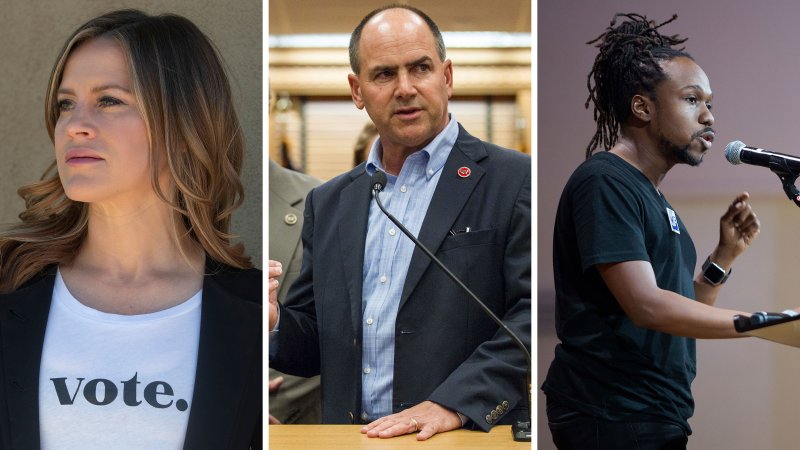
The Voting Rights Lab and IntoAction created state-specific memes and graphics, spread by email, text, Twitter, Facebook, Instagram and TikTok, urging that every vote be counted. Together, they were viewed more than 1 billion times. Protect Democracy’s election task force issued reports and held media briefings with high-profile experts across the political spectrum, resulting in widespread coverage of potential election issues and fact-checking of Trump’s false claims. The organization’s tracking polls found the message was being heard: the percentage of the public that didn’t expect to know the winner on election night gradually rose until by late October, it was over 70%. A majority also believed that a prolonged count wasn’t a sign of problems. “We knew exactly what Trump was going to do: he was going to try to use the fact that Democrats voted by mail and Republicans voted in person to make it look like he was ahead, claim victory, say the mail-in votes were fraudulent and try to get them thrown out,” says Protect Democracy’s Bassin. Setting public expectations ahead of time helped undercut those lies.Amber McReynolds, Zach Wamp and Maurice MitchellAmber McReynolds, Zach Wamp and Maurice Mitchell Rachel Woolf for TIME; Erik Schelzig—AP/Shutterstock; Holly Pickett—The New York Times/Redux
The alliance took a common set of themes from the research Shenker-Osorio presented at Podhorzer’s Zooms. Studies have shown that when people don’t think their vote will count or fear casting it will be a hassle, they’re far less likely to participate. Throughout election season, members of Podhorzer’s group minimized incidents of voter intimidation and tamped down rising liberal hysteria about Trump’s expected refusal to concede. They didn’t want to amplify false claims by engaging them, or put people off voting by suggesting a rigged game. “When you say, ‘These claims of fraud are spurious,’ what people hear is ‘fraud,’” Shenker-Osorio says. “What we saw in our pre-election research was that anything that reaffirmed Trump’s power or cast him as an authoritarian diminished people’s desire to vote.”

Podhorzer, meanwhile, was warning everyone he knew that polls were underestimating Trump’s support. The data he shared with media organizations who would be calling the election was “tremendously useful” to understand what was happening as the votes rolled in, according to a member of a major network’s political unit who spoke with Podhorzer before Election Day. Most analysts had recognized there would be a “blue shift” in key battlegrounds– the surge of votes breaking toward Democrats, driven by tallies of mail-in ballots– but they hadn’t comprehended how much better Trump was likely to do on Election Day. “Being able to document how big the absentee wave would be and the variance by state was essential,” the analyst says.

PEOPLE POWER

The racial-justice uprising sparked by George Floyd’s killing in May was not primarily a political movement. The organizers who helped lead it wanted to harness its momentum for the election without allowing it to be co-opted by politicians. Many of those organizers were part of Podhorzer’s network, from the activists in battleground states who partnered with the Democracy Defense Coalition to organizations with leading roles in the Movement for Black Lives.

The best way to ensure people’s voices were heard, they decided, was to protect their ability to vote. “We started thinking about a program that would complement the traditional election-protection area but also didn’t rely on calling the police,” says Nelini Stamp, the Working Families Party’s national organizing director. They created a force of “election defenders” who, unlike traditional poll watchers, were trained in de-escalation techniques. During early voting and on Election Day, they surrounded lines of voters in urban areas with a “joy to the polls” effort that turned the act of casting a ballot into a street party. Black organizers also recruited thousands of poll workers to ensure polling places would stay open in their communities.

The summer uprising had shown that people power could have a massive impact. Activists began preparing to reprise the demonstrations if Trump tried to steal the election. “Americans plan widespread protests if Trump interferes with election,” Reuters reported in October, one of many such stories. More than 150 liberal groups, from the Women’s March to the Sierra Club to Color of Change, from Democrats.com to the Democratic Socialists of America, joined the “Protect the Results” coalition. The group’s now defunct website had a map listing 400 planned postelection demonstrations, to be activated via text message as soon as Nov. 4. To stop the coup they feared, the left was ready to flood the streets.

STRANGE BEDFELLOWS

About a week before Election Day, Podhorzer received an unexpected message: the U.S. Chamber of Commerce wanted to talk.

The AFL-CIO and the Chamber have a long history of antagonism. Though neither organization is explicitly partisan, the influential business lobby has poured hundreds of millions of dollars into Republican campaigns, just as the nation’s unions funnel hundreds of millions to Democrats. On one side is labor, on the other management, locked in an eternal struggle for power and resources.

But behind the scenes, the business community was engaged in its own anxious discussions about how the election and its aftermath might unfold. The summer’s racial-justice protests had sent a signal to business owners too: the potential for economy-disrupting civil disorder. “With tensions running high, there was a lot of concern about unrest around the election, or a breakdown in our normal way we handle contentious elections,” says Neil Bradley, the Chamber’s executive vice president and chief policy officer. These worries had led the Chamber to release a pre-election statement with the Business Roundtable, a Washington-based CEOs’ group, as well as associations of manufacturers, wholesalers and retailers, calling for patience and confidence as votes were counted.

But Bradley wanted to send a broader, more bipartisan message. He reached out to Podhorzer, through an intermediary both men declined to name. Agreeing that their unlikely alliance would be powerful, they began to discuss a joint statement pledging their organizations’ shared commitment to a fair and peaceful election. They chose their words carefully and scheduled the statement’s release for maximum impact. As it was being finalized, Christian leaders signaled their interest in joining, further broadening its reach.

The statement was released on Election Day, under the names of Chamber CEO Thomas Donohue, AFL-CIO president Richard Trumka, and the heads of the National Association of Evangelicals and the National African American Clergy Network. “It is imperative that election officials be given the space and time to count every vote in accordance with applicable laws,” it stated. “We call on the media, the candidates and the American people to exercise patience with the process and trust in our system, even if it requires more time than usual.” The groups added, “Although we may not always agree on desired outcomes up and down the ballot, we are united in our call for the American democratic process to proceed without violence, intimidation or any other tactic that makes us weaker as a nation.”

SHOWING UP, STANDING DOWN

Election night began with many Democrats despairing. Trump was running ahead of pre-election polling, winning Florida, Ohio and Texas easily and keeping Michigan, Wisconsin and Pennsylvania too close to call. But Podhorzer was unperturbed when I spoke to him that night: the returns were exactly in line with his modeling. He had been warning for weeks that Trump voters’ turnout was surging. As the numbers dribbled out, he could tell that as long as all the votes were counted, Trump would lose.

The liberal alliance gathered for an 11 p.m. Zoom call. Hundreds joined; many were freaking out. “It was really important for me and the team in that moment to help ground people in what we had already known was true,” says Angela Peoples, director for the Democracy Defense Coalition. Podhorzer presented data to show the group that victory was in hand.

While he was talking, Fox News surprised everyone by calling Arizona for Biden. The public-awareness campaign had worked: TV anchors were bending over backward to counsel caution and frame the vote count accurately. The question then became what to do next.

The conversation that followed was a difficult one, led by the activists charged with the protest strategy. “We wanted to be mindful of when was the right time to call for moving masses of people into the street,” Peoples says. As much as they were eager to mount a show of strength, mobilizing immediately could backfire and put people at risk. Protests that devolved into violent clashes would give Trump a pretext to send in federal agents or troops as he had over the summer. And rather than elevate Trump’s complaints by continuing to fight him, the alliance wanted to send the message that the people had spoken.

So the word went out: stand down. Protect the Results announced that it would “not be activating the entire national mobilization network today, but remains ready to activate if necessary.” On Twitter, outraged progressives wondered what was going on. Why wasn’t anyone trying to stop Trump’s coup? Where were all the protests?

Podhorzer credits the activists for their restraint. “They had spent so much time getting ready to hit the streets on Wednesday. But they did it,” he says. “Wednesday through Friday, there was not a single Antifa vs. Proud Boys incident like everyone was expecting. And when that didn’t materialize, I don’t think the Trump campaign had a backup plan.”

Activists reoriented the Protect the Results protests toward a weekend of celebration. “Counter their disinfo with our confidence & get ready to celebrate,” read the messaging guidance Shenker-Osorio presented to the liberal alliance on Friday, Nov. 6. “Declare and fortify our win. Vibe: confident, forward-looking, unified–NOT passive, anxious.” The voters, not the candidates, would be the protagonists of the story.

The planned day of celebration happened to coincide with the election being called on Nov. 7. Activists dancing in the streets of Philadelphia blasted Beyoncé over an attempted Trump campaign press conference; the Trumpers’ next confab was scheduled for Four Seasons Total Landscaping outside the city center, which activists believe was not a coincidence. “The people of Philadelphia owned the streets of Philadelphia,” crows the Working Families Party’s Mitchell. “We made them look ridiculous by contrasting our joyous celebration of democracy with their clown show.”

The votes had been counted. Trump had lost. But the battle wasn’t over.

THE FIVE STEPS TO VICTORY

In Podhorzer’s presentations, winning the vote was only the first step to winning the election. After that came winning the count, winning the certification, winning the Electoral College and winning the transition–steps that are normally formalities but that he knew Trump would see as opportunities for disruption. Nowhere would that be more evident than in Michigan, where Trump’s pressure on local Republicans came perilously close to working–and where liberal and conservative pro-democracy forces joined to counter it.

It was around 10 p.m. on election night in Detroit when a flurry of texts lit up the phone of Art Reyes III. A busload of Republican election observers had arrived at the TCF Center, where votes were being tallied. They were crowding the vote-counting tables, refusing to wear masks, heckling the mostly Black workers. Reyes, a Flint native who leads We the People Michigan, was expecting this. For months, conservative groups had been sowing suspicion about urban vote fraud. “The language was, ‘They’re going to steal the election; there will be fraud in Detroit,’ long before any vote was cast,” Reyes says.Trump supporters seek to disrupt the vote count at Detroit’s TCF Center on Nov. 4Trump supporters seek to disrupt the vote count at Detroit’s TCF Center on Nov. 4 Elaine Cromie—Getty Images
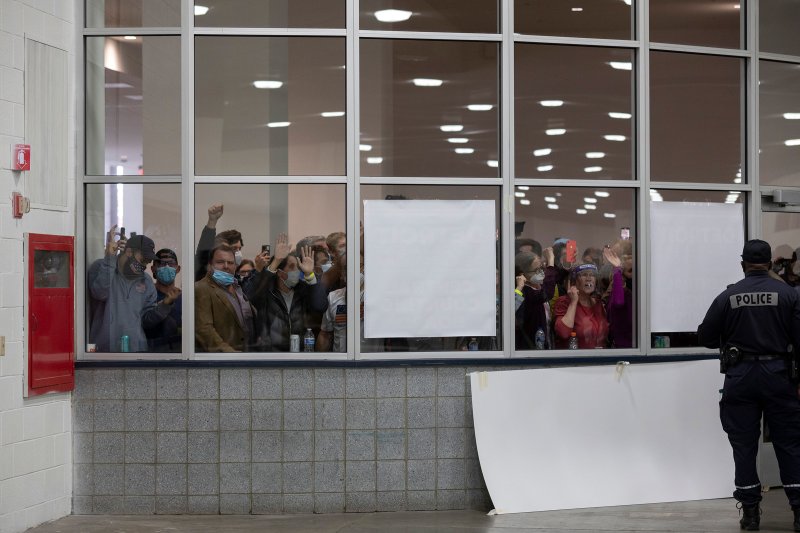
He made his way to the arena and sent word to his network. Within 45 minutes, dozens of reinforcements had arrived. As they entered the arena to provide a counterweight to the GOP observers inside, Reyes took down their cell-phone numbers and added them to a massive text chain. Racial-justice activists from Detroit Will Breathe worked alongside suburban women from Fems for Dems and local elected officials. Reyes left at 3 a.m., handing the text chain over to a disability activist.

As they mapped out the steps in the election-certification process, activists settled on a strategy of foregrounding the people’s right to decide, demanding their voices be heard and calling attention to the racial implications of disenfranchising Black Detroiters. They flooded the Wayne County canvassing board’s Nov. 17 certification meeting with on-message testimony; despite a Trump tweet, the Republican board members certified Detroit’s votes.

Election boards were one pressure point; another was GOP-controlled legislatures, who Trump believed could declare the election void and appoint their own electors. And so the President invited the GOP leaders of the Michigan legislature, House Speaker Lee Chatfield and Senate majority leader Mike Shirkey, to Washington on Nov. 20.

It was a perilous moment. If Chatfield and Shirkey agreed to do Trump’s bidding, Republicans in other states might be similarly bullied. “I was concerned things were going to get weird,” says Jeff Timmer, a former Michigan GOP chair turned anti-Trump activist. Norm Eisen describes it as “the scariest moment” of the entire election.

The democracy defenders launched a full-court press. Protect Democracy’s local contacts researched the lawmakers’ personal and political motives. Issue One ran television ads in Lansing. The Chamber’s Bradley kept close tabs on the process. Wamp, the former Republican Congressman, called his former colleague Mike Rogers, who wrote an op-ed for the Detroit newspapers urging officials to honor the will of the voters. Three former Michigan governors–Republicans John Engler and Rick Snyder and Democrat Jennifer Granholm–jointly called for Michigan’s electoral votes to be cast free of pressure from the White House. Engler, a former head of the Business Roundtable, made phone calls to influential donors and fellow GOP elder statesmen who could press the lawmakers privately.

The pro-democracy forces were up against a Trumpified Michigan GOP controlled by allies of Ronna McDaniel, the Republican National Committee chair, and Betsy DeVos, the former Education Secretary and a member of a billionaire family of GOP donors. On a call with his team on Nov. 18, Bassin vented that his side’s pressure was no match for what Trump could offer. “Of course he’s going to try to offer them something,” Bassin recalls thinking. “Head of the Space Force! Ambassador to wherever! We can’t compete with that by offering carrots. We need a stick.”

If Trump were to offer something in exchange for a personal favor, that would likely constitute bribery, Bassin reasoned. He phoned Richard Primus, a law professor at the University of Michigan, to see if Primus agreed and would make the argument publicly. Primus said he thought the meeting itself was inappropriate, and got to work on an op-ed for Politico warning that the state attorney general–a Democrat–would have no choice but to investigate. When the piece posted on Nov. 19, the attorney general’s communications director tweeted it. Protect Democracy soon got word that the lawmakers planned to bring lawyers to the meeting with Trump the next day.

Reyes’ activists scanned flight schedules and flocked to the airports on both ends of Shirkey’s journey to D.C., to underscore that the lawmakers were being scrutinized. After the meeting, the pair announced they’d pressed the President to deliver COVID relief for their constituents and informed him they saw no role in the election process. Then they went for a drink at the Trump hotel on Pennsylvania Avenue. A street artist projected their images onto the outside of the building along with the words THE WORLD IS WATCHING.

That left one last step: the state canvassing board, made up of two Democrats and two Republicans. One Republican, a Trumper employed by the DeVos family’s political nonprofit, was not expected to vote for certification. The other Republican on the board was a little-known lawyer named Aaron Van Langevelde. He sent no signals about what he planned to do, leaving everyone on edge.

When the meeting began, Reyes’s activists flooded the livestream and filled Twitter with their hashtag, #alleyesonmi. A board accustomed to attendance in the single digits suddenly faced an audience of thousands. In hours of testimony, the activists emphasized their message of respecting voters’ wishes and affirming democracy rather than scolding the officials. Van Langevelde quickly signaled he would follow precedent. The vote was 3-0 to certify; the other Republican abstained.

After that, the dominoes fell. Pennsylvania, Wisconsin and the rest of the states certified their electors. Republican officials in Arizona and Georgia stood up to Trump’s bullying. And the Electoral College voted on schedule on Dec. 14.

HOW CLOSE WE CAME

There was one last milestone on Podhorzer’s mind: Jan. 6. On the day Congress would meet to tally the electoral count, Trump summoned his supporters to D.C. for a rally.

Much to their surprise, the thousands who answered his call were met by virtually no counterdemonstrators. To preserve safety and ensure they couldn’t be blamed for any mayhem, the activist left was “strenuously discouraging counter activity,” Podhorzer texted me the morning of Jan. 6, with a crossed-fingers emoji.

Trump addressed the crowd that afternoon, peddling the lie that lawmakers or Vice President Mike Pence could reject states’ electoral votes. He told them to go to the Capitol and “fight like hell.” Then he returned to the White House as they sacked the building. As lawmakers fled for their lives and his own supporters were shot and trampled, Trump praised the rioters as “very special.”

It was his final attack on democracy, and once again, it failed. By standing down, the democracy campaigners outfoxed their foes. “We won by the skin of our teeth, honestly, and that’s an important point for folks to sit with,” says the Democracy Defense Coalition’s Peoples. “There’s an impulse for some to say voters decided and democracy won. But it’s a mistake to think that this election cycle was a show of strength for democracy. It shows how vulnerable democracy is.”

The members of the alliance to protect the election have gone their separate ways. The Democracy Defense Coalition has been disbanded, though the Fight Back Table lives on. Protect Democracy and the good-government advocates have turned their attention to pressing reforms in Congress. Left-wing activists are pressuring the newly empowered Democrats to remember the voters who put them there, while civil rights groups are on guard against further attacks on voting. Business leaders denounced the Jan. 6 attack, and some say they will no longer donate to lawmakers who refused to certify Biden’s victory. Podhorzer and his allies are still holding their Zoom strategy sessions, gauging voters’ views and developing new messages. And Trump is in Florida, facing his second impeachment, deprived of the Twitter and Facebook accounts he used to push the nation to its breaking point.

As this information was also being reported in November and December, I heard different claims about who should get the credit for thwarting Trump’s plot. Liberals argued the role of bottom-up people power shouldn’t be overlooked, particularly the contributions of people of color and local grassroots activists. Others stressed the heroism of GOP officials like Van Langevelde and Georgia secretary of state Brad Raffensperger, who stood up to Trump at considerable cost. The truth is that neither likely could have succeeded without the other. “It’s astounding how close we came, how fragile all this really is,” says Timmer, the former Michigan GOP chair. “It’s like when Wile E. Coyote runs off the cliff–if you don’t look down, you don’t fall. Our democracy only survives if we all believe and don’t look down.”

Democracy won in the end. The will of the people prevailed. But it’s crazy, in retrospect, that this is what it took to put on an election in the United States of America.

HERE IT IS! Detroit Late Night Ballot Drop… FULL VIDEO


Critical Race Theory is How Democrats Plan to Win Elections


Liberal critics of critical race theory often act as if it’s a mysterious cult that emerged out of nowhere, while its conservative critics tie it to a history of academic Marxism. That’s true but doesn’t explain why it has suddenly become so pervasively established in our culture.

Politics can be downstream of culture, but political culture is downstream of politics.

The resurrection of black nationalism and critical race theory are two faces of the same electoral strategy by a political movement now inextricably tied to black voters and white elites.

When Obama beat Hillary, he didn’t just transform America, he shed the last vestiges of the Democrat working class white vote and recreated the party as a coalition of urban elites, immigrants, and minority voters on the model of Tony Blair’s Labour Party in the UK. This “neo-liberalism”, as lefties like to call it, found its own Corbyn in the form of Bernie Sanders who put on a show of attacking the white urban elites who dominate a former working class party.

Trending: Bill Gates: We Need “Pandemic Fire Squads” To Control You In The Post COVID-19 World

Democrats use critical race theory to deter leftist insurgencies and police the middle class.

The Obama strategy traded the working class white vote for increased black and minority turnout. Since Hispanic voters are much less politically reliable than white voters, the Democrat electoral strategy narrowed down to maximizing black voter turnout. When black voter turnout faltered, as it did in 2016, the Democrats took a beating. But in 2020, black voters made Biden the nominee over Bernie even though he was backed by a majority of white and Hispanic Dems.

Then they handed Democrats control of the Senate.

Obama had initially portrayed his candidacy in MLK terms as ushering in a new post-racial era of national harmony. Then, once in office, he pivoted to the old black nationalism of his mentor, Jeremiah Wright, using his office as a platform for falsely accusing America of racism.

The rise of the Black Lives Matter movement, under the guiding hand of the Obama administration, touched off race riots around election years to generate black voter turnout. Midterm elections usually bring out more white than black voters. The race riots were meant to change that by compensating for Tea Party populism with a new black nationalist movement.

The race riots manufactured a national racial crisis to boost voter turnout by making black people feel threatened and to silence the middle class and white lefties threatened by the steady flow of jobs out of the country, and the concentration of power in a leftist oligarchy.

Working class concerns about open borders and immigration had been dropped by the Democrats even before they officially dropped the working class vote. Bill Clinton, Blair’s political peer, bluntly told working class Democrats that the jobs were not coming back, and that they needed to send their children to college, change their culture, and join the new elite.

But college was no longer a reliable ladder into a shrinking middle class. A generation had been told that they needed “computer literacy” to function in a new economy, but by the time “learn to code” became a taunt, the tech industry was offshoring and importing cheap immigrant labor.

By the end of Obama’s time in office, the American software engineer was on the same pathway as the American factory worker, tasked with training his foreign replacement before being fired.

The new economy was heavily administrative. It would cheerfully offshore manufacturing and engineering jobs, but not the diversity specialists and managers serving as political commissars. White male jobs that depended on skill and reliability became endangered, while jobs in which fitting in at an office was more important than traditional work skills became more reliable bets.

Critical race theory became the damoclean sword hanging over the heads of the suburban middle class. Like Orwell’s 1984, the members of this ‘middle party’ were bludgeoned with a campaign of political terror so that they wouldn’t have time to think about the system they were administering. The political enunchization of the administrative middle class had the same function in Orwell’s fictional dystopia and in the entirely real dystopias across the country.

The new elites are unconcerned with the proles laboring over the actual product, but deeply worry about the political reliability of the administrative class that is their means of control. They don’t care what the workers believe because they earn too little and there’s little leverage over them, but they are obsessed with maintaining their power through the administrative class.

Critical race theory had its moment at the perfect time to offer sinecures to its own organizer class who were being embedded into every workplace in the country. But it also warned the suburban middle class to avoid being seduced by President Trump’s economic populism. The political interrogations of the struggle sessions suppressed any questions about the country.

It also shut down the leftist insurgency. When Bernie Sanders first ran against Hillary, he rejected identity politics and open borders. After a campaign of harassment by black nationalist activists with puppet strings going back to the Democrat establishment, Sanders became an even bigger enthusiast of racial tribalism and illegal migration than Hillary had ever been.

That cut him off from the working class white vote and cost him any shot at the White House.

The future of his movement was outsourced to the identity politics populism of Rep. Alexandria Ocasio Cortez and the Squad for whom racial tribalism comes ahead of economic populism.

Intersectionality prioritizes racial Marxism over economic Marxism. Elements of the Left have rebelled against the political correctness and cancel culture of racial Marxism, but in a political culture where AOC is the face of the populist Left and Bernie gets to appear in memes, the audience for the non-racial Marxism of the alumni of The Intercept is limited to conservatives.

Meanwhile, critical race theory is doing what it’s supposed to do by polarizing America along tribal racial lines and along class lines among white people. White suburban moms attend book clubs discussing White Fragility and other critical race theory texts as a form of networking. Having the right politics is crucial to your career in a variety of fields. Not all of the signs asserting that in this house the inhabitants believe in science, love, and black nationalism, are voluntary statements of belief. They’re people flying the new post-American tribal flag to fit in.

Black turnout has been crucial in some races, but it hasn’t made up for Democrat losses. It’s why Democrats took such a beating in local races once again in 2020. Mark Zuckerberg and the Democrat donor class can throw a fortune at only some races. And without the massive infusions of cash, the Democrats are more likely to lose locally in much of the country.

Democrats weaponized critical race theory to play on the insecurities of a shaky suburban middle class. While manufacturing workers may fear that their jobs are about to be sent to China, suburban middle class office workers have come to fear being stigmatized for violating the confusing and incomprehensible dogma of the new antiracism.

The 2020 election pitted economic fears based on globalism against economic fears based on political correctness among the white middle class. And while President Trump won the white middle class, enough of those suburban moms reading White Fragility voted their new creed.

The secret of brainwashing is that the best way to feign belief in something is to believe it.

Republicans had won over working class whites by taking on China’s economic warfare, open borders migration, and offshoring jobs. But the critiques of political indoctrination and cancel culture were largely limited to rhetoric. President Trump’s executive order trying to root out critical race theory from federal workplaces and federal contractors was mostly ignored.

An Obama judge blocked it and Biden reversed it while calling for “unity and healing”.

Republicans have failed to reckon with critical race theory, not just as a set of ideas to rail against, but as an electoral reality. The Obama administration had understood that there would be a price to pay for jettisoning the white working class and replaced it with a new coalition. That new coalition depended on capturing the Republican suburban white base through political indoctrination and repression crowdsourced not just through social media, but workplaces.

The last two elections showed off the emergence of a new coalition between white elites and minorities which uses critical race theory as a ladder offering admission to the middle class.

Affirmative action and cancel culture are the twin doors governing access to the middle class.

Republican populism championed farmers, engineers and workers threatened by globalism, but it’s also going to have to take on the cause of a suburban middle class threatened by forces much closer to home, not with mere rhetoric, but with real policies and real consequences.

This is the new civil rights movement.

When black people were discriminated against, Republicans and some Democrats built a massive legal machine that brought almost every establishment in the country under the shadow of federal law. Much of the country is now being discriminated against, repressed, and threatened by a political system more national and even more overwhelming than segregation.

If Republicans rise to that fight, because it’s the right thing to do, they will also strike at the electoral axis of the new Democrat coalition with a new civil rights movement.

The Democrats haven’t built this weapon of political terror because they just felt like it. Nor did they decide to do all this because of something an academic once wrote in a book. It’s not a random ideology, but a sophisticated strategy for winning elections and controlling the country.

When President Trump took on immigration, he connected with millions of people who felt cut off and fueled a new Republican wave. But he didn’t do it just with talk, but with action. He promised to build a wall, to ban terror travel, and to implement specific policies and results.

That’s what a new civil rights movement needs to connect with millions more who feel cut off.

Republicans took on open borders. That battle isn’t over. But if they don’t take on critical race theory, the Democrats will use their new coalition to turn America into Europe: a nation of sullen former workers in the Rust Belt, and frightened middle class urban workers, just trying to fit in, while remaining subservient to an expert class fighting ideological crises as the nation is destroyed.

Since No One Has Proven SARS-CoV-2 Exists, What Is The Test Testing For?


THIS ARTICLE IS ABSOLUTELY AND UNEQUIVICABLY 100% TRUE.
FOR THE PAST YEAR I HAVE BEEN ARGUING THIS POINT.
THE ONLY THING THAT EVER CAME OUT OF WUHAN WAS THE DISCOVERY OF THREE GENETIC MARKERS THAT A SUM TOTAL OF PEOPLE HAVE, BUT NOT ALL.

IN ORDER TO TEST A VIRUS FOR COVID, THE ONLY, AND I DO MEAN ONLY WAY TO DO THAT IS BY TESTING IT ON A LIVE HOST, AND TO DATE, NO ONE, AND I DO MEAN NO ONE ON THE FACE OF THIS PLANET HAS DONE THAT.

SO NOW I ASK, IF NO ONE TO DATE HAS TESTED THIS VIRUS ON A LIVE HOST, HOW IS IT THEY CAN EVEN CALL IT COVID, LET ALONE CREATE A VACCINE FOR IT? WAKE UP PEOPLE. WAKE THE HELL UP ALREADY!

On Thursday’s The Sons of Liberty morning show, I pointed out that according to our Constitution, the Center for Disease Control has zero authority to mandate the wearing of facemasks, let alone criminally charging people who don’t since there is no law they are violating.  I also pointed out that both the American CDC, as well as the Chinese CDC never isolated what they are calling the SARS-CoV-2 virus and therefore all of the conclusions they are drawing, including the formulation of a vaccine, can’t actually be tied to it.  It doesn’t even meat Koch’s Postulates for goodness sakes!  However, this would also lead to the question:  For what are they actually using the PCR test?

As I’ve pointed out, the developer of the PCR test clearly said that it was not to be used for things like diagnosing someone has COVID-19.

https://www.brighteon.com/embed/2d4f2b32-a417-4f17-94d2-a58a0e2e4744

Former CBS Healthwatch reporter and author of The Matrix Revealed Jon Rappoport writes:

Trending: Bill Gates: We Need “Pandemic Fire Squads” To Control You In The Post COVID-19 World

As my readers know, I’ve been demonstrating that no one has proven SARS-CoV-2 exists.

Therefore, what is the PCR test testing for?

There are two piles of information here. By assuming SARS-CoV-2 DOES exist, you discover multiple internal flaws in the PCR. I’ve explored all of them in detail. If you back out of that exploration and realize the existence of virus is unproven to begin with, you’re driven to the conclusion that the test results—positive or negative—are completely meaningless.

Performing the test would be on the order of building an outpost at the North Pole to count the population of passing nomadic desert tribes.

Or creating an auto safety bureaucracy that will examine deep-sea divers’ oxygen tanks.

The PCR test looks for a piece of RNA in the swab sample taken from a person. That piece of RNA is PRESUMED to be part of the virus. But since you don’t have an isolated purified specimen of the virus itself, all assumptions about that piece of RNA are null and void.

Therefore, the COVID case numbers, which are based on the test results, are meaningless. So are the death numbers.

The masks, the distancing, the lockdowns—which are based on case numbers—are absurd and destructive.

(For readers who are encountering my work for the first time in this article, I suggest you read my recent piece, “If there is no virus, why are people dying?” From there, read my articles demonstrating that the existence of SARS-CoV-2 is unproven.)

This is certainly not the first time a medical diagnostic test has been revealed as meaningless. As I’ve detailed, the existence of HIV is also unproven. The various antibody tests designed to register the presence of HIV are absurd.

Here is how the medical magic trick works. Arbitrarily take a group of symptoms, lump them together, claim they add up to a specific disease with a label; assert, without evidence, that the cause is a germ; devise a test for the germ that will register positive and negative; claim the test is detecting the germ whose very existence is unproven.

Analogy: you claim you’re the CEO of, and the major stockholder in, X254, a corporation that doesn’t exist. You say you’re worth a few billion dollars. All major media outlets and national governments back your claim. You’re in. Out of nowhere, you’ve become “official.”

Consider the example of pellagra, a horrible skin disease that was plaguing the American South a hundred years ago. It affected several million people.

Medical authorities insisted a germ was the cause. Effort after effort was mounted to find the germ. Zero results. Finally, after decades, a small band of independent researchers won the day. Their contention that pellagra was actually a niacin deficiency was shown to be correct. There was no germ.

Sometimes, the very test which medical authorities devise to detect “the germ causing a disease” backfires on them. Such was the case with Swine Flu.

In the summer of 2009, while the CDC was claiming there were thousands of cases of Swine Flu in America, the overwhelming percentage of test samples taken from patients were coming back, from labs, with no sign of Swine Flu or any other kind of flu.

The lab tests were contradicting the CDC’s assertion that there was a pandemic. Sharyl Attkisson (CBS News) broke this story. Then CBS shut it down.

Tests are terrific propaganda tools. That’s all some of them are. “Well, the doctor ran my tests and he gave me a diagnosis of X. The treatment involves taking three [toxic] drugs. So I’ve started on the regimen.”

“Are you sure you want to take those drugs?”

“Of course. The tests showed I need them.”

“One of those drugs stops all cells in the body from replicating.”

“Doesn’t matter. The tests say I need the drug.”

Sometimes, there is no test, but doctors use a blizzard of arcane labels to pretend their diagnoses are real.

Such is the case with psychiatry, one of the great cons loosed upon the population. The official bible of the profession, the DSM, lists some 300 distinct and separate and named “mental disorders.”

THERE IS NO DEFINING LAB TEST FOR ANY OF THESE “DISORDERS.”

It’s up to the psychiatrist to make his diagnosis seem legitimate to the patient.

If the hidden history of medicine were taught in schools and colleges, it would come as no surprise that the COVID test is a complete hustle and con.

But schools wouldn’t touch that history with a hundred-foot pole.

In 2009, I interviewed Dr. Barbara Starfield, a revered public health expert at the Johns Hopkins School of Public Health. The subject was her July 26, 2000, review, “Is US Health Really the Best in the World?” published in the Journal of the American Medical Association.”

Starfield concluded that, every year in the US, the medical system kills 225,000 people. 106,000 from the effects of FDA approved medicines, and 119,000 from mistreatment and errors in hospitals.

As you read an excerpt from this email interview, keep in mind that most of these deaths were preceded by a diagnostic test of some kind—which speaks volumes about how the tests are interpreted and used.

Rappoport: What has been the level and tenor of the response to your findings, since 2000?

Starfield: The American public appears to have been hoodwinked into believing that more interventions lead to better health, and most people that I meet are completely unaware that the US does not have the ‘best health in the world’.

Q: In the medical research community, have your medically-caused mortality statistics been debated, or have these figures been accepted, albeit with some degree of shame?

A: The findings have been accepted by those who study them. There has been only one detractor, a former medical school dean, who has received a lot of attention for claiming that the US health system is the best there is and we need more of it. He has a vested interest in medical schools and teaching hospitals (they are his constituency).

Q: Have health agencies of the federal government consulted with you on ways to mitigate the [devastating] effects of the US medical system?

A: NO.

Q: Since the FDA approves every medical drug given to the American people, and certifies it as safe and effective, how can that agency remain calm about the fact that these medicines are causing 106,000 deaths per year?

A: Even though there will always be adverse events that cannot be anticipated, the fact is that more and more unsafe drugs are being approved for use. Many people attribute that to the fact that the pharmaceutical industry is (for the past ten years or so) required to pay the FDA for reviews [of its new drugs]—which puts the FDA into an untenable position of working for the industry it is regulating. There is a large literature on this.

Q: Aren’t your 2000 findings a severe indictment of the FDA and its standard practices?

A: They are an indictment of the US health care industry: insurance companies, specialty and disease-oriented medical academia, the pharmaceutical and device manufacturing industries, all of which contribute heavily to re-election campaigns of members of Congress. The problem is that we do not have a government that is free of influence of vested interests. Alas, [it] is a general problem of our society—which clearly unbalances democracy.

Q: Can you offer an opinion about how the FDA can be so mortally wrong about so many drugs?

A: Yes, it cannot divest itself from vested interests. (Again, [there is] a large literature about this, mostly unrecognized by the people because the industry-supported media give it no attention.)

Q: Would it be correct to say that, when your JAMA study was published in 2000, it caused a momentary stir and was thereafter ignored by the medical community and by pharmaceutical companies?

A: Are you sure it was a momentary stir? I still get at least one email a day asking for a reprint—ten years later! The problem is that its message is obscured by those that do not want any change in the US health care system.

Q: Are you aware of any systematic efforts, since your 2000 JAMA study was published, to remedy the main categories of medically caused deaths in the US?

A: No systematic efforts; however, there have been a lot of studies. Most of them indicate higher rates [of death] than I calculated.

Q: What was your personal reaction when you reached the conclusion that the US medical system was the third leading cause of death in the US?

A: I had previously done studies on international comparisons and knew that there were serious deficits in the US health care system, most notably in lack of universal coverage and a very poor primary care infrastructure. So I wasn’t surprised.

Q: Did your 2000 JAMA study sail through peer review, or was there some opposition to publishing it?

A: It was rejected by the first journal that I sent it to, on the grounds that ‘it would not be interesting to readers’!

And just like that, you can learn the truth!

House Impeachment Brief Against Trump Threatens Freedom of Speech of All Americans: Dershowitz


Incitement Is Not a Real Crime. Is It Or Isn’t It? Read And Decide For Yourself.


incite

Former president Donald Trump has been impeached for “incitement to insurrection.” The House Democrats’ claim is that Trump made an inflammatory speech which—a week later—led to the Capitol riot of January 6.

The Senate is now considering whether or not to convict Trump of this “crime.”

I put “crime” in scare quotes for a couple of reasons.

The first reason is that the impeachment proceedings aren’t a criminal trial, so even conviction wouldn’t establish guilt the way an actual criminal court might. Contrary to what much of the public thinks, and what the media is happy to imply, impeachment is properly understood as strictly a political process that does nothing more than remove a person from office. 

Moreover, it’s already clear that if Trump were being tried in an actual criminal court, it is extremely unlikely a prosecutor could get a conviction. Trump’s alleged incitement doesn’t meet the legal requirements for such a charge as set out by the US Supreme Court back in 1969. An incitement conviction would require prosecutors to show there was an imminent threat of violence from the inflammatory remarks. Clearly, the Capitol riot, occurring a week later, was not “imminent,” and in a criminal case, it would be nearly impossible to prove this was directly connected to a political speech made days earlier.

The second reason “crime” needs to be in scare quotes is because incitement isn’t a real crime at all. It assumes that the person committing the “incitement” is simply passing down orders to blank-slate automatons who then turn around and do whatever their “leader” says.

In fact, the only people guilty of rioting are the rioters.

Rothbard spelled this out several times.

For instance, in an essay written for a small newspaper in the late 1960s, Rothbard explains the problem with claiming incitement is a real crime:

Suppose that Mr. A tells Mr. B: “Go out and shoot the mayor.” Suppose, then, that Mr. B, pondering this suggestion, decides it’s a darn good idea and goes out and shoots the mayor. Now obviously B is responsible for the shooting. But in what sense can A be held responsible? A did not do the shooting, and didn’t take part, we will assume, in any of the planning or executing of the act itself. The very fact that he made that suggestion cannot really mean that A should be held responsible. For does not B have free will? Is he not a free agent? And if he is, then B and B alone is responsible for the shooting.

If we attribute any responsibility at all to A, we have fallen into the trap of determinism. We are then assuming that B has no will of his own, that he is then only a tool in some way manipulated by A.

Now, if Person A participated in the planning of a riot or a murder, then Person A is guilty of conspiracy, not incitement. But Person A is not guilty of anything for have merely suggested to Person B that he shoot the mayor. Person B, after all, is responsible for his own actions.

Rothbard continues:

[I]f the will is free, then no man is determined by another; then just because somebody shouts “burn, baby, burn,” no one hearing this advice is thereby compelled or determined to go and carry the suggestion out. Anybody who does carry out the advice is responsible for his own actions, and solely responsible. Therefore, the “inciter” cannot be held in any way responsible. In the nature of man and morality, there is no such crime as “incitement to riot,” and therefore the very concept of such a “crime” should be stricken from the statute books.

Finally, Rothbard notes that incitement laws are also damaging because they are a direct attack on the natural right to free speech:

Cracking down on “incitement to riot,” then, is simply and purely cracking down on one’s natural and crucial right to freedom of speech. Speech is not a crime. And hence the injustice, not only of the crime of incitement, but also of such other “crimes” as “criminal sedition” (sharp criticism of the government), or “conspiracy to advocate overthrow of the government”—in other words, planning someday to exercise one’s basic and natural right to freedom of speech and advocacy.

A decade later, Rothbard emphasized the importance of rejecting the notion of incitement as a crime in his book For a New Liberty. Under the section titled “Freedom of Speech,” he writes:

What, for example, of “incitement to riot,” in which the speaker is held guilty of a crime for whipping up a mob, which then riots and commits various actions and crimes against person and property? In our view, “incitement” can only be considered a crime if we deny every man’s freedom of will and of choice, and assume that if tells and C: “You and him go ahead and riot!” that somehow and are then helplessly determined to proceed and commit the wrongful act. But the libertarian, who believes in freedom of the will, must insist that while it might be immoral or unfortunate for to advocate a riot, that this is strictly in the realm of advocacy and should not be subject to legal penalty.

Later, in his book The Ethics of Liberty, Rothbard again makes very similar remarks:

Suppose that Green exhorts a crowd: “Go! Burn! Loot! Kill!” and the mob proceeds to do just that, with Green having nothing further to do with these criminal activities. Since every man is free to adopt or not adopt any course of action he wishes, we cannot say that in some way Green determined the members of the mob to their criminal activities; we cannot make him, because of his exhortation, at all responsible for their crimes. “Inciting to riot,” therefore, is a pure exercise of a man’s right to speak without being thereby implicated in crime. On the other hand, it is obvious that if Green happened to be involved in a plan or conspiracy with others to commit various crimes, and that then Green told them to proceed, he would then be just as implicated in the crimes as are the others—more so, if he were the mastermind who headed the criminal gang. This is a seemingly subtle distinction which in practice is clearcut—there is a world of difference between the head of a criminal gang and a soap-box orator during a riot; the former is not, properly, to be charged simply with “incitement.”

This problem is related to a similar problem: making noncrimes like slander (i.e., defamation) into prosecutable offenses. A “slanderer” can say all sorts of things. And, indeed, a respect for freedom of speech dictates that we allow him to do so. After all, the people who hear what he has to say remain completely free to come to their own conclusions about what to do with that information. Just because some person says “your sister is a whore,” doesn’t mean we are required to believe him or act on those words in any particular way. 

[Read More: “The Dangers of Defamation Laws” by Ryan McMaken]

In practice, laws against incitement and defamation are very dangerous to basic human rights, and both place nonviolent people in legal jeopardy merely for the “crime” of expressing opinions. These laws are direct attacks on the right to free speech. In the case of Trump and “incitement,” he expressed an opinion about the election and encouraged people to “fight like hell” in a vague, nonspecific way. If this sort of thing is “criminal” then anyone who expresses an opinion that people should “resist” or “fight” against the regime—or even suggest that the regime is illegitimate or worthy of contempt—is likely to find himself on trial any time one of his social media “friends” decides to deface a government building or throw a rock at a cop. 

THIS RIGHT THE HELL HERE IS HOW THE LEFT KEEPS PUSHING THEIR LIES BECAUSE THEY KNOW THEY HAVE THE USEFUL VILLAGE IDIOTS BELIEVING THEM