HER EMOTIONAL FIRE IS WHAT EVERY CONSERVATIVE NEEDS AT THIS POINT. EVERY CONSERVATIVE.
THIS IS AN ABSOLUTE MUST SEE FOR CONSERVATIVES!
SHE PUTS VIRTUALLY ALL CONSERVATIVES TO SHAME. TO SHAME!

THIS IS AN ABSOLUTE MUST SEE FOR CONSERVATIVES!
SHE PUTS VIRTUALLY ALL CONSERVATIVES TO SHAME. TO SHAME!

Hello,
If you clicked on this headline to see if its talking about yet another shooting in the United States, the answer is no.
It’s not talking about particular shootings so much as it’s talking about headlines. It is well known that a large section of the consumer market only consumes the headline of any given informative or opinion piece, an even larger segment only consume the headline and maybe a paragraph or two… so this is the last paragraph some of you will read.
But those with enough intelligence and due dilligence will read on.
You may have noticed an astonishing increase in the number of shooting related headlines permeating the news. If you did, that is deliberate. People click them because tragedy sells, it grabs attention, at the very least seeing the headline sparks a tiny bit of memory and the consumer can ‘fill in the rest’ without reading.
Both getting the click and showing the headline have value for various entities. Especially media entities who are agenda aligned, like perhaps a network noted for being decidedly anti-2A (but they assure you they aren’t, they’re just ‘reasonable’), but that’s hypothetical… obviously.
If you click, they get the view. They can even get that view while accurately (or reasonably accurately) portraying an event below the headline. They don’t need to overly dilute the story, they did so in the headline and more people consume the headline. So for every person that read and understood the event from the piece, multiple people based their understanding of the event solely on the headline they read.
These entities will capitalize on the power of their headline. They will use that headline to shape the formative thoughts about an event, even as they accurately portray the events in the follow-on narrative, even as that narrative calls into question the particular and sometimes rather misleading context of the headline itself. That headline shaped more thoughts than the rest of the piece.
They are weaponizing the headline so that you, Joe & Jane Public, will fill in rest based upon previous context from other cognitively linked events and formative context.
Let’s take this example:
This is actually a fairly tame example of what we are discussing. Other headlines immediately thrust this into the spotlight as another mass shooting, similar to FedEx. “9 Children Shot…” is another variant I’ve seen that is a little more leading, from People.com.
Yet – No arrests have been made and the sheriff, Mike Tregre, said that “not one” witness has given authorities a formal statement about what happened.
Hmmm, why would that be? This happened in front of 60 people and yet nobody is talking?
More than 60 people were gathered at the party when an argument broke out between two groups with an ongoing feud, authorities said.
Ah, there it is. This was a gang fight. Oh… sorry, gang is a “charged” term, I meant this was a fight between two groups who are known to be hostile toward each other usually due to competition and rivalries linked to criminal activities. The ‘children’ involved were all teens, with the exception of a 12-year-old wounded in both legs. There was one 13-year-old that may yet qualify as a ‘child’ in the maternal and paternal sense (the one People headline is trying to invoke), but the remainder were 14 to 17 years old. That age where people can be tried as fully cognizant adults for what occurred.
So in that case, with all that context, with a working understanding of what happened (two groups had beef at the same party and things got bloody/territorial/score settling, a far from unheard of event) why would People headline it “9 Children Shot and Injured at Birthday Party” and “12-year-old” gets a ton of emphasis too.
Those are factual statements in the headlines… from a certain point of view (thanks there Obi-wan), however the formative initial impression is drastically different than the contextualized reality.
For every person who clicks, reads, and understands, they can get ten (actually far more when you look at click-thru metrics) who will see the headlines and simply assume some variation of, ‘Oh no, somebody attacked a kids birthday party! It’s all this gun violence! Kids are being shot at birthday parties! We must do something!!‘ and that thought is far more valuable, when pushing gun control legislation.
It is profitable to make you, the consumer, imagine it was a bunch of small children in conical birthday hats who were gunned down with no provocation. It is less profitable, towards certain goals, to convey that this was two groups who got into a fight, with a known history of conflict, and that nobody who witnessed the event is talking to authorities about it. Likely because they are all connected to the participants in the fight enough that they would rather take care of the aftermath ‘in-house’ as it were, instead of involving the repercussions associated with law enforcement.
Law enforcement involvement is clearly not welcome or desired in this instance, that is abundantly clear. But we didn’t get a headline along the lines of…
With two short sentences, that conveyed a very accurate summation of the events and painted a picture for all those who won’t click on the story. A fight occurred, it occurred between young people, guns were used, 9 young people were injured. Anyone with an extra neuron to rub against the first one can put together a reasonable image of what took place. The only lacking element from my headline is that the youngest person injured was 12, not a teenager yet. Who’s birthday party, or rather how old the child whose party it was, is not very relevant to the event.
Those three actual headlines do not convey the event in nearly so accurate terms, they pick an exploitable fact about the event to shape public opinion. Kids or Children were shot at a birthday party. This is to provoke a very deliberate image.

This is the same common obfuscationary practice that has led to such rampant distrust of “mainstream media” but it continues to shape public perception. Anyone reading the story realizes the source was less than forthright in their headline, as in the headline did not preview and shape the story and the reading of the rest filled in the details. Instead it ‘subverts your expectations’ or some such and you’re left realizing, ‘oh, that’s what they meant by “children” shot at a birthday party’ by the end of the reading.
This is the news, we don’t need to bury the lead in a little mystery or creative misdirection in order to report it… unless that creative misdirection serves a public opinion purpose. Saying nine children got shot at a birthday party conjures a more raw and evocative image than saying nine teenagers and a twelve-year-old got shot during a fight and nobody is snitching to the cops. These writer/reporters know that, that is why headlines read the way they do. This is why it seems like we are having an insanely violent spring full of shootings. (fun fact: violence has always trended seasonally, especially in areas where winter is prohibitively cold)
Outlets like Vox, People, CNN and virtually all other left leaning so-called media outlets are open advocates for more gun control, so they have additional incentives to grab onto every story they can where it is possible to bury the lead and evoke the public perception to push the agenda they seek. It’s also why coverage isn’t even. The more easily emotionally exploitive events, like the FedEx and Massage Parlor slayings, get more traction than something like the Phillip Adams multiple-murder/suicide.
It’s why teenage toughs who got into a gunfight spat at a neighborhood party for a 12-year-old got reported as, “9 Children Shot…” instead.
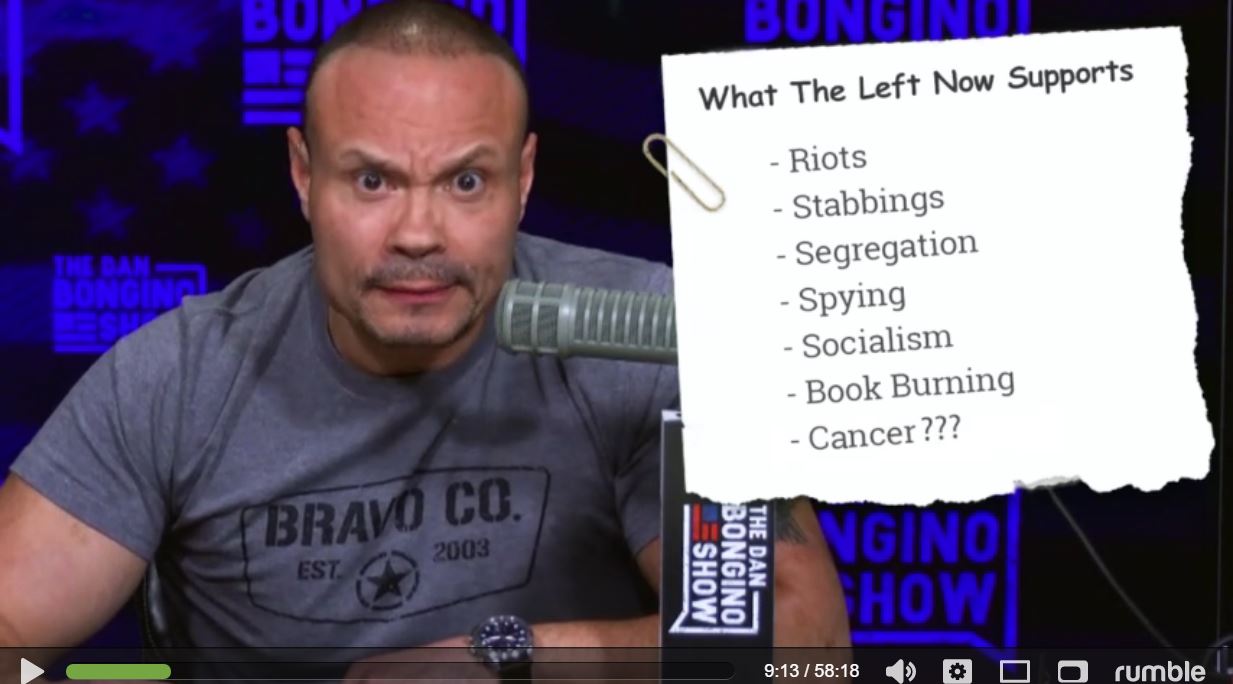
BECAUSE DAN BONGINO IS RIGHT ON TARGET WITH THESE NUTBAGS, THEY ARE ALL LEAVING HIM MESSAGES THAT THEY HOPE HE DIES FROM HIS CANCER DIAGNOSIS.






Remember When Joe Biden Called Obama Articulate and Clean?
(2008)
“I mean, you got the first African-American who is articulate and bright and clean and a nice-looking guy. I mean, that’s a storybook, man,” Biden told the reporter.

New evidence has emerged in the case of 73-year old Karen Garner, an eighty-pound woman with dementia and sensory aphasia. Newly released video shows Garner was beaten to the point of having her arm broken and her shoulder dislocated while being arrested for an alleged attempted theft of $13.88. In June 2020, Garner had apparently attempted to leave a Walmart in Loveland, Colorado, with a bag full of small items but was confronted by store staff. She left empty-handed, and may have simply forgotten to pay.
Minutes later, Garner was walking home when approached by police who demanded she stop and submit to arrest for the “theft.” Within minutes, two police officers threw the old woman—who was apparently confused—to the ground as she kept repeating “I am going home” over and over.
Afterward, police refused to provide any medical attention to the woman, and while she groaned in agony, they threw her in a jail cell for two hours before then transporting her to the county lock-up for an additional three hours.
Garner suffers from both dementia and sensory aphasia, which impairs her ability to verbally communicate and understand others’ communications.
Garner is one of the most vulnerable members of the community – a mother, a grandmother, a tiny, frail human with cognitive disabilities – and they treated her like an animal
The district attorney refused to press charges, since even a DA could see any that group of somewhat rational people—i.e., non–police officers sitting on a jury—was likely to conclude that this woman was of no real threat to anyone.
It’s not hard to imagine the predictable reaction to this video from those who reflexively defend police abuse. She “should have complied,” they’ll say. Some might insist that if she had her arm broken and her tiny body thrown to the ground, she was “asking for it” because, well, she may have tried to steal the equivalent of thirteen dollars.
Indeed, defenders of police abuse and incompetence often attempt to console themselves with the idea that they would always comply with police orders, and therefore would never have to worry about being shot dead, beaten down, or otherwise abused by police.
This might seem plausible for someone who has no family members with severe autism, mental illness, dementia, hearing impairment, lack of fluency in English, or any other condition that might be inconvenient to police officers.
But for many people, the reality of “compliance” isn’t nearly as neat, clean, and black and white as defenders of police want to believe.
Moreover, many innocent and unarmed victims of police shootings aren’t even given a chance to “comply.” They’re just shot dead without warning.
Admittedly, these facts will do little to persuade the “Back the Blue” crowd from changing their slavish devotion to the well-paid, nearly impossible-to-fire, legally immune, and unionized government employees in police departments.
But let’s review some of the evidence anyway.
It’s a little hard to comply with police orders when one isn’t even given the chance to do so. Some are shot even while in the act of complying with police orders.
That was certainly the case for Frank Lobato, a bedridden 63-year old man who was shot to death by police. Police had invaded his house looking for another man who was not in the house. Lobato was suspected of no crime, and was sitting in bed watching television. Police entered his room through a window, immediately decided his soda can was a gun, and opened fire.
Then there was the case of Margie Carranza and Emma Hernandez. Hernandez, 71, and her daughter Carranza were sitting in their pickup truck in Los Angeles in 2013 during a morning routine of delivering newspapers. Suddenly the police fired more than 100 rounds of ammunition into the pickup truck. The police believed the truck belonged to someone else. Fortunately, the women survived. They received a paltry $40,000 settlement from the LAPD, which insists the police did nothing wrong.
More recent is the case of Atatania Jefferson, a woman shot dead in her living room by a police officer in Fort Worth, Texas, in 2019. Jefferson was up late playing videogames with her nephew. Police received a call from a neighbor asking the police to make a “wellness call” to the house because the neighbor was worried that Jefferson’s open front door signaled foul play. When police arrived, one of the officers went around to the back of her house, and peered into Jefferson’s windows. Upon seeing Jefferson inside, the police officer immediately shot her dead.
In 2016, Philando Castile was shot dead by police in suburban Minneapolis. Castile was in legal possession of a concealed weapon, and informed the officer of this fact. This is what owners of concealed weapons are advised to do when dealing with police. Castile complied with all police orders, yet was dead within minutes after police opened fire for no clear reason.
On January 18, 2016, Daniel Shaver was shot to death by police while crawling along the floor as ordered by police. Shaver was sobbing and begging for his life. Police officer Philip Brailsford gunned him down anyway. Shaver had committed no crime. Brailsford was rewarded with a $2,500-per-month pension by the police department.
Not everyone—i.e., the disabled—possesses full control of his faculties and is able to respond in a way that is sufficiently speedy to the liking of police.
In September 2020, for example, autistic 13-year-old Lindon Cameron was shot multiple times by police while Cameron walked down a street in Salt Lake City, unarmed.
In 2013 in Frederick, Maryland, Ethan Saylor, a 26-year-old man with Down syndrome—and an IQ that was likely in the 50–60 range—was killed by police after Saylor refused to leave a movie theater. Police threw Saylor to the ground and sat on him until he suffocated.
In January 2020, 16-year-old Eric Parsa was killed in a similar way by police in a Louisiana parking lot. Police shackled Parsa, who had severe autism, put him in a choke hold, and then sat on him for nine minutes until he died.
Being hearing impaired or incapable of speaking English has provoked police attacks as well.
In January 2014, Oklahoma City police pulled over Pearl Pearson Jr., a man suspected of a hit-and-run. Pearson, attempted to signal to police that he was deaf but before he could do so was pulled from his car and severely beaten. Pearson was never charged with any crime.
Then there is the case of Sureshbhai Patel, a 58-year-old resident of India who was visiting his son in Madison, Alabama, in 2015. Patel was taking a walk through his son’s neighborhood when confronted by police. As Patel did not speak English, a Madison police officer quickly lost patience with him and slammed him to the ground, paralyzing him, within minutes.
The lesson from all of this, of course, is that “compliance” or “doing what you’re told” won’t necessarily save those who have the misfortune of encountering police officers with itchy trigger fingers, or who simply can’t be bothered with making the extra effort to properly work with disabled people or those who have trouble communicating.
As cases like these pile up, it becomes all the more clear that police will, in fact, attack people who aren’t even given a chance to comply, or who are incapable of immediately doing so. Now is the time to abandon the notion that we should just blithely dismiss and ignore police abuse of private citizens because we can safely assume the citizens must have done something to “deserve it.”
Now, no one is claiming that policing needs to have a perfect track record. No private sector firm is likely to achieve such a record. However, those who insist on claiming “do what you’re told and you’ll be fine” cling to sloganeering designed to dismiss any and all calls for reform. Moreover, the most popular reaction to mention of cases in which police attack those with no time or no ability to comply seems to be “this is rare, so there’s no problem.” These people might as well be saying “you can’t make an omelet without breaking some eggs.” Imagine if commercial airlines took the same view: “Hey, airplanes crash sometimes. Sh*t happens.” Clearly, most people would find such an attitude of indifference unacceptable. Yet this is essentially the anti-police-reform position we hear again and again when it comes to the sorts of tragedies discussed above.
So what is to be done?
The first thing to note is that this sort of behavior is exactly what we should expect from a government monopoly with agents who have no skin in the game and have no market incentives to provide quality service at a reasonable price. When it’s politically convenient, police departments claim to serve and protect, but when it comes time to provide actual quality service, they’ll change their tune and insist that they are under no legal obligation to protect anyone. This is how police personnel get away with cowering behind their cars during school shootings. It’s why police spend an outsized amount of their time on harmless soft targets like suburban kids growing pot—but who are actually growing tomatoes. It’s why the police have time to go harass children with overdue library books. Departments are set up to reward officers who focus on petty crimes while more serious crimes are ignored. In many cities, only a tiny percentage of police resources go toward murder investigations. Indeed, police are remarkably inefficient at finding and arresting violent criminals.
Ideally, real reform would reduce the monopoly powers and legal protections afforded to police departments. This means removing qualified immunity for police officers and abolishing police unions.
True reform means ending the war on drugs. It means reducing police encounters with private citizens over small-time, petty infractions. It means redefining many “crimes” as matters to be dealt with in the civil courts. True reform means focusing police resources on serious violent crime and real theft (i.e., not a $13 nontheft at Walmart).
In the case of Karen Garner, there was absolutely no need to make an arrest. In a more reasonable world, at most Garner would have received a citation for her alleged attempt at petty theft. She could have been hauled up before a judge by Walmart, although it’s unclear what Walmart would sue her for since she didn’t actually steal anything.
Stop pretending that everything is fine and everyone will be safe if you “just do what you’re told.” That fantasy may help some people sleep at night, but it’s just that; a fantasy.





 fox files
Written
on 26.April.2021.