
The current understanding of human rights was built on Kant’s idea of universal human rights
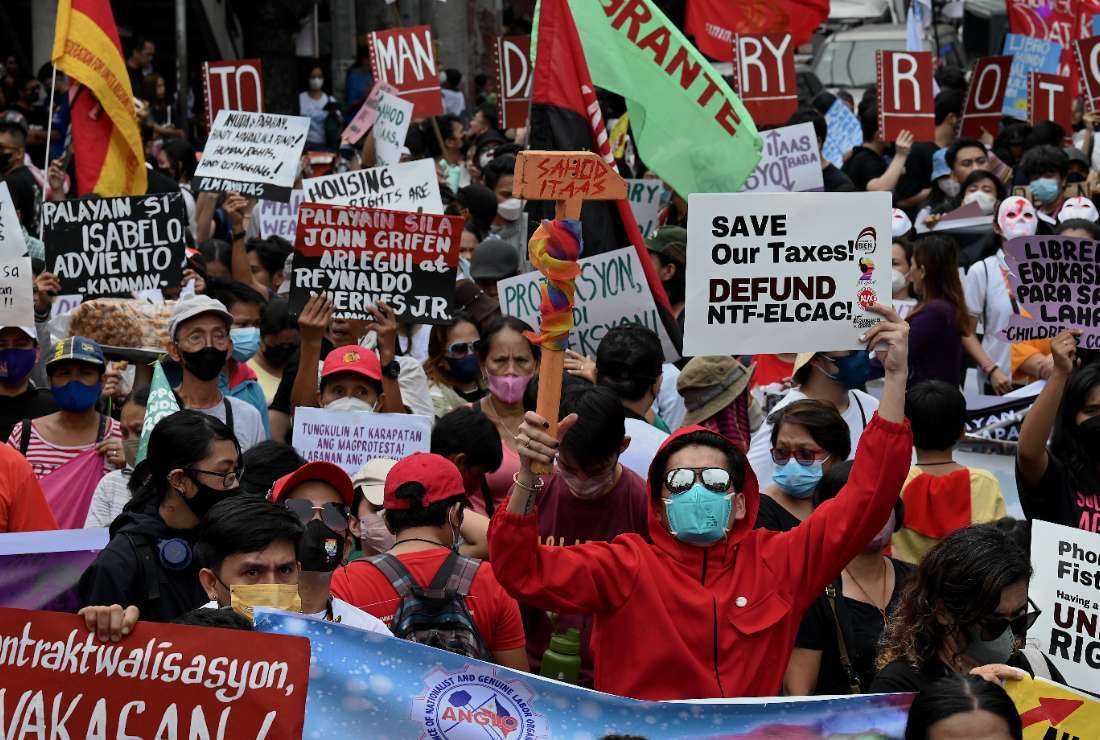
Protesters raise their fists and placards during a demonstration in observance of the International Human Rights day in Manila on Dec. 10, 2022. (Photo: AFP)
“Ask not what your country can do for you — ask what you can do for your country.” Politicians and leaders are fond of quoting this challenge posed by John F. Kennedy in his inaugural address on Jan. 20, 1961. They are in a way right to remind us of our responsibilities and duties. But we also need to realize our rights and privileges, which alone can enable us to have duties.
We discuss often on unalienable rights and obligations in every community. But, we must consider the fundamental right that enables all other rights. A key component of the discussion on human rights is the idea of the “right to have rights.” In the years following World War II, this idea was frequently linked to the German political philosopher Hannah Arendt. She contended that the right to own rights is the most fundamental of all rights. We will talk about the history of this idea, how important it is in today’s political debate, and the problems it creates for the fulfilment of human rights in this article.
Origins of the Right to Have Rights
The concept of the “right to have rights” may be found in the writings of Enlightenment theorists including French philosopher Jean-Jacques Rousseau and German scholar Immanuel Kant. The current understanding of human rights was built on Kant’s idea of universal human rights, which was based on each person’s intrinsic value and dignity. The evolution of the human rights discourse was also inspired by Rousseau’s social contract theory, which holds that people voluntarily cede part of their rights to the state in exchange for safety and security.
The contemporary notion of the “right to have rights” originated with Arendt’s examination of the idea of statelessness, i.e., when people have no political state to protect them. The migrants and refugees are the contemporary examples.
The notion of the “right to have rights” originated in the aftermath of World War II and the Holocaust, which showed the limits of the existing legal and political frameworks for defending human rights of both individuals and groups.
Hannah Arendt (1906-1975), a German-Jewish philosopher who escaped Europe during the war, articulated this thesis in her important contribution “The Origins of Totalitarianism.” In this book, Arendt maintained that the human rights breaches committed by Nazi Germany were made possible by the weakening of the legal and political protections that had previously guaranteed individual liberty. According to Arendt, the Holocaust showed how even the most fundamental rights, like the right to life, might be violated when people did not have the ability to exercise their rights.
Significance of the Right to Have Rights
Since it highlights the significance of political and legal safeguards for human rights, the right to have rights is crucial in today’s political and ethical discourse. It emphasizes that in addition to being individual liberties, human rights are also communal goods that rely on the presence of governmental structures capable of defending them. In this view, the manifestation of other human rights, such as the freedom of expression, the freedom of religion, and the right to a fair trial, is a prerequisite for the achievement of the right to possess rights.
Some Challenges to the Realization of the Right to have Rights
Despite its significance, the right to have rights faces numerous challenges in the contemporary world. The emergence of authoritarian regimes, which threaten democratic institutions and weaken the political and legal safeguards for human rights, is one of the biggest challenges.
The continuation of structural disparities that restrict access to governmental and political institutions, particularly for vulnerable groups including refugees, immigrants, and racial and ethnic minorities, is another problem. The plight of the migrants, who are compelled to flee their own country and are left in the hands of “merchants of death,” seriously tests the morality of the developed world. Their cries for justice and the heinous denial of their right to any rights is a wake-up call for all of mankind.
The neoliberal or libertarian emphasis on individual rights above or against common goods, which frequently favors free market over social wellbeing, puts the right to have rights in jeopardy, for many disadvantaged people.
In conclusion, the right to have rights is a vital component of the human rights discourse that highlights the significance of legal and political safeguards for individual liberty. This idea was developed in the wake of the Holocaust and World War II, and it is still important in today’s political debate.
The growth of authoritarian regimes, the continuation of structural disparities, and the neoliberal emphasis on individual rights are only a few of the obstacles that the right to have rights must overcome. To overcome these obstacles, everyone must work together to defend and advance the political and legal frameworks that uphold even the most basic rights.
It is the absolute minimum we can do to protect our fundamental rights, especially those of immigrants and stateless people. The most fundamental right, which serves as the foundation for all other rights, is the right to one’s political identity.
The Church is very forthright in demanding its rights. It stands for the rights of the poor, tribal and marginalized people, inspired by Pope Francis. At the same time, the Church needs to reflect on its moral obligation to provide the right to have rights, especially to its own laity and to women religious.
The Church needs to realize that reminding them of their duty can only be done, if it recognize its primarily rights and above all the right to have rights. That comes from the very fact of God having created all of us in his own image and likeness. Then we can do justice to the fundamental rights (Maulik Adhikar) that the Indian constitution so proudly speaks of!


 fox files
Leave a comment