The Truth Is Out There


Unfortunately for the mainstream media, this video is everywhere now.  There were all sorts of news stories about someone shooting at “mostly peaceful” “pro-Palestinian” protesters Sunday evening in Skokie, IL.  As if he just couldn’t contain his hatred for Muslims in general and Palestinians in particular.  Of course, now that the video is released, it shows the violent mob swarming the man and beating the hell out of him before he pulled his gun and fired a warning shot instead of shooting one of the thugs beating him with sticks.

You want to know what else is remarkable?  How the Skokie cops didn’t converge on the attack until after the shot was fired.  Were they told to stay “hands off” even with the pro-Palestinian “protesters” attacking people and beating them severely?  Seconds after the shot was fired, the Skokie officers were right there taking the man into custody.

What else is troublesome?  I guarantee you those “mostly peaceful” protesters are busy trying to find out the man’s identity and will undoubtedly vandalize his residence, share plenty of death threats and try to get this guy fired from his job and similarly harass his family.

Here’s a snippet from the Chicago Sun-Times.  I’ve left out all of the paragraph after paragraph of the Palestinians casting themselves as the victims when they were the bullies and instigators of violence, NOT the guy defending himself in a not-so-friendly to self-defense Cook County.

Charges will not be filed against a man who fired a gun near pro-Palestinian protesters in the north suburbs Sunday night, according to the Cook County state’s attorney’s office.

The 39-year-old man, who prosecutors declined to name, was released from police custody. In a statement issued Monday, prosecutors said the man, a Firearm Owner Identification Card and Concealed Carry License holder, had “no criminal history.”

“After reviewing the evidence, which includes surveillance video and witness statements, we have determined the individual … acted in self-defense upon being surrounded by a crowd and attacked by some of those individuals,” according to the statement.

People scream and the crowd scatters, and the man can be seen holding the gun as someone screams, “Get him! Get him!”

Yes, even after he fired his gun, the crowd was still going to get him.  If the cops hadn’t arrived when they did, he probably would have shot a few of his attackers before being overtaken and likely beaten to death.

This all coming from the left who label themselves as the peaceful, for the common middle people party.

Think about that long and hard.


StunningArt / shutterstock.com

For the better part of the last decade, many Americans have wondered just how much is being censored from social media. While horrific content of people killing, raping, and robbing other people is consistently lauded across the platform as “music,” the conservative voice is being gagged. Choked out by the powers that be, their ivory tower mindset has kept them from being reachable for decades.

Now thanks to the Supreme Court upholding a lower court ruling, they can bring back their censorship. Announced on October 23rd, Justice Samuel Alito penned his dissent from a split ruling.

“This case concerns what two lower courts found to be a coordinated campaign by high-level federal officials to suppress the expression of disfavored views on important public issues.” By allowing the ruling to stand, the left could now resume “either coercing social media companies to engage in such censorship or actively controlling those companies’ decisions about the content posted on their platforms.”

Alito’s dissention was also joined by Justices Clarence Thomas and Neil Gorsuch.

Such a crucial ruling hands the federal government the right to fully censor what we see. Thanks to the liberal left and their “free spaces” and prevention of “disinformation” we can no longer guarantee the free speech of what we read online. While there has always been a grain of salt taken with much of the information available online, by censoring it, they are preventing people from doing their own research to learn the unadulterated truth about controversial topics.

This doesn’t just change what we’ll see in terms of COVID. Now they’ll resume shaping the narrative around Israel and Hamas, Ukraine and Russia, and especially Republicans versus Democrats. Poisoning the idea of free thought and the free exchange of ideas like this is more than a slippery slope. It’s outright setting us on course for 1984 to move from movie to reality.


EXCLUSIVE CIVIL LIBERTIES DOC
2
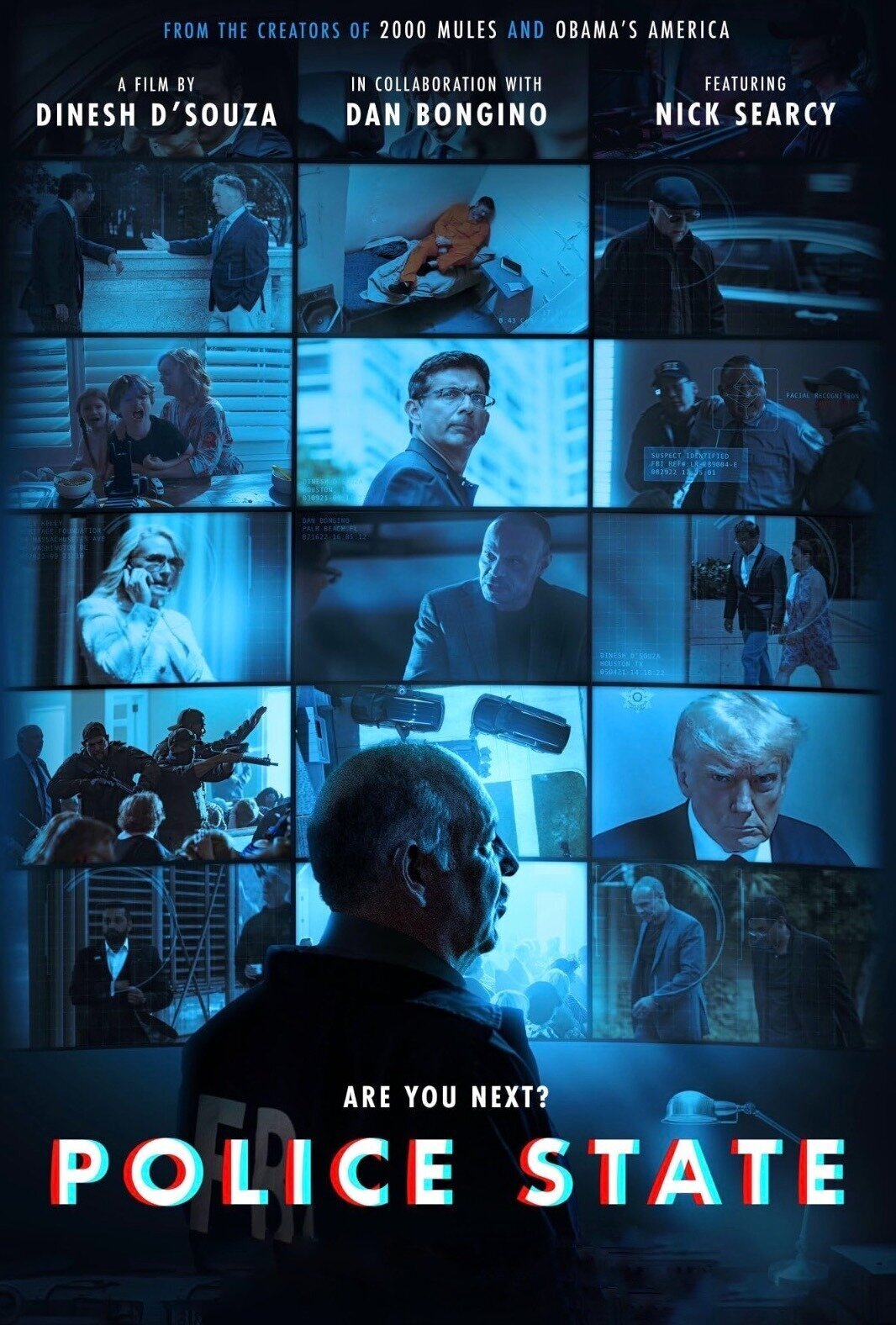
Dinesh D’Souza Documentary “Police State” To Stream Exclusively on Rumble
Rumble, the rapidly expanding video-sharing platform and provider of cloud services, has revealed the launch of exclusive film content, featuring an explosive piece of cinema from political filmmaker and author, Dinesh D’Souza. His latest film, titled “Police State,” has created waves by aligning itself with free speech and anti-censorship ideals, displaying a commitment to the unfiltered dissemination of content.

The film, co-created alongside political commentator Dan Bongino, will be accessible on Rumble and Locals from October 28th.

In the face of rampant online censorship, D’Souza’s “Police State” intends to shed light on the impending risks to American civil liberties. Recognizable for his uniquely unfiltered voice, D’Souza aims to expose the encroaching threat of a police state in a country that has traditionally valued individual freedoms above all else.
2
The film also underlines the urgency of recognizing an increasingly invasive state machinery. For D’Souza, this project represents not just a movie but an urgent call to action. In this vein, he voiced his pleasure to be streaming his utmost critical work on uncensored platforms such as Rumble and Locals.

“This movie will expose the threat to the basic rights of Americans and the alarming movement toward the country becoming a police state,” said D’Souza. “It’s my most urgent and powerful film, and I’m delighted to be streaming it on Rumble and Locals.”

Rumble, known for its mission to challenge cancel culture and encourage the unimpeded flow of ideas, has welcomed the addition of D’Souza’s latest pivotal work. Chris Pavlovski, Rumble Chairman and CEO, expressed his enthusiasm about the progress they have been making with their pay-per-view functionality.

“We’ve made a lot of progress with our pay-per-view functionality, and we are excited to bring this movie to the platform,” said Pavlovski. “With a significant following and an impressive portfolio of movies, D’Souza is a powerful voice, and we expect a great turnout,” he added.

Dinesh’s Locals community includes access to stream “Police State.” Members will also gain access to exclusive live streams and other films like “2000 Mules.”
HYPOCRITICAL
3
The Australian Government Says It Will Be Exempt From Its Own Online “Misinformation” Laws
The Albanese administration’s pursuit of overreaching legislation intended to tackle “false” content on social media platforms is drawing sharp criticism and questions about its implications for free speech. A notable exclusion from this potential crackdown is the very government pushing for it.

This exemption, which would allow government messages to bypass these stringent regulations, was questioned by Independent Senator David Pocock. He rightly posited why governmental communications should remain unexamined when content from other entities would be under scrutiny. To many, the exemption smells suspiciously like a double standard, allowing the government to avoid the very accountability they seek to impose on others. “It would not ‘pass the pub test’ for the exemption to stand when the laws were eventually introduced,” Senator Pocock remarked.

Assistant Minister for Infrastructure Carol Brown rushed to defend the exemption, stating that it is intended to prevent critical emergency communications from the government being accidentally removed by social media platforms.

Special Minister of State Don Farrell, who oversees electoral matters, conveyed the complexity of the issue. “It’s a difficult topic,” he admitted. The balance between preserving free speech and battling misinformation is indeed a delicate one. Senator Farrell remarked, “You don’t want to stop free speech in this country, and we do want people to be able to express their views, even if you consider them crazy and so forth.”
PUSHING BACK AGAINST LAWMAKERS
4
X Won’t Demonetize Russell Brand, The Company Tells Pro-Censorship British MPs
Demonstrating its commitment to upholding principles of free expression, Twitter recently affirmed that it would continue to financially support comedian Russell Brand, refusing to be swayed by mere accusations leveled against him. Elon Musk has promoted the position of not penalizing account holders unless they deviate from the platform’s guidelines or violate local laws.

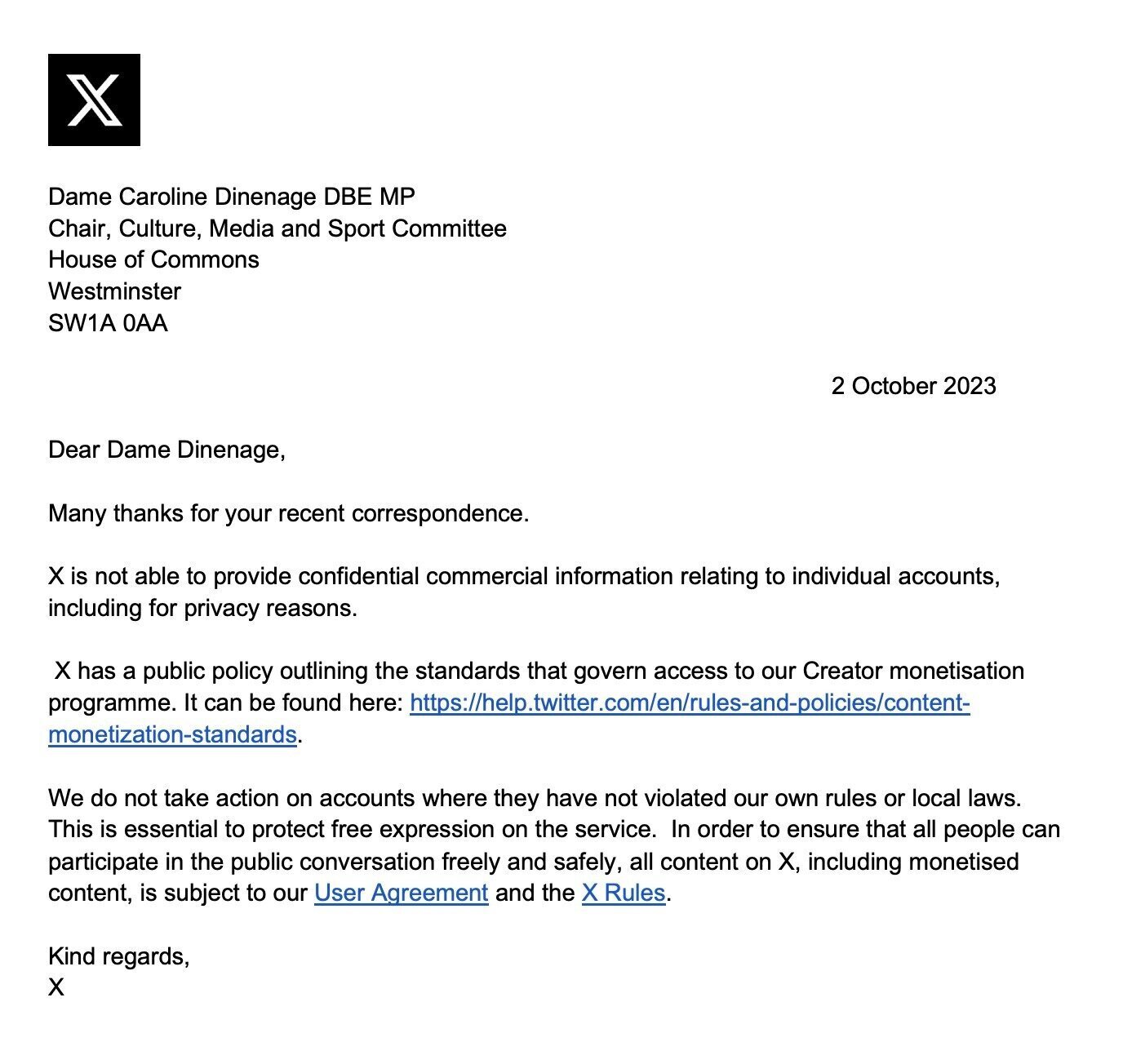
Detailing its stance in a letter addressed to Dame Caroline Dinenage, who chairs the Commons Culture, Media, and Sport committee, and who was widely criticized for asking platforms whether they would allow Brand to earn a living from online platforms, the company explained that its resolution to allow Brand’s financial pursuits on the platform aligns with its intent to protect free expression.

The company said: “X is not able to provide confidential commercial information relating to individual accounts, including for privacy reasons.”

It added: “We do not take action on accounts where they have not violated our own rules or local laws. This is essential to protect free expression on the service. In order to ensure that all people can participate in the public conversation freely and safely, all content on X, including monetised content, is subject to our User Agreement and the X Rules.”
4
X’s chosen course of action resonates with perspectives against encroachments on free speech and accentuates the necessity for platforms to observe impartiality, without resorting to knee-jerk reactions based on unproven insinuations.

This development comes after YouTube barred Brand from generating revenue from his account in the wake of allegations implicating him in incidents of sexual assault, which purportedly transpired between 2006 and 2013. This was based on allegations alone, despite Brand not being convicted, or even charged with such offenses.

Consequently, Dinenage had sought an audience with Linda Yaccarino, X’s CEO, expressing apprehensions regarding the comedian’s ability to monetize his content on the platform amid the accusations.

She also queried whether Musk had influenced the decision-making process pertaining to Brand’s case, given the billionaire owner’s public defense of the comedian.
INVASIVE
5
Visitors to the EU Will Soon Face Fingerprinting and Facial Scans
A significant shift is looming in the way American citizens will be allowed to enter a large majority of European nations. The European Travel Information and Authorization System (ETIAS), an arm of the European Union, has unveiled its plans to implement a system in Spring 2025, requiring Americans to secure prior approval for travels up to 90 days in any of the 30 EU countries.

This is a departure from the current practice where US travelers enjoy effortless entry into these countries without a visa requirement. However, the new regulation will insist on individuals proceeding with their travels only after registering their intent via the official ETIAS website or mobile application, both of which currently do not process such requests.
5
In a radical departure from the norm, from 2025 onwards, American passport holders will no longer receive passport stamps. Alarmingly, the planned regulatory changes involve intense intrusions into personal privacy. The new rules state that visitors will be subjected to both face and fingerprint scans aside from surrendering other biometric data. It’s disconcerting that this data will be reserved within the European Commission’s Common Identity Repository (CIR), a database accessed by numerous agencies, including law enforcement.

The implications of this regulation change could be even more disconcerting from a privacy perspective. Critics and advocates of digital privacy have sounded the alarm on not just the possible misuse of this extensive data pool by governments, but also the potential exposure to hacking threats, be they criminal outfits or invasive foreign governments. There’s also the risk of rogue insiders dealing with this sensitive information.

These regulations reflect a worrying escalation towards a surveillance state that doesn’t differentiate between law-abiding citizens and potential threats but treats them both as data sets to be tagged, traced, and retained.

It’s worth noting that the US began collecting fingerprints of international tourists as part of the US-VISIT (United States Visitor and Immigrant Status Indicator Technology) program, which was initiated in 2004.

Beware of These Links
As people start to get wise to the vast amount of online tracking, using ad blockers and tracker blockers to protect themselves, marketers are getting smart and are looking for new ways to track people. That’s why, these days, you have to be extremely careful of the links you click. This is explored here below.
CENTRALIZED SURVEILLANCE
1
How Mastercard’s Digital ID Project Is Being Used by Governments To Track Health and Vaccination
In Mastercard’s ongoing technological pursuits, there seems to be an agenda of consolidating digital dominance. The so-called “Community Pass” project, helmed by Tara Nathan, Mastercard’s executive vice president, claims to integrate marginalized communities into the digital world. However, with only 3.5 million users so far, skeptics of digital ID plans may wonder about its real reach and intentions.

Nathan’s recent appearance on the company-sponsored podcast “What’s Next In,” touted the supposed merits of the Community Pass. Launched in 2019, this platform ostensibly provides individuals in Sub-Saharan Africa and Asia-Pacific with a digital ID and wallet, allowing them access to services such as government benefits and humanitarian assistance.

Nathan waxed eloquent about the supposed benefits of digitization for developing economies. But her emphasis on using offline digital channels to supposedly empower marginalized individuals raises eyebrows. Is this another case of a multinational company trying to sell its tech solutions to unsuspecting communities under the guise of altruism?
1
While they sing praises about aiding farmers with their digital identity system, one can’t help but question the underlying motives. Is this just a method to tap into the vast, underexplored markets of rural areas? Community Pass seems to be less of an inspiration from their previous mobile money humanitarian ventures and more of an extension of their global financial grip.

Nathan was eager to elaborate on the various components of Community Pass – Farm Pass, Wellness Pass, and Commerce Pass. Each appears tailor-made to address specific challenges. For instance, Farm Pass supposedly helps farmers gain visibility and a credit record. However, this digital interference might just be a ruse to infiltrate local markets and dictate terms.

The Wellness Pass initiative seems particularly odd. While it’s positioned as a system to monitor vaccine roll-outs, isn’t there a clear risk of tracking individuals’ personal health data? Even if institutions like the Ministries of Health in Ethiopia and Mauritania endorse it, the broader implications can’t be ignored.

Their goal to expand the reach of Community Pass to over 30 million people by 2027 sounds more like a corporate conquest than a genuine effort to assist. The project’s privacy concerns are evident. Digital identities, under the pretense of progress, could well turn into tools for invasive surveillance, jeopardizing the very rights of the people they claim to uplift.

Their recent ID2020 certification might vouch for their intention to offer financial inclusion and digital identity services, but with technology’s relentless pace, there’s a dire need for strict regulations. Policymakers must be wary and ensure that such initiatives don’t compromise individuals’ freedoms under the guise of inclusion and so-called progress.

This is shocking. Klaus Schwab, in his best German pre-war stylistic accent voice says the world will no longer be run by countries, or superpowers like America but instead by the World Economic Forum stakeholders such as Blackrock and Bill Gates. This is the man who wants us to have no property, eat bugs and plants, live in dense cities so the countryside can re-wild, and only allow the elites to travel.


The U.S. Navy should play to its strength, enforcing sanctions against Iran by controlling the maritime routes Iran depends on to generate cash for its empire of terror.

The U.S. response to Hamas’ Nazi-like massacre of Israelis, Americans, and anyone else in its murderous path has been, almost without exception, robust. But U.S. officials are largely missing the larger picture and risking being drawn into an escalation — on the enemy’s terms.

Hamas and Hezbollah are the symptoms; Iran is the disease.

But President Biden’s Oval Office address to the nation on Oct. 19 danced around the core issue of Iran’s financing, training, and encouragement of violent, brutal forces across the region and beyond, as well as its nuclear missile program.

Thus, the gathering might of the U.S. Navy off the coast of Israel in the form of two aircraft carrier strike groups and a Marine Expeditionary Unit betrays unimaginative, linear thinking.

If used, American firepower would augment Israel’s own considerable military force. In theory, this threat helps to deter Hezbollah from unleashing its arsenal of 100,000 missiles on Israel, many of them sophisticated.

But, like Hamas, Hezbollah is expert at digging. They hide their missile launchers in an extensive network of tunnels and bunkers — all guarded by an air defense network that is likely to get lucky enough times to raise the specter of captured American pilots.

The last time U.S. naval aviation operated over Lebanon was in 1983, in response to the Beirut barracks bombing in October — an attack that Iranian authorities arrogantly claimed credit for in the past month. Until 9/11, it was the deadliest terror attack on Americans. Two months later, the Syrian military fired on U.S. Navy aircraft, shooting down two A-6 attack jets and capturing an officer.

Optimal Use of U.S. Air Force and Navy

If the incremental addition of American airpower is helpful to the pending effort to destroy Hamas while deterring a wider conflict, that role can more than adequately be filled by the U.S. Air Force.

The U.S. Navy should instead be concentrating 2,000 miles to the east in the Gulf of Oman and the Arabian Sea. There, the U.S. Navy would be playing to its unambiguous strength, enforcing sanctions against Iran by controlling the sea lines of communication that Iran depends on to generate the cash for its empire of terror.

Unfortunately, this would require a Biden administration that was both imaginative and strategic — and not in the thrall of a recently revealed Iranian influence operation that managed to place several advisors friendly to the Iranian mullahs in key national security positions since the Obama administration. Chief among these, Robert Malley, a longtime friend of Secretary of State Antony Blinken and an architect of the Joint Comprehensive Plan of Action (JCPOA) with Iran, a deal that focused exclusively on Iran’s nuclear program, rewarding the mullahs with cash and sanctions relief while greenlighting their missile program and global support for terror.

Iran’s Nuclear Program

Instead, Biden’s systematic appeasement of Iran, a continuation of the Obama-era policy that weirdly sought to use Iran as a counter to perceived Israeli intransigence on the Palestinian problem, has resumed. Up until the gruesome events of Oct. 7, Biden’s national security team was willfully blind to Iran’s bloody history of sponsoring terror and its determined drive to produce nuclear weapons and missiles to deliver them.

As a result, U.N. sanctions against Iran’s nuclear, missile, and drone program — never well enforced by Biden — expired on Oct. 18 with the U.S. announcing its own unilateral set of sanctions. The U.S. continues to pretend these efforts are somehow slowing Iran’s drive to push its nuclear program to completion, while Russian use of Iranian combat drones in Ukraine reveals the prior sanctions regime as inadequate to the task.

Reagan-Era Lessons

The U.S. never fully grappled with the Iranian theocracy after the shah was toppled in 1979. During the Cold War, it was assumed that the Soviet Union would come to Iran’s aid and that the military cost of defeating the regime would be too high.

Instead, the U.S. was content to see Iran tied down in a bloody stalemate against Iraq after the latter invaded in 1980.

As the war started to threaten oil exports out of the Gulf, America responded by providing a U.S. Navy escort to six Kuwaiti-owned super tankers in July 1987.  

After an escorting U.S. Navy ship struck a mine on April 14, 1988, the Reagan administration responded only four days later with Operation Praying Mantis. It was the Navy’s largest combat action since World War II, sinking an Iranian guided missile frigate, crippling a second, sinking four other boats, and destroying two militarized oil platforms at the cost of one helicopter with two crew lost.

The operation was thoroughly wargamed a year before, when it was determined that an unambiguously aggressive response to Iran would likely prevent the conflict from escalating. In other words, a disproportionate response would rob Iran of the ability to control the timing and mode of escalation, reducing U.S. casualties and preserving the peace.

Applying Force

This lesson from the Reagan era opens up a final consideration. Rather than following through on the foolish precedent of incentivizing hostage-taking via negotiation and cash payments, America should ditch the carrots and pick up the stick.

Imagine the transformative discussion over the current hostage crisis — and the forestalling of future hostage-taking by Iran and its proxies — if the U.S. were to announce that every hostage taken is worth $1 billion (or $1.171 billion if we wish to account for Bidenflation). That amount would be deducted from seized Iranian assets or taken from oil tankers filled with Iranian oil. The proceeds would compensate hostages and their families, with the remainder used to replenish the Pentagon’s waning stocks of armaments.

This is exactly the kind of naval power application the U.S. Navy was built for.

Unfortunately, the radical cadres infesting the Biden administration’s national security staff would never allow such an idea to reach the desk of our cognitively impaired commander-in-chief.


Three more philosophical arguments for the existence of God, in terms the ‘regular guy’ can understand.

This site contains the first of two arguments in favor of the existence of God that seem complicated—and are—but can be boiled down to their essentials for the amateur apologist. This post will go through three more.

3. The Argument from Consciousness

Life presents to us an extremely rich qualitative dimension, which is to say, the entire “what it is like”-ness to being you and experiencing the things you experience. The spicy scent of ginger tea, the easy sight of the flamingo, and the luscious guitar sounds of Ratt drive the point home.

The way naturalists usually tell it is that consciousness is a late and local phenomenon, something that emerges from purely mindless physical stuff. Simply put, whatever is fundamental to the naturalist is, effectively, whatever consciousness is not: it is not feeling, not sensing, and not “about” anything (the way thoughts are about things).

But the immediate problem is that it seems extremely difficult, if not outright impossible, to construct consciousness from an utterly unconscious base, as described by naturalism.

Just think about it. How does one take mindless atoms and make a unified center of conscious awareness, a subject that binds together so many different thoughts and feelings through intervals of time?

The problem is not just a matter of trying to establish sufficient material complexity, but also how one leaps, as if by magic, across profoundly different kinds of reality. Compare: just as the number and arrangement of white LEGO blocks is irrelevant to constructing a purple tower (even infinite time and number of pieces won’t help), it seems that the same problem, if not significantly worse, applies when it comes to constructing a unified conscious being from the disparate mindless blocks that the naturalistic worldview has to offer.

The problem doesn’t end there, however. For even if the naturalist can make sense of how consciousness could emerge from an unconscious base, he doesn’t have a good story for explaining why it would emerge. Consciousness seems wasteful for the naturalist, since it’s the mindless atoms that do all the work, anyway. (Remember that according to naturalism, the physical realm causes and determines the mental realm, not the other way around.) Thus, there is no good naturalistic-evolutionary account for why the emergence of consciousness would happen, even if the emergence of consciousness could happen.

Classical theism avoids both issues since theism isn’t committed to everything reducing to physics (which is absurd anyway, but whatever—set that aside). In a real sense, molecules aren’t fundamental in classical and Christian theism. Persons are. Theism starts not from a principle of indifference, but a principle of perfection, where everything in the created world is not just less than, but infinitely less than what stands at the foundation. Surely it is easier to think of how we can get something lesser from something (infinitely) greater than it is to think of how one can get something so profound as consciousness from something entirely bereft of thoughts and feelings, like atoms.

Moreover, theism gives reason to expect conscious beings. We are good to have around. God would know this and would be motivated to bring us about. So not only is our emergence possible on theism, but it is also expected. All this gives another powerful reason to accept classical theism over atheistic naturalism.

4. The Argument from Fine-Tuning

We have a basic intuition that stuff that seems “well put together”—i.e., complex stuff, with functionally interrelated parts—is the product of intelligence. This intuition is frequently applied in experience: we see a mousetrap or a Nintendo Switch or the Mona Lisa, and we naturally think some intelligent being produced it. By and large, this intuition is frequently confirmed in experience. Certain things seem to obviously be the product of forethought, which implies that creative intelligence (the ability to engage in relational thinking), not blind (unintelligent) natural forces, is responsible.

But the atheist says, “Not so fast: evolution shows us how things that appear designed are actually the product of totally unintelligent, pitiless forces of nature.”

However, as the best science informs us, evolution requires a very special physical setup to occur, and the physical setup of our universe is incredibly “fine-tuned” or “really well put together” concerning the necessary conditions for the emergence of interactive life. Physicists tell us that if things were just a teensy-weensy bit different concerning, say, the expansion rate of the universe, the strength of the strong nuclear force, the weight of the electron, or many other examples, the emergence of intelligence life would not be possible, because in many cases chemistry would not be possible, or the universe would have collapsed back in on itself, or some other catastrophic scenario. This conclusion enjoys overwhelming expert consensus, from theists and atheists alike. Where the disagreement largely lies is in what explains the fine-tuning.

From the best of what we know, scientifically speaking, evolution requires a physical system that appears “well put together,” a sort of “Goldilocks” situation, where things are just right for evolution to take hold and eventually produce beings like us. Once all that is understood, it becomes clear that evolution does not defeat our frequently confirmed intuition that stuff that appears well put together is best explained by intelligent agency, something capable of foresight.

At this point, the atheist might say the multiverse could explain fine-tuning. The theist can respond, maybe it does. But how does that help? As physicist Luke Barnes explains, any theoretically plausible model of the multiverse itself requires fine-tuning; thus, the problem is just relocated, not actually resolved. So until someone can propose a multiverse model that is predictively useful as a physical theory and does not itself appear well fit together (finely tuned), the theist is justified in maintaining his intuition that things that appear well put together are well put together because something intelligent is behind them.

The basic intuition is undefeated “all the way down.” There is thus no reason—from science, anyway—to think things that strongly appear to be the product of intelligence somehow aren’t.

Finally, when it comes to an entire physical universe being well put together, it does not take a lot of imagination to suppose whose intelligence is behind it.

(A note: Someone might worry that God is a poor explanation of the physical universe because God would be more complex than the physical universe. This is false. In the most relevant sense, God is far simpler than any physical reality, since God is an unrestricted act of understanding. In other words, God is the absolutely simple and immaterial first principle of all, a being of pure positiveness, with zero limitations or arbitrary restrictions, lacking all internal complexity, especially physical complexity. That makes God not only simpler than any possible physical explanation, but the simplest conceivable explanation there is.)

5. The Argument from Suffering

Recall the argument from consciousness. There it was made clear that the naturalistic worldview holds that our mental life is something late and local, preceded by and entirely caused by unthinking, unfeeling physical bits. Such commitments are what cause many naturalists to endorse a position called epiphenomenalism (an epiphonema is just something that is itself caused but causes nothing) when it comes to our mental life, or our thoughts and feelings. This is a spooky position and contrary to common sense, since it implies, for example, that our desiring coffee—that is, the feeling of wanting coffee—has nothing to do with our going and getting coffee. Such a feeling just coincidentally (magically?) attends to blind physical forces causing the action of “getting coffee.”

Now, to be clear, epiphenomenalism is as self-evidently false as anything in philosophy could be, and to the extent that naturalism is committed to epiphenomenalism, is even more reason to reject naturalism.

But there is yet another problem. Typically, the naturalist tells us that the vast suffering of our experience is far better expected if God does not exist and if naturalism is true, and so we should endorse naturalism over theism. But this story is way too superficial and ignores too much of what actually goes on in naturalistic research programs, including philosophy of mind. So let’s connect some dots.

Evolution selects for outcomes and functions that confer survival advantage, not feelings, per se, and human functions for the naturalist are possible without feeling. For example, the function of me pulling my hand away from the prick of a pin does not require any painful feeling—it requires no feeling at all within the naturalistic understanding, because the feeling is causally irrelevant. Further, if there is a feeling attendant to some function of human behavior, the feeling could have been literally anything; pulling my hand from the pin could have been correlated with the feeling I feel when listening to the Barney theme song, tasting a grape, or looking at my grandmother’s bunion. Why? Again, because the feeling plays no role in what “the physics” is doing, since the feelings are determined by the physics and the physics is in no way determined by the feelings. (For the naturalistic, remember, the causality is entirely in one direction.) Thus, the outcome would have been the same no matter what the feeling is, or if there is any feeling at all, because it is entirely the unconscious, unfeeling physical processes that matter, that do the functional work and that, ultimately, are selected for. Feelings don’t have anything to do with it, and so it just doesn’t seem there is any need for feelings to be there at all, or to be as “fitting” as they are, if the common naturalistic account of things is correct.

We can only scratch the surface of this argument here. The point for now is simply that once these (admittedly subtle) points concerning the mental and physical are understood, naturalism has no real story to tell for the actual distribution of suffering in our world. Things could have gotten along in just the same way they have without any feelings, good or bad. Things could have been far better or far worse, feelings-wise. The problem is that naturalism, when systematically articulated and consistent with its own inner logic, does not adequately predict any specific degree or distribution of suffering. It leaves all possibilities wide open.

However, once we grant a few plausible points about suffering, including that suffering can be spiritually medicinal (soul-healing and soul-building) alongside other plausible stories about God’s governance (particularly about letting natures play their part, including the natures of free beings), there is a strong theistic story we can tell that makes the distribution of suffering in this world not entirely surprising.

This story cannot hereby be rehearsed now, but the simple point is this: naturalism has no explanatory story to tell—ultimately—anyway, about the suffering we experience. Some story is better than no story, and so even the suffering of our experience is evidence for rather than against the existence of God.

Okay—there you have it: three arguments (and two before those in another post) for the existence of God, somewhat simplified.

Apology is necessary here to the reader for the length of this “simplified” summary of arguments. There is still a fair bit going on in the presentations above, to be sure, but still each argument has been distilled to the extent it is entered without omitting any seriously crucial aspect or presentation of the arguments in ways that might lead to false philosophical conceptions about God or something else, like morality.

If these arguments interest you enough to want to pursue them further, look for the forthcoming book The Best Argument for God by Pat Flynn.


The most powerful arguments for God can be pretty complicated . . . but they don’t have to be.

Here’s the problem with philosophical arguments for God (the good ones, anyway): they’re complicated.

This shouldn’t surprise us in the least. Philosophical arguments for God are supposed to reveal something about the nature of fundamental reality and can take years to puzzle through. What should cause us to think that would be easy?

So, although folks will often attempt to pass off comparatively simple arguments, they are, despite being accessible, just plain wrong, or at least poorly formulated—and neither the doubter nor the believer is served by simplistic takes for God.

All this to say that distilling philosophical arguments for God without diluting or distorting them is difficult. Fortunately, as complicated as philosophical arguments for God can be, their general thrust is, for the most part, intuitive. With that in mind, let’s present the general idea of some of the more sophisticated and convincing philosophical arguments for God and to make the presentation simple . . . but not simplistic.

When presented arguments like these are issued at an introductory level, various details will be truncated or omitted and so I must insist that this is a worthwhile tradeoff of means for initial exposition, and that the arguments below are, in fact, good arguments, though we will ultimately have to pursue their fullest development(s) elsewhere.

With those disclaimers, let’s begin.

1. The Argument from Adequate Reason

Common experience reveals stuff that doesn’t explain its own existence—that is, stuff philosophers call contingent. Here’s a list of some such stuff: Graham crackers, Yngwie Malmsteen, photons, corn. These things exist but could have been otherwise or not been at all. Reality did not have to include them, yet here they are. Why?

Philosophers have long claimed that stuff like this—that is, all the contingent things, considered collectively—must have some cause or explanation, and this cause or explanation cannot itself be contingent. That means it must be necessary, a being that must exist no matter what, a being whose nature or essence somehow guarantees its own existence.

A being like that would obviously be very special, quite unlike the beings of common experience, no matter how talented (Yngwie Malmsteen) or tasty (Graham crackers). Indeed, philosophers have argued that a necessary being would have to lack all the features that imply contingency (otherwise, it wouldn’t be a necessary being), such as being arbitrarily limited (say, in power, shape, location, knowledge) or composite (made of parts, physical or metaphysical), or changing and thus acquiring new modes of existence.

When thought through, it turns out that a necessary being would inevitably bear the traditional divine attributes: omnipotence, immateriality, immutability, eternality, simplicity, etc. Philosophers call this the Argument from Adequate (or sometimes SufficientReason.

There are two main obstacles the argument from adequate reason must overcome. First, we have to support the principle that all contingent things do in fact have some adequate cause and don’t just exist as a matter of “brute fact,” with no explanation to be found. The second is closing off the so-called infinite regress objection, or making it clear that even if there were an infinite regress of contingent things—meaning each contingent thing is caused by some prior contingent thing, forever and ever—this would not provide the adequate explanation we require.

There is much that can be said to overcome these obstacles, but here are two quick rejoinders. First, it is highly rational to expect an explanation for something unless there is principled reason not to. After all, how else would we pursue science and philosophy, or increase our understanding of the world? To arbitrarily abandon this “explain everything (or at least as much as we can)” principle, particularly in the face of some fact that crucially seems to require explanation (like contingency), simply because its application converges upon theism, smacks of evasion, not objection, and is quite irrational. So, unless we have some good reason to think the fact of contingency cannot possibly find explanation—and we don’t!—it is far more rational to go with even just a conceivable explanation than no explanation at all.

As for the infinite regress objection? Is it really just turtles all the way down? Here seventeenth-century philosopher Wilhelm Gottfried Leibniz, one of the original formulators of this line of argument, offers a satisfying response: suppose there were an infinite line of geometry books, with each one having been copied from the one previous. Does this infinite regress remove all relevant mystery?

Leibniz says obviously not, and I agree. After all, we would still want to know why there is that infinite line of geometry books instead of nothing, and why the subject is geometry and not, say, biochemistry instead. Thus, according to Leibniz, even if an infinite regress of contingent causes is possible, it is irrelevant. The fact of contingency cannot be adequately explained by further contingency, no matter how much contingency there is and no matter how that contingency is arranged (in a line, circle, etc.).

Finally, a bonus consideration: While it seems that a necessary being is useful for explaining all contingent being, we should still like to know how contingency can arise from necessity. If fundamental reality is necessary, then why isn’t everything necessary? Here again, classical theism has the advantage, since we can argue that God—the single, simple, necessary being—freely chose to create the physical world. God’s act of free choice preserves the fact of contingency (that the world need not have been) while anchoring everything in necessity. Great result.

2. The Argument from Morality

Many of us take morality to be objective, which is to say, we believe that our moral statements and beliefs (e.g., that murder is wrong) are not merely describing people’s attitudes or preferences, but relating to what it means to live an objectively good life and flourish as the kinds of things we are.

If morality is objective, then specific people can be wrong in their moral beliefs, because what makes a moral belief true or false is beyond what a person happens to desire. This ought to be common sense, since most of us think desiring to love our fellow man is really good, whereas desiring to oppress our fellow man is really bad, and we think people who believe or act otherwise are gravely mistaken.

The traditional atheist, who claims that fundamental reality is just indifferent mindless stuff, and that everything about human existence reduces to atomic and evolutionary theory, veers toward nihilism. In other words, our moral sentiments, according to the atheist, are evolutionarily acquired beliefs insofar as they are useful for getting us to “have sex and avoid bears,” not because they are in any sense “true.” For the nihilist, moral beliefs are just personal preferences, mere sentiments or attitudes or tastes, like what we express when evaluating tapioca pudding or Nickelback’s “Photograph.”

It is commonly understood that many atheists, new and old, are nihilists. “There are no objective moral facts,” Nietzsche once pronounced. In modern times, naturalist philosophers like Alex Rosenberg argue that Darwinian theory (conjoined with naturalism) is an acid that dissolves our traditional understanding of morality, and that nihilism is the only consistent atheistic story about morality. As atheist philosopher Michael Ruse tells us, morality is “flimflam” . . . “an illusion” . . . “just a matter of emotions.” All fairly common atheistic commitments—and, I would add, consistent, coming from their naturalistic starting point.

On the other hand, if some atheist is reluctant to abandon objective morality, as many (thankfully) are, he must complicate his worldview to accommodate morality. Doing so invites two serious problems.

First, such complications will be suspiciously ad hoc and render the atheist’s theory less likely to be true. Why? Because simpler theories are more likely to be true, and the simpler atheistic theory is obviously the one that explains away objective morality through “blind” evolutionary forces, as many naturalists convincingly argue.

Moreover, the moral dimension appears extremely rich, which means the complications made by the atheist will have to be extensive to cover everything. For example, the atheist needs not just to explain moral facts (e.g., that rape is always wrong), but moral knowledge (e.g., how we know that rape is always wrong?). Imagine how much we would have to add to a theory that otherwise veers strongly, if not inevitably, to nihilism to accommodate these many features of moral experience. It’s a lot, building in a ton of complications, making the naturalist’s theory not very believable.

Second, recall that the mode of intellectual operation for the naturalist is scientistic, meaning, in cliché form, that we ought not “go beyond the science” in our claims to knowledge. However, moral facts are clearly not something science can tell us about, since nobody can see moral facts through a microscope or telescope, to put it crudely. This “breach of conduct” from a naturalist is problematic, since naturalists are effectively admitting that science isn’t the be-all and end-all and does not exhaust the intelligible content of reality. But if that’s the case, then what’s stopping us from running philosophical arguments for God, including as the best explanation for moral facts and knowledge and human dignity?

Once again, classical theism has considerable advantages, as theism can explain all the relevant moral features of reality with a simple and highly unified theory. For the classical theist, fundamental reality—God, who just is supreme being and supreme goodness—is where being and value converge at their climax. He provides a stable, traditional, and definitely rationally decidable way of thinking about the moral landscape. God can also equip us with reliable ways of forming moral beliefs and would be interested in doing so. So moral knowledge is expected if God exists as well.

For these reasons, if we think morality is objective, that we can know at least some moral truths, and that human beings really do have a special place in the universe, we really should endorse classical theism over atheistic naturalism.

That’s two solid arguments for God, as simple as they can be without distorting them. Hopefully more will follow.


The CDC director wants to win back your trust, she says — at the very time, on the basis of nothing and in defiance of the rest of the world, she’s urging the entire population to get the latest Covid shot.

“Trust is easily broken and, as folks know, trust takes time to rebuild,” said Cohen. “It isn’t something you can fix overnight.”

She seems to have no idea why people don’t trust the CDC or what it did wrong, so her trust-rebuilding tour is unlikely to bear fruit.

Jay Bhattacharya says that for starters, she needs to meet with lockdown critics like Jay himself and Harvard’s Martin Kulldorff. If she were really serious she would have done this within two weeks of her appointment, but of course she isn’t.

Dr. Houman David Hemmati added further steps Cohen would have to take, all of which sound good to me:

1. Open up and release ALL CDC emails, unredacted except for SSN and personal phone numbers, from November 2019 to present. No other exceptions.

2. Purge CDC of ALL employees who: pushed to censor critics, shamed critics, had connections with other government agencies or pharma companies or unions that influenced how they conducted business.

3. Announce a policy of NEVER issuing mandates or recommendations for mandates or recommendations for closures of schools and businesses.

4. Do a re-review of all emergency authorized and approved COVID vax and treatments using the SAME standards previously applied to NON COVID treatments.

5. Promise to NEVER again support the use of ANY medical product, emergency or not, that hasn’t been subject to the SAME rigorous safety/efficacy testing and the same (lengthy and detailed and objective) review by panelists that include outside experts, without exclusion of critics.

If you want trust, that’s how you get it back, otherwise it’s empty words.


… but ‘these people’ just never learn ………………………..

Christ instituted the Catholic Priesthood at the Last Supper in Luke 22:19  See link at article’s end.

Note in the Haydock commentary to Luke 22:19 it explains why it is the actual Flesh and Blood of Christ the faithful receive at a valid Roman Missal of Pius V Mass.  Such a Mass has to be celebrated by a valid and licit Catholic priest, and devoid of his including the name of an antipope in the “one with” (“una cum”) clause in the Canon (fixed) part of the Mass.

But finding such a valid and licit Catholic priest is unknown to this writer during this era of an unbroken line of antipopes since October 28, 1958. These last six false claimants to the Chair of Peter (i. e , antipopes) sustain their leading the ongoing Great Apostasy ever since Antipope John XXIII (Freemason/Rosicrucian Angelo Roncalli, “reigned Oct. 28, 1958-June 3, 1963) launched it forcefully at the beginning of 1962 . That’s when he illicitly removed the true Roman Missal of Pius V Mass – effectively globally ceasing the true Catholic faith in all once-Catholic churches under his control. 

Freemason/Rosicrucian Roncalli then replaced the true Mass with the Quo Primum-condemned “1962 Latin Tridentine Mass” a/k/a ” “John XXIII Mass” that has the words “and Blessed Joseph, her spouse” inserted into the Commemoration of Saints in the Canon (fixed) part of the Mass. That may sound innocuous to the undereducated, but it automatically excommunicates anyone having anything to do with such a defective Mass, per Pope St. Pius V PapalvBull – QUO PRIMUM – issued 1570 in response to a request by the Council of Trent (1545-1563.)

Antipope John XXIII then followed removal of the true Mass with another devastating blow that same year by beginning of the illicit Second Vatican Council (October 1962-Dec. 8, 1965.) The stated purpose announced in January 1959 was to review all the previous teachings of the Church and give them “aggiornamento”:(new meaning.) Any attempt to review a judgment of a General Council or the Holy See is condemned with automatic excommunication by the Papal Bull EXECRABILIS (1460, POPE Pius II).  

In reality, the Second Vatican (V2) Council introduced over 200 heresies, thereby creating a man-made sect of Modernist/Liberalism dogma & doctrine in direct opposition to those of the true Cathoiic Church.

The true Catholic Church can never fail, promised Christ, but since the beginning of these 1962 demonic actions lead by Antipope John XXIII, the true Catholic Church exists in an ongoing state of eclipsed exile worldwide.

Consequently, the apostate Vatican II Counterfeit Catholic sect today has approximately 1.5 billion followers worldwide of that man-made sect’s false god who teaches them –  among hundreds of other false doctrines – that they can now get divorced (a/k/a invalid “annulments” for any reason) and remarried multiple times. The local V2 churches now shamelessly sponsor dances for divorced people to meet as a prelude to committing adultery and concubinage.  This Execrabilis-condemned V2 Counterfeit Catholic sect separated themselves from God the instant they accepted or participated in its development.  They departed from the true God who revealed in Matt. 19:6 :

“6 Therefore they are no longer two, but one flesh. What therefore God has joined together, let not man put asunder.”

And if that wasn’t emphatic or clear enough, the true God says in Mark 10:11-12

“11 And he sayeth to them : Whosoever put away his wife and marry another, committeth adultery against her.”

“12  And if the wife shall put away her husband, and be married to another, she committeth adultery.”

There were 47,000+ mainline Protestant denominations, not counting the Non-Denominational and Evangelical sects, all calling each other’s sect “heretics” (per the 2015 PEW Research Report quoting the 2010 Protestant Encyclopedia.)   Obvious to intelligent souls who are serious, honest, and very concerned about their eternal outcome, each sect has its own god, if not each individual who customizes his understanding of Scripture to accommodate his personal lifestyle  (Liberalism,) thus personal all having differing gods (or some  “spirit” and not the true God) telling them differing private interpretations of Scripture.  Yet all those differing gods of these approximately one billion Protestant, Non-Denominational, and Evangelical man-made sects seem to agree it is not wrong to divorce and remarry as often as affordable.  And this they do while proudly & mendaciously espousing how they live by every word in their bibles. . . In which is quoted the Matthew and Mark verses shown above.

Need you any further proof that these 2.5 billion people calling themselves  “Christian” are not as they claim?   They refuse to hear and obey the true Roman Catholic Church founded by Christ upon Peter.  Christ commands the faithful in Matt. 18:17 as follows:

“17 And if he will not hear them (ed., witnesses), tell the Church. And if he will not hear (ed. obey completely) the Church, let him be to thee as the heathen (ed., Gentile, pagan) and the publican (ed., liar and defrauder)”  

That makes it definite that there can be no salvation dying outside the true Church founded by Christ upon Peter and the Apostle.  Heathens and Publicans are reprobates that are eternally damned!

But the gods of the 2.5 billion false Christians today are told by their deceiving leaders and their personal “spirit” that assists them to privately interpret & understand Scripture to just skip or completely omit such verses from their religion. Their perverted behavior and opinionated contradictions make manifest their lack of the true Christian faith.

And it is that true Christian faith practiced only by the true Roman Catholic Church, (*not those after V2) and that is the only Church that complies completely with Holy Scripture. 

Therefore, no divorce is ever allowed. Only separation, when physical abuse exists is permitted, but the marriage remains in full effect until death, and the spouses are obliged to pray for each other for reconciliation.

Very rarely is sufficient cause found to declare a marriage contract as having never existed due to one party’s failure to disclose a material fact. For had that critical fact ever been previously known, the other party would have never attempted the marriage. Thus the attempt was in vain.  Such valid cause exists when it becomes known that one of the parties really did not want children or was already married and divorced, while the spouse of that first marriage is still living.

These 2.5 billion fraudulent “Christians” today constitute the endtime Great Apostasy. They have abandoned, or never had, the true Catholic faith instituted by Jesus Christ through His Church built upon Peter and the Apostles two millennia ago.

Now the very few remnant Christian faithful worldwide pray the “Missa Sicca” (“Dry Mass” – i. e., no valid priest to transubstantiate the bread and wine) in their homes, and pray Spiritual Communions at the Communion time of the Mass. Many Saints prayed Spiritual Communions hourly.

Also read in Haydock Douay-Rheims Catholic Bible (1859) St. Paul in 2 Cor. 2:18-20. There he is talking of the Apostles and the priests being ambassadors of Christ by their bringing reconciliation for sins (Sacrament of Penance).

Today, in the absence of valid priests, the faithful attempt Acts of Perfect Contrition. It has not the certitude of forgiveness as when the priest says “Ego te absolve” (I absolve you [ by the power of God that passes through the priest].)  But when properly done, the Roman Catholic Church – the only Christian Church founded by Christ upon Peter and the Apostles –  teaches infallibly that God’s forgiveness and restoration to the state of sanctification (justification) is obtainable in the absence of a priest. 

But should ever one find a valid and licit priest (which may not happen until the Second Coming  of Christ, which is the end of the world,) he/she must then confess all those sins for which they had been attempting to have forgiven by Acts of Perfect Contrition in order to have certitude.

Pax et Bonum

https://na01.safelinks.protection.outlook.com/?url=https%3A%2F%2Fjohnblood.gitlab.io%2Fhaydock%2Fid88.html&data=05%7C01%7C%7Cd2c4a5f4c6124b40b7d808db9c6bacd8%7C84df9e7fe9f640afb435aaaaaaaaaaaa%7C1%7C0%7C638275758500925407%7CUnknown%7CTWFpbGZsb3d8eyJWIjoiMC4wLjAwMDAiLCJQIjoiV2luMzIiLCJBTiI6Ik1haWwiLCJXVCI6Mn0%3D%7C3000%7C%7C%7C&sdata=7Q1fLudurmkgXJhuDU%2F7eKkHfE%2F4hdNVvuxQVWfzkiE%3D&reserved=0


Malachi Martin’s (1921-july 27, 1999) was an Irish-born traditionalist Jesuit priest, biblical archaeologist, exorcist, palaeographer, professor and prolific writer on the Roman Catholic Church who became disillusioned by Vatican II in 1964 while serving as secretary to Cardinal Augustin Bea (Germany.) Malachi moved to NYC in 1966 and became a U.S. citizen in 1971.

Malachi Martin’s most popular book is “The Jesuits : The Society of Jesus and the Betrayal of the Roman Catholic Church” (1987. Simon & Schuster: NYC.)  If you ever read it, you will see he was not wrong about the Jesuit fall into ungodly Socialism, Secularism, and Social Justice issues, while developing an anti-Catholic “new mission” to betray & destroy Roman Catholicism in favor of Marxism by these fallen “Jesuits.” For exposing them in his book, Malachi Martin was and is greatly hated by these apostatized “Jesuits.”

The “new mission” goal of today’s apostate “Jesuits” (the true Society of Jesus was founded by St. Ignatius Loyola in 1540) is in preparing the world governments, especially today’s youth and those governments in Latin America and all third World governments, (which is why this current Latin American illicit antipope now sits in Vatican City) to soon enough accept the coming totalitarian One World Government and its One World Religion. Both will be headed by the ultimate Antichrist ruler whom the early Fathers of the Catholic Church believe will identify himself as a Jew.  And it is this ruler that these youths and the world in general at that time will adore and worship. 

Observe astutely the ongoing Great Apostasy from true Christianity a/k/a Catholicism as made evident by the increasing domination of Pride, Self-love, Greed, Lust, Immorality, Indifferentism, Agnosticism, Atheism, Socialism, Marxist Ideology, and Deceiving “Clergy”  – none of which hear the true Church Christ founded upon Peter and the Apostles.

Given this current situation, the time when the ultimate Antichrist rules may come far sooner, and be greatly less expected, than a world presently preoccupied in irrational pursuits of power, wealth, entertainment, earthly pleasures, and sensuality might anticipate.  And when it arrives by God’s Permissive Will, the horrors of its tribulations will serve as God’s Justice upon the heathens and the publicans – as Christ calls them in Matt. 18:17 – who refuse to hear & obey the true Catholic Church He founded upon Peter, and which is now in exile from the apostatized Vatican and all once-Catholic Churches globally.

Ora pro nobis, Santa Maria Mater Dei.