The Truth Is Out There

Posts tagged ‘economy’

As Unrest In Communist China Grows, So Does Its Aggression On The World Stage


At this point, China’s declining economic situation is well documented. The damage is too large to cover up with propaganda, and the Chinese people know it. Even the Chinese Communist Party’s (CCP’s) 75th anniversary was austere. Negative economic factors have been building for years.

China was already having problems in 2018 and 2019 with the Trump administration’s imposition of steep tariffs on Chinese goods. But the COVID-19 pandemic and the CCP’s extreme “zero-COVID” three-year lockdown period made China’s economic downturn much worse.

China Is Being Tested

As we approach the last quarter of 2024, the CCP is being tested by unprecedented domestic economic conditions. As a result, civil unrest is 18 percent higher than last year. The slowdown has many facets, of course. We’ll name just a few in this space.

One big factor is the real estate sector, which is about 30 percent of GDP. It continues to crater, and at the time of this writing, there is no recovery in sight. Home prices and sales continue to decline. What’s more, Chinese consumers are buying less, with consumer spending making up just 38 percent of GDP. By contrast, that figure is 60–70 percent in developed countries.

Sloth and Disillusion

Not unexpectedly, unemployment among China’s youth (ages 16–24) had been at least 21 percent and likely higher when the CCP stopped publishing unemployment figures in June 2023. Then, in December of that year, the CCP released new statistics from a new method of measuring youth unemployment, which did not include students. That new approach dropped that figure down to 14.9 percent, but that’s still almost three times higher than China’s national rate of 5.1 percent.

High jobless rates for young people hinder future growth potential and have added to the “lie flat” trend amongst many in China’s new generation, who have little hope of or ambition to obtain the lifestyle that their parents enjoyed.

Sloth and disillusion are hardly the stuff that strong economies are made of. The risks and dangers of disaffected youth movements are not unknown in China. The ghost of Tiananmen still haunts Chinese authorities, even though the surveillance and control that the CCP has over its people is now light years ahead of the Tiananmen Square era of 1989.

Embedded Political and Industrial Policies

Still, there are embedded economic realities that can’t easily be changed. Party doctrine dictates that China’s top economic advantage is found in its low levels of domestic consumption and high savings rate. These two factors mean domestic capital flows directly into the state-controlled banking system, which it can then allocate to specific industries. This gives the Party tremendous control over industrial policy and private capital.

For instance, China’s economic and development structures are geared toward high levels of industrial output. That may seem fine, but because China’s political organization and industrial arrangements within the Party are focused on large production capacity and not innovation or differentiation, the outcomes are massive overproduction that is often well beyond global demand and unprofitable factories.

Constant oversupplies, from electric vehicle batteries to electronics, result in Chinese manufacturers dumping massive amounts of cheap products into foreign markets, triggering trade friction such as tariffs and other retaliation, which also make conditions worse in China.

In short, China’s distorted industrial policies tied to a graft-loyalty political system have made it incapable of changing without disrupting the CCP structure and the loyalties that come with it.

No Stopping the Downward Spiral

For these reasons and others, over the past several years, China has found itself in a downward spiral of deflation, falling domestic consumption, and declining confidence in the CCP. What’s more, there are few real options that won’t threaten the CCP’s grip over the country. It must be made clear, however, that with its surveillance capabilities, the Party can handle a loss of confidence in the eyes of the people, but it can’t survive a loss of power. The two are not one and the same.

What the CCP will do is continue to support some critical areas of the economy, such as artificial intelligence, robotics, and military enhancements, while letting other sectors flail without little or no bailouts. Some sectors will eventually return, but not in the near future. This is clear to many within and outside of China, as billions of dollars in investment and capital continue to exit China.

Wolf Warrior Diplomacy Is Alive and Well

This brings us to China’s so-called wolf warrior diplomacy approach toward other nations, which it adopted in 2019 on the cusp of the COVID-19 outbreak and global criticism of Beijing’s disastrous handling of the pandemic. China was already under economic duress due to the rising trade war with the United States. Some observers attribute this approach to personal ambition among China’s diplomatic personnel and/or an attempt to improve the perceived investment environment in China.

Neither makes any sense when it’s understood that Xi Jinping is not allowing diplomats to make their own rules and policies, and pre-wolf warrior investment levels were high. Why would the CCP authorities imagine that increasing aggression on the global stage would make more countries want to invest there? They don’t.

A more realistic rationale for China’s rising aggression on the world stage is that Beijing feels the need to control the narrative at home and intimidate the rest of the world. The spillover between a declining economy and rising unrest is clear. At home, the CCP needs to blame the West and other foreigners for its blatant economic failures not only for exculpatory purposes but also to whip up nationalism and justify further aggressions as economic conditions continue to deteriorate.

Some observers have concluded that Beijing’s days of wolf warrior diplomacy are now over. Current events, however, defy such a conclusion. These include the Chinese regime’s provocative incursions with military planes and boats into or near territorial waters or air space of the United StatesTaiwan, and the Philippines, border battles with India, as well as a desire to expand control of the South China Sea. On the global stage, as the return to bullets over diplomacy rises, Beijing sees an opportunity to influence and/or intimidate other nations.

The “Financial Coup” That Seized America


In the wake of the 2008 Financial Crisis, former chief economist of the IMF Simon Johnson warned that the same dysfunctional policies he saw in his basket case banana republics had taken hold in the United States.

Johnson warned that if America didn’t act fast, we would plunge into a “Quiet Coup” as the American financial system effectively captures the government, bailing itself out until we run out of money.
Well, we didn’t act fast. In fact, we got worse.

And here we are.

Our Bankrupt Financial System

In recent videos I’ve talked about the trillion of distress in the financial system, the common thread being that you, the taxpayer, will be bailing them all out — we saw this in the 2023 bank bailouts, pre-paid in the dark.

Of course, given our $35 trillion in national debt we can’t afford it. But pay it we will, driving that 35 trillion to, according to the CBO, 50 trillion plus.

At some point, it gets too big to bail out. Meaning either hard default — they stop paying interest. Or the more likely soft default — they let inflation rip, melting away the national debt along with our life savings. And between here and there is a wholesale fleecing of the middle class and the working class who relies on them for a job.

The Ignored Warning

So, first, the ignored warning by Simon Johnson. I’m no fan of the IMF — their role is essentially feeding their client dictators fresh drugs at massive taxpayer expense. But one thing the IMF does know is dysfunctional governments.

In his warning, Johnson detailed the typical pattern when countries collapse — when they come in desperation to the IMF.

First, a small group of powerful elites takes over policy. This is typically financial elite, or large companies when the country has them.

Because these elites know they’ll be bailed out, they take excessive risks in good times. An iron law of finance is that risk pays reward. Meaning if you know you’re going to get bailed out, you’d be a moron not to take on too much risk.

If every hand at the poker game is all-in, inevitably you lose. You pass your losses to the taxpayer, and start over with fresh chips, courtesy of the suckers.

The Quiet Coup

Johnson lays out his numbers: from 1973 to 1985, America’s financial sector never earned more than 16% of domestic corporate product. But by the early 2000s, it was earning 41%.

It turned a chunk of these profits into lobbying, repealing Depression-era prudential regulations separating banking and investment banking. In other words, freeing banks to gamble with taxpayer-guaranteed funds.

Then it lobbied to raise leverage — meaning how much the financial sector could borrow. So it could make large gambles with a small amount of money — again, all taxpayer guaranteed.
The end result was the 2008 crisis, where banks made trillions in risky loans to people with no income, no assets, and no credit.

The leverage meant they had bet the farm and then some — keeping all the profits. Then when it turned south, they sicced lobbyists on Washington to line up bailouts, using the real economy as a hostage to wring out yet more lobbyist favors.

The Washington-Wall Street Racket

In return, they gave politicians and their staff plum positions or even outright bribes.
Ben Bernanke got $250,000 for a single speech at a financial conference.

Janet Yellen was paid *$7 million in speaking fees by Goldman Sachs and other Wall Street banks — hedge fund Citadel paid Yellen $292,500 for a single speech.

London-based Standard Chartered paid $270,000 for one speech — interesting for a foreign bank when we can only imagine what favors were done in return.

Johnson sums it up: the American financial system is “desperately ill,” kept alive only by an endless series of bailouts, like the ones that headed off bank failures last year.

He says the only solution is forced recognition of bank losses — which would bankrupt them — then selling them to new management that will not have access to bailouts.

What’s Next

Given their lobbying power, the odds of breaking up America’s megabanks are slim to none.
Meaning unless Washington reins in the banks, we’re in store for more existential financial crises, more bailouts and national debt, more running out the clock to financial catastrophe.

We missed our chance in 2008, and in all likelihood, it will take an even bigger crisis before politicians turn on their lobbyists and the financial coup that has seized our republic.

Out of the Frying Pan, Into the Fire


Treasury just had its worst August ever and things are getting worse

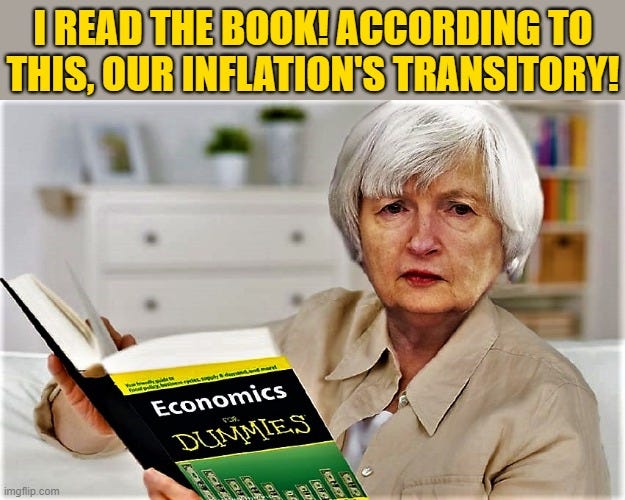
Janet ‘Inflation-Is-Transitory’ Yellen once again has egg on her face. After laughably low deficit projections for the current fiscal year, Treasury has now blown past those forecasts, and we still have a month to go before the end of the current fiscal year. Worse yet, the latest monthly Treasury statement set several record “firsts” — none of which were good.

Janet Yellen economics for dummies - Imgflip

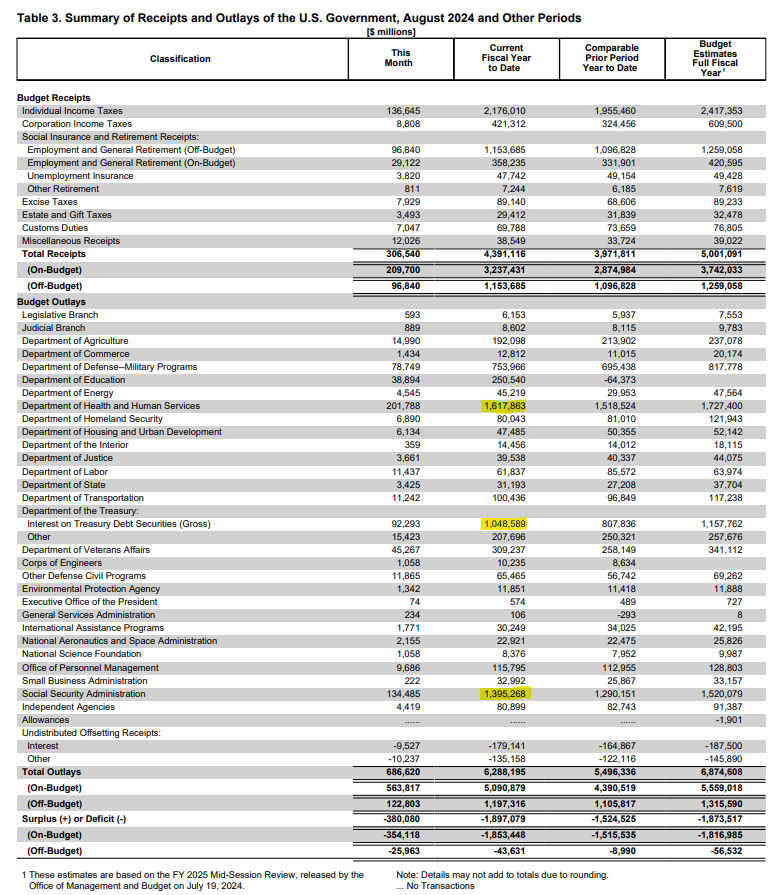
While people already knew that annual interest on the debt was heading to $1 trillion, this was the first time it had ever been recorded. As of August, the 11th month of the fiscal year, the government has spent over $1.049 trillion just to service the $35.3 trillion debt. What makes it scarier is that we still have another month to go in the current fiscal year.

It didn’t even take all 12 months to prove wrong those folks saying interest on the debt wouldn’t break the $1-trillion threshold.

Even with interest rate cuts, there’s no significant evidence that the problem is slowing down. That’s because interest on the debt is a function of BOTH the average interest rate on securities AND the total debt outstanding. Well, the latter is exploding.

Keynes Is the Freddie Krueger of Economics

We’ll add about another $1 trillion to the federal debt before the end of the calendar year, and then likely continue adding about $1 trillion every 100 days or so from there on out.

This was also the worst deficit for the month of August ever—including the blowout spending years of 2020 and 2021 when Congress pushed through all kinds of bloated pork. In fact, at $380 billion, it’s larger than any other monthly deficit of fiscal years 2024 or 2023.

Image

And this isn’t a revenue problem—it’s a spending problem. Despite concerns of a recession, tax revenue has actually held up, so the burgeoning deficit is clearly coming from the other side of the ledger.

In the first 11 months of the current fiscal year, the federal government took in almost as much revenue as in the entire prior fiscal year. If we look at the comparable period (first 11 months of both FY’s) then we see revenues have increased from $4.0 trillion to $4.4 trillion. Spending, however, has increased even faster.

This past August, federal outlays were $687 billion, compared to $194 billion in August 2023 — more than tripling in just one year. Outlays in the comparable period between both years have gone from $5.5 trillion (2023) to $6.3 trillion (2024).

Image

Clearly, the ballooning deficit is a spending problem. And what a problem it is.

Specialists and skeptics were very critical of Treasury’s overly optimistic projections on the current fiscal year’s deficit and, sure enough, we were right. The deficit has already blown past the projection for the fiscal year and—as we’ve already said—there’s still another month to go.

The $1.9-trillion deficit will break the $2-trillion threshold with ease once September is in the books.

And there’s no reason to believe multi-trillion-dollar deficits are going away anytime soon because the runaway spending continues. In fact, mandatory spending and interest on the debt together will exceed government revenue for the foreseeable future. So, literally all discretionary spending will be deficit spending.

The monthly Treasury statement for August bears witness to this sad situation: 55 cents of every dollar the federal government spent last month was borrowed. Spending was more than twice all government receipts.

Image

While the profligate spending out of Washington, DC has certainly exploded over the last four years, the interest on the debt is now also a major contributor to the deficit. The increase in the trend of discretionary spending is now less than the increase in the trend of interest on the debt.

In other words, depending on how you want to measure it, interest on the debt is now the largest contributor to the deficit.

For the fiscal year to date, interest on the debt is the third largest line item in the Treasury’s August statement, behind only the Social Security Administration and the Department of Health and Human Services, both of which have increased relative to their pre-2020 projections, but by much less than interest on the debt.

Image

Federal finance is clearly in shambles, but where do we go from here? Are we actually already in the fiscal doom loop? Yes, and it’s complicated.