To blame a company for being partially owned by BlackRock is to mistake how modern capital markets function. BlackRock’s business model is built on exchange-traded funds. An ETF is designed to replicate a stock index by owning small shares of nearly every company in that index. This is not a matter of choice in the ordinary sense. If BlackRock manages a fund tracking the S&P 500, it must purchase and hold shares of every company in that index. That means BlackRock owns stock in roughly 85–90% of all public companies in the US, with average stakes of less than 10%. The companies have no say in the matter. They cannot reject BlackRock as a shareholder, nor can they prevent their shares from being included in index-tracking funds. Ownership in this sense is automatic, structural, and unavoidable.
For this reason, when one learns that BlackRock owns shares of a given company, that fact alone says nothing about the virtue or vice of the company itself. The company is no more complicit in BlackRock’s ideology than a grocery store is responsible for the political beliefs of the shoppers who buy milk from its shelves. The company’s board and management do not invite BlackRock in. They simply exist in a marketplace where the largest asset manager in the world happens to be a nearly universal shareholder. Confusing this structural fact with moral culpability is a category mistake.
The real issue lies elsewhere. BlackRock’s influence does not stem from controlling boards or directly managing companies. BlackRock does not, as a rule, take board seats. Its power comes from how it votes its shares. Even a 9% block can swing outcomes in a shareholder vote, particularly in a climate where many proposals hinge on slim margins. When BlackRock aligns its votes across thousands of companies, it can impose a sweeping ideological agenda across the entire economy. This is precisely how ESG, environmental, social, and governance mandates, have been injected into corporate America.
The harm of ESG begins with the nature of the metrics themselves. ESG is not a neutral set of financial criteria. It reflects subjective judgments about environmental policies, social initiatives, and governance structures. A company might be penalized for producing affordable energy from fossil fuels, or for failing to meet arbitrary diversity quotas, regardless of whether those practices maximize shareholder value. This diverts resources from profitability into politically fashionable projects. Instead of focusing on innovation, efficiency, and customer service, companies are pressed to produce reports, hire consultants, and redesign operations to meet ESG targets.
This shift damages shareholders, who are the legal owners of corporations. The fiduciary duty of management is to maximize long-term shareholder value. ESG muddies that duty. By elevating political and social objectives above profit, ESG transforms corporations into vehicles for ideological conformity. Shareholders lose returns, while executives and asset managers gain prestige and influence. The market becomes less about allocating capital efficiently and more about signaling virtue to a class of unelected gatekeepers. That is why state attorneys general, led by Texas Attorney General Ken Paxton and joined by ten other states, filed suit in November 2024 against BlackRock, Vanguard, and State Street. The complaint charges that these asset managers formed an investment cartel, using their combined influence in coal companies to press producers to slash output by more than 50% by 2030 in line with ESG commitments through initiatives like Climate Action 100+ and the Net Zero Asset Managers Initiative. The lawsuit alleges that this collusion created artificial supply constraints, raised coal and electricity prices, and delivered windfall profits to the asset managers, violating federal antitrust statutes like the Sherman and Clayton Acts as well as Texas and other states’ consumer protection and deceptive-trade-practices laws. It also charges deceptive marketing, pointing out that BlackRock promoted some funds as non-ESG while pursuing ESG actions anyway. This legal push is part of a broader anti-ESG campaign, with Texas already pulling billions from BlackRock and placing the firm on and off investment blacklists depending on whether its ESG commitments were rolled back.
Moreover, ESG does not even succeed on its own terms. The metrics are vague and inconsistent. One rating agency may score a company highly for governance while another downgrades it for failing environmental tests. Companies learn to game the system, spending money on glossy sustainability reports rather than real improvements. The result is box-checking, not progress. And because BlackRock owns virtually every company, it has no incentive to consider whether ESG harms an individual firm. If all competitors are equally burdened, the relative market share of each remains unchanged. What is lost is efficiency, competition, and ultimately the prosperity of the US economy as a whole.
Some critics argue that companies could resist, that boards could defy BlackRock’s pressure. But here the mechanics of shareholder democracy matter. A single retail investor holding 0.01% of shares cannot compete with BlackRock’s 9%. Boards pay attention to blocs of that size. To pretend otherwise is to ignore how votes are counted. The tragedy is that companies may well prefer to ignore ESG distractions, but they face the reality that their largest shareholders demand compliance. In this way, BlackRock functions as an unelected regulator, imposing mandates that Congress never approved and voters never endorsed.
The breadth of this power cannot be overstated. As of 2024, BlackRock reported holdings in over 3,400 US-listed companies, out of roughly 3,950 total. This near-universal presence means its voting policies ripple across every sector. Oil and gas firms are pressured to decarbonize, even if doing so reduces profitability. Tech firms are prodded to adopt speech codes, even if doing so alienates customers. Banks are pushed to deny loans to politically disfavored industries, even if the loans would be profitable. In each case, the same story repeats: ESG dictates override market logic.
It is crucial, then, to keep the blame in the right place. The company itself is not evil because BlackRock is a shareholder. ExxonMobil did not invite BlackRock into its ownership structure, any more than Lockheed Martin or Apple did. BlackRock bought its shares because its funds require it to. The company may or may not pursue bad policies, but the mere fact of BlackRock’s ownership is morally inert. The culpability rests with BlackRock’s use of its voting power to advance ESG mandates, not with the companies compelled to live under them.
The lesson for investors, policymakers, and citizens is twofold. First, do not confuse structural ownership with ideological alignment. A company is not guilty by association simply because BlackRock owns a slice of its stock. Second, recognize the true danger of concentrated financial power. When one firm can vote 9% of shares in nearly every public company, it becomes a shadow government, shaping the private sector without the checks and balances of democratic accountability.
The Federal Reserve’s Reverse Repurchase Agreement (RRP) facility is not a household phrase, yet for years it has quietly functioned as a critical stabilizer for America’s financial system. At its peak in 2022, this overnight cash lot held more than $2.5 trillion, money parked by large institutions in exchange for ultra-safe Treasury collateral, ready to be drawn down during periods of market stress. Today, that cushion has all but vanished. The RRP balance stands at just $57.49 billion, the lowest since 2021. This is not a natural development. It is the result of a conscious policy choice by Fed Chair Jerome Powell, whose refusal to cut interest rates has rendered the facility’s yield uncompetitive, driving liquidity out of the Fed’s reach and into riskier corners of the market.
Understanding why this matters requires a grasp of what the RRP does. It is an overnight agreement in which the Fed borrows cash from big players, money market funds, government-sponsored enterprises, and certain banks, by selling them Treasuries and promising to buy them back the next day with interest. This interest rate sets a floor under short-term funding markets. If the Fed offers 4.25% risk-free, no sensible lender will accept less elsewhere. The RRP also acts as a buffer, absorbing excess liquidity during periods of quantitative easing and releasing it during periods of tightening, so that the brunt of liquidity withdrawal does not immediately slam into bank reserves.
For two years, this tool served as a shock absorber. As the Fed shrank its balance sheet through quantitative tightening, trillions flowed out of RRP rather than out of bank reserves. The ride was smooth because the buffer was deep. Now, with that buffer nearly empty, every additional dollar drained from the system will come directly from bank reserves. In mechanical terms, Powell has taken the suspension system off the car while still barreling down a pothole-ridden road.
Why has the RRP collapsed? The primary reason is that the rate it pays, 4.25%, has been left in the dust by Treasury bill yields, which have drifted higher as the Fed’s policy rate remained elevated and as Treasury supply surged. Money market funds, which once found the RRP attractive, can now earn more by buying short-term Treasuries outright. The choice is obvious, and they have voted with their dollars. Powell’s refusal to cut rates keeps the RRP rate locked well below competitive market yields, ensuring the facility remains a ghost town.
Some will claim this shift is benign, liquidity, they argue, has not vanished from the system but merely migrated. That view is dangerously naïve. The location of liquidity matters. Dollars parked at the Fed are under its direct control and can be injected back into the system instantly. Dollars sitting in private market instruments are slower to mobilize and more exposed to market risk. When stress hits, the Fed will have less dry powder ready for immediate deployment.
The risks are not abstract. Lower bank reserves tighten the credit channel. Banks with thinner reserves are more cautious lenders. They pull back on loans, raise borrowing costs, and become more sensitive to volatility in funding markets. This is precisely the environment in which a credit crunch can germinate. Without the RRP as a stabilizing outlet, short-term interest rates also become more volatile, leaving households and businesses exposed to abrupt swings in borrowing costs.
This fragility is magnified by the current stage of quantitative tightening. When the RRP was flush with cash, the Fed could drain hundreds of billions from the system without touching bank reserves. Now, each dollar of QT lands directly on banks’ balance sheets. This accelerates the approach to the so-called “reserve scarcity” point, beyond which further tightening risks destabilizing funding markets. We saw this movie in 2019, when the Fed’s miscalculation triggered a spike in repo rates and forced an emergency intervention. Powell should have learned that lesson. Instead, he seems intent on repeating it.
The cost of his stubbornness is not confined to abstract market plumbing. It is hammering American families. Mortgage rates above 7% have priced millions out of the housing market. Car loans at historically high rates have put reliable transportation out of reach for many working families. Business credit has grown costlier, slowing investment and job creation. By keeping rates artificially high, Powell is not just draining the RRP; he is draining opportunity from the real economy.
The pain extends to the US government itself. Elevated rates mean Washington is paying tens of billions more in annual interest on the national debt than necessary, money that could otherwise go to infrastructure, defense, or tax relief. In effect, Powell’s policy funnels taxpayer dollars into higher debt service costs, a choice that benefits no one but bondholders.
It is difficult to ignore the political undertone. Not a single economist employed by the Federal Reserve has made a political contribution to a Republican candidate in over 25 years, and almost everyone at the Fed is a staunch Democrat firmly opposed to Trump’s agenda. By holding rates high deep into the first year of President Trump’s second term, Powell’s Fed is creating economic headwinds that act as a de facto rebuke of the administration’s pro-growth agenda. Whether deliberate or not, the effect is the same: a central bank using monetary conditions to undermine the elected government’s policies.
Defenders of Powell’s stance will insist that cutting rates prematurely risks reigniting inflation. But inflation has already cooled from its peak, and the economy is showing signs of slowing. Adjusting the RRP rate and the broader policy rate downward now would support both financial stability and Main Street prosperity. Even a modest cut could restore competitiveness to the RRP, preserve the liquidity buffer, reduce borrowing costs, and ease the fiscal burden on taxpayers.
The remedy is straightforward. Cut rates. Not recklessly, but decisively enough to re-anchor the RRP, restore lending confidence, and give Americans breathing room to buy homes, finance cars, and invest in their futures. Do it now, before a preventable liquidity crunch becomes the next crisis.
A financial system without the RRP cushion is like a jet without landing gear—capable of flying in calm skies, but courting disaster if forced to land.
Powell’s refusal to adjust course is not a display of prudence; it is a partisan-tinged gamble America cannot afford.
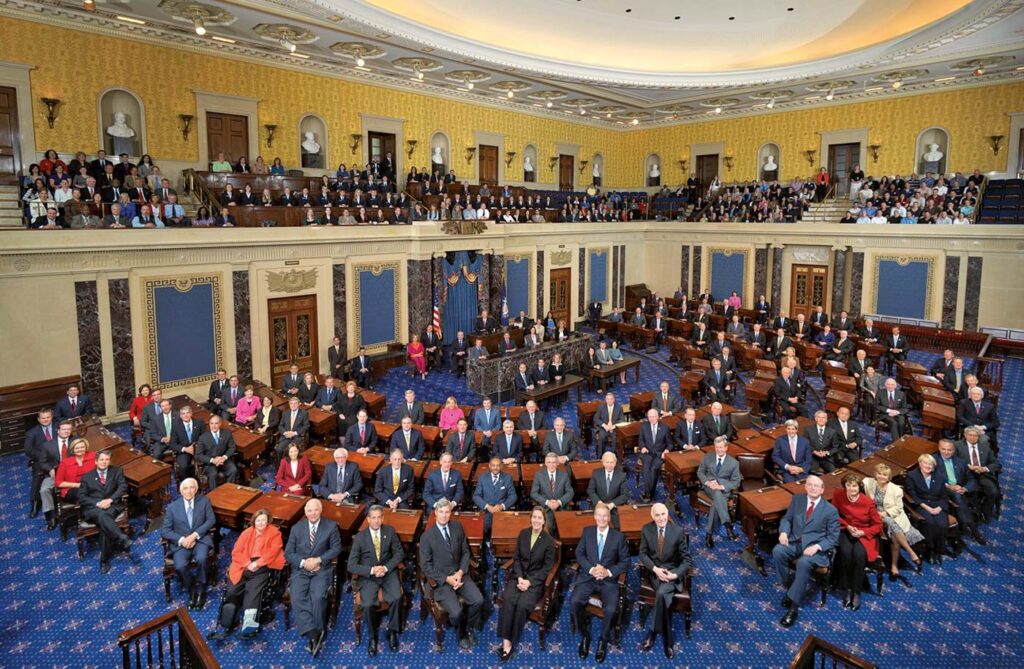
On June 17, 2025, the U.S. Senate passed the so-called GENIUS Act (Guiding and Establishing National Innovation for U.S. Stablecoins) in a 68-30 bipartisan vote. Stablecoins, digital assets designed to maintain a stable value relative to a fixed asset like the U.S. dollar, have emerged as a pivotal component of the burgeoning digital economy, offering the promise of faster, cheaper, and more accessible financial transactions.
The seemingly broad bipartisan support, often touted by proponents as a sign of its necessity, masks deeper concerns from critics who argue that the bill’s provisions disproportionately benefit established financial giants, many of whom have heavily lobbied Congress on crypto legislation. This coalition of interests raises fundamental questions about whose protection the bill truly prioritizes.
U.S. Senate, 111th Congress, Senate Photo Studio, Public domain, via Wikimedia Commons
A Closer Look at the Bill’s Restrictive Provisions
The GENIUS Act’s core mechanism for control lies in its severe restrictions on stablecoin issuance. The bill limits the ability to issue stablecoins to only three types of entities: subsidiaries of insured depository institutions, federally qualified nonbank payment stablecoin issuers, or state-qualified payment stablecoin issuers.
This narrow definition of “permitted issuers” creates an almost insurmountable barrier to entry for smaller, innovative DeFi projects, and startups. The stringent licensing requirements, high capital reserves, and ongoing compliance costs associated with becoming an “insured depository institution subsidiary” or a “federally qualified nonbank issuer” are prohibitively expensive and bureaucratically complex for new entrants.
Instead of fostering a competitive ecosystem, the Act effectively creates a cartel, consolidating control over the future of digital payments within the existing financial infrastructure — the very institutions that crypto was designed, in part, to decentralize.
This framework effectively hands the reins of the stablecoin future to established players like JPMorgan Chase, Citibank, and other large commercial banks, many of whom have publicly expressed interest in issuing their own stablecoins. The result is not innovation from the ground up, but rather a top-down control by entities comfortable with the status quo.
In the name of “consumer safety,” the bill also bans interest payments on stablecoin holdings. Historically, stablecoins have offered users the potential to earn yield through various DeFi protocols, such as lending platforms or liquidity pools. This ability to generate passive income has been a significant draw for many, especially in an era of near-zero interest rates in traditional banking.
By banning interest payments, the GENIUS Act eliminates a key incentive for stablecoin adoption, undermining a core benefit that digital currencies offer over traditional fiat. Consequently, Americans who might otherwise earn yield through digital currencies are instead pushed back into the traditional banking system, where interest rates on standard savings accounts are notoriously low.
This prohibition, framed as “consumer protection” to prevent “run risks” seen in past crypto failures, is more accurately described as protectionism for legacy financial institutions. By eliminating the competitive advantage of yield-bearing stablecoins, the Act forces consumers back into conventional banking products, where their capital remains within the walled gardens of large banks, earning minimal returns for them while the banks profit from relending those funds.
Additionally, the Act requires all stablecoins to be backed one-to-one with U.S. dollars or similar liquid assets. While seemingly prudent to ensure stability, this rule, by strictly limiting the types of backing assets and prohibiting fractional reserves, effectively limits capital efficiency and reduces monetary velocity — the rate at which money is exchanged in an economy.
This impairs the ability of stablecoins to support dynamic lending markets and foster small business growth within the digital ecosystem. In traditional finance, banks operate on a fractional reserve system, allowing them to lend out a portion of their deposits, thereby increasing the money supply and facilitating economic activity.
While the crypto space has seen failures from under-collateralized stablecoins, a complete ban on any form of capital efficiency means stablecoins cannot be re-hypothecated or used in a way that generates new economic value through lending, which is a cornerstone of a healthy financial system.
The irony is stark: while stablecoins are mandated to hold 100% reserves, traditional banks operate on a fractional reserve system, lending out the vast majority of their deposits. This double standard suggests that the true aim is not merely stability, but control, preventing stablecoins from ever truly competing with the established financial order.
This rigid 1:1 backing, while ensuring safety, also ensures stagnation, effectively freezing innovation and thus propping up a financial status quo that has demonstrably failed many through inflationary policies and limited access to capital.
Supporters, including prominent figures like Senator Cynthia Lummis (R-Wyo.) and Senator Kirsten Gillibrand (D-N.Y.), champion the GENIUS Act as a necessary framework to bring regulatory clarity to the nascent stablecoin market.
Senator Lummis, a co-sponsor and known advocate for digital assets within a regulated framework, insisted on X, the Act “preserves the dual banking system, protects consumers, [and] secures our financial future.” Senator Gillibrand echoed similar sentiments, asserting that the bill would “protect consumers from the risks seen in recent crypto market volatility” while safeguarding “the dominance of the U.S. dollar” in the rapidly evolving digital landscape.
They often point to past failures, such as the collapse of algorithmic stablecoins or unregulated crypto exchanges like FTX, as justification for these stringent measures, arguing that strict guardrails are essential to prevent systemic risk and illicit financial activity.
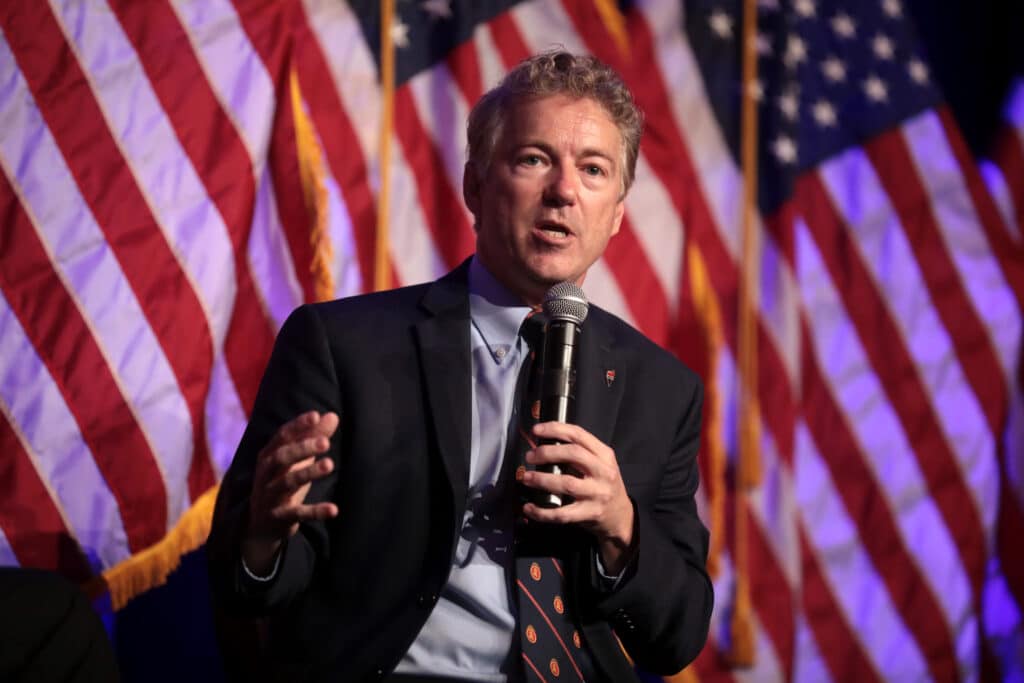
However, for a growing chorus of critics, these claims are nothing more than elaborate window dressing. Senators Rand Paul (R-Ky.) and Josh Hawley (R-Mo.), a vocal opponent of what he perceives as corporate cronyism, didn’t mince words.
Gage Skidmore from Surprise, AZ, United States of America, CC BY-SA 2.0 , via Wikimedia Commons
Known for his libertarian leanings and skepticism towards increased government intervention, Senator Paul argued the legislation would add needless federal regulations. Senator Hawley’s concerns focus on the potential for the bill to empower tech giants at the expense of ordinary citizens and existing financial institutions.
The Missouri legislator argued that the Act, as written, could allow tech giants to create digital currencies that would compete with the dollar and incentivize these companies to collect even more user financial data. Hawley even went so far as to call the bill “a huge giveaway to Big Tech.” He also expressed concerns that the bill’s safeguards against the risks of letting tech companies issue their own digital currencies had been weakened.
Other criticisms stem from the bill’s foundational design: by limiting issuance to heavily regulated and often large financial entities, and by stifling the very mechanisms (like yield) that make stablecoins attractive alternatives, the Act creates an uneven playing field designed to favor existing banking infrastructure rather than fostering genuine innovation from independent developers or smaller fintech companies.
Robust opposition also comes from Peter Van Valkenburgh, director of Research at Coin Center, a leading nonprofit advocacy group dedicated to the policy issues facing cryptocurrency and decentralized computing technologies.
Van Valkenburgh, a respected voice in the crypto policy space, offered a stinging critique of a amendment granting the president and the Office of Foreign Assets Control (OFAC) expansive authority to ban Americans from using certain blockchain technologies, including open-source smart contracts, without due process.
His argument focuses on ensuring that legislation does not infringe upon the rights of developers and users of decentralized technologies and highlights that the ban on yield doesn’t safeguard consumers from risk so much as it removes a compelling reason for consumers to opt for stablecoins over traditional bank accounts, thereby protecting the revenue streams and market dominance of established financial institutions.
This is, quite simply, regulatory capture in its purest form. Regulatory capture occurs when a regulatory agency, created to act in the public interest, instead advances the commercial or political concerns of special interest groups that dominate the industry or sector it is charged with regulating.
In this case, legacy financial institutions, through aggressive lobbying and influence — with reports indicating banking associations and major financial conglomerates have spent millions in recent years lobbying Congress on digital asset legislation — appear to have directly shaped legislation that serves their interests by limiting competition and solidifying their market position, rather than truly fostering a healthy, open financial ecosystem.
They are not merely playing the game; they are quite literally writing the rules for a game they want to win without any meaningful competition.
Surveillance Disguised as Security
Beyond its profound economic implications, the GENIUS Act raises significant red flags concerning civil liberties and individual financial privacy. The Act mandates strict Know Your Customer (KYC) and Anti-Money Laundering (AML) requirements for all stablecoin issuers.
In practice, this means that every user interacting with a regulated stablecoin would be subject to extensive identity verification — providing names, addresses, Social Security numbers, and potentially even biometric data — and continuous transaction monitoring by regulated entities.
While proponents argue such measures are essential to combat illicit finance and terrorism, critics contend they pave the way for unprecedented federal surveillance.
Given documented instances where government agencies have leveraged financial institutions to deplatform individuals or organizations based on political or social views — often under vague pretexts — granting Washington a direct pipeline into every digital wallet should be an immediate non-starter for any advocate of civil liberties.
For example, critics point to actions taken during the Canadian trucker protests, where authorities ordered financial institutions to freeze accounts of protestors without due process. Similarly, there have been reports of certain politically active groups in the U.S. having their banking services terminated without clear justification.
Under the expansive pretext of “national security,” the GENIUS Act grants the federal government broad, unchecked authority to track, freeze, or even seize stablecoin assets, effectively transforming financial freedom from a fundamental right into a revocable privilege dependent on government approval.
The bill explicitly mandates that stablecoin issuers “maintain the technical ability to freeze and burn wallets to ensure compliance with lawful orders” and “coordinate with law enforcement as a condition of participating in U.S. secondary markets.”
This means that the technology itself will be designed with a kill switch, allowing federal agencies to unilaterally halt transactions or confiscate funds in digital wallets, bypassing traditional judicial processes or requiring minimal legal hurdles.
This capability transforms stablecoins from a tool for economic empowerment into a potential instrument of state control, undermining the very ethos of decentralized, permissionless finance.Should House Republicans demand major changes to the GENIUS Act — including ending the surveillance powers and restoring interest payments — even if it means tanking the bill entirely? *
Yes — kill it if it doesn’t protect liberty
Maybe — fix the worst parts, but don’t start over
No — pass it now to bring crypto under control
Special Carve-Outs and Hypocrisy
One of the most alarming and ethically questionable details unearthed in the bill is a specific exemption that reportedly shields certain government officials and their families from prohibitions on personally profiting from stablecoin ventures.
This glaring conflict of interest has ignited fierce criticism, particularly in light of recent public disclosures, for example, that President Donald Trump has personally profited from stablecoin-related investments. Reports from major news outlets have highlighted that entities tied to President Trump have engaged in ventures involving stablecoins, raising questions about the timing and nature of such exemptions within legislation that heavily regulates the very market he might benefit from.
Senator Jeff Merkley (D-Ore.) reportedly criticized the outcome, accusing Republicans of rubberstamping “Trump-style crypto corruption” and stating that GOP lawmakers refused to hold a vote on an ethics clause that would have closed this loophole.
This apparent double standard fundamentally undermines the entire premise of the bill as a “consumer protection” measure. If the very lawmakers crafting the regulations can carve out exceptions for themselves or their associates to profit, it suggests the legislation is less about public interest and more about maintaining a system where the politically connected can leverage new markets while restricting access and innovation for the general public.
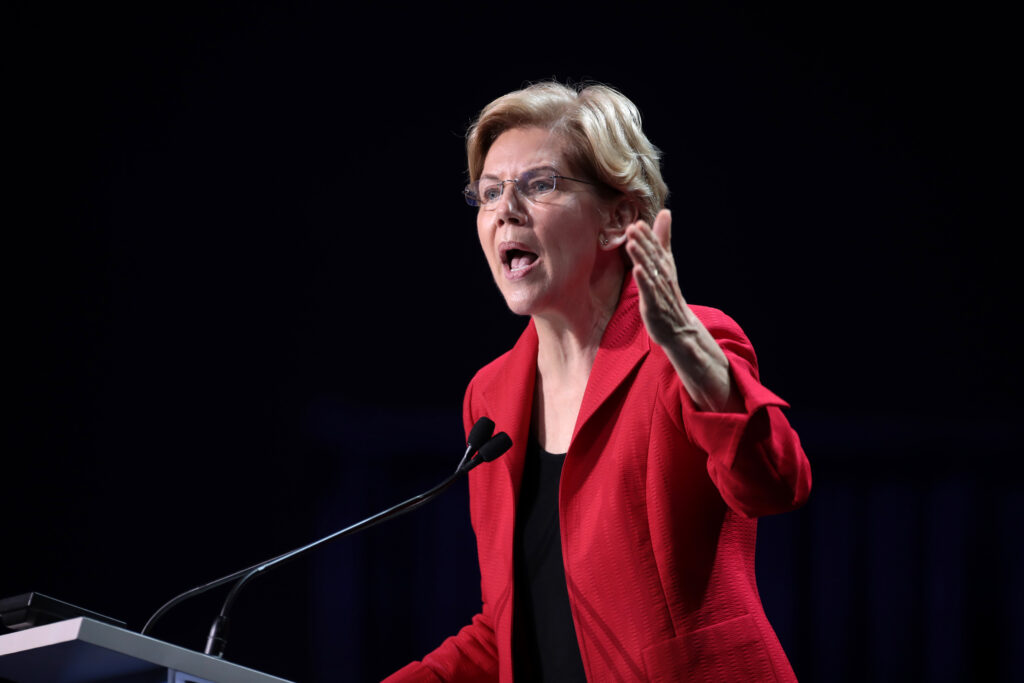
Even Senator Elizabeth Warren (D-Mass.), a vocal critic of the broader cryptocurrency industry often dubbed “no friend of crypto” due to her consistent warnings about its potential for illicit finance and systemic risk, has found reason to criticize the GENIUS Act.
While her concerns typically center on expanding regulatory authority and consumer safeguards, she notably argued that the bill, as written would leaves the door wide open for another FTX-style collapse by massively expands the marketplace for stablecoins while failing to address the basic national security risks posed by them.
She also pointed to “glaring loopholes that would allow Tether, a notorious foreign stablecoin issuer, access to U.S. markets.” Her critique, predictably, aligns with a desire for even more stringent oversight rather than a defense of innovation, yet it highlights the bill’s perceived shortcomings even from within the regulatory camp, suggesting it fails to achieve its stated goals even for some of its theoretical allies.
This illustrates a peculiar alliance of opposition: free-market conservatives who decry government overreach and stifle innovation find common ground with progressive regulators like Warren, albeit for vastly different reasons.
For conservatives, the bill is an assault on financial freedom and an example of corporate capture. For Warren, it’s not restrictive enough to prevent perceived dangers, highlighting a shared concern about the bill’s fundamental design, despite differing philosophies on regulation itself.
Gage Skidmore from Peoria, AZ, United States of America, CC BY-SA 2.0 , via Wikimedia Commons
Where Things Stand
The GENIUS Act has successfully passed the Senate and now moves to the House of Representatives, where it is currently under consideration by the House Financial Services Committee.
Prospects for its passage appear strong, largely due to its bipartisan Senate support and the significant backing it has received from powerful banking and certain fintech interests who stand to gain from the established regulatory framework.
However, the House Financial Services Committee has been working on its own stablecoin legislation, the “STABLE Act,” which, while conceptually similar, contains some key differences regarding foreign stablecoin issuers, the requirements for transitioning from state to federal oversight, and specific phase-in timelines.
This means the two chambers will likely need to reconcile their versions, potentially in a conference committee, before a final bill can be sent to the president’s desk.
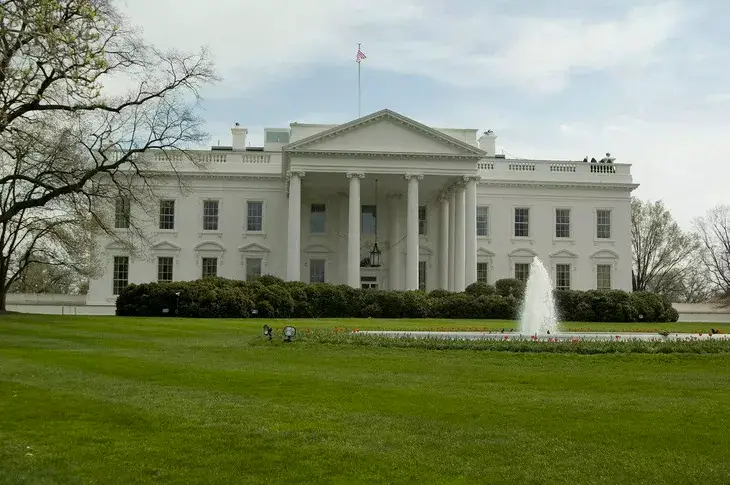
Official White House Photo, Public domain, via Wikimedia Commons
However, not all within Congress are ready to rubber-stamp the Senate’s version. A vocal group of House conservatives, including members of the House Freedom Caucus, is actively pushing for significant amendments.
Their proposed changes include a repeal of the controversial interest ban, a mandate for far greater transparency in reserve audits (beyond the current disclosure requirements), and crucially, efforts to strip out the expansive “national security” provisions that they argue constitute excessive government overreach into private financial affairs.
These amendments represent a last-ditch effort to salvage some semblance of financial freedom and competitive market dynamics within the bill. Repealing the interest ban would restore a key incentive for stablecoin use, while enhanced transparency in audits could build genuine consumer trust rather than relying on centralized control.
Stripping out the national security overreach is seen by these conservatives as vital to protecting civil liberties and preventing the potential for a “social credit system” where financial access is tied to government compliance.
Whether the House will serve as a check or a rubber stamp remains to be seen.
Conclusion
The GENIUS Act, far from being a “genius” solution, stands exposed as a sophisticated Trojan Horse. It is a calculated, strategic maneuver by entrenched financial powers and their well-placed allies in Washington to co-opt a truly transformative technology — decentralized digital currencies — and forcibly bring it under their centralized control.
Cloaked in the language of “consumer protection” and “financial stability,” this legislation systematically restricts economic freedom, stifles genuine competition from innovative startups, and dangerously empowers unelected bureaucrats with unprecedented control over individual financial activity.
For anyone who values economic liberty, technological innovation, and protection against governmental overreach, this legislation demands strong opposition. Financial freedom is not merely an economic concept; it is foundational to individual liberty itself.
The GENIUS Act, by design and by consequence, represents a profound attack on both, threatening to turn a promising digital future into a regulated, surveilled extension of a failing financial past.
Citizens concerned about this pivotal legislation should contact their representatives in the House, urging them to critically examine the bill’s true implications, support amendments that protect innovation and privacy, and resist the push to consolidate financial power in the hands of a few.
The Federal Reserve‘s data repository, FRED, presents one of the most quietly subversive truths in modern economics. Across administrations, tax regimes, and political ideologies, federal tax receipts have hovered around an average of 17.5% of GDP. This single metric, consistent across time and policy, should provoke a complete reconsideration of fiscal strategy. If no matter how high or low tax rates go, the government captures roughly 17.5% of the economy, then the only sane objective is to grow the economy. This is not ideology, it is arithmetic.
And yet, the progressive left persists in chasing higher tax rates, even as history and hard data render the strategy self-defeating. Why? Because for the modern progressive, revenue is not the end. It is the excuse. The aim is not to feed the treasury, but to reshape society. That makes tax policy less a tool of statecraft than a weapon of social reengineering.
This is not speculation, it is doctrine. Consider the words of Denis Healey, the British Labour Chancellor, who once promised to tax the rich “until the pips squeak.” The goal was not productivity or revenue, it was punishment. Redistribution as retribution. What mattered was not how much government could collect but how much it could confiscate from those it resented. The modern American progressive inherits this moral absolutism: high taxes are right, low taxes are wrong, and results be damned.
Yet the results do matter, especially when judged by the very standard progressives claim to uphold: the public good. Empirical evidence from FRED undermines their moralizing. The US government, regardless of tax rate, collects about 17.5% of GDP. If rates go up and GDP slows, the government collects less. If rates go down and GDP grows, it collects more. In real terms, the size of the pie matters more than the size of the slice.
This is the heart of supply-side logic. It is also the lesson ignored by static modeling agencies like the Congressional Budget Office. The CBO consistently underestimates the growth impact of tax and regulatory reforms. When Trump’s 2017 Tax Cuts and Jobs Act passed, the CBO predicted modest effects. Instead, GDP growth surged to 2.9% in 2018, well above forecast. Capital investment jumped, business confidence soared, and tax receipts increased. It wasn’t magic. It was motion.
The same fallacy mars the CBO’s score of Trump’s latest initiative, the One Big Beautiful Bill Act. Projecting a paltry 1.7% long-term growth rate, the CBO forecasts a $3.8 trillion increase in debt. But a growth rate of just 2.2% cuts that shortfall by more than a trillion. A 2.7% growth rate nearly wipes it out. Add in the revenue from Trump’s reciprocal tariffs, conservatively estimated at $2.3 to $3.3 trillion over a decade, and the fiscal picture flips from deficit to surplus. The math is not fuzzy, it is just inconvenient for the central planners.
Why does the CBO get it wrong? Because its models assume a static world, where tax cuts are giveaways and regulation is costless. This is Keynesian nostalgia dressed in academic robes. It denies incentives, discounts dynamism, and assumes the private sector merely reacts rather than innovates. That intellectual blindness is no accident. Most CBO directors have never built a business or managed payroll; instead, they are drawn from the ivy-covered halls of Harvard and Princeton, trained in theory but untethered from enterprise. Trump’s economic team does not share these illusions. Neither should the American people.
The Trump agenda focuses on unleashing growth: simplifying permitting for nuclear energy and pipelines, accelerating drug approvals, expanding domestic mining and drilling, and building AI infrastructure without bureaucratic drag. Each policy removes a bottleneck, and in doing so, expands the tax base. Yet the CBO ignores all of this. It includes no measure for the acceleration of permitting, no accounting for regulatory relief across entire industries, no projection of the increased oil and gas exploration, production, or refining, and no scoring for the trillions in foreign direct investment secured by Trump. Why not? Because it cannot model the real-world effects of policies it ideologically opposes. If FRED is right, and it is, then unleashing GDP is the only serious strategy. Everything else is political theater.
This is where the progressive project reveals its true priorities. It is not simply wrong about tax policy. It is hostile to economic growth. Because growth reduces dependency, and dependency is their currency of power. A larger GDP gives people more autonomy. That undermines the case for state intervention. Progressives, despite their rhetoric, do not trust people to live freely and prosper. They trust themselves to allocate resources, distribute privileges, and engineer outcomes. Higher taxes are the toll they place on that liberty.
Redistribution is also their electoral strategy. By taxing a demonized few, they buy votes from a politicized many. Student loan forgiveness, rent subsidies, welfare expansions, these are not programs, they are payoffs. That the math does not work is irrelevant. What matters is that the bill arrives after the election.
Even worse, high taxes empower the permanent bureaucracy. A complex tax code justifies an army of IRS agents, compliance officers, and lobbyists. These are not mechanisms for revenue, they are instruments of control. Simpler, lower taxes threaten their sinecures. They resist simplification not out of fiscal concern, but institutional self-preservation. Meanwhile, only a minority of Americans actually pay federal income taxes at all, further concentrating the burden on a shrinking pool of producers. This creates an upside-down incentive structure, where most citizens vote for benefits paid by others, while the tax code grows ever more opaque to sustain the illusion of fairness.
This leads to an uncomfortable truth. The tax code is not designed to raise money efficiently. It is designed to raise influence. Every deduction, exemption, and bracket is a node of political leverage. Progressives exploit this to reward allies and punish dissenters. Conservatives should dismantle it with the same clarity and resolve that Trump brings to regulation.
Growth, then, is not just an economic imperative. It is a moral one. A growing economy elevates the working class, funds national defense, and underwrites the social safety net. It does all this without coercion. It also reaffirms the central conservative principle that liberty, not redistribution, is the path to prosperity.
Trump’s approach, often derided as simplistic, is in fact the most sophisticated policy vision in Washington. It recognizes the limitations of static models, the distortions of bureaucratic incentives, and the moral hazards of dependency. It wagers, correctly, that the American people are not liabilities to be managed but assets to be unleashed.
The 17.5% rule is not just a quirk of FRED’s database. It is a mirror reflecting the futility of progressive fiscal policy. If the government only ever captures a fixed share of GDP, then policies must aim at increasing GDP. This is the only strategy consistent with both sound economics and limited government. Anything else is vanity or vendetta.
Take, for instance, a recent story that made the rounds on social media. According to these reports, Oxfam — the British NGO — found that a huge chunk of the World Bank’s spending on climate change-related issues was “missing.”
Thank heaven for REAL fact-checkers like the Australian Associated Press — a Poynter Institute-accredited fact-checker from down under — which set us all straight: “An Oxfam report did not find that $US41 billion has gone ‘missing’ from the World Bank’s climate change fund, contrary to claims online.”
What a relief. Instead, the AAP noted, the Oxfam report found that the World Bank just doesn’t really know where the money went.
See? Totally different!
The controversy centers around an Oct. 2024 report titled “Climate Finance Unchecked: How much does the World Bank know about the climate actions it claims?” Answer: not as much as it probably should.
The findings are front-loaded in a TL;DR on page two of the 33-page report, in case you’re not interested in reading the whole thing through: “Oxfam finds that for World Bank projects, many things can change during implementation. On average, actual expenditures on the Bank’s projects differ from budgeted amounts by 26–43% above or below the claimed climate finance. Across the entire climate finance portfolio, between 2017 and 2023, this difference amounts to US$24.28–US$41.32 billion,” the report states.
“No information is available about what new climate actions were supported and which planned actions were cut. Now that the Bank has touted its focus on understanding and reporting on the impacts of its climate finance, it is critical to stress that without a full understanding of how much of what the Bank claims as climate finance at the project approval stage becomes actual expenditure, it is impossible to track and measure the impacts of the Bank’s climate co-benefits in practice.”
The Oxfam report stated “generous accounting practices by different countries and providers, combined with the lack of transparency and consistency in how climate finance is defined, calculated, and reported, is at the root of the crisis of trust in climate finance.”
As the International Consortium of Investigative Journalists pointed out in a November summation of Oxfam’s findings, this is sort of a big deal when you consider how the World Bank is in the process, more or less, of turning itself into the Global Climate Change Savings & Loan.
“In recent years, the World Bank has touted its spending on climate finance and its plans to dramatically expand it,” the ICIJ noted.
“World Bank President Ajay Banga said in December that the bank had met its goal to devote 35% of its financing to climate three years ahead of schedule and set a new target of 45% by 2025. That goal is well within reach; the bank announced in September that its climate finance investments reached 44% of total financing, or $42.6 billion, over the past fiscal year. ‘We’re putting our ambition in overdrive,’ Banga said.”
The report underscored that there’s a huge difference between the World Bank’s ambition and the world bank’s accounting processes, however, and one that needs to be addressed. But both Oxfam and the AAP fact-checking team wanted to you to be sure that the NGO “was not alleging any mismanagement of funds due to corruption or waste; it was concerned about the World Bank’s reporting process for deviations in planned and actual climate finance.”
“This distinction is significant,” a spokesperson for Oxfam said.
“Oxfam’s report doesn’t suggest funds are missing but points to a transparency issue that makes it difficult to know precisely what the Bank is delivering in terms of climate finance: where it’s going and what it’s supporting.”
Yes, well, excuse us for sounding like negative Nancys, but this sounds a bit like one of those cheerful bosses who describes a major organizational setback as an “opportunity for breakthrough improvement.” Indeed it might be, on some level, but a Panglossian refusal to acknowledge the bedrock realities of the situation that accompanies it becomes downright hilarious — unless you’re on the hook for it, of course.
And if you’re an American, you are! According to a Congressional Research Service report, the U.S. contributes over 16 percent of the World Bank’s total capital through its financial commitments, and has significant voting power on all of the World Bank organizations that provide climate change funding.
Yes, this may be a drop in the bucket in terms of your tax dollars, and yes, there are bigger climate hustle bureaucrats that have spent your cash on (hey, whatever happened to that promising green energy start-up Solyndra?), but the difference between “a transparency issue that makes it difficult to know precisely what the Bank is delivering in terms of climate finance” and “missing” sounds an awful lot like the difference between “I did not have sexual relations with that woman, Miss Lewinsky” and “Indeed, I did have a relationship with Miss Lewinsky that was not appropriate and in fact, wrong.”
Of course, when it comes to virtually any other institutional spending issue, using the word “missing” to refer to something being lost or something being unaccounted for would be a distinction without a difference. Here, it’s unspoken why it’s problematic and why fact-checkers are taking issue with it: When it comes to spending on issues related to climate change and green energy, there are Good Guys and there are Bad Guys.
The Good Guys say this is merely an accounting quibble while the Bad Guys say that this means at least $24 billion and up to $41 billion of World Bank funds are somewhere in the ether of global finance networks thanks to variances in accounting practices that charitably can be described as ‘curious’.
Thus, it’s not, “contrary to claims online,” missing. It’s just not accounted for! At this point, I’m not sure which is the bigger racket: dubious national or supranational funding of projects that fall loosely under the aegis of purported climate change mitigation, or fact-checking. At least this can be said about fact-checking: It costs a hell of a lot less.
A recent analysis reveals a troubling trend in the U.S. labor market: while private sector jobs are disappearing at an alarming rate, the federal government continues to expand its workforce. This discrepancy has raised concerns among economists and policymakers about the implications for economic growth and the overall job market.
According to the latest data, the private sector is facing significant job losses, with many industries experiencing layoffs and hiring freezes. As businesses struggle to navigate the ongoing challenges of the Biden-Harris economy, many have been forced to downsize, leading to a growing number of unemployed workers.
In stark contrast, the federal government is adding more jobs to its payroll. Recent reports indicate that the number of federal employees has been steadily increasing, reflecting a trend toward a larger government presence in the labor market. This expansion raises questions about the sustainability of such growth, especially as private sector job opportunities dwindle.
The October jobs report also saw employment gains in August and September be revised down by 81,000 and 31,000, respectively, bringing the number of jobs added for the months to 78,000 and 223,000, according to the BLS. Meanwhile, unemployment has risen substantially since April 2023 from 3.4% to 4.1%, with the increase prompting the Federal Reserve to cut the federal funds target range by 0.5%.
The impact of these job losses is felt most acutely in sectors that are traditionally considered pillars of the economy, such as manufacturing and retail. As companies streamline operations to cope with economic pressures, the prospects for workers in these fields remain bleak.
The economy was dogged by strikes in the third quarter of 2024, with tens of thousands of dock workers and Boeing airplanemachinists ceasing work. Hurricanes Helene and Milton also could have reduced job growth by roughly 50,000, according to the Economic Policy Institute.
Relatedly, the disappointing employment gains under the Biden-Harris administration could worsen Vice President Kamala Harris‘ already weak standing with voters on the economy, as 54% of registered voters trust Trump to deal with the economy while just 45% trust Harris, according to the October Gallup poll. Inflation rose from 1.4% when President Joe Biden took office in January 2021 to approximately 9% in June 2022, and now sits at 2.4%.
Critics argue that an expanding federal workforce will only exacerbates the nation’s economic challenges. They contend that government jobs do not contribute to economic growth in the same way that private sector employment does, as federal positions are often funded by taxpayer dollars rather than generating revenue through goods and services.
Furthermore, as private sector workers find themselves without jobs, the growing federal workforce could strain public resources and lead to increased government spending without corresponding increase in revenue — and additionally create incentive for increased taxes and audits from the IRS.
The higher the percentage of Americans employed by the U.S. government, the more control the government has over its peoples.
In the wake of the 2008 Financial Crisis, former chief economist of the IMF Simon Johnson warned that the same dysfunctional policies he saw in his basket case banana republics had taken hold in the United States.
Johnson warned that if America didn’t act fast, we would plunge into a “Quiet Coup” as the American financial system effectively captures the government, bailing itself out until we run out of money. Well, we didn’t act fast. In fact, we got worse.
And here we are.
Our Bankrupt Financial System
In recent videos I’ve talked about the trillion of distress in the financial system, the common thread being that you, the taxpayer, will be bailing them all out — we saw this in the 2023 bank bailouts, pre-paid in the dark.
Of course, given our $35 trillion in national debt we can’t afford it. But pay it we will, driving that 35 trillion to, according to the CBO, 50 trillion plus.
At some point, it gets too big to bail out. Meaning either hard default — they stop paying interest. Or the more likely soft default — they let inflation rip, melting away the national debt along with our life savings. And between here and there is a wholesale fleecing of the middle class and the working class who relies on them for a job.
The Ignored Warning
So, first, the ignored warning by Simon Johnson. I’m no fan of the IMF — their role is essentially feeding their client dictators fresh drugs at massive taxpayer expense. But one thing the IMF does know is dysfunctional governments.
In his warning, Johnson detailed the typical pattern when countries collapse — when they come in desperation to the IMF.
First, a small group of powerful elites takes over policy. This is typically financial elite, or large companies when the country has them.
Because these elites know they’ll be bailed out, they take excessive risks in good times. An iron law of finance is that risk pays reward. Meaning if you know you’re going to get bailed out, you’d be a moron not to take on too much risk.
If every hand at the poker game is all-in, inevitably you lose. You pass your losses to the taxpayer, and start over with fresh chips, courtesy of the suckers.
The Quiet Coup
Johnson lays out his numbers: from 1973 to 1985, America’s financial sector never earned more than 16% of domestic corporate product. But by the early 2000s, it was earning 41%.
It turned a chunk of these profits into lobbying, repealing Depression-era prudential regulations separating banking and investment banking. In other words, freeing banks to gamble with taxpayer-guaranteed funds.
Then it lobbied to raise leverage — meaning how much the financial sector could borrow. So it could make large gambles with a small amount of money — again, all taxpayer guaranteed. The end result was the 2008 crisis, where banks made trillions in risky loans to people with no income, no assets, and no credit.
The leverage meant they had bet the farm and then some — keeping all the profits. Then when it turned south, they sicced lobbyists on Washington to line up bailouts, using the real economy as a hostage to wring out yet more lobbyist favors.
The Washington-Wall Street Racket
In return, they gave politicians and their staff plum positions or even outright bribes. Ben Bernanke got $250,000 for a single speech at a financial conference.
Janet Yellen was paid *$7 million in speaking fees by Goldman Sachs and other Wall Street banks — hedge fund Citadel paid Yellen $292,500 for a single speech.
London-based Standard Chartered paid $270,000 for one speech — interesting for a foreign bank when we can only imagine what favors were done in return.
Johnson sums it up: the American financial system is “desperately ill,” kept alive only by an endless series of bailouts, like the ones that headed off bank failures last year.
He says the only solution is forced recognition of bank losses — which would bankrupt them — then selling them to new management that will not have access to bailouts.
What’s Next
Given their lobbying power, the odds of breaking up America’s megabanks are slim to none. Meaning unless Washington reins in the banks, we’re in store for more existential financial crises, more bailouts and national debt, more running out the clock to financial catastrophe.
We missed our chance in 2008, and in all likelihood, it will take an even bigger crisis before politicians turn on their lobbyists and the financial coup that has seized our republic.
Treasury just had its worst August ever and things are getting worse
Janet ‘Inflation-Is-Transitory’ Yellen once again has egg on her face. After laughably low deficit projections for the current fiscal year, Treasury has now blown past those forecasts, and we still have a month to go before the end of the current fiscal year. Worse yet, the latest monthly Treasury statement set several record “firsts” — none of which were good.
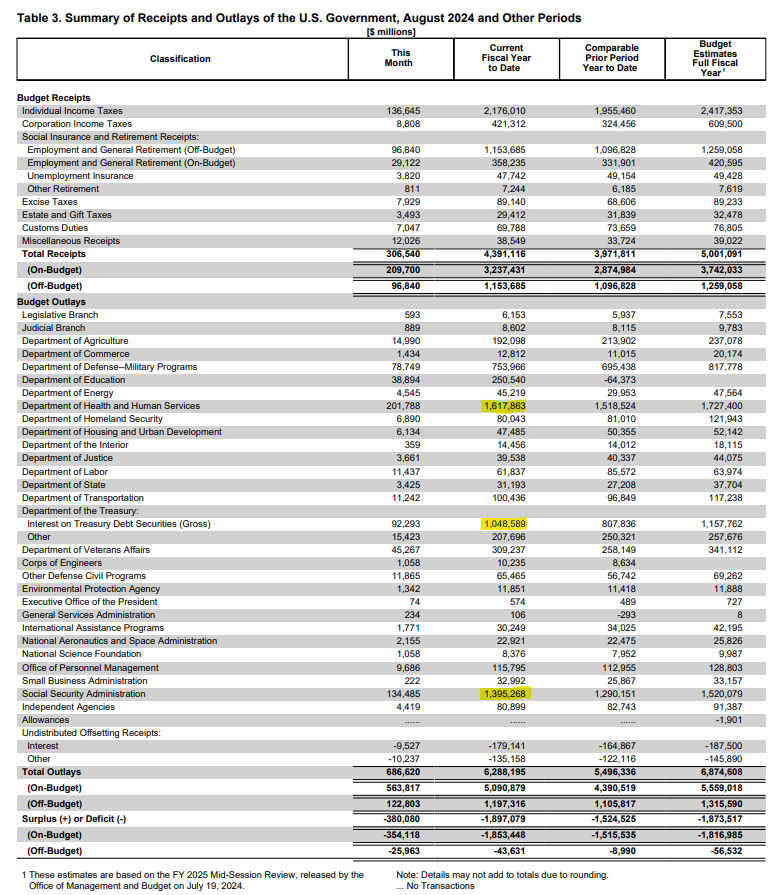
While people already knew that annual interest on the debt was heading to $1 trillion, this was the first time it had ever been recorded. As of August, the 11th month of the fiscal year, the government has spent over $1.049 trillion just to service the $35.3 trillion debt. What makes it scarier is that we still have another month to go in the current fiscal year.
It didn’t even take all 12 months to prove wrong those folks saying interest on the debt wouldn’t break the $1-trillion threshold.
Even with interest rate cuts, there’s no significant evidence that the problem is slowing down. That’s because interest on the debt is a function of BOTH the average interest rate on securities AND the total debt outstanding. Well, the latter is exploding.
We’ll add about another $1 trillion to the federal debt before the end of the calendar year, and then likely continue adding about $1 trillion every 100 days or so from there on out.
This was also the worst deficit for the month of August ever—including the blowout spending years of 2020 and 2021 when Congress pushed through all kinds of bloated pork. In fact, at $380 billion, it’s larger than any other monthly deficit of fiscal years 2024 or 2023.
And this isn’t a revenue problem—it’s a spending problem. Despite concerns of a recession, tax revenue has actually held up, so the burgeoning deficit is clearly coming from the other side of the ledger.
In the first 11 months of the current fiscal year, the federal government took in almost as much revenue as in the entire prior fiscal year. If we look at the comparable period (first 11 months of both FY’s) then we see revenues have increased from $4.0 trillion to $4.4 trillion. Spending, however, has increased even faster.
This past August, federal outlays were $687 billion, compared to $194 billion in August 2023 — more than tripling in just one year. Outlays in the comparable period between both years have gone from $5.5 trillion (2023) to $6.3 trillion (2024).
Clearly, the ballooning deficit is a spending problem. And what a problem it is.
Specialists and skeptics were very critical of Treasury’s overly optimistic projections on the current fiscal year’s deficit and, sure enough, we were right. The deficit has already blown past the projection for the fiscal year and—as we’ve already said—there’s still another month to go.
The $1.9-trillion deficit will break the $2-trillion threshold with ease once September is in the books.
And there’s no reason to believe multi-trillion-dollar deficits are going away anytime soon because the runaway spending continues. In fact, mandatory spending and interest on the debt together will exceed government revenue for the foreseeable future. So, literally all discretionary spending will be deficit spending.
The monthly Treasury statement for August bears witness to this sad situation: 55 cents of every dollar the federal government spent last month was borrowed. Spending was more than twice all government receipts.
While the profligate spending out of Washington, DC has certainly exploded over the last four years, the interest on the debt is now also a major contributor to the deficit. The increase in the trend of discretionary spending is now less than the increase in the trend of interest on the debt.
In other words, depending on how you want to measure it, interest on the debt is now the largest contributor to the deficit.
For the fiscal year to date, interest on the debt is the third largest line item in the Treasury’s August statement, behind only the Social Security Administration and the Department of Health and Human Services, both of which have increased relative to their pre-2020 projections, but by much less than interest on the debt.
Federal finance is clearly in shambles, but where do we go from here? Are we actually already in the fiscal doom loop? Yes, and it’s complicated.









 fox files
Recent Comments