The Truth Is Out There

Posts tagged ‘global-warming’

Geoengineering Fails on Every Level—Technical, Economic, and Political, Say Columbia University Scientists


Nature’s ‘Scientific Reports’ study confirms the technology doesn’t exist, the materials don’t exist, and the risks can’t be contained—making “sun-blocking” schemes both impossible and dangerous.
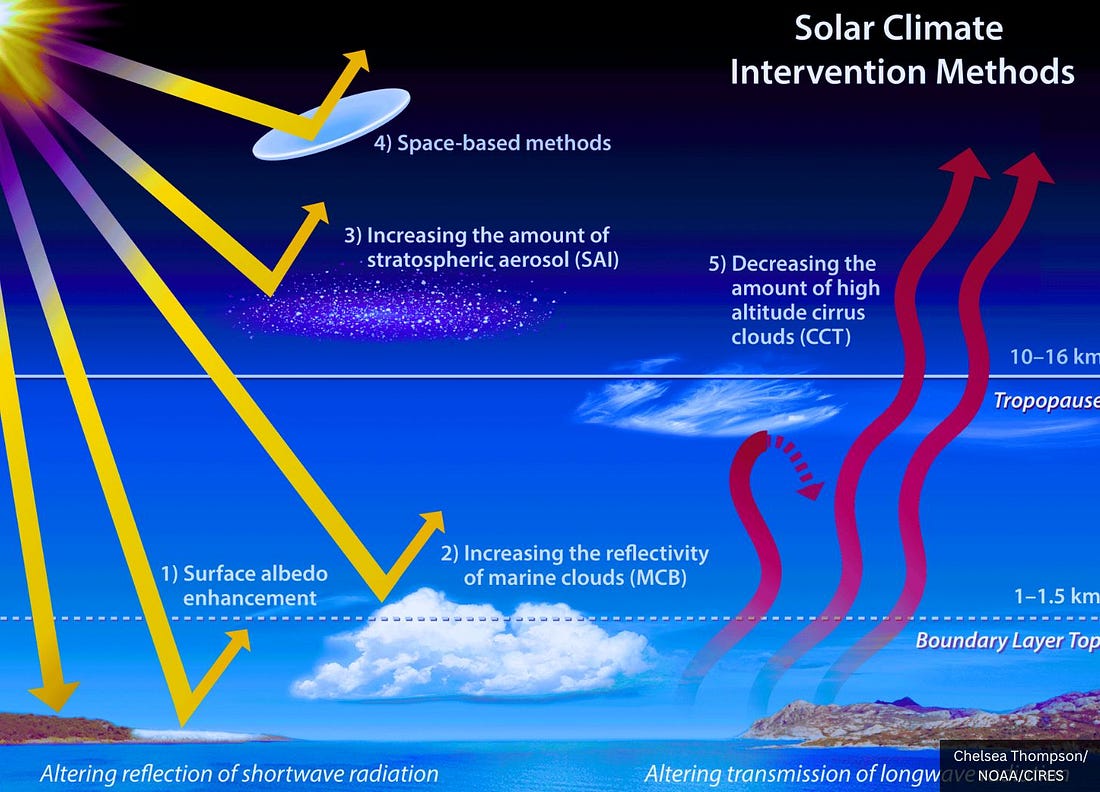
A new peer-reviewed Scientific Reports paper published last week from Columbia University scientists delivers a devastating blow to solar geoengineering, the controversial practice of attempting to cool the planet by spraying sunlight-reflecting particles into the upper atmosphere to block or deflect incoming solar radiation.

The technique is known as ‘stratospheric aerosol injection’ (SAI).

SAI is a form of ‘solar radiation modification’ (SRM), a practice that official White House documents acknowledge is being funded both “covertly and openly.”

But the stratosphere should not be confused with the troposphere.

The troposphere is where the FAA, NASA, and NOAA admit metal nanoparticle- and sulfur-containing commercial jet emissions produce—when the air at altitude is cold and wet enough (Schmidt-Appleman Criterion)—visible lines that linger, disperse, and block the sun and sky.

These tropospheric sun- and sky-blocking emissions are sometimes referred to as “chemtrails.”

SAI is different in that it deliberately targets the stratosphere, a much higher and more stable layer of the atmosphere, with the explicit goal of altering temperatures worldwide.

SAI is not a byproduct of aviation, but a planned, large-scale climate intervention intended to reflect sunlight away from Earth.

While commercial aviation-caused weather manipulation—what could be called apparently accidental tropospheric aerosol injection (TAI)—occurs year-round and all over the world, SAI refers to the deliberate, large-scale injection of reflective particles into the stratosphere.

Unlike TAI, SAI is an experimental practice reportedly still limited to a small number of government- and university-backed projects.
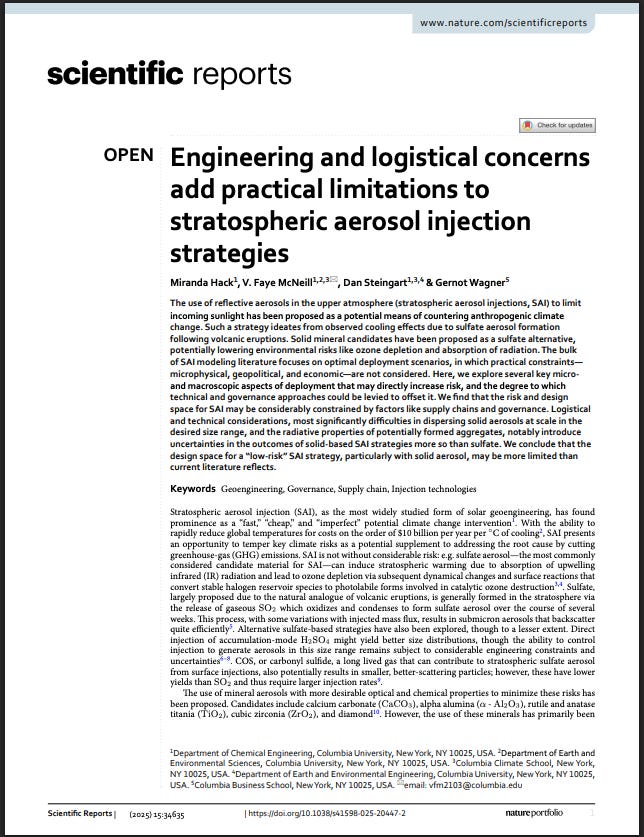
The new study, titled “Engineering and logistical concerns add practical limitations to stratospheric aerosol injection strategies,” confirms that spraying reflective particles into the atmosphere to cool the planet is not only impractical—it’s dangerous.

The authors conclude bluntly that “the design space for a ‘low-risk’ SAI strategy, particularly with solid aerosol, may be more limited than current literature reflects.”

Once real-world physics, economics, and governance are factored in, the entire concept collapses.

The findings come as Israeli-U.S. geoengineering company Stardust Solutions announces a $60 million fundraising round for its efforts to block the sun by spraying particles—the composition of which has not been disclosed by the company—into the atmosphere as soon as April 2026.


The Case Against Climate Change Alarmism

Geoengineering efforts are carried out in the name of so-called “climate change,” the long-debunked near-religious belief system that treats Earth’s temperature shifts as a crisis so severe it warrants experimental manipulation of the atmosphere.

Climate alarmists, who often support geoengineering, argue that human activity is driving a global carbon crisis.

Yet their entire premise rests on the claim that mankind’s carbon emissions are powerful enough to destabilize the Earth’s climate.

However, man’s carbon contribution makes up only about 4% of the atmosphere’s already minuscule 0.04% carbon dioxide.

That means the entire climate panic hinges on the idea that a human-made fraction of a fraction of a trace gas—about four one-hundredths of one percent of the air we breathe—controls the planet’s temperature.

In reality, nature drives changes in climate—not man.

A peer-reviewed Geomatics study by Ned Nikolov and Karl Zeller confirms that recent warming of the Earth is driven entirely by changes in solar energy and Earth’s reflectivity—not carbon dioxide.

That study showed that variations in sunlight and cloud-cover account for 100% of the observed warming trend and calling for “a fundamental reconsideration” of the carbon-based climate narrative.

Moreover, a peer-reviewed Sci journal study found that natural temperature-driven processes—not human activity—dominate the carbon cycle, concluding that “no signs of human (fossil fuel) CO₂ emissions can be discerned” in over 40 years of atmospheric data and that mankind’s contribution plays only a “minor role” in recent climatic evolution.

A recent Science study—even praised by The Washington Post as the most rigorous reconstruction of Earth’s climate history—confirms that the planet is now in its coolest state in 485 million years, with ancient global temperatures once reaching nearly 97°F, far hotter than today’s 59°F average.

Finally, a review of 50 years of environmental “doomsday” predictions shows that not one has come true, exposing climate alarmists and government-backed “experts” as having a 0–50 record of failed eco-apocalyptic forecasts despite decades of media hype.

Taken together, the data dismantle the narrative entirely—proving that Earth’s climate has always been driven by natural solar and atmospheric cycles, not by humanity’s trace emissions, and that today’s “crisis” is nothing more than a manufactured pretext for international control masquerading as science.

1. Unrealistic from the Start

The Columbia team exposes what most geoengineering models hide: they assume perfect machines and global cooperation that don’t exist.

The study reads:

“The bulk of SAI modeling literature focuses on optimal deployment scenarios, in which practical constraints—microphysical, geopolitical, and economic—are not considered. Here, we explore several key micro- and macroscopic aspects of deployment that may directly increase risk, and the degree to which technical and governance approaches could be levied to offset it. We find that the risk and design space for SAI may be considerably constrained by factors like supply chains and governance.”

In plain language, the science propping up geoengineering depends on computer scenarios that ignore engineering limits, political chaos, and the laws of physics. Once those are included, the so-called “solution” becomes an uncontrollable global hazard.

2. The Engineering Failure

At the core of the problem is physics.

The solid particles proposed for stratospheric spraying—calcium carbonate, alumina, titanium dioxide—can’t be aerosolized properly.

The Columbia researchers write:

“Due to the solid aerosol candidates’ high density and small primary particle size, these are classified as Geldart Group C “hard to fluidize” materials, meaning they resist flowing along with a gas as primary particles, instead forming large (several microns) agglomerates. Cohesive intermolecular forces tend to hold primary particles together, and as primary particle sizes decrease, these cohesive forces tend to decrease less significantly than opposing forces in a gas flow, resulting in agglomerates that resist breakup.”

These particles stick together and form heavy clumps instead of spreading into a fine reflective mist.

That means they fall too quickly and fail to scatter sunlight.

The only way to break them apart, the researchers found, would require aircraft equipped with massive high-pressure compression systems.

“High pressure, slower-moving gas is clearly necessary to impart sufficient drag on an agglomerate, indicating the need for some sort of heavy-duty (> 100-fold pressure increase) in-flight air compression system, or the on-board transport of a highly pressurized carrier gas, which may impact economic assessments of costs for injection, as well as potential safety concerns. Additionally, at higher solid mass fractions, Weber numbers near the throat are reduced, a result of the coupled nature of the solid and gas momentum equations, which limits the ability of gas-particle laden systems to reach Mach 1 at the nozzle throat. If such a nozzle dispersal approach were adopted, this may reduce possible solid dispersal rates (as suggested by literature) additionally increasing injection costs by decreasing the total amount of aerosol able to be injected per flight. Estimates for cost of sulfur-based deployments stem nearly entirely from aircraft-related expenses, making such decreases in payload likely to significantly impact costs.”

In other words, the equipment doesn’t exist.

And even if it did, the cost and safety risks would be prohibitive.

3. The Optical Collapse

The paper shows that even if particles somehow reached the stratosphere, their reflectivity would vanish almost instantly once they agglomerate.

“Generally, larger aggregates scatter less efficiently, as expected for increasing optical size parameters. Fractal dimension appears to play a role in aggregate scattering efficiency. For aggregates with fractal dimensions greater than 1.5 (i.e. less branched fractals), reductions in SW forcing efficiency are less severe. For fractals with = 1.1, aggregates quickly reach a near-0 forcing efficiency as they coagulate. These large aggregates would sediment quickly, requiring increased injection rates alongside larger burdens to achieve the same degree of shortwave forcing as optimal monomers.”

The larger the clump, the less sunlight it reflects and the faster it falls out of the atmosphere.

The authors admit that these “fractal aggregates” could turn supposed cooling particles into heat-absorbing ones.

That means geoengineering could accelerate warming instead of slowing it.

“In the absence of a more advanced understanding of stratospheric dispersion and coagulation dynamics, a solid injection strategy is suboptimal compared to sulfate purely on the basis of relatively high risk-risk magnitudes (e.g. significantly reduced shortwave fractal scattering efficiency and lifetimes) with poorly constrained risk likelihoods. In the case of perfect injection and dispersion (e.g. monomer dispersal), solids do have the capability to lower sulfate-associated risk. However, a less-optimal solid injection and dispersion strategy, in which aggregation occurs, extends the risk space significantly beyond the lower bound of most sulfate scenarios.”

They conclude that even the “safer” solid minerals are riskier than sulfates—the same compounds that destroy ozone after volcanic eruptions.

4. Not Enough Raw Materials on Earth

The supply-chain analysis is equally damning.

The authors calculate that to sustain a global aerosol program, demand for minerals like zirconia and industrial diamond would exceed current global production.

“Based on current market production, candidates like ZrO₂ and diamond (here, industrial) would be subject to demands greater than or close to their current supply, increasing likelihoods for demand-pull inflation in these supply chains. Candidates like CaCO₃TiO₂Al₂O₃ and SO₂ may be less subject to such constraints given more robust supply compared to potential increases in demand.”

“In comparison, less-elastic supply chains may be subject to inflated prices without a significant compensating drop in demand, whether this is due to a lack of suitable alternatives and/or a less flexible need for that commodity. However, given that the supply for these candidates—with the exception of diamond—tend to generally be fairly robust compared to the requisite masses for the SAI strategy considered here, changes to demand may not be noteworthy. Larger-scale SAI strategies (e.g. offsetting all warming; more extreme GHG scenarios) or less effective strategies (e.g. uncoordinated deployment with reduced lifetimes and resultantly higher injection rates, aggregate formation) could easily increase demand by 2–10x, making strain on inelastic supply chains like lime, sulfur or alumina significant.”

Even abundant materials like lime and alumina would face massive price inflation.

The paper calls these resources “inelastic,” meaning production can’t scale without disrupting entire industries.

In short, geoengineering would cannibalize global manufacturing to feed an experiment that can’t work.

5. A Governance Nightmare

The study warns that stratospheric injection would require absolute international coordination—something the world has never achieved.

Without it, the outcome is chaos.

“An uncoordinated, decentralized scenario does not yield the control required to optimize these parameters, resulting in aerosols with shorter lifetimes and poorer radiative properties, increasing requisite burdens, lifetimes, and associated risks.”

If one nation or private actor launched its own spraying campaign, the result would be uneven aerosol coverage, shifting rainfall patterns, and unpredictable climate disruptions.

The authors stress that decentralized deployment would magnify every risk factor simultaneously.

6. The Fatal Admission

After hundreds of pages of technical analysis, the authors concede that no version of stratospheric aerosol injection can be considered “low-risk.”

“We here show that logistic constraints favor sulfate on the basis of fewer uncertainties and a more well-defined risk space that is relatively invariant with price.”

“These practical limitations, if left unaddressed, push SAI scenarios further away from the idealized scenarios explored in the literature. A more complete understanding of “worst-case” tropospheric climate impacts through GCM model runs that simulate aggregate injection might better contextualize these results and allow for a more complete risk-risk picture. Critical here, as well, is a better understanding of how solid aerosol microphysics will lead to aggregation post-dispersal, which may further lower the upper bound on feasible solid injection rates, increasing costs. Quantifying the (relative) risk-cost trade-off of solid monomer dispersal – that is, the increase in cost for reduced payloads – will better inform the likelihood of the acceptance of increased costs in exchange for potentially lowered environmental risk. Moreover, the eventual risk of any SAI strategy ultimately will be bound by how it is governed and deployed.”

Even the least bad option—sulfate aerosols—comes with well-known ozone destruction and atmospheric heating effects.

The supposed “improvements” offered by solid particles only add new dangers and higher costs.

Their closing words admit what critics have long argued:

“The development of technical and governance-based approaches to mitigate risks associated with deployment strategy, candidate selection, and aggregate injection is critical to the design or discussion of any realistic ‘low-risk’ SAI strategy.”

In other words, no realistic “low-risk” plan exists.

Bottom Line

The Columbia University study leaves no ambiguity: solar geoengineering is a scientific, logistical, and moral failure.

  • The physics doesn’t work: the aerosols can’t disperse properly, and the particles clump together before they ever achieve their intended effect.
  • The optics don’t work: once these agglomerates form, their ability to reflect sunlight collapses, turning a supposed cooling mechanism into a potential heat trap.
  • The economics don’t work: raw materials like zirconia, alumina, and even industrial diamond would be exhausted or inflated beyond practical reach, cannibalizing entire industries just to maintain a fantasy.
  • The governance doesn’t work: any unilateral spraying effort by a corporation or country would create global chaos, altering rainfall patterns and climate systems with no way to reverse the damage.

Even the authors’ own conclusions confirm it.

Their words make clear that no “low-risk” version of stratospheric aerosol injection exists.

The most “feasible” material, sulfate—the same compound responsible for volcanic ozone depletion—remains dangerous, unstable, and costly.

Meanwhile, the justification for these experiments rests on a collapsing foundation: a half-century of failed climate predictions, peer-reviewed studies showing natural solar variation—not human carbon emissions—drives global temperature change, and empirical data confirming the planet is in its coolest period in nearly half a billion years.

The combined evidence dismantles the alarmist narrative entirely.

What remains is not science, but ideology—a technocratic attempt to seize control of Earth’s systems under the guise of saving them.

In reality, geoengineering is not a climate solution.

It’s a catastrophe waiting to happen: a reckless experiment on humanity’s only home, built on fear, false science, and financial ambition.


DOE Report Upends Climate Alarmism: CO2 Not the Villain We Were Told


The intellectual foundation of modern climate policy rests on a shaky assumption: that anthropogenic carbon dioxide emissions, left unchecked, will wreak unmanageable havoc on the Earth’s climate and economy, and that radical mitigation is the only path forward. This assumption has been treated not as hypothesis but dogma, one that brooks no dissent. Yet, on July 29, 2025, the Department of Energy (DOE) disrupted this orthodoxy with a quietly released but tectonic report, A Critical Review of Impacts of Greenhouse Gas Emissions on the U.S. Climate. Its findings deserve our undivided attention.

Developed by the 2025 Climate Working Group under Energy Secretary Chris Wright, this report evaluates the empirical record, existing literature, and widely cited models of climate change and its impact. It issues a sober verdict: the harms of CO2-induced warming are overstated, the benefits underreported, and the United States’ costly mitigation policies amount to symbolic gestures with virtually no measurable effect on global climate trajectories.

Pause on that last point. The United States is often urged to lead the world in climate action, regardless of cost or efficacy. But as the DOE report makes clear, our domestic efforts will have “undetectably small direct impacts on the global climate” and whatever marginal effects might accrue would only unfold over centuries. That is not policy, that is performance art.

The report’s challenge to prevailing climate dogma is not confined to global impact. Its most devastating conclusion lies in the economic analysis. CO2-induced warming, it asserts, is less damaging economically than conventionally believed. Why? For one, the benefits of carbon dioxide, especially in enhanced plant growth and agricultural productivity, have been systematically minimized. Atmospheric enrichment with CO2, the molecule that every leaf on Earth craves, has produced tangible greening of the planet, as satellite data has repeatedly confirmed. The report notes that elevated CO2 levels are associated with longer growing seasons, higher crop yields, and improved drought resistance.

To this, some will object: but what about the disasters? The hurricanes, the wildfires, the floods and droughts? Here, too, the DOE report punctures myth with data. Trends in extreme weather, whether hurricanes, tornadoes, or droughts, do not show a statistically significant increase in frequency or intensity in the US. The belief that climate change is driving more disasters is not borne out by the nation’s own historical record. The pattern is familiar: catastrophic headlines dominate the news cycle, but peer-reviewed long-term data often reveals no clear signal.

What the report urges us to reconsider is not science per se, but scientific selectivity. Which studies are emphasized, which outcomes are modeled, which scenarios are dramatized, these are not neutral choices. They reflect a politicization of climate discourse that has ossified around worst-case predictions. The DOE’s panel of independent scientists, drawing on physical science, climate modeling, economics, and academic research, concludes that aggressive mitigation strategies could be more harmful than beneficial.

Why? Because such policies incur massive economic costs today in exchange for theoretical benefits centuries in the future. The social cost of carbon, a number derived from notoriously elastic models, is used to justify expansive regulation and taxation. But the opportunity cost of mitigation is rarely tallied. The DOE report points to harms from these policies: deindustrialization, energy poverty, manufacturing flight, and disproportionate burdens on low-income families. In seeking to avert a hypothetical crisis tomorrow, we are creating a very real one today.

Consider Germany’s “Energiewende” experiment. Once celebrated as a model for renewable transition, it has left the country with some of the highest energy prices in the world, increased coal usage, and stagnating industrial output. That is not progress; that is regression clad in moral virtue.

The DOE report does not deny climate change. Rather, it questions whether the response, especially by the US, acting alone, is rational, proportional, or effective. A sound policy approach would weigh benefits against costs, factor uncertainty, and consider adaptation as a co-equal strategy. It would recognize that prosperity, technological advancement, and institutional resilience are the most reliable defenses against climate risk.

And what of the global context? China emits more CO2 than the US and EU combined, and continues to expand its coal fleet. India, rightly prioritizing growth and poverty alleviation, follows a similar path. Even under idealized global mitigation scenarios, temperature effects remain marginal for decades. If the goal is climate stability, US policy must reckon with this reality.

There is a deeper lesson here about humility. Climate models are not oracles, and long-range forecasts are fraught with uncertainties. The Intergovernmental Panel on Climate Change (IPCC) itself acknowledges the “deep uncertainty” surrounding cloud feedbacks, ocean cycles, and aerosol effects. Yet policymakers cling to worst-case models like RCP8.5 as if they were certainties. The DOE report reminds us that science, when honest, acknowledges what it does not know.

The economic modeling is equally uncertain. How do we quantify the benefit of a slightly cooler planet in 2150? How do we discount the loss of economic growth, technological progress, and human well-being between now and then? These are not simple equations. They are philosophical judgments smuggled into spreadsheets.

One need not reject the premise of climate change to accept the report’s conclusion. One need only accept that climate risk exists alongside other risks—economic, geopolitical, social. A rational society does not bankrupt itself to prevent a hypothetical future while ignoring the very real suffering of its present.

This report ought to serve as a corrective. It does not deny that CO2 has climatic effects, but it insists we view those effects in context. It challenges the catechism of decarbonization as the sole moral and practical imperative. It urges policymakers to consider adaptation, resilience, and economic growth as indispensable tools in managing a changing climate.

To those who regard such conclusions as heresy, consider this: Truth does not fear scrutiny. If the consensus is as solid as claimed, it should welcome a challenge from a panel of independent scientists operating under a federal mandate. That is how science progresses, not through suppression, but through argument.

The American people deserve more than theatrical virtue-signaling. They deserve climate policies rooted in realism, not alarmism; in cost-benefit analysis, not eschatology. The DOE report offers a roadmap. We would do well to follow it.

It’s time to put Earth Day to bed and get on taking care of God’s creations


It seems that some people/organization leaders have either not awakened to the truth or want to try to keep the funds coming in in a fight against the non-extent fear of Global Warming.  It would be (it is) easy to dig deep – back to the early days of Earth Day and find out where the upside-down science came from. Why have the purveyors of” Man-made global warming is destroying the earth, so we must rid the earth of most humans and Oh, take control of every aspect of life on earth as well, pushed this nonsense?

It all began because some people wanted to control the entire world. They found each other and began planning how to achieve world-dominance.

Cecil Rhodes, in his Confession of Faith, is credited with the idea of recapturing the United States for the British Empire. This idea was to lead to the United Nations and all the necessary steps to erase nationalism and establish a one-world order. And many steps there were, as you can imagine – from setting up eleemosynary (in name only) organizations/foundations 1 that would form the basic tools of public/private/partnerships associated with the United Nations to reinvent governments around the world – especially the constitutional American one.

In order to scare the pants off us – enough to be willing to do almost anything to rid the world of excess CO2 (which actually keeps us alive) – the powers-that-be on both sides of the political aisle – have fed us lies as facts, lies that tell us if we don’t reduce the earth’s population by over 95%, quit eating meat, quit using fossil fuels. There’s a huge list of forbidden activities if we want to save Mother Earth and her non-human inhabitants. 2

CFACT’s climate specialist, Marc Morano, pointed out, “We can’t distinguish between natural variability and human impact”. (note: this short piece spells it out, short but not at all sweet.. 

Oh, yes, there really are climate scientists who wholeheartedly disagree with the supposed findings that spurred the Global Biodiversity Assessment. The original study of Global Warming didn’t show that we were facing a dire future. A letter signed by over 50 leading members of the American Meteorological Society warned about the policies promoted by environmental pressure groups. “The policy initiatives derive from highly uncertain scientific theories. They are based on the unsupported assumption that catastrophic global warming follows from the burning of fossil fuel and requires immediate action. We do not agree.” 3

From day one, honest scientists have been telling us “Global warming” was a hoax. And ever since, we get intermittent articles reminding us. For example, in 2007, the U.S. Senate Committee on Environment and Public Works put out a news release stating harsh sound facts: 

“Anthropogenic (man-made) global warming bites the dust,” declared astronomer Dr. Ian Wilson after reviewing the new study which has been accepted for publication in the Journal of Geophysical Research.  Another scientist said the peer-reviewed study overturned “in one fell swoop” the climate fears promoted by the UN and former Vice President Al Gore. The study entitled “Heat Capacity, Time Constant, and Sensitivity of Earth’s Climate System,” was authored by Brookhaven National Lab scientist Stephen Schwartz.

I think what we are seeing is an intense drive to bring back the lies the globalist elite and their toadies have promulgated for far too many decades. We have a window here that we must take advantage of a window that is open to sound science, reason, logic, and rule of law. Almost all of the tenets we believe in, based our values, attitudes, and beliefs on have been under attack by Socialist one-worlders who have been free to brainwash, program, and indoctrinate across the spectrum of venues from the schools to the churches to the mainstream media  — even our courts and governments.

Now it truly is time to write and speak the truth of global warming. It is time for reason and logic to prevail over it all.

Sources:

  1. The foundation’s power is the power of money.
  2. Ski runs, grazing of livestock, disturbance of the soil surface, fencing of pastures or paddocks, agriculture, modern farm production systems, chemical fertilizers, herbicides, building materials, industrial activities, human-made caves of brick and mortar or concrete and steel, paved and tarred roads, highways, railroads, floor and wall tires, aquaculture, technology improvements, farmlands, rangelands, hunting, sewers, drain systems, pipelines, fisheries, golf courses, scuba diving, synthetic drugs, List from the Global Biodiversity Assessment Report by the United Nations
  3. https://scholar.google.com/sreascholar_lookup?journal=World%20Climate%20Review&title=Conspiracy,%20consensus%20or%20correlation?%20What%20scientists%20think%20about%20the%20%E2%80%98popular%20vision%E2%80%99%20of%20global%20warming&author=P%20Michaels&volume=1&publication_year=1993&pages=11&

Climate Alarmist Gets Costly Lesson After Attempt to Silence Critics Backfires. BAM!


Climate Alarmist Gets Costly Lesson After Attempt to Silence Critics Backfires

In the high-stakes world of climate science, questioning the established narrative can come with serious consequences. And let me tell you, nobody knows this better than Mark Steyn and National Review, who found themselves on the receiving end of a defamation lawsuit after criticizing Michael Mann’s famous “hockey stick” graph – that convenient climate model that helped launch a thousand carbon tax proposals and endless doomsday predictions that somehow never quite materialize. For over a decade, Mann, the darling of climate activism, has been locked in a bitter legal battle against those who dared challenge his work. But sometimes, even science’s elite must face the cold reality of the judicial system – a reality that doesn’t care about consensus or how many times you’ve been invited to speak at Davos.

Mann’s lawsuit against National Review began in 2012, a case that would stretch on for years, consuming resources and threatening to silence critical voices in climate science debate. The University of Pennsylvania professor, celebrated in climate advocacy circles (and boy, do they love to celebrate each other), had declared the publication a “threat to our children” in private emails. His rage was triggered after Canadian conservative commentator Mark Steyn wrote a post questioning Mann’s methodology, followed by National Review editor Rich Lowry publishing a piece supporting Steyn’s critique. Imagine that – journalists actually doing their job by questioning powerful institutional figures!

What Mann didn’t anticipate, however, was how this attempt to punish his critics might ultimately send him reaching for his own checkbook instead. Isn’t it funny how those who scream loudest about “following the science” are often the first to run to the courts when their work faces actual scientific scrutiny?

The Superior Court of the District of Columbia recently delivered news that likely sent shockwaves through Mann’s office. Despite his desperate legal maneuvers to delay the inevitable, the court flatly rejected his bid to postpone payment of a staggering $530,000 in legal fees to National Review – the very publication he sought to destroy through litigation. I guess silencing critics isn’t as cheap as it used to be.

Judge Albert Irving wrote in March that Mann and his lawyers had presented misleading information to the jury while the defamation case was at trial. Specifically, Mann and his representation misled the jury as to how much grant funding he missed out on due to the actions of the defendants, a key element of his defamation case, with Irving describing the deception as “extraordinary in its scope, extent, and intent.”

This decisive ruling comes after Mann had already requested a stay to delay payment, essentially asking the court for more time before having to sign a check to the conservative publication he had once hoped to financially cripple. In January 2025, the court had ordered Mann to pay approximately $530,000 within 30 days, and his subsequent attempt to get that deadline extended just crashed and burned – much like so many climate model predictions. In a fitting twist of irony, the very legal system Mann had weaponized against his critics is now demanding he pay up, and promptly.

A Pattern of Deception Exposed

What makes this ruling particularly damning is the court’s acknowledgment of Mann’s dishonesty during the trial process. Judge Irving’s blistering assessment that Mann and his lawyers misled the jury about the financial impact of the criticism he received cuts to the heart of his entire defamation claim. The judge didn’t mince words, characterizing the deception as “extraordinary in its scope, extent, and intent.” (And believe me, that’s saying something in Washington!)

The implications extend far beyond this single case. For years, climate skeptics have faced accusations of being “science deniers,” while attempts to question climate orthodoxy have been met with personal attacks, professional ostracism, and now, as Mann demonstrated, lawfare. This court decision represents a rare instance where the tables have turned – where the cost of attempting to silence legitimate scientific debate through litigation has been assigned to the silencer rather than the silenced.

Victory for Scientific Discourse

The court’s decision marks a significant moment for free expression in scientific debate. The $530,000 payment Mann now owes represents more than just compensation for legal expenses – it stands as a warning to those who would use litigation to stifle criticism rather than engaging with it on its merits. For conservatives who’ve long questioned the climate catastrophe narrative, this ruling feels like vindication.

In an age where climate policy drives trillion-dollar economic decisions and shapes international agreements, robust debate about the underlying science shouldn’t just be permitted – it should be encouraged. Mann’s lawsuit represented the opposite approach: an attempt to use legal intimidation to shield his work from scrutiny.

This case serves as a reminder of why the founders placed free speech as the first amendment in our Bill of Rights. Scientific progress depends on challenging established theories, questioning methodologies, and yes, sometimes criticizing the work of prominent researchers. When scientists attempt to use courts rather than evidence to vindicate their positions, they undermine the very foundation of scientific inquiry.

Key Takeaways

  • A DC court rejected climate scientist Michael Mann’s attempt to avoid paying $530,000 in legal fees to National Review after his failed lawsuit.
  • The judge issued a scathing assessment that Mann and his lawyers deliberately misled the jury about lost grant funding.
  • This case exposes how climate alarmists often use legal intimidation rather than scientific evidence to silence critics.
  • Free speech in scientific debate scores a major victory as Mann’s attempt to punish skeptics backfires spectacularly.