The Truth Is Out There

Posts tagged ‘sustainability’

Bill Gates Launches $1.4 Billion Soil Bioengineering Initiative Under the Guise of ‘Climate Adaptation’


The Gates Foundation’s latest billion-dollar program aims to re-engineer the soil itself with “biofertilizers”—using long-debunked climate change as justification.

The Gates Foundation on Friday announced a $1.4 billion “climate adaptation” package at COP30 in Belém, Brazil—framed as a humanitarian effort to help “smallholder farmers” survive extreme weather.

But beneath the slick marketing language lies a coordinated plan to bioengineer the world’s soil with the help of pharmaceutical giant Novo Nordisk, embedding potentially genetically modified microorganisms into the food chain under the banner of “climate resilience.”

If successful, this program would reshape agriculture and perhaps even biology itself.

What Gates calls “soil health” could mean the deliberate release of lab-made “biofertilizer” lifeforms into farmland, raising serious health concerns over food grown in bioengineered soil and national security risks tied to foreign-controlled biological agents operating inside national food supplies.

You can contact the Gates Foundation here and Novo Nordisk here.


The move comes after Gates’ recent stunning admission that climate change “will not lead to humanity’s demise,” after years of claiming the opposite.

Gates now says the “doomsday view of climate change” that believes “cataclysmic climate change will decimate civilization” is wrong.

“Fortunately for all of us, this view is wrong. Although climate change will have serious consequences—particularly for people in the poorest countries—it will not lead to humanity’s demise. People will be able to live and thrive in most places on Earth for the foreseeable future. Emissions projections have gone down, and with the right policies and investments, innovation will allow us to drive emissions down much further,” Gates wrote on his website.

“Unfortunately, the doomsday outlook is causing much of the climate community to focus too much on near-term emissions goals, and it’s diverting resources from the most effective things we should be doing to improve life in a warming world.”

“It’s not too late to adopt a different view and adjust our strategies for dealing with climate change.”

Despite his call for a new strategy, Gates is now using climate change as a cudgel for total environmental control—shifting his focus from reducing emissions in the air to reprogramming life in the ground itself, manipulating the very soil of the Earth under the guise of “adaptation.”

Background: Climate Justification for a Global Soil Overhaul

At COP30, Gates cast the initiative as a moral crusade, saying small farmers “are feeding their communities under the toughest conditions imaginable.”

He claimed investing in their “resilience” is “one of the smartest, most impactful things we can do for people and the planet.”

But the press release itself admits the money will fund far more than irrigation or seeds.

It will bankroll “soil health innovations”—new biotechnologies designed to “restore degraded land, enhance productivity, and reduce emissions.”

These efforts are already tied to a $30 million partnership between the Gates Foundation and the Novo Nordisk Foundation to advance “soil science research.”

The phrase sounds harmless—until you read what Novo Nordisk announced in July 2025: a plan to develop bioengineered synthetic fertilizers through a new joint project called the ‘Initiative for Biofertilizer Innovation and Science’ (IBIS).

Funding Breakdown: Billions for ‘Climate’—Millions for Soil Manipulation

  • Total investment: $1.4 billion over four years, announced November 7, 2025.
  • Purpose: to expand access to “climate adaptation innovations” in sub-Saharan Africa and South Asia.
  • Soil component: $30 million co-funded with Novo Nordisk Foundation for bioengineered soil projects.
  • Parallel program: Novo Nordisk’s IBIS initiative—DKK 215 million (≈ US$30-35 million) to the Technical University of Denmark for synthetic microbial “biofertilizer” research.

That means nearly $60 million in coordinated soil-engineering funds are embedded inside Gates’ broader billion-dollar “climate” package.

The remainder will deploy digital platforms, genetically modified crops, and AI-driven advisory systems to guide farmers’ planting decisions—a digital leash disguised as climate adaptation.

Soil Bioengineering Agenda: The Quiet Core of the Program

The Novo Nordisk-Gates partnership describes “biofertilizers” as microorganisms engineered to help plants absorb nutrients, supposedly to reduce reliance on synthetic fertilizers.

The initiative’s lead scientist, Rasmus Frandsen, said IBIS will create “an end-to-end development pipeline” for testing and manufacturing biofertilizer candidates.

In plain terms, this is industrial-scale synthetic biology applied to soil—replacing traditional compost and manure with lab-designed microbes that alter how plants take up nitrogen and phosphorus.

Once these biofertilizers are patented and commercialized, the same small farmers Gates claims to be helping will depend on proprietary bio-inputs just to grow crops.

That raises urgent questions:

  • What are the health implications of eating food grown in bioengineered soil?
  • What national security risks arise when foreign-designed organisms are released into farmland ecosystems?
  • And could these engineered microbes mutate, spread uncontrollably, or even trigger crop collapse if they disrupt natural soil biology?

The IBIS program is housed at the Technical University of Denmark’s Department of Biotechnology and Biomedicine, alongside universities in Copenhagen, Aarhus, and Tamil Nadu, India—forming a network that blurs the line between agricultural research and biotech manufacturing.

Climate Change as the Cover Story

Throughout the COP30 announcement, “climate” is the selling point.

The foundation insists that “less than 1% of global climate finance” helps small farmers and that “investing in their resilience” is “an economic and moral imperative.”

By framing the soil itself as a climate problem, Gates converts agriculture into a new domain of carbon policy.

The soil becomes a measurable climate asset—subject to monitoring, modification, and “innovation” in the name of reducing emissions.

The narrative of extreme weather, droughts, and floods serves to justify large-scale interventions in how the earth itself is managed.

This is less philanthropy than it is the creation of a new agricultural operating system, where every nutrient cycle is programmable, every farmer is data-tracked, and every patch of soil becomes a substrate for experimentation.

Bottom Line

Behind Gates’ $1.4 billion “climate adaptation” pledge is a worldwide soil-bioengineering campaign, an industrial project to rewrite the biology of the land under the pretext of saving it.

Climate change provides the moral pretext.

Soil health provides the entry point.

Biotechnology provides the mechanism.

But the implications go far beyond agriculture.

Health risks arise when the food supply grows from bioengineered soil teeming with synthetic microbes never tested for human consumption.

National security risks emerge when foreign-engineered organisms are deliberately released into domestic farmland, effectively placing a country’s food chain under external biological influence.

And the possibility remains that these engineered microbes could mutate, collapse crops, or contaminate ecosystems—with no way to reverse the damage once they’re in the ground.

In short, Gates’ new “adaptation” strategy replaces climate panic with biological control.

Instead of blocking sunlight or seeding clouds, he’s now targeting the planet’s foundation—the soil itself—under the guise of humanitarian progress.

The soil may still look brown, but its DNA—and its sovereignty—are being rewritten.

Do you consent?

Geoengineering Fails on Every Level—Technical, Economic, and Political, Say Columbia University Scientists


Nature’s ‘Scientific Reports’ study confirms the technology doesn’t exist, the materials don’t exist, and the risks can’t be contained—making “sun-blocking” schemes both impossible and dangerous.

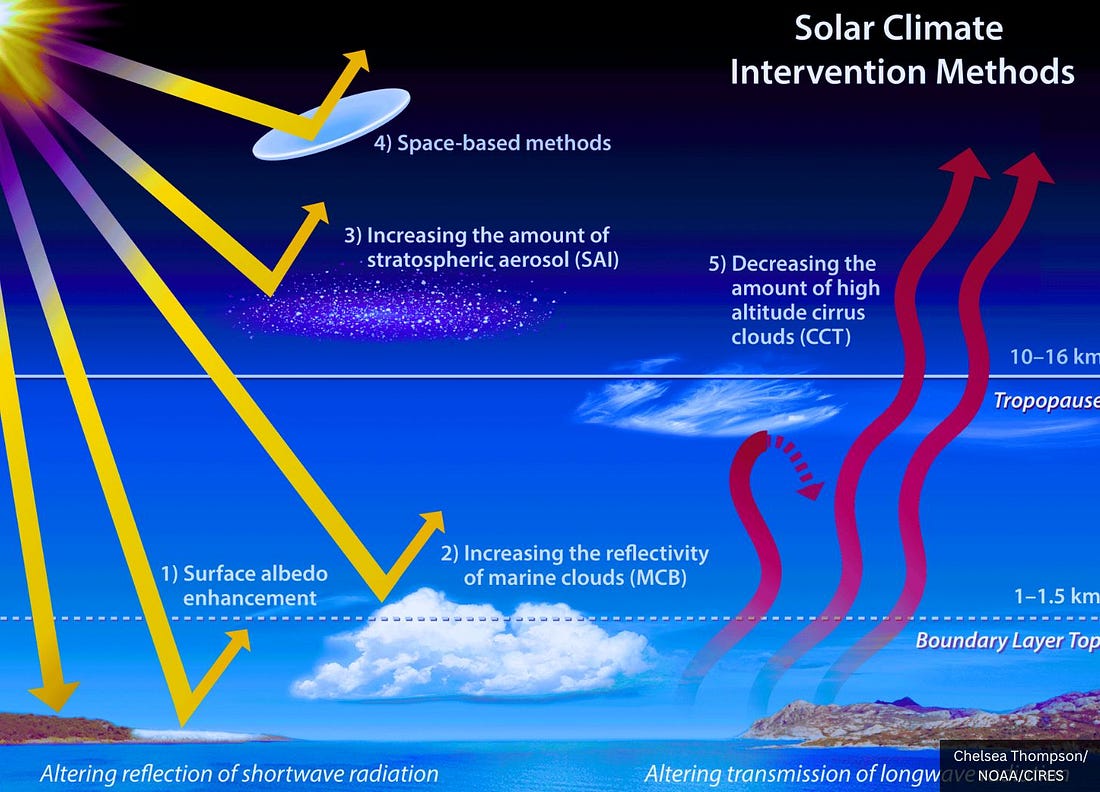
A new peer-reviewed Scientific Reports paper published last week from Columbia University scientists delivers a devastating blow to solar geoengineering, the controversial practice of attempting to cool the planet by spraying sunlight-reflecting particles into the upper atmosphere to block or deflect incoming solar radiation.

The technique is known as ‘stratospheric aerosol injection’ (SAI).

SAI is a form of ‘solar radiation modification’ (SRM), a practice that official White House documents acknowledge is being funded both “covertly and openly.”

But the stratosphere should not be confused with the troposphere.

The troposphere is where the FAA, NASA, and NOAA admit metal nanoparticle- and sulfur-containing commercial jet emissions produce—when the air at altitude is cold and wet enough (Schmidt-Appleman Criterion)—visible lines that linger, disperse, and block the sun and sky.

These tropospheric sun- and sky-blocking emissions are sometimes referred to as “chemtrails.”

SAI is different in that it deliberately targets the stratosphere, a much higher and more stable layer of the atmosphere, with the explicit goal of altering temperatures worldwide.

SAI is not a byproduct of aviation, but a planned, large-scale climate intervention intended to reflect sunlight away from Earth.

While commercial aviation-caused weather manipulation—what could be called apparently accidental tropospheric aerosol injection (TAI)—occurs year-round and all over the world, SAI refers to the deliberate, large-scale injection of reflective particles into the stratosphere.

Unlike TAI, SAI is an experimental practice reportedly still limited to a small number of government- and university-backed projects.

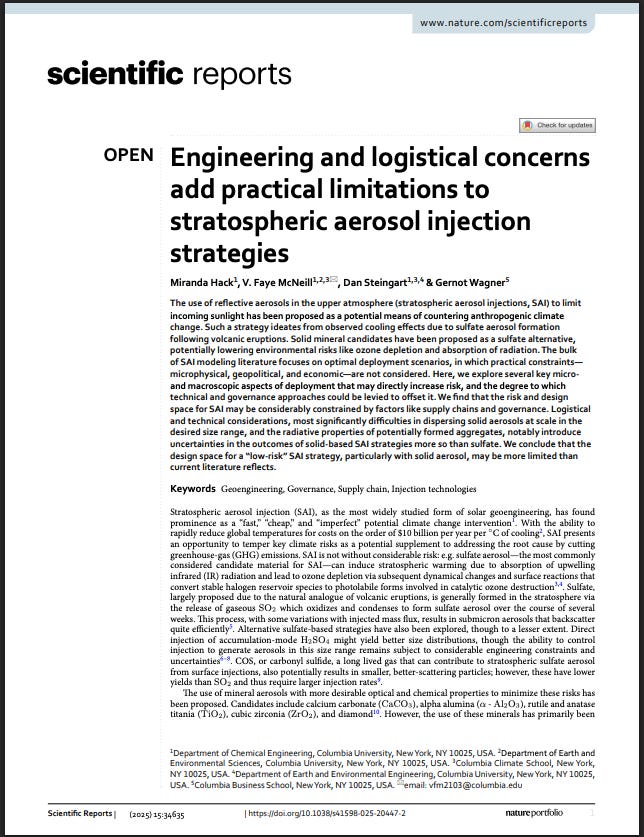
The new study, titled “Engineering and logistical concerns add practical limitations to stratospheric aerosol injection strategies,” confirms that spraying reflective particles into the atmosphere to cool the planet is not only impractical—it’s dangerous.

The authors conclude bluntly that “the design space for a ‘low-risk’ SAI strategy, particularly with solid aerosol, may be more limited than current literature reflects.”

Once real-world physics, economics, and governance are factored in, the entire concept collapses.

The findings come as Israeli-U.S. geoengineering company Stardust Solutions announces a $60 million fundraising round for its efforts to block the sun by spraying particles—the composition of which has not been disclosed by the company—into the atmosphere as soon as April 2026.


The Case Against Climate Change Alarmism

Geoengineering efforts are carried out in the name of so-called “climate change,” the long-debunked near-religious belief system that treats Earth’s temperature shifts as a crisis so severe it warrants experimental manipulation of the atmosphere.

Climate alarmists, who often support geoengineering, argue that human activity is driving a global carbon crisis.

Yet their entire premise rests on the claim that mankind’s carbon emissions are powerful enough to destabilize the Earth’s climate.

However, man’s carbon contribution makes up only about 4% of the atmosphere’s already minuscule 0.04% carbon dioxide.

That means the entire climate panic hinges on the idea that a human-made fraction of a fraction of a trace gas—about four one-hundredths of one percent of the air we breathe—controls the planet’s temperature.

In reality, nature drives changes in climate—not man.

A peer-reviewed Geomatics study by Ned Nikolov and Karl Zeller confirms that recent warming of the Earth is driven entirely by changes in solar energy and Earth’s reflectivity—not carbon dioxide.

That study showed that variations in sunlight and cloud-cover account for 100% of the observed warming trend and calling for “a fundamental reconsideration” of the carbon-based climate narrative.

Moreover, a peer-reviewed Sci journal study found that natural temperature-driven processes—not human activity—dominate the carbon cycle, concluding that “no signs of human (fossil fuel) CO₂ emissions can be discerned” in over 40 years of atmospheric data and that mankind’s contribution plays only a “minor role” in recent climatic evolution.

A recent Science study—even praised by The Washington Post as the most rigorous reconstruction of Earth’s climate history—confirms that the planet is now in its coolest state in 485 million years, with ancient global temperatures once reaching nearly 97°F, far hotter than today’s 59°F average.

Finally, a review of 50 years of environmental “doomsday” predictions shows that not one has come true, exposing climate alarmists and government-backed “experts” as having a 0–50 record of failed eco-apocalyptic forecasts despite decades of media hype.

Taken together, the data dismantle the narrative entirely—proving that Earth’s climate has always been driven by natural solar and atmospheric cycles, not by humanity’s trace emissions, and that today’s “crisis” is nothing more than a manufactured pretext for international control masquerading as science.

1. Unrealistic from the Start

The Columbia team exposes what most geoengineering models hide: they assume perfect machines and global cooperation that don’t exist.

The study reads:

“The bulk of SAI modeling literature focuses on optimal deployment scenarios, in which practical constraints—microphysical, geopolitical, and economic—are not considered. Here, we explore several key micro- and macroscopic aspects of deployment that may directly increase risk, and the degree to which technical and governance approaches could be levied to offset it. We find that the risk and design space for SAI may be considerably constrained by factors like supply chains and governance.”

In plain language, the science propping up geoengineering depends on computer scenarios that ignore engineering limits, political chaos, and the laws of physics. Once those are included, the so-called “solution” becomes an uncontrollable global hazard.

2. The Engineering Failure

At the core of the problem is physics.

The solid particles proposed for stratospheric spraying—calcium carbonate, alumina, titanium dioxide—can’t be aerosolized properly.

The Columbia researchers write:

“Due to the solid aerosol candidates’ high density and small primary particle size, these are classified as Geldart Group C “hard to fluidize” materials, meaning they resist flowing along with a gas as primary particles, instead forming large (several microns) agglomerates. Cohesive intermolecular forces tend to hold primary particles together, and as primary particle sizes decrease, these cohesive forces tend to decrease less significantly than opposing forces in a gas flow, resulting in agglomerates that resist breakup.”

These particles stick together and form heavy clumps instead of spreading into a fine reflective mist.

That means they fall too quickly and fail to scatter sunlight.

The only way to break them apart, the researchers found, would require aircraft equipped with massive high-pressure compression systems.

“High pressure, slower-moving gas is clearly necessary to impart sufficient drag on an agglomerate, indicating the need for some sort of heavy-duty (> 100-fold pressure increase) in-flight air compression system, or the on-board transport of a highly pressurized carrier gas, which may impact economic assessments of costs for injection, as well as potential safety concerns. Additionally, at higher solid mass fractions, Weber numbers near the throat are reduced, a result of the coupled nature of the solid and gas momentum equations, which limits the ability of gas-particle laden systems to reach Mach 1 at the nozzle throat. If such a nozzle dispersal approach were adopted, this may reduce possible solid dispersal rates (as suggested by literature) additionally increasing injection costs by decreasing the total amount of aerosol able to be injected per flight. Estimates for cost of sulfur-based deployments stem nearly entirely from aircraft-related expenses, making such decreases in payload likely to significantly impact costs.”

In other words, the equipment doesn’t exist.

And even if it did, the cost and safety risks would be prohibitive.

3. The Optical Collapse

The paper shows that even if particles somehow reached the stratosphere, their reflectivity would vanish almost instantly once they agglomerate.

“Generally, larger aggregates scatter less efficiently, as expected for increasing optical size parameters. Fractal dimension appears to play a role in aggregate scattering efficiency. For aggregates with fractal dimensions greater than 1.5 (i.e. less branched fractals), reductions in SW forcing efficiency are less severe. For fractals with = 1.1, aggregates quickly reach a near-0 forcing efficiency as they coagulate. These large aggregates would sediment quickly, requiring increased injection rates alongside larger burdens to achieve the same degree of shortwave forcing as optimal monomers.”

The larger the clump, the less sunlight it reflects and the faster it falls out of the atmosphere.

The authors admit that these “fractal aggregates” could turn supposed cooling particles into heat-absorbing ones.

That means geoengineering could accelerate warming instead of slowing it.

“In the absence of a more advanced understanding of stratospheric dispersion and coagulation dynamics, a solid injection strategy is suboptimal compared to sulfate purely on the basis of relatively high risk-risk magnitudes (e.g. significantly reduced shortwave fractal scattering efficiency and lifetimes) with poorly constrained risk likelihoods. In the case of perfect injection and dispersion (e.g. monomer dispersal), solids do have the capability to lower sulfate-associated risk. However, a less-optimal solid injection and dispersion strategy, in which aggregation occurs, extends the risk space significantly beyond the lower bound of most sulfate scenarios.”

They conclude that even the “safer” solid minerals are riskier than sulfates—the same compounds that destroy ozone after volcanic eruptions.

4. Not Enough Raw Materials on Earth

The supply-chain analysis is equally damning.

The authors calculate that to sustain a global aerosol program, demand for minerals like zirconia and industrial diamond would exceed current global production.

“Based on current market production, candidates like ZrO₂ and diamond (here, industrial) would be subject to demands greater than or close to their current supply, increasing likelihoods for demand-pull inflation in these supply chains. Candidates like CaCO₃TiO₂Al₂O₃ and SO₂ may be less subject to such constraints given more robust supply compared to potential increases in demand.”

“In comparison, less-elastic supply chains may be subject to inflated prices without a significant compensating drop in demand, whether this is due to a lack of suitable alternatives and/or a less flexible need for that commodity. However, given that the supply for these candidates—with the exception of diamond—tend to generally be fairly robust compared to the requisite masses for the SAI strategy considered here, changes to demand may not be noteworthy. Larger-scale SAI strategies (e.g. offsetting all warming; more extreme GHG scenarios) or less effective strategies (e.g. uncoordinated deployment with reduced lifetimes and resultantly higher injection rates, aggregate formation) could easily increase demand by 2–10x, making strain on inelastic supply chains like lime, sulfur or alumina significant.”

Even abundant materials like lime and alumina would face massive price inflation.

The paper calls these resources “inelastic,” meaning production can’t scale without disrupting entire industries.

In short, geoengineering would cannibalize global manufacturing to feed an experiment that can’t work.

5. A Governance Nightmare

The study warns that stratospheric injection would require absolute international coordination—something the world has never achieved.

Without it, the outcome is chaos.

“An uncoordinated, decentralized scenario does not yield the control required to optimize these parameters, resulting in aerosols with shorter lifetimes and poorer radiative properties, increasing requisite burdens, lifetimes, and associated risks.”

If one nation or private actor launched its own spraying campaign, the result would be uneven aerosol coverage, shifting rainfall patterns, and unpredictable climate disruptions.

The authors stress that decentralized deployment would magnify every risk factor simultaneously.

6. The Fatal Admission

After hundreds of pages of technical analysis, the authors concede that no version of stratospheric aerosol injection can be considered “low-risk.”

“We here show that logistic constraints favor sulfate on the basis of fewer uncertainties and a more well-defined risk space that is relatively invariant with price.”

“These practical limitations, if left unaddressed, push SAI scenarios further away from the idealized scenarios explored in the literature. A more complete understanding of “worst-case” tropospheric climate impacts through GCM model runs that simulate aggregate injection might better contextualize these results and allow for a more complete risk-risk picture. Critical here, as well, is a better understanding of how solid aerosol microphysics will lead to aggregation post-dispersal, which may further lower the upper bound on feasible solid injection rates, increasing costs. Quantifying the (relative) risk-cost trade-off of solid monomer dispersal – that is, the increase in cost for reduced payloads – will better inform the likelihood of the acceptance of increased costs in exchange for potentially lowered environmental risk. Moreover, the eventual risk of any SAI strategy ultimately will be bound by how it is governed and deployed.”

Even the least bad option—sulfate aerosols—comes with well-known ozone destruction and atmospheric heating effects.

The supposed “improvements” offered by solid particles only add new dangers and higher costs.

Their closing words admit what critics have long argued:

“The development of technical and governance-based approaches to mitigate risks associated with deployment strategy, candidate selection, and aggregate injection is critical to the design or discussion of any realistic ‘low-risk’ SAI strategy.”

In other words, no realistic “low-risk” plan exists.

Bottom Line

The Columbia University study leaves no ambiguity: solar geoengineering is a scientific, logistical, and moral failure.

  • The physics doesn’t work: the aerosols can’t disperse properly, and the particles clump together before they ever achieve their intended effect.
  • The optics don’t work: once these agglomerates form, their ability to reflect sunlight collapses, turning a supposed cooling mechanism into a potential heat trap.
  • The economics don’t work: raw materials like zirconia, alumina, and even industrial diamond would be exhausted or inflated beyond practical reach, cannibalizing entire industries just to maintain a fantasy.
  • The governance doesn’t work: any unilateral spraying effort by a corporation or country would create global chaos, altering rainfall patterns and climate systems with no way to reverse the damage.

Even the authors’ own conclusions confirm it.

Their words make clear that no “low-risk” version of stratospheric aerosol injection exists.

The most “feasible” material, sulfate—the same compound responsible for volcanic ozone depletion—remains dangerous, unstable, and costly.

Meanwhile, the justification for these experiments rests on a collapsing foundation: a half-century of failed climate predictions, peer-reviewed studies showing natural solar variation—not human carbon emissions—drives global temperature change, and empirical data confirming the planet is in its coolest period in nearly half a billion years.

The combined evidence dismantles the alarmist narrative entirely.

What remains is not science, but ideology—a technocratic attempt to seize control of Earth’s systems under the guise of saving them.

In reality, geoengineering is not a climate solution.

It’s a catastrophe waiting to happen: a reckless experiment on humanity’s only home, built on fear, false science, and financial ambition.

DOE Report Upends Climate Alarmism: CO2 Not the Villain We Were Told


The intellectual foundation of modern climate policy rests on a shaky assumption: that anthropogenic carbon dioxide emissions, left unchecked, will wreak unmanageable havoc on the Earth’s climate and economy, and that radical mitigation is the only path forward. This assumption has been treated not as hypothesis but dogma, one that brooks no dissent. Yet, on July 29, 2025, the Department of Energy (DOE) disrupted this orthodoxy with a quietly released but tectonic report, A Critical Review of Impacts of Greenhouse Gas Emissions on the U.S. Climate. Its findings deserve our undivided attention.

Developed by the 2025 Climate Working Group under Energy Secretary Chris Wright, this report evaluates the empirical record, existing literature, and widely cited models of climate change and its impact. It issues a sober verdict: the harms of CO2-induced warming are overstated, the benefits underreported, and the United States’ costly mitigation policies amount to symbolic gestures with virtually no measurable effect on global climate trajectories.

Pause on that last point. The United States is often urged to lead the world in climate action, regardless of cost or efficacy. But as the DOE report makes clear, our domestic efforts will have “undetectably small direct impacts on the global climate” and whatever marginal effects might accrue would only unfold over centuries. That is not policy, that is performance art.

The report’s challenge to prevailing climate dogma is not confined to global impact. Its most devastating conclusion lies in the economic analysis. CO2-induced warming, it asserts, is less damaging economically than conventionally believed. Why? For one, the benefits of carbon dioxide, especially in enhanced plant growth and agricultural productivity, have been systematically minimized. Atmospheric enrichment with CO2, the molecule that every leaf on Earth craves, has produced tangible greening of the planet, as satellite data has repeatedly confirmed. The report notes that elevated CO2 levels are associated with longer growing seasons, higher crop yields, and improved drought resistance.

To this, some will object: but what about the disasters? The hurricanes, the wildfires, the floods and droughts? Here, too, the DOE report punctures myth with data. Trends in extreme weather, whether hurricanes, tornadoes, or droughts, do not show a statistically significant increase in frequency or intensity in the US. The belief that climate change is driving more disasters is not borne out by the nation’s own historical record. The pattern is familiar: catastrophic headlines dominate the news cycle, but peer-reviewed long-term data often reveals no clear signal.

What the report urges us to reconsider is not science per se, but scientific selectivity. Which studies are emphasized, which outcomes are modeled, which scenarios are dramatized, these are not neutral choices. They reflect a politicization of climate discourse that has ossified around worst-case predictions. The DOE’s panel of independent scientists, drawing on physical science, climate modeling, economics, and academic research, concludes that aggressive mitigation strategies could be more harmful than beneficial.

Why? Because such policies incur massive economic costs today in exchange for theoretical benefits centuries in the future. The social cost of carbon, a number derived from notoriously elastic models, is used to justify expansive regulation and taxation. But the opportunity cost of mitigation is rarely tallied. The DOE report points to harms from these policies: deindustrialization, energy poverty, manufacturing flight, and disproportionate burdens on low-income families. In seeking to avert a hypothetical crisis tomorrow, we are creating a very real one today.

Consider Germany’s “Energiewende” experiment. Once celebrated as a model for renewable transition, it has left the country with some of the highest energy prices in the world, increased coal usage, and stagnating industrial output. That is not progress; that is regression clad in moral virtue.

The DOE report does not deny climate change. Rather, it questions whether the response, especially by the US, acting alone, is rational, proportional, or effective. A sound policy approach would weigh benefits against costs, factor uncertainty, and consider adaptation as a co-equal strategy. It would recognize that prosperity, technological advancement, and institutional resilience are the most reliable defenses against climate risk.

And what of the global context? China emits more CO2 than the US and EU combined, and continues to expand its coal fleet. India, rightly prioritizing growth and poverty alleviation, follows a similar path. Even under idealized global mitigation scenarios, temperature effects remain marginal for decades. If the goal is climate stability, US policy must reckon with this reality.

There is a deeper lesson here about humility. Climate models are not oracles, and long-range forecasts are fraught with uncertainties. The Intergovernmental Panel on Climate Change (IPCC) itself acknowledges the “deep uncertainty” surrounding cloud feedbacks, ocean cycles, and aerosol effects. Yet policymakers cling to worst-case models like RCP8.5 as if they were certainties. The DOE report reminds us that science, when honest, acknowledges what it does not know.

The economic modeling is equally uncertain. How do we quantify the benefit of a slightly cooler planet in 2150? How do we discount the loss of economic growth, technological progress, and human well-being between now and then? These are not simple equations. They are philosophical judgments smuggled into spreadsheets.

One need not reject the premise of climate change to accept the report’s conclusion. One need only accept that climate risk exists alongside other risks—economic, geopolitical, social. A rational society does not bankrupt itself to prevent a hypothetical future while ignoring the very real suffering of its present.

This report ought to serve as a corrective. It does not deny that CO2 has climatic effects, but it insists we view those effects in context. It challenges the catechism of decarbonization as the sole moral and practical imperative. It urges policymakers to consider adaptation, resilience, and economic growth as indispensable tools in managing a changing climate.

To those who regard such conclusions as heresy, consider this: Truth does not fear scrutiny. If the consensus is as solid as claimed, it should welcome a challenge from a panel of independent scientists operating under a federal mandate. That is how science progresses, not through suppression, but through argument.

The American people deserve more than theatrical virtue-signaling. They deserve climate policies rooted in realism, not alarmism; in cost-benefit analysis, not eschatology. The DOE report offers a roadmap. We would do well to follow it.

It’s time to put Earth Day to bed and get on taking care of God’s creations


It seems that some people/organization leaders have either not awakened to the truth or want to try to keep the funds coming in in a fight against the non-extent fear of Global Warming.  It would be (it is) easy to dig deep – back to the early days of Earth Day and find out where the upside-down science came from. Why have the purveyors of” Man-made global warming is destroying the earth, so we must rid the earth of most humans and Oh, take control of every aspect of life on earth as well, pushed this nonsense?

It all began because some people wanted to control the entire world. They found each other and began planning how to achieve world-dominance.

Cecil Rhodes, in his Confession of Faith, is credited with the idea of recapturing the United States for the British Empire. This idea was to lead to the United Nations and all the necessary steps to erase nationalism and establish a one-world order. And many steps there were, as you can imagine – from setting up eleemosynary (in name only) organizations/foundations 1 that would form the basic tools of public/private/partnerships associated with the United Nations to reinvent governments around the world – especially the constitutional American one.

In order to scare the pants off us – enough to be willing to do almost anything to rid the world of excess CO2 (which actually keeps us alive) – the powers-that-be on both sides of the political aisle – have fed us lies as facts, lies that tell us if we don’t reduce the earth’s population by over 95%, quit eating meat, quit using fossil fuels. There’s a huge list of forbidden activities if we want to save Mother Earth and her non-human inhabitants. 2

CFACT’s climate specialist, Marc Morano, pointed out, “We can’t distinguish between natural variability and human impact”. (note: this short piece spells it out, short but not at all sweet.. 

Oh, yes, there really are climate scientists who wholeheartedly disagree with the supposed findings that spurred the Global Biodiversity Assessment. The original study of Global Warming didn’t show that we were facing a dire future. A letter signed by over 50 leading members of the American Meteorological Society warned about the policies promoted by environmental pressure groups. “The policy initiatives derive from highly uncertain scientific theories. They are based on the unsupported assumption that catastrophic global warming follows from the burning of fossil fuel and requires immediate action. We do not agree.” 3

From day one, honest scientists have been telling us “Global warming” was a hoax. And ever since, we get intermittent articles reminding us. For example, in 2007, the U.S. Senate Committee on Environment and Public Works put out a news release stating harsh sound facts: 

“Anthropogenic (man-made) global warming bites the dust,” declared astronomer Dr. Ian Wilson after reviewing the new study which has been accepted for publication in the Journal of Geophysical Research.  Another scientist said the peer-reviewed study overturned “in one fell swoop” the climate fears promoted by the UN and former Vice President Al Gore. The study entitled “Heat Capacity, Time Constant, and Sensitivity of Earth’s Climate System,” was authored by Brookhaven National Lab scientist Stephen Schwartz.

I think what we are seeing is an intense drive to bring back the lies the globalist elite and their toadies have promulgated for far too many decades. We have a window here that we must take advantage of a window that is open to sound science, reason, logic, and rule of law. Almost all of the tenets we believe in, based our values, attitudes, and beliefs on have been under attack by Socialist one-worlders who have been free to brainwash, program, and indoctrinate across the spectrum of venues from the schools to the churches to the mainstream media  — even our courts and governments.

Now it truly is time to write and speak the truth of global warming. It is time for reason and logic to prevail over it all.

Sources:

  1. The foundation’s power is the power of money.
  2. Ski runs, grazing of livestock, disturbance of the soil surface, fencing of pastures or paddocks, agriculture, modern farm production systems, chemical fertilizers, herbicides, building materials, industrial activities, human-made caves of brick and mortar or concrete and steel, paved and tarred roads, highways, railroads, floor and wall tires, aquaculture, technology improvements, farmlands, rangelands, hunting, sewers, drain systems, pipelines, fisheries, golf courses, scuba diving, synthetic drugs, List from the Global Biodiversity Assessment Report by the United Nations
  3. https://scholar.google.com/sreascholar_lookup?journal=World%20Climate%20Review&title=Conspiracy,%20consensus%20or%20correlation?%20What%20scientists%20think%20about%20the%20%E2%80%98popular%20vision%E2%80%99%20of%20global%20warming&author=P%20Michaels&volume=1&publication_year=1993&pages=11&

Why Western Europe Is Literally Returning to the Dark Ages


A line of people stretched for blocks at a bus stop at Cibeles Square in downtown Madrid as subway and trains went totally out of service Monday. Power went out across all of Spain and Portugal and parts of France and Belgium, cutting cellphone and internet networks, halting trains and trapping people in elevators.

A line of people stretched for blocks at a bus stop at Cibeles Square in downtown Madrid as subway and trains went totally out of service Monday. Power went out across all of Spain and Portugal and parts of France and Belgium, cutting cellphone and internet networks, halting trains and trapping people in elevators. (Thomas Coex – AFP / Getty Images)

In between the fall of the Roman Empire and the birth of the Italian Renaissance, Western Europe economically stagnated and culturally declined in what are commonly called the Dark Ages.

This period, which lasted several centuries, has become known as the Dark Ages primarily because societal advancements and human progress generally ceased as sound science, facts, and the truth were disregarded by elites who sought power and control.

Sadly, Western Europe is treading down this road again.

few days ago, Spain, Portugal, and parts of France and Belgium literally went dark for hours after a massive power disruption led to a system-wide grid collapse.

More than 50 million people were left without electricity. Traffic signals did not work, causing chaos on the roadways. Subway systems couldn’t function, leaving people stranded wherever they were. Stores and businesses closed, as payments were limited to cash only. Mobile phone service was spotty, rendering smartphones almost useless and making rapid communication impossible. Even some hospitals and medical facilities, which generally have backup generators, were left without power.

In other words, modern life nearly ground to a total halt for tens of millions of people in some of the most advanced nations and cities in the world.

The reason this dreadful event occurred is that Western European elites have rejected sound science, common sense, and the truth in favor of climate alarmism.

It is no great surprise that Western Europe is the undisputed world champion when it comes to pushing the so-called green agenda. From the Paris Accords to the UN’s heavy-handed role in supporting the climate alarmism narrative over the past several years, Western Europe is ground zero when it comes to climate-change zealotry.

Therefore, it should also come as no surprise that the cause of Europe’s biggest power outage in modern history occurred in Spain, which is a darling of the green movement because it generates more than half of its power from wind and solar.

Specifically, two solar power plants in southwest Spain experienced a sudden and steep reduction in power generation, triggering a systemic collapse of grid infrastructure that occurred almost instantly.

Put simply, it is absurd to assume that a modern nation like Spain can power itself primarily via renewable energy.

As everyone knows, the sun doesn’t always shine, and the wind doesn’t always blow. This obvious fact means that renewable energy sources have an Achilles heel in that they are intermittent by nature.

It is also true that there is not nearly enough battery storage capacity to keep extra power on hand when these sources are not providing reliable power.

Despite these clear shortcomings, European elites have insisted that renewable energy must be adopted as soon as possible. From net-zero madness to ESG scores, Europe has been at the vanguard of eliminating affordable and reliable energy in favor of unaffordable and unreliable so-called green energy.

What makes this whole climate alarmism narrative even more nonsensical is the fact that so-called green energy is not environmentally friendly. Scores of reports and studies show that huge solar panel fields and gargantuan wind turbines produce a host of environmental problems, such as habitat destruction, wildlife loss, etc. After these massive structures meet their shelf life, which is typically only a decade or so, they are also impossible to recycle.

I am more than confident that the very elites who have been pushing the green movement for the past many years are completely aware of these matters, however, they have chosen to forge ahead, undaunted by these pesky facts.

This leads me to believe that they do not intend nor desire to “save the planet.” It also makes me much surer that they are not interested in improving the lives of hardworking, middle-class Europeans. If that were the case, they would have abandoned the green energy nonsense long ago.

With that being said, I can’t help but wonder if their actual intent is to increase their power and control.

Europe, unlike the United States, has a very long history of wealthy elites wielding outsized power and control in a system rigged against the masses. In many instances, these elites have conspired to create zero-sum systems in which they win, and the rest lose.

Make no mistake, Western European elites are committed to forcing their climate alarmist agenda upon the masses, whether they like it or not.

As such, we must underscore the sheer stupidity of their ridiculous, yet sinister, plan to replace reliable, affordable, and abundant energy with unreliable, unaffordable, and environmentally destructive power sources that are wholly dependent on sunny and windy conditions.

The Factual Context for Climate and Energy Policy


Virtually all climate policy discussions assume that climate science compels us to make large and rapid reductions in greenhouse gas emissions. But any realistic policy must balance the hazards, risks, and benefits of a changing climate against the world’s growing demand for reliable, affordable, and clean energy. To strike that balance, climate policymakers will consider society’s values and priorities, its tolerance for risk, equities among generations and geographies, and the efficacy, costs, and collateral impacts of any policy. This paper reviews some of the scientific, techno-economic, and societal facts and circumstances that should inform those policy decisions and draws some straightforward conclusions from them.

CLIMATE IMPACTS

Projections of the impacts of future climate changes rely on assumptions about future greenhouse gas emissions fed into large computer models of the ocean and atmosphere. Although those models can give a hazy picture of what lies before us at the global scale, their deficiencies on smaller scales are legion. For example, two senior climate researchers firmly within the scientific mainstream have said this:

For many key applications that require regional climate model output or for assessing large-scale changes from small-scale processes, we believe that the current generation of models is not fit for purpose.1

That’s particularly important because adaptation measures depend upon regional model projections. One of the same senior researchers noted the following:

It is difficult, and in many places impossible, to scientifically advise societal efforts to adapt in the face of unavoidable warming. Our knowledge gaps are frightful because they make it impossible to assess the extent to which a given degree of warming poses existential threats.2

Users of the model output similarly caution about being overly credulous:

The use of these [climate] models to guide local, practical adaptation actions is unwarranted. Climate models are unable to represent future conditions at the degree of spatial, temporal, and probabilistic precision with which projections are often provided, which gives a false impression of confidence to users of climate change information.3

Even if we can’t rely on unvalidated climate models, we can get some sense of how the world has fared under a changing climate by looking back to 1900. Since that time, the globe warmed 1.3°C, about as much as the Intergovernmental Panel on Climate Change (IPCC) predicts will occur in the next century under moderate future emissions. But even as the globe warmed and the population quintupled, humanity prospered as never before. For example, global average lifespan went from thirty-two years to seventy-two years, economic activity per capita grew by a factor of seven, and the death rate from extreme weather events plummeted by a factor of fifty! Any assertion that a similar warming over the next century will be catastrophic is implausible and finds little support in either IPCC science assessments or the underlying scientific literature and data.

Although climate varies a lot on its own, many still allege that we’ve broken the climate in the past few decades. Yet table 12.12 of the most recent IPCC report (AR6 WG1) shows it’s hard to find long-term global trends in most types of extreme weather events, including storms, droughts, and floods. And economic loss rates have declined slightly over the past thirty years, averaging about 0.2 percent of global GDP.4 A wealthier world is a more resilient world.

Perhaps future climates will be a lot worse. But the United Nations (UN) projects substantial economic growth, even for an emissions-heavy future. The IPCC’s 2014 Fifth Assessment Report said the following in chapter 10:

For most economic sectors, the impact of climate change will be small relative to the impacts of other drivers (medium evidence, high agreement). Changes in population, age, income, technology, relative prices, lifestyle, regulation, governance, and many other aspects of socioeconomic development will have an impact on the supply and demand of economic goods and services that is large relative to the impact of climate change.5

Subsequent research has confirmed that warming is expected to be a minor hinderance to growth—a few degrees of warming by the end of the century would make the growing economy a few percent smaller than it might have been.6 For example, if the US economy were to grow at an average annual rate of 2 percent, it would be four times larger seventy years from now. A climate impact of, say, 4 percent would reduce the growth from 400 percent to 384 percent, a change much smaller than our ability to project that quantity. Of course, there are uncertainties in these projections, GDP is not the only
measure of well-being, and the rich will fare better than the poor. But the term ‘existential crisis’ is hardly justified.7

Another form of “climate impact” is the disruption caused by large and rapid reductions in greenhouse gas emissions. William Nordhaus’s work showed that there is an optimal pace to reduce emissions: moving too quickly causes turmoil and deploys immature technologies. His 2018 Nobel lecture stated that an economically optimal decarbonization could let the global temperature rise in 2100 exceed 6°C (quadruple the Paris Accord guardrail of 1.5°C!). Of course, that’s based on assumptions that can be, and have been, challenged, but Nordhaus’s main takeaway is “don’t panic”—take the time to reduce
emissions gracefully.8

MORAL CONSIDERATIONS

To paraphrase the best climate science can tell us, something very bad might happen—but we do not know exactly what, or precisely when, or just how bad it is going to be. Developed countries fret about that “climate threat” and therefore urge prompt, large-scale action to reduce global emissions. But that vague, uncertain, and distant threat is hardly compelling for most of the world, which has many more certain, immediate, and soluble problems.

The 1.5 billion people in the developed world enjoy abundant and affordable energy. But the globe’s other 6.5 billion don’t have enough energy. The inequalities are astounding. Americans consume thirty times more energy per capita than Nigerians. And 3 billion of the world’s 8 billion people use less electricity every year than does the average US refrigerator. Energy poverty also means cooking with wood and dung, and smoke in the kitchen kills some 2 million people each year.

Global energy demand is predicted to increase 50 percent by midcentury as most of the world develops. Fossil fuels are the most reliable and convenient way for developing nations to get that energy, as they long have been for everyone; coal, oil, and natural gas providing about 80 percent of the word’s energy today. And so global emissions will persist in coming decades, even as the developed world’s emissions decline slowly. Just to stabilize, let alone reduce, humanity’s warming influences at an allegedly safe level, emissions must vanish in the latter half of this century.

Reliable and affordable energy is the overwhelming priority for developing nations. So, when they’re told that the science compels us, their clear response is What do you mean by “us”? We hear the Indian prime minister protest that the path for development is being closed to developing nations, while Niger’s former president says Africa is being punished by Western decisions and will fight to exploit the fossil fuels it has.9

There are moral issues when the developed world seeks to deny developing nations the energy they need, restraining economic progress by mandating costly and ineffective energy systems, particularly if the developed countries are not going to pay a “green premium” for low-emission technology from their already stretched budgets.

A very different immorality arises from continued exaggerations like science compels, which induce eco-anxiety. Some 60 percent of young people globally are very worried about climate change, and many are reluctant to have children.10

•••

The facts and figures about climate and energy that I have laid out show that the world will not get to net zero emissions by midcentury and that net zero by 2100 would be a heroic achievement. But they also show that the world isn’t facing climate catastrophe. If advocates continue to exaggerate the importance and urgency of reducing emissions at the expense of more immediate and tangible societal needs, what will the public think as the world continues to fall short of its emissions goals yet continues to prosper?

TECHNO-ECONOMIC REALITIES

Energy systems are recalcitrant for good reasons. These systems involve massive investments in assets that last decades, their parts need to work together (for example, cars, fuel, and the fueling infrastructure must all be compatible), and there are many stakeholders whose interests don’t often align. It also takes time to refine the hardware and operating procedures that ensure high reliability. So, energy systems are best changed slowly and steadily over decades—more like orthodontics than the tooth extraction
implied by large and rapid reductions.

Reducing emissions from energy systems will involve electrifying most transportation and heat while transitioning to a zero-emissions electrical grid. Although electric vehicles and industrial heat pose their own challenges, this paper focuses on the linchpin of the strategy, decarbonizing the grid.

The electrical grid must reliably deliver electricity. The wind turbines and solar panels so much in vogue are indeed today’s cheapest ways of producing electricity. Unfortunately, they are unreliable: solar panels don’t produce at night, and the wind comes and goes hourly. So there has to be a reliable backup system for when the renewables fail—technologies such as natural gas with carbon capture or nuclear power or some form of storage (like giant batteries).

Reliable backup isn’t too expensive in day-to-day operations. But there are infrequent occasions, up to two weeks long, when neither wind nor solar will generate much. Those times are so important the Germans coined a word for them: dunkelflaute—a dark stillness. Dunkelflauten are documented in all locales with significant deployment of renewables, including the UK, Germany, Texas, and California.

To ride through those long dunkelflauten, the backup grid must be at least as capable as the wind and solar alone, and hence at least as expensive. In other words, the most expensive part of a renewables-heavy grid is reliability, and it becomes more and more expensive as the reliability requirement becomes more stringent.

The cost of reliability can be estimated by models that subject different grids (i.e., mixes of storage, gas, nuclear, wind and solar generation) to historical hour-by-hour weather and demand data. One such study of the US grid demanding >99.99 percent reliability (roughly today’s federal standard) showed that natural gas with or without carbon capture would be the cheapest, and that grids with only wind and solar generation and various forms of storage would be at least two or three times more costly.11

So, it is incorrect, and entirely misleading, to assert that a renewables-heavy grid will be cheap—unless you’re okay with poor reliability. And it’s reasonable to ask, If the backup system needs to be so capable, why have renewables at all? In short, wind and solar can never be more than an ornament to more reliable technologies.

Solar and wind generation have other drawbacks. They need a lot more land because sunlight and wind are much less concentrated than fossil or nuclear energy.12 To produce the same electricity, wind takes four times as much land as gas, seven times as much as coal, and thirty times as much as nuclear. And you need to cover that land with enormous structures. To produce the same amount of electricity, wind takes ten times as much concrete and steel as nuclear.13

Renewable energy technologies also use a lot more high-value materials, such as copper, molybdenum, and dysprosium, because they need to be very efficient.14 An electric car uses almost seven times as much high-value materials as a conventional car, while onshore wind generation uses almost nine times as much as natural gas.

Unfortunately, those high-value materials and their processing are concentrated in inconvenient countries. The Democratic Republic of the Congo produces 75 percent of the world’s cobalt, while China is a major player in extracting rare earths and graphite and in processing an array of critical minerals.

And although China uses less than 40 percent of the world’s solar panels, it makes 75 percent of all panels, 97 percent of the wafers, 85 percent of the cells, and 79 percent of the polysilicon.15 Chinese manufacturing costs are lower due to cheap (coal-fired) electricity, loose environmental standards, and forced labor.16 The US government has imposed sanctions on some Chinese material for solar panels, which has driven up costs.17 And the Inflation Reduction Act begins an effort to onshore or “friend shore”
the supply chains for critical minerals.18

But some of the drawbacks of fossil fuels that disturb many people would still be there in a high-renewables world—there will still be international trade to lower commodities costs. And there will still be pollution from extracting and processing the enormous quantities of materials that renewables require. However, since critical minerals are input to the manufacture of energy equipment, disruption of one of those supply chains would not have the immediate impact that disruption of a fossil fuel would entail.

In addition, renewables may not remain the cheapest form of generation. If wind, solar, electric vehicles (EVs), and the like are deployed at the envisioned pace, mineral supplies will have a hard time keeping up. For example, by the middle of the next decade, copper demand is expected to double, but the supply will be 20–25 percent short because new mines will have lower quality ore and take sixteen years to start up.19

SUMMARY

A dispassionate look at trends in demographics, development, and energy technology shows that global net zero by 2050 is a fantasy and that it’s quite unlikely even by 2100. But also, the consequences of missing that goal will hardly be catastrophic. That doesn’t mean the world, or we in the United States, shouldn’t do anything. But it does undermine claims of urgency. Here’s what I think we should do.

Sustain and improve climate science. Our knowledge of the climate system is not what it should be. Paleoclimate studies tell us how and why climate has changed in the past; current observations with improved coverage, precision, and continuity tell us what the climate system is doing today; and models give a sense of what might happen in the future. There is a particular need for greater statistical rigor in the analyses and for more focused modeling efforts to reduce uncertainties.

Improve communications to the public. We need to cancel the alleged climate crisis even as we acknowledge that human influences on the climate are growing and that we should be working to reduce them. The public must have an accurate view of both climate and energy that gets beyond sound bites like We are on a highway to climate hell with our foot still on the accelerator. 20 Such alarmism is counterproductive, since many people are savvy enough to dismiss unsupported scare stories.

Acknowledge that energy reliability and affordability take precedence over emissions reductions. A good start was President Joe Biden’s recent admission that oil and gas will be necessary in the United States for at least a decade. (Actually, it will be far longer than that.) Europe’s current energy crisis is self-inflected: fossil fuel investments and domestic production were abandoned in favor of unreliable import partners and unreliable wind and solar generation. It was easy to see that this would lead to trouble, but mitigation was deemed more important than reliability and affordability.

Pursue thoughtful decarbonization. Governments should embark on programs that aim to reduce emissions by productively coordinating technology development, private sector activity, regulation, and behavior change. It will also be important to estimate costs, timescales, and any actual impacts on the climate (i.e., will it make a difference?). An essential element is research, development, and demonstration (RD&D) of emissions-lite technologies to reduce the so-called green premium. Small fission reactors, grid storage and management, batteries, noncarbon chemical fuels, and carbon capture and storage should be high on the list of today’s most promising early-stage technologies.

But programs that go beyond RD&D to meaningful deployment should not scattershot mandates and incentives currently popular. Energy is delivered by complex systems that touch—to borrow from a recent movie title—“everything, everywhere, all the time.” Those systems are recalcitrant for fundamental reasons, so they are best changed slowly. Precipitous climate action is far more disruptive than any plausible impact of climate change. Recent events in Germany, the UK, and the Netherlands show how overly severe emissions regulations can destabilize the political landscape.

Acknowledge developing world energy needs. Most of the world today is energy starved, and fossil fuels are currently the most convenient and reliable way of meeting that demand. Without costly backup systems, weather-dependent wind and solar generation cannot provide appropriate energy access for the people of developing countries. Most advocates of rapid global decarbonization never say what they would do to meet the developing world’s energy needs. And for those who do say, It has yet been answered that respects technical, economic, demographic, and political realities.

Place a greater focus on alternative strategies for dealing with a changing climate. The most important is adaptation. It’s autonomous; adaptation is what humans do, it is effective, it is proportional, and it is local and hence achievable. If nothing else, governments should work to facilitate adaptation.

•••

Policymakers need to realize that large and rapid reductions in emissions are overkill—they risk far more damage to humanity than any conceivable impact from climate change itself. But there is a sensible path forward that will moderate human influences on the climate while responding to the growing demand for reliable and affordable energy. The policy challenge is to identify that path and begin to follow it.

NOTES

  1. Tim Palmer and Bjorn Stevens, “The Scientific Challenge of Understanding and Estimating Climate Change,” Proceedings of the National Academy Sciences 116, no. 49 (December 2, 2019): 24390–95,
    https://www.pnas.org/doi/10.1073/pnas.1906691116.
  2. Bjorn Stevens, “What We Don’t Know About Climate Change and Why It Matters,” 8th Annual Michio Yanai Distinguished Lecture, May 5, 2022, https://atmos.ucla.edu/yanai-lectures/8th-annual -michio-yanai-distinguished-lecture/.
  3. Hannah Nissan, Lisa Goddard, Erin Coughlan de Perez, John Furlow, Walter Baethgen, Madeleine C. Thomson, and Simon J. Mason, “On the Use and Misuse of Climate Change Projections in International Development,” WIREs Climate Change 10, no. 3 (May/June 2019), https://wires.onlinelibrary.wiley.com/doi/full/10.1002/wcc.579.
  4. Roger Pielke Jr., “Global Disaster Losses: 1990–2023,” Honest Broker, January 12, 2024, https://rogerpielkejr.substack.com/p/global-disaster-losses1990-2023.
  5. Douglas J. Arent, Richard S.J. Tol, Eberhard Faust, Joseph P. Hella, Surender Kumar, Kenneth M. Strzepek, Ferenc L. Tóth, and Denghua Yan, “Key Economic Sectors and Services,” in Climate Change 2014: Impacts, Adaptation, and Vulnerability. Part A: Global and Sectoral Aspects. Contribution of Working Group II to the Fifth Assessment Report of the Intergovernmental Panel on Climate Change, ed. Christopher B. Field et al. (Cambridge, UK: Cambridge University, 2014), 659–708, https://www.ipcc.ch/report/ar5/wg2/.
  6. Richard S.J. Tol, “A Meta-Analysis of the Total Economic Impact of Climate Change,” Tinbergen Institute Discussion Paper (TI 2022-056/VIII), August 25, 2022, https://papers.tinbergen.nl/22056.pdf.
  7. One might still fret about severe but unlikely climate events such as the slowing of the Atlantic circulation or the outgassing of the permafrost, although these have also been judged to have a few percent impact on the economy. Simon Dietz, James Rising, Thomas Stoerk, and Gernot Wagner,
    “Economic Impacts of Tipping Points in the Climate System,” PNAS 118, no. 34 (August 16, 2021),
    https://www.pnas.org/doi/10.1073/pnas.2103081118.
  8. William D. Nordhaus, “Climate Change: The Ultimate Challenge for Economics,” Nobel Prize lecture, December 8, 2018, Stockholm University, https://www.nobelprize.org/prizes/economic-sciences/2018/nordhaus/lecture/.
  9. Sunil Prabhu, “‘Colonial Mindset’: PM Slams Pressures On India Over Climate Pledges,” NDTV, November 27, 2021, https://www.ndtv.com/india-news/pm-modi-in-the-name-of-environment-various-pressures-created-on-india-all-this-is-result-of-colonial-mentality-2626202; “Africa Being ‘Punished’ by Fossil Fuel Investment Ban—Niger,” Al Jazeera, June 15, 2022, https://www.aljazeera.com/news/2022/6/15/africa-punished-by-investment-clamp-on-fossils-says-niger.
  10. Harriet Barber, “‘Eco-anxiety’: The Fear of Environmental Doom and How to Overcome It,” Telegraph, October 31, 2021, https://www.telegraph.co.uk/global-health/climate-and-people/eco-anxiety-fear-environmental-doom-overcome/.
  11. Jacqueline A. Dowling, Katherine Z. Rinaldi, Tyler H. Ruggles, Steven J. Davis, Mengyao Yuan, Fan Tong, Nathan S. Lewis, and Ken Caldeira, “Role of Long-Duration Energy Storage in Variable Renewable Electricity Systems,” Joule 4, no. 9 (September 16, 2020): 1907–28, https://www.sciencedirect.com/science/article/pii/S2542435120303251.
  12. “Energy, Water, and Land Use,” Third National Climate Assessment, US Global Change Research Program, 2014, https://nca2014.globalchange.gov/report/sectors/energy-water-and-land; see figure 10.6, “Projected Land-Use Intensity in 2030.”
  13. IEA, “The Role of Critical Minerals in Clean Energy Transitions,” IEA 50, May 2021, https://www.iea.org/reports/the-role-of-critical-minerals-in-clean-energy-transitions.
  14. IEA, “Role of Critical Minerals.”
  15. International Energy Agency, “Special Report on Solar PV Global Supply Chains,” July 2022, https://iea.blob.core.windows.net/assets/4eedd256-b3db-4bc6-b5aa-2711ddfc1f90/Special Report on SolarPVGlobalSupplyChains.pdf.
  16. U S Treasury, Office of Foreign Assets Control, https://ofac.treasury.gov/ .
  17. Thomas Kaplan, Chris Buckley, and Brad Plumer, “U.S. Bans Imports of Some Chinese Solar Materials Tied to Forced Labor,” New York Times, June 24, 2021, https://www.nytimes.com/2021/06/24/business/economy/china-forced-labor-solar.html.
  18. James Timbie, John Deutch, James O. Ellis Jr., David Fedor, Rodney Ewing, Rajeev Ram, and Sulgiye Park, “Progress on Critical Materials Resilience,” Hoover Institution, July 25, 2023, https://www.hoover.org/research/progress-critical-materials-resilience.
  19. S&P Global, “The Future of Copper: Will the Looming Supply Gap Short-Circuit the Energy Transition?,” https://www.spglobal.com/marketintelligence/en/mi/Info/0722/futureofcopper.html.
  20. Brad Dress, “UN Chief: ‘We Are on a Highway to Climate Hell with Our Foot on the Accelerator,” The Hill, November 7, 2022, https://thehill.com/homenews/3723070-un-chief-we-are-on-a-highway-to-climate-hell-with-our-foot-on-the-accelerator/.


SDG Ground Zero?


First, some background and context:

By now, most of you reading, are familiar with the United Nations’ Sustainable Development Goals (SDGs). If not, the Goals are in a set of 17 different topics which spearhead every part of our lives, governments & economies. The over-reaching goal is complete compliance of every member-state country to adhere to these ‘set in stone’ goals. 

(SDG 1-No poverty; SDG 2- Zero hunger, SDG 3-Good Health & Well-being, SDG 4-Quality Education, SDG 5-Gender Equality, SDG 6-Clean Water/Sanitation, SDG 7-Affordable/Clean Energy, SDG 8-Decent Work/Economic Growth, SDG 9-Industry/Innovation/Infrastructure, SDG 10- Reduced Inequalities, SDG 11- Sustainable Cities/Communities, SDG 12- Responsible Consumption/Production, SDG 13- Climate Action, SDG 14- Life Below Water, SDG 15- Life on Land, SDG 16, Peace/Justice/Strong Institutions, SDG 17- Partnerships for the Goals)

This begs the question, however, about the power these SDGs have over or above the US Constitution, as well as any other member-state’s national governing framework. Does the US Constitution remain America’s supreme framework in the coming days, weeks & years?

Our US Constitution was severely weakened with the creation of the USMCA (US-Mexico-Canada Agreement) and the subsequent passage (by Congress) of laws to fully implement USMCA mandates. We the People did not ask for, nor vote for this Agreement or to be bound by it under federal law.

However, USMCA did set up regionalism which adheres more to the United Nations than to the US Constitution. The USMCA, much like the SDGs, split everything which impacts our lives, government & economies into commission governed by appointed individuals, not elected ones.

USMCA was/is a key component to adhering to the SDGs, not American values, attitudes or beliefs.

The USMCA is much like the European Union’s regionalism.

What does this mean? People living within the region (not necessarily in your country) decide what your country will do, or not do.  The UN cannot fully survive in its plans for total control without regionalism throughout our world! (*Note, if you’ve ever studied a FEMA map of the USA, the regions are carbon copies of those from the United Nations. Similar maps of the world show the compliance by grouping nations/countries into regions.)

This past month, September 2024, the United Nations hosted its “Summit of the Future” in New York City. In brief detail the Summit was to further cement not only the SDGs in our lives, but to expand the UN’s power (via a new charter). In doing this, the UN’s Universal Declaration of Human Rights gained even more power.

Among the ‘rights’ assigned in that Universal Declaration, every aspect of how we live, what we do, how we do it, etc. are defined. These assigned rights seek to put government as our god and not respect our God-given rights (which no government or international entity can remove). These God-given rights are inherent, as they should be.

Government, in its truest form should protect those inherent rights, not remove or seek to somehow improve them. For example, freedom is among our God-given rights. There’s no improvement possible by any government which can assign or guarantee freedom. Why not?

Freedom should be at 100 percent, all the time, for each of us. It’s mathematically impossible to improve it to any percent over 100. Governments CAN and do, seek to reduce our freedoms of 100 percent.

Why This Matters:

So, imagine the shock, horror and gasping that occurs when you discover that the SDGs seek to use the Holy Bible to oversee your worship? If you don’t read the Holy Bible, that’s okay, the UN has thought of that and included EVERY religion in its quest to totally control us! If you’re not a believer of any religion, you, too, are being assimilated among these religions, as an ‘outreach project’ to encompass agnostics and atheists. (*Note: in the US, the Church of Satan is also among the government recognized religions.)

Enter SDG Zero!

According to the blog article from ‘listeninginspires’, 1 SDG 0 (Sustainable Development Goal Zero) is the ‘foundation and ULTIMATE goal of Agenda 2030’. What does this really mean?

It means a private conversation between 2 globalists has been taken out of context and applied to every human being! Much like the private exchange of a letter by Thomas Jefferson where “separation of church and state” has been falsely credited to the U.S. Constitution!

By taking this one comment, “There is an unwritten 18th Sustainable Development Goal. It is about love and joy, and it infuses all the others.”, the United Nations has just encroached on every member-state nation (United States included) an ‘activor’ called ‘joy’.

If you look at the textbook definition of ‘joy’ you will not see ‘activor’. If you look up the Holy Bible’s references to ‘joy’ you can learn that being in a state of joy is a gift, not an emotion to be manipulated to fit a government’s plan OR an unelected global governing group! However, if you continue to read the blog article you’ll see that ‘joy’ is being used as a way to create a false narrative for change. After all, if you don’t do what you do with love and joy in your heart, what ARE you doing to further the SDGs and Agenda 2030?!

One of the last points in the blog article is simply blasphemous. “SDG Zero is the ‘alpha and omega’ of Agenda 2030”!

The U.N.’s Satanic Roots:

Since education research is my main focus, back in 2014, I wrote an article 2 on the luciferian roots of the United Nations. If you have not learned about this before, take the time to access the article. You’ll learn that while God is mentioned, it’s in a new world order way where creation becomes the god the UN uses to manipulate the SDGs. (For more on that my article 3 from 2020 will have much more for you.)

A Religious Backdoor:

Have you ever heard of the Lausanne Covenant? It was an agreement made decades ago to unite the world’s major religions in being the hands and feet of Christ. Rev. Billy Graham was one of the main spearheading leaders. Since then, the churches still abiding by the Covenant have aligned to the UN’s Sustainable Development Goals with the justification it’s “What Jesus would do.” The entire effort is led by the Lausanne Movement (The Movement is governed by a Congress, where a plethora of public-private partnerships, especially in the faith based capacity are included)

“If you aren’t catching the connection, it’s this: because the UN has the A21/2030 in place and the SDGs (Sustainable Development Goals) are entrenched in our schools, communities, and churches; the gaia/satanic portions are attached, but as GOOD and helpful ways to live!

Woven into every bit of this is ‘social justice’. Sadly, the 3rd point of the Lausanne Covenant is ‘holistic living’ which uses social justice as a platform!” 4

If you need further proof that the Lausanne Covenant is still focused on Christ, please visit their ‘action’ page “Following Jesus Globally”. 5 Be sure to scroll down and see the SDGs in living color. (Note: No mention of SDG Zero will be evident.)

Action Steps:

It’s been my goal to show you just how stealthily the United Nations has compromised one of our most sacred parts of our being: our faith and worship. To them, it’s a mockery that must be homogenized into walking away from our faith and worship of God and express our faith and worship of their leadership as they supposedly have our best interests at heart. NOTHING could be further from the truth about the SDGS or Agenda 2030! So, what can you do?

1) Follow the trail from the UN to the White House (regardless of which mainstream party is in power). Currently, as with every Administration, is a nationwide effort to purposefully BLEND church and state (it’s called ‘faith based partnerships’). These partnerships are sold to us, the taxpayer as community improvement or neighborhood services. 6 While the effort is to counter hate, buried in the fourth pillar of the plan is ‘collective action’. In SDG language, ‘collective’ means you are expected and demanded to comply.

2) Learn more about the URI 7 (United Religions Initiative) it’s an arm of the United Nations.

Their goal? Creating globally minded peacekeepers. Of all their target areas, every one of them is rooted in the UN’s SDGs, not the Word of God. (Be sure to look for the URI’s 26 page pdf called “Faith Action on the United Nations SDGs”. In it you’ll find that Christian, Buddist, pagan, atheist or other religious backgrounds are all included.)

Bottom line: The UN is determined that no one will escape their global grasp of control. Going after your faith and belief system should be off the table, COMPLETELY!

Sources:

  1. https://www.listening-inspires.world/post/sdg-0-the-sdg-of-love-and-joy
  2. https://www.commoncorediva.com/2014/09/24/would-you-believe-it-evil-hath-no-place-in-education/
  3. https://www.commoncorediva.com/aiovg_videos/war-against-the-core-satanism-earth-worship-un-indoctrination-coming-into-public-schools/
  4. https://www.commoncorediva.com/2020/08/11/ready-for-radical-upheaval/
  5. https://lausanne.org/global-analysis/following-jesus-globally
  6. https://www.whitehouse.gov/briefing-room/statements-releases/2023/05/25/fact-sheet-biden-harris-administration-releases-first-ever-u-s-national-strategy-to-counter-antisemitism/
  7. https://www.uri.org/