A recent analysis reveals a troubling trend in the U.S. labor market: while private sector jobs are disappearing at an alarming rate, the federal government continues to expand its workforce. This discrepancy has raised concerns among economists and policymakers about the implications for economic growth and the overall job market.
According to the latest data, the private sector is facing significant job losses, with many industries experiencing layoffs and hiring freezes. As businesses struggle to navigate the ongoing challenges of the Biden-Harris economy, many have been forced to downsize, leading to a growing number of unemployed workers.
In stark contrast, the federal government is adding more jobs to its payroll. Recent reports indicate that the number of federal employees has been steadily increasing, reflecting a trend toward a larger government presence in the labor market. This expansion raises questions about the sustainability of such growth, especially as private sector job opportunities dwindle.
The October jobs report also saw employment gains in August and September be revised down by 81,000 and 31,000, respectively, bringing the number of jobs added for the months to 78,000 and 223,000, according to the BLS. Meanwhile, unemployment has risen substantially since April 2023 from 3.4% to 4.1%, with the increase prompting the Federal Reserve to cut the federal funds target range by 0.5%.
The impact of these job losses is felt most acutely in sectors that are traditionally considered pillars of the economy, such as manufacturing and retail. As companies streamline operations to cope with economic pressures, the prospects for workers in these fields remain bleak.
The economy was dogged by strikes in the third quarter of 2024, with tens of thousands of dock workers and Boeing airplanemachinists ceasing work. Hurricanes Helene and Milton also could have reduced job growth by roughly 50,000, according to the Economic Policy Institute.
Relatedly, the disappointing employment gains under the Biden-Harris administration could worsen Vice President Kamala Harris‘ already weak standing with voters on the economy, as 54% of registered voters trust Trump to deal with the economy while just 45% trust Harris, according to the October Gallup poll. Inflation rose from 1.4% when President Joe Biden took office in January 2021 to approximately 9% in June 2022, and now sits at 2.4%.
Critics argue that an expanding federal workforce will only exacerbates the nation’s economic challenges. They contend that government jobs do not contribute to economic growth in the same way that private sector employment does, as federal positions are often funded by taxpayer dollars rather than generating revenue through goods and services.
Furthermore, as private sector workers find themselves without jobs, the growing federal workforce could strain public resources and lead to increased government spending without corresponding increase in revenue — and additionally create incentive for increased taxes and audits from the IRS.
The higher the percentage of Americans employed by the U.S. government, the more control the government has over its peoples.
A critical question arises: can we trust the systems responsible for ensuring the legitimacy of our votes? This issue is more pressing now, given the recent USPS directive, quietly issued at the end of September, to reroute mail-in ballots outside of the usual processing channels. The foundation of confidence in our electoral system demands that any deviation from established norms undergo rigorous scrutiny. The timing and nature of this last-minute change by the USPS not only threatens transparency but also risks compromising the integrity of our democratic processes. Combined with the partisan leanings of postal workers’ unions, this raises serious concerns about undermining public trust in our elections.
Historically, the USPS has relied on centralized processing facilities where each piece of mail, including absentee ballots, is scanned, photographed and weighed. The scanning equipment used is primarily the Mail Isolation Control and Tracking (MICT) system, which was introduced in 2001. Manufactured by Northrop Grumman, these machines are designed to capture an image of each piece of mail, allowing it to be tracked throughout the entire mail-handling process. This technology has provided a robust audit trail for all mail processed, ensuring a high level of transparency and accountability. This scanning process serves not only as a logistical necessity but also as a fundamental check on the integrity of the system. Each mail piece leaves behind a digital fingerprint—an image that can be used to cross-check, count and verify delivery against numbers reported by election officials. This ensures transparency; it allows voters and watchdog groups alike to verify that the numbers match up, that ballots sent are accounted for and that they safely reach their destination without tampering or manipulation.
2025 General Election Extraordinary Measures Memorandum
The new directive effectively sidelines this crucial verification process. Mail-in ballots, instead of passing through these central facilities, are now routed directly to local Boards of Elections (BOEs) without the standard imaging.
I never understood why Democrats were so focused on deploying thousands of ballot drop boxes—we’ve got post offices in every town and city across the country. Why build a secondary collection infrastructure? That was before I realized the USPS was scanning and photographing every ballot. This process allowed election officials to determine whether excess ballots were turned in outside of the USPS or if some ballots were excluded. The directive from the USPS to have ballots bypass facilities where they would be scanned and photographed could be a convenient alternative for someone intent on avoiding accountability, auditability or transparency.
There is no known precedent for sidelining the USPS’s centralized imaging system in previous election cycles. This last-minute directive fundamentally alters an established audit trail, appearing unprecedented and raising serious concerns about motives and consequences. The impact of this cannot be overstated: without centralized imaging, we lose the ability to confirm whether the number of ballots delivered corresponds to the number counted. Essentially, a crucial auditing mechanism has been deliberately disabled. The USPS will no longer be able to confirm the volume of mail-in ballots sent to election officials, nor will there be a way to ensure that fraudulent ballots are not introduced into the system or legitimate ballots excluded.
This decision did not emerge in a vacuum. The USPS itself is a highly unionized institution—with over 92% of its workers belonging to a union, the vast majority of whom are registered Democrats. According to Federal Election Commission (FEC) data, 90% of postal workers’ political contributions go to Democrat candidates, further underscoring the partisan leanings within the institution. The National Association of Letter Carriers (NALC), led by President Brian Renfroe, and the American Postal Workers Union (APWU), led by President Mark Dimondstein, along with other unions, have thrown their weight behind the Democrat Party, specifically endorsing Kamala Harris for President. This endorsement is not merely a statement of preference; it carries a much darker undertone. Union leaders, including Mark Dimondstein and Brian Renfroe, have explicitly communicated to their members that former President Donald Trump would dismantle the postal service, end democracy, and transform America into a fascist state. Such rhetoric raises a critical concern: How can we trust postal workers who have been conditioned to believe that one candidate threatens their livelihood and their country?
This is not about whether the unions’ political leanings are right or wrong. It’s about the potential for a conflict of interest so glaring that it risks compromising the integrity of our elections. When an organization that processes nearly half of all presidential ballots—approximately 65 million ballots nationally, accounting for nearly 46% of all votes—is not only politicized but actively working to influence the outcome of an election, alarm bells should be ringing for everyone, regardless of political persuasion. Moreover, certain states, such as Oregon, Washington, Colorado, Utah and Hawaii, conduct their elections almost entirely by mail, with over 90% of ballots being delivered and returned by the USPS. In these states, the influence of USPS is even more pronounced, making transparency and impartiality all the more critical. Imagine being a postal worker convinced by union leaders that President Trump is akin to a fascist dictator-in-waiting. What steps might you take? Would you quietly dispose of ballots from neighborhoods filled with Trump signs? Would you hesitate to deliver ballots to certain districts perceived as leaning conservative? Given that prosecutions in recent years have demonstrated that individual postal workers have indeed thrown away ballots, these concerns are not merely hypothetical—they are grounded in reality. These examples illustrate the potential for abuse and underscore the importance of accountability.
Just last month, reports surfaced of entire bundles of mail-in ballots discarded before reaching voters in crucial swing districts. This follows previous incidents where ballots were discovered in dumpsters, or delayed until they were no longer valid. For example, in 2020, postal worker Nicholas Beauchene of New Jersey was charged with delay of mail and obstruction of mail after discarding 99 ballots in dumpsters. Similarly, Thomas Cooper, a postal worker in West Virginia, was charged with attempted election fraud for altering ballot requests. Another case involved Michael Delacruz, a mail carrier from Pennsylvania, who faced charges for dumping mail, including ballots, in 2021. Such incidents have a direct impact on the fundamental right to vote. And yet, here we are, with a new directive that effectively disables the very mechanism that would allow us to identify such incidents in real time. Informed Delivery, a service that allowed voters to see scanned images of their ballots, provided a layer of confidence to voters by showing that their ballots were indeed in the mail. With 64.9 million active users, this service was a critical tool for voters to track their ballots. With this service now unable to provide images of ballots due to the bypass of centralized scanning, voters are left in the dark, unable to confirm if their ballot has even entered the system.
This culminates in a troubling reality: we are expected to accept, on faith alone, that everything will work out. But faith is not a foundation for democracy—verification is. Public confidence in our elections depends on robust systems that are transparent and auditable. By removing centralized imaging and routing ballots outside of the normal chain of custody, the USPS, under the Biden-Harris regime, has chosen opacity over transparency. This is not merely a bureaucratic choice; it is a political one with serious implications for the legitimacy of our elections.
The endorsement of Kamala Harris by postal unions, and the inflammatory rhetoric used by union leadership against President Trump, have not occurred in isolation. These actions paint a disturbing picture when combined with a directive that decreases transparency in handling ballots. This is not how public trust is built—it is how it is dismantled. For democracy to function, it is vital that voters have confidence not only in the fairness of the election but in the institutions tasked with safeguarding that fairness. When federal workers are openly partisan, and when the systems designed to ensure accountability are dismantled, public confidence erodes, and the specter of illegitimacy looms.
The Biden-Harris regime must be held accountable for these decisions. The American people deserve an electoral system that is both secure and visibly transparent—a system where transparency is prioritized over partisan interests. The decision to prevent the imaging of ballots undermines this transparency. The endorsement by postal unions undermines public confidence. These are not isolated incidents; they are deliberate choices made by those in power, and they have consequences.
We must remember that the integrity of our elections depends not only on preventing fraud but also on ensuring that every step of the process is open to scrutiny. By sidelining established verification procedures, the USPS is removing that scrutiny. The Biden-Harris administration has decided that political gain outweighs public trust, which ultimately poses the greatest danger. We can and must do better. The American people deserve nothing less. You have been warned.
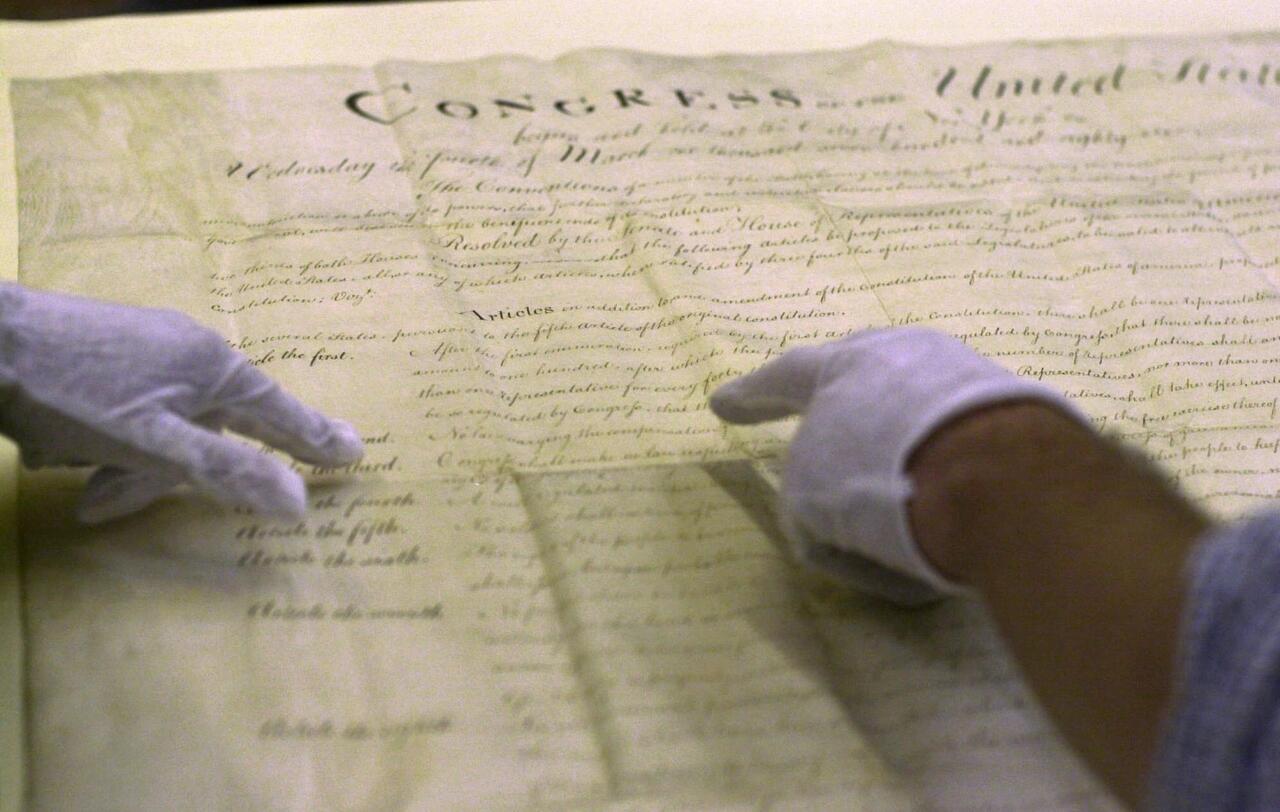
Vice President Kamala Harris and Democrats claim they are the party of freedom. In Harris’ interview on Club Shay Shay on Monday, she argued that people need to vote for her to preserve the First, Second, and Fourth Amendments, that Trump “wants to terminate the Constitution.”
Yet, on the First Amendment, Harris previously called for government “oversight or regulation” of social media to stop what she calls misinformation. In 2022, her vice-presidential nominee, Gov. Tim Walz, claimed: “There’s no guarantee to free speech on misinformation or hate speech.”
On gun ownership, Harris went so far as claiming: “I am in favor of the Second Amendment, I don’t believe that we should be taking anyone’s guns away.”
Reassuring, but Harris’ emphatic past support for gun control is consistent and legion. Let’s look at her record. She claimed during her 2020 presidential campaign, “I support a mandatory buyback program.” When pressed about Joe Biden’s claim at the time that she couldn’t ban assault weapons with an executive order, Harris enthusiastically responded, “Hey, Joe, rather than saying ‘No, we can’t,’ let’s say ‘Yes, we can.’”
But this is nothing new. Harris has strongly advocated for gun control for years. As San Francisco’s District Attorney, she declared, “Just because you legally possess a gun in the sanctity of your locked home doesn’t mean that we’re not going to walk into that home and check to see if you’re being responsible.”
She even supports warrantless searches, raising concerns she also doesn’t want to be bothered by the Fourth Amendment.
In a 2008 amicus brief, Harris argued that a complete ban on all handguns is constitutional. She even said there is no individual right to self-defense.
The Biden-Harris administration has been the most anti-self defense administration to date, shutting down thousands of gun dealers by mid-2022 due to minor paperwork errors. They renewed Obama’s Operation Choke Point to cut off financial resources for gun manufacturers and dealers; the companies that remained had to grapple with increased costs. The Biden-Harris administration has also established a national gun registry.
If Kamala Harris becomes president, she will push for even more restrictions. The new Office of Gun Violence Prevention is “overseen” by Harris, which coordinates the administration’s gun control initiatives. The office oversaw a recently released U.S. Surgeon General report that fails to mention a single benefit of gun ownership.
The OGVP was instrumental in implementing the Bipartisan Safer Communities Act, introducing complex rules that classify many gun owners as firearms dealers. If you sell a gun to a friend once and discuss selling a second one to anyone, you must first become a licensed dealer. If you sell one gun and keep a record of the transaction, you are also required to first become licensed.
Many BCSA rules are vague, giving the government discretion to arbitrarily label individuals as dealers.
Under Harris’ leadership, the OGVP pushed for lawsuits against gun makers and sellers whenever criminals use their guns. She also pushed to ban semi-automatic “assault” weapons, and require background checks on all private gun transfers.
By early 2022, the Bureau of Alcohol, Tobacco, Firearms, and Explosives had developed a digital database containing nearly a billion firearms transactions.
U.S. Reps. Jim Jordan and Thomas Massie found that Bank of America provided the FBI with credit card data for firearms purchases without even requiring a warrant or probable cause.
With a national gun registry in place, officials can now easily identify legal gun owners. Harris’ past threats to confiscate guns become much more likely to succeed.
Gun control has already taken center stage in Harris’ campaign. Harris made gun control a key topic in her first event in Wisconsin and again at a gathering of the American Federation of Teachers.
It isn’t just that Democrats want to regulate every part of our lives, but the real threat to the First, Second, and Fourth Amendments to the Bill of Rights are at risk from Harris. Those freedoms are endangered if she wins. You have been warned.
If Kamala Harris wins the presidential election on Tuesday, Americans will be told that the final vote count is a sacred number that was practically handed down from Mt. Sinai engraved on a stone tablet. Any American who casts doubt on Harris’s victory will be vilified like one of those January 6, 2021 protestors sent to prison for “parading without a permit” in the US Capitol. Actually, anyone who doubted the 2020 election results was being prominently denounced as “traitors” even before the Capitol Clash.
But is there any reason to expect the final vote count in this presidential election to be more honest than any other number that the Biden-Harris administration jiggered in the last four years?
Biden, Harris, and their media allies endlessly assured Americans that the national crime rate had fallen sharply since Biden took office. That statistical scam was produced by the equivalent of disregarding all the votes in California and New York. FBI crime data simply excluded many of the nation’s largest cities until a revision earlier this month revealed that violent crime had risen nationwide.
Deceitful national crime data helped cover-up the disastrous impact of open border policies. The Biden-Harris administration did backflips to avoid disclosing the true size of the surge of illegal immigrants from early 2021 onwards. Kamala Harris did zombie-like face plants in recent interviews when elbowed for honest answers.
In the same way that another surge of unverified mail-in ballots may determine the 2024 election, Biden manipulated the number of illegal aliens by using his presidential parole power to entitle more than a million people from Haiti, Venezuela, Cubans, and other countries to legally enter and stay in America on his own decree. The Biden administration even provided a vast secretive program to fly favored foreign nationals into select airports late at night where their arrival would occur under the radar.
Some states will officially count mail-in ballots that arrive well after Election Day even if the envelopes have no postmark. This is the same “late doesn’t matter” standard that Biden used to vindicate the $42 billion provided by his 2021 infrastructure law to boost broadband access in rural America—which Uncle Joe said was “not unlike what Roosevelt did with electricity.” Unlike the Tennessee Valley Authority, Biden’s broadband program has nothing to show since it delivered faster internet access to almost no one. The same default occurred with the Inflation Reduction Act’s alleged showpiece achievement—42,000 new charging stations around the nation for electric vehicles. But that program produced more presidential applause lines than EV refills. As of March, $7.5 billion in federal spending had only produced seven new charging stations nationwide.
How many votes will Harris lose on Tuesday because Americans remain outraged at the inflation that has slashed the dollar’s value by more than 20 percent since Biden took office? There would be far more popular fury if the feds had not deceived Americans about the full financial damage that Washington inflicted. The official inflation statistic doesn’t count soaring mortgage and housing costs—which is akin to excluding any state south of the Mason-Dixon Line from the national vote tally. Larry Summers, Bill Clinton’s Treasury Secretary, said that if the feds today used the same inflation gauges used in the 1970s, Biden’s peak inflation would have been 18 percent, twice as high as the reported number.
Tens of millions of voters will not be obliged to show any identification before voting in this election: they are presumed trustworthy regardless of zero verification. But this is the same standard that the Biden-Harris administration uses for not disclosing its most controversial policies to American citizens. People will vote next week without knowing the facts behind whistleblower allegations on Vice Presidential nominee Tim Walz’s connections to the Chinese Communist Party, to Secret Service failures to prevent Trump assassination attempts, and the brazen details of the Censorship Industrial Complex.
In Washington, politicians feel entitled to applause for any grandiose promise—regardless of their failure to deliver. Similarly, politicians and election officials promising that the presidential vote count will be accurate and reflect “the will of the people” is far more important than tabulating the actual ballots. Will the unmanned ballot boxes in big cities be stuffed with bogus ballots the same way a politician jams endless balderdash into his campaign speeches? As pundit Stephen Kruiser quipped, “the clothing donation boxes that were all over my old neighborhood in Los Angeles were probably more secure than the ballot drop boxes.”
Of course, if Trump wins, then all the forces of decency must instantly shift to the other side of the barricades. Any electoral victory by Trump will be illegitimate because of politically incorrect comments made by speakers at Trump campaign rallies. As in 2017, if Trump wins, every “true patriot”—or at least every true progressive—will be honor-bound to join The Resistance™.
Keep your heads on a swivel. Do not say you have not been warned.
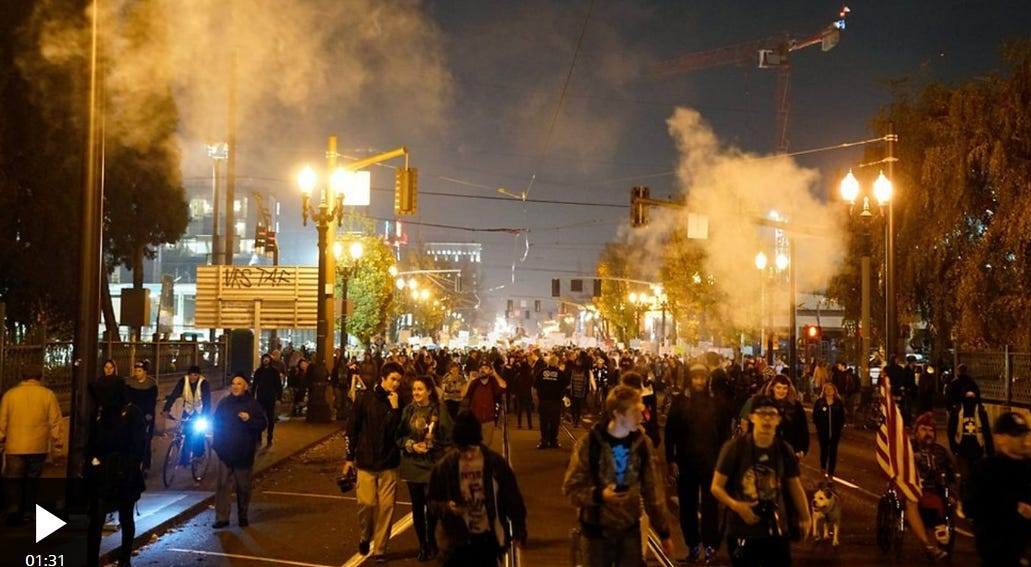
Anti-Trump protestors, some violent, took over major U.S. cities for weeks in 2016. But the January 6-obssessed media and Democratic Party want the public to forget what happened. Here’s a reminder.
Donald Trump’s comments about envisioning neocon nepobaby Liz Cheney deployed to any one of the Cheney family’s favorite war zones has resulted in perhaps the most deceitful media campaign of the 2024 presidential news cycle. Cable news commentators including increasingly irrelevant and bitter NeverTrumpers such as Jonah Goldberg—who walked back his tirade on CNN claiming Trump advocated the use of a “firing squad” against Cheney—caterwauled how Trump’s remark would spark “political violence.”
The unsubstantiated allegation is central to Kamala Harris’ closing argument. She continues to insist without evidence that Trump is a perpetrator rather than a victim of “political violence.” Harris fielded a pre-planned question during a campaign stop in Wisconsin on Friday to accuse Trump of using “violent rhetoric” that disqualifies him from office.
Despite numerous examples of Democrat-involved political violence in Washington over the past decade—2017 Trump inaugural riots, 2018 Kavanaugh protests, 2020 BLM/antifa riots, post-election confrontations with Trump supporters during “Stop the Steal” events in November and December 2020, and recent incidents tied to pro-Hamas demonstrations—the media now claims Republicans, not Democrats, will start tearing down major cities including the nation’s capital if Trump does not win the election.
January 6 Survivors Speak
D.C. police and activist groups, according to the Washington Post, are preparing for violence initiated by “white supremacists,” aka Trump voters, after Election Day. Apparently still traumatized by the unarmed four-hour disturbance on Capitol Hill nearly four years ago, the ruling elite wants to take every precaution necessary to prevent another QAnon shaman or Indiana meemaw from invading their personal fiefdom on the Potomac.
“I really fear outsiders coming in,” D.C. resident Gail Sullivan told the Post last week. ‘This is where the insurrection happened. Maybe it will spill out more into our neighborhoods than it did before.’”
D.C. resident Shreya Tulsiani told Politico last month that she still struggles with flashbacks of that fateful day. “January 6th was a very scary time,” she confessed. ‘I used to live right off of North Capitol Street, so I could see the Capitol. There were Proud Boys petting my dog that day.”
OMG PROUD BOYS PET HER DOG!
Cassie Miller and her husband recently decided to move out of their Capitol Hill home “having lived through” the events of January 6 and fearful of a reprise. “We decided we’d rather be safe than sorry,” Miller told the local D.C. NBC News channel.
To create more drama, the U.S. Capitol Police conducted a “mass casualty” exercise earlier this week, a publicity stunt intended to bolster fears of MAGA trouble. This is the same law enforcement agency, by the way, that protected then promoted Lt. Michael Byrd, the officer who shot and killed Ashli Babbitt at near-point blank range on January 6.
Police across the country reportedly also are bracing for post-election violence. Why? Politico reporter Betsy Woodruff Swan of course blames Trump. “[As] Trump once again promotes falsehoods about election fraud and denigrates election officials, law enforcement officers worry that the floodgates to violence are open,” Swan claims. Swan then used a few thousand more words to detail alleged threats to election workers and other incidents that solely targeted Democrats and Democratic jurisdictions in the post 2020-period.
January 6 Amnesia
If reporters and their Democratic handlers suffer from amnesia about the recent history of election-related violence spawned by supporters of their own party, we know why. As repeatedly stated, every day is January 6, 2021 to Democrats and regime media. It’s as if American history ceased to exist in any meaningful way before that date; nothing that happened before January 6 matters.
So here is a little refresher about what went down following Trump’s shocking victory on November 8, 2016 when Democrats, NeverTrumpers, and the media exploded into a full-blown fit of rage:
The New York Timesdocumented days of protests spanning 52 cities following Trump’s election. Anti-Trump demonstrators blocked traffic in Miami, Portland, Las Vegas, and Madison, Wisconsin; protesters burned an American flag in front of the Georgia Capitol building.
Democrats in Los Angeles burned a pinata resembling the president-elect.
After three days of intense violence, Portland police declared a riot on November 10, 2016. Anti-Trump thugs attacked police, vandalized business, and set buildings on fire. The following day, the Portland police department announced the use of “pepper spray, rubber ball distraction devices, [and] rubber baton rounds” to halt the rioting.
More than 7,000 protesters took to the streets of Oakland, California on November 9. A local Oakland newspaper described the chaos: “Protesters hurled Molotov cocktails, rocks and fireworks at police. Some protesters set off fireworks. Others burned a Trump effigy, and someone set a pile of cardboard on fire in the middle of a downtown intersection. A group of protesters wearing clown and Guy Fawkes masks used bricks, their feet and a large stick to smash the glass windows of the Oakland Coin and Jewelry Exchange at 1725 Broadway. Other storefronts on that block were covered in graffiti as well. Multiple trash and cardboard fires were started in the middle of the street and a much larger fire was raging at the intersection of 17th Street and Broadway.” At least three Oakland police officers were injured that night.
Confrontations with police in Omaha, Nebraska resulted in the deployment of mob control munitions on November 10, 2016; at least two people were arrested for obstructing justice.
Protesters began shouting “kill the police” during an anti-Trump demonstration in Indianapolis on November 12, 2016. Some protesters threw rocks at police; at least seven protesters were arrested and two officers received minor injuries.
Demonstrations lasted for weeks leading up to Inauguration Day. Students walked out of classes; protesters surrounded Trump’s hotel properties in Chicago, New York, and Washington; and clashes with police continued. Now, some events certainly can’t be categorized as violent but considering the Biden/Harris Department of Justice now considers anyone who nonviolently participated in the events of January 6 a domestic terrorist—the new rules must apply to history.
Post-election protests in 2016 culminated in a violent riot in the nation’s capital on January 20, 2017. Protesters tied to antifa lit cars and businesses on fire just blocks from the inauguration proceedings. More than 200 rioters were arrested and six officers sustained injuries.
But unlike those who protested on January 6, the DOJ dropped all charges against 2017 inaugural rioters.
In anticipation of potential post-election violence next week, D.C. businesses have begun boarding up their doors and windows. Regardless of the media spin or outlandish fears by D.C. residents of another unarmed “insurrection,” those business owners undoubtedly fear Kamala Harris supporters will cause trouble if she loses. After all, years of precedent prove the opposite of what Democrats and the media want the public to believe. They, not Trump supporters, represent the real threat for “political violence.”
In late 2019, the FBI came into possession of Hunter Biden‘s laptop. The laptop contained damning evidence that directly implicated the Biden family and Joe Biden himself. Specifically, it proved a pattern of influence-peddling, where political access was traded for personal and familial gain involving various international players. However, instead of revealing this information, or even preparing for a legitimate disclosure, the FBI chose a different route. Over the course of 2020, they embarked on a campaign with Big Tech to ensure this story—the truth—would be buried before it ever came to light. The FBI, aided by Big Tech companies, successfully suppressed the Hunter Biden laptop story in an effort that ultimately constituted interference in the 2020 presidential election—and according to polling changed the outcome of the election.
The timeline of the Hunter Biden laptop story—from its initial acquisition by the FBI to the New York Post’s publication of the details, and the ensuing censorship by Big Tech—reveals the depth of coordination that was at play. The FBI’s actions went beyond mere incompetence or negligence; it was a preemptive strategy to condition influential social media platforms to dismiss any forthcoming stories about Hunter Biden as Russian disinformation. This “prebunking” approach—preemptively discrediting real information—ensured that when the truth finally emerged, it was met with skepticism, censorship and suppression.
The Timeline of Interference
The first significant event in this saga occurred in late 2019, when the FBI acquired Hunter Biden’s laptop. By this point, the FBI had verified its authenticity—a verification that took place before any public reporting on the laptop’s contents. The laptop, abandoned by Hunter Biden at a Delaware repair shop, contained emails, photos and documents detailing the Biden family’s involvement in foreign business dealings, with the former Vice President allegedly benefiting from these ventures. The laptop was, without a doubt, real, and the FBI knew it.
Despite this knowledge, the FBI took a questionable next step. In early 2020, they began meeting with Big Tech companies, such as Facebook, Twitter and Microsoft, ostensibly to prepare them for potential Russian disinformation campaigns targeting the upcoming election. During these meetings, the FBI set the narrative. They warned that foreign actors—most notably Russia—might attempt a “hack-and-leak” operation intended to discredit the Biden family. The FBI specified that this operation would likely involve claims about the Biden family’s ties to Ukraine—a detail very close to the information that was already present on Hunter Biden’s laptop.
These meetings between the FBI and Big Tech were not casual conversations. Over the course of 2020, the FBI held more than 30 such meetings with major social media platforms, consistently hammering home the point about an impending “October Surprise” in the form of leaked information about the Bidens. Not only did this position social media companies to expect an attack, but it also primed them to act as gatekeepers, ready to filter or suppress anything that matched the FBI’s predicted narrative.
Big Tech’s Role in Suppression
The turning point came in October 2020 when the New York Post published its explosive story on the Hunter Biden laptop. The timing—just weeks before the presidential election—made the story incredibly significant. Almost immediately after publication, Big Tech companies took action to limit its spread. Twitter outright banned users from sharing links to the story, even locking accounts that tried, including that of the New York Post itself. Facebook, for its part, suppressed the story’s reach on its platform, reducing its visibility to users and ensuring it would not gain traction in the crucial days leading up to the election.
This coordinated suppression did not happen in a vacuum. Internal communications from Facebook reveal that they were acting based on information from the FBI. In one chat, Facebook employees openly discussed how the FBI had warned them about an imminent leak related to Burisma—the Ukrainian energy company with ties to Hunter Biden. These conversations happened only a week before the New York Post story broke. The alignment between what the FBI had “warned” about and what actually happened was notable.
Even more noteworthy are the internal communications from Facebook and Microsoft employees, who acknowledged that the FBI had effectively “tipped them off” about the story. One Microsoft employee noted that the FBI’s warning had specifically mentioned a potential Burisma story, adding that the timing matched exactly with the New York Post release. Such specificity raises serious questions about whether the FBI’s intention was ever about safeguarding the election from disinformation—or if it was about managing the narrative to protect one candidate from a damaging story.
Facebook’s own leadership seemed aware of the stakes. In internal messages, Nick Clegg, Facebook’s Vice President of Global Affairs, admitted that their handling of this issue would influence how a “Biden administration views us.” This kind of political calculation—censoring legitimate news to curry favor with an incoming administration—is the very definition of election interference. The internal cynicism among Facebook’s staff was evident: when discussing their suppression of the New York Post story, one employee noted, “The Press is only as good to you as you are bad to Trump.”
The very employees tasked with executing these policies knew the likely impact. They joked about how, when eventually called to testify, they would say that their actions to “influence the 2020 election” had been planned with the U.S. government for years. These jokes were admissions. The censorship was not incidental; it was designed, coordinated, and executed based on direct guidance from the FBI.
The Impact on Public Perception
The FBI’s efforts did not end with Big Tech’s suppression of the story. Only days after the New York Post article was published, 51 former intelligence officials released a public statement claiming that the Hunter Biden laptop had “all the classic earmarks of a Russian information operation.” This statement, orchestrated by Secretary Antony Blinken while he was an advisor to the Biden campaign, was intended to cast further doubt on the story. The statement provided the final piece of the puzzle: a supposed expert validation that the laptop was part of a foreign disinformation effort, even though it was not. Former Vice President Joe Biden cited this letter in his defense during debates, using it to dismiss the revelations as “Russian disinformation,” even as the FBI knew it was authentic.
In the four years since the 2020 election, the truth has slowly unraveled. Mark Zuckerberg and other Big Tech leaders have admitted that their actions to suppress the New York Post story were influenced directly by the FBI. These admissions come too late. The damage—in the form of suppressed information, manipulated public opinion and election interference—has already been done. The FBI’s preemptive framing of the Hunter Biden story as a Russian plot was a calculated effort to control the narrative and protect a favored candidate.
A Pattern of Censorship
What happened with Hunter Biden’s laptop was just the beginning. Once the Biden regime took office, pressure on Big Tech to censor content only grew. In the months following the inauguration, platforms like Facebook, YouTube and Amazon began receiving explicit demands from the White House to curb speech deemed undesirable by the regime. This included not only political content but also opinions and jokes, signaling an era of broad and pervasive censorship. My own accounts on Twitter and Medium were permanently suspended.
The collaboration between the Biden-Harris regime and Big Tech took many forms, but the roots were planted in 2020 when the FBI orchestrated a plan to “prebunk” an accurate story about Joe Biden’s corruption. This prebunking effort weaponized both the media and major technology companies, effectively turning them into tools of state influence. By controlling the flow of information, the FBI ensured that voters would not learn about Hunter Biden’s dealings until it was too late to matter. This not only undermined faith in the institutions that are supposed to ensure fair elections but also demonstrated a significant level of governmental overreach.
Conclusion
The suppression of the Hunter Biden laptop story in 2020 represents one of the clearest examples of state-sponsored election interference in U.S. history. The FBI had the laptop, verified its authenticity and instead of allowing the information to reach the public, undertook a campaign to preemptively discredit it. They primed Big Tech to see the story as a foreign attack, and when the New York Post broke the news, Big Tech platforms did what they had been conditioned to do—they censored it. The result was a manipulated election where critical information about one candidate was withheld from the public.
This case is not only about Hunter Biden’s laptop. It is about the relationship between the federal government and the platforms we rely on for information. It is about the deliberate actions taken by those in power to shape what voters know and, ultimately, how they vote. The weaponization of the FBI and Big Tech to “prebunk” a true story speaks to the broader dangers of unchecked government influence over supposedly independent media channels. As the revelations continue to unfold, the American people must demand accountability, transparency, and, most importantly, a commitment to protecting the sanctity of free and fair elections.
The Federal Trade Commission (FTC), under Chair Lina Khan, has been transformed from an independent regulatory body into a tool for furthering the Biden-Harris regime’s ideological objectives—at least, that’s what the evidence proves. This shift in focus has fundamentally disrupted the landscape of startup innovation in Silicon Valley. Once a thriving ecosystem where young startups could rely on eventual acquisition as a viable exit strategy, the FTC’s stringent anti-merger policies under Chair Khan have instead introduced what amounts to a tax on entrepreneurship. And this so-called tax is not just bureaucratic red tape; it’s a direct impediment to the dream of every startup: turning a novel idea into a profitable venture, even if the ultimate goal is simply to get acquired by an established player like Google, Amazon or Microsoft. Khan’s FTC—steering under the direction of Executive Order 14036—has taken on a European-style aversion to size itself, substituting broad market condemnation for nuanced analysis.
FTC Chair Lina Khan’s Aggressive Stance on Antitrust Enforcement
FTC Chair Lina Khan’s aggressive stance on antitrust enforcement has sparked considerable criticism, especially from venture capitalists and tech advocates who argue that her policies discourage innovation and undermine the startup ecosystem. Khan’s approach prioritizes preemptive action against acquisitions—particularly in tech—focusing on preventing monopolies before they form. This shift marks a departure from traditional antitrust enforcement, which usually only intervenes after a monopoly’s power is well-established. Critics, including venture capital leaders like Marc Andreessen, argue that blocking acquisitions prevents startups from being acquired by larger companies, which often serve as their primary exit strategy. They contend that fewer acquisitions make startups less attractive investments, reducing funding and limiting opportunities for innovation.
The National Venture Capital Association (NVCA) and others in Silicon Valley have also highlighted that antitrust actions, such as those against Meta’s attempted acquisition of VR company Within, can deter investment and reduce valuations of startups due to diminished acquisition prospects. According to the NVCA, venture funding relies heavily on the potential for acquisition, with nearly 90% of venture-backed exits occurring through acquisitions rather than IPOs. The broader concern is that restricting these exit paths disincentivizes startups from entering the market in the first place, thereby curbing technological advancement and economic growth.
Moreover, critics argue that Khan’s policies could inadvertently increase market concentration by stifling small companies before they can scale, making them less likely to challenge established giants independently. With reduced venture capital investment and the departure of some smaller players due to regulatory barriers, Khan’s policies might unintentionally favor dominant firms rather than foster competition and consumer choice.
However, Khan and her supporters maintain that unchecked acquisitions often lead to “killer acquisitions,” where larger firms acquire startups solely to neutralize potential competition. She argues that her approach is a necessary corrective to the “winner-takes-all” dynamics prevalent in tech, aiming to ensure a competitive landscape that fosters genuine innovation rather than monopolistic control.
These perspectives reflect a complex and contentious debate over the FTC’s role in regulating competition. While proponents see Khan’s approach as protecting long-term market health, detractors warn it could stifle innovation and prevent the growth of future tech leaders.
The Acquisition Ecosystem: Once a Fountainhead of Innovation
Historically, Silicon Valley thrived not because every startup had to become a multi-billion-dollar business, but because every startup had options. Investors could pour money into new ventures knowing there were numerous paths to return—whether through growth into a unicorn or by being acquired. Founders could innovate boldly, focusing on niche solutions or enhancing existing products, with the knowledge that even modest success could lead to a rewarding acquisition—a “soft landing” that allowed them to contribute within larger companies and eventually build again. This model made sense: Small tech firms, brimming with ideas but short on scale, married perfectly with larger corporations that could apply their resources to scale up those ideas. Everyone won—investors, founders, consumers and even regulators who wanted thriving markets.
Chair Lina Khan, however, seemingly has other plans. Under her direction, the FTC has cast a chilling effect over mergers and acquisitions (M&A) within the tech sector. Even mergers that would create clear consumer benefits—providing resources to enhance existing products, or even, paradoxically, increasing competition with major international firms—are subjected to a labyrinthine review process, one seemingly crafted more for obstruction than for adjudicating antitrust concerns in good faith.
The House Oversight Committee Report: A Chronicle of FTC Overreach
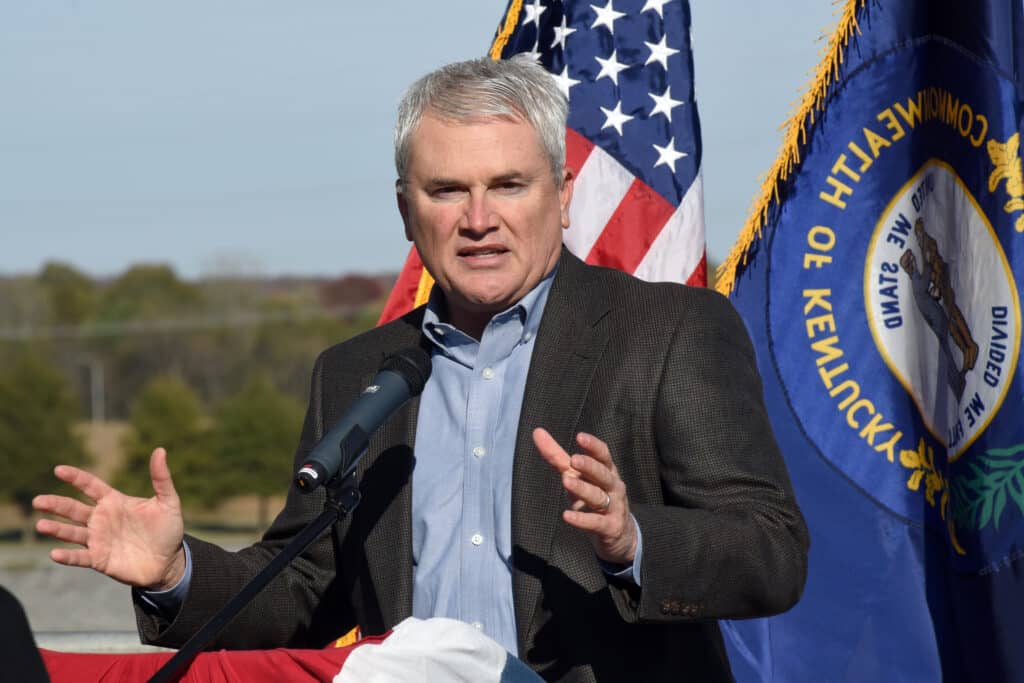
James Comer (R-Ky.), the Chairman of the House Committee on Oversight and Accountability, delivered a resounding indictment of Lina Khan’s FTC in his recent report titled, “The Federal Trade Commission Under Chair Lina Khan: Undue Biden-Harris White House Influence and Sweeping Destruction of Agency Norms”. The report paints a damning picture of Khan’s tenure, showing an agency unmoored from its original purpose and openly compliant to the political will of the White House. As noted in the report, Khan has “trampled on principles of due process, respect for the rule of law, and ethical standards to achieve her ideologically fueled ends at the FTC.” This is no light accusation; the charge is that Khan has taken an institution that was supposed to be independent and turned it into an ideological battering ram against American entrepreneurship.
U.S. Army Corps of Engineers Nashville District, CC BY-SA 2.0
One critical example lies in Khan’s approach to mergers like that of Meta’s proposed acquisition of Within Unlimited, and Microsoft’s bid for Activision Blizzard. Both cases—designed to challenge “potential competition” and vertical integration respectively—ended in resounding losses for Khan’s FTC in federal court. It wasn’t just that the FTC lost; it’s that the courts found the commission had failed to provide even basic grounds for its arguments against the mergers. Judge Jacqueline Scott Corley, an Obama appointee, pointed out that the FTC had not even raised “serious questions regarding whether the proposed merger is likely to substantially lessen competition.” The failures are not merely tactical errors; they reveal the degree to which Khan’s approach deviates from legal norms and reflects ideological zealotry.
Prominent Deals Blocked or Challenged Under Khan’s FTC
Under Lina Khan’s leadership, the FTC has halted or delayed several high-profile acquisitions across various sectors, resulting in significant backlash from venture capitalists and tech innovators alike. Here are some prominent deals Khan’s FTC has blocked or challenged, invoking criticism that her tactics stifle competition and innovation:
Meta’s Attempted Acquisition of Within (2022): The FTC filed to prevent Meta’s acquisition of Within, a VR fitness app, aiming to block what it deemed an anti-competitive move in the nascent virtual reality sector. For Meta, this acquisition was integral to its Metaverse ambitions, but Khan’s FTC argued it would restrict competition in VR fitness apps and stunt innovation in the VR space. Tech proponents argue this block punishes smaller companies needing investment to grow and denies the market innovative tech synergies in the VR landscape.
Illumina and Grail Deal: Illumina, a genetic sequencing giant, attempted a $7.1 billion acquisition of Grail, a cancer detection company. Khan’s FTC argued this merger would hinder competition in the emerging cancer screening market by consolidating too much control under Illumina. This legal action took years, with Illumina ultimately abandoning the acquisition in 2024, largely because Khan’s FTC framed it as anti-competitive, though Grail’s potential benefited from Illumina’s resources and technology integration.
Kroger and Albertsons Merger: Recently, the FTC scrutinized Kroger’s $24.6 billion bid to acquire Albertsons, a merger that Kroger argued would enable it to compete better against retail behemoths like Walmart and Amazon. Khan’s FTC, however, is reviewing the merger, expressing concerns that it might raise grocery prices by reducing competition. Critics point out that stopping or delaying such mergers harms consumers who stand to benefit from lower costs in a consolidated operation. This case illustrates Khan’s expansive view on the anti-competitive risks of mergers, even in non-tech sectors.
Semiconductor and Defense Sector Acquisitions: Under Khan, the FTC also blocked or impeded multiple mergers in the semiconductor and defense sectors, though details of each deal remain confidential. Analysts argue that these sectors, which are critical for national security and innovation, suffer from regulatory overreach that may restrict tech advancement in microchips, which are crucial to industries worldwide. The approach fuels investor concerns, making VCs wary of funding startups in areas where acquisition by larger firms is the most viable exit strategy.
Khan’s FTC has arguably gone beyond traditional regulatory scope, blocking even speculative mergers to prevent potential monopolies before they materialize. This radical strategy, while aimed at preventing Big Tech consolidation, is viewed by detractors as throttling the innovation ecosystem, particularly for startups that depend on the potential of acquisition. VCs have criticized this “anti-innovation” approach, arguing that without acquisition options, startups lose their key growth pathways, a blow to both entrepreneurship and consumer choice in emerging markets.
Emulating Europe’s Bureaucratic Failures
Perhaps the most egregious example of this shift is the FTC’s partnership with European regulators in implementing the EU’s Digital Markets Act (DMA). The DMA is a distinctly anti-American, protectionist piece of legislation aimed at hobbling the success of U.S. tech giants like Google, Apple and Amazon in favor of European firms. Despite its thinly veiled animosity towards American companies, Khan’s FTC took the inexplicable step of actively assisting with the DMA’s implementation, sending FTC staffers to Europe to guide its adoption. According to Maria Coppola, Director of the FTC’s Office of International Affairs, the FTC undertook these actions partly because “legislative proposals… were, like, cut and paste from European legislation,” and they wanted to be prepared if similar proposals were adopted here in the United States. Essentially, the FTC appears to be helping Europe impose rules that its own courts, and even the White House, recognize as harmful to American business.
This pattern reflects an abdication of the FTC’s duty to American consumers and a disservice to the principles upon which American antitrust law is built. Our laws are intended to prevent harm to competition, not punish success or hamstring companies simply for being large. The European model, which imposes punitive measures on companies for being “gatekeepers,” is at odds with decades of American antitrust principles. By adopting this approach, the FTC under Khan isn’t just obstructing mergers; it’s sabotaging American firms in the global market, putting them at a disadvantage compared to foreign competitors.
The cumulative effect of Khan’s anti-merger crusade is a dramatic chilling effect on startup culture in Silicon Valley. Venture capitalists (VCs) are less willing to take a gamble on a startup if the most likely exit—acquisition—is being systematically blocked by the FTC. The idea that every startup must turn into a standalone, billion-dollar enterprise or be considered a failure is not just laughable; it’s dangerous to the spirit of American innovation. Some of the most revolutionary technological features we use today came from smaller startups acquired by major players: Google acquiring YouTube, Facebook buying Instagram, and Amazon absorbing Twitch—all ventures that benefited from larger corporate backings.
Chair Khan’s direction has reversed a longstanding culture of innovation and transformation. Instead of bolstering companies with resources and scale, her FTC—under the influence of Biden-Harris policies—seems to prefer a European-style system of perpetual market fragmentation. Not surprisingly, the Silicon Valley that was once the envy of the world for its ingenuity and entrepreneurial daring is seeing fewer startups founded, fewer funded, and fewer able to make a mark on the world.
The Stakes for the 2024 Election: A Vote for Innovation
The upcoming 2024 election is crucial for determining the future of American innovation. If Kamala Harris is elected president, it is highly likely that Lina Khan’s destructive antitrust crusade will continue, further stifling the startup ecosystem and preventing the growth of new technologies that could enhance American competitiveness. In contrast, just this morning, Elon Musk pointed out that Donald Trump has committed to firing Lina Khan on his first day in office—a move that many see as essential to restoring sanity to the FTC and allowing American innovation to thrive again.
It’s time for voters to understand the stakes clearly: the choice is between an administration that supports a bureaucratic assault on entrepreneurship or one that aims to restore opportunities for innovators, founders and venture capitalists. The decision will determine whether America continues to be the global hub of innovation or slips into stagnation under the weight of needless regulation and ideological rigidity. A vote for Donald Trump is a vote for growth, opportunity and the restoration of an environment where the American dream—especially for entrepreneurs—can once again flourish.
The impact of these policies extends beyond just Silicon Valley; it affects every American who benefits from a thriving, competitive economy. The choice is simple: either continue with the Biden-Harris regime’s heavy-handed, anti-business approach or pivot toward policies that encourage growth and prosperity. If we want to see innovation thrive, the tech sector rebound and opportunities expand for all, it is crucial that Lina Khan and her destructive policies are shown the door. Let’s vote for innovation and a prosperous future—let’s vote to bring common sense back to Washington.













 fox files

Recent Comments