The Truth Is Out There

Archive for March, 2025

A Government Held Hostage: Why The Supreme Court Must Rein In Rogue Federal Judges


In a case that would read like satire were its consequences not so severe, a single district judge has attempted to substitute his judgment for that of the president of the United States, his Cabinet and the entire machinery of the executive branch. On the shaky foundation of delayed bathroom openings and speculative FOIA frustrations, the U.S. District Court for the Northern District of California ordered six federal agencies to reinstate over 16,000 probationary employees whom the executive had lawfully terminated. That is no way to run a government. It is, however, an efficient way to cripple one.

This unprecedented judicial intrusion warrants urgent reversal by the Supreme Court. It implicates not only the structural integrity of the constitutional order but also the basic operability of the executive branch. If allowed to stand, this injunction would green-light a new era of governance—by district court decree—where plaintiffs need not even be the employees affected, but merely individuals inconvenienced by the possibility of less-than-optimal service from the federal leviathan.

Let us be clear: the terminated employees were probationary. That term is not decorative. It denotes a class of individuals whom the federal government, acting through agency discretion, has not yet deemed fit for permanent service. The very purpose of probationary status, long recognized in civil service jurisprudence, is to afford the government the flexibility to assess aptitude before conferring permanence. To strip the executive of this discretion at the whim of a district court is to invert the hierarchy of constitutional authority.

Even more astonishing is the identity of the plaintiffs. Not the employees themselves—who, under the Civil Service Reform Act, must pursue redress through specific administrative channels—but organizations that claim their members were adversely affected by reductions in services. The theoretical chain from dismissal to harm proceeds thus: an agency terminated an employee, which may have led to a slower FOIA response or a delayed bathroom opening at a national park, which may have annoyed a citizen who belongs to a nonprofit, which nonprofit now claims standing to challenge the Executive’s staffing decisions. This is not law; it is farce.

The doctrine of standing, which limits federal courts to adjudicating actual cases and controversies, is designed to prevent such misadventures. As the Supreme Court affirmed in TransUnion LLC v. Ramirez, federal courts do not exist to conduct general oversight of the Executive Branch. They are not roving commissions to improve customer service. Yet the district court in AFGE v. OPM embraced a theory of injury so attenuated it makes the proverbial butterfly effect look rigorous.

Even assuming arguendo that the court could entertain such a theory, its remedy is legally indefensible. Reinstatement of employees is a drastic and rarely granted measure, especially where, as here, the employees themselves are not before the court. As the Court recognized in Sampson v. Murray, judicially compelled reinstatement of a single employee represents a significant intrusion on executive discretion. Imposing that remedy on a mass scale, without statutory warrant and without a showing of irreparable harm, is more than judicial activism; it is judicial usurpation.

Moreover, the district court’s order tramples Congress’ deliberate scheme for federal personnel disputes. The Civil Service Reform Act provides a comprehensive and exclusive avenue for terminated employees to challenge their dismissals. End-runs through district court by third-party organizations are not just unauthorized; they are antithetical to the statute’s purpose. As the Supreme Court held in United States v. Fausto, permitting such circumvention would upend the structure Congress enacted and invite a chaotic patchwork of judicial micromanagement.

The executive has not stood idle. Following the court’s temporary restraining order, the Office of Personnel Management clarified its guidance, emphasizing that it did not and could not direct agencies to terminate specific employees. Agencies, in turn, independently affirmed their staffing decisions. Some even rescinded terminations. Others, in line with the president’s directive to optimize the federal workforce, maintained course. This reflects exactly what the Constitution envisions: agency discretion under the aegis of a politically accountable executive.

Yet the court was not satisfied. It doubled down, ordering full reinstatement to active duty—no administrative leave permitted—and demanding agencies report their progress to the bench. In effect, the judge transformed himself into a personnel director for the federal government, supervising onboarding procedures and issuing dictates about work assignments. This is not judicial review; it is receivership.

The administrative burden imposed by the order is staggering. Agencies have been forced to contact, rehire and reassign thousands of individuals in a matter of days. The government must pay salaries, issue credentials and allocate workspace—all under the threat of contempt. And should the injunction be reversed—as it almost certainly will be—the agencies will be forced to terminate these employees again, compounding the cost and confusion.

Meanwhile, the constitutional damage mounts. This case is not an outlier; it is part of a growing trend. As the government notes, more than 40 injunctions or temporary restraining orders have been issued against the executive branch in just two months—more than during the first three years of the previous administration. The judiciary is not merely overstepping its bounds; it is sprinting past them.

This Court has the tools to restore order. The standards for issuing a stay are well established: likelihood of success on the merits, irreparable harm, and the balance of equities. Each factor weighs heavily in favor of the government. The constitutional structure demands a course correction. Judicial modesty is not a quaint ideal—it is a constitutional imperative.

If one district judge can effectively seize control of six executive agencies based on speculative harms and attenuated theories of standing, then no executive action is safe from pretextual interference. The line between judicial oversight and judicial governance has been crossed. It is the task of the Supreme Court to redraw it—and to redraw it firmly.

For the sake of the separation of powers, for the integrity of the executive and for the rule of law itself, the Court must act. The injunction must be stayed. The machinery of government must be permitted to function. And the Constitution must, once again, be obeyed.

China is Terrified of Trump


China is terrified that Donald Trump could turn it into a Japan-style zombie economy.

According to the Wall Street Journal, China is “Right to worry.”

The reason is Trump’s aggressive tariffs on China — with more to come on April 2nd — are hitting when China’s economy is already reeling from failed central planning.

This includes trillions of overcapacity dumped into state favorites from green energy and EV’s to semiconductors and commercial aircraft.

Overcapacity in China

To illustrate, by 2019 China had five hundred electric vehicle makers.

80% have already gone bust. With a hundred still to go.

This over-capacity is crashing prices in China, which are actually falling again — despite panicked money-printing by China’s central bank.

Meanwhile, private-sector estimates peg China’s economy limping along just over 2% growth — a far cry from double-digits a decade ago.

Ominously, after China’s youth employment soared past 20%, Beijing stopped reporting it.

China’s response to overcapacity has been dumping abroad, which is why you can get four dollar shirts on Temu.

That’s pissing off trade partners including the EU.

But that’s barely making a dent, with prices still falling. Which puts tens of thousands more factories at risk.

That could mean millions more jobs lost.

Last year China had nearly a thousand “dissent events” — including riots.

Millions of unemployed factory workers would be gasoline to the fire.

Trump’s Tariffs

Donald Trump is now feeding China’s house of cards into the wood chipper.

A few weeks ago he hiked tariffs to between 17 and a half to 35 percent, with more to come on April second, when Trump goes nuclear with reciprocal tariffs.

Even China perma-bull JP Morgan admitted “we felt tariffs were a negotiating tactic rather than a structural change. We appear to be wrong.”

I’ve mentioned in previous articles that Trump’s dream of bringing production back to America is actually possible if business taxes and red tape are tamed.

DOGE is aiming directly at both. And Trump keeps flirting with repealing the entire income tax.

Given America’s huge economy — we’re one-quarter of the entire global economy — if you nestle that under a big beautiful tariff umbrella and cut costs and red tape you get a flood of Chinese companies wanting to Make it in America.

Beijing will be bribing them to stay.

China’s Abuse of Foreign Firms

It’s not just Trump.

Doing business in China has always been like dating a stripper — good-looking but there’s an awful lot of drama.

Beijing forces you to train your competitors and share your trade secrets — so-called forced technology transfer.

Its regulations change depending who you know. With foreigners at the back of the line.

Occasionally it arrests your managers as hostages if it’s upset with your country.

Thanks to all this, foreign investment into China has collapsed 96% since Xi Jinping took office, actually turning negative — more leaving than coming — with a record $168 billion outflow last year.

There’s even talk that China could be turning into a Japan-style zombie economy thanks to government allocation of capital. Bond markets say it already has.

What’s Next

China’s President Xi appears incapable of handling the challenge. He’s the most anti-business Chinese leader since Mao — with a decade of low growth to show for it.

Worse, his instinctive combativeness is going to create fireworks with Donald Trump, who’s currently luring China’s most important ally, Russia, out of its orbit.

Sadly for the Chinese people, Xi’s greatest achievement is the police state he built. So, at age 71, there’s no cavalry coming.

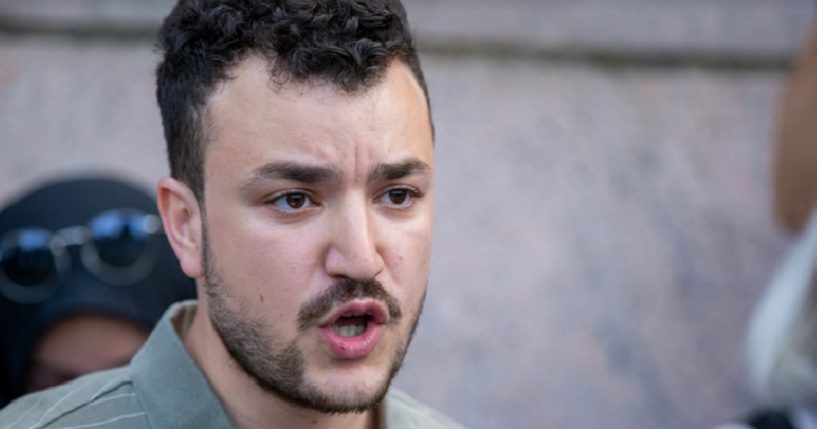
Green Card-Holding Palestinian Trump’s Deporting Gets Even Worse News as Justice Finds Him


Palestinian activist Mahmoud Khalil is pictured during an April protest at Columbia University campus in New York. (Ted Shaffrey / AP)

Palestinian activist Mahmoud Khalil is pictured during an April protest at Columbia University campus in New York. (Ted Shaffrey / AP)

Mahmoud Khalil, a Palestinian activist and former Columbia University graduate student detained by immigration authorities over the weekend, appears to have violated explicit federal immigration laws.

Immigration and Customs Enforcement agents arrested Khalil, a permanent resident with a green card, on Saturday.

The agents originally told Khalil his student visa was being revoked, according to The Associated Press, which quoted Khalil’s attorney, Amy Greer.

Greer told the AP she spoke on the phone with the agents during the arrest and said her client had a green card. The agent then told her the green card was being revoked instead, Greer said, according to the AP.

On Sunday, in a post on the social media platform X, Secretary of State Marco Rubio announced that the federal government will be “revoking the visas and/or green cards of Hamas supporters in America so they can be deported.”

A spokeswoman for the Department of Homeland Security said Khalil was arrested “in support of President Trump’s executive orders prohibiting anti-Semitism” because he “led activities aligned to Hamas, a designated terrorist organization,” according to the AP.

On Monday, however, a federal judge in New York blocked Khalil’s deportation. Judge Jesse M. Furman said that Khalil must remain in the United States “to preserve the court’s jurisdiction” as the court considers his case, according to NBC News.

A hearing for the case is scheduled in federal court for Wednesday.

Other protesters have assembled in New York City to demand the release of Khalil.

Completing this poll entitles you to The Western Journal news updates free of charge via email. You may opt out at anytime. You also agree to our Privacy Policy and Terms of Use.

Pennsylvania Democratic U.S. Rep. Summer Lee also came to his defense, asserting on social media that “Mahmoud Khalil should be at home with his 8-month pregnant wife.”

But it appears that federal law is rather clear about support of a terrorist organization serving as grounds for removal from the country — and that is likely worse news for Khalil.

When discussing “inadmissible aliens,” the law specifically includes any foreigner who “endorses or espouses terrorist activity or persuades others to endorse or espouse terrorist activity or support a terrorist organization.”

The U.S. government has designated Hamas as a “foreign terrorist organization” for nearly 30 years, according to a webpage from the Office of the Director of National Intelligence.

The group uses a variety of weaponry to “to advance attacks against Israeli military forces and civilians.”

Hamas also “engages in cyber espionage, computer network exploitation, and kidnapping operations.”

No matter how much leftist protesters and lawmakers may complain, Khalil does not belong in the United States if he is going to align himself with terrorist organizations.

For non-citizens, being in the United States is a privilege, not a right.

Wasting the incredible opportunity of attending an Ivy League school and building a better life after graduation is incredibly foolish.

The last thing the United States needs is the importation and continued presence of foreigners trying to drag us into their conflicts.

This deportation should send a crystal clear message to the rest of the country that coming here for such activities, especially in support of clearly designated terrorist organizations, is not allowed.

When Did Michael Moore Become a Limousine Liberal?


The filmmaker from Flint was once the enemy of CEOs, but now he sings their praises in pursuit of his progressive goals

March 10, 2025

michael moore

Michael Moore annoys me. Not so much because of his tired, old progressive political beliefs stuck in the 1980s, but because his sardonic persona so often turns to serious moralizing.

This inconsistency in Moore was recently on display as he ruffled feathers on the immigration issue on his Substack. Moore never seems to let truth—nevermind ideological principle—guide his hand, preferring to chase the “current thing” that captures his progressive audience. 

Moore argues for unfettered illegal immigration in his recent piece, “Our Muslim Boy Wonder.” It’s festooned with accusations of racism by Trump’s “MAGA-nation,” but the piece is a gushing love letter to Steve Jobs—extolling the virtues of a multicultural nation that allowed an obscure Muslim from Syria to meet a Wisconsin farm girl and have a child that would become the billionaire founder of Apple. 

It’s a little weird for a guy who built a career out of mocking millionaire and billionaire leaders of industry for mistreating workers to wax poetic for possibly the most famous tech industrialist of all time with a professional (and personal) history of treating people like absolute shit.  

Hypocrisy is literally the code of the road for public figures of all stripes. Nobody cares. But for a documentary filmmaker, authenticity should be the standard by which he is judged, and Moore’s hypocrisy flows like a river. 

Moore has been influential as a public figure, promoting a working-class populist brand of progressive politics as far back as I can remember. Hard to believe he’s been at this game for almost 50 years, but half-assed internet history indicates Moore landed on the scene in late 1970s and really got cooking as a journalist in the early 1980s.  

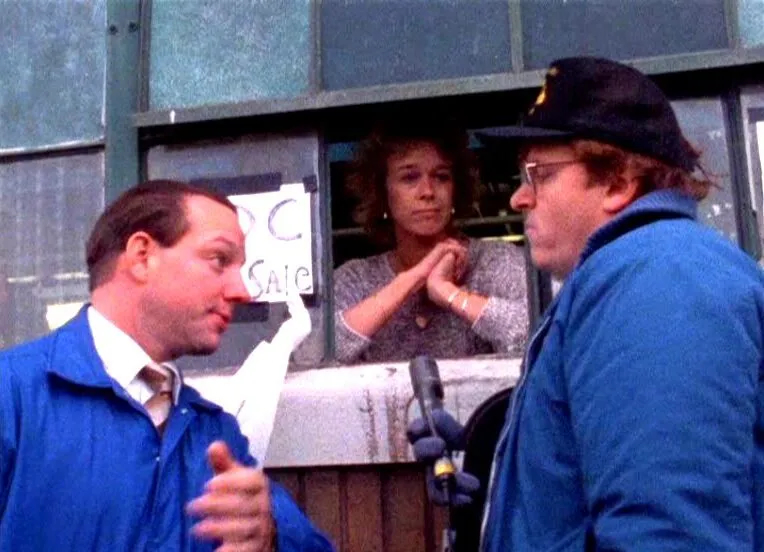
His film “Roger & Me,” filmed between 1987 and 1988, detailed the shuttering of General Motors plants in Flint and was probably the first documentary to hit the American mainstream in the late 1980s. It made him a pseudo-star. In Michigan, the film was a phenomenon embraced by the deep-blue union workers in the UAW and the building trades. To them, it felt like a love letter. 

michael moore "roger and me"

If it is, he’s the recipient. Moore is a narcissist. He spends the bulk of the film chasing Roger Smith, the chairman of General Motors, with considerable comedic flare. Smith is largely forgotten today but was one of the most powerful men in America at the time. Moore offers respite from his chase by intercutting the film with vignettes of Flint residents. In these scenes, his angle becomes dark. 

Moore seems intent on depicting the most cartoonish and bizarre people as normal everyday residents of Flint, telling the rest of the nation that Michiganders are mentally unstable rubes. Even worse, Moore chooses the class-warfare angle by seeking out country club types and entrapping them into brief statements of detached and emotionless sympathy. The film is a personal vendetta against the free market, and downtrodden Flint residents are merely the hammer he uses to smash it. 

michael moore "roger and me"

To be fair, Moore offers one moment of realism. The only Flint resident depicted with any depth is a brief interview with a former GM employee, a personal friend of Moore’s. He introduces him as such and has him detail the day he was laid off and drove home listening to the Beach Boys’ “Wouldn’t it be Nice,” while suffering a nervous breakdown. But this one emotional moment is ripped away from the viewer, as Moore returns us to his cat-and-mouse chase after Smith.  

Moore also makes some odd politically motivated omissions.

A well-known Democrat and prominent leftist, it’s not all that surprising that he fails to mention that Flint was, and had been for well over a decade prior to the film, a Democrat-run city, inside a state with a Democrat power column led by Gov. James Blanchard. These were all pro-union forces presiding over a state and city in steady decline. 

It all makes sense in hindsight. Why would Moore depict failing politicians with whom he is ideologically aligned when he can take aim at big business and easily lay all the blame on a single person? It’s an easier film to make and a better enemy for his audience. But is it honest? 

Interestingly, “Roger & Me” was not well received by Flint Democrats, specifically the young mayor, Matthew Collier, who lamented the film. In a 2014 interview, Collier criticized the film for being unfair to Flint, depicting untrue events such as rising crime and unemployment—which he said were actually going down at the time it was filmed—and the destruction of Fisher 1 GM Body Plant (which was actually being renovated and repurposed as a tech center). He argued the film did more harm than good, demoralizing and crippling the city. 

Moore has revisited Michigan in his subsequent films, always with a taste for mocking the state and its inhabitants. His 2002 film, “Bowling for Columbine,” made in response to the 1999 Columbine High School shooting in Littleton, Colorado, was another platform for him to take aim at his home state. In the film, Moore blames the tragedy on gun culture, which he links to the state of Michigan in nefarious tropes that suggest connections to the Michigan Militia by interviewing James Nichols, the brother of Terry Nichols and friend to Timothy McVeighl, co-conspirators behind the 1995 Oklahoma City Bombing and early members of the militia. 

To prove this, he makes a visit to North Country Bank in Traverse City, with camera crew in tow. Moore claims this bank gives a free rifle to anyone who opens an account, and he depicts this by seemingly opening an account for which he receives a long-barreled shotgun from the bank manager. The farce depicts Michigan as a bizarre land of freakish rubes. 

But hold on a minute, Moore again omits key facts. Yes, it’s true that North Country Bank (at that time) was offering a free gun to anyone opening an account. But the account had to be a credit deposit of several thousands of dollars. The gun promotion was done with the intent of enticing wealthy out-of-state game hunters to choose Michigan as their hunting vacation destination. 

The average person opening an account at North Country with a couple hundred dollars and a driver’s license was not handed a gun, but that didn’t serve Moore’s ideological interests. 

Perhaps there really are two Michael Moores. Moore 1.0 was hamfisted progressive populist filmmaker of yesteryear, intent on chasing and harassing rich corporate titans. Moore 2.0 is an affluent wine-track limousine liberal praising the very first Tech-bro billionaire. 

Did Michael Moore ease his fiery class warfare radicalism or did the progressive movement he clings to shift from the vanguard of the “Little Man” to the elite defenders of corporate America? 

Perhaps Moore never changed. Perhaps his incessant, thinly veiled ridiculing of working-class Michigan residents is the real Michael Moore after all. 

Who are the Judges ruling against Trump’s orders?


Money Trails and Backgrounds of 10 Democrat-Appointed Judges Blocking Trump Policies

Federal judges ruling against President Donald Trump’s recent executive actions have been almost entirely appointees of his two Democrat predecessors.

Some were previously activists, others were steeped in Democrat politics, and one is a former clerk for then-Judge Sonia Sotomayor. These judges have issued rulings to block Trump’s policies on immigration, federal spending, the Department of Government Efficiency, and other matters. 

Plaintiffs have been “forum shopping” to attain more favorable rulings, said Curt Levey, president of the Committee for Justice. Forum shopping means they search for specific parts of the country where judges are more likely to be liberal and sympathetic to their case.

“They are trying to flood the zone and make it hard for the Trump administration to pursue its agenda,” Levey told The Daily Signal. “They are likely to win at the district level. And liberal districts are often in liberal circuits. So, in some cases, they can win at the circuit level and give the appearance that the Trump administration is under siege. Another advantage to flooding the zone is that the Supreme Court is limited. It only hears about 75 cases per year.”

Some of the judges ruling against Trump include:

A one-time major Democrat donor, U.S. District Judge John McConnell Jr. of Rhode Island, recently sided with a group of Democrat state attorneys general in a lawsuit to block Trump’s attempted funding freeze for numerous federal grants to nongovernmental organizations. 

From 2000 until when President Barack Obama nominated him to the federal bench in 2010, McConnell contributed about $60,000 to Democrat candidates. The U.S. Chamber of Commerce opposed his nomination, noting his long career as a lawyer who sued over lead paint and tobacco, Forbes reported

McConnell was a former treasurer of the Rhode Island Democratic Committee and chaired the campaign of Providence Mayor David Cicilline, according to the Providence Journal. Cicilline was later elected to the U.S. House. 

Notably, the judge previously rejected a lawsuit to remove candidate Trump from Rhode Island’s 2024 ballot

In a separate case targeting the order on the funding freeze, U.S. District Judge Loren AliKhan of the District of Columbia, an appointee of President Joe Biden, imposed a restraining order on the freeze. AliKhan was previously on the District of Columbia Court of Appeals and the D.C. solicitor general. 

U.S. District Judge Amir Ali of the District of Columbia, a Biden appointee, enforced a restraining order to prevent the spending freeze on foreign aid disbursed by the State Department and the U.S. Agency for International Development. In 2020, Ali contributed $1,500 to Biden’s presidential campaign, according to OpenSecrets.org. He also made modest contributions to numerous other Democrat candidates. 

Before his nomination, Ali was the executive director of the MacArthur Justice Center, an organization initially founded to oppose the death penalty but that has since expanded to other criminal justice issues.  

U.S. District Judge Theodore Chuang of the District of Maryland, an Obama appointee, blocked the Trump administration from conducting immigration raids and arrests at certain houses of worship. 

During much of Obama’s time in office, Chuang was the deputy general counsel for the Department of Homeland Security. Before that, from 2007 to 2009, he was the deputy chief investigative counsel for the Democrat majority on the House Committee on Oversight and Government Reform. He was also a past contributor to several Democrat candidates, including giving $750 to Obama’s 2008 campaign and $1,250 to the 2004 presidential bid of Democrat John Kerry. 

U.S. District Judge Jeannette Vargas of the Southern District of New York recently halted DOGE’s access to Department of Treasury records. 

Biden nominated Vargas, a former New York federal prosecutor, last year. Vargas contributed $2,000 to Biden’s 2020 campaign, and before that, gave $750 to Democrat Hillary Clinton’s 2016 campaign. Before working in the Justice Department, Vargas clerked for then-U.S. 2nd Circuit Appeals Court Judge Sotomayor from 2001 to 2002. 

U.S. District Judge Jamal Whitehead of the Western District of Washington state blocked Trump’s executive order suspending refugee admissions. Biden nominated Whitehead in 2023. During the Obama administration, Whitehead was the senior trial attorney at the Equal Employment Opportunity Commission.

U.S. District Judge Deborah Boardman of the District of Maryland sided with the American Federation of Teachers, a union, to block DOGE from accessing information from the Office of Personnel Management and the Department of Education regarding student loans. 

Biden nominated Boardman, a former federal public defender, in 2021. She has been a moderate donor to numerous Democrat campaigns, including giving $500 to Obama’s 2008 campaign and $500 to Clinton in the same campaign cycle.  

U.S. District Judge Lauren King of the Western District of Washington, a Biden appointee, temporarily blocked the Trump administration’s restrictions on federal funding for “sex change” treatments for minors. 

U.S. District Judge George O’Toole of the District of Massachusetts, an appointee of President Bill Clinton, issued a similar ruling to block the Trump administration’s restriction on sex change funding. He was recommended for the seat by then-Sen. Ted Kennedy, D-Mass.

U.S. District Judge Adam Abelson of Maryland, Biden appointee, blocked Trump’s executive order ending federal support of “diversity, equity, and inclusion” programs, or DEI. A very modest donor to Democrat candidates, he was previously a magistrate judge and in private practice in Maryland. 

Some notable exceptions to the Democrat-appointed judges handing Trump court losses: There have been at least four court rulings on Trump’s order scrapping birthright citizenship, with two of those rulings coming from Republican appointees—Judges John Coughenour of Washington state and Joseph Laplante of New Hampshire. They were nominated by Presidents Ronald Reagan and George W. Bush, respectively.