The Smithsonian Institution is one of the Nation’s greatest civic treasures: a place where parents bring their children and tourists from across the country and around the world come to learn about America. At the Smithsonian’s National Museum of American History (NMAH), visitors young and old should encounter the story of the United States told with honesty, seriousness, and
pride. In particular, it should help the American people understand where America came from, what makes it distinctive, and why it is worth preserving.
In making their case to Congress in 1953, Smithsonian leadership argued that one of the “main
reasons” NMAH should be created is “[t]o place before millions who visit the Nation’s Capital
each year a stimulating permanent exposition that commemorates our heritage of freedom and
highlights the basic elements of our way of life.”1
In 1955, then-Smithsonian Secretary Leon Carmichael testified to Congress that, if authorized,
the Museum would “tell the story of American national progress” and “cement America’s
progress for citizen and foreign visitors alike.”2
As he put it, “The museum we envision…is planned to instill in each citizen a deepened faith in our country’s destiny as champion of individual dignity and enterprise. Equally, it is conceived to instill in each foreign visitor admiration and respect for our ever-expanding social and technological horizons.”3
Two months later, based on that promise, Congress authorized the Museum’s construction and allocated $36
million to cover the costs.4
Then-Director of the U.S. National Museum, Remington Kellogg, noted at the Museum’s
opening in 1964 that the new museum was intended “to awaken in citizen and foreigner alike a
clear understanding of the inspiring story of the United States—its origins, struggles,
development, traditions, strength.”5
One NMAH curator who worked at the Museum for nearly
four decades before retiring in 2016 noted that the Museum’s founding goal “was more than
simply the increase and diffusion of general knowledge”; NMAH was intended to be “proudly
patriotic.”6
Speaking at the Museum’s dedication ceremony in January 1964, President Lyndon B. Johnson
explained his hope and belief that the Museum’s “iconic artifacts should be used to foster
patriotism.”7
He stated:
I would hope that there will come to this building the children of the nation. For here is
recorded, as William Faulkner expressed it, the agony and the sweat of the human spirit,
the victory of freedom and genius of our country. Here, young children see, with their
own eyes, yes, even to touch with their own hands, the ripe fruit of America’s historical
harvest. Whitney’s cotton gin, Singer’s sewing machine, McCormick’s reaper, Edison’s
phonograph, Bell’s telephone—they are all here, a part of this treasure-house of our
inheritance. The more we understand the meaning of the past, the more we appreciate the
winning of the future. If this Museum did nothing more than illuminate our heritage so
that others could see a little better our legacy, however so small the glimpse, it would
fulfill a noble purpose.8
This report by the Domestic Policy Council demonstrates that NMAH fails in the basic task of
illuminating our heritage. Our central finding is not that the Museum has simply added
overlooked stories, corrected perceived errors, or broadened its historical scope. Rather, it is that
Museum leadership has explicitly adopted an ideological framework that no longer treats the
American story as a shared national inheritance to be taught or celebrated, but as a political
instrument to divide, dispirit, and discourage our citizens.
As this report shows, confirmed in the words of Museum leadership, this ideological capture has
moved the Museum’s mission away from straightforward historical education and scholarship
toward an extreme political activism that seeks to transform our country.
That shift from history to activism is clearly documented in this report. Anthea Hartig, NMAH’s
director since 2019, has explicitly stated that she sees history as a “prime tool of social justice”9
and one of her roles as connecting “research and scholarship to activism and advocacy.”10 Hartig
has also stated that “we work to reframe the traditional celebratory narrative of U.S. history for
visitors.”11 She claims to have had a personal head start “propped up as I was and I am by the
cushions of whiteness and the pillows of the bourgeoisie.”12 Hartig believes the museum
profession has “to figure out” how “we’re going to” “problematize” the “250th Anniversary of
the signing of the Declaration of Independence in 2026,”13 that “loving America is very
complicated,”14 and that objects in the Museum’s collection should be used to move attention
away from an “Anglo-centric” focus on the American Founding.15 These are not the words of an
objective historian, but rather those of an activist advancing an ideological agenda contradictory
to the Museum’s founding purpose of fostering patriotism.
At the heart of our concern is a simple question: what should a national museum of American
history do? Our conviction—like that of Secretary Carmichael, Director Kellogg, and President
Johnson—is that such a museum should tell the American story clearly and fairly. It should
explain the rise of the original thirteen colonies, the struggle for independence, the principles of
the Declaration of Independence and the U.S. Constitution, and the role these documents have
played in securing Americans’ most basic freedoms. It should document and share the
achievements and failures of the Nation and the extraordinary men and women of every color
and creed who shaped its course. It should tell the truth, including of the Nation’s mistakes and
injustices, but it should do so within a coherent account of a people striving, often imperfectly
but more often nobly, to live up to our founding principles of liberty and equality under a
republican form of government. It should especially teach the history of an American nation that
is worthy of our affections and worth passing along to future generations.
1
Any proper telling of American history should—as the Reverend Dr. Martin Luther King Jr.
noted—explain that “the goal of America is freedom” and bring “our nation back to those great
wells of democracy which were dug deep by the founding fathers in their formulation of the
Constitution and the Declaration of Independence.”16
According to the findings from our monthslong investigation, that is no longer what visitors
encounter. Instead, the Museum confronts visitors with materials intended to undermine faith in
American institutions and the longstanding shared ideals of the American people.
As this report shows, the Museum purposely presents America as a problematic country
irredeemably conceived, founded by deeply flawed men, and still operating today as an
instrument of systemic racism and oppression. In the Museum’s current telling, the country is,
above all, defined by white supremacy, slavery, conquest, exclusion, hierarchy, racism,
xenophobia, misogyny, and systemic injustice.
The report identifies a broad pattern: the Founders are minimized, if not entirely excluded;
traditional patriotic narratives are treated with suspicion, if not outright contempt; and the basic
symbols and stories that once helped unify Americans are presented not as reasons for gratitude
and inspiration, but as objects to be inherently questioned, dismantled, “problematized,”17 and
reinterpreted to achieve ideological ends.
To the extent that there is a story told at the Smithsonian’s National Museum of American
History, it is not one of “the victory of freedom and genius of our country” but one of regret,
tragedy, and shame.
Key Findings
- NMAH Fails to Substantively Present America’s Founders and Founding
One of the most significant findings in this report concerns what is missing. It notes that a visitor
to the Museum today will find no major exhibit dedicated to America’s Founding era, George
Washington, Thomas Jefferson, other Founding Fathers, the Continental Congress, the Pilgrims,
the Puritans, or major moments of the American Revolution, such as Washington’s crossing of
the Delaware. Instead, visitors will find Founders, such as Benjamin Franklin, introduced chiefly
through their connection to slavery while their decisive roles in building the Republic and their
anti-slavery efforts are minimized or ignored.18 George Washington and Abraham Lincoln
appear in didactics that say next to nothing about who they are, let alone why they matter.19 The
Pledge of Allegiance is treated as a tool for instilling nationalism without serious engagement
with its rich meaning.20 And the Declaration of Independence and U.S. Constitution are quoted
selectively in ways that mute their claims about equality, ordered liberty, natural rights, and the
divine source of those inalienable rights.21 Museum materials repeatedly suggest that Christianity
functioned principally as an instrument of conquest, exclusion, or cultural erasure, while the
constructive role of Christian belief and Christian institutions in shaping the Nation and its
freedoms receives scant, if any, attention.22 White, male, and Christian Americans are regularly
denigrated as the alleged embodiment of oppressive power structures.23 Exhibits frame the
2
Pilgrims mainly as colonial oppressors,24 Thanksgiving as a “National Day of Mourning,”25 and
the European settlement of the continent chiefly as a great “unsettling.”26
- NMAH Has “Problematized” the 250th Anniversary of America’s Founding
At a time when the Nation is marking the 250th anniversary of its Founding, the report shows that
these omissions and inversions are not accidental. It documents how Museum leadership has
openly stated that the 250th anniversary should be “problematized”27—invoking a popular term
of-art to “Critical Social Justice” theorists that refers to the process of highlighting alleged
“oppressions” within a given subject to “deconstruct,” disqualify, and discredit the prevailing
narrative on that subject.28 NMAH’s goal of “problematizing” America’s Founding explains why
Museum leadership has also stated that the alleged “gaps” surrounding the Declaration should be
emphasized29 and that American history should be reframed away from an “America First
mentality”30 and an “Anglo-centric” focus on the American Founding.31 It also explains why the
Museum’s special In Pursuit of Life, Liberty, and Happiness programming for America’s 250th
anniversary fails to actually celebrate America’s Founders or Founding, and why Independence
Day itself went unmarked by any special programming at NMAH in 2025 and 2026, despite the
Museum being open.32 Taken together, these choices reinforce the conclusion that the Museum is
not merely neglecting America’s central story. It is intentionally withholding and subverting it.
- NMAH Removed “American History” from Its Mission Statement to “Get Out of the
‘America First’ Mentality”
The report places special emphasis on the Museum’s change in its mission statement under
current leadership, which replaced the phrases “infinite richness” and “American history” with
language about empowering people to create “a more just and compassionate future” by
exploring “the complexity of our past.”33 In the words of Director Hartig, this was done in order
to “get out of the ‘America First’ mentality” when telling history.34
- NMAH Has Abandoned Historical Scholarship for Political Activism
The report demonstrates that the Museum has shifted from scholarship to activism, pointing to
Museum leadership’s own public statements tying “research and scholarship to activism and
advocacy,”35 dismantling inherited narratives,36 using history as a “prime tool of social justice,”37
calling for American history to be “reframed,”38 and describing museum work in terms of
“reparations,”39 “restorative history,”40 “systemic intervention,”41 “decolonization,”42 and “social
justice.”43
NMAH’s Activist “Interpretive Plan”
The report notes that the Museum’s Interpretive Plan directs staff to, “whatever the topic,” tie
exhibits back to a set of seven “core issues of our time”—specifically, race/identity,
gender/sexuality, climate change, immigration/migrations, economic inequality, technological
change, and nationalism/globalism—as part of its “commitment to relevance.”44 The result is that
visitors encounter the same ideological storyline over and over again, whether the subject is
democracy, entertainment, immigration, childhood, women’s labor, sports, or early American
3
settlement. The complaint is not that these subjects should never be discussed, but that they are
increasingly presented through one dominant worldview—one that assumes America’s
institutions are chiefly instruments of oppression and that the Museum’s duty is to provoke
visitors into activist forms of political resistance to that alleged oppression.
NMAH’s Anti-White Activism
The report also describes a longstanding staff reading group devoted to “Museums as a Site for
Social Action Toolkit,” a framework that explicitly treats museums as engines for anti
oppression activism, frames objectivity, individualism, a sense of urgency, and “worship of the
written word” as oppressive character traits of “whiteness” and “white supremacy culture,” and
calls for institutional anti-white transformation rather than neutral stewardship.45 It reveals how
Smithsonian and Museum leadership have elevated individuals who view the current portrayal of
American history as too “white” to positions of educational leadership, in addition to creating
special Smithsonian-wide hiring practices and programming for every major demographic—
including “Non-US Residents” and “Non-English Speakers”—except whites, Christians, males,
and Americans.46
NMAH’s Illegal Alien Activism
The report reveals how the Museum’s Center for Restorative History cast illegal alien political
activism in heroic terms,47 partnered with and interviewed deported illegal aliens,48 and designed
official materials that included signs advocating for the abolition of the “287g” program, which
allows local law enforcement to partner with federal law enforcement to identify and deport
criminal illegal aliens.49
NMAH’s Transgender Activism
The report also catalogs how moral and biological truths established in reason, faith, and
tradition are being set aside in favor of ideological, anti-scientific claims. It cites examples in
which Museum exhibits and educational materials present gender as fluid, treat biological males
as girls or women, and fold contemporary advocacy for transgenderism into the Museum’s
treatment of female childhood development, women’s history, and women’s sports.50 The report
notes that some of this material is situated in youth-facing exhibits and accompanied by sexually
explicit or sexually suggestive content that many parents would find deeply inappropriate for
children, who are frequent visitors and a target audience of the Museum.51
- The Smithsonian Has Not Met Its Obligations to the American People
Underlying all of this is a larger institutional concern. The Smithsonian is not just another private
cultural nonprofit. It is a federally connected trust instrumentality of the United States, overseen
by a Board of Regents currently led by the Chief Justice of the United States Supreme Court, and
supported heavily by taxpayer funding to the tune of over one billion dollars per year. That
means the public has a right to expect that it will operate as a faithful steward of the Nation’s
historic and cultural heritage, not as a vehicle for ideological campaigns.
4
Conclusion: Ideological Capture at the Museum
We must be committed to restoring truth and sanity in how American history is presented and
taught. President Trump’s Executive Order of March 2025 notes that the Smithsonian’s effort “to
rewrite history deepens societal divides and fosters a sense of national shame, disregarding the
progress America has made and the ideals that continue to inspire millions around the globe.”52
As a result, to restore the truth of America’s story as it regards the Smithsonian Institution, EO
14253 directs the Vice President (as Regent of the Smithsonian) to work with the Assistant to the
President for Domestic Policy “to remove improper ideology from such properties, and shall
recommend to the President any additional actions necessary to fully effectuate such policies”
and with the Director of the Office of Management and Budget to “prohibit expenditure on
exhibits or programs that degrade shared American values, divide Americans based on race, or
promote programs or ideologies inconsistent with Federal law and policy.”53
Rather than part of a national trust for the diffusion of knowledge, dedicated to explaining the
“infinite richness and complexity of American history,”54 the National Museum of American
History has become an instrument—a “prime tool,” as Director Hartig has put it—for a radical,
activist cohort dedicated to reframing the American story to serve its ideological ends.55
In both theory and practice, NMAH is a clear and institutionalized example of intersectional
critical theory—an intellectual framework rooted in Marxism that seeks to radically transform
society by revealing and challenging alleged “overlapping systems of oppression”—applied to
American history. It fails “to provide America’s young people access to what is genuinely
inspiring and unifying in our history, as well as to the lessons imparted by the American
experience of overcoming great national challenges”—stories and lessons that make “possible
the informed and honest patriotism that is essential for a successful republic.”56 Its message does
not seek to instill an “American education grounded in the principles of our founding that is
accurate, honest, unifying, inspiring, and ennobling,” but rather seeks to teach disdain and inspire
disgust of our great country.57
Today, the Museum fails to “place before millions who visit the Nation’s Capital each year a
stimulating permanent exposition that commemorates our heritage of freedom and highlights the
basic elements of our way of life.”58 It has strayed far from Secretary Carmichael’s original
vision of a place that “instill[s] in each citizen a deepened faith in our country’s destiny as
champion of individual dignity and enterprise” and “in each foreign visitor admiration and
respect for our ever-expanding social and technological horizons.”59 It has fallen far short of
Director Kellogg’s hope that it would “awaken in citizen and foreigner alike a clear
understanding of the inspiring story of the United States—its origins, struggles, development,
traditions, strength.”60 And it has failed to live up to President Johnson’s dream that it would
record “as William Faulkner expressed it, the agony and the sweat of the human spirit, the
victory of freedom and genius of our country” and “the ripe fruit of America’s historical harvest”
for the children of the Nation.61 In short, NMAH has failed to maintain the “treasure-house of
our inheritance” because it no longer seeks to “illuminate our heritage.”62
As our nation celebrates its 250th anniversary, NMAH has refused to celebrate the Nation and its
history. It has not created any exhibit dedicated to presenting a general narrative of American
5
history or telling the story of any of our Founding Fathers, the Second Continental Congress, the
Declaration of Independence, the American Revolutionary War, or the achievement of
independence and the establishment of the constitutional rule of law—even in the 250th
anniversary of the first of those pivotal events.
The serious concerns raised in this report are not about a few exhibits or a few controversial
labels. They concern whether America’s premier history museum still presents America as a
coherent nation and heritage worth teaching with gratitude and honesty. The Museum can
broaden the story without dissolving the story. It can and should acknowledge slavery, injustice,
mistreatment of Native peoples, and other grave wrongs without encouraging citizens to view
their country mainly through suspicion, resentment, and division. But that is not what the
National Museum of American History is doing. As it stands today, it would benefit most
Americans, especially parents bringing their children for a tour, if the Smithsonian’s flagship
history museum had a label at every entrance that reads: “Warning: the exhibits in this museum
were prepared by people who don’t want you to love your country.”
The findings of this report matter beyond the museum world. Not all Americans follow academic
theories or curatorial fashions, but they do understand when a revered public institution has
traded settled truths and basic history for political activism and division. They do notice when
the heroes, principles, and events that formed the country are pushed to the margins. They notice
when their children are introduced to inappropriate sexual and ideological content under the
guise of civic education. And they object when their children and grandchildren are being
indoctrinated to regard their country primarily as a source of oppression and unresolved
grievance.
The report concludes that the Smithsonian Institution, and the National Museum of American
History in particular, under its current leadership and current interpretive ideology, cannot be
trusted to tell America’s story honestly and in a way that is inspiring, unifying, and worthy of our
great republic. By the intention and at the direction of current Museum and Smithsonian
leadership, NMAH has become subject to institutional capture by a radical, activist ideology that
is fundamentally opposed to telling the noble, honest story of the great country we know and
love.
6
7
Table of Contents
Chapter I. Introduction ……………………………………………………………………………………………… 9
- The Smithsonian’s Fiduciary Responsibilities ………………………………………………………….. 9
- The National Museum of American History’s Responsibility to Tell the American Story
10
- Key Findings ……………………………………………………………………………………………………… 11
Chapter II. The National Museum of American History and Its Radical Ideology …………………. 20
- NMAH’s Self-Proclaimed Activist Leadership ………………………………………………………. 21
- NMAH’s New Mission of Social and Political Activism …………………………………………. 21
- NMAH’s Attempt to Push Museum Visitors Away from an “America First Mentality” 22
- NMAH’s Center for Restorative History ……………………………………………………………….. 25
Chapter III. Examples of Ideological Purpose at the National Museum of American History …. 29
- NMAH’s Extensive Partnerships with, and Advocacy for Extending Citizenship to,
Illegal Aliens …………………………………………………………………………………………………………….. 29
- NMAH’s Partnership with Illegal Alien Activists Who Campaigned to Oust a North
Carolina Sheriff from Office ……………………………………………………………………………………….. 30
- NMAH’s Efforts to Indoctrinate Middle and High School Students into Opposing the
Enforcement of Federal Immigration Law ……………………………………………………………………. 32
- NMAH Created a Video Highlighting Protestors Demanding to “Abolish ICE” ………… 33
- The Smithsonian’s Belief that America Is Unjust and Therefore Its Story Must Be
Challenged ……………………………………………………………………………………………………………….. 37
- NMAH’s Role in the Smithsonian’s “Pan-Institutional” Effort to Reframe American
History “Through the Lens of Migration and Immigration” ……………………………………………. 38
- NMAH’s Claim That “There Is No Single American Culture, Language, or Narrative” 40
- NMAH’s Attempt to Manipulate Language to Downplay the Illegality of Illegal
Immigration ………………………………………………………………………………………………………………. 41
- NMAH’s Efforts to Turn American High Schools into Law Clinics for Illegal Aliens … 42
- NMAH’s Pro-Illegal Alien Activism Shaped a Flagship Exhibit About America ……. 47
- NMAH’s Head of PreK-12 Learning Helped Develop Its “Educational” Curriculum
Advocating for Citizenship for Illegal Aliens ………………………………………………………………… 50
- NMAH’s Head of PreK-12 Learning’s Disdain for America’s “System of Law” ……. 52
- NMAH’s Head of PreK-12 Learning Criticized Western Civilization Because it
“Privileges Order” and White People; Wants to Give U.S. Land Back to Indigenous Peoples 53
- NMAH Promoted Materials from the Anti-White Southern Poverty Law Center in Its
“Educational” Curriculum and Programming for High School Students …………………………… 54
- How the Smithsonian Works to Indoctrinate Thousands of American Teachers ……… 55
8
- NMAH’s Head of PreK-12 Learning Warned of the “Danger of A Single Story in
Storytelling Today” that Focuses on White People ………………………………………………………… 56
- NMAH’s Head of PreK-12 Learning Believes That White People Have an “Empathy
Gap” Preventing Them from Wanting to “See Stories That Center Black People” …………….. 56
- NMAH’s Pro-Illegal Alien Activism and Its Role Informing Other Major Exhibits … 58
- NMAH’s Efforts to Convince America’s Children to Defy All Authority ……………… 63
- NMAH’s Involvement in the Smithsonian’s “Reckoning with Our Racial Past”
Initiative …………………………………………………………………………………………………………………… 64
- NMAH Implemented an Anti-Racist “Toolkit” for Staff to “Transform” Museums into
Anti-White Institutions ………………………………………………………………………………………………. 64
- More Examples of NMAH’s Progressive Reframing of American History …………….. 78
- NMAH’s Efforts to Reject Biological Reality and Support Anti-Woman Activism …. 81
- NMAH’s Efforts to Upend “Entrenched Gender Binaries” and Allow Men in Women’s
Sports 85
- NMAH’s Decision to Put Inappropriate Material in Front of Children …………………… 89
- NMAH’s Decision to Put Sexually Suggestive Material in Front of Children …………. 90
- NMAH’s Pro-Abortion Activism ……………………………………………………………………… 91
- NMAH’s Efforts to Turn America’s Youth into Anti-Gun Activists ……………………… 92
Chapter IV. How the National Museum of American History Undermines American History … 96
- NMAH and the Smithsonian’s Rejection of a Coherent National Narrative ……………….. 96
- NMAH and the Smithsonian’s Political Activism by Omission ……………………………….. 99
- NMAH’s Slander of America’s Founders ……………………………………………………………. 102
- NMAH’s Repeated Claim that America Rests on Stolen Land ……………………………….. 105
- NMAH’s Slander of America and Reframing of its “Traditional Celebratory Narrative”
105
- America’s Flagship Museum Insists the Country Hasn’t Changed Since 1957 …………. 112
- The Smithsonian and NMAH Are Not Celebrating America’s Founders or Founding on
America’s 250th Anniversary …………………………………………………………………………………….. 114
- NMAH No Longer Holds Patriotic Ceremonies Celebrating America’s Flag …………… 124
- NMAH No Longer Celebrates America’s Independence Day (July 4th) …………………… 125
- The Smithsonian’s Determination to Stage an Intervention with the American People
and Focus on America’s Flaws During Our 250th Anniversary ………………………………………. 126
- The Smithsonian Proudly Highlighted an Employee’s Talk on a Future Where
“America Exists in Hindsight” in Its 2023 DEI Initiatives Report ………………………………….. 127
Chapter V. Conclusion: Ideological Capture at the Museum …………………………………………….. 128
Chapter I. Introduction
- The Smithsonian’s Fiduciary Responsibilities
The Smithsonian Institution was created by an act of Congress on August 10, 1846, to carry out
the terms of the will of British scientist James Smithson (1765-1829), who in 1826 bequeathed
his entire estate to the United States “to found at Washington, under the name of the Smithsonian
Institution, an establishment for the increase and diffusion of knowledge among men.”’63
Today, the Smithsonian Institution is the world’s largest museum and research complex and
includes twenty-one museums and galleries, the National Zoo, and research facilities in several
states. The Smithsonian Institution is not a private institution or an independent trust but is a
“trust instrumentality of the United States” by which it carries out the institutional mission of the
trust on behalf of the United States Government.64
The charter of the Smithsonian Institution is codified in federal law, and the Federal Government
oversees the Institution through a Board of Regents heavily controlled by Congress, which
appoints and approves fifteen of its seventeen members.65 The Board’s membership consists of
the Chief Justice of the United States, the Vice President of the United States, three members of
the Senate appointed by the Vice President, three members of the House of Representatives
appointed by the Speaker of the House, and nine citizen members appointed by a Joint
Resolution of Congress. The head of the Smithsonian is the Secretary, who is appointed by the
Board of Regents. The Smithsonian executes no direct government program or policy beyond the
regulation of its buildings and property of the United States that has been assigned to it.
The Smithsonian makes an annual budget request to Congress, and the Smithsonian receives an
annual budget appropriation that over the past two decades amounts to about two-thirds of its
annual expenditures. This amounted to $1,080,500,000 in appropriations for Fiscal Year 2026.
Some of these expenditures pay for the employment of staff, and those staff are considered
federal employees; when the government shuts down, so does the Smithsonian Institution. The
Smithsonian also has separate funding streams from proceeds received through grants, gifts,
bequests, commercial revenue-generating activities, and investments, which the Smithsonian
refers to as “trust funds.” Those resources also fund some activities, including employment of
nonfederal, “trust employees.” All moneys “recovered by and accruing to” the Smithsonian are
paid into the Treasury of the United States, where they are accredited to a Smithsonian account.
In addition to annual budget submissions and various periodic reports to Congress, the
Smithsonian files an accounting of resources as a tax-exempt educational organization under
Section 501(c)(3) of the Internal Revenue Code.
While the Smithsonian is not an “agency” within the meaning of the Administrative Procedure
Act or the Federal Advisory Committee Act, and not a “federal agency” as the term is used in the
Privacy Act or the Freedom of Information Act, the Attorney General concluded in 1988 that the
Smithsonian is an “independent establishment in the executive branch” and is therefore an
“executive agency” for purposes of the Federal Property and Administrative Services Act.66 The
Attorney General also concluded in 1997 that the Smithsonian is “so closely connected to the
9
Government that the two cannot realistically be viewed as separate entities.”67 Nevertheless, the
Smithsonian ultimately reports to its Board and to Congress, is organizationally separate from
the executive branch, and is not subject to many laws designed strictly for executive branch
agencies.68 This is why, “[u]nlike most federal agencies, the Smithsonian is authorized to accept
gifts and to generate revenue outside of the federal appropriations process.”69
In light of its federal status and the fact that it receives over one billion dollars in federal funding
from the American taxpayer every year, the President has a duty and obligation to seek reforms
of the Smithsonian, and to urge the Chief Justice of the United States, as the Chancellor of the
Smithsonian, as well as the Vice President, as a Regent of the Smithsonian and as President of
the Senate, and the Speaker of the House, to take appropriate action to restore the integrity of the
National Museum of American History.
On March 27, 2025, President Trump issued Executive Order 14253, “Restoring Truth and
Sanity to American History,” which found that “Over the past decade, Americans have witnessed
a concerted and widespread effort to rewrite our Nation’s history, replacing objective facts with a
distorted narrative driven by ideology rather than truth” and reconstructing “our Nation’s
unparalleled legacy of advancing liberty, individual rights, and human happiness” as “inherently
racist, sexist, oppressive, or otherwise irredeemably flawed.”70
- The National Museum of American History’s Responsibility to Tell the American Story
The Smithsonian Institution in general, and the National Museum of American History in
particular, should be “a symbol of inspiration and American greatness—igniting the imagination
of young minds, honoring the richness of American history and innovation, and instilling pride in
the hearts of all Americans.”71 As NMAH noted in its 2018 Master Plan, a national museum of
American history should explore, celebrate, and tell the American national story.72
That story should be a basic consensus view that is not ideological or politicized, but presents the
facts of history—what actually happened—as accurately as possible with minimal present-day
bias.73 It should explain the circumstances and conditions that gave rise to thirteen self-governing
colonies in North America, how those colonies united to oppose British misrule, and came to
declare their independence and fight a war before forming a new nation. It should tell the story of
how the Founders, inspired largely by the Ancient Greek democracies and republican-era Rome,
undertook to create a new form of government that would reflect the will of the people,
constrained by civic virtue, the separation of powers, and checks and balances, and supported by
religion and morality. It should focus on what makes America distinctive—the ideas that define
the Nation, the key individuals that have shaped its course, and the great accomplishments and
progress America has made. It should explain the Nation’s guiding principles and institutional
form in the Declaration of Independence and the Constitution, as well as America’s rise,
expansion, and growth as a continental nation.
It should tell the whole story of a nation, including the good and the bad, so Museum visitors can
understand the development that led our nation to where it is today. In doing so, it should tell a
story of a people driven to overcome injustice and live up to its promise—a story of imperfection
but also extraordinary accomplishment, of tragedies but also great triumphs, and hardship but
10
also noble heroism. In short, it should focus on “Americanism—the people, principles, and
progress that define our nation.”74
It should tell the story of how the colonies inherited slavery from both global and European
slaving practices, but also how the words, actions, and ideas of America’s Founders helped spark
a worldwide movement that ultimately ended slavery. It should tell the story of how at least eight
American colonies passed or attempted to pass laws to either tax or severely limit the
importation of slaves before the Revolutionary War, only to be forced by the British Crown to
continue it. It should tell the story of how 750,000 Americans died in the Civil War. It should tell
the story of how Americans came to reject Jim Crow and segregation, backing a colorblind
standard derived from America’s founding documents. In short, it should tell the story of the
birth of America and how the United States, because of the principles enshrined in the
Declaration of Independence and upheld in the Constitution, has done more to advance and
secure fundamental rights than any other nation in the world.
It should also tell of the enormous technological, scientific, and economic progress America has
bequeathed to the world, from the lightning rod, to the telephone, to the light bulb, to the
assembly-line-produced car, the airplane, the moon landing, the cell phone, the personal
computer, the internet, and much more.
It should tell the story of America’s contributions to global freedom, from saving Europe from
multiple tyrannies, to illustrating the virtues of a market economy and a free people—leading
nations around the world to continue to attempt to emulate the United States and enjoy a
comparably high standard of living.
Walking through the Museum today, you will find no exhibits dedicated to presenting a general
narrative of American history or telling the story of any of our Founding Fathers, the Second
Continental Congress, the Mayflower, the Pilgrims, the Puritans, or Washington crossing the
Delaware. In early 2026, seventy-five percent of the advertising boards placed on sidewalks
around the museum showcased exhibits dedicated to peoples and cultural traditions foreign to the
United States.75
- Key Findings
Our ongoing review of the Smithsonian has revealed numerous areas that demonstrate how
current Museum leadership has failed to tell America’s story and adheres to a radical, activist
ideology:
- The leadership of the Smithsonian’s NMAH has made it a stated goal to “reframe the
traditional celebratory narrative of U.S. history” (pg. 21) and “transform[] the national
historical narrative” (pg. 27) away from America’s Founding and the Founders and towards
a narrative of a deeply flawed creation of the country and an ongoing oppression of peoples
by systemically racist governing institutions.
The Smithsonian is approaching its task of reframing American history in several ways,
including by:
11
a. Failing to dedicate a single (new or current) exhibit on display at NMAH to
George Washington, Thomas Jefferson, other Founders, or pivotal events of the
American Revolution, including Washington’s crossing of the Delaware, during
the 250th anniversary of these events (pg. 11). Instead, in two of its major exhibits,
the Museum only includes the following minor acknowledgements:
i. A didactic in NMAH’s American Democracy exhibit entitled “Abraham
Lincoln in the Classroom,” which provides no information about the
accomplishments of the two great American heroes it cites—Lincoln and
Washington—noting only that both were presidents and that Americans
have used images of them in an attempt to “instill patriotic values and
reinforce the idea of a shared national heritage” (pg. 100);
ii. A didactic in American Democracy entitled, “What are the Rights and
Responsibilities of Citizens?” which fails to mention the Founders by
name or even refer to them by their traditional collective title (“Founders”
or “Founding Fathers”), simply highlighting that a “founding generation of
American political leaders asserted that the independent nation would be
based on the ideal that its citizens had the right to ‘Life, Liberty, and the
Pursuit of Happiness,’ and that the government under the Constitution was
designed to ‘promote the general Welfare and secure the Blessings of
Liberty’”—failing to include the Preamble’s essential context proving that
our Founders truly did believe that there are “self-evident,” objective
truths about human beings, that one of those truths is that “all men are
created equal,” and that those universal rights of “Life, Liberty and the
pursuit of Happiness” are endowed by our Creator, not men (pgs. 100
101); and
iii. One reference to Benjamin Franklin in the entirety of NMAH’s Many
Voices, One Nation exhibit, not as one of our most important Founding
Fathers, but simply as a “Philadelphian,” an alleged racist, and someone
who allegedly had an “ambivalent view” of immigrants and “worried that
they introduced an ‘alien’ element to the colony” (pg. 48).
b. Highlighting that some Founders, like Alexander Hamilton and Benjamin
Franklin, owned slaves while downplaying or completely excluding information
about their abolitionist efforts (or their pivotal roles in American history) in
NMAH exhibits—including:
i. A didactic about the Broadway musical Hamilton in NMAH’s
Entertainment Nation exhibit that simply called Alexander Hamilton an
“influential and flawed founding father” likely, in part, because he owned
slaves while providing no information about his key roles in America’s
Founding and early development. It failed to mention that he was a vocal
critic of slavery and helped found the anti-slavery New York
12
Manumission Society in 1785, which worked to end the slave trade,
supported and lobbied for the “ultimate extermination” of slavery,
“connected black people with resources such as legal representation,
helped protect them from kidnapping from slave dealers, put on anti
slavery lectures and readings,” and founded seven African Free Schools
that “educat[ed] more than 1,400 students by the time they started
becoming part of the New York City public school system in the 1830s”
(pg. 102); and
ii. An exhibit dedicated to “the women, indentured servants, and enslaved
people” whose “labor enabled” Benjamin Franklin’s electrical research
that baselessly asked museum visitors to ponder whether Franklin’s
scientific experiments, including those related to “electric shocks,” ever
involved “an indentured servant or an enslaved person,” despite admitting
that there is no evidence that they did (pg. 103).
c. Stating that America’s 250th anniversary should be “problematize[d]” and the
“gaps” surrounding the Declaration of Independence magnified (pg. 126);
d. Failing to celebrate America’s Founders in its special In Pursuit of Life, Liberty,
and Happiness programming allegedly “celebrating” the 250th anniversary of
America’s Founding (pg. 114);
e. Failing to hold any Independence Day programming on July 4, 2025, despite the
museum being open, and failing to schedule or hold any special Independence
Day events celebrating America’s 250th anniversary on July 4, 2026 (pgs. 125
126);
f.
No longer holding patriotic Star-Spangled Banner flag-folding ceremonies
celebrating America’s flag, or any other special programming, to celebrate Flag
Day (pgs. 124-125);
g. Stating that “loving America is very complicated” (pg. 38) and showcasing the
statement of a Smithsonian employee who stated that it will be nice when the U.S.
“exists in hindsight” in its 2023 annual DEI report (pg. 127);
h. Directing NMAH staff to remove the phrases “infinite richness” and “American
history” from the mission statement of the National Museum of American
History—rewriting it to only focus on “the complexity of our past” (pgs. 22, 24);
i.
Working to “get out of the ‘America First’ mentality” and focus on “the entirety
of the Americas, not just our part of North America,” which it views as a “big
challenge, especially going into 2026, which will be the 250th anniversary of the
signing of the Declaration of Independence” (pg. 22);
13
j.
Stating that a particular object in NMAH’s collections is a “favorite thing”
because the object powerfully served to reframe history away from an “Anglo
centric narrative” that would focus the world’s attention on the American
Revolution and “especially…the United States’ founding” (pg. 23);
k. Framing America’s Founding in an exhibit as a fundamentally oppressive and
genocidal effort to take Native Americans’ land and oppress their culture and
peoples (pg. 108-110);
l.
Framing Christopher Columbus’s landing and exploration of the New World as a
murderous genocide and “unsettling” of the continent to be lamented, not
celebrated, including:
i. Calling Christopher Columbus a “murderer,” “slaver,” “killer,” and
“thief,” urging the abolition of Columbus Day (pg. 104); and
ii. Creating NMAH’s Many Voices, One Nation exhibit, which portrays the
European settling of America as a “profound unsettling of the continent”
with a section entitled “Unsettling the Continent, 1492-1776” that states
that “Our world today grows out of that unsettling history” (pg. 104).
m. Creating an Upending 1620 exhibit that explicitly reframes the Christian Pilgrims
as colonizers, not “founders of the U.S. nation,” seeks to “demonstrate that not
every passenger aboard the Mayflower was fleeing religious persecution,”
reframes Thanksgiving as a “National Day of Mourning,” and “urges audiences to
reexamine these stories” and challenge their “preconceptions” because Plymouth
“is cemented in many minds as the birthplace of the United States and central to
its founding events,” and therefore contradicts the narrative of America that
NMAH seeks to tell (pgs. 109-110);
n. Insisting that the Smithsonian “legitimize” and “support the New York Times’
1619 Project” which, “in the words of the Times, set out to ‘reframe the country’s
history, understanding 1619 as our true founding’” (pg. 104);
o. Claiming that America is not an enormous force for good but is rather an
oppressive, imperialist nation that was “founded on the backs of African
and…Indian slavery and genocide” (pg. 104), built on stolen land (pg. 105), and
is irredeemably infected with “systemic racism” (pgs. 55, 113);
p. Endorsing the American Association for State and Local History’s Reframing
History project, which notes that “historical narratives that center white men as
the ‘neutral,’ depoliticized American history that should be taught in schools (for
example, learning about the Founding Fathers)” are “a way of perpetuating
dominant groups’ power” and “reinforce white supremacist logic,” with NMAH’s
Director calling the project’s final report a “blueprint for us to expand the power
of our own engagement to then ignite civic engagement” (pgs. 106-107);
14
q. Including in NMAH’s American Democracy exhibit a wall featuring large
lettering with the words “PRIVILEGE,” “SLAVERY,” and “RIGHTS OF
WOMAN” while terms like “FREE PRESS,” “CITIZENSHIP,” and “RIGHTS
OF MAN” are much smaller, and a didactic asking visitors “if there were to be
common beliefs and a national narrative that expressed the values of the nation,
what should be included?” without providing an answer (pg. 97).
- The Smithsonian’s NMAH leadership has made it a stated goal to make history “a prime
tool of social justice” (pgs. 21-22), “be an agent of social change” (pgs. 64, 70), and connect
“research and scholarship to activism and advocacy” (pg. 21), including by:
a. Creating an Interpretive Plan whose prime directive is to, “whatever the topic,” tie
everything to “the core issues of our time,” namely, “race and identity,” “gender
and sexuality,” “environmental change,” “immigration and migrations,”
“economic inequality,” “technological change,” and “nationalism and globalism,”
stating that “To do anything less is to shirk our commitment to relevance” (pg. 80,
cleaned up);
b. Launching a Center for Restorative History to “encourage systemic change”
within the Smithsonian for the purpose of “transforming the national historical
narrative, restructuring institutional priorities, and privileging knowledge
production in the communities that have been silenced or overlooked by museums
and other educational institutions,” which include “BIPOC people (Black,
Indigenous, and other people of color); LGBTQ+ people (who identify as lesbian,
gay, bisexual, transgender, queer, and more),” and “people who have intersecting
identities within these communities”—that is, “privileging,” “partnering with,”
and “spotlight[ing] the people and stories” of virtually every group but straight,
white Americans (pg. 27);
c. Commissioning the drafting of a museum-wide “Decolonization/Restorative
History Plan” (pgs. 25-27);
d. Holding regular meetings “for NMAH staff members to meet, discuss and read”
the “Museums as a Site for Social Action” Toolkit, a 200+ page, three-year
roadmap (co-authored by half a dozen current/former Smithsonian employees) on
how to “truly transform the museum space” that “privileges dominant Western
ideals of race, class, and gender” and is linked “with white supremacy, hetero
patriarchy, abuse of labor, colonization, imperialist theft of art and artifacts,
destruction or absencing of alternative ways of interpreting or representing art and
artifacts, structural racism and other oppressions” (pgs. 64-65);
e. Utilizing its National Youth Summits on issues ranging from “Teen Resistance to
Racism, and Gender Equity” to “Elections and Politics” to invite Democratic
Party operatives to speak about, “How can young people engage in political
action and influence elections?” (pg. 56);
15
f.
Creating exhibits and educational materials asserting that there are more than two
genders, biological males can become “girls” and “women,” and men should be
allowed to compete in women’s sports, including:
i. Describing a biological male as “a girl trapped inside a boy’s body” in a
youth-oriented exhibit (pg. 82);
ii. Stating “girls can be assigned male at birth” in a youth-oriented exhibit
(pg. 82);
iii. Defining and discussing the terms “gender fluidity,” “[g]ender-fluid
children,” “gender identity,” “gender nonconforming,” “gender
normative,” and “gender role” in its Glossary of Terms for its Becoming
US educational curriculum, including:
- Stating that “a child may feel they are a girl some days and a boy
on others, or possibly feel that neither term describes them
accurately” so it “is best to ask people who are gender fluid which
pronouns they prefer” (pg. 81);
- Defining “gender identity” as “[o]ne’s internal, deeply held sense
of one’s gender” that “does not [always] fit neatly into” the male or
female categories (pg. 81);
- Instructing educators to “avoid” the “[o]utdated” term “Gender
Identity Disorder” (pg. 81);
- Noting that “[p]eople who step out of their socially assigned
gender roles are sometimes referred to as transgender” but that
“[s]imply being transgender does not make someone gender non
conforming,” and therefore it “is best to ask gender non
conforming people which pronouns they prefer” (pg. 81); and
- Claiming that “[o]ur culture recognizes two basic gender roles:
masculine (having the qualities attributed to males) and feminine
(having the qualities attributed to females)” but “[o]ther cultures
have three or more gender roles” (pg. 81).
iv. Alleging that “transgender, nonbinary, and cisgender female athletes”
continue to struggle for and “demand equality” in sports (pg. 86).
g. Putting inappropriate material in a Girlhood (It’s Complicated) exhibit designed
for young children, including the pages of a 6-year-old girl’s diary where she
expresses fear about “getting boobs” and wishes for her nonexistent “penis to
grow” (pg. 89);
16
h. Putting sexually suggestive materials inappropriate for young children in its
exhibits, including drag queens, magazine covers featuring photos of nude young
women, and a two-piece chrome and rubber crotch harness designed for
sadomasochism (S&M) sexual activity (pg. 90);
i.
j.
Creating an All Work, No Pay exhibit portraying homemaking as oppressive to all
women, but particularly to “African Americans, Latinas and other women of
color” (pg. 78);
Taking a firm stance in favor of abortion, publicly criticizing the Supreme Court’s
Dobbs v. Jackson decision, and encouraging Museum visitors to do the same (pg.
91);
k. Incorporating anti-gun activism into youth-oriented exhibits (pgs. 92-95);
l.
Creating exhibits and educational materials designed to convince America’s
children to defy authority, including teachers, parents, and religion (pg. 63); and
m. Lionizing Angela Davis, a prominent Marxist and former vice-presidential
candidate of the U.S. Communist Party who has called for the abolition of police,
jails, prisons, and immigrant enforcement (pg. 78).
- The Smithsonian’s NMAH has extensively advocated for millions of illegal aliens to be
granted U.S. citizenship and voting rights, including by:
a. Creating a Becoming US educational curriculum that instructs high school
teachers to avoid using the terms “illegal alien,” “illegal immigrant,” “illegal,
illegals” (pgs. 41-42) and teach the next generation of American voters that illegal
aliens are essential to America’s culture, economy, and society, and therefore
should become U.S. citizens—stating, (a) “There is no single American culture,
language, or narrative”; (b) “Migrants have both been active citizens and have
been denied access to the benefits and responsibilities of citizenship throughout
American history”; and (c) “Xenophobia, forced migration, and deportation have
affected individuals’ participation in democracy” (pgs. 40-41);
b. Creating an Undocumented Organizing Collecting Initiative where NMAH’s
Center for Restorative History staff traveled across the country and Mexico to
celebrate, interview, and partner with deported illegal aliens and other illegal
alien activists who worked to “swing an election” to oust a North Carolina sheriff
from office because he helped Immigration and Customs Enforcement (ICE)
deport nearly 300 criminal illegal aliens (including drunk drivers, rapists, heroin
traffickers, and pedophiles) in 2017 (pgs. 29-31);
c. Creating Tell Me What Democracy Looks Like, “a digital space” where middle
and high school students can “meet five undocumented organizers and learn what
17
democracy looks like from their perspectives,” and an accompanying video that
repeatedly highlighted illegal alien activists who demanded that ICE be abolished
and illegal aliens be granted U.S. citizenship (pgs. 32-33); and
d. Stating that “contextualizing” the “modern debate” over whether illegal aliens
should be granted U.S. citizenship “through history’s lens is one of the key things
that we do” at NMAH (pg. 24).
- The Smithsonian’s NMAH and leadership have consistently denigrated and displaced
whites, males, Christians, and Americans in educational materials and programming, failing
to highlight how Christians and Christian principles also have contributed to America’s
Founding and flourishing, and focusing on race in areas where it has little to no historical
relevance. Examples include:
a. Studying a “White Supremacy Culture” document that alleges that “objectivity,”
“individualism,” a “sense of urgency,” “worship of the written word,” and other
traits are characteristics of “white supremacy” (pgs. 73-78).
b. Prioritizing hiring and special programming for “Non-US Residents” and “Non
English Speakers” across the Smithsonian Institution (pgs. 68);
c. Complaining that “the whole construct [of history taught in K-12 schools] was
primarily white” and that teaching a single narrative that centers white people
stunts “our imaginations” and is “dangerous” (pg. 55);
d. Alleging that “white audiences” have an “empathy gap” which “makes it difficult
for [them] to relate to and subsequently want to see stories that center Black
people,” and that closing that gap must be part of its educational programming
(pg. 56);
e. Promoting materials from the anti-white Southern Poverty Law Center in its
“educational” programming for high school students and teachers (pgs. 55-56);
and
f.
Supporting the transfer of American land and power back to Indigenous peoples
and recommending that individuals read an article by an author who advocates for
such changes on the basis that “the museum [is] an imperial structure that is
intimately tied to systemic whiteness” (pg. 53); and
- The Smithsonian’s NMAH has developed and promoted a national education curriculum
that presents a radical view of American history and elevated individuals to positions of
leadership to advance that radical view through educational programming that has reached
tens of millions of individuals (and up to 80% of history teachers) in recent years. Examples
include:
18
a. Creating a Becoming US educational curriculum that—in addition to pushing for
citizenship for illegal aliens—fails to focus on the Founding Fathers or the
American Founding, but rather on the peoples, cultures, and languages that were
present “long before the founding of the United States” despite being centered
around the question “How did we become US?” (pg. 48);
b. Promoting an individual to the position of “Head of PreK-12 Learning” at NMAH
after he (i) warned of the “Danger of A Single Story in Storytelling Today” that
focuses on white people; (ii) argued that white people have an “empathy gap”
preventing them from wanting to “see stories that center black people”; (iii)
criticized America’s “system of law” because it involves a neutral judge presiding
over an adversarial process that “makes one party the ‘bad guy’” and includes
“coercion or punishment” and “force” as “a consideration” rather than focus on
“problem-solving”; (iv) criticized the “logic” of western civilization because it
“privileges order, organization, and taxonomy” and “situates non-white and non
western as inferior”; (v) argued that the U.S. should go further than
“decolonization” and “move towards reMaorification or reindigenosation” (which
involves “the repatriation of…all of the land” to Indigenous Peoples and “a full
scale re-ordering of the world through political, economic, and social processes”);
(vi) noted that he made his ninth-grade classroom a place that was “informed by
thinking that confronts coloniality”; and (vii) co-led NMAH’s “Decolonization
Working Group” (pgs. 51-54); and
c. Partnering with the Southern Poverty Law Center (SPLC), including
recommending that high school teachers prepare to teach the Becoming US
curriculum by exploring the website of SPLC’s Teaching Tolerance program and
using SPLC’s Let’s Talk guide, which (i) frames classroom discussion around
themes of “injustice,” “identity and power,” and systems that “privilege some at
the expense of others,” (ii) discusses how to “not reinforce hierarchies, but to
correct for them,” and (iii) highlights a toolkit entitled “Confronting White
Nationalism in Schools” (pgs. 54-55).
Our interim findings also reveal that both the Smithsonian and NMAH, much like the broader
museum profession,76 engage in discriminatory and likely illegal behaviors and practices, and are
funded in part by large endowments that advocate for discriminatory practices, such as the
Mellon Foundation, America’s largest funder of the humanities,77 and others.78
19
Chapter II. The National Museum of American History and Its Radical Ideology
NMAH was created in 1957 and opened in 1964 as the Museum of History and Technology
within the United States National Museum.79 It became the National Museum of History and
Technology in 1969, and in 1980 its “name was changed to the National Museum of American
History to better represent its basic mission—the collection, care, and study of objects that reflect
the experience of the American people.”80
As a Blue Ribbon Commission on the National Museum of American History noted in 2002,
“NMAH enjoys one of the most desirable locations in America. It is at the heart of the national
mall, in dramatic proximity to the Washington Monument, with direct views of the Smithsonian
castle and the Lincoln Memorial.”81 Each year, millions of visitors from across the country and
around the world visit NMAH and participate in its public programs, educational activities,
collections, and research facilities on its approximately 750,000 square foot property, which
includes “a basement, three main exhibition levels, two office collection levels, and a mechanical
penthouse on the roof.”82 And each year, “Millions more make virtual visits to the museum’s
website.”83
In fact, the Smithsonian recently described NMAH in its official budget request to Congress as
“the Smithsonian’s flagship history museum.”84 NMAH is “America’s only national museum of
American history” and “America’s largest history museum,” with “about 200,000 square feet of
exhibition floor space” and “more than three million objects” in its collections, “which occupy
an additional 265,000 square feet of storage space” and “amount to a unique and irreplaceable
representation of America’s social, cultural, scientific and technological history.”85 It is rightly
described as a “national treasure.”86
Photo of the Smithsonian’s National Museum of American History (https://americanhistory.si.edu/visit) and
Director Anthea M. Hartig (https://www.si.edu/about/bios/anthea-m-hartig).
20
- NMAH’s Self-Proclaimed Activist Leadership
The Director of NMAH is appointed by the Secretary of the Smithsonian, in consultation with
the Board of Regents, which serves as the governing body of the Institution. The current
Director, Anthea M. Hartig, was appointed in December 2018 and took over the position in
February 2019 with a starting salary of $300,000.87 The Director reports to the Secretary of the
Smithsonian Institution, Lonnie Bunch, who is appointed by the Board of Regents. In this role,
he is responsible for the operations of all Smithsonian Institution entities, and receives over
$989,000 in annual compensation.88
There have long been indications that Dr. Hartig is more interested in political activism than
historical scholarship. Dr. Hartig explained her self-understanding early in her tenure at NMAH:
“I will always be in a state of becoming an historian, and I know what a head start I had propped
up as I was and I am by the cushions of whiteness and the pillows of the bourgeoisie.
Throughout my career, one of my roles, as I now understand it, is to address the often lack of
continuity and discourse between academic scholarship and research and public interpretation,
commemoration, and not to mention connecting that research and scholarship to activism and
advocacy.”89
Dr. Hartig’s objective as Director of NMAH was also made clear in a statement she published on
the Museum’s website in 2020, within a week of George Floyd’s death: “The nation was founded
on the great paradox of a dynamic form of republican democracy based on the supremacy of
white, landed men and the institution of chattel slavery. What then is our task? . . . At the
National Museum of American History, we work to reframe the traditional celebratory narrative
of U.S. history for visitors to our museum and digital spaces. Hosting and facilitating dynamic
public programming and national reckonings is critical for us to help all Americans make sense
of these tragically difficult times.”90
In a 2022 presentation entitled, Challenging the Narrative Landscape of the Past to Create a
More Just Future at the Smithsonian, Hartig explained that under her leadership, NMAH is
working with other Smithsonian museums to “dismantle” the “narrative lockdown that many of
us have inherited.”91 In June 2024, Hartig put it simply: “History as a practice…is for me a prime
tool of social justice.”92
- NMAH’s New Mission of Social and Political Activism
Shortly after becoming Director, Hartig also gave NMAH a new goal: become “the most
accessible, inclusive, relevant, and sustainable public history museum in the nation.”93 To
achieve this goal, Director Hartig and Smithsonian leadership directed NMAH staff to write a
new mission statement and Strategic Plan for the museum.
Previously, NMAH’s mission had been the following: “Through incomparable collections,
rigorous research, and dynamic public outreach, we explore the infinite richness and complexity
of American history. We help people understand the past in order to make sense of the present
and shape a more humane future.”94 However, after Hartig became Director, NMAH rewrote its
21
mission to simply read: “Empowering people to create a more just and compassionate future by
exploring, preserving, and sharing the complexity of our past.”95
As “the infinite richness” of American history was dropped to leave only “complexity,” and
“American history” was replaced by “our past,” the new objective became empowerment for the
sake of social and political activism, not learning for the sake of understanding. Rather than
presenting American history to understand the past, NMAH now seeks to use the complexities of
history to encourage societal change,96 aligning with Hartig’s goal of making history “a prime
tool of social justice.”97
Screenshot of Director Hartig outlining NMAH’s new mission, available at https://youtu.be/QxKVJ1pYcEw?t=2578.
- NMAH’s Attempt to Push Museum Visitors Away from an “America First Mentality”
In a June 2024 presentation to undergraduate and graduate history students, Hartig explained that
NMAH made this change in order to help people “get out of the ‘America First’ mentality,”
adding that “it’s a big challenge, especially going into 2026, which will be the 250th anniversary
of the signing of the Declaration of Independence.”98 She stated:
It’s hard to get out of the ‘America First’ mentality, and that’s—we didn’t talk much
about that, but we wrestle—I wrestle—with that all the time. It’s just that, and why we
changed our mission when I first came, you know, to be very future-facing but also to
really think, you know, kind of what does it mean to show that full and rich complexity
of the past. I think it’s a big challenge, especially going into 2026, which will be the 250th
anniversary of the signing of the Declaration of Independence, the 25th year since 9/11,
the fifth year since January 6th.99
As part of getting “out of the ‘America First’ mentality,” Hartig explained that she believes that
“the scope of U.S. history” and the term “America” should really include “the entirety of the
Americas, not just our part of North America.”100
22
In a 2022 presentation entitled Doing Our Work in a Time of Multiple Pandemics and Cascading
Crises, Hartig put this belief into practice, sharing a list of her “favorite things” from NMAH’s
national collection of 1.8 million objects, which in many cases explicitly directed attention away
from America, Americans, and American history towards non-American individuals, countries,
and ethnic groups.101 Hartig noted that the selected items “encapsulate” her “learning path as a
historian” and “the importance of conserving and sharing the materiality of our past as a useful
tool to create a more just and informed and compassionate future,” reflecting NMAH’s new
mission statement.102
One of the first objects Hartig highlighted was a cane belonging to Toussaint L’Ouverture, a
military and political leader in the 1804 Haitian Revolution, because it “disrupts and complicates
and re-centers global revolutions and kind of moves it away from a relatively ethno- and Anglo
centric narrative, especially of the United States’ founding.”103 In other words, Hartig stated that
she liked the Haitian cane because it reframed history away from America, particularly
America’s “Anglo” (white) Founding Fathers, which is the Museum’s intent under its current
leadership.
Other items on Hartig’s list of “favorite things” within NMAH’s collections include:
- The “outfits worn by childbearing servants in Hulu’s adaptation of Margaret Atwood’s
The Handmaid’s Tale” because the “costumes have been worn by activists in several
high-profile demonstrations, including those for women’s reproductive rights”;104
- The “homemade and hand-painted butterfly wings…collected from a young Nebraskan
activist who was marching on Capitol Hill in 2018” because “Monarch wings are an
important symbol to undocumented organizers as their annual journey across the North
American continent speaks to the migration, survival, and transformation of many
immigrants”;105
- Billie Jean King’s tennis outfit because she was a “social justice pioneer” who defeated a
man in “the battle of the sexes tennis match”;106 and
- A statue created by “agricultural activists” depicting Lady Liberty as a Hispanic
immigrant worker carrying a basket of tomatoes.107
23
Screenshot of Hartig highlighting NMAH’s “DACA Wings” as one of her favorite things because she says they
“are an important symbol to undocumented organizers,” https://youtu.be/HERz54an_-c?t=1816.
After singling out the “DACA Wings” as one of her favorite objects in NMAH’s collections,
Hartig explained that NMAH decided to feature them in a new exhibit dedicated to “Girlhood,”
because “DACA is part of an ongoing debate that’s lasted now for centuries over who gets to be
a citizen, who gets to be educated. Contextualizing that modern debate through history’s lens is
one of the key things that we do [at NMAH] and especially that we do in Girlhood.”108
Screenshots of Director Hartig explaining that NMAH has incorporated the DACA Wings into its “Girlhood (It’s
Complicated)” exhibit to push for citizenship for illegal aliens, https://youtu.be/HERz54an_-c?t=1892.
NMAH’s Interpretative Plan explains how NMAH’s new mission, Strategic Plan, and
“contextualiz[ation]” of “modern debate” works in practice, stating that the focus on “the
complexity of our past” creates an opportunity for a new collective community: “We share the
complexity of the past for a purpose: our statement looks to the future and envisions
empowerment, justice, and compassion.”109 By focusing on “cross-cultural encounters,
24
revolutions and resistances, turning points and points that failed to turn,” the Museum will create
new experiences so that visitors “will recognize themselves as change-makers and connect to
each other as a public. They will be empowered to pursue a ‘just and compassionate future.’”110
In other words, Hartig made it clear from the beginning that her leadership of NMAH would be
social justice activism under the guise of historical commemoration. And, on that promise, she
has been delivering.
- NMAH’s Center for Restorative History
The institutionalization of this stated purpose can be seen in the establishment of NMAH’s
Center for Restorative History (CRH), which Dr. Hartig launched the same year she became
NMAH Director with the stated goal of fundamentally changing how the Smithsonian taught
history. In 2021, Hartig noted, “We’re launching the Center for Restorative History, which aims
to…address the harm that we’ve done as the Smithsonian.”111
Screenshots available at https://americanhistory.si.edu/about/centers/restorative-history. Highlights added.
To ensure that the Center would be deeply integrated into the Museum’s broader work, Director
Hartig also commissioned the drafting of a museum-wide “Decolonization/Restorative History
Plan,”112 which the Smithsonian now states does not exist113—even though NMAH’s Collections
Plan refers to the Decolonization Plan as if it exists and Director Hartig gave a presentation in
2022, which included a slide devoted to explaining NMAH’s “New Collections,” “Interpretive,”
and “Decolonization Plans.”114
25
Screenshots of the NMAH Collections Plan, available at
https://americanhistory.si.edu/sites/default/files/NMAH_Collections_Plan.pdf, at 5. Highlights added.
Screenshot of a 2022 video in which Director Hartig presents a slide explaining how NMAH developed a new
“decolonization” plan, available at https://www.youtube.com/watch?v=HERz54an_-c&t=3023s. Highlights added.
In 2022, Hartig explained that the “hopes that we had to create a true Decolonization Plan have
grown” and “beautifully come into another being…in the form of the emergent Center for
Restorative History,” co-founded by NMAH’s Tsione Wolde-Michael and Nancy Bercaw.115
26
Screenshot of NMAH Director Hartig giving a talk entitled, “Challenging the Narrative Landscape of the Past to
Create a More Just Future at the Smithsonian,” highlighting how CRH seeks to “DECOLONIZE THIS MUSEUM,”
available at https://youtu.be/CVpbfZnBNu4?t=988.https://youtu.be/CVpbfZnBNu4?t=988.
According to the Center’s explanatory document, Restorative History draws “on the principles of
restorative justice [and] addresses the needs of historically harmed communities by examining
the past to understand the root causes of historical harms.”116 The document explains: “Examples
of historically harmed communities in the United States are BIPOC people (Black, Indigenous,
and other people of color); LGBTQ+ people (who identify as lesbian, gay, bisexual, transgender,
queer, and more); people with disabilities; working-class people; people from regions without
equal access to education and museums; and people who have intersecting identities within these
communities.”117 According to NMAH, the root cause of these harms is “systemic
oppression.”118
Restorative History, therefore, “encourages systemic change within an organization” and is a
“systemic intervention” for the purpose of “transforming the national historical narrative,
restructuring institutional priorities, and privileging knowledge production in the communities
that have been silenced or overlooked by museums and other educational institutions.”119
And, as the Center’s explanatory document notes, the key to “transforming the national historical
narrative” was systemic change at NMAH: “Working out of a national museum was an important
intervention, as the museum is an institution that has perpetuated harm through its histories of
collecting and display.”120
27
Screenshots of CRH’s explanatory document “RESTORATIVE HISTORY [explained]” on NMAH’s website,
available at https://americanhistory.si.edu/sites/default/files/Restorative%20History-explained_2.pdf.
As CRH explains on NMAH’s website, to redress that harm, the Center “spotlight[s] the people
and stories that have been excluded from our national narrative using the principles of restorative
justice. We do this by partnering with communities across the country that continue to resist
these exclusions.”121
28
Chapter III. Examples of Ideological Purpose at the National Museum of American
History
- NMAH’s Extensive Partnerships with, and Advocacy for Extending Citizenship to,
Illegal Aliens
One such partnership came via CRH’s Undocumented Organizing Collective Initiative
(UOCI)—now scrubbed from NMAH’s website—which framed illegal alien activists lobbying
the U.S. Government, on behalf of the 11 million+ illegal aliens nationwide who legally should
not be in the country, as heirs to the emancipation of American slaves and the Civil Rights
Movement.122
Screenshot of the message visitors receive when they attempt to visit NMAH’s Undocumented Organizing Collecting
Initiative website, available at https://americanhistory.si.edu/about/centers/restorative-history/projects/uoci. See
archived link below.
“There are only a handful of moments in our nation’s history when people without citizenship or
voting rights have changed government policy. It happened during emancipation, woman
suffrage, and civil rights, and it’s happening again right now with undocumented immigrant
organizing,” reads the opening lines of UOCI’s since-deleted page on NMAH’s website.123
Under the banner of UOCI, NMAH staff (Nancy Bercaw, Patricia Arteaga, and José Centeno
Meléndez) traveled to six different locations across the country and locations in Mexico to
interview illegal alien “activists” who were demanding U.S. citizenship.124 This included
traveling to Mexico City to interview deported illegal aliens, and to North Carolina to interview
illegal alien activists who worked to “swing an election” against a local sheriff because he
worked with Immigration and Customs Enforcement (ICE) to deport almost 300 criminal illegal
aliens, including drunk drivers, rapists, heroin traffickers, and pedophiles, in 2017.125
29
Screenshots from an archived version of NMAH’s since-deleted webpage highlighting CRH’s UOCI, available at
https://web.archive.org/web/20240724012024/https://americanhistory.si.edu/about/centers/restorative
history/projects/uoci. Notice the posters showing Monarch butterflies and the words “HERE TO STAY.”
- NMAH’s Partnership with Illegal Alien Activists Who Campaigned to Oust a North
Carolina Sheriff from Office
After traveling across the continent to document the stories and efforts of these illegal alien
activists, including some who ousted a sheriff for helping ICE deport some of the worst
criminals, CRH staff sat down for an interview with the Smithsonian magazine to recount their
efforts.126 The article noted:
Mayra Stefania Arteaga of Charlotte, North Carolina, spoke with Centeno-Meléndez [a
Smithsonian Latino Museum Studies Program fellow, who was then leading the oral
history effort to record interviews] for nearly four hours, touching on what brought her
30
family to the United States from El Salvador, her experience as a Temporary Protected
Status holder and how she became a community organizer. Her oral history documents
the campaign against the re-election of Sheriff Irwin Carmichael in Mecklenburg County.
Carmichael’s department participated in a program run by U.S. Immigration and Customs
Enforcement that deported almost 300 [criminal illegal] immigrants in 2017. Immigrant
activists including Mayra Stefania Arteaga worked to frame the 2018 sheriff’s election as
a referendum on the policy. Working in solidarity with other organizations, like the
Southeast Asian Coalition and Charlotte Uprising, attending steering committee
meetings, putting pressure on Carmichael through social media, among other tactics,
made their campaign successful. Carmichael’s loss demonstrated the persuasion of
activists who lacked the power to vote.127
In a 2020 article entitled Redefining ‘American,’ UOCI co-leads Nancy Bercaw and Patricia
Arteaga describe the initiative as way to “give voice to undocumented immigrant activism,”
“collaborat[e] with at-risk communities whose members are facing deportation,” and help create
“a new recognition of what citizenship can look like.”128
These political efforts from the museum and its staff glorify illegal aliens who violated U.S. law
and continue to do so by remaining in the U.S. These products are written and structured to
convince the American public that illegal aliens should be simply given amnesty and U.S.
citizenship.
In their article, the two NMAH curators also refer to UOCI by another title: “Transformative
Politics: Undocumented Immigrant Activism 2000 to Present” and describe how they “were
witnessing civically engaged activists who—without citizenship or the power to vote—were
successfully engaging in politics on many levels. They were influencing national policy, shaping
public opinion, challenging local governments, and galvanizing Congress to act on their
behalf.”129
Bercaw and Arteaga conclude their article by posing a series of “key questions” revealing that
UOCI’s true goal was to prompt societal change and, as their article’s title suggests, redefine
“what it means to be an ‘American,’” adding that these questions guide the work that they do
“every day” at NMAH “and with this project”:
Through this project, we hope to record not just a moment in time or how a new political
voice emerged, but also how this movement asks key questions:
- How can we civically engage within our own communities to address policies that are
detrimental to people’s livelihoods?
- How can we change our future when lives are inextricably rooted in systems of
oppression?
- Who gets to define what it means to be an ‘American’?
- Who belongs?
31
Those are the questions we are posing every day in our work at the National Museum of
American History and with this project.130
The existence of NMAH’s CRH and UOCI demonstrate that the Museum is creating
programming centered on non-American groups that it believes have been oppressed by
Americans and their representatives in government.
For example, in their Redefining ‘American’ article, Bercaw and Arteaga ask: “How can the
people we work with in their communities trust us as a federal institution? How do we build trust
in order to redress past Smithsonian practices? Or how do we introduce the museum to those
who are unfamiliar with the Smithsonian or with museum-going more generally? A key
component is the partnerships we have with undocumented organizers. They are trusted figures
within the sites where we are working, and they consult with us.”131
- NMAH’s Efforts to Indoctrinate Middle and High School Students into Opposing the
Enforcement of Federal Immigration Law
Through NMAH’s UOCI, NMAH also created Tell Me What Democracy Looks Like, “a digital
space” where middle and high school students can “meet five undocumented organizers and
learn what democracy looks like from their perspectives,” an initiative which Director Hartig
boasted about to donors in the Museum’s annual Highlights Report in 2021.132
As with UOCI, NMAH deleted the page on its website devoted to this initiative.133 However, an
archived version reveals that it was divided into multiple sections with headings ranging from the
“Problem of Citizenship” and “Intersectional Organizing” to “Criminalizing Immigration” and
“History in Real Time: Undocumented Organizing.”134
The official graphic NMAH created for Tell Me What Democracy Looks Like depicts illegal
aliens wearing shirts with phrases like:
- “Immigration is a BLACK issue”;
- NO “287g” (referring to the primary program that allows local law enforcement to
partner with ICE to identify and deport criminal illegal aliens);
- “UNDOCUMENTED AND UNAFRAID”;
- “DEFEND DACA”; and
- “CITIZENSHIP FOR ALL”135
32
Screenshot of NMAH’s “Tell Me What Democracy Looks Like” graphic, available at
https://web.archive.org/web/20240701064456/https://www.americanhistory.si.edu/explore/projects/tell-me-what
democracy-looks-like.
UOCI staff also created a page on the Smithsonian Learning Lab’s website entitled, Tell Me
What Democracy Looks Like: Learning from Undocumented Organizers, which reads:
“Welcome to Tell Me What Democracy Looks Like—a digital space where you can meet
undocumented organizers and learn firsthand what democracy looks like to them. Through their
stories, these organizers invite us to look beyond the headlines and the issues often associated
with undocumented immigrants, from DACA (Deferred Action for Childhood Arrivals) to
the DREAMers. In the process, they stretch our imagination by offering fresh approaches to
familiar topics such as community, citizenship, belonging, and even identity itself.”136
- NMAH Created a Video Highlighting Protestors Demanding to “Abolish ICE”
In its since-deleted Tell Me What Democracy Looks Like page on its website, NMAH created a
video highlighting how Jung Woo Kim, an “undocumented organizer” in the Washington, DC
area who runs the National Korean American Service & Education Consortium (NAKASEC), is
engaged in “organizing through mutual aid.”137 One text box invited visitors to “discover how
issues impacting undocumented communities have deep roots in the nation’s history.”138
33
34
Screenshots available at https://web.archive.org/web/20230201233112/https:/americanhistory.si.edu/tell-me-what
democracy-looks-like/jung-woo-kim. The YouTube video has since been made private. See
https://www.youtube.com/watch?v=bkT-NKqF3-8.
The Tell Me What Democracy Looks Like video itself repeatedly showed NAKASEC activists
holding banners and wearing shirts calling for “CITIZENSHIP FOR ALL” and to “ABOLISH
ICE.”139
Screenshots available at https://web.archive.org/web/20230201233112/https:/americanhistory.si.edu/tell-me-what
democracy-looks-like/jung-woo-kim.
35
36Screenshots available at https://web.archive.org/web/20230201233112/https:/americanhistory.si.edu/tell-me-what
democracy-looks-like/jung-woo-kim.
The video also highlighted how Jung Woo Kim’s NAKASEC, an illegal alien activist group, set
up an “Emergency Mutual Aid Fund” to give “$500 in cash assistance” to those who “don’t
qualify for existing government aid due to [their] immigration status” in Washington, DC,
Maryland, and Virginia during COVID-19.140
Screenshots available at https://web.archive.org/web/20230201233112/https:/americanhistory.si.edu/tell-me-what
democracy-looks-like/jung-woo-kim. Highlights in original video.
5. The Smithsonian’s Belief that America Is Unjust and Therefore Its Story Must Be
Challenged
NMAH engaged in all these efforts with the explicit goal of challenging the traditional telling of
America’s story. NMAH’s current Collections Plan makes this clear, stating that NMAH’s
“strategic plan compels and inspires us to collect from underrepresented communities (so as to
challenge traditionally exclusionary historical narratives)” and to “do so in a spirit of
collaboration, building relationships and trust.”141
Indeed, these initiatives fit within the current Smithsonian leadership’s broader view that “the
American story” needs to be challenged, questioned, and undermined because it believes
America was founded on, and remains rooted in, “injustice.”
In Hartig’s 2022 slideshow presentation entitled, Challenging the Narrative Landscape of the
Past to Create a More Just Future at the Smithsonian, one slide presents NMAH’s UOCI as a
way to bring about “narrative change” and then depicts precisely what the Smithsonian believes
that narrative change should be.142
Like NMAH’s Tell Me What Democracy Looks Like graphic, the slide is covered with illegal
alien activists wearing shirts with the same pro-illegal alien slogans: “Immigration is a BLACK
issue,” NO “287g” (again, referring to the primary program that allows local law enforcement to
partner with ICE to identify and deport criminal illegal aliens), “UNDOCUMENTED AND
UNAFRAID,” “DEFEND DACA,” and “CITIZENSHIP FOR ALL.”143
Screenshot of a slide in NMAH Director Hartig’s presentation entitled, “Challenging the Narrative Landscape of
the Past to Create a More Just Future at the Smithsonian,” noting that CRH seeks “narrative change.” See
https://youtu.be/CVpbfZnBNu4?t=1315.
37
This is what the Smithsonian believes, and it is why Anthea Hartig, the Director of America’s
History Museum, openly admitted that she finds it difficult to love America, stating in a 2022
presentation that “loving America is very complicated.” 144
Screenshot of the opening slide NMAH Director Anthea Hartig used for an NMAH presentation in September 2022,
where she stated “loving America is very complicated,” available at https://youtu.be/CVpbfZnBNu4?t=411.
6. NMAH’s Role in the Smithsonian’s “Pan-Institutional” Effort to Reframe American
History “Through the Lens of Migration and Immigration”
NMAH’s CRH, UOCI, and Tell Me What Democracy Looks Like are simply three manifestations
of NMAH’s core values, which include pro-illegal alien activism. Indeed, in a 2022 presentation,
Hartig explained the four core values that NMAH seeks to embody “daily” as a museum:
Accountability, Care, Collaboration, and Courage.145 In a slide outlining those four values,
Hartig revealed their common theme by including a picture of a Monarch butterfly, which, as
explained above, is one of Hartig’s “favorite things” at NMAH146 and a well-known symbol in
the illegal alien activist community, symbolizing illegal aliens crossing the border from Mexico
into the U.S. (mirroring the migration patterns of Monarch butterflies across North America), the
fight to grant illegal aliens U.S. citizenship, and President Obama’s Deferred Action for
Childhood Arrivals (DACA) program—which was designed to protect millions of illegal aliens
from deportation.147
38
Screenshot of NMAH Director Hartig’s presentation entitled, “Challenging the Narrative Landscape of the Past to
Create a More Just Future at the Smithsonian,” available at https://youtu.be/CVpbfZnBNu4?t=572.
In line with these core values, in November 2019, under Director Hartig’s leadership, NMAH
launched the Becoming US: Teaching Immigration and Migration History in the 21st
Century “educational framework” to “change how migration and immigration are learned” in
high schools across America and focus people’s attention on the peoples, cultures, and languages
that were present “long before the founding of the United States[.]”148 NMAH’s website explains
how the framework was developed by NMAH staff and curators and represents the
Smithsonian’s half-decade “pan-institutional” effort to reframe American history “through the
lens of migration and immigration,” stating:
In 2014 the museum embarked on a pan-institutional journey to research, document,
interpret, and present the history of the United States through the lens of migration and
immigration. This effort resulted in an exhibition in the museum’s The Nation We Build
Together wing called Many Voices, One Nation; the scholarly book Many Voices, One
Nation: Material Culture Reflections on Race and Migration in the United States;
and Becoming US, the national education curricula.149
When NMAH uses its educational reach to advance a particular political ideology, it undermines
its core mission of historical education and erodes the public’s trust in the institution. NMAH’s
Becoming US “educational” framework instructs hundreds of thousands of high school teachers
across America to teach the next generation of American voters that illegal aliens are essential to
America’s culture, economy, and society. Therefore, the curriculum implies all aliens, legal or
illegal, should be granted U.S. citizenship and allowed to vote. In fact, according to NMAH, it
would be unjust to do otherwise.
The framework’s Essential Understandings section instructs teachers to “include experiences”
for their students that (a) “provide for the study of how people living in the land that is now the
United States create, interact with, and change structures of power, authority, and governance”
39
and (b) “provide for the study of the ideals, principles, and practices of citizenship in relationship
to migrants and migrant policy,” noting that “[u]nderstanding migration plays a central role in
understanding enslavement and liberation.”150
Screenshots of image on the “Becoming US” homepage, depicting multiple monarch butterflies symbolizing illegal
aliens’ fight for U.S. citizenship, and phrases like “UNDOCUMENTED AND UNAFRAID” and “SOCIAL
JUSTICE,” available at https://americanhistory.si.edu/becoming-us/ and https://americanhistory.si.edu/becoming
us/about.
7. NMAH’s Claim That “There Is No Single American Culture, Language, or Narrative”
NMAH’s Becoming US framework also directs America’s teachers to instruct students that:
- “There is no single American culture, language, or narrative”;
- “The U.S. economy depends on an influx of migrants to augment the workforce in a
number of industries”;
- “Understanding the connections forged between science, technology, and society over
time in the United States requires a migrant perspective”;
- “Since Europeans arrived on what we now consider U.S. land, people—whether forcibly
or freely—have arrived from different places in the world”;
- “The U.S.-Mexico border was created as a result of a war by which the United States
acquired extensive land and incorporated the people who lived on that land. Those
circumstances have contemporary relevance”; and
40
- “Migrants have both been active citizens and have been denied access to the benefits and
responsibilities of citizenship throughout American history.”151
One Key Concepts section encourages students to “resist anti-democratic practices” and implies
that deporting illegal aliens harms their “participation in democracy” and is oppressive,
exclusive, and unequal:
- “Changes in immigration policy have affected who is considered a citizen and how and
when migrants could exercise their rights and civic responsibilities.”
- “American history has been propelled by the power of individuals and groups who have
resisted anti-democratic practices.”
- “Xenophobia, forced migration, and deportation have affected individuals’ participation
in democracy.”
“Americans have grappled with questions of freedom, inclusion, and equality since the nation’s
founding. They have struggled to answer these questions in the face of differing, sometimes
competing, visions for the country.”152
- NMAH’s Attempt to Manipulate Language to Downplay the Illegality of Illegal
Immigration
NMAH’s Becoming US educational curriculum also instructs high school teachers to avoid using
the terms “illegal alien,” “illegal immigrant,” “illegal, illegals” when teaching students.153
Instead, NMAH tells high school teachers to use the terms “undocumented worker” or
“undocumented immigrant,” alleging that the other terms “criminalize[] the person rather than
the actual act of illegally entering or residing in the United States” and carry “psychological
baggage.”154
41
Screenshot of NMAH’s “Becoming US” illegal immigration-related Glossary of Terms, available at
https://americanhistory.si.edu/becoming-us/sites/default/files/downloads/NMAH_Becoming%20Us_Glossary.pdf.
In reality, for decades, both Republican and Democratic presidents have used the term “illegal
alien” to describe an individual’s legal status before the law. 155 Indeed, since at least the 1980s,
“illegal alien” has been a foundational term in U.S. federal law to describe any person who is not
a citizen or national of the United States that is present or entered the country without legal
authorization.156 In fact, 100 years ago, the New York Times used the term “illegal alien” to
describe the arrest of a man from Ireland who rode a bicycle across the U.S. border in 1926.157
- NMAH’s Efforts to Turn American High Schools into Law Clinics for Illegal Aliens
In advancing its pro-illegal alien agenda, NMAH regularly employs sophisticated framing
techniques that selectively highlight or omit information, bypass deliberate, analytical thinking,
and tap into rapid, emotion-driven decision-making to lead its audiences to preferred
conclusions.
A “case study” for teachers using NMAH’s Becoming US educational framework entitled, A
Dream Deferred, seeks to build empathy for illegal aliens, framing President Obama’s DACA
42
policy as an ideal pathway for illegal aliens to eventually become citizens and recommends that
educators teach students “about DREAMers” and “the long-fought battle to preserve those
protections.”158
The lesson “Warm Up” encourages students to emotionally put themselves into the shoes of
illegal aliens, asking: “What are some of your dreams? What could prevent your dreams from
coming true? What are three things that cause people’s dreams to be deferred?”159 Teachers are
encouraged to instruct students “that executive actions, including executive orders are not
permanent and can be undone by future presidents” and “Ask students if they’ve heard of the
DREAM Act or DACA.”160
After hearing the students’ responses to the “Warm Up” lesson, NMAH instructs teachers to
“provide students with the following background”:
The terms DACA and ‘dreamers’ are often used interchangeably. DREAMers got their
name from the DREAM Act, a bill first proposed in 2001 and then again in 2009, 2010,
and 2011. The bill, which never passed, would allow the children of undocumented
immigrants to remain in the United States as temporary residents and, after meeting a
series of requirements, as permanent residents who could ultimately earn U.S.
citizenship. However, after Congress failed to pass the DREAM Act three times,
President Obama used his power of executive action to protect this group of immigrants
by allowing DREAMers to remain in the country temporarily. That executive action is
known as DACA (Deferred Action for Childhood Arrivals).161
After providing this background, NMAH encourages teachers to go further and “[h]elp students
learn more about the policy details of DACA, the chronology of its evolution, and the political
context that surrounds it. Begin by distributing copies of this infographic for students to
reference.”162 It is apparent that NMAH’s true goal is not education or even advocacy, but
facilitating illegal aliens’ enrollment in the DACA program.
The infographic that NMAH directs teachers to distribute to students (shown below) notes that it
was created by “Immigrant Law Group PC,” a for-profit law firm founded by Stephen
Manning,163 and explains how students “might qualify for DACA,” instructs students how to
apply, and even provides the names of, and deadlines for submitting, necessary forms. The
infographic then promises prospective DACA applicants that if they enroll, they can get a “2
year deferment period,” “work permit,” “apply for student loans and driver’s license,” and a
Social Security number.164
43
Created by “Immigrant Law Group PC,” NMAH encourage high school teachers to pass out this infographic
explaining how students “might qualify for DACA” and how they can apply to maximize their chances of staying in
the U.S. See https://web.archive.org/web/20240727121953/https://www.riohondo.edu/dreamers/wp
content/uploads/sites/71/2016/11/DACA-infographic-copy-4-low-low-res-1024×791.jpg.
NMAH then recommends that teachers “show and discuss this short ‘DACA, Explained’ video”
created by Vox.165 The video begins with an emotional story of a child learning for the first time
that he is “undocumented” and could be deported at any time and then proceeds to discuss how
President Obama heroically created DACA in 2012, how President Trump rescinded it, and how
DACA has helped “young undocumented immigrants” get a job with better pay, open their first
bank account, buy their first car, and pursue educational opportunities they previously could
not.166 There is zero discussion about how DACA affects Americans, their economics,
educational opportunities, or why this should be considered core “American history.”167
44
Screenshot of the pro-DACA YouTube video that NMAH recommends high school teachers across America play for
their students in the classroom, available at https://youtu.be/UzYDqQDNFzc?t=297.
After showing students the pro-DACA video, NMAH instructs teachers to “project and talk
through this interactive timeline,” which catalogs how the DREAM Act was first introduced in
Congress in 2001 with “bipartisan support,” how President Obama issued an executive order
creating DACA in 2012, how Obama expanded DACA in 2014 to include the “undocumented
parents of children who are U.S. citizens or legal permanent residents,” how a federal district and
appellate court ruled against Obama’s 2014 actions, how the Supreme Court’s 2016 ruling left in
place the lower court’s ruling, and how that ruling harmed “5 million undocumented
immigrants.”168 The timeline also features an interview with an illegal alien who “crossed
illegally into the United States” in 2003 and is now a “DACA recipient.”169
Photo from the interactive timeline NMAH instructs high school teachers across America to share with students,
available at https://www.kqed.org/lowdown/28184/how-we-got-here-the-rise-and-demise-of-daca-with-lesson-plan.
45
NMAH then instructs teachers to “assign students to read and take notes on this ‘DACA Time
Bomb’ article about the fate of 800,000 DREAMers after President Trump rescinded DACA in
September of 2017.”170 The article, also published by Vox, prominently features a photo of a
woman crying and states that President Trump’s action “marks the beginning of six months of
existential anxiety, as hundreds of thousands of immigrants struggle to go on with their lives
without knowing whether they’ll be accepted as inhabitants of the United States by April — or
whether the only certainty they’ll get at the end of six months is knowing the date on which
they’ll lose their ability to work in the US legally and gain the constant threat of deportation.”171
As if this was not enough, NMAH further instructs teachers that, “Once students have a working
understanding of DACA as policy, [they should] spend time learning about the very real and
personal impact it has on its recipients, the DREAMers, [using] multimedia narratives to provide
students with more than a single story about DREAMers”:
- “What Dreamers Gained from DACA, and Stand to Lose”
- “Living Undocumented”
- “Interview with Dalia Nava”
- “10 Dreamers You Should Know”
- “Student Activism”172
NMAH then encourages teachers to enter into discussion “by providing students with readings
that illustrate a range of ideological positions on the issue of undocumented immigrants.”
- “Right and Left on Trump’s DACA Decision”
- “The Conservative Case Against the DREAM Act”
- “The Case for Keeping DACA”
- “10 Reasons We Need The DREAM Act”173
NMAH then directs teachers to have students “synthesize their reading and analyze the debate in
an essay that addresses one of these three questions (adapted from the unit’s essential
questions)”:
- “How does the debate over DACA reflect ideas about belonging and citizenship?”
- “Are claims made in the debate over the DREAMers that favor the protection of some
groups over others?”
- “How do the positions held reflect or contradict American values and liberal
traditions?”174
All of this is done to instill a clear political message within the next generation of American
voters: Unless DACA is defended and illegal aliens are allowed to stay, America’s reputation as
a welcoming, loving country is at stake. This is not only a corruption of NMAH’s intended
purpose, but a factually false dichotomy. NMAH advances it regardless.
46
- NMAH’s Pro-Illegal Alien Activism Shaped a Flagship Exhibit About America
According to NMAH, the Museum’s Becoming US “educational” framework “resulted in an
exhibition . . . called Many Voices, One Nation.”175 NMAH’s Many Voices, One Nation exhibit
is a physical manifestation of its Becoming US framework. For example, the exhibit includes in
its didactics many of the same statements included in the framework.176
Given that the framework underpinning the exhibit states that “[t]here is no single American
culture, language, or narrative,”177 it should not come as a surprise to learn that NMAH’s Many
Voices, One Nation exhibit provides no coherent narrative of American history. Instead, it pieces
together alleged examples of Americans oppressing immigrants and other groups while claiming
to “take visitors on a chronological and thematic journey that maps the cultural geography of the
unique and complex stories that animate the Latin emblem on the country’s Great Seal and the
national ideal: E pluribus unum, Out of many, one.”178
While NMAH claims that our “national ideal” is unity when it serves its divisive, activist
purposes, it refuses to present, and states that there is not, a single, unified American culture,
language, or narrative, likely because doing so would not serve its activist purposes.
Like the Becoming US framework, the ultimate goal of Many Voices, One Nation is to convince
visitors that illegal aliens are entitled to citizenship, voting rights, and “belonging” in America.
This explains why America’s motto, E Pluribus Unum, is criticized throughout the exhibit for
lacking inclusivity. One didactic reads: “In a desire to unify the colonies, the first U.S. Congress
chose the motto E Pluribus Unum—Out of Many, One. It took generations for those ineligible
for citizenship in the new nation—including Native Americans, people of African descent, and
women—to negotiate their place as part of the ‘One.’”179
There are several problems with this didactic. First, it is factually wrong about who chose the
motto and why it was chosen. “E Pluribus Unum” was first proposed by a committee that
included Benjamin Franklin, Thomas Jefferson, and John Adams as part of an early national seal
design.180 It was the Continental Congress—not “the first U.S. Congress”—that formally adopted
the motto on June 20, 1782, as part of the Great Seal of the United States.181 According to
Charles Thomson, who presented the design, the motto served as “a textual representation” of the
states united under a central Congress—a reference to the union of states, not an aspirational
promise of civic inclusion.182
Second, at the time of America’s Founding, women were not “ineligible for citizenship”; they
simply lacked the full rights of citizenship, along with a massive portion of the male
population—many of whom were white. In fact, in the early republic, up to half of all white men
were unable to vote because they did not meet the strict property-ownership or tax-paying
requirements in their states—a system the American colonies inherited from Great Britain and
which was “widely used in many nations around the world until the 1800s.”183 But NMAH
intentionally leaves these facts out.
Third, framing these groups as outside the “One” for generations erases their foundational
presence in America. Enslaved people, Native Americans, and women were not absent from
47
America’s formation, but were active agents within it. To declare these groups outside the “One”
is not just historically inaccurate; it retroactively strips them of the belonging they had always
claimed and exercised, recasting their identity as contingent on legal recognition rather than
rooted in the land, labor, and culture they had long shaped.
Unfortunately, these inaccuracies, distortions, and omissions are par for the course for NMAH.
When one understands NMAH’s activist goal of pushing for citizenship for illegal aliens, it
makes sense why the only reference to Benjamin Franklin in the entire Many Voices, One Nation
exhibit is about his “ambivalent view” of immigrants, seeking to paint him as racist or
exclusionary: “Philadelphian Benjamin Franklin expressed an ambivalent view of these
immigrants. He admired their industry but worried that they introduced an ‘alien’ element to the
colony.”184 Notice the only descriptor for Benjamin Franklin is where he was from, not the
pivotal role he played in American history or the fact that he was the only founder to sign all four
of America’s key founding documents: the Declaration of Independence, Treaty of Alliance with
France, Treaty of Paris, and U.S. Constitution.
Photo of “Establishing the United States?” didactic in NMAH’s “Many Voices, One Nation” exhibit. Highlights
added.
NMAH’s pro-illegal immigration activism is also why the first display greeting visitors reframes
American history to be largely about the peoples and groups oppressed by Americans, with four
statements answering the question, “How did we become US?”: “Some of Us Were Already
Here”—referring to Native Americans; “Some of Us Came Here Voluntarily”—referring to the
American colonists; “Some of Us Were Forcibly Brought Here”—referring to African slaves;
and “Some of Us Remained In Place as the United States Expanded to Our Land”—referring to
Native Americans and implicitly alleging that the U.S. stole their land. This sets the tone that
visitors should understand that, according to NMAH, America has a long history of being an
oppressive country.
The exhibit then invites visitors to “Discover How Diverse Peoples Built A Nation Together”—
seeking to reframe America’s story from being focused on (a) Christopher Columbus, who
discovered America, (b) the Pilgrims who founded the first self-governing American colony in
1620, and (c) the Founding Fathers who fought to create the nation in 1776 and designed its
enduring constitutional structure in 1787 (e.g., George Washington, John Adams, Thomas
48
Jefferson, James Madison, Alexander Hamilton, Benjamin Franklin, and John Jay) and towards
political activism and modern-day grievances.185
Understanding NMAH’s ultimate activist goal—citizenship for millions of illegal aliens—also
explains why the exhibit repeatedly emphasizes that non-Americans “from many cultures” and
“different languages” used to live in the land now called the United States “long before the
founding of the United States, even before European contact” and why it frames being American
as a “negotiation [that] continues,” implying that some individuals that should be Americans are
not yet.186
Recognizing NMAH’s true motives also reveals why the introductory didactic in the exhibit
argues that, “In creating the new nation, early leaders envisioned a country that promised
opportunity and freedom—but only for some” and that “the people who lived in the United
States” had to “negotiate, or work out, what it means to be American,” a “negotiation” that
“continues” today—implying that what it means to be American is unsettled and still needs to be
changed or “work[ed] out.”187
In fact, throughout the entire Many Voices, One Nation exhibit, the only time that NMAH
mentions the term “founders” is in reference to their alleged “acceptance” of slavery.188 In a
didactic entitled, “Negotiating Freedom,” the exhibit states that, “[t]he importation of enslaved
African peoples and slavery’s acceptance by founders of the new nation bound the country to an
institution at odds with its ideals of equality, liberty, and freedom.”189
Photos of the adult-sized renderings of the Statue of Liberty (and its Greco-Roman-inspired forerunner, Columbia)
in NMAH’s “Many Voices, One Nation” exhibit, including one depicting an immigrant worker as Lady Liberty.190
Never mind the fact that Abraham Lincoln, the Great Emancipator himself, asserted in 1858 that,
“a vast portion of the American people” and “the framers of the Constitution itself” viewed
slavery as “a vast moral evil” and “have rested in the belief that slavery was in course of ultimate
extinction.”191 As Lincoln put it, “Why did those old men, about the time of the adoption of the
Constitution, decree that Slavery should not go into the new territory, where it had not already
gone? Why declare that within twenty years the African Slave Trade, by which slaves are
49
supplied, might be cut off by Congress? Why were all these acts? I might enumerate more of
these acts—but enough. What were they but a clear indication that the framers of the
Constitution intended and expected the ultimate extinction of that institution[?]”192
Like other inconvenient truths, NMAH ignores this history because it completely undercuts its
core narrative and instead attempts to instill within visitors its belief that migration and
immigration, including the granting of citizenship to illegal aliens, is a defining modern-day civil
rights and human liberty issue. This is why the exhibit features three different sculpted
renderings of the Statue of Liberty (or its Greco-Roman-inspired forerunner, Columbia) in three
separate locations through the exhibit, including one depicting Lady Liberty as an immigrant
farm worker.
Despite the fact that NMAH’s Becoming US “educational” curriculum fails to include any
information about George Washington,193 Thomas Jefferson,194 the other Founding Fathers,195
the Declaration of Independence196 or the U.S. Constitution,197 NMAH chose to highlight the
curriculum in a video highlighting its efforts to “mark the 250th anniversary of the Declaration
of Independence.”198
Screenshot of NMAH’s “Celebrate the Nation’s 250th in 2026” page on its website, where a video highlights its
“Becoming US” curriculum as one way the Museum will “mark the 250th anniversary of the Declaration of
Independence,” available at https://americanhistory.si.edu/explore/projects/celebrate-the-nations-250th-in-2026.- NMAH’s Head of PreK-12 Learning Helped Develop Its “Educational” Curriculum
Advocating for Citizenship for Illegal Aliens
According to official Smithsonian data, the Smithsonian’s educational programs and publications
have reached tens of millions of individuals in recent years, with NMAH’s educational efforts
alone reaching over 8 million since FY 2022.199 In fact, it is estimated that, “More than 80% of
history teachers use materials from federal museums such as the Smithsonian.”200 Given the
50
Smithsonian and NMAH’s significant influence over American classrooms, it is important to
understand the beliefs of the individuals responsible for developing its educational materials.
Dr. Orlando R. Serrano, Jr. is the current “Head of PreK-12 Learning” at NMAH, where he has
led the development of the Museum’s educational programs, teacher professional development,
and curriculum content since May 2024.201 Prior to serving as Head of PreK-12 Learning,
Serrano was NMAH’s Manager of PreK-12 Learning and before that NMAH’s Manager of
Youth and Teacher Programs (his first role at NMAH after joining in July 2017), where he
“manage[d] the museum’s programs and resources for PK-12 audiences” and “support[ed] and
develop[ed] informal educational and leadership experiences for students, professional
development workshops for educators, and curriculum content.”202
In those capacities, Dr. Serrano stated that he has developed “original public programming for
local and national K-12 teacher and student audiences” with the goal of shifting “pedagogic
focus from object-based learning to civic education and engagement, direct democratic
practice.”203 In a 2022 article published in the Smithsonian magazine entitled, “To Reimagine the
Future, Start by Expanding the Stories of Our Past,” Dr. Serrano and Megan Linehan, another
NMAH educational staffer, explained that historical education should be used to “open up
imaginative possibilities for what the U.S. could be and become.”204
Dr. Serrano’s stated goal of using history to drive “anti-racist” societal change mirrors Director
Hartig’s statement in 2024 that history should be all about “redress” and “reparations.” As she
put it, “Redress, in the form of reparations, goes beyond acknowledgment of wrongdoing; it
should involve taking responsibility and considering acts of correction as we pursue restorative
justice—what, for us, is restorative justice through history.”205
Like Director Hartig, Dr. Serrano has delivered on his promise of activism. On his LinkedIn
page, Serrano notes that he was behind NMAH’s pro-illegal alien Becoming US “educational”
curriculum,206 which instructs high school teachers to teach American students that illegal aliens
are entitled to U.S. citizenship and that “deportation [has] affected individuals’ participation in
democracy,”207 despite the fact that they do not have a right to be here.
Dr. Serrano similarly describes how he led NMAH’s “Decolonization Working Group under the
direction of the Center for Restorative History (CRH)” and sat “on CRH leadership team as
Facilitator of Learning and Practice as well as member of the Research Committee.”208
NMAH leadership has repeatedly empowered Dr. Serrano, allowing him to serve as key manager
of the Museum’s educational initiatives for over eight years, placing him on the Center for
Restorative History’s “leadership team,” making him a “Co-Lead” of its “Decolonization
Working Group,” and elevating him as the “Head” of NMAH’s educational programming for
American elementary, middle, and high school students—all based on his interpretative vision of
American history.
But what exactly is that vision? It is, in short, as you will read below, the vision of abolishing
America’s criminal justice system, “the state,” and the “logic” of western civilization itself.
51
- NMAH’s Head of PreK-12 Learning’s Disdain for America’s “System of Law”
In a 2023 article published in the Journal of Museum Education, Dr. Serrano noted that NMAH’s
CRH was explicitly created for the purpose of activism, or as he put it, “predicated on the idea
that historical inquiry, research, and practice could be leveraged for justice” and “resolution,
repair, and/or redress.”209 But he also explained how CRH and Restorative Justice, while great,
were not the ultimate goal, but merely “a beginning,” writing: “It must be stated at the outset that
the thinking, writing, and practice in [Restorative Justice] RJ is rich and deep. The four themes
outlined below are not the totality of thinking on [Restorative Justice] RJ, but a beginning.”210
In a footnote to that sentence, Serrano reveals what the ending to that “beginning” is.211 The
footnote reads: “A closely related community of thinking and practice [to Restorative Justice],
transformative justice (TJ), is growing.”212 Likewise, CRH’s recommended reading list includes
a piece entitled, “Center for Restorative History Convening 2: Transformative Justice.”213
NMAH’s ultimate goal for CRH is therefore not merely restorative justice, but transformative
justice. But what does transformative justice mean? In short, it means that the Museum seeks not
just the abolition of ICE (as shown in its Tell Me What Democracy Looks Like programming214)
but abolition of the entire U.S. criminal justice system, including prisons and all forms of
incarceration, and “the state” itself.
Serrano’s footnote concludes, “For a primer on TJ [Transformative Justice] visit the Barnard
Center for the Study of Women for a series of videos titled Building Accountable
Communities that introduces TJ principles and practices.”215
Upon visiting that website, one will learn about how the Barnard Center for the Study of Women
works to “advance intersectional social justice feminist analyses and generate steps toward social
transformation” and how transformative justice seeks “to end policing and develop real strategies
for keeping each other safe” while moving “towards an abolitionist horizon.”216
As Mia Mingus, a prominent transformative justice advocate (honored by the Obama White
House as a “Champion of Change,”217 cited in a recent Smithsonian magazine article,218 and
featured on the website Serrano directs readers to visit219) explained, transformative justice “is
an abolitionist framework that understands systems such as prisons, police and I.C.E. as sites
where enormous amounts of violence take place and as systems that were created to be
inherently violent in order to maintain social control. TJ works to build alternatives to our current
systems which often position themselves as protectors, while simultaneously enacting the very
forms of violence they claim to condemn.”220 In short, “transformative justice” envisions a
country without a justice system at all.
This ideological foundation that Museum leadership references helps explain why NMAH
continually denigrates ICE, police, and the rule of law and why Director Hartig argued that the
“modern-day police force” arose out of “slave patrols.”221
52
It also explains why Dr. Serrano went on to criticize “the U.S. system of law” in the same article
because it involves a neutral judge presiding over an adversarial process that “makes one party
the ‘bad guy’” and includes “coercion or punishment” and “force” as “a consideration” rather
than focus on “problem-solving.”222 He explained that:
In the U.S. system of law, problem-solving is rarely foregrounded. A judge presides over
a case and
… makes one party the ‘bad guy’ and the other ‘the good guy;’ one of them is
‘wrong’ and the other is ‘right.’ The vertical justice system is so concerned with
winning and losing that when the parties come to the end of the case, little or
nothing is done to solve the underlying problems which caused the dispute in the
first place. For centuries, the focus of English and American law has been
punishment by the ‘state.’
In contrast, Navajo justice is driven by problem-solving, ‘peacemaking,’ a process of
talking things out. Yazzie explains, ‘[t]he absence of coercion or punishment is important
in Navajo justice concept because there are differences in the way people are treated
when force is a consideration.’223
- NMAH’s Head of PreK-12 Learning Criticized Western Civilization Because it
“Privileges Order” and White People; Wants to Give U.S. Land Back to Indigenous
Peoples
NMAH does not seek to merely eradicate America’s criminal justice system; it seeks to uproot
the foundational “logic” of western civilization itself on the grounds that it allegedly elevates
white people and western culture to the exclusion of others.224
In the same article, Dr. Serrano explained that, “We do not feel free, because we are still in the
same place that centers” “western liberal humanism,” “a western liberal logic that privileges
order, organization, and taxonomy,” “[t]hat is to say, metrics that it creates and can understand,”
and “situates non-white and non-western as inferior.”225 This claim, however, confuses historical
prejudices with the foundational principles of the West—e.g., rule of law, rationalism, free
inquiry, and individual liberty—which have lifted people of every color, culture, and creed out of
poverty precisely because they are rooted in the timeless truth that all men are made in the Image
of God and therefore endowed with God-given human dignity and equality.
Dr. Serrano also discussed how before coming to the Smithsonian, he made his ninth-grade
classroom a place that was “informed by thinking that confronts coloniality”226 and how he
believes that museums like NMAH should go further than “decolonization” and “move towards
reMaorification or reindigenosation,” which involves giving land and power back to Indigenous
peoples, viewing “the museum as an imperial structure that is intimately tied to systemic
whiteness,” as prominent Decolonization advocate Puawai Cairns put it.227
In fact, NMAH’s CRH featured an article authored by Puawai Cairns making that exact
argument in its Restorative History [explained] explanatory document.228
53
Screenshot of the Recommended Reading and Listening section of CRH’s explanatory document, available at
https://americanhistory.si.edu/sites/default/files/Restorative History-explained_2.pdf.
Dr. Serrano concluded his 2023 article with several recommendations to his readers, including
one about “be[ing] sincere” that noted, “If one is going to claim to do RH [Restorative History]
work, one needs to do RH work.”229 Citing two academics, Dr. Serrano noted that, “in the U.S.
settler colonial context, decolonization ‘must involve the repatriation of land simultaneous to the
recognition of how land and relations to land have always already been differently understood
and enacted; that is all of the land and not just symbolically.’”230 Serrano concluded,
“Decolonization is incommensurable with civil rights, social justice, and/or DEIA [Diversity,
Equity, Inclusion, and Accessibility] because it requires a full-scale re-ordering of the world
through political, economic, and social processes that have material expressions. If one is not
doing RH, one should not say they are doing RH.”231
It is evident that Director Hartig, who regularly begins her official speeches with a land
acknowledgement, and Dr. Serrano both seek a “full-scale re-ordering of the world” under the
guise of “restorative history.”
- NMAH Promoted Materials from the Anti-White Southern Poverty Law Center in Its
“Educational” Curriculum and Programming for High School Students
In achieving this “full-scale re-ordering of the world,” NMAH chose to partner with the SPLC,
which was recently criminally indicted by a grand jury for funneling more than $3 million in a
“massive fraud operation” that involved paying “the leaders” of “extremist groups” “including
the Ku Klux Klan, Aryan Nations, and National Socialist Party of America” to engage in racist
acts, including “state and federal crimes,” and then fundraising off of those crimes to advance an
anti-white agenda.232 In other words, the SPLC—a self-proclaimed “anti-hate group”—was
found to be “manufacturing racism to justify its existence.”233
For example, in its Becoming US: Teacher Resources for a More Accurate & Inclusive
Migration & Immigration Narrative, which Dr. Serrano and other NMAH staff members helped
develop, NMAH recommends234 that high school teachers prepare to teach the curriculum by
exploring the website of SPLC’s Teaching Tolerance program235 and using SPLC’s Let’s Talk
guide, which (a) frames classroom discussion around themes of “injustice,” “identity and
power,” and systems that “privilege some at the expense of others,” (b) discusses how to “not
reinforce hierarchies, but to correct for them,” and (c) highlights a toolkit entitled “Confronting
White Nationalism in Schools.”236
54
- How the Smithsonian Works to Indoctrinate Thousands of American Teachers
In addition to NMAH, the Smithsonian’s educational leadership has also embraced the SPLC’s
anti-white agenda and pushed an anti-American ideology that claims our country rests on stolen
land. For example, Smithsonian Under Secretary for Education Monique Chism, the individual
responsible for establishing the Smithsonian’s educational priorities and overseeing its collective
initiatives, opened the Smithsonian’s 2023 National Education Summit with two separate “land
acknowledgement[s]” (one at the beginning of each of the summit’s first two days of
programming).237 To get an understanding of the reach of these summits, the Smithsonian’s 2024
National Education Summit was attended by over 5,400 educators, librarians, and policymakers
from all 50 states and 87 countries.238
Screenshot of Smithsonian Under Secretary for Education Monique Chism delivering a land acknowledgement at
the beginning of the Smithsonian’s 2023 National Education Summit, available at
https://www.si.edu/educators/national-education-summit-2023#rworp.
Under Secretary Chism then went on to discuss the importance of focusing on “systemic
racism,” complained that “the whole construct [of history taught in K-12 schools] was primarily
white,”239 and promoted the SPLC’s Teaching Tolerance program, which, as one family-oriented
non-profit noted, seeks to force an “endorsement of the [LGBTQ] community” among children
as young as preschoolers and kindergarteners.240 By devoting institutional energy into promoting
these ideological frameworks, the Smithsonian has demonstrably and improperly deviated from
scholarship into activism, especially attempting to target the youth with their radical ideology.
55
- NMAH’s Head of PreK-12 Learning Warned of the “Danger of A Single Story in
Storytelling Today” that Focuses on White People
Incorporating SPLC’s divisive materials into its “educational” curriculum for high school
students also fits within NMAH Director Hartig and Dr. Serrano’s broader effort to avoid any
suggestion of an “Anglo-centric” narrative of American history,241 which includes using the
Museum’s annual National Youth Summit programming to divide and dispirit young
Americans.242
In their 2022 article entitled “To Reimagine the Future, Start by Expanding the Stories of Our
Past,” Dr. Serrano and his NMAH colleague Megan Linehan discuss “The ‘Danger of a Single
Story’ in Storytelling Today.”243 They stated:
Each year, the National Museum of American History (NMAH) brings together young
people for a conversation on a topic of their choosing, a National Youth Summit (NYS).
We meet with young people and ask them what they are interested in learning about and
discussing together. Recent summits have centered Woman Suffrage, Teen Resistance to
Racism, and Gender Equity. This year, we are discussing Democracy. Our driving
question is, ‘How do the stories we tell about the past shape our democracy?’ In
particular, we are interested in how these stories, the perspectives they hold, and people
they center impact how we imagine what democracy is and can be. Diverse and inclusive
protagonists, authors, and narratives are vital to cultivating imagination, creativity, and
empathy. As educators, we should be creating learning environments that provide our
students windows and mirrors: points of entry into experiences different from their own,
as well as opportunities to reflect on their lives and histories in relationship with others.
The alternative, one narrative and perspective, is myopic, even dangerous.244
- NMAH’s Head of PreK-12 Learning Believes That White People Have an “Empathy
Gap” Preventing Them from Wanting to “See Stories That Center Black People”
Serrano and Linehan then explain that white people are to blame for all this, noting that “white
audiences” have an “empathy gap” which “makes it difficult for [them] to relate to and
subsequently want to see stories that center Black people.”245 Serrano and Linehan emphasize
that it is important to “clos[e] the empathy gap” in “our popular culture” but even more so “in
our classrooms” and through NMAH programming to “open up imaginative possibilities for
what the U.S. could be and become.”246
This is where NMAH’s annual National Youth Summits, which have reached tens of thousands
of Americans,247 come in. Rather than tell America’s story, NMAH seeks to use its youth
oriented programming to turn America’s children into activists and “reimagine the story of
democracy in the U.S.,” specifically, a “non-white” story that does not tell a cohesive narrative
of American history.248
This is why NMAH’s Youth Summits on “Woman Suffrage, Teen Resistance to Racism, and
Gender Equity” have consistently focused on elevating the stories of non-white males,249 and
why NMAH’s 2024 National Youth Summit asked the question, “How can young people engage
56
in political action and influence elections?,” explored “questions of representation, power, and
accountability to examine how young people have boldly driven change in our democracy,” and
“offer[ed] ideas for students to consider how they will develop their civic identities to inspire our
shared future.”250
To understand what kind of “political action and influence [over] elections” NMAH was seeking
to advance through its 2024 Summit, consider a few of the featured speakers it chose to invite:
- “Gen-Z Historian” Kahlil Greene, who has argued that “ICE enforcement has chilling
parallels to the slave patrols of the 19th Century, designed to hunt human beings for
profit and power”;251
- Jahnavi Rao, who was the former Youth Head of Youth Engagement and Millennial
Voter Participation for the Democratic National Committee, where she “[w]orked with
College Democrats of America Chapters to implement voter registration events at college
graduations,” then Deputy Campaign Manager for a Democratic candidate in
Pennsylvania, then an intern in the Biden White House where she “discuss[ed] youth
priorities and collaboration opportunities with the Second Gentleman and various cabinet
officials”;252 and
- Sydney Fahn, a former Director of Outreach for Women High Schoolers for Biden,
former Outreach Director for Colorado High Schoolers for Biden, former field intern for
a Democratic candidate for the U.S. Congress, former intern for then-Democratic
candidate Jon Ossoff’s U.S. Senate campaign, former President and Founder of the
Boulder Chapter of High School Democrats of Colorado, former co-founding President
of a Chapter of New York High School Democrats, former intern for a Democratic
Member of the New York City Council, and most recently, former intern for Senate
Majority Leader Chuck Schumer, prior to her current role running New Voters Research
Network with Jahnavi Rao, according to her LinkedIn profile.253
Rather than spend time highlighting America’s rich history, NMAH utilizes its youth-focused
“educational” programming as an opportunity to invite Democratic Party operatives to turn
American teenagers into political activists. And NMAH leaves no doubt as to what it believes
that activism should be.
57
Screenshot of the promotional graphic NMAH created for its 2024 National Youth Summit, encouraging teenagers
to become political activists, available at https://americanhistory.si.edu/releases/youth-summit-2024.
- NMAH’s Pro-Illegal Alien Activism and Its Role Informing Other Major Exhibits
In their Redefining ‘American’ article, NMAH’s UOCI curators Bercaw and Arteaga explain
how they worked to integrate “undocumented organizing” materials collected through UOCI into
multiple exhibits across the Smithsonian, including NMAH’s Girlhood (It’s Complicated) and
the National Museum of the American Latino’s (NMAL) flagship exhibit, ¡Presente! A Latino
History of the United States.254
Within Girlhood (It’s Complicated), NMAH included a display case featuring “DACA Wings”
with the phrases “#Here to Fight” and “Undocumented & UNAFRAID” written on the back.255
Surrounding the “DACA Wings” case, NMAH placed four panels featuring various didactics; all
four talk about citizenship and include didactics with titles like “Raising Citizens,” “Claiming
Citizenship,” and “Making Citizens.”256
Photos of the “DACA Wings” display and didactic in NMAH’s “Girlhood (It’s Complicated)” exhibit, available at
https://americanhistory.si.edu/explore/exhibitions/girlhood/gallery.257
58
The first didactic directly in front of the “DACA Wings” display, “Raising Citizens,” states that
America denied women “their personhood” for 140+ years because they were ineligible to vote,
noting: “Girls’ education became important after the American Revolution. The Republic wanted
educated voters and counted on girls (as future mothers) to teach their children well. While the
United States valued women as mothers, it denied them their personhood. Nationally, women
had a voice but no vote until 1920.”258
Photo of the “Raising Citizens” didactic in front of the “DACA Wings” display in NMAH’s “Girlhood (It’s
Complicated)” exhibit, available at https://americanhistory.si.edu/explore/exhibitions/girlhood/gallery.
The second didactic on the same panel, entitled “Schooled for the Nation,” frames motherhood
as something to be escaped from or questioned and alleges that “Girls’ power over the future
made many adults uncomfortable. Who would raise future citizens? Who would raise children
denied this right? The battleground over national belonging was waged over a girl’s education.
Girls could shape the future and create new versions of America.”259
Notice how this first panel frames women’s voting rights, citizenship, and education as just a few
examples of America’s enduring “battleground[s] over national belonging.”260 With the DACA
butterfly in the background, the exhibit’s implication is clear: illegal aliens’ citizenship is another
“battleground over national belonging.”261
Like the first, the second panel focuses the visitor’s attention on citizenship, with a didactic
entitled “Claiming Citizenship: Freedom Schools” discussing how “slavery, segregation, and
racism denied African Americans access to full citizenship”—implying that similar injustices are
behind America’s refusal to grant citizenship to millions of illegal aliens.262
59
Photo of the “Claiming Citizenship” didactic facing toward the “DACA Wings” display in NMAH’s “Girlhood (It’s
Complicated)” exhibit, available at https://americanhistory.si.edu/explore/exhibitions/girlhood/gallery.263
Likewise, the third panel includes a didactic entitled, “Making Citizens: Indian Boarding
Schools,” which says: “American citizenship is not always desired. As members of sovereign,
independent nations, American Indian families raised girls to pass on their languages, values, and
traditions. In response, U.S. educators physically removed girls and boys from their homes and
communities. These educators wanted to erase Indian cultures. And, yet again, the key target was
girls because Anglo educators also believed girls would raise the next generation.”
Photo of the “Making Citizens” didactic facing toward the “DACA Wings” display in NMAH’s “Girlhood (It’s
Complicated)” exhibit, available at https://americanhistory.si.edu/explore/exhibitions/girlhood/gallery.
60
Ironically, while instructing American teachers in its educational resources that “[t]here is no
single American culture, language, or narrative,”264 the one place NMAH admits a native
country’s language matters is in reference to Indians losing their native language in American
boarding schools. A didactic on the same panel entitled “Language Matters” reads: “A people’s
language carries names, words, and ideas unique to their culture. After many children lost their
native language in boarding school, Indian nations began to teach their language formally in
tribal schools.”265
The fourth and final panel surrounding the DACA Butterfly Wings features a didactic entitled
“Demanding Inclusion: Deferred Action for Childhood Arrivals,” which states: “Schoolgirls
have been on the front line of change, demanding inclusion. Undocumented girls raised in the
United States see themselves as Americans. The nation disagrees. In 2012 the Obama
administration issued Deferred Action for Childhood Arrivals (DACA). Under DACA, youths
could stay in the country if they could document having lived in the United States for five years.
But DACA made it clear that citizenship would not be granted. DACA offers only temporary
protection from deportation, a fact driven home when President Donald Trump rescinded DACA
in 2017—only to be blocked by the Supreme Court in 2020.”266
Photo of the “Demanding Inclusion” didactic facing toward the “DACA Wings” display in NMAH’s “Girlhood (It’s
Complicated)” exhibit, available at https://americanhistory.si.edu/explore/exhibitions/girlhood/gallery.
The didactic also includes several artifacts belonging to a Mexican illegal alien (e.g., her first
grade picture, high school report card, national honor society certificate), and a quote, stating:
“Being a DACA recipient is bittersweet. . . . It lessened the fear of being deported . . . but this
relief is temporary.”267
61
In its American Democracy exhibit, NMAH recently added an umbrella and t-shirt depicting a
Monarch butterfly covered in American stars and stripes and the word “VOTE” underneath,
implying that illegal aliens should be given the right to vote.
Photos of an umbrella and t-shirt in NMAH’s “American Democracy” exhibit.
Again, the message could not be clearer: a visitor encountering the exhibits on display at NMAH
or the educational materials provided online will notice how it is the illegal alien whose rights
and interests NMAH seeks to prioritize and tell the story of, not the American people’s. In
discussing the issue of illegal immigration, NMAH makes no effort to highlight Americans’
rights and interests in, for example, protecting (a) the availability and wages of low-skilled jobs
and workers; (b) already strained public resources like schools, healthcare, and welfare; and (c)
the public safety, national security, and cultural and social cohesion of America—not to mention
the rule of law. This is by design, and it is intended to spur visitors into political action, not teach
American history.
Photo of wall in NMAH’s “Girlhood” exhibit, https://americanhistory.si.edu/explore/exhibitions/girlhood/gallery.
A message on a wall in NMAH’s Girlhood (It’s Complicated) exhibit illustrates how the
Museum’s new mission shows up in practice: “When the rules don’t fit, many girls take
action.”268
In short, NMAH’s repeated message to young visitors is: “Be a social and political activist.” To
be clear, this message is not unique to NMAH’s Girlhood (It’s Complicated) exhibit. Indeed,
Kathleen Franz, the “project director” for NMAH’s Girlhood exhibit269 was a member of the 11
62
person committee responsible for drafting NMAH’s Collections Plan, which directs the entire
Museum to collect and present history to “inspire community organizers to effect change,”
“making choices in response to the needs and knowledge of our time, with an eye toward
shaping new futures.”270
- NMAH’s Efforts to Convince America’s Children to Defy All Authority
As Girlhood curator Sam Vong makes clear, NMAH’s Girlhood (It’s Complicated) exhibit is
simply one manifestation of the NMAH Interpretive Plan’s directive to challenge all authority by
sharing stories that “illuminate how power works” and change “ingrained structures of
power,”271 stating:
Girls have consistently resisted and even subverted how institutions, experts, and other
social authorities have sought to define and shape them and their girlhood. They have
creatively fashioned their own identities and have influenced the ways we see and
understand gender in all its nuances. This exhibition is important because it not only
invites people to see girls as political and as history makers but it also encourages us to
explore how power operates in American society through this concept of girlhood.272
NMAH encourages all young children—but girls in particular—to “talk back,” defy authority,
including teachers, parents, and religion. As just one example, in a didactic about girls’
education, NMAH states that “[i]n school, girls are taught to fit in… They learn the rules, and
they learn how to break the rules. In this mix, girls confront what society expects from them.
Like anyone being ‘schooled,’ girls talk back.”273
Photos of NMAH’s “Girlhood (It’s Complicated)” exhibit, available at https://youtu.be/GVYesfMeMOc?t=1229 and
https://americanhistory.si.edu/explore/exhibitions/girlhood/gallery. Highlights added.
63
In other words, NMAH and the Smithsonian does not just promote activism; it explicitly
encourages opposition to authority in general, and specifically for minors, on the apparent
assumption that authority figures are always or usually wrong.
- NMAH’s Involvement in the Smithsonian’s “Reckoning with Our Racial Past”
Initiative
In line with its new activist objectives, the Smithsonian created its “Our Shared Future:
Reckoning with Our Racial Past” initiative in 2021. Deborah Lynn Mack, the initiative’s head,
explained how the initiative explores how museums can take “an activist stance” to advance
“equity.”274
Director Hartig ensured that NMAH played a central role in this initiative, co-hosting an event
with current Smithsonian Under Secretary for Museums and Culture Kevin Gover (who receives
over $515,000 in annual compensation, according to the Smithsonian’s 2023 tax filing275) to
discuss how museums can serve as engines for “social justice work.”276
At the event, Gover asked Dr. Mack, “Deborah, I mean, did you get into the museum business in
order to be an agent of social change?”277 Mack replied,
Actually, absolutely! […] [G]iven a charge that basically said, you know, that an activist
stance, an engaged community stance, a listening and collaborative stance would be
totally appropriate, and that was the history that I brought to the museum, it’s been really
excellent. It’s been great to bring on the next two generations of practitioners, of staff,
across Smithsonian, to see them engage in this work in ways that actually reinforces their
activism, their sense of equity, their sense of social justice, and in a sense that also tells
them that when they come to Smithsonian, they can bring their total selves to
Smithsonian. They can bring their histories and their aunties and their communities and
their collections and their beliefs with them, and THAT is part of who we are.278
Gover then asked Hartig “And is that why you came to the Smithsonian, Anthea?”279 Hartig
replied, “It is, actually! I was at a point in my life and my career where there was no higher
calling than to do my best every day to lead the National Museum of American History. […] The
fundamental needs of a democratic and civilized society are domestic peace and social
justice.”280
- NMAH Implemented an Anti-Racist “Toolkit” for Staff to “Transform” Museums into
Anti-White Institutions
In 2019—the same year Hartig became Director—NMAH started holding a recurring meeting
for NMAH staff members to meet, discuss and read the “Museums as a Site for Social Action
Toolkit,” (or “MASS Action Toolkit”), a 200+ page, three-year roadmap (co-authored by half a
dozen current/former Smithsonian employees281) on how to “truly transform the museum space”
that “privileges dominant Western ideals of race, class, and gender” and is linked “with white
supremacy, hetero-patriarchy, abuse of labor, colonization, imperialist theft of art and artifacts,
64
destruction or absencing of alternative ways of interpreting or representing art and artifacts,
structural racism and other oppressions.”282
Screenshot of the “Museums as a Site of Social Action” toolkit, available at https://incluseum.com/wp
content/uploads/2018/07/df17e-toolkit_10_2017.pdf, at 13. Highlights added.
Screenshot of the Smithsonian’s DEI Initiatives Report for Fiscal Year 2023, showing that NMAH convened a
reading group to discuss the toolkit for at least four years (October 2019-October 2023, i.e., the end of FY 2023),
available at https://www.si.edu/sites/default/files/unit/oeema/diir_fy2023.pdf, at 41.
One of the charts within the toolkit, entitled Continuum on Becoming an Anti-Racist
Multicultural Organization, notes that the ultimate goal is to structurally “transform” museums
from institutions that maintain “white power and privilege” to “anti-racist multicultural”
organizations in a “transformed society” that “share[s] power with diverse racial, cultural, and
economic groups.”283 “Institutional structures and culture that maintain white power and
privilege” must be destroyed.284
65
Screenshot of “Continuum on Anti-Racism” chart within the Museums as a Site of Social (MASS) Action Toolkit
that NMAH staff met regularly to discuss, available at https://incluseum.com/wp-content/uploads/2018/07/df17e
toolkit_10_2017.pdf, at 201. Highlights added.
The toolkit also included various sections calling on museum staff to “confront whiteness” by
“making the case for inclusion” to “create more just institutions”285—mirroring the language
Director Hartig incorporated into her new vision for NMAH to be the most “inclusive” museum
in the nation and NMAH’s new mission to “create a more just and compassionate future.”286
For example, one heading in Chapter 8: Change-Making through Pedagogy, entitled “Centering
Anti-Oppression: Confronting Whiteness” states:
Museums hold institutional and cultural power as established by their colonial and
imperial histories. Like other institutions (schools, hospitals, housing, policing, etc.) the
ways in which museums maintain that power is by uncritically and unreflectively
upholding the very systems that define this power. These systems, intersecting
66
assemblages of capitalism, patriarchy, whiteness, ableism, and cis- and
heteronormativity, have been historically presented as “objective” in museum
interpretation and continue to be the lens by which objects and narratives are interpreted.
As such, museum educators are tasked with making these interpretations accessible to
audiences, the burden being to promote critical thinking and inquiry skills that
deconstruct this ‘objectivity’. In our interviews, it became evident that one system of
power that manifests most saliently is white supremacy. White supremacy culture is
defined and expanded upon in Chapter Three of this toolkit (Changing Museum Culture:
Making the Case for Inclusion), but some of its characteristics, defensiveness, either/or
thinking, power hoarding, objectivity, and right to comfort, came up in our interviews.
We discussed the psychic and emotional toll women of color educators bear, the roles
white museum educators need to embody in museums, and transforming the spaces we
create by confronting whiteness. When considering the impacts of whiteness, nothing is
more important to consider than the bodily, emotional, and psychic harm of
unreflectively acting within white supremacy culture.287
According to the NMAH-endorsed toolkit, museums “being ‘non-racist’ or ‘culturally sensitive’”
is not enough; they must “take on an explicitly anti-racist/anti-oppressive stance.”288 “What
seems clear is that white supremacy is a white people problem that white people need to fix,” the
toolkit reads.289 “White supremacy culture breeds defensiveness. If museums are truly going to
open up toward transformation, those with the most proximity to whiteness, white people, need
to let go of defensiveness in order to share power.”290
The NMAH-endorsed toolkit also mirrors NMAH’s Interpretive Plan, its Center for Restorative
History, and Director Hartig’s broad vision for NMAH in crucial ways. First, the toolkit states
that “[a]nti-oppression work has mechanisms built into it to critically reflect and recognize when
and how power manifests,” mirroring the NMAH Interpretive Plan’s directive to “share histories
that. . . illuminate how power works.”291
Second, the toolkit states that “centering anti-oppression work needs to be a cross-departmental
effort if there are to be systemic changes,” mirroring the NMAH Interpretive Plan’s directive to
“share histories that…cross disciplines and sub-disciplines.”
Third, the toolkit states that “social justice work cannot be institutional(ized). The very nature of
social justice movements is the need for flexible, improvisatory, and constantly evolving
responsiveness to fight against the status quo and problematic normative standards,” mirroring
(a) the NMAH Interpretive Plan’s directive to “arrive at ever-evolving understandings—
interpretations—that frame the past in new ways”292; and (b) Director Hartig’s statement that
American history should be “an ever-shifting landscape of knowledge” that can be “turn[ed] into
a tool of utility” to “ignite civic engagement.”293
Fourth, the toolkit states that “[t]he history of museums is rooted in colonialism and patriarchy,”
mirroring NMAH’s decision to (a) write a museum-wide “Decolonization Plan,” as highlighted
in its current Collections Plan, which the Smithsonian has failed to provide to the White House
despite our request for it as part of our monthslong investigation, (b) establish a Center for
Restorative History; and (c) create a “decolonization working group” because “the museum is an
67
institution that has perpetuated harm through its histories of collecting and display.”294 Indeed,
NMAH’s Collections Plan states that NMAH “must document and understand instances in which
collections were assembled in support of, justification for, or expression of colonialism and
racism. Across the institution, we must collaborate to use the emerging framework of Restorative
History and decolonization to address these injustices and their legacies of harm.”295 As Director
Hartig put it, “We’re launching the Center for Restorative History…[to] address the harm that
we’ve done as the Smithsonian.”296
Fifth, the toolkit laments how “Non-Hispanic, White staff continue to dominate the job
categories most closely associated with the intellectual and educational mission of museums,
including those of curators, conservators, educators and leadership,”297 mirroring (a) NMAH’s
decision to create an IDEA (Inclusion, Diversity, Equity and Access) Advisory Council298; (b)
the Smithsonian’s broader effort to make diversity, equity, and inclusion (DEI) “integral to all
aspects of [its] operations and key components of [its] Strategic Plan” and “increase
representation” of “under-served communities” in the Smithsonian’s “workforce, supplier base,
and public programming”; and (c) the Smithsonian’s decision to regularly publish annual
Diversity and Inclusion Initiatives Reports (DIIR) “to capture and report on the multiplicity of
diversity and inclusion related activities around the Institution” including “more than 4,570
Smithsonian Institution diversity and inclusion initiatives” since FY 2014 under the categories of
“Program Diversity,” “Supplier Diversity,” and “Workforce Diversity.”299 The toolkit does not
value merit in museum hiring, but one’s race.
To make it clear that whites, Christians, males, and Americans are the only major groups of
individuals intentionally not included in its special DEI hiring practices and programming, the
Smithsonian defines “under-served communities” as the following groups:
- “African Americans”
- “Asian Americans”
- “Hispanics”
- “Latinos”
- “LGBTQIA+”
- “Native Americans”
- “Native Hawaiians/Pacific Islanders”
- “Residents of Under-Resourced Communities”
- “Women” and
- “Other,” which includes, among others:
o “Educators in Ghana”
o “International Community”
o “Nigerians”
o “People who were Formerly Incarcerated”
o “Diverse Adult Audiences”
o “Non-English Speakers”
o “Gender Nonconforming Individuals”
o “Non-US Residents” and
o “Muslims.”300
68
Screenshot of the Smithsonian’s FY 2023 Diversity and Inclusion Initiatives Report, available at
https://www.si.edu/sites/default/files/unit/oeema/diir_fy2023.pdf, at 4. Highlights added.
Notice how despite receiving over one billion dollars from American taxpayers every year, 301 the
Smithsonian prioritizes hiring and providing special programming to “Non-US Residents,” such
as those in Ghana, Nigeria, South Korea, and “Non-English Speakers”—demonstrating that the
Smithsonian has sold out the very people who pay for its operations and whom it supposedly
serves.302
Sixth, the toolkit’s stated goal of “transforming” museums into multicultural, anti-racist, and
anti-capitalist (and ultimately institutions antagonistic to whites and males)303 is mirrored in the
goal of NMAH’s Center for Restorative History, which seeks to be “a systemic intervention” to
(a) “transform [museum] policies to effectively meet the [historically harmed] partner’s needs
while also redressing past and current practices that perpetuate harm” and (b) “transform the
national historical narrative, restructur[e] institutional priorities, and privileg[e] knowledge
production in the communities that have been silenced or overlooked by museums and other
educational institutions.”304
69
Even the toolkit’s title, “Museums as a Site for Social Action,”305 mirrors Director Hartig’s
misguided, overarching vision for NMAH, which is that the Museum and the practice of public
history should be “a prime tool for social justice.”306 The title also fits well with Hartig’s
admission that she “got into the museum business in order to be an agent of social change.”307
Like NMAH’s CRH and the broader Smithsonian, the toolkit bemoans how museum leadership
positions have historically “overwhelmingly been filled with straight, white people,” causing
museum culture to “strongly reflect the norms of white, straight culture, able-bodied people.”308
It also repeatedly criticizes museums for “center[ing] the culture of white, straight, male
dominated society as the pinnacle of culture” and for “othering” non-white, straight, male
cultures, noting that “when we collect, interpret or preserve the cultures of marginalized or
oppressed peoples, they are labeled, or ‘othered’ as different than the norm.”309 In short, the
toolkit argues that museums are infected with an “oppressive” “culture of whiteness,
straightness, and maleness” that must be eradicated:
Practices embedded in museums are based on a culture of whiteness, straightness, and
maleness. Norms of curator generated narratives and high culture defined by museums
permeate the bedrock of best practices. Regardless of intentions, often the impact of these
practices is oppressive to marginalized groups. Until museums can define and create
inclusive museum cultures that foster inclusive museum practices, the best efforts of
museum staff may not be good enough.310
This helps explain why NMAH boasts that its Center for Restorative History “is comprised of
predominantly BIPOC staff,” referring to Black, Indigenous, and People of Color (i.e., non-white
people).311
Ironically, NMAH spends years studying a toolkit that condemns museums for staffing
leadership with people of a particular race and culture and then turns around and boasts about
staffing its Center for Restorative History based on race. A reader should ask: if filling positions
based on the race of staff was wrong before, why is it celebrated now? But the toolkit never
answers that question, because doing so would expose that the goal is not fairness, but power.
This anti-white agenda also helps explain why NMAH seeks to erase Christopher Columbus, the
Founding Fathers, and the Pilgrims from American history. Portraying such history and historical
figures at all, no matter how pivotal, let alone accurately, would be, in the eyes of NMAH, to
perpetuate the oppressive “white supremacy culture” that the Smithsonian and broader museum
profession is currently working so hard to undo.
Moreover, the toolkit explains that any attempt to resist this radical takeover and transformation
of museums from history-focused institutions to political activist organizations would itself be
deemed an expression of white privilege and a form of “defensiveness” that would prove the
reality and oppressive nature of “white supremacy culture,” even though the toolkit states that
such privilege often operates as “unseen, invisible, even seemingly nonexistent:”312
As white privilege, and other types of privilege prevalent in museums (straight privilege,
male privilege, able-bodied privilege) operate as unseen, invisible, even seemingly
70
nonexistent, people often feel that their power is challenged when inclusion of others is
imminent. This often leads to a sense of defensiveness exhibited by those in power.
People often respond to new ideas with defensiveness, making it more difficult to
implement change. Within museums, ‘much energy is spent trying to prevent abuse and
protect power as it exists’ or to expend extra energy in an effort not to hurt the feelings of
those with power. ‘The defensiveness of people in power creates an oppressive culture.’
This is the opposite of the culture that must be created for museums to become inclusive
organizations.313
The “White Supremacy Culture” document (shown two pages below) included in the NMAH
endorsed toolkit mirrors the language found in the Smithsonian’s now infamous “Aspects &
Assumptions of Whiteness & White Culture in the United States” graphic, which asserted that
“rational thinking and hard work, among others, are white values” that have been “normalized”
and “internalized” in American society.314
71
Screenshot of the “Aspects & Assumptions of Whiteness & White Culture in the United States” graphic, available at
https://www.newsweek.com/smithsonian-race-guidelines-rational-thinking-hard-work-are-white-values-1518333.
While the Smithsonian deleted and apologized for the above graphic after receiving substantial
public backlash, noting that it had “erred in including the chart,”315 the document below
demonstrates that those same racist statements and ideas were being discussed at NMAH for
years after that apology, informing staff responsible for the development of NMAH’s
Interpretive and Collection Plans, educational resources, and exhibits of today.
72
73
74
75
76
77
Screenshots of the “White Supremacy Culture” document included in the NMAH-endorsed toolkit, describing
objectivity, individualism, perfectionism, paternalism, either/or thinking, a sense of urgency, defensiveness, quantity
over quality, worship of the written word, and other traits as damaging “white supremacy” characteristics,
available at https://incluseum.com/wp-content/uploads/2018/07/df17e-toolkit_10_2017.pdf, at 206-207. Highlights
added.
22. More Examples of NMAH’s Progressive Reframing of American History
The first exhibit debuted under Hartig’s leadership, All Work, No Pay: A History of Women’s
Invisible Labor, framed homemaking as oppressive to all women but particularly to “African
Americans, Latinas and other women of color.”316 The exhibit proudly displayed a quote by
Angela Davis, a famous Marxist feminist and former vice-presidential candidate of the U.S.
Communist Party in 1980, who has called for the abolition of police, jails, prisons, ICE, and
immigration detention facilities, and whose quote “You have to act as if it were possible to
radically transform the world. And you have to do it all the time” is prominently featured on the
homepage of the Smithsonian’s “Our Shared Future: Reckoning with Our Racial Past”
initiative.317
NMAH’s Girlhood (It’s Complicated) exhibit, which debuted the following year in 2020, alleged
that America is fundamentally misogynist because white, African American, and Latina women
earn less than white men do on average, stating, “Schools undervalue girls because Americans
undervalue women. Gender bias is reflected in their paychecks.”318
NMAH’s “Wage Gap” chart bemoans how white men earn more than white women, who in turn
earn more than African American women, who in turn earn more than Latinas—all due to
alleged “[g]ender bias.”319
78
Photos of “Schooled to Work” and “The Wage Gap, 2018” didactics in NMAH’s “Girlhood (It’s Complicated)”
exhibit, available at https://americanhistory.si.edu/explore/exhibitions/girlhood/gallery.
This exhibit fails to present other possible explanations for why wages may differ, and simply
assumes it is because of “gender bias.” To NMAH’s current leaders and curators, factors like
hours worked, education, skillsets, and occupation have no bearing. The answer must be
discrimination and oppression, everywhere and always.
Indeed, this is the simplistic explanation NMAH provides for nearly every outcome in American
history. There is little room for merit, hard work, personal choice, religious conviction,
education, or factors largely outside anyone’s control, such as geography, environment, family
background, personality traits, or childhood development.
Screenshot of slide where Hartig explains how NMAH shares histories that “illuminate how power works” and
“invite interpretation” in a 2022 lecture, available at https://www.youtube.com/watch?v=HERz54an_-c&t=3023s.
79
This is why today, when walking through NMAH’s Entertainment Nation exhibit—which is
featured in the Smithsonian’s “Our Shared Future: 250” programming for America’s 250th
anniversary320—visitors learn that P.T. Barnum’s circus symbols reflect “concerns about
maintaining white supremacy,” that “Ukeleles are both a product of U.S. imperialism and a
potent symbol of Native Hawaiian resistance,” that “Wild West shows turned the subjugation of
Indigenous people into theater,” and that Mickey Mouse represents “vestiges of longstanding
traditions of blackface minstrelsy.”321
At the same time, those visitors also learn about a bisexual blues singer, a lesbian actress, a
sexually-liberated film star, an LGBTQ “icon,” a lesbian TV star, a gay major league baseball
player, and a queer women’s soccer player, reflecting the NMAH Interpretative Plan’s prime
directive to, “whatever the topic,” tie everything to “the core issues of our time,” namely:
(1) “race and identity”;
(2) “gender and sexuality”;
(3) “environmental change”;
(4) “immigration and migrations”;
(5) “economic inequality”;
(6) “technological change”; and
(7) “nationalism and globalism.”322
NMAH directs that every exhibit, no matter the topic, be linked to at least one of these seven
“core issues,” stating that “To do anything less is to shirk our commitment to relevance. . . .
What gives these issues their potency is that they are both the live questions of our moment and
the enduring challenges of our country’s history. They reflect the ideals and dilemmas at the
heart of our national struggle.”323
Screenshots of NMAH’s Interpretive Plan, available at
https://americanhistory.si.edu/sites/default/files/NMAH_Interpretive_Plan.pdf. Highlights added.
NMAH’s Interpretive Plan and its seven core issues is the radical lens through which the current
leadership of the Smithsonian and NMAH views both the past and the present. Therefore, it
should come as no surprise that the Museum’s exhibits are often cast in the wild-eyed language
of an ideological manifesto.
80
23. NMAH’s Efforts to Reject Biological Reality and Support Anti-Woman Activism
One of the clearest examples of NMAH’s radical ideology is its refusal to correctly identify or
define what a woman is.324 For example, in its Glossary of Terms for its Becoming US
educational curriculum, which is supposedly intended to “change how migration and
immigration are learned,”325 NMAH defines and discusses the terms “gender fluidity,”
“[g]ender-fluid children,” “gender identity,” “gender nonconforming,” “gender normative,” and
“gender role.”326 NMAH’s Glossary states that “a child may feel they are a girl some days and a
boy on others, or possibly feel that neither term describes them accurately,” so it “is best to ask
people who are gender fluid which pronouns they prefer.”327 The Glossary also defines “gender
identity” as “[o]ne’s internal, deeply held sense of one’s gender” that “does not [always] fit
neatly into” the male or female categories and instructs educators to “avoid” the “[o]utdated”
term “Gender Identity Disorder.”328
NMAH’s Glossary then notes that “[p]eople who step out of their socially assigned gender roles
are sometimes referred to as transgender” but that “[s]imply being transgender does not make
someone gender non-conforming” and therefore it “is best to ask gender non-conforming people
which pronouns they prefer.”329 The Glossary concludes its discussion of gender by claiming that
“[o]ur culture recognizes two basic gender roles: masculine (having the qualities attributed to
males) and feminine (having the qualities attributed to females)” but “[o]ther cultures have three
or more gender roles,” and therefore suggests that we should be open to the possibility that our
culture is simply wrong on this issue.330
How “gender identity,” “gender fluidity,” “gender normativity,” “gender nonconformity,” and
“gender roles” have anything to do with the history of migration and immigration in the United
States is unclear. NMAH never explains in its Glossary. This is likely because NMAH’s true
goal is not to teach history, but to push a radical, all-encompassing, transformative ideology that
seeks to uproot Americans’ “outdated” and well-established views on these issues.
81
Screenshot of NMAH’s “Becoming US” gender-related Glossary of Terms, available at
https://americanhistory.si.edu/becoming-us/sites/default/files/downloads/NMAH_Becoming%20Us_Glossary.pdf.
Indeed, unlike most Americans, NMAH believes that men can become women and pushes that
ideology onto minors. For example, NMAH’s Girlhood exhibit framed Jazz Jennings, a
biological male, as someone who “always knew [that] she ‘was a girl trapped inside a boy’s
body,’” dedicating an entire “A Girl’s Life” display to discuss his “transgender” experience.331
The display included statements such as, “I was a boy, when I was supposed to be a girl,” “our
culture’s definitions of girlhood . . . just don’t fit,” “girls can be assigned male at birth,” and
“girlhood comes in many forms.”332
82
Photos of display case and didactic in NMAH’s “Girlhood (It’s Complicated)” exhibit.333 Highlights added.
Another display entitled, “Not Checking the Boxes,” similarly alleges that gender is merely a
deeply-felt inner sense of one’s identity, noting, “Sometimes gender isn’t revealed at birth.”334
The didactic tells the story of an “intersex” biological female who was “called by a name
traditionally given to girls” but “legally changed his name to Ryan and transitioned to male”
“because he felt he possessed ‘a girl body and a boy brain’” and “never performed activities
expected of a girl.”335 The didactic concludes: “Ryan’s story shows how checking boxes as male
or female is limited. Those boxes could never fully capture the complex realities of one’s gender
and sexuality.”336
83
84
Photos of “Not Checking the Boxes” didactic in NMAH’s “Girlhood (It’s Complicated)” exhibit, available at
https://americanhistory.si.edu/explore/exhibitions/girlhood/gallery.
An accompanying quote from Ryan encourages children visiting NMAH’s exhibit to embrace
their true gender identity, even if it differs from biological reality.337 It reads: “[F]or so many
years, I lived and hid behind my mask…. You need your mask to protect you from harm, but if
you don’t remove it (or leave it on too long) it obstructs your view and prevents you from seeing.
My mask serve(d) as my protection for decades but it was only when I finally had the courage to
remove it that I was able to live freely.”338
Photo of display case and Ryan’s quote in NMAH’s “Girlhood (It’s Complicated)” exhibit, available at
https://americanhistory.si.edu/explore/exhibitions/girlhood/gallery.
24. NMAH’s Efforts to Upend “Entrenched Gender Binaries” and Allow Men in Women’s
Sports
In a December 2024 speech, Director Hartig noted that the Girlhood (It’s Complicated) exhibit
was designed to highlight what it was like “growing up female in the United States since the
early republic in the face of patriarchal oppression” and intended to not “reconstruct entrenched
gender binaries, but rather provoke a thoughtful discussion of gender as having a long and
complicated history.”339 Hartig explained how the exhibit “invited visitors to become part of this
long legacy of activism,” concluding that she hoped “that girls, women, and people inhabiting
female bodies will keep talking to each other and to us.”340 Apparently, to NMAH, “people
inhabiting female bodies” are not always girls or women, and people “inhabiting” male bodies
are not always boys or men.
Hartig’s confusion about what it means to be a woman is also reflected across multiple NMAH
exhibits341 and encapsulated well in a message written on a wall in the Girlhood exhibit, stating,
“In school, we learn who gets to be a girl…” implying that “who gets to be a girl” is something
that society, not biology, determines.342
Photo of wall art stating “In school, we learn who gets to be a girl” in NMAH’s “Girlhood (It’s Complicated)”
exhibit, available at https://americanhistory.si.edu/explore/exhibitions/girlhood/gallery.
In a virtual event celebrating the opening of the Girlhood exhibit, NMAH featured video
submissions from several young girls stating that girls “love and support all colors, sizes, beliefs,
and genders” and “always will be disproving the idea of what a girl is and what a girl isn’t.”343
In line with its commitment to avoiding “entrenched gender binaries” and inviting “visitors to
become part of this long legacy of activism,” NMAH’s Change Your Game exhibit (currently on
display) discusses whether biological male athletes should be allowed in women’s sports and
questions whether “gender testing” is “fair” because “intersex, transgender, and gender
nonconforming athletes complicate those binary categories,” and “challenge traditional gender
norms.”344
85
Photo of the “Is Gender Testing Fair?” didactic currently on display at NMAH’s “Change Your Game” exhibit.
NMAH’s We Belong Here exhibit—which features a chest binder belonging to a “trans
nonbinary” skateboarder—answered this slanted question, alleging that “The struggle for equal
opportunity in sports began long before Title 9 became law in 1972. And it continues today as
transgender, nonbinary, and cisgender female athletes demand equality.”345
Apart from directly calling biological males females and biological females males, NMAH also
praises activism that blurs the lines between the two genders, whether it be women embracing
more masculine dress and hair styles, or participating in traditionally “male-dominated”
academic fields and sports. For example, one didactic in the Girlhood exhibit, entitled
“Dangerous Girls,” praises how girls “made new gender-bending ideas—such as bobbing their
hair—popular” and “upended ideas about female respectability.”346
86
87
Photo of “Dangerous Girls” didactic in NMAH’s “Girlhood (It’s Complicated)” exhibit, available at
https://americanhistory.si.edu/explore/exhibitions/girlhood/gallery. Highlights added.
Another wall features a didactic stating that “girls have used fashion to transform themselves,
markets, and ideas about gender and growing up.”347
Photos of “Fashion (remix)” wall and didactic in NMAH’s “Girlhood (It’s Complicated)” exhibit, available at
https://americanhistory.si.edu/explore/exhibitions/girlhood/gallery. Highlights added.
Similarly, NMAH’s “We Belong Here” exhibit highlights a chest binder that “trans nonbinary”
skateboarder Leo Baker used to make herself appear more like a man while skateboarding.
“Trans nonbinary” skateboarder Leo Baker’s chest binder is on display on NMAH’s “We Belong Here” exhibit,
available at https://americanhistory.si.edu/explore/exhibitions/we-belong-here/online/leo-baker.
The ideology threading through all of these exhibits—from the overtly transgender content to the
seemingly benign “girls breaking barriers” framing—is gender theory, a branch of the
postmodern critical theory framework (often called “postmodern progressivism”). Its core claim
is that biological sex is a social construct, gender exists on a fluid spectrum, and traditional
categories of male and female are oppressive “binaries” that must be dismantled.
What makes NMAH’s approach particularly concerning is the packaging. The more explicit
content—displaying a chest binder, questioning gender testing in women’s sports, referring to
biological females as “people inhabiting female bodies”—is easy to identify. But the same
ideology is being smuggled into exhibits that appear, on the surface, to simply celebrate girls and
women.
The Girlhood exhibit is a case in point. It is not, at its core, a celebration of accomplished
American girls and women. It is a vehicle for teaching children that “who gets to be a girl” is
determined by society rather than biology, that traditional femininity is something to be
“upended,” and that young girls should view themselves as foot soldiers in “a long legacy of
activism.” The wall art, the video testimonials from young girls dutifully reciting that they are
“disproving the idea of what a girl is,” the praise for “gender-bending”—none of this is neutral
history. It is ideological instruction directed at minors, using the authority and prestige of a
national museum to normalize ideas that most American families have not consented to have
taught to their children.
In short, NMAH is not preserving and presenting American history. It is using history as a
wrapper for delivering gender ideology to the public—and doing so with federal funding.
88
25. NMAH’s Decision to Put Inappropriate Material in Front of Children
NMAH’s ideological agenda comes at a direct cost to the dignity and privacy of the very
children it claims to celebrate. While refusing to call her a girl in its Girlhood exhibit, NMAH
displayed inappropriate pages from Ryan’s diary where she recounts her struggle with being a
girl, including where Ryan (then-named Jennifer) says “I hope no body reads my diary.”348
Indeed, NMAH invited children to read about how the then-six-year-old biological female
struggled with the idea of “getting boobs” and a “period” after attending a birthday party where
other little girls were talking about the matter, writing, “Every body was talking about getting
boobs and their period. I wanted to hide. I pray to God every night for my penis to grow. I know
now it won’t but I still pray.”349
Photos of “Dear Diary…” display with Ryan’s diary pages in NMAH’s “Girlhood (It’s Complicated)” exhibit,
available at https://americanhistory.si.edu/explore/exhibitions/girlhood/gallery.
89
26. NMAH’s Decision to Put Sexually Suggestive Material in Front of Children
NMAH also placed sexually suggestive material and other material inappropriate for young
children in and around its Entertainment Nation exhibit, which is frequented by families and
children, including video clips depicting drag queens and a magazine cover featuring a photo of
nude young women.350 A separate exhibit featured a two-piece chrome and rubber crotch harness
designed for sadomasochism (S&M) sexual activity,351 and another displayed the cover of a self
published magazine entitled “Girl Germs” that shows two partially nude women embracing and
discusses female masturbation and sexual experiences.352
Photos of a video playing on repeat depicting drag queens and a magazine cover featuring nude women in NMAH’s
“Entertainment Nation” exhibit, which is frequented by young children, a “Girl Germs” magazine cover on display
in its “Music HerStory” online exhibit featuring partially nude women (https://library.si.edu/exhibition/music
herstory/changemakers), and a BDSM crotch harness on display in its “Illegal to be You: Gay History Beyond
Stonewall” exhibit (https://americanhistory.si.edu/explore/exhibitions/gay-history-beyond-stonewall/online).
90
27. NMAH’s Pro-Abortion Activism
Another clear example of NMAH’s ideological extremism is Director Hartig’s decision to turn
NMAH into a pro-abortion institution. For example, immediately after the Supreme Court’s
Dobbs v. Jackson decision was announced on June 24, 2022, Hartig noted that she crafted a
statement condemning the ruling.353
In a 2024 speech, Hartig explained that one of the “Talk Back” prompts featured in NMAH’s
Girlhood (It’s Complicated) exhibit “became especially—and painfully—relevant after Politico
leaked the draft of the Supreme Court’s decision […] in May 2022: Has someone else ever made
a decision that affected your body?”354 Hartig continued: “The Supreme Court did just that when
it ruled against Dobbs on June 24, effectively overturning the 1973 Roe v. Wade decision, which
held that the Constitution protects access to abortion.”355
In the same speech, Hartig boasted to her fellow historians that NMAH’s Girlhood (It’s
Complicated) exhibit urged museum visitors to voice “their outrage about attacks on
reproductive freedom through these Talk Back cards, penned by the political voices of people
identifying themselves mostly as women, girls, and lgbtqia+ (lesbian, gay, bisexual, transgender,
queer, intersex, asexual, plus) youth,” adding that, “while two cards spoke for the unborn, 184
tracked closely to national polls that put the majority of Americans on the side of reproductive
rights.”356
Hartig then explained how NMAH’s new mission is designed to empower activism on politically
controversial issues like abortion, stating: “At the Smithsonian, we are committed to the increase
and diffusion of knowledge to all. And at the National Museum of American History, we are
then moreover committed to our mission: empowering people to create a just and compassionate
future by exploring, preserving, and sharing the complexity of our past. I feel that a future
without federally protected reproductive health care rights is not informed, just, or
compassionate.”357 Hartig concluded that she and her colleagues were “[s]olidly in our lanes as
historians” when they shared their “dismay” in how history was “manipulated” when “the Court
adopted a flawed interpretation of abortion criminalization,” instructing fellow historians that: “It
is essential that we continue to engage our audiences in conversations on the history of
reproductive health care… so that a brighter future that centers all our needs and rights to our
bodies and lives will emerge… remember our powers as historians… That history is a prime tool
of justice only continues to grow more resolute in my mind, as I hope it does in yours.”358
Many of the phrases from Hartig’s 2024 speech appear verbatim in an October 2022 NMAH
press release, entitled Girls talk back on questions of body autonomy, issued four months after
the Supreme Court’s ruling in Dobbs.359 As the statement’s title reframed the abortion debate in
terms of a woman’s “body autonomy,” the text repeatedly referenced the Dobbs decision in the
context of a long history of oppression against women’s bodies, such as through “dress codes”
and “birth control,” in the U.S.360 The statement also articulated Hartig’s and NMAH’s stated
commitment to not “reconstruct entrenched gender binaries” and highlighted how NMAH’s
Girlhood exhibit has helped “women, girls, and LGBTQIA+ youth” express their “political
voices”:
91
As for reproductive rights, the Talk Back space has been animated by the political voices
of people identifying themselves as women, girls, and LGBTQIA+ youth since the May
2, 2022, leak of the draft opinion on Roe v. Wade published in Politico. Many visitors
gestured to the lack of self-determination over female and trans bodies in general as
evidenced by dress codes, body shaming, and birth control. Others answered the question
posed on the card directly, pointing to the Supreme Court and using slogans that have
been spread across various media.”361
Screenshot of a YouTube video created for NMAH’s “Girlhood (It’s complicated)” exhibit showing an activist
raising a poster with the phrase “MY BODY MY CHOICE,” available at https://youtu.be/bE5NKAE58w0?t=24.
28. NMAH’s Efforts to Turn America’s Youth into Anti-Gun Activists
NMAH and the Smithsonian have not been able to resist incorporating their anti-Second
Amendment activism into exhibits, articles, and educational materials, including those aimed at
young children.
For example, in its Girlhood (It’s Complicated) exhibit, NMAH dedicated an entire space to
“News and Politics (girls on the front lines of change)” that exclusively featured anti-gun
activists, artwork, and didactics.
One of the walls featured an end-to-end quote by Toni Morrison, an anti-white activist and
author who attempted to link a spike in “hate crimes” after the 2016 election to “Trump voters”
who were afraid that “America is losing its whiteness.”362 In a 2016 article, entitled Making
America White Again, Morrison argued that “the United States holds whiteness as the unifying
force,” bemoaned how white people are “not watched in a department store” and “are the
preferred customer in high-end restaurants,” and lamented how “so many white
voters…embraced the shame and fear sowed by Donald Trump.”363 Below Morrison’s quote,
NMAH dedicated the rest of the wall to artwork showcasing dozens of pro-gun control “March
92
93
for Our Lives” activists at the Capitol in Washington, DC, holding up signs common at gun
control rallies, such as “Enough Is Enough” and “Not One More.”364
Photo of the space that exclusively featured anti-gun activists, artwork, and didactics in NMAH’s “Girlhood (It’s
Complicated)” exhibit, available at https://americanhistory.si.edu/explore/exhibitions/girlhood/gallery.
The accompanying didactic implies that the anti-gun activism on display is both a bipartisan
issue and history in the making, encouraging visitors to join in. It reads: “Girls make history.
Now, and in the past, girls show us that politics runs much deeper than being a Democrat or a
Republican. It’s political to speak up, to support a cause, or to use social media to turn heads or
change minds. Some girls grab headlines. Others don’t. But that doesn’t mean they don’t make
history. Just being a girl makes a person political.”365
Photos of “News and Politics (girls on the front lines of change)” didactic and wall featuring a quote by activist
Toni Morrison and pro-gun control protestors in NMAH’s “Girlhood (It’s Complicated)” exhibit, available at
https://americanhistory.si.edu/explore/exhibitions/girlhood/gallery. Highlights added.
In the corner, NMAH displayed a life-sized poster of Naomi Wadler, an 11-year-old girl who
delivered a speech “in the 2018 March for Our Lives to end gun violence” after “becoming
politically aware at age 5[.]”366
Photos of “Naomi Wadler” display and didactic in NMAH’s Girlhood (It’s Complicated) exhibit, available at
https://americanhistory.si.edu/explore/exhibitions/girlhood/gallery.
An accompanying didactic shows Wadler speaking at a podium displaying the logo of March for
Our Lives (MFOL), an organization that says it is dedicated to supporting prosecutions and
investigations into gun rights groups like the National Rifle Association (NRA) and advocating
for policy change, including downsizing police departments; dismantling voter ID laws; ending
lifetime appointments for Supreme Court justices; appointing judges of “diverse…genders;”
stripping gun manufacturers’ legal immunity; repealing “Stand Your Ground” laws; requiring
national licensing to purchase a firearm; and banning “assault weapons,” unserialized firearms,
and high-capacity magazines.367
MFOL also advocates for creating a national registry of firearms, raising the minimum age to
purchase a firearm to 21, and preventing individuals “convicted of misdemeanor-level hate or
bias-motivated crimes” from acquiring or possessing a firearm.368 Notably, in its 2024 policy
agenda, MFOL stated that it opposes history that centers a “cisgender, heterosexual, white,
Christian, able-bodied man” and seeks to confront “armed supremacy,” which it defines as “the
use of guns and the threat of gun violence to reinforce power structures, hierarchies and status,”
including by law enforcement.369
The exhibit also sets in front of young NMAH visitors a quote from the young activist’s speech,
encouraging children in elementary school to already be thinking about activism and politics.370
It reads: “My friends and I might still be in . . . elementary school, but . . . we know life isn’t
equal for everyone and we know what is right and wrong. We . . . stand in the shadow of the
Capitol and we know that we have seven short years until we too have the right to vote.”371
94
95
Photo of “Naomi Wadler, March 24, 2018” didactic in NMAH’s “Girlhood (It’s Complicated)” exhibit, available at
https://americanhistory.si.edu/explore/exhibitions/girlhood/gallery.
When introducing the exhibit to the American people, Director Hartig chose to sit in front of the
Naomi Wadler display because, as she put it, “girlhood is political and because girls past and
present have pushed back against expectations and spoken their minds.”372
Screenshots of NMAH Director Anthea Hartig sitting in front of the wall featuring the pro-gun control “March for
Our Lives” activists in 2020, available at https://youtu.be/GVYesfMeMOc?t=728.
Chapter IV. How the National Museum of American History Undermines American
History
Today, America’s Founders, Founding, and national story are missing at America’s history
museum. By design, the Museum is not telling any cohesive national story. As illustrated by the
educational resources it offers to high school teachers across America, stating that “[t]here is no
single American culture, language, or narrative,”373 NMAH has no plans to tell a coherent story
of America and will not do so as currently led.
Millions of museum visitors, student groups and families, immigrants and international guests,
expecting to learn something about America’s inspiring narrative, attracted by the prestige of a
great national museum and its prominent artifacts, are given an altogether different story of our
past at the National Museum of American History. As the Museum is curated today, there is no
“infinite richness” of American history worth recounting, and no national narrative worth
teaching. There is only “the complexity of our past” that tells a shameful tale of systemic
oppression.
- NMAH and the Smithsonian’s Rejection of a Coherent National Narrative
The larger “systemic intervention” at the NMAH to reframe American history overall is reflected
especially in the two key exhibits currently on display at the museum that address America’s
beginnings: American Democracy: A Great Leap of Faith and Many Voices, One Nation. These
exhibits illustrate how the changes Hartig made to NMAH’s mission statement has directly
influenced exhibit development.
As previously stated, by substituting “our” for “American” in describing the past and taking out
“infinite richness” as a modifier for the past within the new mission statement, Director Hartig
telegraphed her desire to move the National Museum of American History away from a
cohesive, patriotic national narrative towards an amorphous, undefined, non-American-centric,
and—as Hartig later put it—“ever-shifting” portrayal of American history that can be used as “a
tool of utility” to “ignite civic engagement.”374
Indeed, like other members of current Smithsonian leadership,375 Hartig has questioned whether
there even should be a “grand narrative” of American history.376 In 2021, she stated that she does
not believe NMAH’s “audiences” want such a “grand narrative” of American history: “I also
think we’re hearing from our audiences that they want not just one narrative; they don’t want a
kind of a grand narrative. They want many stories represented. They want to see themselves
reflected in the stories, the art, the science that we share, that we collect, that we preserve, and
that we digitize. So, I think in many respects, especially our younger audiences want the
information so that then they can apply their critical lens so that we can help them on their path
towards an understanding. And really, I think in the end . . . to help them find ways to enact their
civic duty.”377
This explains why American Democracy: A Great Leap of Faith begins with a reference to the
Declaration of Independence—“many Americans” united around its statement of rights and the
principle of the consent of the governed—but immediately notes that “Americans also inherited a
96
belief in social hierarchy and institutions that perpetuated inequality.”378 References to early
events of the period center on Thomas Paine to emphasize the revolutionary nature of the
moment.379
But there is no narrative explaining how Americans got to this point, who the key players were,
what shaped their thinking and political judgments, or why they declared independence and what
they intended in creating a new nation.
The exclusive focus of the exhibit following this content is the Nation’s failures as a democracy
and popular resistance to alleged systemic flaws. For example, one wall features large lettering
with the words “PRIVILEGE,” “SLAVERY,” and “RIGHTS OF WOMAN” while terms like
“FREE PRESS,” “CITIZENSHIP,” and “RIGHTS OF MAN” are much smaller.380
The right to petition, which is a core right of the First Amendment, is interpreted to mean protest.
The exhibit culminates in a wall of thirty-two protest posters, almost all for various progressive
causes, such as one calling for “basic rights and more efficient pathways to citizenship for the
nearly 11 million people living in the country without legal authorization.”381
Hartig’s decision to avoid a unified, national narrative also explains why NMAH’s American
Democracy exhibit asks visitors, “How should Americans remember their Revolution and the
founding of the nation?” without providing an answer. The didactic, unironically entitled
“Revolution and the National Story” gives visitors no definitive information about either,
suggesting that no one really knows whether the America’s Founding was a “sacred event led by
a great patriot, who as American children would learn, never told a lie” or a “deeply imperfect”
event as “Americans disputed the issue within decades of the Revolution itself.”382
Photo of the “Revolution and the National Story” didactic in NMAH’s “American Democracy” exhibit.
97
Another didactic asks, “Do We Need a Shared National Identity?” While noting that Americans
have “established holidays such as the Fourth of July and later Thanksgiving Day and chronicled
the story of America from the landing at Plymouth Rock through the Founding Fathers and the
Revolutionary War,” it frames the issue as unsettled and part of an “ongoing debate,” asking
visitors to consider, “if there were to be common beliefs and a national narrative that expressed
the values of the nation, what should be included?”383 In other words, the museum effectively
tells its visitors, “We are the National American History Museum, but we do not know what the
national narrative should be, so you tell us.”
In a didactic entitled “Teaching American History,” NMAH refuses to take a firm stance on
whether schools should teach “patriotic values and the history of the nation through the Founding
Fathers and aspirational figures” at all or rather teach “historical understanding and the stories of
less famous and diverse peoples and groups,” noting that “Schools throughout the nation have
struggled to find the right balance appropriate for their communities.” 384
The didactic implies that teaching patriotism and the Founding Father’s central role in America’s
story is somehow ahistorical, is more or less appropriate for certain American “communities,”
rather than for everyone to learn, and that there is a legitimate debate about whether the
contributions to American history of George Washington, John Adams, Thomas Jefferson, James
Madison, Benjamin Franklin, Alexander Hamilton, and John Jay should be taught in schools
throughout the country.385
Photo of the “Teaching American History” didactic in NMAH’s “American Democracy: A Great Leap of Faith”
exhibit. Highlights added.
98
Another didactic entitled “Creating the Father of Our Country” states that “Mason Locke
Weems’s biography of George Washington…helped to establish a national narrative that
cemented Founding Fathers in our national consciousness.”386
In this telling by NMAH, a biography, not the heroic actions of George Washington and other
Founders to fight, found, and lead our country, is the reason that there were “dozens of pageants
and plays that celebrated the bicentennial of [Washington’s] birth and continue today”—as if
Americans had to “create” the narrative that George Washington was the father of our country.
Photo of the “Creating the Father of Our Country” didactic in NMAH’s “American Democracy” exhibit.
- NMAH and the Smithsonian’s Political Activism by Omission
NMAH’s refusal to affirm that Washington was a hero mirrors how its Many Voices, One Nation
exhibit handles the Father of Our Country, limiting references to Washington to trivial facts and
never his profound influence and role in shaping the new nation.
George Washington is never properly presented to visitors. For example, one didactic entitled
“Assimilation through Public Schools” notes that “Public schools encouraged the incorporation
of newcomers with programs and images intended to inspire patriotism. In most classrooms,
American flags hung alongside images of the American eagle and George Washington”—
completely failing to tell visitors a single fact about him.387 Another didactic, entitled “Emblem
of America Pitcher, around 1800,” states that, “This British-made pitcher depicts America as a
European American female figure with a U.S. flag, and George Washington, along with smaller
images of Native Americans.”388 Who is George Washington and why does he matter? Visitors
are never told.
Likewise, a didactic in American Democracy on “The Pledge of Allegiance” does not tell visitors
anything about what the Pledge says, but only includes basic information (i.e., its author, when
99
and how it was published) and that it was intended to “instill American nationalism through flag
ceremonies” across the country.389 Why does NMAH not showcase the words? Perhaps because
the words themselves would undercut the Museum’s broader narrative that America is not, and
has not long been, dedicated to “Liberty and Justice for all.”
Indeed, an adjoining didactic on “Independence Day” states that Americans created
“celebrations” to “establish national identity” and “a day of patriotic symbolism and a tribute to
the founding principles of equality of liberty and revolutionary ideals of democracy,” while not
including any reference to the actual Founders who proclaimed those principles and fought and
died in that Revolution to secure them. Yet, the didactic promptly adds, “For Americans still
fighting for those freedoms, the holiday became a day to remind the country of the promise yet to
be fulfilled.”390
Even a didactic in American Democracy entitled “Abraham Lincoln in the Classroom” only
notes that “The historic images that hung in classrooms across America were intended to instill
patriotic values and reinforce the idea of a shared national heritage. While George Washington
was a perennial favorite, fellow president Abraham Lincoln tended to be only regionally
displayed.”391
Photo of “Abraham Lincoln in the Classroom” didactic in NMAH’s “American Democracy: A Great Leap of Faith”
exhibit.
Visitors will note the complete lack of information about the accomplishments of two of
America’s greatest heroes. All visitors learn from this didactic is that Washington and Lincoln
were U.S. presidents and that Americans have used images of them in an attempt to “instill
patriotic values and reinforce the idea of a shared national heritage.”392 What are those values,
what is that shared national heritage, and how and why do these men embody them? In this
didactic and throughout the exhibit, NMAH is noticeably silent on such matters.
Another didactic in American Democracy asks, “What are the Rights and Responsibilities of
Citizens?” continuing: “The founding generation of American political leaders asserted that the
independent nation would be based on the ideal that its citizens had the right to ‘Life, Liberty,
and the Pursuit of Happiness,’ and that the government under the Constitution was designed to
100
‘promote the general Welfare and secure the Blessings of Liberty.’ With these rights, they
believed, came responsibilities that citizens needed to assume in order to fulfill the promise of
the new nation. These lofty goals and principles never had a singular interpretation and over time
have led to differing ideas and heated debates.”393
Photos of “What are the Rights and Responsibilities of Citizens?” didactic in NMAH’s “American Democracy: A
Great Leap of Faith” exhibit.
Visitors will not find any Founders mentioned by name or even referred to by their traditional
collective title (“Founders” or “Founding Fathers”) in this didactic, but rather acknowledged as a
“founding generation of American political leaders.”394 Nor will visitors find the most important
part of the Declaration of Independence’s preamble: “We hold these truths to be self-evident,
that all men are created equal, that they are endowed by their Creator with certain unalienable
Rights, that among these are Life, Liberty and the pursuit of Happiness.”395 Why are these
historic words intentionally omitted? It is likely because including this essential context would
prove that our Founders truly did believe (a) that there are self-evident, objective truths about
human beings, (b) that one of those truths is that all men are created equal, and (c) that those
universal rights of “Life, Liberty and the pursuit of Happiness” are granted by God, not men.
An informed visitor will also take note that the only part of the Constitution’s preamble that the
didactic cites refers to promoting “welfare” and securing undefined “Blessings of Liberty.”396
There is no reference to how the Constitution secures those rights or promotes such welfare,
namely by “establish[ing] Justice” (a fair legal system where law is higher than any individual),
“provid[ing] for the common defence” (against foreign invaders and outside threats), and
creating a structured system of government that separates and limits government power.397 Such
a visitor will also notice how NMAH refuses to affirmatively note that rights do actually come
with responsibilities, noting only that the Founders “believed” that was the case.398
The NMAH didactic claims that these “lofty goals and principles never had a singular
interpretation and over time have led to differing ideas and heated debates.”399 In other words,
NMAH states that no one knows what these words actually mean and the debate is ongoing. This
101
suggests that one can interpret them however they see fit and that the Founders did not explain
themselves enough.400 Finally, the NMAH didactic never attempts to answer the stated question
of what responsibilities might come with the rights of citizenship.401
NMAH does not tell visitors that citizens have a duty to obey the laws, respect the rights and
property of others, and treat fellow citizens with equality. It does not tell visitors that citizens
have a fundamental responsibility to join together in voluntary groups and civic associations to
solve community problems without state intervention, actively participate in local politics, and
make sacrifices for the communal good. It fails to mention that citizens have a responsibility to
love their country, prioritize the public good over private interests, and maintain the moral virtue
necessary for free society. And it fails to tell visitors that citizens must remain watchful over the
government and laws to maintain control over their own destiny.
These are omissions by design. If NMAH provided even the most basic context on didactics
about America’s Founders and the American Founding, it would undercut the underlying
arguments presented in those didactics, not to mention the broader exhibit and museum. And if
NMAH informed visitors about the responsibilities of citizenship (like jury duty or paying taxes),
it would undermine its goal of radical social transformation through civil disobedience and
resistance to legitimate laws and state institutions.
- NMAH’s Slander of America’s Founders
Since it rewrote its mission statement to take out the words “infinite richness…of American
history,” NMAH has only committed to telling visitors about “the complexity of our past.” And
when the Founders are mentioned, that “complexity” is always code for slavery. For example,
one didactic about the Broadway musical Hamilton in Entertainment Nation simply called
Alexander Hamilton an “influential and flawed founding father” likely, in part, because he may
have owned slaves.402 There is no mention of Hamilton’s key role in drafting The Federalist
Papers, helping Washington win the Revolutionary War, establishing the American financial
system, founding the Coast Guard, or devising early American industrial policy—or the fact that
he was a vocal critic of slavery and helped found the anti-slavery New York Manumission
Society in 1785, which worked to end the slave trade,403 supported and lobbied for the “ultimate
extermination” of slavery,404 “connected black people with resources such as legal
representation, helped protect them from kidnapping from slave dealers, put on anti-slavery
lectures and readings,” and quickly started founding African Free Schools that “educat[ed] more
than 1,400 students by the time they started becoming part of the New York City public school
system in the 1830s[.]”405 Indeed, “[h]istorian Eric Foner, in his book Gateway to
Freedom, describes the [New York Manumission Society’s African Free Schools] as ‘the
backbone of black education in the city,’” educating remarkable Americans, such as “James
McCune Smith, the first African American to earn a medical degree; Ira Aldridge, a prominent
Shakespearean actor; and Henry Highland Garnet, a leading abolitionist once called America’s
‘Moses.’”406
Another NMAH exhibit, The Electric Dr. Franklin, devotes a full 20 percent of the exhibit to
“Enslaved People,” stating that “Benjamin Franklin’s remarkable scientific accomplishments
were, in part, enabled by slavery” and he “chose to take advantage of that system” even though
102
“he later became an abolitionist.”407 While entitled The Electric Dr. Franklin, the exhibit is
dedicated to “the women, indentured servants, and enslaved people” whose “labor enabled”
Franklin’s electrical research, rather than to Benjamin Franklin himself.408
The exhibit includes multiple speculative paragraphs asking museum visitors to ponder whether
Franklin’s experiments, including those related to “electric shocks,” ever involved “an
indentured servant or an enslaved person,” while admitting there is no evidence that they did and
“he never mentioned them in reports of his work.”409
In fact, the exhibit curators admit that they are “not even certain exactly how many people he
kept enslaved” and how many were indentured servants.410 Only in the section’s second to last
paragraph do we learn that “Franklin became president of the Pennsylvania Society for the
Abolition of Slavery in 1787, and supported Pennsylvania’s adoption of gradual emancipation,”
in addition to making the “emancipation of Bob a condition for the Baches to inherit his
estate.”411
The section concludes, “Franklin’s place in the nation’s history of slavery is part of his legacy, as
is his electrical research. […] We encourage visitors to look for more information about
Franklin, and especially about the people whom he enslaved.”412
Even the didactic beside the famous eleven-foot Neoclassical statue of a toga-clad George
Washington, which has long greeted visitors at the museum since shortly after it opened in 1964,
refuses to affirm the exceptional courage of the American people. It reads that the depiction of
“Hercules saving himself and his brother Iphicles from a snake” on the sculpture “symbolizes the
perceived courage of the American people.”413
“George Washington” sculpture by Horatio Greenough, 1840, and accompanying didactic on display at NMAH.
103
The thinly veiled anti-Americanism on display at NMAH is merely a symptom of the widespread
belief among Smithsonian leadership that America is, and has been since Columbus first set foot
in the New World, a fundamentally oppressive nation. This helps to explain why Smithsonian
leadership has called Christopher Columbus a “murderer,” “slaver,” “killer,” and “thief,” and
ignored his contributions to America’s Founding, urging the abolition of Columbus Day.414 It is
why NMAH’s Upending 1620 exhibit reframes the Pilgrims as “colonizers” and suggests
Thanksgiving should be a “National Day of Mourning,”415 and why the Many Voices, One
Nation exhibit portrays the European settling of America as a “profound unsettling of the
continent” with a section entitled “Unsettling the Continent, 1492-1776” noting that, “Our world
today grows out of that unsettling history.”416
Photos of “Unsettling the Continent, 1492-1776” didactic in NMAH’s “Many Voices, One Nation” exhibit.
Highlights added.417
Indeed, as illustrated by the “1492-1776” didactic, current Smithsonian leadership view
Columbus and our Founders as two sides of the same coin. After calling Columbus a murderous
“slaver,” they levy the same charge against our Founders. In 2023, NMAH Director Hartig stated
that “chattel slavery,” not Americans’ relentless fight for freedom, was “the legacy of the
nation’s founding” and that our “democracy was founded on the backs of African and . . . Indian
slavery and genocide.”418 In 2019, the Secretary of the Smithsonian insisted that the Institution
“legitimize” and “support the New York Times’ 1619 Project” which, “in the words of the Times,
set out to ‘reframe the country’s history, understanding 1619 as our true founding, and placing
the consequences of slavery and the contributions of black Americans at the very center of the
story we tell ourselves about who we are.’”419 In collaborating with the New York Times’ 1619
Project, the Secretary of the Smithsonian noted that he viewed it as “a great victory” that
“everybody” “saw that the Smithsonian had fingerprints on it.”420
104
The National Museum of the American Indian’s (NMAI) Nation to Nation exhibit—which is
also featured in the Smithsonian’s “Our Shared Future: 250” programming for America’s 250th
anniversary and which current Smithsonian Under Secretary for Museums and Culture Kevin
Gover actively promoted as head of NMAI between 2007 and 2021421—frames America’s
founding as a fundamentally oppressive and genocidal effort to take Native Americans’ land and
oppress their culture and peoples.422 For example, the exhibit’s introductory video begins by
stating that the story of the U.S. and Native American Indian nations is a story about “the rise of
a new great nation at the sacrifice of hundreds of others.”423 The exhibit also features several
YouTube videos, including one entitled “The ‘Indian Problem’” where Suzan Shown Harjo, one
of the exhibit’s curators, states that, “When you wrench people from their homelands, wasn’t that
genocide? We don’t make the case that there was genocide. We know there was.”424
- NMAH’s Repeated Claim that America Rests on Stolen Land
Echoing NMAI’s fundamental claim that America was built on stolen land, Smithsonian Under
Secretary for Education Monique Chism and NMAH Director Anthea Hartig, on at least ten
different occasions, have begun their official museum-related speeches with a “land
acknowledgement” of thanksgiving “to the First Peoples on whose land we’re honored to live,
love, struggle, and work.”425
NMAH’s exhibits also allege that the U.S. rests on stolen land. For example, NMAH’s Many
Voices, One Nation exhibit alleges that the U.S. government, “forcibly pushed Indians from their
ancestral lands” for “European American settlement,” “provided 160 acres of land often taken
from Native peoples to immigrants who declared intent to become citizens and willingness to
farm on the land for five years,”426 and “declared war with Mexico to acquire western land” in
1846.427
- NMAH’s Slander of America and Reframing of its “Traditional Celebratory
Narrative”
Like American Democracy, NMAH’s Many Voices, One Nation exhibit explains that in creating
the new nation, “early leaders envisioned a country that promised opportunity and freedom—but
only for some.”428 It would be up to “the people who lived in the United States . . . to negotiate,
or work out, what it meant to be American.”429
105
Photo of the introductory didactic in NMAH’s “Many Voices, One Nation” exhibit. Highlights added.430
While American Democracy: A Great Leap of Faith deconstructs and reinterprets the American
idea to mean revolution and resistance to persistent racial hierarchies and systemic flaws through
petition and protest, Many Voices, One Nation reframes “our past” to consist of cross-cultural
encounters of ethnic, sexual, and racial identity groups seeking restorative justice, particularly
immigrants.
The two exhibits—both of which are prominently featured in the Smithsonian’s “Our Shared
Future: 250” programming for America’s 250th anniversary431—decisively reframe the narrative
of American history.
The key figures of early American history are set aside, and the key events are decontextualized
to avoid the presentation of a coherent or chronological story by which those historic individuals
and events are central. This decentering avoids, as Hartig explained, “the traditional celebratory
narrative of U.S. history”432 and deconstructs American history through a progressive analysis of
the past, and then the reconceptualization of history as social encounters and restorative action
defines and empowers a new public identity “to create a more just and compassionate future.”433
NMAH’s reframing of American history follows the exact blueprint outlined in the final report
of the American Association for State and Local History’s (AASLH) Reframing History project,
which notes that “historical narratives that center white men as the ‘neutral,’ depoliticized
American history that should be taught in schools (for example, learning about the Founding
Fathers)” are “a way of perpetuating dominant groups’ power” and “reinforce white supremacist
logic.”434
This Reframing History report was endorsed by multiple Smithsonian museums,435 with Hartig
calling it a “blueprint for us to expand the power of our own engagement to then ignite civic
engagement” and NMAL Founding Director Jorge Zamanillo calling it “a great resource” for
NMAL “staff and the educators that work on these programs every day.”436
106
107
Screenshots from AASLH’s “Reframing History” June 2022 YouTube video, https://youtu.be/A0qv7DVXBvw?t=283.
In fact, in 2022, Hartig hosted an event at NMAH to discuss and “mark the launch” of the report,
stating, “We are delighted to welcome this program, especially in light of our work as we
together have crafted a new Strategic Plan that we hope will take us through the next 10 years of
our existence.”437
Screenshot from AASLH’S “Reframing History: A Conversation at the Smithsonian National Museum of American
History” March 2022 YouTube video, https://youtu.be/IQv2tN9p5_E?t=1523. NMAH Director Anthea Hartig is
sitting on the far right, moderating the panel, and NMAL Director Jorge Zamanillo is sitting on the far left.
The Reframing History report’s anti-white animus helps explain the anti-white and anti-Christian
sentiment expressed by Hartig, others across the Smithsonian, and within NMAH exhibits.438
Screenshots of the Smithsonian American Art Museum and Smithsonian Learning Lab’s poster, “DOWN WITH THE
WHITENESS,” and a page with additional information and recommended reading for SAAM’s “groundbreaking”
exhibition, which argues that whiteness “operates as a system of power that normalizes and reproduces structures
of inequality, exclusion, and violence.” These screenshots typify the anti-white sentiment across the Smithsonian and
are available at https://learninglab.si.edu/q/r/6186305 and https://americanart.si.edu/furthering-conversation
about-whiteness. Highlights added.
For example, one didactic in Many Voices, One Nation states that America stole Indian land in
the 1800s to help “white gold miners” and “pressured the Nez Perce people into ceding their
lands by exploiting divisions caused by Christianizing efforts.”439 Another bemoans how one
Native population “had largely been forced out or Christianized . . . by the early 1800s.”440 And
another notes, “Some [Indians who were removed in the Midwest] were able to retain Native
belief systems; others became Christians.”441 Yet another states that “Christian religious fervor…
lay behind early European efforts at conquest in the Americas.”442
These claims are selective, tendentiously framed, and present a distorted picture of history by
omitting critical context. The displacement of Native peoples in the 1800s was driven by a
complex mix of factors—agricultural expansion, the belief in Manifest Destiny, population
pressure, economic opportunity, and resource extraction—making the reduction of this history to
serving “white gold miners” a politically loaded oversimplification.443
Presenting Native conversion as uniformly coerced similarly erases the historical record of
voluntary conversion and the significant role Christian Native leaders played in their own
108
communities.444 And describing early European conquest as motivated by “Christian religious
fervor” frames Christian evangelism and Christians’ flight from religious persecution in Europe
as an intent to subjugate the New World, rather than flee life-threatening persecution, spread the
good news of the Gospel, and share the love of Jesus Christ with those in this new land.
What makes this pattern especially glaring is what NMAH leaves out entirely. The Museum
makes no meaningful effort to acknowledge the central and positive role Christianity played in
the Founding and flourishing of America. It was Christian conviction and principles that
animated the abolitionist movement and Civil Rights Movement. Figures like William
Wilberforce,445 Frederick Douglass,446 Harriet Beecher Stowe,447 and Martin Luther King Jr.448
grounded their opposition to slavery and racial discrimination explicitly in Christian faith. It was
Christian moral philosophy that undergirded the Declaration of Independence’s assertion of God
given, unalienable rights.449 And it was Christian institutions—churches, schools, and charitable
organizations—that built much of America’s civil society from the ground up.450 The selective
condemnation of Christianity’s role in American history, combined with the complete silence on
its civilizing and liberating contributions, is not a neutral curatorial choice. It is a pattern—one
consistent with a museum-wide editorial agenda that treats Christianity as a historical villain
while ignoring the faith that, more than any other, shaped the ideals that America continues to
strive toward.
Additionally, NMAH’s Upending 1620: Where Do We Begin? exhibit explicitly reframes the
Christian Pilgrims as colonizers, not “founders” or “settlers” and claims that the fact that a “chest
that traveled across the Atlantic Ocean” on the Mayflower was owned by an English family that
“did not belong to the Pilgrims’ religious sect . . . demonstrates that not every passenger aboard
the Mayflower was fleeing religious persecution.”451 It also reframes Thanksgiving as a
“National Day of Mourning,” offers “evidence that upends these myths,” and “urges audiences to
reexamine these stories without reducing their importance in American history. Fragments from
Plymouth Rock are on display, juxtaposed with artifacts from the Wampanoag community,
questioning the stone’s role in the Plymouth’s landing and challenging visitors’
preconceptions.”452
109
Photos of NMAH’s “Upending 1620: Where Do We Begin?” exhibit.453
The Smithsonian stated that the exhibit was designed to undo the “myth” of Plymouth precisely
because it “is cemented in many minds as the birthplace of the United States and central to its
founding events.” Because it is central to these events, it therefore contradicts the incoherent,
anti-Christian, and anti-freedom narrative of America that NMAH and the Smithsonian seek to
tell.454 Because Plymouth proves that America’s longstanding belief in self-government and
peaceful coexistence with neighboring sovereigns has Christian roots, current Smithsonian
leadership has stated that it must be destroyed, boycotted, mourned, and “upended.”
Photo of the 1998 “Day of Mourning” “protest banner” displayed in NMAH’s “Upending 1620: Where Do We
Begin?” exhibit, which says it seeks to “upend” the “powerful myths, when later Americans reimagined the English
as ‘Pilgrims’ and founders of the U.S. nation.”455 The Smithsonian notes that the banner was used in a National
Day of Mourning protest “first organized by Indigenous Americans in 1970 to honor their ancestors, tell a more
complete history, and continue their strive for equality” and “provid[es] insight into this alternative way to mark
the American Thanksgiving holiday.”456
110
In addition to attacking America’s white Christian Founders, NMAH’s exhibits also portray
restrictive immigration laws as a tool of white supremacy. The Many Voices, One Nation
didactic entitled “Negotiating Inclusion” alleges that when “thousands of Chinese journeyed to
the American West, encouraged by the promise of gold rush opportunity” in the 1850s, “[t]heir
race…troubled white Americans,” leading to the 1882 Chinese Exclusion Act, “the first of many
restrictive immigration laws.”457 Another states, “White laborers considered the Chinese
competition and responded with hostility.”458
One American Democracy didactic asks “How Diverse Should the Citizenry Be?” and notes that
“In a nation created by immigrants…One view is that ‘multiculturalism,’ the preservation of
diverse cultural heritage, enriches the country…Still others challenged diversity by seeking to
restrict immigration and exclude certain racial and ethnic groups.”459
In addition to attacking America’s white Christian Founders, NMAH’s exhibits also portray
restrictive immigration laws as a tool of white supremacy. The Many Voices, One Nation
didactic entitled “Negotiating Inclusion” alleges that when “thousands of Chinese journeyed to
the American West, encouraged by the promise of gold rush opportunity” in the 1850s, “[t]heir
race…troubled white Americans,” leading to the 1882 Chinese Exclusion Act, “the first of many
restrictive immigration laws.”460 Another states, “White laborers considered the Chinese
competition and responded with hostility.”461
One American Democracy didactic asks “How Diverse Should the Citizenry Be?” and notes that
“In a nation created by immigrants…One view is that ‘multiculturalism,’ the preservation of
diverse cultural heritage, enriches the country…Still others challenged diversity by seeking to
restrict immigration and exclude certain racial and ethnic groups.”462
Photo of “How Diverse Should the Citizenry Be?” didactic in NMAH’s “American Democracy” exhibit.
Another American Democracy didactic claims that “the calls for exclusion of certain groups span
the history of the nation” and is not limited “to certain ethnic and racial groups, but also sought
to exclude those of differing . . . sexual orientations.”463
This rhetoric mirrors language Director Hartig used in an April 13, 2024 address while serving as
the President of the Organization for American Historians, where she recounted the story of
111
Juana Briones, a Mexican-American immigrant who “fought a long battle to retain title to her
lands” after “the American take-over of California in 1848,” stating:
Understanding Juana’s life thus also foreshadows and connects for us the long and on
going histories of brutality in all European colonial regimes across the continent. In
particular, in California after 1848, Anglo-American ‘sexual violence, laws prohibiting
interracial and same-sex relationships, and controls on women’s reproduction helped es
tablish and maintain white male supremacy and class hierarchy in North America. Each
served as scaffolding to slavery, Native American removal, Jim Crow, and immigration
restrictions.’464
Notice what Hartig repeatedly demonizes here—“European,” “Anglo-American,” “white
male”—and her characterization of “immigration restrictions” as a racist and oppressive practice
akin to “slavery,” “Native American removal,” and “Jim Crow.”465
6. America’s Flagship Museum Insists the Country Hasn’t Changed Since 1957
But it is not just America’s past that NMAH and Smithsonian leadership have a problem with;
they view America as systemically racist today. This is a remarkable position for a history
museum to take. Between 1957 and today, America passed the Civil Rights Act, the Voting
Rights Act, and the Fair Housing Act; desegregated its schools, military, and public institutions;
elected a Black president twice; and built the most racially diverse professional and civic
leadership class in its history. None of this appears to register with NMAH’s current leadership.
In 2020, Director Hartig directed NMAH staff to form a “rapid response collecting posture as the
pandemic hit and as, of course, the ongoing and cascading crises—especially racial,
constitutional, environmental, as well as civic—roiled throughout the nation. And that meant, of
course, especially after the murders of George Floyd and Ahmaud Arbery and Breonna Taylor
and sadly so many others . . . really trying to center anti-Black violence across time in our new
collecting around political history but as well thinking about the many, many ways in which the
discrepancies of history have played out in COVID response and, of course, human loss[.]”466
Screenshot of Director Hartig explaining how NMAH worked to document the Black Lives Matter movement,
available at https://youtu.be/CVpbfZnBNu4?t=703.
112
Hartig oversaw the creation of NMAH’s Reckoning with Remembrance exhibit, which argues
that the murder of Emmett Till in 1955 “is not just part of a racist past; it reflects our ongoing
present.”467 Hartig also ensured that NMAH was involved in the Smithsonian’s Reckoning with
Our Racial Past initiative, which notes that it is based on “centuries of systemic racism and its
urgent, present-day reality.”468 Other articles, including some published by NMAH staff curators
on NMAH’s website allege that: “Our political and legal systems are inextricably intertwined
with and fueled by structural racism.”469 “Racism has been a public health emergency in
America for over 400 years.”470 And America is facing “two pandemics—COVID-19 and
structural racism.”471
In support of her assertion that America is systemically racist today, Director Hartig compared
the example of Minnie Jean Brown fighting “daily discriminatory and tortuous behaviors of her
white classmates” at Little Rock Central High School in the 1950s to recent data, featured in
NMAH’s Girlhood (It’s Complicated) exhibit, finding that “Black girls are suspended 6x more
often than white girls.”472
Hartig noted that this black-white discrepancy in suspensions clearly means that there is
“ongoing discrimination especially against black and brown girls,” displaying an NMAH graphic
stating that “Schools are telling black girls that they (and their education) don’t matter.”473
Screenshot of Director Hartig explaining how America is racist today because data shows that black girls are
suspended from school more often than white girls, available at https://youtu.be/CVpbfZnBNu4?t=893.
After all, to Director Hartig, there could be no other reason why a student in America today
could be suspended from school apart from their race. This conclusion, however, ignores a
substantial body of research finding that disparities in school discipline are influenced by
numerous factors beyond race alone, including lack of parental guidance or support, trauma,
mental health issues, gang involvement, drug use, social media, socioeconomic status, school
climate, and wide variation in disciplinary policies across districts and states—none of which
Hartig acknowledges or attempts to address.474
NMAH’s intentional decision to pretend that race relations in America were the same in 1957 as
they are 63 years later in 2020 (when the exhibit opened) illustrates how current museum
113
leadership, under the pretext of telling American history, seeks to highlight and twist tragic
events in America’s past to achieve its partisan goal of shaming Americans into supporting
radical social and political change in the present.
Photos of NMAH’s “Who Gets to Go to School and Stay in School?” didactic, available at
https://americanhistory.si.edu/explore/exhibitions/girlhood/gallery.
7. The Smithsonian and NMAH Are Not Celebrating America’s Founders or Founding
on America’s 250th Anniversary
NMAH’s only special programming to commemorate America’s 250th anniversary, In Pursuit of
Life, Liberty & Happiness, fails to celebrate America’s Founders and the American Founding.
This exhibition highlights 250 objects from the museum’s collections, including remarkable
artifacts like the desk Thomas Jefferson used to draft the Declaration of Independence, George
Washington’s uniform, a ship of the early U.S. Navy, and, of course, the Star-Spangled Banner,
the 1813 flag that inspired the National Anthem.475
Visitors to NMAH today will notice that these objects have not been moved to any new,
prominent position within the Museum. Jefferson’s desk and Washington’s uniform remain in
the same display cases and exhibits that they were previously. NMAH has only affixed a couple
small bilingual stickers to each display case, indicating that the pieces belong to its broader “In
Pursuit” list of objects. This is hardly a new “exhibition,” as claimed by NMAH.476 It is a
repackaging of items spread like a scavenger hunt across the Museum.
114
115
Photos of NMAH’s display case for Jefferson’s desk as of May 17, 2026.
Photos of NMAH’s display cases for Washington’s uniform as of May 17, 2026.
While NMAH failed to move these revered, historic objects to a place of prominence, it did
move several of its preferred objects of political activism to a central place in the Museum. For
example, in the Souvenir Guidebook provided to visitors, the Museum highlights a Monarch
butterfly-themed graduation gown, symbolizing the movement to grant illegal aliens U.S.
citizenship.
Photos of NMAH’s Souvenir Guidebook informing visitors about the objects on display for its “In Pursuit” exhibit.
NMAH created a special display near the main entrance to the Museum (on the first floor),
showcasing the butterfly gown and a didactic stating that it “expand[ed] the boundaries of
belonging” when it was worn by a “queer, Mexican, and undocumented” man who “came out” at
his college graduation.
Photos of NMAH’s special display showcasing the Butterfly gown and “COME OUT” didactic.
116
NMAH also highlighted a framed photo of a drag queen in a separate special display in its Flag
Hall (main atrium on the second floor) as well as in its Souvenir Guidebook, again, as part of its
In Pursuit programming allegedly designed to celebrate the 250th anniversary of America’s
independence. The accompanying didactic states: “Drag legend Angel Jack, part of San
Francisco’s counterculture in the 1970s, wore thrift-store finds and exaggerated makeup to
entertain audiences with parodies of gender norms.”
Photos of NMAH’s special display showcasing the drag queen framed photo and “ENTERTAIN” didactic.
NMAH was sure to include its 12-foot immigrant farm worker statue of liberty among its 250
objects as well.
Photos of NMAH’s “Immokalee Statue of Liberty” and “In Pursuit” sticker.
117
This is because NMAH’s special programming to commemorate America’s 250th anniversary is
more about American activism than the American Founding. One of the primary informational
panels explaining the new “exhibition” reads: “The objects around you—and called out in every
exhibit in the museum—tell the story of change-makers who pursued the promises of the
Declaration of Independence.”
Photos of one of the primary informational panels for the “In Pursuit” exhibit.
What are those promises? Who are those change-makers? Apart from the title of “life, liberty,
and happiness,” NMAH does not tell visitors.
The Museum refuses to substantively address the Declaration of Independence and
Revolutionary War because it does not want visitors thinking about America’s Founders or
Founding at all. When drafting the words for a welcome sign explaining NMAH’s new
programming, Director Hartig made sure to include her pronouns (“she/her/hers”) but failed to
mention any of the Founding Fathers, anything about the Revolutionary War, or anything of
substance about America’s Founding. Instead, Hartig stated that the focus would be on the
“Americans [who] have worked since that time to realize the ideals written into” the Declaration,
as well as “the next 250 years,” rather than “the revolutionary generation” who signed, fought,
and died for it. She stated:
118
Thank you for joining us this year as we celebrate the 250th anniversary of the
Declaration of Independence. Throughout the museum you’ll experience the history and
legacies of the revolutionary generation, that took a great leap into democracy together in
1776. And you’ll see how Americans have worked since that time to realize the ideals
written into this groundbreaking document. We are proud to celebrate the birth of the
United States and will continue to share the stories of all Americans as we look to the
next 250 years.
Photos of Director Hartig’s welcome sign explaining NMAH’s “In Pursuit” programming.
119
A visitor to the Museum today will not find a single depiction of a Founding Father or other
famous American symbol (e.g., Liberty Bell, Statue of Liberty, bald eagle, American flag) on
any of the promotional boards surrounding the Museum building or on the covers of the current
promotional materials provided to visitors inside the building (e.g., maps, guidebooks). Instead,
NMAH’s main design theme is white squiggly lines with red and blue backgrounds.
Photos of the “In Pursuit” promotional boards, banners, and signs surrounding the Museum.
Despite being the Museum housing America’s most iconic flag, American flags—including new
reproductions or depictions of the Star-Spangled Banner—are noticeably absent from the Flag
Hall of the Museum and most of the interior decorations.
120
Photos of the Flag Hall of the Museum and other interior “In Pursuit” decorations.
The only new depiction of the American flag that we could find inside the Museum was wall art
depicting two Americans holding up their own American flags at a ceremony honoring a fallen
soldier.
Photo of wall art depicting two Americans holding up American flags at a ceremony honoring a fallen soldier.
121
122
In fact, NMAH included a sign with the names of the “Founding Funders” who contributed
financially towards its special programming that refuses to substantively address the Founding
Fathers.
Photos of the “Founding Funders” sign on display as part of NMAH’s “In Pursuit” exhibit.
Even the Museum’s new map refuses to utter the phrase “Founding Fathers.” The back cover
reads: “Since 1776, generations of Americans, have pursued life, liberty, and happiness—the
‘unalienable rights’ at the heart of the Declaration of Independence. Their story is so big it takes
the entire museum to tell! Objects in 1 and 2 Center and highlighted in exhibits throughout the
museum offer examples of the many ways people have acted on the promises of the nation’s
founding document.”
Photos of the back of the English version of the museum map for NMAH’s “In Pursuit” exhibit.
As with every other material related to America’s 250th anniversary, visitors will notice the
intentional vagueness here. Not only are the Founding Fathers not mentioned, but there is no
reference to any of the brave Americans who fought, sacrificed, and won the Revolutionary War
and toiled to establish the enduring constitutional framework of the American Republic.
It quickly becomes clear that the goal of NMAH’s In Pursuit programming is not to inspire
visitors with the exceptional bravery and wisdom of the Founders, nor marvel at the providential
Founding and endurance of our Republic, but rather to highlight the activists whom the Museum
believes have done what the Founders and Founding ultimately failed to do. In short, NMAH
does not seek to celebrate America’s 250th anniversary; it seeks to “problematize” it.
By failing to create any new exhibits recognizing the great figures or the key events of the
American Revolution or any special presentation on the Declaration of Independence during
America’s 250th anniversary, NMAH has shown what it looks like to “problematize” and reframe
American history away from any “celebratory narrative of U.S. history.”477
Much like NMAH’s In Pursuit “exhibition,” the Smithsonian’s new American Aspirations
exhibit located within the Smithsonian Castle is a collection of approximately “30 objects from
five of the Smithsonian’s 21 museums.”478
While referencing “the ideals expressed in the Declaration of Independence,” this exhibit likewise fails to tell the story of any of America’s Founders or the American Founding, providing incredibly minimal information about the
Founders it does mention in passing (i.e., Thomas Jefferson, George Washington, and John
Adams).479
This is because the exhibit is focused on “presenting the promise and aspirations of
America,” rather than celebrating the Nation’s Founders, Founding, and our unparalleled legacy
of freedom.480
In fact, the opening didactic of the Smithsonian’s new American Aspirations exhibit states that
the ideals of the Declaration have been “in conflict and contested since [America’s] founding”
and still need to be “fulfill[ed]” and “ma[d]e concrete.”481 Another didactic, “In Pursuit of New
Horizons,” besmirches one of the opening chapters in American history, editorializing that the
“romantic story” of Plymouth is a “tale” that is part of America’s “mythic past.”482
Another didactic entitled “In Pursuit of Fairness” shamefully divides Americans based on race
by reducing the decades-long effort to eradicate slavery—pursued by Americans of every
background and color—to a racial lens, noting that, “Since the inception of our nation, African
Americans fought to abolish slavery, achieve equality and freedom, and overcome segregation
through a variety of means: legal recourse, political persuasion, public protests, and non-violent
demonstrations,” and that “many have found…tragic irony in the phrase ‘We hold these truths to
be self-evident, that all men are created equal.”483
Rather than celebrate the ideals, heroes, and exceptional achievements of Americans of all
backgrounds, the Smithsonian’s American Aspirations exhibit critiques America’s alleged
contradictions and divides Americans by race. In so doing, the exhibit is the latest example of
how the Smithsonian is working to “problematize” and discredit American history during our
Nation’s 250th anniversary year and is illustrative of the NMAH Interpretive Plan’s curatorial
123
guidelines, which instruct staff to, “whatever the topic,” bring exhibits back to a radical
ideological framework as part of the Smithsonian’s “commitment to relevance.”484
8. NMAH No Longer Holds Patriotic Ceremonies Celebrating America’s Flag
In fact, for many years, NMAH held a hands-on summer “flag folding” program where visitors
would unfold a replica of the Star-Spangled Banner in the middle of the Museum each “June,
July and August,” sing the National Anthem, and then refold the flag.485 For at least the last five
years, NMAH has no longer hosted this program. Even in the 250th year of America’s
independence, it appears that this program will not be making a return to the Museum. The only
flag-related ceremony we found since 2020 under current Smithsonian and NMAH leadership
was a June 13, 2022 ceremony to mark the addition of four flags belonging to unincorporated
U.S. territories to NMAH’s “outdoor display of the 50 state flags and those of Puerto Rico and
the District of Columbia” to advance “the museum’s role in telling the complicated story of
American history.”486
Screenshot of June 14, 2017 video where “Smithsonian visitors at [NMAH] unfold a replica of the 30×42 foot Star
Spangled Banner and sing the National Anthem together,” available at https://youtu.be/NS58ilwIa2Q?t=10.
Perhaps the reason NMAH does not devote any substantial attention to the “the symbol of our
nation” on “Flag Day” (June 14) is because it is too busy preparing for “June Pride
Month/WorldPride in D.C.” each year.487 Last year, NMAH listed on its website its calendar of
exhibitions and events for June 2025, and its programming for Flag Day was inviting visitors to
visit the Star-Spangled Banner in the same display case where it rests year-round.488 NMAH
announced that its LGBTQ-Pride Month celebrations, however, would begin on May 24, span 12
full days, and include participating in the Washington D.C.’s citywide “WorldPride” event “by
hosting a series of programs between May 24 and June 8” that included “ongoing and special
displays, a documentary screening, [and] book signing and choral performances.”489
124
Screenshot of the “WorldPride” event logo featured on NMAH’s website, available at
https://americanhistory.si.edu/press/releases/June-2025-calendar.
As Director Hartig explained in a June 2024 presentation, all her attention was focused on flying
the Smithsonian Pride Alliance’s “intersexual pride flag during June” in 2023 and 2024: “One of
the other key policy changes that’s just happened this month internally has been—I’m the liaison
to the Pride Alliance here—and for the first time in the history of the Smithsonian, we flew the
pride flag last year and this year, and so that’s a small thing in a way: to fly their intersexual
pride flag during June.”490
This year—America’s 250th year of independence—NMAH has failed to schedule or hold any
special programming or celebratory activities for Flag Day (June 14), not even one of its
traditional flag-folding ceremonies.491
9. NMAH No Longer Celebrates America’s Independence Day (July 4th)
In fact, NMAH’s Calendar of Exhibitions and Events for the summer of 2025 reveals that
America’s national history museum did not devote any special programming to celebrate
Independence Day on July 4th, 2025, despite the museum being open that day.492 Even the article
NMAH published describing the NMAH-related programming that would be taking place during
July 2025 failed to even refer to “Independence Day” or “July 4.”493 No one reading that article
would even know the holiday exists, let alone that the following year—2026—is the 250th
anniversary of the drafting and adoption of the Declaration of Independence for which we
celebrate it.
Rather, the only NMAH programming in close proximity to July 4th that the Museum highlighted
last year was “a screening of ‘The Ride Ahead,’ a documentary” on July 3rd that “follows Samuel
Habib, a typical 21-year-old, itching to move out, start a career and find love.”494 In keeping with
its view that the telling of history should result in activism, NMAH explained that, “Following
the screening, the filmmakers will be in conversation with lawyer, scholar, activist and
community organizer Ly Xīnzhèn M. Zhǎngsūn Brown and the audience.”495
125
Even NMAH’s Civic Season programming, which uses “history” as a pretext to spur America’s
youth to become political activists,496 spans “from Juneteenth (June 19) to the Fourth of July,”
stopping short on July 3.497 Indeed, NMAH’s “Civic Season 2025” page makes clear that there
was “No Programming” on July 4.498
Even in 2026—the 250th anniversary year of America’s independence—the Smithsonian and
NMAH have failed to schedule or hold any special July 4th-only programming for Independence
Day.499
10. The Smithsonian’s Determination to Stage an Intervention with the American People
and Focus on America’s Flaws During Our 250th Anniversary
These actions are not an oversight, but quite intentional. By its own terms, the leadership of the
Smithsonian and NMAH are dedicated to carrying out an intervention with the American people,
who must be made to confront “national reckonings” of America’s past.500 If you thought you
could spend a day visiting the Capitol with your family to celebrate America’s 250th birthday and
share in the infinitely rich history of the country you love by visiting America’s national history
museum, you would be sadly mistaken.
NMAH leadership has openly stated that it seeks to focus on America’s flaws this year. In 2020,
Director Hartig asserted that the museum profession has “to figure out” how “we’re going to
problematize” the “250th Anniversary of the signing of the Declaration of Independence in
2026.”501 In 2023, Hartig wrote that “given that we are lurching towards the semiquincentennial
of the signing of the Declaration of Independence in 2026, let’s focus on the gaps surrounding
that document.”502
Barbara Clark Smith—a NMAH “curator of early American social and political history” and co
curator NMAH’s Upending 1620 exhibit,503 who was on the Committee responsible for drafting
NMAH’s current Interpretive Plan504—noted in a recent interview posted on NMAH’s website
that, “The 250th anniversary invites us to reconsider the Declaration’s relevance and its role in
shaping American identity today” given “the historical and present-day inequities that would
have us question the authenticity of these promises.”505 When asked, “What lessons from 1776
are relevant today, and should we celebrate the 250th?” Smith simply replied, “The
Revolutionary era teaches us that profound change is possible. Despite inheriting a world
structured by deep inequalities, the revolutionaries challenged these norms. They imagined a new
order based on the consent of the common people. It’s up to us to ask for ourselves: What parts
of our history should we celebrate today? What do we regret, and how must we change? Can we
unite around shared commitments in order to make a difference?”506
In addition, the Smithsonian’s programming for America’s 250th anniversary is entitled “Our
Shared Future: 250,” integrating it into the Smithsonian’s broader “Our Shared Future” initiative,
the only other aspect of which is entitled “Our Shared Future: Reckoning with our Racial
Past,”507 which, according to the Secretary of the Smithsonian, is intended to “explore [the]
history and legacy of race and racism” in America.508 As noted on its website, the initiative seeks
to explore “how museums and cultural institutions can serve as an engine for social justice and
126
the changes needed to end racial and economic inequality” in light of “Black Lives Matter and
2020 and George Floyd.”509
11. The Smithsonian Proudly Highlighted an Employee’s Talk on a Future Where
“America Exists in Hindsight” in Its 2023 DEI Initiatives Report
The Smithsonian decided to highlight the entry of one Smithsonian employee in one of its annual
DEI initiatives reports, which stated that the employee had “delivered a talk from the perspective
of a future when the United States of America (and the Archives of American Art) exists in
hindsight.”510 The Smithsonian chose to proudly list a talk about a future where America no
longer exists as a contribution to one of its 400+ DEI initiatives that fiscal year.511
Screenshot of the Smithsonian highlighting an employee who “delivered a talk from the perspective of when the
United States of America…exists in hindsight” as one of its DEI initiatives in its FY 2023 DEI report, available at
https://www.si.edu/sites/default/files/unit/oeema/diir_fy2023.pdf, at 34.
127
Chapter V. Conclusion: Ideological Capture at the Museum
We must be committed to restoring truth and sanity in how American history is presented and
taught. President Trump’s Executive Order of March 2025 notes that the Smithsonian’s effort “to
rewrite history deepens societal divides and fosters a sense of national shame, disregarding the
progress America has made and the ideals that continue to inspire millions around the globe.”512
As a result, to restore the truth of America’s story as it regards the Smithsonian Institution, EO
14253 directs the Vice President (as Regent of the Smithsonian) to work with the Assistant to the
President for Domestic Policy “to remove improper ideology from such properties, and shall
recommend to the President any additional actions necessary to fully effectuate such policies”
and with the Director of the Office of Management and Budget to “prohibit expenditure on
exhibits or programs that degrade shared American values, divide Americans based on race, or
promote programs or ideologies inconsistent with Federal law and policy.”513
Rather than part of a national trust for the diffusion of knowledge, dedicated to explaining the
“infinite richness and complexity of American history,”514 the National Museum of American
History has become an instrument—a “prime tool,” as Director Hartig has put it—for a radical,
activist cohort dedicated to reframing the American story to serve its ideological ends.515
In both theory and practice, NMAH is a clear and institutionalized example of intersectional
critical theory—an intellectual framework rooted in Marxism that seeks to radically transform
society by revealing and challenging alleged “overlapping systems of oppression”—applied to
American history. It fails “to provide America’s young people access to what is genuinely
inspiring and unifying in our history, as well as to the lessons imparted by the American
experience of overcoming great national challenges”—stories and lessons that make “possible
the informed and honest patriotism that is essential for a successful republic.”516 Its message
does not seek to instill an “American education grounded in the principles of our founding that is
accurate, honest, unifying, inspiring, and ennobling,” but rather seeks to teach disdain and inspire
disgust of our great country.517
Today, the Museum fails to “place before millions who visit the Nation’s Capital each year a
stimulating permanent exposition that commemorates our heritage of freedom and highlights the
basic elements of our way of life.”518 It has strayed far from Secretary Carmichael’s original
vision of a place that “instill[s] in each citizen a deepened faith in our country’s destiny as
champion of individual dignity and enterprise” and “in each foreign visitor admiration and
respect for our ever-expanding social and technological horizons.”519 It has fallen far short of
Director Kellogg’s hope that it would “awaken in citizen and foreigner alike a clear
understanding of the inspiring story of the United States—its origins, struggles, development,
traditions, strength.”520 And it has failed to live up to President Johnson’s dream that it would
record “as William Faulkner expressed it, the agony and the sweat of the human spirit, the
victory of freedom and genius of our country” and “the ripe fruit of America’s historical harvest”
for the children of the Nation.521 In short, NMAH has failed to maintain the “treasure-house of
our inheritance” because it no longer seeks to “illuminate our heritage.”522
As our nation celebrates its 250th anniversary, NMAH has refused to celebrate the Nation and its
history. It has not created any exhibit dedicated to presenting a general narrative of American
128
history or telling the story of any of our Founding Fathers, the Second Continental Congress, the
Declaration of Independence, the American Revolutionary War, or the achievement of
independence and the establishment of the constitutional rule of law—even in the 250th
anniversary of the first of those pivotal events.
For purposes of policy formulation under EO 14253, this review of the National Museum of
American History concludes that NMAH, by the intention and at the direction of current
Museum and Smithsonian leadership, has become subject to institutional capture by a radical,
activist ideology that is fundamentally opposed to telling the noble, honest story of the great
country we know and love.
1David K. Allison & Hannah Peterson, Exhibiting America: The Smithsonian’s National History Museum, 1881
2018 (Feb. 18, 2021), https://www.govinfo.gov/content/pkg/GOVPUB-SI-PURL-gpo152991/pdf/GOVPUB-SI
PURL-gpo152991.pdf, at 50.
2Id.
3Id.
4Id.
5Id. at 54.
6Id. at 43.
7Id. at 44.
8Id.
9Luskin Center for History and Policy, Doing History Now Musings on Relevance, Impact, and Service (Anthea
Hartig), (YouTube, Feb. 25, 2025) at 3:01, https://youtu.be/WaxpiAFKW8o?t=181.
10 University of California Riverside, Chancellor’s Distinguished Lecture Series: Anthea M. Hartig, (YouTube,
Nov. 16, 2020) at 41:24, https://youtu.be/QxKVJ1pYcEw?t=2484.
11 Anthea M. Hartig, In Slavery’s Shadow: George Floyd and American Legacies, NAT’L MUSEUM OF AM.
HIST. (May 31, 2020), https://americanhistory.si.edu/press/releases/slaverys-shadow-george-floyd-and-american
legacies-anthea-m-hartig-elizabeth.
12 University of California Riverside, Chancellor’s Distinguished Lecture Series: Anthea M. Hartig, (YouTube,
Nov. 16, 2020) at 41:24, https://youtu.be/QxKVJ1pYcEw?t=2484.
13 University of California Riverside, Chancellor’s Distinguished Lecture Series: Anthea M. Hartig, (YouTube,
Nov. 16, 2020) at 1:03:31, https://youtu.be/QxKVJ1pYcEw?t=3811.
14 Joseph McGill and the Slave Dwelling Project, Challenging the Narrative Landscape of the Past to Create a More
Just Future (YouTube, Sept. 20, 2022) at 14:15, https://youtu.be/CVpbfZnBNu4?t=855.
15 Norfolk Society of Arts, 2022 NSA | Lecture Four | Anthea M Hartig, (YouTube, Jan. 26, 2022) at 35:30,
https://youtu.be/HERz54an_-c?t=2130.
16 Martin Luther King Jr., Letter from a Birmingham Jail (Apr. 16, 1963),
https://www.africa.upenn.edu/Articles_Gen/Letter_Birmingham.html.
17 University of California Riverside, Chancellor’s Distinguished Lecture Series: Anthea M. Hartig, (YouTube,
Nov. 16, 2020) at 1:03:31, https://youtu.be/QxKVJ1pYcEw?t=3811.
18 See Hamilton didactic in Entertainment Nation exhibit (“Featuring performers of color in the roles of the nation’s
all-white founders, Hamilton struck a chord that reverberated far beyond Broadway. Lin-Manuel Miranda told the
story of influential and flawed founding father, Alexander Hamilton. Through rap and hip-hop-and non-white
casting—Hamilton made this history accessible and relatable to audiences of color and gave more people a sense of
ownership of American history.”); Franklin’s Electrical Years: Enslaved People in Franklin’s Research?, NMAH
(n.d.), https://americanhistory.si.edu/explore/exhibitions/electric-dr-franklin/online/enslaved-people (last accessed
Mar. 31, 2026) (where NMAH devotes a full 20 percent—one of the five sections—of the exhibit to “Enslaved
People,” stating that “Benjamin Franklin’s remarkable scientific accomplishments were, in part, enabled by
slavery,” and only in the section’s second to last paragraph do we learn that “Franklin became president of the
Pennsylvania Society for the Abolition of Slavery in 1787, and supported Pennsylvania’s adoption of gradual
emancipation,” in addition to making the “emancipation of Bob a condition for the Baches to inherit his estate.”).
129
19 See, e.g., “Creating the Father of Our Country” and “Abraham Lincoln in the Classroom” didactics in NMAH’s
American Democracy: A Great Leap of Faith exhibit; “Assimilation through Public Schools” and “Emblem of
America Pitcher, around 1800” didactics in NMAH’s Many Voices, One Nation exhibit.
20 See “The Pledge of Allegiance” didactic in NMAH’s American Democracy: A Great Leap of Faith exhibit
(“Francis Bellamy wrote the original Pledge of Allegiance. It was first published in The Youth’s Companion to
coincide with the dedication of the World’s Columbian Exposition in Chicago on October 21, 1892, as a way to
instill American nationalism through flag ceremonies.”).
21 See “What are the Rights and Responsibilities of Citizens?” didactic in NMAH’s American Democracy: A Great
Leap of Faith exhibit; see also Anthea M. Hartig, Where Have All the Women Gone? Let’s Bring Them Back before
It’s Too Late, THE J. OF AM. HIST. (Dec. 2024), https://doi.org/10.1093/jahist/jaae179, at 439.
22 See, e.g., “Incorporating Nez Perce Land,” “Tataviam Sandstone Mortar and Pestle, used in the 1800s,” “Indian
Removal in the Midwest,” and “Helmet” didactics in NMAH’s Many Voices, One Nation exhibit; 1620 Display at
National Museum of American History Asks “Where Do We Begin?”, THE SMITHSONIAN (Nov. 4, 2021),
https://www.si.edu/newsdesk/releases/1620-display-national-museum-american-history-asks-where-do-we-begin;
Upending 1620: Where Do We Begin?, NMAH (n.d.), https://americanhistory.si.edu/explore/exhibitions/upending
1620-where-do-we-begin (last accessed Apr. 7, 2026).
23 See, e.g., “Negotiating Inclusion” didactic in NMAH’s Many Voices, One Nation exhibit; Anthea M. Hartig,
Where Have All the Women Gone? Let’s Bring Them Back before It’s Too Late, THE J. OF AM. HIST. (Dec. 2024),
https://doi.org/10.1093/jahist/jaae179, at 429-430 (where Hartig repeatedly demonizes the terms “European,”
“Anglo-American,” and “white male” and treats “immigration restrictions” as a racist and oppressive practice akin
to “slavery,” “Native American removal,” and “Jim Crow); MASS Action Toolkit, INCLUSEUM (Oct. 2017),
https://incluseum.com/wp-content/uploads/2018/07/df17e-toolkit_10_2017.pdf, at 12-13, 147-149 (which was
studied by NMAH staff for years and outlines the three-year roadmap to “truly transform the museum space” that
“privileges dominant Western ideals of race, class, and gender” and is linked “with white supremacy, hetero
patriarchy, abuse of labor, colonization, imperialist theft of art and artifacts, destruction or absencing of alternative
ways of interpreting or representing art and artifacts, structural racism and other oppressions.” See Smithsonian
Diversity and Inclusion Initiatives Report: Fiscal Year 2023,
https://www.si.edu/sites/default/files/unit/oeema/diir_fy2023.pdf, at 41).
24 Upending 1620: Where Do We Begin, NMAH (n.d.) https://americanhistory.si.edu/explore/exhibitions/upending
1620-where-do-we-begin (last accessed Mar. 31, 2026).
25 Id; see also 1620 Display at National Museum of American History Asks “Where Do We Begin?”, THE
SMITHSONIAN (Nov. 4, 2021), https://www.si.edu/newsdesk/releases/1620-display-national-museum-american
history-asks-where-do-we-begin.
26 See “Unsettling the Continent, 1492-1776” didactic in NMAH’s Many Voices, One Nation exhibit.
27 University of California Riverside, Chancellor’s Distinguished Lecture Series: Anthea M. Hartig, (YouTube,
Nov. 16, 2020) at 1:03:31, https://youtu.be/QxKVJ1pYcEw?t=3811.
28 See, e.g., Problematize, NEW DISCOURSES (n.d.), https://newdiscourses.com/tftw-problematize/ (last accessed May
28, 2026) (noting that “Problematizing is the functional core of Critical Social Justice and its Theory and activism.
To problematize something is to look for, identify, manufacture, and/or ‘expose’ the ‘problematics’ in it or
associated with it. Problematics are ways in which the phenomenon, entity, person, circumstance, object, etc., under
examination falls short of the moral agenda that necessarily lies at the heart of the critical theory examining it (by
definition of a critical theory, which must be normative against what it sees as ‘oppression’ Problematizing is, as
adherents to Critical Social Justice and other critical theories would say, the process of making those oppressions
(and other moral failings) ‘visible.’ Put otherwise, problematics are what critical theories criticize, and
problematizing is how it does its criticism. The goal of this activity is to replace false consciousness (especially
internalized oppression) with critical consciousness (i.e., wokeness) and thus agitate for a social and cultural
revolution.). Of particular interest are ways in which those things might marginalize, exclude, minoritize, harm,
cause oppression, or maintain or legitimate dominance and injustice through the machinations of systemic power. It
is impossible to overstate the central relevance of problematizing to the Theory and praxis of Critical Social Justice.
This is because problematizing is the chief epistemological tool of any critical theory, which is taken to a particular
extreme in the critical Theories of Critical Social Justice (e.g., critical race Theory, postcolonial Theory, queer
Theory, whiteness studies, fat studies, disability studies, gender studies, women’s studies, masculinity studies, media
studies, and critical pedagogy). That is, problematization is the primary, if not sole, means by which a critical theory
130
decides whether or not a concept is valid and thus constitutes authentic knowledges (or ‘truths’).”); Mike Gonzalez
& Katharine Cornell Gorka, Nextgen Marxism: What It Is And How To Combat It (2024), at 142 (noting that “These
terms—dismantle, centering, disrupt, problematize, interrogate, all existing words with new revolutionary twists
that made up a veritable new dialect—were furnished by a coterie of legal academics who took over an important
corner of the law faculty, the area of civil rights.”); see also Duncan Waite & Khalid Arar, Problematizing the
Social in Social Justice Education, in Handbook on Promoting Social Justice in Education (Denise Mifsud et al.
eds., 2020), https://link.springer.com/rwe/10.1007/978-3-030-14625-2_153 at 169; Problematising History:
Indigenous perspectives on Welsh settlement in Patagonia, THE NATIONAL LIBRARY OF WALES, n.d.,
https://www.library.wales/discover-learn/external-exhibitions/problematising-history (last accessed May 28, 2026)
(discussing a “Problematising History” project that seeks “to reflect critically on settler colonialism and its
foundational narratives, where the relationship between indigenous peoples, Welsh immigrants and the Argentine
State is portrayed as a harmonious meeting of cultures” and reframe that narrative away from one that “make[s]
Mapuche Tehuelche memories invisible and silence[s] their testimonies about forced displacement, territorial
dispossession and heritage appropriations” and towards one that highlights the “life experiences, testimonies, and
memories that were made invisible, denied or pushed to the margins.”); Paul R. Carr, Whiteness and White
Privilege: Problematizing Race and Racism in a Color-blind World and in Education, INT’L J. CRITICAL PEDAGOGY
1, 1 (2016), https://janeway.uncpress.org/ijcp/article/id/740/, at 7, (arguing “that Whiteness captures different,
overlapping and fundamental concerns that shape contemporary societies globally, and can be used to understand,
problematize and deconstruct a range of social conditions, interactions, and lived realities for all people” and
“concluding with some suggestions for critical engagement in and through education so as to, hopefully, lay the
groundwork for social justice and a more socially just society.”).
29 Anthea Hartig et al., Modern American History and the Smithsonian, 6 Mᴏᴅ. Aᴍ. Hɪsᴛ., 250 (2023),
https://doi.org/10.1017/mah.2023.30, at 244.
30 Luskin Center for History and Policy, Doing History Now Musings on Relevance, Impact, and Service (Anthea
Hartig), (YouTube, Feb. 25, 2025) at 1:15:36, https://youtu.be/WaxpiAFKW8o?t=4536.
31 Norfolk Society of Arts, 2022 NSA | Lecture Four | Anthea M Hartig, (YouTube, Jan. 26, 2022) at 35:30,
https://youtu.be/HERz54an_-c?t=2130.
32 See Calendar of Exhibitions and Events: July 2025, NMAH (Jun 12, 2025),
https://americanhistory.si.edu/press/releases/July-2025-calendar; see also Civic Season, NMAH (n.d.),
https://americanhistory.si.edu/explore/topics/civic-season (last accessed Apr. 15, 2026).
33 See Strategic Plan 2020-2030, NMAH (Feb. 2020) (on file with author), at 1; see also Screenshot of Director
Hartig outlining NMAH’s new mission, available at https://youtu.be/QxKVJ1pYcEw?t=2578.
34 Luskin Center for History and Policy, Doing History Now Musings on Relevance, Impact, and Service (Anthea
Hartig), (YouTube, Feb. 25, 2025) at 1:15:36, https://youtu.be/WaxpiAFKW8o?t=4536.
35 University of California Riverside, Chancellor’s Distinguished Lecture Series: Anthea M. Hartig, (YouTube,
Nov. 16, 2020) at 41:24, https://youtu.be/QxKVJ1pYcEw?t=2484.
36 Joseph McGill and the Slave Dwelling Project, Challenging the Narrative Landscape of the Past to Create a More
Just Future (YouTube, Sept. 20, 2022) at 1:20:34, https://youtu.be/CVpbfZnBNu4?t=4834.
37 Luskin Center for History and Policy, Doing History Now Musings on Relevance, Impact, and Service (Anthea
Hartig), (YouTube, Feb. 25, 2025) at 3:01, https://youtu.be/WaxpiAFKW8o?t=181.
38 See, e.g., Anthea M. Hartig, In Slavery’s Shadow: George Floyd and American Legacies, NAT’L MUSEUM OF AM.
HIST. (May 31, 2020), https://americanhistory.si.edu/press/releases/slaverys-shadow-george-floyd-and-american
legacies-anthea-m-hartig-elizabeth.
39 See, e.g., Luskin Center for History and Policy, Doing History Now Musings on Relevance, Impact, and Service
(Anthea Hartig), (YouTube, Feb. 25, 2025) at 32:00, https://youtu.be/WaxpiAFKW8o?t=1920; Id. at 1:24:15,
https://youtu.be/WaxpiAFKW8o?t=5055.
40 See, e.g., Joseph McGill and the Slave Dwelling Project, Challenging the Narrative Landscape of the Past to
Create a More Just Future, (YouTube, Sept. 20, 2022) at 15:45 https://youtu.be/CVpbfZnBNu4?t=948; Restorative
History [explained], NMAH CENTER FOR RESTORATIVE HISTORY (n.d.)
https://americanhistory.si.edu/sites/default/files/Restorative%20History-explained_2.pdf (last accessed Mar. 30,
2026).
131
41 Restorative History [explained], NMAH CENTER FOR RESTORATIVE HISTORY (n.d.)
https://americanhistory.si.edu/sites/default/files/Restorative%20History-explained_2.pdf (last accessed Mar. 30,
2026).
42 See, e.g., NMAH Collections Plan (Jan. 2021),
https://americanhistory.si.edu/sites/default/files/NMAH_Collections_Plan.pdf, at 4 (noting that NMAH’s
“Decolonization/Restorative History plan” was “called for in the Strategic Plan”); Restorative History [explained],
NMAH CENTER FOR RESTORATIVE HISTORY (n.d.)
https://americanhistory.si.edu/sites/default/files/Restorative%20History-explained_2.pdf, at 10 (last accessed Mar.
30, 2026); see also Norfolk Society of Arts, 2022 NSA | Lecture Four | Anthea M Hartig, (YouTube, Jan 26, 2022)
at 50:23, https://www.youtube.com/watch?v=HERz54an_-c&t=3023s (where Hartig references the existence of the
Decolonization Plan); Joseph McGill and the Slave Dwelling Project, Challenging the Narrative Landscape of the
Past to Create a More Just Future, (YouTube, Sept. 20, 2022) at 9:49, https://youtu.be/CVpbfZnBNu4?t=589
(where Hartig notes that the Strategic Plan “called out for three subsequent plans: Collections Plan, Interpretive
Plan, and a Decolonization Plan”).
43 See, e.g., Luskin Center for History and Policy, Doing History Now Musings on Relevance, Impact, and Service
(Anthea Hartig), (YouTube, Feb. 25, 2025) at 3:01, https://youtu.be/WaxpiAFKW8o?t=181; Transcript: From ‘Our
Divided Nation’ to ‘Our Shared Future’: Museums and the Advancement of Equity and Understanding, OUR
SHARED FUTURE (Oct. 27, 2021),
https://web.archive.org/web/20250328103327/https://oursharedfuture.si.edu/events/our-divided-nation-our-shared
future-museums-and-advancement-equity-and-understanding#transcript.
44 NMAH Interpretative Plan, NMAH (Jan. 2021),
https://americanhistory.si.edu/sites/default/files/NMAH_Interpretive_Plan.pdf, at 7.
45 See Smithsonian Diversity and Inclusion Initiatives Report: Fiscal Year 2023,
https://www.si.edu/sites/default/files/unit/oeema/diir_fy2023.pdf, at 41; MASS Action Toolkit, INCLUSEUM (Oct.
2017), https://incluseum.com/wp-content/uploads/2018/07/df17e-toolkit_10_2017.pdf.
46 Smithsonian Diversity and Inclusion Initiatives Report: Fiscal Year 2023, THE SMITHSONIAN (2023),
https://www.si.edu/sites/default/files/unit/oeema/diir_fy2023.pdf, at 3-4.
47 See, e.g., Undocumented Organizing Collecting Initiative, NMAH (n.d.),
https://web.archive.org/web/20240724002347/https://americanhistory.si.edu/about/centers/restorative
history/projects/uoci?utm_source=web&utm_medium=calendar (last accessed Mar. 31, 2026); Anna Diamond, How
the Smithsonian Is Documenting the Work of Immigrant Rights Activists, SMITHSONIAN MAG. (Feb. 21, 2020),
https://web.archive.org/web/20241204082257/https://www.smithsonianmag.com/smithsonian-institution/how
smithsonian-documenting-undocumented-political-organizing-movements-180974220/; Nancy Bercaw & Patricia
Arteaga, Redefining ‘American’, AMERICAN ALLIANCE OF MUSEUMS (Sept. 1, 2020), https://www.aam
us.org/2020/09/01/redefining-american/.
48 Anna Diamond, How the Smithsonian Is Documenting the Work of Immigrant Rights Activists, SMITHSONIAN
MAG. (Feb. 21, 2020),
https://web.archive.org/web/20241204082257/https://www.smithsonianmag.com/smithsonian-institution/how
smithsonian-documenting-undocumented-political-organizing-movements-180974220/ (“The curatorial team has
settled on six different locations to conduct their collecting: Washington, D.C., Southern California (Orange County
and Los Angeles), Chicago, Nebraska, North Carolina in the U.S. and Mexico City in Mexico. Each city
corresponds to a pattern in immigration and organizing identified in their research. For example, Mexico City is
where many who have been deported from the U.S. currently live in large numbers and are organizing to bring
awareness to their situation.”).
49 See NMAH’s “Tell Me What Democracy Looks Like” graphic, available at
https://web.archive.org/web/20240701064456/https://www.americanhistory.si.edu/explore/projects/tell-me-what
democracy-looks-like; Screenshot of Anthea Hartig’s Screen at Joseph McGill and the Slave Dwelling Project,
Challenging the Narrative Landscape of the Past to Create a More Just Future (YouTube, Sept. 20, 2022) at 21:54,
https://youtu.be/CVpbfZnBNu4?t=1314.
50 See, e.g., Anthea M. Hartig, Where Have All the Women Gone? Let’s Bring Them Back before It’s Too Late, THE
J. OF AM. HIST. (Dec. 2024), https://doi.org/10.1093/jahist/jaae179, at 436; “Is Gender Testing Fair?” didactic
currently on display at NMAH’s Change Your Game exhibit; We Belong Here: Explore Online, NMAH (n.d.),
https://americanhistory.si.edu/explore/exhibitions/we-belong-here/online; Dangerous Girls” didactic in NMAH’s
132
Girlhood (It’s Complicated) exhibit, available at https://americanhistory.si.edu/explore/exhibitions/girlhood/gallery;
“Fashion (remix)” wall and didactic in NMAH’s Girlhood (It’s Complicated) exhibit, available at
https://americanhistory.si.edu/explore/exhibitions/girlhood/gallery; “Trans nonbinary” skateboarder Leo Baker’s
chest binder on display at NMAH’s “We Belong Here” exhibit, available at
https://americanhistory.si.edu/explore/exhibitions/we-belong-here/online/leo-baker.
51 See, e.g., “Dear Diary…” display with Ryan’s diary pages in NMAH’s Girlhood (It’s Complicated) exhibit,
available at https://americanhistory.si.edu/explore/exhibitions/girlhood/gallery (discussing how she struggled with
the idea of “getting boobs” and praying “every night for my penis to grow.”); “What is love?” movie theater video
and other videos in NMAH’s Entertainment Nation exhibit.
52 Exec. Order No. 14,253, 90 Fed. Reg. 14,563 (Apr. 3, 2025) (Restoring Truth and Sanity to American History).
53 Id.
54 National Museum of American History – Strategic Plan: 2013-2018, NMAH (2013),
https://amhistory.si.edu/docs/nmah_strategicplan_2013.pdf (showing NMAH’s previous mission statement).
55 See Luskin Center for History and Policy, Doing History Now Musings on Relevance, Impact, and Service
(Anthea Hartig), (YouTube, Feb. 25, 2025), https://youtu.be/WaxpiAFKW8o?t=181 (with Hartig noting that
“History as a practice…is for me a prime tool of social justice.”).
56 Exec. Order No. 13,958, 85 Fed. Reg. 70,951 (Nov. 5, 2020) (Executive Order on Establishing the President’s
Advisory 1776 Commission).
57 Id.
58 David K. Allison & Hannah Peterson, Exhibiting America: The Smithsonian’s National History Museum, 1881
2018 (Feb. 18, 2021), https://www.govinfo.gov/content/pkg/GOVPUB-SI-PURL-gpo152991/pdf/GOVPUB-SI
PURL-gpo152991.pdf, at 50.
59 Id.
60 Id. a 54.
61 Id. at 44.
62 Id. at 44-45.
63 20 U.S.C. § 41.
64 See the Smithsonian’s 2023 tax filing (Form 990, Schedule G, Part IV),
https://projects.propublica.org/nonprofits/organizations/530206027/202542239349300544/full (noting that the
Smithsonian Institution “IS A TRUST INSTRUMENTALITY OF THE U.S. AND AS SUCH IS EXEMPT FROM
STATE REGULATIONS PURSUANT TO THE SUPREMACY CLAUSE OF THE U.S. CONSTITUTION.”).
65 20 U.S.C. § 41 et seq.
66 The Status of the Smithsonian Institution Under the Federal Property and Administrative Services Act, 12 Op.
O.L.C. 122 (1988), https://www.justice.gov/file/150986/dl?inline.
67 Immunity of Smithsonian Institution from State Insurance Laws, 21 Op. O.L.C. 81, 86 (1997),
https://www.justice.gov/file/146711/dl?inline.
68 Office of General Counsel, Legal History, THE SMITHSONIAN (n.d.), https://www.si.edu/ogc/legalhistory (last
accessed June 4, 2026).
69 Id.
70 Exec. Order No. 14,253, 90 Fed. Reg. 14,563 (Apr. 3, 2025) (Restoring Truth and Sanity to American History).
71 Id.
72 See NMAH Facilities Master Plan Update, May 2018 (on file with author) (noting that “The National Museum of
American History is the nation’s primary exhibition and research center for exploring, celebrating, and telling the
American story.”).
73 In contrast, the NMAH-endorsed Reframing History report views “talking about historical ‘truth’” and “reporting
on ‘just the facts’” as unhelpful because it “will cue unproductive thinking about truth versus bias and will lead
people to assume that interpretations about the past—including those made by historians—are inherently ‘biased.’”
Making History Matter: From Abstract Truth to Critical Engagement, AASLH (Feb. 2022),
https://download.aaslh.org/Research/FWI-Reframing-History-Report.pdf, at 6, 8.
74 See Letter from Vince Haley, Dir., Domestic Policy Council, Lindsey Halligan, White House Senior Assoc., &
Russ Vought, Dir., Office of Mgmt. & Budget, to Lonnie G. Bunch III, Sec’y, Smithsonian Inst. (Aug. 12, 2025),
https://www.whitehouse.gov/wp-content/uploads/2025/08/Letter-Sec.-Bunch-Smithsonian-8.12.2025.pdf.
133
75 In January 2026, 12 of the 16 advertising boards placed on sidewalks around the museum highlighted just two
exhibits: Corazon y Vida: Lowriding Culture, highlighting Mexican-Americans and Mexican culture, and How Can
You Forget Me: Filipino American Stories, highlighting Filipino-Americans and Filipino culture.
76 The museum profession has catechized and codified the ideological dogma of DEI to such an astonishing degree
that to begin to understand and unpack the academic underpinnings of this radical ideological framework would
itself need to be the subject of a separate update. One example illustrative of this ideological radicalism is NMAH’s
decision to host “a recurring meeting for NMAH staff members to meet, discuss and read the MASS Action Toolkit”
since 2019. See Smithsonian Diversity and Inclusion Initiatives Report: Fiscal Year 2023,
https://www.si.edu/sites/default/files/unit/oeema/diir_fy2023.pdf, at 41. MASS Action stands for “Museums as a
Site for Social Action.” The toolkit outlines the three-year roadmap to “truly transform the museum space” that
“privileges dominant Western ideals of race, class, and gender” and is linked “with white supremacy, hetero
patriarchy, abuse of labor, colonization, imperialist theft of art and artifacts, destruction or absencing of alternative
ways of interpreting or representing art and artifacts, structural racism and other oppressions.” MASS Action Toolkit,
INCLUSEUM (Oct. 2017), https://incluseum.com/wp-content/uploads/2018/07/df17e-toolkit_10_2017.pdf, at 12-13.
77 In 2021, the Mellon Foundation allocated $72 million to “racial justice” projects aimed at shedding a public
spotlight on “the nation’s racist past” and bringing about “cultural and social transformation.” Mellon Awards
$72M+ to Teams Led by Humanities Scholars to Ensure “Just Futures” and Expand National Cultural Narratives,
MELLON FOUND. (Jan. 13, 2021), https://www.mellon.org/news/mellon-awards-more-than-72-million-to-teams-led
by-humanities-scholars-to-ensure-just-futures-and-expand-national-cultural-narratives. It has also subsidized other
social justice projects on “Ecowomanism,” “Transfeminisms,” “Racial Colonial Capitalism,” “Environmental Anti
Racism,” “Black Trans Studies,” and “Visualizing Abolition,” a project that “promotes research and art that calls for
the elimination of prisons.” See John D. Sailer, The Mellon Foundation’s Idea of ‘Social Justice’, WALL ST. J. (Feb.
6, 2026), https://www.wsj.com/opinion/the-mellon-foundations-idea-of-social-justice-d73cebf7?
78 The Smithsonian’s intertwinement with the dogma of DEI is too voluminous and all-encompassing to be
adequately addressed here. As such, it will be the subject of a future update.
79 History, NMAH, https://americanhistory.si.edu/about/history (last accessed May 1, 2026).
80 Id.; Record Unit 250, SMITHSONIAN INSTITUTION ARCHIVES (n.d.),
https://siarchives.si.edu/collections/siris_arc_216814 (last accessed May 1, 2026).
81 Blue Ribbon Comm’n on the Nat’l Museum of Am. History, Report of the Blue Ribbon Commission on the
National Museum of American History (2002), https://americanhistory.si.edu/reports/brc/2a.htm.
82 History, NMAH, https://americanhistory.si.edu/about/history (last accessed May 1, 2026) (noting that “some 4
million visitors a year have passed through the doors to enjoy the museum’s exhibitions, public programs,
educational activities, collections, and research facilities”); see also NMAH Facilities Master Plan Update, May
2018, at 10 (on file with author) (noting that “the Museum welcomes more than 3.8 million visitors a year, supports
over 500 staff, and operates 364 days a year on a 12.8 acre site, and in a 750,000 square foot, 6–level structure,
prominently located on the National Mall.”).
83 History, NMAH, https://americanhistory.si.edu/about/history (last accessed May 1, 2026).
84 Smithsonian Fiscal Year 2023 Budget Justification to Congress, THE SMITHSONIAN (Apr. 2022),
https://www.si.edu/sites/default/files/about/smithsonianfy2023budgetrequestcongress.pdf; Smithsonian Fiscal Year
2024 Budget Justification to Congress, THE SMITHSONIAN (Mar. 2023),
https://www.si.edu/sites/default/files/about/fy2024-budgetrequestcongress.pdf (noting that “The NMAH’s vision is a
timely reflection of its status as the Smithsonian’s flagship history museum”).
85 Blue Ribbon Comm’n on the Nat’l Museum of Am. History, Report of the Blue Ribbon Commission on the
National Museum of American History (2002), https://americanhistory.si.edu/reports/brc/2a.htm.
86 Id.
87 Women are increasingly getting the top museum jobs. Will more of them finally get equal pay? CIMAM (July 5,
2019), https://cimam.org/news-archive/women-are-increasingly-getting-top-museum-jobs-will-more-them-finally
get-equal-pay/ (noting that Hartig “took over the National Museum of American History for $300,000”).
88 See the Smithsonian’s FY 2024 tax filing (Form 990, Schedule J),
https://projects.propublica.org/nonprofits/organizations/530206027/202542239349300544/full (listing $989,566 as
the Secretary of the Smithsonian’s total compensation in 2023); the Smithsonian’s FY 2019 tax filing (Form 990,
Schedule J), https://projects.propublica.org/nonprofits/organizations/530206027/202022279349301432/full.
134
89 University of California Riverside, Chancellor’s Distinguished Lecture Series: Anthea M. Hartig, (YouTube,
Nov. 16, 2020) at 41:24, https://youtu.be/QxKVJ1pYcEw?t=2484; see also Alice George, Why Museums Are
Primed to Address Racism, Inequality in the U.S., SMITHSONIAN MAG. (Nov. 4, 2021),
https://www.smithsonianmag.com/smithsonian-institution/why-museums-are-primed-address-racism-inequality-us
180978992/ (in which Hartig states, “I think that it’s possible for us to create a very complicated landscape of
interwoven narratives in which we see the intersections. . .where we understand the solidarities, where we know and
come together to make change”); Anthea M. Hartig, Where Have All the Women Gone? Let’s Bring Them Back
before It’s Too Late, THE J. OF AM. HIST. (Dec. 2024), https://doi.org/10.1093/jahist/jaae179 (in which Hartig asks,
“And what is the role that women historians can have in connecting schools, universities, and communities in the
project of promoting change and greater social and gender justice?”).
90 Anthea M. Hartig, In Slavery’s Shadow: George Floyd and American Legacies, NAT’L MUSEUM OF AM.
HIST. (May 31, 2020), https://americanhistory.si.edu/press/releases/slaverys-shadow-george-floyd-and-american
legacies-anthea-m-hartig-elizabeth.
91 Joseph McGill and the Slave Dwelling Project, Challenging the Narrative Landscape of the Past to Create a More
Just Future (YouTube, Sept. 20, 2022) at 1:20:34, https://youtu.be/CVpbfZnBNu4?t=4834.
92 Luskin Center for History and Policy, Doing History Now Musings on Relevance, Impact, and Service (Anthea
Hartig), (YouTube, Feb. 25, 2025) at 3:01, https://youtu.be/WaxpiAFKW8o?t=181.
93 About, NMAH (n.d.), https://americanhistory.si.edu/about (last accessed Mar. 31, 2026); AASLH, Reframing
History: A Conversation at the Smithsonian National Museum of American History, (YouTube, Mar. 1, 2022) at
1:55, https://youtu.be/IQv2tN9p5_E?t=115 (Hartig: “We’ve dedicated ourselves and my incredible staff and board
and volunteers to becoming the most inclusive, relevant, accessible, and sustainable museum in the nation.”); see
also Anthea M. Hartig, Where Have All the Women Gone? Let’s Bring Them Back before It’s Too Late, THE J. OF
AM. HIST. (Dec. 2024), https://doi.org/10.1093/jahist/jaae179 (“As we move toward and through the
semiquincentennial toward realizing our vision in 2030 to be the most inclusive, accessible, relevant, and sustainable
history museum in the nation…”).
94 National Museum of American History – Strategic Plan: 2013-2018, NMAH (2013),
https://amhistory.si.edu/docs/nmah_strategicplan_2013.pdf (showing NMAH’s previous mission statement).
95 Strategic Plan 2020-2030, NMAH (Feb. 2020) (on file with author), at 1. Despite listing its Interpretive and
Collection Plans on its website, NMAH’s current Strategic Plan is noticeably absent on the “Plans and Reports”
page of its website. We had to request a copy after the Smithsonian failed to provide the Plan in its initial document
productions. See Plans and Reports, NMAH, https://americanhistory.si.edu/about/reports (last accessed Mar. 30,
2026). Also absent from NMAH’s website is its “Decolonization/Restorative History plan” cited on page 4 of
NMAH’s Collections Plan as being “called for in the Strategic Plan” (although there is no reference to such a plan in
the version of the Strategic Plan the Smithsonian provided to us) and referenced by Director Hartig as in existence in
a January 2022 lecture. See Norfolk Society of Arts, 2022 NSA | Lecture Four | Anthea M Hartig, (YouTube, Jan.
26, 2022) at 50:23, https://www.youtube.com/watch?v=HERz54an_-c&t=3023s.
96 Compare National Museum of American History – Strategic Plan: 2013-2018, NMAH (2013),
https://amhistory.si.edu/docs/nmah_strategicplan_2013.pdf, with Strategic Plan 2020-2030, NMAH (Feb. 2020) (on
file with author). It is also worth noting that since removing “rigorous research” from its mission, the Smithsonian
website reports that NMAH staff have been consistently publishing fewer and fewer academic studies and books.
See Publication History for NMAH-American History, SMITHSONIAN DASHBOARD, https://dashboard.si.edu/research
(last accessed Mar. 30, 2026).
97 Luskin Center for History and Policy, Doing History Now Musings on Relevance, Impact, and Service (Anthea
Hartig), (YouTube, Feb. 25, 2025) at 3:01, https://youtu.be/WaxpiAFKW8o?t=181.
98 Luskin Center for History and Policy, Doing History Now Musings on Relevance, Impact, and Service (Anthea
Hartig), (YouTube, Feb. 25, 2025) at 1:15:36, https://youtu.be/WaxpiAFKW8o?t=4536.
99 Id. (cleaned up).
100 Luskin Center for History and Policy, Doing History Now Musings on Relevance, Impact, and Service (Anthea
Hartig), (YouTube, Feb. 25, 2025) at 1:13:40, https://youtu.be/WaxpiAFKW8o?t=4420.
101 See Norfolk Society of Arts, 2022 NSA | Lecture Four | Anthea M Hartig, (YouTube, Jan. 26, 2022) at 20:25,
https://youtu.be/HERz54an_-c?t=1225.
102 Norfolk Society of Arts, 2022 NSA | Lecture Four | Anthea M Hartig, (YouTube, Jan. 26, 2022) at 20:25,
https://youtu.be/HERz54an_-c?t=1225.
135
103 Id. at 35:30, https://youtu.be/HERz54an_-c?t=21 30.
104 Id at 29:31, https://y outu.be/HERz54an_-c?t=1772.
105 Id at 30:16, https://youtu.be/HERz54an_-c?t=1816.
106 Id at 26:21, https://youtu.be/HERz54an_-c?t=1581.
107 Id at 28:18, https://youtu.be/HERz54an_-c?t=1698.
108 Id at 31:32, https://youtu.be/HERz54an_-c?t=1892.
109 NMAH Interpretative Plan, NMAH (Jan. 2021),
https://americanhistory.si.edu/sites/default/files/NMAH_Interpretive_Plan.pdf.
110 Id.
111 Alice George, Why Museums Are Primed to Address Racism, Inequality in the U.S., SMITHSONIAN MAG. (Nov. 4,
2021), https://www.smithsonianmag.com/smithsonian-institution/why-museums-are-primed-address-racism
inequality-us-180978992/.
112 See NMAH Collections Plan (Jan. 2021),
https://americanhistory.si.edu/sites/default/files/NMAH_Collections_Plan.pdf, at 4 (noting that NMAH’s
“Decolonization/Restorative History plan” was “called for in the Strategic Plan”); See Restorative History
[explained], NMAH CENTER FOR RESTORATIVE HISTORY (n.d.)
https://americanhistory.si.edu/sites/default/files/Restorative%20History-explained_2.pdf, at 10 (last accessed Mar.
30, 2026); see also Norfolk Society of Arts, 2022 NSA | Lecture Four | Anthea M Hartig, (YouTube, Jan 26, 2022)
at 50:23, https://www.youtube.com/watch?v=HERz54an_-c&t=3023s (where Hartig references the existence of the
Decolonization Plan); Joseph McGill and the Slave Dwelling Project, Challenging the Narrative Landscape of the
Past to Create a More Just Future, (YouTube, Sept. 20, 2022) at 9:49, https://youtu.be/CVpbfZnBNu4?t=589
(where Hartig notes that the Strategic Plan “called out for three subsequent plans: Collections Plan, Interpretive
Plan, and a Decolonization Plan”). However, to date, the Smithsonian has failed to produce NMAH’s
“Decolonization Plan” to the White House.
113 Letter from the Smithsonian Institution to the White House (Apr. 20, 2026) (on file with the author) (asserting
that “No Decolonization/Restorative History Plan exists. While the 2020 NMAH Strategic Plan called for one,
efforts to produce that plan were disbanded as such a plan was not prudent or possible. Likewise, the Decolonization
Working Group no longer exists. Similarly, there is also no New Collections Interpretive Decolonization Plan, nor
has there ever been one.”).
114 See Summary of the Smithsonian’s Document Productions to the White House (on file with the author); NMAH
Collections Plan (Jan. 2021), https://americanhistory.si.edu/sites/default/files/NMAH_Collections_Plan.pdf, at 5
(noting “the Decolonization Plan’s pursuit of restorative justice through history”).
115 Joseph McGill and the Slave Dwelling Project, Challenging the Narrative Landscape of the Past to Create a
More Just Future (YouTube, Sept. 20, 2022) at 15:45, https://youtu.be/CVpbfZnBNu4?t=948 (Hartig: “The hopes
that we had to create a true Decolonization Plan have grown and were challenged and have beautifully come into
another being, if you will, in the form of the emergent Center for Restorative History—this practice developed by
many, including those on the call with me…spearheaded by Tsione Wolde-Michael and Dr. Nancy Bercaw.”).
116 Restorative History [explained], NMAH CENTER FOR RESTORATIVE HISTORY (n.d.)
https://americanhistory.si.edu/sites/default/files/Restorative%20History-explained_2.pdf (last accessed Mar. 30,
2026).
117 Id.
118 Id.
119 At the same time that the Center was created in 2019, and continuing for the next three years, there was “a
recurring meeting for NMAH staff members to meet, discuss and read the MASS Action Toolkit.” See Smithsonian
Diversity and Inclusion Initiatives Report: Fiscal Year 2023,
https://www.si.edu/sites/default/files/unit/oeema/diir_fy2023.pdf, at 41. MASS Action stands for “Museums as a
Site for Social Action.” The toolkit outlines the three-year roadmap to “truly transform the museum space” that
“privileges dominant Western ideals of race, class, and gender” and is linked “with white supremacy, hetero
patriarchy, abuse of labor, colonization, imperialist theft of art and artifacts, destruction or absencing of alternative
ways of interpreting or representing art and artifacts, structural racism and other oppressions.” MASS Action Toolkit,
INCLUSEUM (Oct. 2017), https://incluseum.com/wp-content/uploads/2018/07/df17e-toolkit_10_2017.pdf, at 12-13.
120 Restorative History [explained], NMAH CENTER FOR RESTORATIVE HISTORY (n.d.)
https://americanhistory.si.edu/sites/default/files/Restorative%20History-explained_2.pdf (last accessed Mar. 30,
136
2026). The Center’s recommended reading for its audiences includes a variety of materials divided into six
categories: (1) “Restorative Justice” with titles like Decolonizing Restorative Justice; (2) “Reconciliation,
Transitional Justice, and Reparative Practice” with titles like Restorative Justice and Reparations; (3)
“Decolonization and Museums” with titles like Decolonization Is Not a Metaphor and Decolonizing the
Smithsonian; (4) “Collections and Community Engagement” with titles like Museums, African Collections and
Social Justice, Ten Principles for an Anti-Racist, Anti-Orientalist, Activist Approach to Collections, and Legacies of
Colonialism in Museum Documentation; (5) “Museum Theory and Practice” with titles like Centering Intersectional
Feminism Online and The Future of Archaeology Is Antiracist; and (6) “History of Museums,” with titles like
Rethinking Settler Colonialism and From Scientific Racism to Human Prehistory in Museums. See Bibliography for
Further Reading and Listening, NMAH CENTER FOR RESTORATIVE HISTORY,
https://americanhistory.si.edu/sites/default/files/CRH%20Website%20Bibliography.pdf (last accessed Mar. 30,
2026).
121 Center for Restorative History, NMAH, https://americanhistory.si.edu/about/centers/restorative-history (last
accessed Mar. 30, 2026) (cleaned up).
122 While the page outlining CRH’s UOCI no longer exists on NMAH’s website, an archived version can still be
found online. See Undocumented Organizing Collecting Initiative, NMAH (n.d.),
https://web.archive.org/web/20240724002347/https://americanhistory.si.edu/about/centers/restorative
history/projects/uoci?utm_source=web&utm_medium=calendar (last accessed Mar. 31, 2026).
123 Undocumented Organizing Collecting Initiative, NMAH (n.d.),
https://web.archive.org/web/20240724002347/https://americanhistory.si.edu/about/centers/restorative
history/projects/uoci?utm_source=web&utm_medium=calendar (last accessed Mar. 31, 2026).
124 Anna Diamond, How the Smithsonian Is Documenting the Work of Immigrant Rights Activists, SMITHSONIAN
MAG. (Feb. 21, 2020),
https://web.archive.org/web/20241204082257/https://www.smithsonianmag.com/smithsonian-institution/how
smithsonian-documenting-undocumented-political-organizing-movements-180974220/ (noting that “The curatorial
team has settled on six different locations to conduct their collecting: Washington, D.C., Southern California
(Orange County and Los Angeles), Chicago, Nebraska, North Carolina in the U.S. and Mexico City in Mexico. Each
city corresponds to a pattern in immigration and organizing identified in their research. For example, Mexico City is
where many who have been deported from the U.S. currently live in large numbers and are organizing to bring
awareness to their situation.”).
125 Id; After losing his election, Sheriff Carmichael sat down for an interview with a local news station, which
reported that “the biggest push back Carmichael faced was for 287G – the immigration program, that was in place
long before Carmichael became Sheriff, that flags criminals who are in the country unlawfully. ‘Top 4 crimes in
Mecklenburg County for 287G: DWI is 1, assault on a female is 2, both of those are misdemeanors,’ said Sheriff
Carmichael. ‘The third and fourth ones are felonies. Third one is trafficking heroin and the fourth one is indecent
liberties with a child.’” Mecklenburg County Sheriff reflects on success, criticism as term ends, WBTV (Nov. 21,
2018), https://www.wbtv.com/2018/11/21/mecklenburg-county-sheriff-reflects-success-criticism-term-ends/. In
other words, CRH chose to document the stories of illegal aliens who ousted a sheriff for helping ICE deport
hundreds of criminals from American communities.
126 Anna Diamond, How the Smithsonian Is Documenting the Work of Immigrant Rights Activists, SMITHSONIAN
MAG. (Feb. 21, 2020),
https://web.archive.org/web/20241204082257/https://www.smithsonianmag.com/smithsonian-institution/how
smithsonian-documenting-undocumented-political-organizing-movements-180974220/.
127 Id.
128 Nancy Bercaw & Patricia Arteaga, Redefining ‘American’, AMERICAN ALLIANCE OF MUSEUMS (Sept. 1, 2020),
https://www.aam-us.org/2020/09/01/redefining-american/.
129 Id.
130 Id.
131 Id.
132 Resiliency + Hope—Highlights Report 2021, NMAH (2021),
https://amhistory.si.edu/docs/NMAH_report_2021.pdf.
133 Compare Original NMAH “Tell Me What Democracy Looks Like” Page, available at
https://www.americanhistory.si.edu/explore/projects/tell-me-what-democracy-looks-like with Archived Version of
137
NMAH’s “Tell Me What Democracy Looks Like” Page, available at
https://web.archive.org/web/20240701064456/https://www.americanhistory.si.edu/explore/projects/tell-me-what
democracy-looks-like.
134 See Navigation Panel on an Archived Version of NMAH’s “Tell Me What Democracy Looks Like” Page,
available at https://web.archive.org/web/20230206065951/https://americanhistory.si.edu/tell-me-what-democracy
looks-like/esther-jeon.
135 See NMAH’s “Tell Me What Democracy Looks Like” graphic, available at
https://web.archive.org/web/20240701064456/https://www.americanhistory.si.edu/explore/projects/tell-me-what
democracy-looks-like.
136 Tell Me What Democracy Looks Like: Learning from Undocumented Organizers, SMITHSONIAN LEARNING LAB
(last modified Feb. 5, 2025), https://learninglab.si.edu/collections/tell-me-what-democracy-looks-like-learning
from-undocumented-organizers/jio9sA5r6OIWbgqQ.
137 Survival, Compassion, and Connection: Jung Woo Kim on Organizing through Mutual Aid, NMAH (n.d.),
https://web.archive.org/web/20230201233112/https:/americanhistory.si.edu/tell-me-what-democracy-looks
like/jung-woo-kim (last accessed Apr. 15, 2026).
138 Id.
139 Id.
140 Id.
141 See NMAH Collections Plan (Jan. 2021),
https://americanhistory.si.edu/sites/default/files/NMAH_Collections_Plan.pdf, at 2 (noting that “For instance, as the
strategic plan compels and inspires us to collect from underrepresented communities (so as to challenge traditionally
exclusionary historical narratives), we do so in a spirit of collaboration, building relationships and trust. In all our
collecting, we creatively balance acquisition of collections that extend the reach and utility of our holdings with
alternatives to outright ownership that sustain partnerships, avoid duplication, and conserve resources”).
142 See Screenshot of Anthea Hartig’s Screen at Joseph McGill and the Slave Dwelling Project, Challenging the
Narrative Landscape of the Past to Create a More Just Future (YouTube, Sept. 20, 2022) at 21:54,
https://youtu.be/CVpbfZnBNu4?t=1314.
143 See id.
144 Joseph McGill and the Slave Dwelling Project, Challenging the Narrative Landscape of the Past to Create a
More Just Future (YouTube, Sept. 20, 2022) at 14:15, https://youtu.be/CVpbfZnBNu4?t=855 (where Hartig states,
“As we all know in this conference, loving America is very complicated.”).
145 Joseph McGill and the Slave Dwelling Project, Challenging the Narrative Landscape of the Past to Create a
More Just Future (YouTube, Sept. 20, 2022) at 9:32, https://youtu.be/CVpbfZnBNu4?t=572.
146 See Norfolk Society of Arts, 2022 NSA | Lecture Four | Anthea M Hartig, (YouTube, Jan. 26, 2022) at 30:16,
https://youtu.be/HERz54an_-c?t=1816.
147 Id; id at 31:32, https://youtu.be/HERz54an_-c?t=1892.
148 See Becoming US: About, NMAH (n.d.) (last accessed Apr. 4, 2026), https://americanhistory.si.edu/becoming
us/about; Becoming US, NMAH (n.d.), https://americanhistory.si.edu/becoming-us/ (last accessed May 8, 2026)
(noting that the Becoming US educational curriculum seeks to answer “How did we become US?” and focus
people’s attention to peoples, cultures, and languages that came “long before the founding of the United States[.]”).
149 About, NMAH (n.d.) (last accessed Apr. 4, 2026), https://americanhistory.si.edu/becoming-us/about.
150 See Becoming US: Essential Understandings, NMAH (n.d.), https://americanhistory.si.edu/becoming
us/essential-understandings (last accessed Apr. 4, 2026); Larry Ferlazzo, The Smithsonian Releases New Curriculum
on U.S. Migration & Immigration History, LARRY FERLAZZO BLOG (Nov. 17, 2019),
https://larryferlazzo.edublogs.org/2019/11/17/the-smithsonian-releases-new-curriculum-on-u-s-migration
immigration-history/.
151 See Becoming US: Essential Understandings, NMAH (n.d.), https://americanhistory.si.edu/becoming
us/essential-understandings (last accessed Apr. 7, 2026).
152 Id.
153 Becoming Us – Glossary of Terms, NMAH (n.d.), https://americanhistory.si.edu/becoming
us/sites/default/files/downloads/NMAH_Becoming%20Us_Glossary.pdf (last accessed June 11, 2026), at 16.
154 Id.
138
155 See, e.g., Arizona v. United States, 132 S. Ct. 2492, 2497 (2012),
https://www.law.cornell.edu/supremecourt/text/11-182 (holding that “Immigration and Customs Enforcement (ICE),
an agency within the Department of Homeland Security, is responsible for identifying, apprehending, and removing
illegal aliens” and citing the Immigration Reform and Control Act of 1986 (IRCA), which the Court describes as “a
comprehensive framework for ‘combating the employment of illegal aliens,’ Hoffman Plastic Compounds,
Inc. v. NLRB, 535 U. S. 137”); Presidential Memorandum on Deterring Illegal Immigration, 60 Fed. Reg. 7885 (Feb.
7, 1995), https://www.govinfo.gov/content/pkg/FR-1995-02-10/pdf/95-3554.pdf (where President Clinton notes that
“this Administration is the first to obtain funding from the Congress to reimburse States for a share of the costs of
incarcerated illegal aliens.”).
156 See, e.g., id.; 8 U.S.C. §1365, https://www.law.cornell.edu/uscode/text/8/1101; 8 U.S.C. §1101 (a)(3),
https://www.law.cornell.edu/uscode/text/8/1101.
157 Over Border on Bicycle, N.Y. TIMES (Aug. 15, 2026),
https://timesmachine.nytimes.com/timesmachine/1926/08/15/104211201.html.
158 Becoming US: A Dream Deferred, NMAH (n.d.), https://americanhistory.si.edu/becoming-us/policy/dream
deferred (last accessed Apr. 9, 2026).
159 Id.
160 Id.
161 Id.
162 Id.
163 See Immigrant Law Group PC, INFLUENCE WATCH (n.d.), https://www.influencewatch.org/for-profit/immigrant
law-group-pc/ (last accessed May 5, 2026).
164 Becoming US: A Dream Deferred, NMAH (n.d.), https://americanhistory.si.edu/becoming-us/policy/dream
deferred (last accessed Apr. 9, 2026); see Infographic created by the for-profit law firm, Immigrant Law Group PC,
that NMAH encourages high school teachers to pass out to students, available at
https://web.archive.org/web/20240727121953/https://www.riohondo.edu/dreamers/wp
content/uploads/sites/71/2016/11/DACA-infographic-copy-4-low-low-res-1024×791.jpg.
165 Becoming US: A Dream Deferred, NMAH (n.d.), https://americanhistory.si.edu/becoming-us/policy/dream
deferred (last accessed Apr. 9, 2026); see Vox, DACA, explained (YouTube, Sept. 6, 2017) (pro-DACA YouTube
video that NMAH recommends high school teachers across America play for their students in the classroom),
https://youtu.be/UzYDqQDNFzc?t=297.
166 Vox, DACA, explained (YouTube, Sept. 6, 2017) (pro-DACA YouTube video that NMAH recommends high
school teachers across America play for their students in the classroom), https://youtu.be/UzYDqQDNFzc?t=297.
167 See id.
168 See Matthew Green, TIMELINE: Inside the Epic, Ongoing Battle over DACA, KQED (Feb. 26, 2018),
https://www.kqed.org/lowdown/28184/how-we-got-here-the-rise-and-demise-of-daca-with-lesson-plan.
169 See id.
170 Becoming US: A Dream Deferred, NMAH (n.d.), https://americanhistory.si.edu/becoming-us/policy/dream
deferred (last accessed Apr. 9, 2026).
171 Dara Lind, Trump just turned DACA into a ticking time bomb for 800,000 immigrants, VOX (Sept. 5, 2017),
https://web.archive.org/web/20180816145228/https://www.vox.com/2017/9/5/16252648/trump-daca-end-deadline.
172 Becoming US: A Dream Deferred, NMAH (n.d.), https://americanhistory.si.edu/becoming-us/policy/dream
deferred (last accessed Apr. 9, 2026).
173 Id.
174 Id.
175 About, NMAH (n.d.) (last accessed Apr. 4, 2026), https://americanhistory.si.edu/becoming-us/about.
176 Compare “Becoming US” Essential Understandings and other educational materials with Many Voices, One
Nation’s opening display and didactics.
177 See Becoming US: Essential Understandings, NMAH (n.d.), https://americanhistory.si.edu/becoming
us/essential-understandings (last accessed Apr. 6, 2026) (noting that “There is no single American culture, language,
or narrative.”).
178 Many Voices, One Nation, NMAH (n.d.) (last accessed Apr. 6, 2026),
https://americanhistory.si.edu/explore/exhibitions/many-voices.
179 See “Establishing the United States” didactic in NMAH’s Many Voices, One Nation exhibit.
139
180 Original Design of the Great Seal of the United States (1782), NATIONAL ARCHIVES (n.d.),
https://www.archives.gov/milestone-documents/original-design-of-the-great-seal-of-the-united-states (last accessed
June 12, 2026).
181 Congress Adopts the Great Seal of the United States, HISTORY.COM (Nov. 13, 2009),
https://www.history.com/this-day-in-history/june-20/congress-adopts-the-great-seal-of-the-united-states.
182 Id.
183 See, e.g., ALEXANDER KEYSSAR, THE RIGHT TO VOTE: THE CONTESTED HISTORY OF
DEMOCRACY IN THE UNITED STATES (2000), https://www.amren.com/news/2018/11/alexander-keyssar
history-of-the-right-to-vote/ (noting that “In the late colonial period, perhaps just under 60 percent of white men
owned property and could vote.”); What Are Property Qualifications?, SPIEGATO (n.d.),
https://spiegato.com/en/what-are-property-qualifications? (last accessed June 12, 2026); Chapter 1.0. Voting Rights
in Early America, Introduction, UNIV. OF WISCONSIN-MADISON (n.d.), https://wisc.pb.unizin.org/ls261/chapter/part
1-the-road-to-partial-democracy/ (last accessed June 12, 2026) (noting that “The linchpin of both colonial and
British suffrage regulations was the restriction of voting to adult men who owned property.”).
184 See “Germans in Pennsylvania” didactic in NMAH’s Many Voices, One Nation exhibit.
185Many Voices, One Nation: Explore Online, NMAH (n.d.) (last accessed Apr. 7, 2026),
https://americanhistory.si.edu/explore/exhibitions/many-voices/online.
186 See Many Voices, One Nation: Explore Online, NMAH (n.d.) (last accessed Apr. 7, 2026),
https://americanhistory.si.edu/explore/exhibitions/many-voices/online (noting that “The people of North America
came from many cultures and spoke different languages long before the founding of the United States, even before
European contact. In creating the new nation, early leaders envisioned a country that promised opportunity and
freedom—but only for some. As the population grew, the people who lived in the United States found ways to
negotiate, or work out, what it meant to be American. That negotiation continues. This exhibition explores how the
many voices of people in America have shaped our nation.”).
187 See introductory didactic in NMAH’s Many Voices, One Nation exhibit (noting that “The people of North
America came from many cultures and spoke different languages long before the founding of the United States,
even before European contact. In creating the new nation, early leaders envisioned a country that promised
opportunity and freedom—but only for some. As the population grew, the people who lived in the United States
found ways to negotiate, or work out, what it means to be American. That negotiation continues. This exhibition
explores how the many voices of people in America have shaped our nation.”).
188 See generally NMAH’s Many Voices, One Nation exhibit and the “Negotiating Freedom” didactic in NMAH’s
Many Voices, One Nation exhibit.
189 See the “Negotiating Freedom” didactic in NMAH’s Many Voices, One Nation exhibit (noting that “The
importation of enslaved African peoples and slavery’s acceptance by founders of the new nation bound the country
to an institution at odds with its ideals of equality, liberty, and freedom.”).
190 See Statue of Liberty and Columbia displays across NMAH’s Many Voices, One Nation exhibit.
191 See Abraham Lincoln’s July 10, 1858 Speech at Chicago, Illinois, TEACHING AMERICAN HISTORY,
https://teachingamericanhistory.org/document/speech-at-chicago-illinois.
192 Id.
193 See Becoming US – “George Washington” Search Results, NMAH (n.d.),
https://americanhistory.si.edu/becoming-us/search?search_api_fulltext=george+washington (last accessed May 8,
2026) (showing no results).
194 See Becoming US – “Thomas Jefferson” Search Results, NMAH (n.d.), https://americanhistory.si.edu/becoming
us/search?search_api_fulltext=thomas+jefferson (last accessed May 8, 2026) (showing no results).
195 Search “John Adams,” “James Madison,” “Alexander Hamilton,” “Benjamin Franklin,” and “John Jay” at
NMAH’s Becoming US webpage, and you will not find anything. See, e.g., Becoming US – “John Adams” Search
Results, NMAH (n.d.), https://americanhistory.si.edu/becoming-us/search?search_api_fulltext=john+adams (last
accessed May 8, 2026).
196 See Becoming US – “Declaration” Search Results, NMAH (n.d.), https://americanhistory.si.edu/becoming
us/search?search_api_fulltext=declaration (last accessed May 8, 2026) (showing no results).
197 See Becoming US – “Constitution” Search Results, NMAH (n.d.), https://americanhistory.si.edu/becoming
us/search?search_api_fulltext=constitution (last accessed May 8, 2026) (showing one result, which is simply a
reference to “Constitution Avenue” where NMAH is located).
140
198 See Celebrate the Nation’s 250th in 2026, NMAH (n.d.),
https://americanhistory.si.edu/explore/projects/celebrate-the-nations-250th-in-2026 (last accessed May 8, 2026).
199 See Public Engagement: Educational Outreach, THE SMITHSONIAN (n.d.), https://dashboard.si.edu/public
engagement#educational-outreach (last accessed Apr. 23, 2026); see also Smithsonian Institution: FY 2025
Management’s Discussion & Analysis, THE SMITHSONIAN (n.d. – last cited Sept. 20, 2025),
https://www.si.edu/sites/default/files/about/smithsonian_fy2025_mda.pdf (stating that “Participation in Smithsonian
educational programs” reached “30.1 million” in FY 2024).
200 See AHA Staff and Members Quoted on the Impact of Smithsonian Review on Classrooms, AM. HISTORICAL
ASSOC. (Sept. 5, 2025), https://www.historians.org/news/aha-staff-and-member-quoted-on-the-impact-of
smithsonian-review-on-classrooms/.
201 Orlando R. Serrano, Jr., Ph.D., LINKEDIN (n.d.), https://www.linkedin.com/in/orlando-r-serrano-jr-ph-d
16426771/ (last accessed Apr. 23, 2026) (listing Serrano as the “Elizabeth MacMillan Head of PreK-12 Learning”
since May 2024 to Present as the “Manager of PreK-12 Learning” between January 2023 and May 2024 and the
“Manager of Youth and Teacher Programs” between July 2017 and January 2023.)
202 See Orlando R. Serrano, Jr., There are Different Suns: Learning, Restorative History, and Finding
Ground, JOURNAL OF MUSEUM EDUCATION (July 4, 2023), 346–360,
https://www.tandfonline.com/doi/full/10.1080/10598650.2023.2286178#ack.
203 Orlando R. Serrano, Jr., Ph.D., LINKEDIN (n.d.), https://www.linkedin.com/in/orlando-r-serrano-jr-ph-d
16426771/ (last accessed Apr. 23, 2026).
204 Megan Linehan & Orlando Serrano, To Reimagine the Future, Start by Expanding the Stories of Our Past,
SMITHSONIAN MAG. (Dec. 1, 2022), https://www.smithsonianmag.com/blogs/smithsonian
education/2022/12/01/2022-national-youth-summit/.
205 Luskin Center for History and Policy, Doing History Now Musings on Relevance, Impact, and Service (Anthea
Hartig), (YouTube, Feb. 25, 2025) at 32:00, https://youtu.be/WaxpiAFKW8o?t=1920.
206 Orlando R. Serrano, Jr., Ph.D., LINKEDIN (n.d.), https://www.linkedin.com/in/orlando-r-serrano-jr-ph-d
16426771/ (last accessed Apr. 23, 2026).
207 See Becoming US: Essential Understandings, NMAH (n.d.), https://americanhistory.si.edu/becoming
us/essential-understandings (last accessed Apr. 7, 2026); Becoming US: A Dream Deferred, NMAH (n.d.),
https://americanhistory.si.edu/becoming-us/policy/dream-deferred (last accessed Apr. 9, 2026).
208 Orlando R. Serrano, Jr., Ph.D., LINKEDIN (n.d.), https://www.linkedin.com/in/orlando-r-serrano-jr-ph-d
16426771/ (last accessed Apr. 23, 2026); see Orlando R. Serrano, Jr., There are Different Suns: Learning,
Restorative History, and Finding Ground, JOURNAL OF MUSEUM EDUCATION (July 4, 2023), 346–360,
https://www.tandfonline.com/doi/full/10.1080/10598650.2023.2286178#abstract.
209 Orlando R. Serrano, Jr., There are Different Suns: Learning, Restorative History, and Finding Ground, JOURNAL
OF MUSEUM EDUCATION (July 4, 2023), 346–360,
https://www.tandfonline.com/doi/full/10.1080/10598650.2023.2286178.
210 Id.
211 Id.
212 Id., at https://www.tandfonline.com/doi/full/10.1080/10598650.2023.2286178#inline_frontnotes.
213 Bibliography for Further Reading and Listening, NMAH (n.d.)
https://americanhistory.si.edu/sites/default/files/CRH%20Website%20Bibliography.pdf, at 7 (last accessed June 26,
2026).
214 See Survival, Compassion, and Connection: Jung Woo Kim on Organizing through Mutual Aid, NMAH (n.d.),
https://web.archive.org/web/20230201233112/https:/americanhistory.si.edu/tell-me-what-democracy-looks
like/jung-woo-kim (last accessed Apr. 15, 2026) (showing a Tell Me What Democracy Looks Like video of illegal
alien activists holding banners and wearing shirts calling for “CITIZENSHIP FOR ALL” and to “ABOLISH ICE.”);
NMAH’s “Tell Me What Democracy Looks Like” graphic, available at
https://web.archive.org/web/20240701064456/https://www.americanhistory.si.edu/explore/projects/tell-me-what
democracy-looks-like (depicting illegal aliens wearing shirts with phrases like NO “287g,” referring to the primary
program that allows local law enforcement to partner with ICE to identify and deport criminal illegal aliens).
215 Id., at https://www.tandfonline.com/doi/full/10.1080/10598650.2023.2286178#inline_frontnotes
216 Everyday Practices of Transformative Justice, BARNARD CENTER FOR RESEARCH ON WOMEN (n.d.),
https://bcrw.barnard.edu/videos/everyday-practices-of-transformative-justice/ (last accessed Apr. 23, 2026).
141
217 See Wanting More and Finding Disability Justice, OBAMA WHITE HOUSE (May 13, 2013),
https://obamawhitehouse.archives.gov/blog/2013/05/13/wanting-more-and-finding-disability-justice.
218 See Lorraine Boissoneault, Ancient Humans Mastered Fire. Now, Burning Fossil Fuels and Blazing Landscapes
Threaten to ‘Undo the World’, SMITHSONIAN MAGAZINE (Apr. 16, 2026),
https://www.smithsonianmag.com/science-nature/ancient-humans-mastered-fire-now-burning-fossil-fuels-and
blazing-landscapes-threaten-to-undo-the-world-180988531/ (quoting Mia Mingus).
219 See Everyday Practices of Transformative Justice, BARNARD CENTER FOR RESEARCH ON WOMEN (n.d.),
https://bcrw.barnard.edu/videos/everyday-practices-of-transformative-justice/ (last accessed Apr. 23, 2026)
(including a video featuring Mia Mingus, among others).
220 Mia Mingus, Transformative Justice: A Brief Description, (Jan. 11, 2019),
https://transformharm.org/tj_resource/transformative-justice-a-brief-description/.
221 See, e.g., Survival, Compassion, and Connection: Jung Woo Kim on Organizing through Mutual Aid, NMAH
(n.d.), https://web.archive.org/web/20230201233112/https:/americanhistory.si.edu/tell-me-what-democracy-looks
like/jung-woo-kim (last accessed Apr. 15, 2026) (showing a Tell Me What Democracy Looks Like video of illegal
alien activists holding banners and wearing shirts calling for “CITIZENSHIP FOR ALL” and to “ABOLISH ICE.”);
NMAH’s “Tell Me What Democracy Looks Like” graphic, available at
https://web.archive.org/web/20240701064456/https://www.americanhistory.si.edu/explore/projects/tell-me-what
democracy-looks-like (depicting illegal aliens wearing shirts with phrases like NO “287g,” referring to the primary
program that allows local law enforcement to partner with ICE to identify and deport criminal illegal aliens); Anthea
Hartig, In Slavery’s Shadow: George Floyd and American Legacies, Anthea M. Hartig, Elizabeth MacMillan
Director, National Museum of American History, NMAH (May 31, 2020),
https://americanhistory.si.edu/press/releases/slaverys-shadow-george-floyd-and-american-legacies-anthea-m-hartig
elizabeth (where Hartig states that “The killing of George Floyd is the latest chapter of violently policing the
movement, action, and freedom of African Americans” and that “slave patrols lasted for over 150 years and are part
of the foundation of the modern-day police force.”).
222 Orlando R. Serrano, Jr., There are Different Suns: Learning, Restorative History, and Finding Ground, JOURNAL
OF MUSEUM EDUCATION (July 4, 2023), 346–360,
https://www.tandfonline.com/doi/full/10.1080/10598650.2023.2286178.
223 Id.
224 Orlando R. Serrano, Jr., There are Different Suns: Learning, Restorative History, and Finding Ground, JOURNAL
OF MUSEUM EDUCATION (July 4, 2023), 346–360,
https://www.tandfonline.com/doi/full/10.1080/10598650.2023.2286178.
225 Id.
226 Id.
227 See id; Puawai Cairns, Decolonisation: we aren’t going to save you, AM. ALLIANCE FOR MUSEUMS (Dec. 17,
2018), https://www.aam-us.org/2018/12/17/decolonisation-we-arent-going-to-save-you/.
228 Restorative History [explained], NMAH CENTER FOR RESTORATIVE HISTORY (n.d.),
https://americanhistory.si.edu/sites/default/files/Restorative History-explained_2.pdf, at 11 (last accessed Apr. 23,
2026).
229 Orlando R. Serrano, Jr., There are Different Suns: Learning, Restorative History, and Finding Ground, JOURNAL
OF MUSEUM EDUCATION (July 4, 2023), 346–360,
https://www.tandfonline.com/doi/full/10.1080/10598650.2023.2286178.
230 Id.
231 Id.
232 Press Release, Dept. of Justice Office of Public Affairs, Federal Grand Jury Charges Southern Poverty Law
Center for Wire Fraud, False Statements, and Conspiracy to Commit Money Laundering (Apr. 21, 2026),
https://www.justice.gov/opa/pr/federal-grand-jury-charges-southern-poverty-law-center-wire-fraud-false-statements
and.
233 Id.
234 Becoming US: Preparing to Teach, NMAH (n.d.), https://americanhistory.si.edu/becoming-us/preparing-teach
(last accessed Apr. 24, 2026).
235 See id. (linking to a page on SPLC’s “Learning for Justice” website featuring SPLC’s Let’s Talk! Report,
available at https://www.splcenter.org/resources/reports/lets-talk/).
142
236 See NMAH’s page featuring SPLC’s Let’s Talk guide, available at https://americanhistory.si.edu/becoming
us/sites/default/files/downloads/TT-Lets-Talk-December-2019.pdf.
237 National Education Summit: Towards A More Equitable Future (Transcript), SMITHSONIAN OUR SHARED
FUTURE: RECKONING WITH OUR RACIAL PAST (n.d.),
https://web.archive.org/web/20240607142320/https://oursharedfuture.si.edu/events/national-education-summit
towards-more-equitable-future#transcript (last accessed Apr. 25, 2026).
238 Mark Mills, 2024 Education Impact Report Released, SMITHSONIAN MAG. (Apr. 2, 2025),
https://www.smithsonianmag.com/blogs/smithsonian-education/2025/04/02/2024-education-impact-report-released/.
239 National Education Summit: Towards A More Equitable Future (Transcript), SMITHSONIAN (2023),
https://web.archive.org/web/20240607142320/https://oursharedfuture.si.edu/events/national-education-summit
towards-more-equitable-future#transcript (where Dr. Monique M. Chism notes that “I missed a lot during my, K
through 12 years. In terms of Asian American history, there was never introduced Native American Indian history,
never introduced or talked about, never learned anything about Latino, Mexican American. I mean, the whole
construct was primarily white. And at times, there was a construct around blackness with Martin Luther King,
Rosa Parks. But I never learned about any of the other contributions of people of color in my formal learning at all.
So there was a huge absence in every aspect, and women never heard about the contributions of women. So big
gaps.” Emphasis added.).
240 See Issue Brief: Southern Poverty Law Center’s “Teaching Tolerance” Project, FAMILY RESEARCH COUNCIL
(n.d.), https://downloads.frc.org/EF/EF14C22.pdf (last accessed Apr. 26, 2026).
241 Norfolk Society of Arts, 2022 NSA | Lecture Four | Anthea M Hartig, (YouTube, Jan. 26, 2022) at 35:30,
https://youtu.be/HERz54an_-c?t=2130.
242 See Megan Linehan & Orlando Serrano, To Reimagine the Future, Start by Expanding the Stories of Our Past,
SMITHSONIAN MAG. (Dec. 1, 2022), https://www.smithsonianmag.com/blogs/smithsonian
education/2022/12/01/2022-national-youth-summit/.
243 Megan Linehan & Orlando Serrano, To Reimagine the Future, Start by Expanding the Stories of Our Past,
SMITHSONIAN MAG. (Dec. 1, 2022), https://www.smithsonianmag.com/blogs/smithsonian
education/2022/12/01/2022-national-youth-summit/.
244 Id.
245 Id.
246 Id.
247 Smithsonian Hosts National Youth Summit on Elections and Politics, NMAH (Aug. 20, 2024),
https://americanhistory.si.edu/releases/youth-summit-2024 (noting that “Since the program was launched in 2011,
the museum has created vigorous programing with detailed curricula, websites and outreach opportunities for
students and teachers across the nation through which the National Youth Summit has engaged more than 70,000
live viewers and many more through the archived programs.”).
248 See id.
249 Megan Linehan & Orlando Serrano, To Reimagine the Future, Start by Expanding the Stories of Our Past,
SMITHSONIAN MAG. (Dec. 1, 2022), https://www.smithsonianmag.com/blogs/smithsonian
education/2022/12/01/2022-national-youth-summit/.
250 National Youth Summit – Join the Conversation, THE SMITHSONIAN (n.d.), https://affiliations.si.edu/national
youth-summits/ (last accessed Apr. 26, 2026).
251 See Smithsonian Hosts National Youth Summit on Elections and Politics, NMAH (Aug. 20, 2024),
https://americanhistory.si.edu/releases/youth-summit-2024; The Preamble Podcast, How ICE Is Mimicking 19th
Century Slave Patrols, and What AI Tech Billionaires Really Want (Feb. 2, 2026), https://podscan.fm/podcasts/the
preamble/episodes/how-ice-is-mimicking-19th-century-slave-patrols-and-what-ai-tech-billionaires-really-want.
252 See Smithsonian Hosts National Youth Summit on Elections and Politics, NMAH (Aug. 20, 2024),
https://americanhistory.si.edu/releases/youth-summit-2024; Jahnavi Rao, LINKEDIN (n.d.),
https://www.linkedin.com/in/jahnavirao/details/experience/ (last accessed May 5, 2026).
253 See Smithsonian Hosts National Youth Summit on Elections and Politics, NMAH (Aug. 20, 2024),
https://americanhistory.si.edu/releases/youth-summit-2024; Sydney Fahn, LINKEDIN (n.d.),
https://www.linkedin.com/in/sydney-fahn/details/experience/ (last accessed May 5, 2026).
254 Nancy Bercaw & Patricia Arteaga, Redefining ‘American’, AMERICAN ALLIANCE OF MUSEUMS (Sept. 1, 2020),
https://www.aam-us.org/2020/09/01/redefining-american/ (noting that “‘Undocumented Organizing’ material will be
143
on view this fall in the ‘Girlhood (It’s Complicated)’ exhibition at the National Museum of American History and
will be part of the opening exhibition of the Smithsonian Latino Center’s Molina Gallery in 2021.”).
255 See display case featuring “DACA Wings” in NMAH’s Girlhood (It’s Complicated) exhibit.
256 See “DACA Wings, 2018” display in NMAH’s Girlhood (It’s Complicated) exhibit, available at
https://americanhistory.si.edu/explore/exhibitions/girlhood/gallery.
257 Id. Highlights added.
258 See “Raising Citizens” didactic in NMAH’s Girlhood (It’s Complicated) exhibit.
259 See “Schooled for the Nation” didactic in NMAH’s Girlhood (It’s Complicated) exhibit.
260 See id.
261 Id.
262 See “Claiming Citizenship: Freedom Schools” didactic in NMAH’s Girlhood (It’s Complicated) exhibit.
263 See the “Claiming Citizenship: Freedom Schools” didactic facing toward the “DACA [Butterfly] Wings,” which
symbolizes the activist movement to grant 11 million+ illegal aliens U.S. citizenship and voting rights, in NMAH’s
Girlhood (It’s Complicated) exhibit, available at https://americanhistory.si.edu/explore/exhibitions/girlhood/gallery.
264 See Becoming US: Essential Understandings, NMAH (n.d.), https://americanhistory.si.edu/becoming
us/essential-understandings (last accessed Apr. 4, 2026).
265 See didactic entitled “Language Matters” in NMAH’s Girlhood (It’s Complicated) exhibit, available at
https://americanhistory.si.edu/explore/exhibitions/girlhood/gallery.
266 See “Demanding Inclusion: Deferred Action for Childhood Arrivals” didactic in NMAH’s Girlhood (It’s
Complicated) exhibit, available at https://americanhistory.si.edu/explore/exhibitions/girlhood/gallery.
267 See “Demanding Inclusion: Deferred Action for Childhood Arrivals” didactic and “DACA Wings” didactic and
display case in NMAH’s Girlhood (It’s Complicated) exhibit, available at
https://americanhistory.si.edu/explore/exhibitions/girlhood/gallery.
268 See “When the Rules Don’t Fit, Many Girls Take Action” wall message in NMAH’s Girlhood (It’s Complicated)
exhibit, available at https://americanhistory.si.edu/explore/exhibitions/girlhood/gallery.
269 Megan Smith, Why Did the Smithsonian Create an Exhibit About Girlhood? SMITHSONIAN MAG. (Aug. 9, 2021)
https://www.smithsonianmag.com/blogs/national-museum-american-history/2021/08/09/why-girlhood/; see also
Kathleen Franz, Girlhood (It’s complicated), SMITHSONIAN DIGITIZATION PROGRAM OFFICE (Mar. 29, 2021),
https://dpo.si.edu/blog/girlhood-its-complicated.
270 See NMAH Collections Plan (Jan. 2021),
https://americanhistory.si.edu/sites/default/files/NMAH_Collections_Plan.pdf, at 1, 3 (noting that “The NMAH
Collections Plan Working Group is: Benjamin Filene, Josh Gorman, and Diane Wendt (co-chairs), Stephanie Fares,
Kathleen Franz, Steve Hemlin, Claire Jerry, Ken Kimery, Scott Nolley, Alison Oswald, Abby Pfsterer, Carlene
Stephens, Steve Velasquez, Hillery York” and that NMAH is “constantly building and rebuilding the collection of
our moment, making choices in response to the needs and knowledge of our time, with an eye toward shaping new
futures.”).
271 See NMAH Interpretative Plan, NMAH (Jan. 2021),
https://americanhistory.si.edu/sites/default/files/NMAH_Interpretive_Plan.pdf, at 6.
272 Megan Smith, Why Did the Smithsonian Create an Exhibit About Girlhood? SMITHSONIAN MAG. (Aug. 9, 2021)
https://www.smithsonianmag.com/blogs/national-museum-american-history/2021/08/09/why-girlhood/.
273 See “Education (being schooled)” wall and didactic in NMAH’s Girlhood (It’s Complicated) exhibit, available at
https://americanhistory.si.edu/explore/exhibitions/girlhood/gallery.
274 Transcript: From ‘Our Divided Nation’ to ‘Our Shared Future’: Museums and the Advancement of Equity and
Understanding, OUR SHARED FUTURE (Oct. 27, 2021),
https://web.archive.org/web/20250328103327/https://oursharedfuture.si.edu/events/our-divided-nation-our-shared
future-museums-and-advancement-equity-and-understanding#transcript.
275 See the Smithsonian’s 2023 tax filing (Form 990, Schedule J),
https://projects.propublica.org/nonprofits/organizations/530206027/202542239349300544/full (listing $515,671 as
Gover’s total compensation in 2023).
276 Transcript: From ‘Our Divided Nation’ to ‘Our Shared Future’: Museums and the Advancement of Equity and
Understanding, OUR SHARED FUTURE (Oct. 27, 2021),
https://web.archive.org/web/20250328103327/https://oursharedfuture.si.edu/events/our-divided-nation-our-shared
future-museums-and-advancement-equity-and-understanding#transcript.
144
277 Id.
278 Id.
279 Id.
280 Id.
281 At least a half dozen current and former Smithsonian employees and consultants contributed to the drafting of the
toolkit, including Kayleigh Bryant-Greenwell, “an education specialist with the Smithsonian Institution’s National
Museum of African American History and Culture,” Makeba Clay, a consultant for “the Smithsonian Institution
National Museum of African Art,” V. Gina Díaz, a former employee of the “Smithsonian Institution Latino Center,”
Omar Eaton-Martínez, an employee of “the Smithsonian National Museum of American History,” Sage Morgan
Hubbard, the former “youth programs coordinator at the National Museum of American History,” Evelyn Orantes, a
consultant for “The Smithsonian National Museum of the American Indian,” and Toni Wynn, who is working on a
project for the “Smithsonian’s Anacostia Community Museum.” See MASS Action Toolkit, INCLUSEUM (Oct. 2017),
https://incluseum.com/wp-content/uploads/2018/07/df17e-toolkit_10_2017.pdf, at 220-222, 226-227, 231.
282 See Smithsonian Diversity and Inclusion Initiatives Report: Fiscal Year 2023,
https://www.si.edu/sites/default/files/unit/oeema/diir_fy2023.pdf, at 41. MASS Action stands for “Museums as a
Site for Social Action.” The toolkit outlines the three-year roadmap to “truly transform the museum space” that
“privileges dominant Western ideals of race, class, and gender” and is linked “with white supremacy, hetero
patriarchy, abuse of labor, colonization, imperialist theft of art and artifacts, destruction or absencing of alternative
ways of interpreting or representing art and artifacts, structural racism and other oppressions.” MASS Action Toolkit,
INCLUSEUM (Oct. 2017), https://incluseum.com/wp-content/uploads/2018/07/df17e-toolkit_10_2017.pdf, at 12-13.
283 See MASS Action Toolkit, INCLUSEUM (Oct. 2017), https://incluseum.com/wp-content/uploads/2018/07/df17e
toolkit_10_2017.pdf, at 201 (cleaned up).
284 Id.
285 See, e.g., MASS Action Toolkit, INCLUSEUM (Oct. 2017), https://incluseum.com/wp
content/uploads/2018/07/df17e-toolkit_10_2017.pdf, at 147.
286 See About, NMAH (n.d.), https://americanhistory.si.edu/about (last accessed Mar. 31, 2026); AASLH, Reframing
History: A Conversation at the Smithsonian National Museum of American History, at 1:55 (YouTube, Mar. 1,
2022), https://youtu.be/IQv2tN9p5_E?t=115 (where Hartig notes that “We’ve dedicated ourselves and my incredible
staff and board and volunteers to becoming the most inclusive, relevant, accessible, and sustainable museum in the
nation.”); see also Anthea M. Hartig, Where Have All the Women Gone? Let’s Bring Them Back before It’s Too
Late, THE J. OF AM. HIST. (Dec. 2024), https://doi.org/10.1093/jahist/jaae179 (noting that “As we move toward and
through the semiquincentennial toward realizing our vision in 2030 to be the most inclusive, accessible, relevant,
and sustainable history museum in the nation…”); Strategic Plan 2020-2030, NMAH (Feb. 2020) (on file with
author), at 1 (citing NMAH’s new mission: “Empowering people to create a more just and compassionate future by
exploring, preserving, and sharing the complexity of our past.”).
287 MASS Action Toolkit, INCLUSEUM (Oct. 2017), https://incluseum.com/wp-content/uploads/2018/07/df17e
toolkit_10_2017.pdf, at 147.
288 MASS Action Toolkit, INCLUSEUM (Oct. 2017), https://incluseum.com/wp-content/uploads/2018/07/df17e
toolkit_10_2017.pdf, at 148-149.
289 Id. at 149.
290 Id.
291 NMAH Interpretative Plan, NMAH (Jan. 2021),
https://americanhistory.si.edu/sites/default/files/NMAH_Interpretive_Plan.pdf, at 6. See also Norfolk Society of
Arts, 2022 NSA | Lecture Four | Anthea M Hartig, (YouTube, Jan. 26, 2022) at 50:23
https://www.youtube.com/watch?v=HERz54an_-c&t=3023s (showing Hartig highlighting how NMAH will share
histories that “illuminate how power works.”).
292 See NMAH Collections Plan (Jan. 2021),
https://americanhistory.si.edu/sites/default/files/NMAH_Collections_Plan.pdf, at 5.
293 AASLH, Reframing History, (YouTube, June 15, 2022) at 1:42, https://youtu.be/A0qv7DVXBvw?t=102 (where
Hartig notes that “Just thinking about the ways in which history is animated—history has its eyes on you, history is
watching—history doesn’t do anything. Historians do. Thinkers do. Teachers do. Archivists do. We are the ones
who engage with the past who put the clues and the pieces together to understand in an ever-shifting landscape of
knowledge what has happened so that then we can turn that into a tool of utility. […] I like to think of democracy
145
and history as verbs, right? They should be animated and active and alive and the [Reframing History] report lays
out a blueprint for us to expand the power of our own engagement to then ignite civic engagement.”).
294 See NMAH Collections Plan (Jan. 2021),
https://americanhistory.si.edu/sites/default/files/NMAH_Collections_Plan.pdf, at 4 (noting that NMAH’s
“Decolonization/Restorative History plan” was “called for in the Strategic Plan”); See Restorative History
[explained], NMAH CENTER FOR RESTORATIVE HISTORY (n.d.)
https://americanhistory.si.edu/sites/default/files/Restorative%20History-explained_2.pdf, at 10 (last accessed Mar.
30, 2026); see also Norfolk Society of Arts, 2022 NSA | Lecture Four | Anthea M Hartig, (YouTube, Jan 26, 2022)
at 50:23, https://www.youtube.com/watch?v=HERz54an_-c&t=3023s (where Hartig references the existence of the
Decolonization Plan); Joseph McGill and the Slave Dwelling Project, Challenging the Narrative Landscape of the
Past to Create a More Just Future, (YouTube, Sept. 20, 2022) at 9:49, https://youtu.be/CVpbfZnBNu4?t=589
(where Hartig notes that the Strategic Plan “called out for three subsequent plans: Collections Plan, Interpretive
Plan, and a Decolonization Plan”). However, to date, the Smithsonian has failed to produce NMAH’s
“Decolonization Plan” to the White House.
295 NMAH Collections Plan (Jan. 2021),
https://americanhistory.si.edu/sites/default/files/NMAH_Collections_Plan.pdf, at 19.
296 Alice George, Why Museums Are Primed to Address Racism, Inequality in the U.S., SMITHSONIAN MAG. (Nov. 4,
2021), https://www.smithsonianmag.com/smithsonian-institution/why-museums-are-primed-address-racism
inequality-us-180978992/.
297 MASS Action Toolkit, INCLUSEUM (Oct. 2017), https://incluseum.com/wp-content/uploads/2018/07/df17e
toolkit_10_2017.pdf, at 41.
298 See Smithsonian Diversity and Inclusion Initiatives Report: Fiscal Year 2023, THE SMITHSONIAN (2023),
https://www.si.edu/sites/default/files/unit/oeema/diir_fy2023.pdf, at 41; (noting that Magdalena Mieri and Leslie
Poster are both NMAH IDEA Council representatives.)
299 Smithsonian Diversity and Inclusion Initiatives Report: Fiscal Year 2023, THE SMITHSONIAN (2023),
https://www.si.edu/sites/default/files/unit/oeema/diir_fy2023.pdf, at 3.
300 Id. at 4.
301 See Facts About the Smithsonian Institution, THE SMITHSONIAN (Apr. 7, 2026),
https://www.si.edu/newsdesk/factsheets/facts-about-smithsonian-institution-short (noting that “The Smithsonian’s
current federal appropriation is more than $1 billion. The Institution is about 62% federally funded (an annual
congressional appropriation and federal grants and contracts).”).
302 Smithsonian Diversity and Inclusion Initiatives Report: Fiscal Year 2023, THE SMITHSONIAN (2023),
https://www.si.edu/sites/default/files/unit/oeema/diir_fy2023.pdf, at 3.
303 See MASS Action Toolkit, INCLUSEUM (Oct. 2017), https://incluseum.com/wp-content/uploads/2018/07/df17e
toolkit_10_2017.pdf, at 201.
304 See Restorative History [explained], NMAH CENTER FOR RESTORATIVE HISTORY (n.d.)
https://americanhistory.si.edu/sites/default/files/Restorative%20History-explained_2.pdf, at 9-10 (last accessed Mar.
30, 2026).
305 See generally MASS Action Toolkit, INCLUSEUM (Oct. 2017), https://incluseum.com/wp
content/uploads/2018/07/df17e-toolkit_10_2017.pdf.
306 Luskin Center for History and Policy, Doing History Now Musings on Relevance, Impact, and Service (Anthea
Hartig), (YouTube, Feb. 25, 2025), https://youtu.be/WaxpiAFKW8o?t=181.
307 See Transcript: From ‘Our Divided Nation’ to ‘Our Shared Future’: Museums and the Advancement of Equity
and Understanding, OUR SHARED FUTURE (Oct. 27, 2021),
https://web.archive.org/web/20250328103327/https://oursharedfuture.si.edu/events/our-divided-nation-our-shared
future-museums-and-advancement-equity-and-understanding#transcript (where Smithsonian Under Secretary for
Museums and Culture Kevin Gover asks Director Hartig “And is that why you came to the Smithsonian,
Anthea?”—referring to Dr. Mack’s previous explanation that she “got into the museum business in order to be an
agent of social change” and Hartig replies, “It is, actually!”).
308 MASS Action Toolkit, INCLUSEUM (Oct. 2017), https://incluseum.com/wp-content/uploads/2018/07/df17e
toolkit_10_2017.pdf, at 34, 35, 40.
309 Id. at 34-35.
310 Id. at 35.
146
311 Restorative History [explained], NMAH CENTER FOR RESTORATIVE HISTORY (n.d.)
https://americanhistory.si.edu/sites/default/files/Restorative%20History-explained_2.pdf, at 10.
312 MASS Action Toolkit, INCLUSEUM (Oct. 2017), https://incluseum.com/wp-content/uploads/2018/07/df17e
toolkit_10_2017.pdf, at 40-41.
313 Id.
314 See Marina Watts, In Smithsonian Race Guidelines, Rational Thinking and Hard Work Are White Values,
NEWSWEEK (July 17, 2020), https://www.newsweek.com/smithsonian-race-guidelines-rational-thinking-hard-work
are-white-values-1518333.
315 See Chacour Koop, Smithsonian museum apologizes for saying hard work, rational thought is ‘white culture’,
MIAMI HERALD (July 17, 2020), https://www.miamiherald.com/news/nation-world/national/article244309587.html.
316 Allison Keyes, In the Home, a Woman’s Work Is Never Done, Never Honored and Never Paid For,
SMITHSONIAN MAG. (Mar. 18, 2019), https://www.smithsonianmag.com/smithsonian-institution/home-womans
work-never-done-never-honored-and-never-paid-180971703/.
317 Id. (noting that “‘Black women, Asian women and Latinos are at the lower end of the wage scale, and we have a
nice quote in this exhibition from (activist) Angela Davis because she is really part of the debates in the 1960s and
70s to value women’s work. What she points out is, that black women are like Sisyphus. They’ve labored in a
double invisibility in the home working in other people’s homes and working in their own homes and their wages
are the lowest,’ says [exhibit co-curator Kathleen] Franz. ‘So, we really wanted to pull that out as well so that people
see that women are not all the same.’”); Beth Potier, Abolish prisons, says Angela Davis:, THE HARVARD GAZETTE
(Mar. 13, 2003), https://news.harvard.edu/gazette/story/2003/03/abolish-prisons-says-angela-davis/; An Initiative for
Social Change, https://oursharedfuture.si.edu/ (last accessed Apr. 2, 2026) (showing a photo of Smithsonian
Secretary Lonnie Bunch just above a quote by Angela Davis, stating, “You have to act as if it were possible to
radically transform the world. And you have to do it all the time.”). In addition to NMAH and the Smithsonian more
broadly, Angela Davis is also beloved by other individual Smithsonian museums, such as NMAL, NMAAHC,
SAWHM. See NMAAHC (@nmaahc), INSTAGRAM (June 4, 2022), https://www.instagram.com/p/CeYfCIitrCr/
(where NMAAHC honors Angela Davis in an Instagram post and notes that she was “the vice-presidential candidate
of the U.S. Communist Party” in 1980); Upcoming Events: Connecting our Past & Present with Thread: Angela
Davis, THE SMITHSONIAN (n.d.), https://www.si.edu/events/hispanic-heritage
month?page=2&trumbaEmbed=view%3Devent%26eventid%3D181031307 (last accessed Apr. 2, 2026) (noting that
NMAL will be hosting a “virtual embroidery workshop honoring the legacy of Angela Davis” for Women’s History
Month in March 2025); Angela Davis, NMAAHC, https://nmaahc.si.edu/angela-davis (praising Angela Davis for
“tackl[ing] oppression faced by the black community, women, and the LGBTQ+ community,” founding “Critical
Resistance, an organization working to abolish the prison-industrial complex,” and authoring books like “Are
Prisons Obsolete? (2003)”); Smithsonian, How Did Angela Davis Inspire a Movement?, (YouTube, Mar. 9, 2020),
https://www.youtube.com/watch?v=QBNZo_joB-E (highlighting Angela Davis as an inspiring figure in American
women’s history who provided “national attention for prisoners’ rights,” “social and human rights activism,” “black
girl magic,” and “black pride” and noting that any person of color who is incarcerated is a “political prisoner”
because “the system itself is oppressive”).
318 See “The Wage Gap, 2018” didactic in NMAH’s Girlhood (It’s Complicated) exhibit, available at
https://americanhistory.si.edu/explore/exhibitions/girlhood/gallery.
319 Id.
320 See Our Shared Future: 250 | Exhibitions, THE SMITHSONIAN (n.d.), https://www.si.edu/250/exhibitions (last
accessed Mar. 31, 2026).
321 See didactics currently on display at NMAH’s Entertainment Nation exhibit.
322 Id; NMAH Interpretative Plan, NMAH (Jan. 2021),
https://americanhistory.si.edu/sites/default/files/NMAH_Interpretive_Plan.pdf, at 7 (cleaned up).
323 NMAH Interpretative Plan, NMAH (Jan. 2021),
https://americanhistory.si.edu/sites/default/files/NMAH_Interpretive_Plan.pdf, at 7.
324 In all fairness to NMAH, multiple other Smithsonian museums—including the Smithsonian’s American
Women’s History Museum (SAWHM), National Museum of African American History and Culture (NMAAHC),
NMAL, and National Portrait Gallery (NPG)—also allege that biological males can be women. See, e.g.,
Photographic slide of Marsha P. Johnson at a New York City Gay Pride Parade, NMAAHC,
https://nmaahc.si.edu/object/nmaahc_TA2019.38.1.1.1.14 (describing Marsha P. Johnson, a biological male, with
147
the pronouns “she herself”); Sylvia Rivera, NMAL (n.d.), https://latino.si.edu/exhibitions/presente/latino
identity/sylvia-rivera (highlighting three biological males—Sylvia Rivera, Marsha P. Johnson, and Adela
Vázquez—as women and noting Vázquez’s efforts to support “trans women”); Smithsonian NPG
(@smithsoniannpg), INSTAGRAM (Mar. 11, 2022), https://www.instagram.com/p/Ca9xvoPMQDm/ (highlighting
Sylvia Rivera, a biological male, as “a transgender woman” for Women’s History Month). SAWHM’s website
features an “Adult Learners” page, linking to a Smithsonian podcast about Lucy Hicks Anderson, a biological male
who “owned brothels.” Adult Learners, SAWHM (n.d.), https://womenshistory.si.edu/learn/adult-learners (last
accessed Mar. 31, 2026); Lucy Hicks Anderson, SMITHSONIAN SIDEDOOR (Nov. 30, 2022),
https://www.si.edu/sidedoor/lucy-hicks-anderson. In the podcast, Ashleigh Coren, then-Acting Head of Education
for the Smithsonian American Women’s History Initiative, called Anderson “the coolest woman ever.” Season 8,
Episode 13 Lucy Hicks Anderson Final Transcription, Smithsonian (Nov. 2022),
https://www.si.edu/sites/default/files/season_8_episode_13_lucy_hicks_anderson_final_transcription.pdf.
325 Becoming US – About, NMAH (n.d.), https://americanhistory.si.edu/becoming-us/about (last accessed June 11,
2026).
326 Becoming Us – Glossary of Terms, NMAH (n.d.), https://americanhistory.si.edu/becoming
us/sites/default/files/downloads/NMAH_Becoming%20Us_Glossary.pdf (last accessed June 11, 2026), at 13.
327 Id.
328 Id.
329 Id.
330 Id.
331 See the “A Girl’s Life” display dedicated to Jazz Jennings in NMAH’s Girlhood (It’s Complicated) exhibit,
available at https://americanhistory.si.edu/explore/exhibitions/girlhood/gallery.
332 See Girlhood: Virtual Gallery Tour, NMAH (n.d.),
https://americanhistory.si.edu/explore/exhibitions/girlhood/gallery (last accessed Mar. 31, 2026).
333 See “‘Glorious Day’ By Jazz Jennings” display in NMAH’s Girlhood (It’s Complicated) exhibit, available at
https://americanhistory.si.edu/explore/exhibitions/girlhood/gallery.
334 See “Not Checking the Boxes” didactic in NMAH’s Girlhood (It’s Complicated) exhibit, available at
https://americanhistory.si.edu/explore/exhibitions/girlhood/gallery.
335 Id.
336 Id.
337 See Ryan’s quote beside the “Not Checking the Boxes” didactic in NMAH’s Girlhood (It’s Complicated) exhibit,
available at https://americanhistory.si.edu/explore/exhibitions/girlhood/gallery.
338 Id.
339 Anthea M. Hartig, Where Have All the Women Gone? Let’s Bring Them Back before It’s Too Late, THE J. OF AM.
HIST. (Dec. 2024), https://doi.org/10.1093/jahist/jaae179, at 436 (where Hartig highlights how the exhibit was
“traveling across the country” after having been on display at NMAH between autumn 2020 and January 2023,
adding that “The exhibition was organized around the thesis that, for many, growing up female in the United States
since the early republic in the face of patriarchal oppression did not mean they lacked political awareness or agency.
Moreover, as the crack curatorial team led by the project director Kathleen Franz posited, ‘As historians, we don’t
want to reconstruct entrenched gender binaries, but rather provoke a thoughtful discussion of gender as having a
long and complicated history.’ Exploring the themes of news and politics (in the section ‘Girls on the Front Line of
Change’), education (in ‘Getting Schooled’), work (in ‘Hey, Where’s My Girlhood?’), wellness (in ‘Body Talk’),
and fashion (in ‘Remix’), in corresponding sections of the exhibition design, with spotlights on individuals in ‘A
Girl’s Life.’”).
340 Id. at 439.
341 See, e.g., NMAH’s We Belong Here, Change Your Game, and Illegal to Be You: Gay History Beyond Stonewall
exhibits.
342 See wall art in NMAH’s Girlhood (It’s Complicated) exhibit (stating “In school, we learn who gets to be a
girl…”), available at https://americanhistory.si.edu/explore/exhibitions/girlhood/gallery.
343 Exactly Agency, NMAH Presents: Girlhood (It’s Complicated) Virtual Opening Event, (YouTube, Oct. 8, 2020)
at 4:10, https://youtu.be/GVYesfMeMOc?t=250.
344 See “Is Gender Testing Fair?” didactic on display at NMAH’s Change Your Game exhibit. A now-taken down
didactic previously asked visitors to ponder whether college swimmer Lia Thomas, who “was assigned male at
148
birth” and began his “swimming career on the men’s team,” should be allowed to switch to the women’s team. See
David Scott, Trans athlete exhibition sparks outrage at Smithsonian museum as Donald Trump orders review, THE
SUN (Aug. 15, 2025), https://www.the-sun.com/sport/14983781/trans-athlete-exhibition-smithsonian-outrage
donald-trump/.
345 We Belong Here: Explore Online, NMAH (n.d.), https://americanhistory.si.edu/explore/exhibitions/we-belong
here/online.
346 See “Dangerous Girls” didactic in NMAH’s Girlhood (It’s Complicated) exhibit, available at
https://americanhistory.si.edu/explore/exhibitions/girlhood/gallery.
347 See “Fashion (remix)” wall and didactic in NMAH’s Girlhood (It’s Complicated) exhibit, available at
https://americanhistory.si.edu/explore/exhibitions/girlhood/gallery. Italics added.
348 See “Dear Diary…” display with Ryan’s diary pages in NMAH’s Girlhood (It’s Complicated) exhibit, available
at https://americanhistory.si.edu/explore/exhibitions/girlhood/gallery.
349 Id.
350 See “What is love?” movie theater video and other videos in NMAH’s Entertainment Nation exhibit.
351 See photo of the display case of NMAH’s Illegal to Be You: Gay History Beyond Stonewall exhibit, available at
https://americanhistory.si.edu/explore/exhibitions/gay-history-beyond-stonewall; objects on display on NMAH’s
online Illegal to be You: Gay History Beyond Stonewall exhibit, under the heading “How far will you go to express
who you are?”, available at https://americanhistory.si.edu/explore/exhibitions/gay-history-beyond
stonewall/online/how-far-will-you-go.
352 Music HerStory: Changemakers, NMAH (n.d.), https://library.si.edu/exhibition/music-herstory/changemakers
(last accessed May 8, 2026).
353 Anthea M. Hartig, Where Have All the Women Gone? Let’s Bring Them Back before It’s Too Late, THE J. OF AM.
HIST. (Dec. 2024), https://doi.org/10.1093/jahist/jaae179 (quoting Hartig’s presidential address from the annual
meeting of the Organization of American Historians on April 13, 2024: “When I was determining the topic for this
address, the days immediately after the Supreme Court overturned Roe v. Wade played across my mind’s eye. Along
with my announcement of a significant reorganization of the National Museum of American History and my
diagnosis with COVID-19 for the first time, the release of the Dobbs v. Jackson decision closed out the week on
June 24, 2022. Already tracking and participating in analyzing the Dobbs decision in both OAH and national
museum capacities, we immediately went to work crafting statements. The OAH’s was released along with those of
the American Historical Association, the National Council of Public History, and countless others. Mine and the
museum’s were not made available, but I shall share much of it tonight, with assistance from my colleagues.”). See
also OAH and AHA’s joint statement on the Dobbs v. Jackson decision here: OAH and AHA Issue Joint Statement
on the U.S. Supreme Court Dobbs v. Jackson Decision, OAH (July 6, 2022),
https://web.archive.org/web/20240415081125/https://www.oah.org/2022/07/06/joint-oah-aha-statement-on-the
dobbs-v-jackson-decision/ (stating that the “decision erodes fundamental rights and has the potential to exacerbate
historic injustices and deepen inequalities in our country” and has “established a flawed and troubling precedent.”).
354 Anthea M. Hartig, Where Have All the Women Gone? Let’s Bring Them Back before It’s Too Late, THE J. OF AM.
HIST. (Dec. 2024), https://doi.org/10.1093/jahist/jaae179, at 439.
355 Id.
356 Id., at 439-440.
357 Id., at 441.
358 Id., at 441-442.
359 Girls talk back on questions of body autonomy, NMAH (Oct. 26, 2022),
https://americanhistory.si.edu/explore/stories/girls-talk-back.
360 Id.
361 Id.
362 See Megan Lasher, Toni Morrison Explains Why White Supremacy Is Spiking, TIME (Nov. 22, 2016),
https://time.com/4579856/toni-morrison-trump-white-crime/.
363 Toni Morrison, Making America White Again, THE NEW YORKER (Nov. 14, 2016),
https://www.newyorker.com/magazine/2016/11/21/toni-morrison-trump-election-making-america-white-again.
364 See wall featuring “News and Politics (girls on the front lines of change)” didactic in NMAH’s Girlhood (It’s
Complicated) exhibit, available at https://americanhistory.si.edu/explore/exhibitions/girlhood/gallery.
149
365 See “News and Politics (girls on the front lines of change)” didactic in NMAH’s Girlhood (It’s Complicated)
exhibit, available at https://americanhistory.si.edu/explore/exhibitions/girlhood/gallery.
366 See “Naomi Wadler” didactic in NMAH’s Girlhood (It’s Complicated) exhibit (“Speaking before hundreds of
thousands of people can be nerve-racking. But you’d never guess that watching Naomi Wadler. At age 11, she rose
to national prominence as a leader in the 2018 March for Our Lives to end gun violence. She remembers becoming
politically aware at age 5 when George Zimmerman fatally shot Trayvon Martin, a 17-year-old African American
high school student”).
367 It Ends with Us: A Plan to Reimagine Safety and End Gun Violence, MARCH FOR OUR LIVES (2024),
https://marchforourlives.org/wp-content/uploads/2024/04/MFOL-Policy-Agenda-2024.pdf.
368 Id.
369 Id.
370 See “Naomi Wadler, March 24, 2018” didactic in NMAH’s Girlhood (It’s Complicated) exhibit (“My friends and
I might still be in . . . elementary school, but . . . we know life isn’t equal for everyone and we know what is right
and wrong. We . . . stand in the shadow of the Capitol and we know that we have seven short years until we too have
the right to vote. So I am here today to honor the words of Toni Morrison, ‘If there’s a book that you want to read
but it hasn’t been written yet, you must be the one to write it.’”).
371 Id.
372 See Exactly Agency, NMAH Presents: Girlhood (It’s Complicated) Virtual Opening Event, (YouTube, Oct. 8,
2020) at 12:08, https://youtu.be/GVYesfMeMOc?t=728.
373 See Becoming US: Essential Understandings, NMAH (n.d.), https://americanhistory.si.edu/becoming
us/essential-understandings (last accessed Apr. 4, 2026) (noting “There is no single American culture, language, or
narrative.”).
374 AASLH, Reframing History, at 1:42 (YouTube, June 15, 2022), https://youtu.be/A0qv7DVXBvw?t=102 (where
Hartig notes that “Just thinking about the ways in which history is animated—history has its eyes on you, history is
watching—history doesn’t do anything. Historians do. Thinkers do. Teachers do. Archivists do. We are the ones
who engage with the past who put the clues and the pieces together to understand in an ever-shifting landscape of
knowledge what has happened so that then we can turn that into a tool of utility. […] I like to think of democracy
and history as verbs, right? They should be animated and active and alive and the [Reframing History] report lays
out a blueprint for us to expand the power of our own engagement to then ignite civic engagement.”).
375 See, e.g., Transcript: From ‘Our Divided Nation’ to ‘Our Shared Future’: Museums and the Advancement of
Equity and Understanding, OUR SHARED FUTURE (Oct. 27, 2021),
https://web.archive.org/web/20250328103327/https://oursharedfuture.si.edu/events/our-divided-nation-our-shared
future-museums-and-advancement-equity-and-understanding#transcript (in which Gover asks Hartig, “do you think
it’s even possible to construct an American narrative upon which we all agree?”).
376 Transcript: The Path Forward: Museums with Secretary of the Smithsonian Institution Lonnie G. Bunch III &
Director of the National Museum of American History Anthea M. Hartig, PhD, WASH. POST (May 12, 2021),
https://www.washingtonpost.com/washington-post-live/2021/05/12/transcript-path-forward-museums-with
secretary-smithsonian-institution-lonnie-g-bunch-iii-director-national-museum-american-history-anthea-m-hartig
phd/.
377 Id.
378 See “Declaring Independence” didactic in NMAH’s American Democracy: A Great Leap of Faith exhibit.
379 See generally didactics in NMAH’s American Democracy: A Great Leap of Faith exhibit, including Thomas
Paine’s quote “We have it in our power to begin the world over again.”
380 See wall with “PRIVILEGE,” “SLAVERY,” and “RIGHTS OF WOMAN” in very large lettering in NMAH’s
American Democracy: A Great Leap of Faith exhibit.
381 Id; See “Justice & Dignity For All US Immigrants” poster description.
382 See “Revolution and the National Story” didactic in NMAH’s American Democracy: A Great Leap of Faith
exhibit (“How should Americans remember their Revolution and the founding of the nation? Was it a complete,
perfect, sacred event led by a great patriot who, as American children would learn, never told a lie? Or was it part of
a wider, unfinished movement for liberty—deeply imperfect but with sacred aspirations open to all people?
Americans disputed the issue within decades of the Revolution itself.”).
383 See “Do We Need a Shared National Identity?” didactic in NMAH’s American Democracy: A Great Leap of
Faith exhibit (“Following independence, citizens of the new nation sought to forge their own identity and create a
150
unique history. They established holidays such as the Fourth of July and later Thanksgiving Day and chronicled the
story of America from the landing at Plymouth Rock through the Founding Fathers and the Revolutionary War. In
part Americans did so not only for themselves, but also to instill in future generations a shared ideal of citizenship.
An ongoing debate resulted: if there were to be common beliefs and a national narrative that expressed the values of
the nation, what should be included?”).
384 See “Teaching American History” didactic in NMAH’s American Democracy: A Great Leap of Faith exhibit.
Italics added.
385 See id.
386 See “Creating the Father of Our Country” didactic in NMAH’s American Democracy: A Great Leap of Faith
exhibit.
387 See “Assimilation through Public Schools” didactic in NMAH’s Many Voices, One Nation exhibit.
388 See “Emblem of America Pitcher, around 1800” didactic in NMAH’s Many Voices, One Nation exhibit.
389 See “The Pledge of Allegiance” didactic in NMAH’s American Democracy: A Great Leap of Faith exhibit
(“Francis Bellamy wrote the original Pledge of Allegiance. It was first published in The Youth’s Companion to
coincide with the dedication of the World’s Columbian Exposition in Chicago on October 21, 1892, as a way to
instill American nationalism through flag ceremonies.
390 See “Independence Day” didactic in NMAH’s American Democracy: A Great Leap of Faith exhibit.
391 See “Abraham Lincoln in the Classroom” didactic in NMAH’s American Democracy: A Great Leap of Faith
exhibit.
392 Id.
393 See “What are the Rights and Responsibilities of Citizens?” didactic in NMAH’s American Democracy: A Great
Leap of Faith exhibit.
394 Id.
395 Id.
396 Id.
397 Id.
398 Id.
399 Id.
400 Id.
401 Id.
402 See “Hamilton” didactic in NMAH’s Entertainment Nation exhibit (“Featuring performers of color in the roles of
the nation’s all-white founders, Hamilton struck a chord that reverberated far beyond Broadway. Lin-Manuel
Miranda told the story of influential and flawed founding father, Alexander Hamilton. Through rap and hip-hop-and
non-white casting—Hamilton made this history accessible and relatable to audiences of color and gave more people
a sense of ownership of American history.”).
403 Race and Antebellum New York City: The New York Manumission Society, NEW YORK HISTORICAL SOCIETY
(n.d.), https://www.nyhistory.org/web/africanfreeschool/history/manumission-society.html (last accessed May 11,
2026) (noting that “‘The New York Society for the Manumission of Slaves and the Protection of such of them as
had been or wanted to be Liberated’ was created in 1785 by some of New York’s most wealthy and influential white
citizens. Its members included luminaries such as John Jay and Alexander Hamilton. Their work on behalf of black
New Yorkers began with protesting the widespread practice of kidnapping black New Yorkers (both slave and free)
and selling them as slaves elsewhere. Later they lobbied to pass the 1799 law which granted gradual manumission to
New York’s slaves. The organization provided legal assistance to both free and enslaved blacks who were being
abused.”).
404 Craig A. Landy, When Men Amongst Us, Shall Cease to Be: Emancipation of Slaves in the State of New York, 12
Judicial Notice 42 (2017), https://racism.org/articles/citizenship-rights/21-slavery-to-reparations/2003
emancipation-of-slaves-in-the-state-of-new-york (noting that “In 1811, the Manumission Society petitioned the New
York legislature for an end to slavery. Governor Tompkins, a longtime member of the Society, called in his 1812
annual message to that body for the ‘gradual and ultimate extermination amongst us, of slavery, that reproach of a
free people.’”).
405 Hamilton Education Program – Founding the New-York Manumission Society, 1785, THE GILDER LEHRMAN
INST. OF AM. HISTORY (n.d.), https://hamilton.gilderlehrman.org/event/founding-new-york-manumission-society
1785 (last accessed May 11, 2026) (noting that “In 1785, Alexander Hamilton and 31 other prominent New Yorkers
151
founded the New-York Manumission Society. In their charter, the founders declared that ‘those, among us, who are
held as Slaves … are by Nature, as much entitled as ourselves’ to liberty. The Society supported the gradual abolition
of slavery and focused on education for African American children and adults, founding African Free Schools. The
members also worked to defend Black New Yorkers (enslaved and free) who were kidnapped to be sold elsewhere
into slavery. Many of the men who founded the Manumission Society were slaveholders themselves who rejected
Alexander Hamilton’s proposal that all members manumit the men, women, and children they enslaved. Slavery,
Hamilton wrote as early as 1774, ‘relaxes the sinews of industry, clips the wings of commerce, and introduces
misery and indigence in every shape.’”).
406 Olivia B. Waxman, Land Deed for Pioneering School Sheds Light on an Early American Anti-Slavery Effort,
TIME (Feb. 26, 2020), https://time.com/5790341/alexander-hamilton-african-free-school/.
407 Franklin’s Electrical Years: Enslaved People in Franklin’s Research?, NMAH (n.d.),
https://americanhistory.si.edu/explore/exhibitions/electric-dr-franklin/online/enslaved-people (last accessed Mar. 31,
2026).
408 The Electric Dr. Franklin: Explore Online, NMAH (n.d.),
https://americanhistory.si.edu/explore/exhibitions/electric-dr-franklin/online (last accessed Apr. 15, 2026).
409 Id.
410 Id.
411 Id.
412 Id.
413 See the current didactic accompanying the 1840 Horatio Greenough statue of George Washington on display at
NMAH. Italics added.
414 In a 2016 baccalaureate address entitled “Choosing our Histories,” Smithsonian Under Secretary for Museums
and Culture Kevin Gover told Brown University students that he supports replacing Columbus Day with Indigenous
Peoples’ Day, arguing that Columbus was a “slaver” and “killer,” and says Americans should reconsider our origin
stories with “Indians in them,” such as the “pilgrims, Plymouth, and the first Thanksgiving, the Jamestown colony
and Pocahontas, Lewis and Clark’s Corps of Discovery and Sacajawea, and the Trail of Tears.” Baccalaureate
address: “Choosing our Histories” by Kevin Gover, BROWN UNIV. (May 28, 2016),
https://www.brown.edu/news/2016-05-28/gover. In 2021, Gover stated that the traditional understanding of
Thanksgiving as a “day where the Indians and the Pilgrims came together and there was this wonderful giving of
thanks and all this racial harmony…works to the disadvantage of Native people.” Transcript: Race in America:
History Matters with Angeline Boulley & Kevin Gover, WASH. POST (Nov. 19, 2021),
https://www.washingtonpost.com/washington-post-live/2021/11/19/transcript-race-america-history-matters-with
angeline-boulley-kevin-gover/. In 2024, Gover added new descriptors to his list for Columbus, calling him a
murderer, slaver, and thief. See Association of Tribal Archives, Libraries, and Museums, Kevin Gover, Keynote
Address at the 2015 ATALM Conference (YouTube, Sept. 28, 2024), https://youtu.be/H78cppVUxTw?t=912
(“…everybody started going, well, what about this Columbus guy? And then they learned he was a murderer and a
slaver and a thief.”).
415 Upending 1620: Where Do We Begin, NMAH (n.d.) https://americanhistory.si.edu/explore/exhibitions/upending
1620-where-do-we-begin (last accessed Mar. 31, 2026).
416 See Visual Description | Many Voices, One Nation, NMAH (n.d.), https://americanhistory.si.edu/visual
descriptions/visual-description-many-voices-one-nation (last accessed Mar. 31, 2026).
417 See “Unsettling the Continent, 1492-1776” didactic in NMAH’s Many Voices, One Nation exhibit.
418 Anthea Hartig et al., Modern American History and the Smithsonian, 6 Mᴏᴅ. Aᴍ. Hɪsᴛ. 244, 250 (2023),
https://doi.org/10.1017/mah.2023.30.
419 Ryan P. Smith, Lonnie Bunch Sizes Up His Past and Future at the Smithsonian, SMITHSONIAN MAG. (Sept. 23,
2019), https://www.smithsonianmag.com/smithsonian-institution/lonnie-bunch-sizes-his-past-and-future
smithsonian-180973198/.
420 Id.
421 See Our Shared Future: 250 | Exhibitions, THE SMITHSONIAN (n.d.), https://www.si.edu/250/exhibitions (last
accessed Mar. 31, 2026); Kevin Gover, Nation to Nation: Treaties Between the United States and American Indian
Nations, AM. INDIAN, Summer/Fall 2014, https://www.americanindianmagazine.org/story/nation-nation-treaties
between-united-states-and-american-indian-nations (noting that the exhibit highlights “from a Native perspective”
the “American acceptance of tribal self-government and nation-to-nation diplomacy through treaty making” that
152
“quickly morphed into disaster through broken and coercive treaties that promoted Indian removal and tribal land
loss, as well as government policies that dismantled tribes as political institutions, obliterated tribal land ownership
and fostered the forced assimilation of Native people into white culture.”).
422 See Smithsonian NMAI, The “Indian Problem”, (YouTube, Mar. 3, 2015) at 10:51, https://youtu.be/if
BOZgWZPE?t=651.
423 Smithsonian NMAI, Nation to Nation, (YouTube, Mar. 12, 2015) at 0:10, https://youtu.be/gNll8ZWQPkI?t=10.
424 Smithsonian NMAI, The “Indian Problem”, (YouTube, Mar. 3, 2015) at 10:51, https://youtu.be/if
BOZgWZPE?t=651 (“When you move a people from one place to another, when you displace people, when you
wrench people from their homelands, wasn’t that genocide? We don’t make the case that there was genocide. We
know there was.”) The video begins with a quote attributed to a Native American tribal leader, stating, “They [the
U.S.] made us many promises, more than I can remember. But they kept but one. They promised to take our land
and they took it.” Smithsonian NMAI, The “Indian Problem”, (YouTube, Mar. 3, 2015) at 0:09, https://youtu.be/if
BOZgWZPE?t=9.
425 See, e.g., Smithsonian Education, Towards A More Equitable Future, (YouTube, July 25, 2023) at 0:21,
https://youtu.be/g7ea-eIRitg?t=21 (where Smithsonian Under Secretary for Education Monique Chism states, “I
wanna first offer a land acknowledgement to say we gratefully acknowledge the native peoples on whose ancestral
homelands we gather, and to say that we’re just so thankful to be able to host our event here and also to honor the
native communities across the nation.”); LemelsonCenter, Welcome to Black Inventors and Innovators: New
Perspectives 2020, (YouTube, Nov. 13, 2020) at 0:15, https://youtu.be/wEKnRZcMPHc?t=15 (where NMAH
Director Anthea Hartig states, “I’m honored to join you today and to acknowledge the precedents of the Piscataway,
Pamunkey, and Nacotchtank peoples here, as I am in Washington, D.C. Wherever you are, at this moment, give
thanks to the First People on whose land we live, love, struggle, and work.”). There is no guessing about Hartig’s
belief that America’s existence is a testament to its participation in an ongoing, centuries-old theft of land from
Native Americans. On at least 10 occasions during her tenure as NMAH Director, Hartig has claimed that the United
States rests on stolen land. In addition to the above, see University of California Riverside, Chancellor’s
Distinguished Lecture Series: Anthea M. Hartig, (YouTube, Nov. 16, 2020) at 6:34,
https://youtu.be/QxKVJ1pYcEw?t=394 (where Hartig states that “I, too, am honored to join you and acknowledge
the precedents, the ancestors, and the descendants of the Piscataway, the Pamunkey, and the Nacotchtank tribes as I
join you from Washington, D.C. So wherever you are at this moment, give thanks to the First Peoples on whose land
we’re honored to live, love, struggle, and work.”) National Museum of American History, Chancellor’s
Distinguished Lecture Series: Anthea M. Hartig, (YouTube, Nov. 16, 2020) at 6:34, Smithsonian Power of Giving
2020 | Educational Equity – Symposium Welcome, Day 1, (YouTube, Mar. 23, 2021) at 1:03,
https://youtu.be/ivhpLjRrSsQ?t=63 (where Hartig states that “I’d like to first acknowledge that the Smithsonian is
on the native lands shared by the Piscataway, the Pamunkey, and the Nacotchtank, and their descendants are with us
today. Wherever we’re viewing this, let us acknowledge and give our respect and gratitude to native peoples for the
opportunity to work and live in their territories.”); Norfolk Society of Arts, 2022 NSA | Lecture Four | Anthea M
Hartig, (YouTube, Jan. 26, 2022) at 18:00, https://youtu.be/HERz54an_-c?t=1080 (where Hartig states that “I’m
honored to acknowledge the precedents and the ancestors and the descendants of the Piscataway, Pamunkey, and
Nacotchtank tribes here as I join you from Washington D.C.’s Capitol Hill neighborhood. So wherever you are at
this moment, give thanks to the First Peoples on whose land we’re honored to live, love, struggle, work, preserve,
care, and do our work.”); AASLH, Reframing History: A Conversation at the Smithsonian National Museum of
American History, (YouTube, Mar. 1, 2022) at 0:46, https://youtu.be/IQv2tN9p5_E?t=46 (where Hartig states that
“Let us acknowledge the precedents of the Piscataway, Pamunkey, and Anacostine tribes and their descendants. As
we know, the Chesapeake Bay area is rich indigeneity and is still home to many indigenous peoples from all over
the hemisphere. We give our respect and our gratitude to all of them for the opportunity to work and to live in their
territories.”); National Museum of American History, Smithsonian Institution Constitution and Citizenship Day | Dr.
Anthea Hartig, (YouTube, Sept. 16, 2022) at 0:21, https://youtu.be/1H50qpqv8vs?t=21 (where Hartig states that
“I’d like to first gratefully acknowledge the precedents of the Piscataway peoples on whose land this museum sits.
They shared this greater Washington, D.C., area with the Anacostine and the Pamunkey tribes. Wherever we are
today, let us acknowledge and give our respect and gratitude for the opportunity to work and live in their
territories.”); Challenging the Narrative Landscape of the Past to Create a More Just Future, (YouTube, Sept. 20,
2022) at 2:15, https://youtu.be/CVpbfZnBNu4?t=135 (where Hartig states that “I’m honored to first recognize that
I’m here in the museum on the ancestral lands that were shared by the broader Algonquian peoples, in particular the
153
Piscataway, the Pamunkey, the Nacotchtank. Their descendants and so many native peoples still live and work here
in the District of Columbia, and we’re deeply grateful and want to acknowledge and give our respects and gratitude
to them and to their ancestors for the opportunity to work in this territory.”); TDC, The Power of Giving:
Philanthropy’s Impact on Social Justice, (Vimeo, Sept. 21, 2023) at 1:34,
https://vimeo.com/1054649094?fl=pl&fe=cm#t=1m32s (where Hartig states that “Before we begin, let us pause to
acknowledge with gratitude the native peoples on whose land we gather today. These are the ancestral homes of the
Piscataway people joined by the Nacotchtank and the Pamunkey tribes and, of course, their descendants. We
acknowledge the native peoples of more broadly the Americas. And this is a humble and incomplete
acknowledgement, but it reminds us of the significance of place, the continued persistence and lives of indigenous
peoples and our work to build respectful relationships.”); Anthea M. Hartig, Where Have All the Women Gone?
Let’s Bring Them Back before It’s Too Late, THE J. OF AM. HIST. (Dec. 2024), https://doi.org/10.1093/jahist/jaae179
(quoting Hartig’s presidential address from the annual meeting of the Organization of American Historians on April
13, 2024: “As we gather here in this layered and complicated place, we acknowledge that the land upon which the
colonial city of New Orleans sits has been and remains known as Balbancha, a Choctaw word for “a place of other
languages.” Many nations since time’s beginning have and continue to live here—currently including but not limited
to the Isle de Jean Charles Band of the Chitimacha, Choctaw, Biloxi Tribe, the United Houma Nation, and Pointe
au-Chien Indian Tribe. These incomplete but heartfelt acknowledgements remind us not only of the depth of our
histories but also of our collective and ongoing work to uplift and honor each other. In this complex space, I so hope
that you have found engagement, meaning, and inspiration in both the offerings and the opportunities to come
together at the conference.”); Luskin Center for History and Policy, Doing History Now Musings on Relevance,
Impact, and Service (Anthea Hartig), (YouTube, June 17, 2024) at 0:37, https://youtu.be/WaxpiAFKW8o?t=37
(where Hartig states that “I want to acknowledge with humility and in incompleteness that we’re here, of course, in
what we know is Washington, in the District of Columbia, but I speak to you on the, from the unseated lands of the
Piscataway people who were joined by the Nacotchtank and Pamunkey tribes is part of the broader Algonquin
Alliance that really still shapes this region today. And so wherever we call home, let us join and acknowledging the
layered complexities of our place, give our respect and gratitude to Native local peoples and the opportunity to live,
and to work, and to study in their territories.”); What is the role of a public historian?: A Conversation with Anthea
Hartig, (YouTube, Mar. 11, 2025), at 8:20, https://youtu.be/-hiEA5hVMaM?t=500 (where Hartig states that “To this
day, I’m here in Washington, D.C. I’m on the ancestral lands that were shared by the Piscataway, the Nacotchtank,
and they, you know, as you know, the descendants are here, our communities are, are very rich with native peoples
from all over the continent, especially here in Washington and in Los Angeles, and, but yet we still, I think, struggle
to recognize that.”).
426 See “Land and Opportunity in the Midwest” didactic in NMAH’s Many Voices, One Nation exhibit.
427 See “Incorporating Western Lands” didactic in NMAH’s Many Voices, One Nation exhibit.
428 See the introductory didactic in NMAH’s Many Voices, One Nation exhibit.
429 Id.
430 Id.
431 See Our Shared Future: 250 | Exhibitions, THE SMITHSONIAN (n.d.), https://www.si.edu/250/exhibitions (last
accessed Mar. 31, 2026). In fact, the American Democracy exhibit was selected as the exhibit representing the other
America 250 related exhibitions on the Smithsonian’s Our Shared Future: 250 homepage. See Our Shared Future:
250, THE SMITHSONIAN (n.d.), https://www.si.edu/250 (last accessed Mar. 31, 2026).
432 See Anthea M. Hartig, In Slavery’s Shadow: George Floyd and American Legacies, NAT’L MUSEUM OF AM.
HIST. (May 31, 2020), https://americanhistory.si.edu/press/releases/slaverys-shadow-george-floyd-and-american
legacies-anthea-m-hartig-elizabeth.
433 Strategic Plan 2020-2030, NMAH (Feb. 2020) (on file with author), at 1.
434 Making History Matter: From Abstract Truth to Critical Engagement, AASLH (Feb. 2022),
https://download.aaslh.org/Research/FWI-Reframing-History-Report.pdf, at 12, 15.
435 E.g., NMAH and NMAL. See AASLH, Reframing History, (YouTube, June 15, 2022) at 4:43,
https://youtu.be/A0qv7DVXBvw?t=283 (where Hartig notes that “The report lays out a blueprint for us to expand
the power of our own engagement to then ignite civic engagement”); AASLH, Reframing History, (YouTube, June
15, 2022) at 1:03, https://youtu.be/A0qv7DVXBvw?t=63 (where NMAL Founding Director Jorge Zamanillo notes
that “I think now we have this framework and a toolkit that we can share with the staff and the educators that work
on these programs every day, and that’s going to be a great resource.”).
154
436 See AASLH, Reframing History, (YouTube, June 15, 2022) at 4:43, https://youtu.be/A0qv7DVXBvw?t=283
(where Hartig notes that “The report lays out a blueprint for us to expand the power of our own engagement to then
ignite civic engagement”); AASLH, Reframing History, (YouTube, June 15, 2022) at 1:03,
https://youtu.be/A0qv7DVXBvw?t=63 (with NMAL Founding Director Jorge Zamanillo noting, “I think now we
have this framework and a toolkit that we can share with the staff and the educators that work on these programs
every day, and that’s going to be a great resource.”).
437 AASLH, Reframing History: A Conversation at the Smithsonian National Museum of American History,
(YouTube, Mar. 1, 2022) at 1:42, https://youtu.be/IQv2tN9p5_E?t=102.
438 See, e.g., the Smithsonian American Art Museum and Smithsonian Learning Lab’s poster on display, stating
“DOWN WITH THE WHITENESS.” Smithsonian American Art Museum, Smithsonian Learning Lab Resource:
Down with the Whiteness, SMITHSONIAN LEARNING LAB (Feb. 6, 2022), https://learninglab.si.edu/q/r/6186305. And
NMAH Director Hartig has made statements like, “Pausing, I acknowledge openly the privilege and dominance of
my whiteness and the comfortable cushion my class affords me.” See, e.g., Anthea M. Hartig, Where Have All the
Women Gone? Let’s Bring Them Back before It’s Too Late, THE J. OF AM. HIST. (Dec. 2024),
https://doi.org/10.1093/jahist/jaae179. Following January 6, Hartig issued a press release, stating that “This week
reminds us of the long and deep history of white supremacy and the hatred and privilege it affords.” Anthea M.
Hartig, Statement from the Elizabeth MacMillan Director Anthea M. Hartig, NAT. MUSEUM OF AM. HIST. (Jan. 8,
2021), https://americanhistory.si.edu/press/releases/statement-elizabeth-macmillan-director-anthea-m-hartig.
439 See “Incorporating Nez Perce Lands” didactic in NMAH’s Many Voices, One Nation exhibit.
440 See “Tataviam Sandstone Mortar and Pestle, used in the 1800s” didactic in NMAH’s Many Voices, One Nation
exhibit.
441 See “Indian Removal in the Midwest” didactic in NMAH’s Many Voices, One Nation exhibit.
442 See “Helmet” didactic in NMAH’s Many Voices, One Nation exhibit.
443 See, e.g., Westward Expansion, HISTORY.COM (n.d.), https://www.history.com/articles/westward-expansion (last
accessed June 13, 2026).
444 See Rory Wilson, Úuyitpe hiwéeke c’íiqin: The Creation and Reception of Written Nez Perce in the 19th Century,
COLUMBIA UNIV. IN THE CITY OF N.Y. (Apr. 3, 2023), https://sites.asit.columbia.edu/historydept/wp
content/uploads/sites/29/2024/05/Wilson-Rory_Final-thesis.pdf, at 9-11 (noting that “from the very beginning, it
was Native interest and initiative that brought both formal instruction in writing and Christianity to the tribe”).
445 See, e.g., William Wilberforce, A Letter on the Abolition of the slave trade, Addressed to the Freeholders and
Other Inhabitants of Yorkshire (1807), https://christianhistoryinstitute.org/study/module/wilberforce/ (noting that
“God Almighty has set before me two great objects, the suppression of the slave trade and the reformation of
manners”).
446 See, e.g., Irene Ludji et al., Frederick Douglass: Christianity of Slaveholders vs. Christianity of Christ (Dec.
2014), https://ejurnal.iftkledalero.ac.id/index.php/JLe/article/download/75/59 (noting that “In New Bedford
[Douglass] started to read the Liberator, a paper edited by William Lloyd Garrison, a white abolitionist. […]
Douglass claimed Garrison as the messenger from God who came to deliver colored people from the bondage of
slavery. Garrison himself relied on the Scripture and his interpretation of it in order to build his argument. Therefore,
Douglass’ encounter with Garrison added a new side to the development of his thinking of abolitionism in America.
[…] Only six years after his first encounter with Garrison, Douglass published his first autobiography Narrative of
the Life. In this first autobiography, Douglass[] […] by using his understanding of Christian teaching, challenged the
injustice of the slavery and showed the misleading deeds of a Church that was proslavery. A church in union with
slaveholders was standing against Christ because ‘slavery is a crime against God.’ Douglass’ close interpretation of
the Scripture proved his compatibility as the follower of the Garrisonian movement. […] Here, Douglass’ faith
became a foundation for his criticism of the hypocrisy of the proslavery Christianity. […] Douglass also spoke about
what he thought Christianity should look like in America. In his reception speech on May 1846 he stated: ‘I love that
religion that comes from above, in the Wisdom of God … I love that religion that sends its votaries to bind up the
wounds of him that has fallen among thieves. I love that religion that makes it the duty of its disciples to visit the
fatherless and the widow in their affliction. I love that religion that is based upon the glorious principle of love to
God and love to man.’ This was what Douglass pictured of how Christianity should look. This showed Douglass’
Christian beliefs. Douglass, by using his knowledge of scripture, wanted to show that it is easy for the true followers
of Christ to see that slavery and Christianity were not compatible. […] Douglass almost always referenced Christian
scriptures and interpretation to elaborate his passion for bringing freedom for slaves. He was a “democratic as well
155
as Christian idealist” according to Martin. Abolitionism was an integral part of Douglass’ vision and Christianity
was the basis he used to expand this vision. […] Douglass’ argument on uplifting the oppressed also demonstrated
his Christian understanding of grace. Grace always comes first. It is because of God’s grace that we were created
equal in God’s image. When this equality is not granted because of a system such as slavery then it is a Christian’s
duty to win it back. When we choose to be what God created us to be, it will be counted as an achievement in God’s
eye. For Douglass, to be free and to bring freedom for others were his Christian duties. […] ‘The Christian story
informed his understanding of his own life, his estimates of human good and evil, and his verdicts regarding slavery
and quality. Christianity was an inheritance he received and interpreted, a faith system that shaped him, and that he
shaped.’”).
447 See, e.g., Harriet Beecher Stowe, 8 The Writings of Harriet Beecher Stowe: Household Papers and Stories
(Riverside ed., Houghton Mifflin and Company 1896), https://www.gutenberg.org/files/31217/31217-h/31217-h.htm
(noting that “Mrs. Stowe, speaking of Uncle Tom’s Cabin, said: ‘I wrote what I did because, as a woman, as a
mother, I was oppressed and heartbroken with the sorrows and injustice which I saw, and because, as a Christian, I
felt the dishonor to Christianity.’”).
448 See, e.g., Martin Luther King Jr., Letter from a Birmingham Jail (Apr. 16, 1963),
https://www.africa.upenn.edu/Articles_Gen/Letter_Birmingham.html (explaining how segregation is “morally
wrong and sinful” because it does not accord with “the moral law or the law of God” and noting that “I am grateful
to God that, through the influence of the Negro church, the way of nonviolence became an integral part of our
struggle”; that “there is nothing new about this kind of civil disobedience. It was evidenced sublimely in the refusal
of Shadrach, Meshach and Abednego to obey the laws of Nebuchadnezzar, on the ground that a higher moral law
was at stake. It was practiced superbly by the early Christians, who were willing to face hungry lions and the
excruciating pain of chopping blocks rather than submit to certain unjust laws of the Roman Empire”; that “Just as
the prophets of the eighth century B.C. left their villages and carried their ‘thus saith the Lord’ far beyond the
boundaries of their home towns, and just as the Apostle Paul left his village of Tarsus and carried the gospel of Jesus
Christ to the far corners of the Greco Roman world, so am I compelled to carry the gospel of freedom beyond my
own home town. Like Paul, I must constantly respond to the Macedonian call for aid”; that “though I was initially
disappointed at being categorized as an extremist, as I continued to think about the matter I gradually gained a
measure of satisfaction from the label. Was not Jesus an extremist for love: ‘Love your enemies, bless them that
curse you, do good to them that hate you, and pray for them which despitefully use you, and persecute you.’ Was not
Amos an extremist for justice: ‘Let justice roll down like waters and righteousness like an ever flowing stream.’ Was
not Paul an extremist for the Christian gospel: ‘I bear in my body the marks of the Lord Jesus.’ Was not Martin
Luther an extremist: ‘Here I stand; I cannot do otherwise, so help me God.’ And John Bunyan: ‘I will stay in jail to
the end of my days before I make a butchery of my conscience.’ And Abraham Lincoln: ‘This nation cannot survive
half slave and half free.’ And Thomas Jefferson: ‘We hold these truths to be self evident, that all men are created
equal . . .’ So the question is not whether we will be extremists, but what kind of extremists we will be. Will we be
extremists for hate or for love? Will we be extremists for the preservation of injustice or for the extension of justice?
In that dramatic scene on Calvary’s hill three men were crucified. We must never forget that all three were crucified
for the same crime–the crime of extremism. Two were extremists for immorality, and thus fell below their
environment. The other, Jesus Christ, was an extremist for love, truth and goodness, and thereby rose above his
environment”; and that “I say this as a minister of the gospel, who loves the church; who was nurtured in its bosom;
who has been sustained by its spiritual blessings and who will remain true to it as long as the cord of life shall
lengthen.”).
449 See, e.g., Christianity and the Declaration of Independence, CHRISTIAN LAW ASSOCIATION (July 11, 2024),
https://christianlaw.org/christianity-and-the-declaration-of-independence/ (noting that “The Declaration, of course,
asserts that all people are created equal. Even though they did not fully live out this idea in regards to slavery at the
time, the Christian idea about the equality of humans would eventually be adopted more and more in the American
system of government, culminating in a time when slavery would be abolished. […] In 1890, historian Richard
Frothingham wrote, ‘[A] low view of man was exerting its full influence when Rome was at the height of its power
and glory. Christianity then appeared with its central doctrine, that man was created in the Divine image, and
destined for immortality; pronouncing that, in the eye of God, all men are equal. This asserted for the individual an
independent value. It occasioned the great inference, that man is superior to the State, which ought to be fashioned
for his use. This was the advent of a new spirit and a new power in the world.’ Ultimately, the eradication of slavery
in the United States is rooted in the Christian ideal of the equality of mankind. […] Jefferson drew many of his ideas
156
from John Locke and William Blackstone, both Biblical Christians. He also reflected the work of a group of twenty
seven Scotch-Irish church elders in Mecklenburg County, North Carolina, who drafted their own Declaration in May
1775, under the direction of Elder Ephraim Brevard, a graduate of Princeton. A comparison of the Declaration of
Independence with the Mecklenburg Declaration of Independence reveals many similar phrases. In declaring the
endowment of these unalienable rights, Jefferson was also influenced by George Mason’s “Virginia Declaration of
Rights” […] Much of the wording of the Declaration itself is rooted in the work of Christian ideas as expressed by
Godly people of Jefferson’s generation.”).
450 See, e.g., Barbara J. Elliott, Faith, Civil Society, & the American Founding, THE IMAGINATIVE CONSERVATIVE
(Jan. 31, 2025), https://theimaginativeconservative.org/2025/01/faith-civil-society-american-founding-barbara
elliott.html.
451 See 1620 Display at National Museum of American History Asks “Where Do We Begin?”, THE SMITHSONIAN
(Nov. 4, 2021), https://www.si.edu/newsdesk/releases/1620-display-national-museum-american-history-asks-where
do-we-begin; Upending 1620: Where Do We Begin?, NMAH (n.d.),
https://americanhistory.si.edu/explore/exhibitions/upending-1620-where-do-we-begin (last accessed Apr. 7, 2026).
452 Id.; Upending 1620, SMITHSONIAN LEARNING LAB (n.d.), https://learninglab.si.edu/collections/upending
1620/QTpjC87EvKW3dxlA (last accessed Apr. 7, 2026).
453 Upending 1620: Where Do We Begin?, NMAH (n.d.),
https://americanhistory.si.edu/explore/exhibitions/upending-1620-where-do-we-begin (last accessed Apr. 7, 2026).
454 See 1620 Display at National Museum of American History Asks “Where Do We Begin?”, THE SMITHSONIAN
(Nov. 4, 2021), https://www.si.edu/newsdesk/releases/1620-display-national-museum-american-history-asks-where
do-we-begin.
455 See 1620 Display at National Museum of American History Asks “Where Do We Begin?”, THE SMITHSONIAN
(Nov. 4, 2021), https://www.si.edu/newsdesk/releases/1620-display-national-museum-american-history-asks-where
do-we-begin; Upending 1620: Where Do We Begin? NMAH (n.d.),
https://americanhistory.si.edu/explore/exhibitions/upending-1620-where-do-we-begin (last accessed Apr. 7, 2026).
456 1620 Display at National Museum of American History Asks “Where Do We Begin?”, THE SMITHSONIAN (Nov.
4, 2021), https://www.si.edu/newsdesk/releases/1620-display-national-museum-american-history-asks-where-do
we-begin. Emphasis added.
457 See “Negotiating Inclusion” didactic in NMAH’s Many Voices, One Nation exhibit.
458 See “Chinese Exclusion” didactic in NMAH’s Many Voices, One Nation exhibit.
459 See “How Diverse Should the Citizenry Be?” didactic in NMAH’s American Democracy: A Great Leap of Faith
exhibit.
460 See “Negotiating Inclusion” didactic in NMAH’s Many Voices, One Nation exhibit.
461 See “Chinese Exclusion” didactic in NMAH’s Many Voices, One Nation exhibit.
462 See “How Diverse Should the Citizenry Be?” didactic in NMAH’s American Democracy: A Great Leap of Faith
exhibit.
463 See “Love It or Leave It” didactic in NMAH’s American Democracy: A Great Leap of Faith exhibit.
464 Anthea M. Hartig, Where Have All the Women Gone? Let’s Bring Them Back before It’s Too Late, THE J. OF AM.
HIST. (Dec. 2024), https://doi.org/10.1093/jahist/jaae179, at 429-430. Emphasis added.
465 Id.
466 Joseph McGill and the Slave Dwelling Project, Challenging the Narrative Landscape of the Past to Create a
More Just Future (YouTube, Sept. 20, 2022) at 11:38, https://youtu.be/CVpbfZnBNu4?t=698.
467 Reckoning with Remembrance: Explore Online, NMAH (n.d.),
https://americanhistory.si.edu/explore/exhibitions/reckoning-with-remembrance/online (last accessed Mar. 31,
2026).
468 An Initiative for Social Change, OUR SHARED FUTURE (July 25, 2023), https://oursharedfuture.si.edu/ (last
accessed Mar. 31, 2026).
469 Mahader Tamene, et al., COVID-19, police violence, and the historical thread that binds them: Structural racism
as a public health issue, NMAH (Aug. 27, 2020), https://americanhistory.si.edu/explore/stories/covid-19-police
violence-and-historical-thread-binds-them-structural-racism-public.
470 Katherine Ott, Racism is a public health crisis, NMAH (Aug. 21, 2020),
https://americanhistory.si.edu/explore/stories/racism-public-health-crisis. Ott has been a curator at the National
Museum of American History for 20+years and curated NMAH’s Illegal to Be You: Gay History Beyond Stonewall
157
exhibit. Smithsonian Online Event! Illegal to Be You: Gay History Beyond Stonewall with Katherine Ott, ARIZONA
HISTORICAL SOC. (June 11, 2020), https://arizonahistoricalsociety.org/events/smithsonian-online-event-illegal-to-be
you-gay-history-beyond-stonewall-with-katherine-ott/.
471 Modupe Labode, Black Life in Two Pandemics: Histories of Violence, NMAH (Aug. 25, 2020),
https://americanhistory.si.edu/explore/stories/black-life-two-pandemics-histories-violence. Labode has been a
curator at NMAH since August 2019, concentrating on “African American social justice history.” Krystal
Klingenberg & Modupe Labode, An Inside Look at Smithsonian’s ‘Collected’ Podcast Season Two: The Musical
Genius of Black Women, SMITHSONIAN MAG. (June 4, 2025), https://www.smithsonianmag.com/blogs/smithsonian
american-womens-history-museum/2025/06/04/an-inside-look-at-smithsonians-collected-podcast-season-two-the
musical-genius-of-black-women/. “She is the chair of the African American History Curatorial Collective and is on
the staff of the Center for Restorative History, where she is the lead of the Emmett Till Historic Marker Project.”
Modupe Labode, GRADFUTURES (n.d.), https://gradfutures.princeton.edu/ModupeLabode (last accessed Apr. 3,
2026).
472 Joseph McGill and the Slave Dwelling Project, Challenging the Narrative Landscape of the Past to Create a
More Just Future (YouTube, Sept. 20, 2022) at 14:53, https://youtu.be/CVpbfZnBNu4?t=893.
473 Id. at 15:32, https://youtu.be/CVpbfZnBNu4?t=932.
474 See U.S. Gov’t Accountability Off., GAO-18-258, K-12 Education: Discipline Disparities for Black Students,
Boys, and Students with Disabilities (Mar. 2018), https://www.gao.gov/assets/gao-18-258.pdf, at 24-26 (listing
trauma, mental health issues, social media, gang involvement, drug use, lack of parental guidance or support, and
situational barriers, among others, as behavior challenges that impact school discipline decisions).
475 In Pursuit of Life, Liberty & Happiness, SMITHSONIAN (n.d.), https://www.si.edu/exhibitions/pursuit-life-liberty
happiness%3Aevent-exhib-6778 (last accessed May 26, 2026).
476 See In Pursuit of Life, Liberty, and Happiness, NMAH (n.d.),
https://americanhistory.si.edu/explore/exhibitions/in-pursuit (last accessed May 26, 2026) (stating that “In Pursuit is
a museum-wide exhibition that spans the full 250,000 square feet of our building’s three floors” that “opened on
May 14, 2026.”).
477 See Anthea M. Hartig, In Slavery’s Shadow: George Floyd and American Legacies, NAT’L MUSEUM OF AM.
HIST. (May 31, 2020), https://americanhistory.si.edu/press/releases/slaverys-shadow-george-floyd-and-american
legacies-anthea-m-hartig-elizabeth.
478 Robin Pogrebin, Curating in the Cross Hairs: Is This the Smithsonian Chief’s Last Show?, N.Y. TIMES (May 28,
2026), https://www.nytimes.com/2026/05/28/arts/design/lonnie-bunch-smithsonian-american-aspirations.html.
479 American Aspirations, THE SMITHSONIAN (n.d.), https://www.si.edu/exhibitions/american-aspirations%3Aevent
exhib-6813 (last accessed June 20, 2026).
480 Smithsonian Exhibition: American Aspirations, THE SMITHSONIAN (n.d.), https://www.si.edu/castle/american
aspirations?utm_campaign=MyVisitSI&utm_medium=referral&utm_source=si.edu (last accessed June 20, 2026);
see “American Aspirations” didactic in the Smithsonian’s American Aspirations exhibit at the Smithsonian Castle.
481 See “American Aspirations” didactic in the Smithsonian’s American Aspirations exhibit at the Smithsonian
Castle (noting that “The United States has been shaped by aspirational ideals, often shared but sometimes in conflict
and contested since its founding. […] America’s challenge and obligation is to fulfill, to expand access to, and to
make concrete these founding ideals.”).
482 See “In Pursuit of New Horizons” didactic in the Smithsonian’s American Aspirations exhibit at the Smithsonian
Castle (noting that “According to oral tradition, the merchant ship the Mayflower landed on or near Plymouth Rock
in 1620. The romantic story of the Pilgrims at Plymouth has had lasting effect on Americans’ identity. Set against
the harsh realities of carving out a settlement in a new frontier and the impact of displacing native communities, is
the tale of discovery, opportunity, and religious freedom. Pieces of Plymouth Rock became keepsakes and relics of
America’s mythic past.”).
483 See “In Pursuit of Fairness” didactic in the Smithsonian’s American Aspirations exhibit at the Smithsonian Castle
(noting that “The struggle to extend the benefits of freedom to all Americans has been the source of conflict, war,
protest, and human loss. Yet in the struggle to make a freer and fairer America, many have found both inspiration
and tragic irony in the phrase ‘We hold these truths to be self-evident, that all men are created equal….’ Since the
inception of the nation, African Americans fought to abolish slavery, achieve equality and freedom, and overcome
segregation through a variety of means: legal recourse, political persuasion, public protests, and non-violent
158
demonstrations. The African American struggle provided plans and strategies for others to follow to ensure that
American freedom was available to all.”).
484 NMAH Interpretative Plan, NMAH (Jan. 2021),
https://americanhistory.si.edu/sites/default/files/NMAH_Interpretive_Plan.pdf, at 7.
485 See Hands-on history: Folding a national symbol, NMAH (Nov. 14, 2011),
https://americanhistory.si.edu/explore/stories/hands-history-folding-national-symbol; Folding a full-size replica of
the Star-Spangled Banner, NMAH (Nov. 7, 2011), https://americanhistory.si.edu/explore/stories/folding-full-size
replica-star-spangled-banner.
486 PHOTO OPPORTUNITY: U.S. Territories Will Be Honored in Flag-Raising Ceremony June 14, NMAH (June
13, 2022).
487 See Calendar of Exhibitions and Events: June 2025, NMAH (May 7, 2025),
https://americanhistory.si.edu/press/releases/June-2025-calendar.
488 Id.
489 Id.
490 Luskin Center for History and Policy, Doing History Now Musings on Relevance, Impact, and Service (Anthea
Hartig), (YouTube, Feb. 25, 2025) at 48:53, https://youtu.be/WaxpiAFKW8o?t=2933.
491 See NMAH’s 2026 Event Calendar for June 14, 2026, available at https://tinyurl.com/5fhpzsma (last accessed
May 8, 2026) (showing no flag-related programming or celebrations for Flag Day).
492 See Calendar of Exhibitions and Events: June 2025, NMAH (May 7, 2025),
https://americanhistory.si.edu/press/releases/June-2025-calendar; Calendar of Exhibitions and Events: July 2025,
NMAH (Jun 12, 2025), https://americanhistory.si.edu/press/releases/July-2025-calendar.
493 See Calendar of Exhibitions and Events: July 2025, NMAH (Jun 12, 2025),
https://americanhistory.si.edu/press/releases/July-2025-calendar.
494 Id.
495 Id.
496 See Civic Season, NMAH (n.d.), https://americanhistory.si.edu/explore/topics/civic-season (last accessed Apr. 15,
2026) (noting that the programming seeks to help participants “pursue historically informed civic action” after
exploring NMAH exhibits like Many Voices, One Nation and American Democracy and educational videos entitled,
“Young People Shake Up Elections (History Proves It)”).
497 See Calendar of Exhibitions and Events: July 2025, NMAH (Jun 12, 2025),
https://americanhistory.si.edu/press/releases/July-2025-calendar.
498 Civic Season 2025, NMAH (n.d.), https://americanhistory.si.edu/explore/topics/civic-season/2025 (last accessed
Apr. 15, 2026).
499 See Celebrate the Nation’s 250th in 2026, NMAH (n.d.),
https://americanhistory.si.edu/explore/projects/celebrate-the-nations-250th-in-2026 (last accessed May 8, 2026);
Smithsonian Launches “Our Shared Future: 250” Programming To Commemorate America’s Birthday,
SMITHSONIAN (Mar. 23, 2026), https://www.si.edu/newsdesk/releases/smithsonian-launches-our-shared-future-250
programming-commemorate-americas.
500 See Anthea M. Hartig, In Slavery’s Shadow: George Floyd and American Legacies, NAT’L MUSEUM OF AM.
HIST. (May 31, 2020), https://americanhistory.si.edu/press/releases/slaverys-shadow-george-floyd-and-american
legacies-anthea-m-hartig-elizabeth.
501 University of California Riverside, Chancellor’s Distinguished Lecture Series: Anthea M. Hartig, (YouTube,
Nov. 16, 2020) at 1:03:31, https://youtu.be/QxKVJ1pYcEw?t=3811.
502 Anthea Hartig et al., Modern American History and the Smithsonian, 6 Mᴏᴅ. Aᴍ. Hɪsᴛ. 244, 250 (2023),
https://doi.org/10.1017/mah.2023.30.
503 GlavasC, 5 Questions With Barbara Clark Smith, SMITHSONIAN AFFILIATIONS (Oct. 29, 2019),
https://affiliations.si.edu/5-questions-with-barbara-clark-smith/ (Smith: “I am working with my colleague Kenneth
Cohen on a small exhibition case that treats the encounter between Wampanoag people and the Separatists (or
‘Pilgrims’) who landed at Patuxet / Plymouth in 1620. The 400th anniversary of that encounter offers an opportunity
to revisit and rethink those extraordinary events.”).
504 See NMAH Interpretative Plan, NMAH (Jan. 2021),
https://americanhistory.si.edu/sites/default/files/NMAH_Interpretive_Plan.pdf, at 2(noting that “The NMAH
Interpretive Plan Committee is: Benjamin Filene and Christopher Wilson (co-chairs), Amanda Bowen, Nigel Briggs,
159
Barbara Clark-Smith, Jordan Grant, Michael Johnson, Jocelyn Knauf, Magdalena Mieri, Christine Russo, Margaret
Salazar-Porzio”).
505 Barbara Clark Smith & Caroline Klibanoff, Made By Us Q&A Series: Barbara Clark Smith, NMAH (n.d.),
https://americanhistory.si.edu/explore/projects/made-by-us/qa (last accessed Apr. 3, 2026).
506 Id. Channeling Hartig, Smith also noted that “this anniversary should be a catalyst for increased civic
engagement and understanding of our collective history.” Id.
507 See National Education Summit: Towards A More Equitable Future (Transcript), SMITHSONIAN OUR SHARED
FUTURE: RECKONING WITH OUR RACIAL PAST (n.d.),
https://web.archive.org/web/20240607142320/https://oursharedfuture.si.edu/events/national-education-summit
towards-more-equitable-future#transcript (last accessed Apr. 25, 2026) (noting that “as part of our Shared Future
initiative, we [the Smithsonian] have an initiative that is entitled Reckoning with Our Racial Past.”).
508 See Alice George, Why Museums Are Primed to Address Racism, Inequality in the U.S., SMITHSONIAN MAG.
(Nov. 4, 2021), https://www.smithsonianmag.com/smithsonian-institution/why-museums-are-primed-address
racism-inequality-us-180978992/; Our Shared Future: 250, The Smithsonian, https://www.si.edu/250; From ‘Our
Divided Nation’ to “Our Shared Future’: Museums and the Advancement of Equity and Understanding, Our Shared
Future (Oct. 27, 2021), https://oursharedfuture.si.edu/events/our-divided-nation-our-shared-future-museums-and
advancement-equity-and-understanding.
509 Id.
510 Smithsonian Diversity and Inclusion Initiatives Report: Fiscal Year 2023, THE SMITHSONIAN (2023),
https://www.si.edu/sites/default/files/unit/oeema/diir_fy2023.pdf, at 34.
511 Id.
512 Exec. Order No. 14,253, 90 Fed. Reg. 14,563 (Apr. 3, 2025) (Restoring Truth and Sanity to American History).
513 Id.
514 National Museum of American History – Strategic Plan: 2013-2018, NMAH (2013),
https://amhistory.si.edu/docs/nmah_strategicplan_2013.pdf (showing NMAH’s previous mission statement).
515 See Luskin Center for History and Policy, Doing History Now Musings on Relevance, Impact, and Service
(Anthea Hartig), (YouTube, Feb. 25, 2025), https://youtu.be/WaxpiAFKW8o?t=181 (with Hartig noting that
“History as a practice…is for me a prime tool of social justice.”).
516 Exec. Order No. 13,958, 85 Fed. Reg. 70,951 (Nov. 5, 2020) (Executive Order on Establishing the President’s
Advisory 1776 Commission).
517 Id.
518 David K. Allison & Hannah Peterson, Exhibiting America: The Smithsonian’s National History Museum, 1881
2018 (Feb. 18, 2021), https://www.govinfo.gov/content/pkg/GOVPUB-SI-PURL-gpo152991/pdf/GOVPUB-SI
PURL-gpo152991.pdf, at 50.
519 Id.
520 Id. a 54.
521 Id. at 44.
522 Id. at 44-45.
160





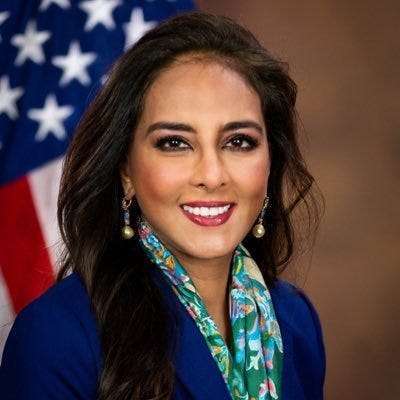 AAGHarmeetDhillon @AAGDhillon Evanston’s “first in the nation” reparations program is discriminatory and illegal. @CivilRights sued the city today challenging the program. Other cities are on notice: discriminate against residents — you’ll










Recent Comments