The Truth Is Out There

Archive for August, 2025

Social Justice, Destruction of Property Rights, and Government Tyranny (Part One)


You are a poor minority living in a government housing project called “Affordable.” It’s all paid for by the tax dollars of mostly middle-income Americans. Included are still more government programs that are providing monthly checks and coupons to supply food, free healthcare, free education, and let’s also throw in free cell phones.

Does that not make us a generous nation? Are not the poor well cared for and satisfied? Aren’t the taxpayers proud of their contribution to the common good? The answer to every one of these questions is NO!
 

First, consider these facts about that stipend income from the welfare check. Originally, it was called “assistance” and the purpose was to help out when the paycheck wasn’t quite covering needs during difficult times. Over time the system changed from “assistance” to “Government Benefit.” Now it’s an entire system of total dependence. While promises to help provide job training and even some actual jobs exist, few actually provide enough income or security to allow recipients to leave the program. In addition, if a recipient even tries to put some of that money away in savings, as an attempt to provide for an emergency, it is confiscated and possibly the welfare check stops all together. It’s no longer “assistance” during hard times. Now it’s control.
 

Then there is that public housing situation. Here’s what it’s like to actually live in those government projects. In many cities the neighborhoods are drastically rundown in disrepair as lights, air conditioning, and appliances fail to work. The roof leaks, windows are broken, and the plumbing backs up. Trash around the grounds is in ever-growing piles, and is rarely, if ever cleaned and hauled away. Don’t even think about any kind of yard work to create a place for the children to play. Worse, the residents live in fear of gang elements like MS-13 that have taken over the neighborhoods to rule as their territory. Pimps, pedophiles, and drug dealers prey on the children. And no matter how many times residents may ask for repairs, it never happens.
 

Why are the conditions so bad in this government-controlled housing? Government is a monopoly that has no incentive to be efficient. The taxpayers are forced to pay and the money rolls in so the politicians can puff out their chests over how generous THEY are in helping the less fortunate. Meanwhile, the management of these properties is overseen by government bureaucrats with no personal stake in the projects. Their paychecks keep rolling in, no matter what happens to the properties they manage.
 

In such an atmosphere, the inherent hopelessness leaves little room for making future goals for their lives. There is rarely a way out once the system has a hold on you. By herding minorities and low-income families like cattle into these tenements, the government is committing them to a future worse than poverty. They have lost their rights, their choices, and their ability to excel through self-determination and personal growth.
 

Yet, proponents of government’s fair housing want you to think that those favoring the programs are the compassionate ones, helping minorities to survive in an oppressive capitalist world of the rich. Essentially fear is the common tactic used to keep minorities under government control. Anyone who opposes the system and promotes sound economics and a system of equal opportunity, is accused of heartlessness and racism, determined to pull the plug on the welfare lifeline.
 

To promote the fear and division, politicians, the news media, and the public education system continually drive home the message that our nation’s founders created an oppressive society in which Whites get all the goodies and minorities are deliberately oppressed. In addition, goes their propaganda, the free enterprise system is designed to take the money from the poor and put it in the rich man’s pocket. And so, the result is strife, jealousy, and hatred between the races. Meanwhile, the middle class actually funds most of it from their weekly paychecks, purchases, and property taxes.
 

The true purpose is to move forward to impose the agenda now powered by the World Economic Forum (WEF) and others driving to change our culture and system of representative government toward their goal of global governance.
 

This, then, is the determined mission of today’s radical Leftist movement now in control of the Democrat Party They are driving to be seen as the saviors of the oppressed. Government oversight, redistribution of wealth, and social justice are the chosen tools to enforce this false equality. Yet, the only true result has been the massive growth of poverty.
 

Now these forces are moving to expand their tactics by pushing the failed government housing model into your neighborhood. The new drive is to eliminate single-family home zoning protection. Our new controllers insist that such policy is really designed as a means for wealthy homeowners to “self-segregate” themselves from those they don’t want living in their neighborhoods. Specifically, they charge that private property ownership is racist. To establish true “FREEDOM” in America, they tell us we need to open these “white privilege neighborhoods” to allow federal fair housing programs, including high rise government rental units in every neighborhood. They claim single family home neighborhoods contribute to a growing housing shortage. So goes their argument: “we could put ten families in the area where only one now lives in those neighborhoods. It’s only fair!”
 

Baltimore, Maryland became one of the first cities to feel such pressure and threats as the NAACP sued Baltimore over alleged housing segregation. The NAACP argument was that Section 8 subsidized housing programs “bunch people together, and that it only fuels more crime and other problems.” Not fair! The solution, says the NAACP, is to “integrate the poor among wealthier families.” Outrageous as it sounds, such social justice mongers actually claim this will help increase the income opportunities for the poor when they begin to live in those affluent neighborhoods.
 

The pressure from these groups, has resulted in Baltimore being forced to agree to spend $30 million of tax-payer dollars over the next ten years to build 1,000 low-income homes in affluent neighborhoods.
 

The result will be a destruction of property values and the loss of equity for the homeowners. In short, destruction of earned wealth leading to destruction of the middle class creating even more poor. It’s a growth product. Meanwhile, massively powerful corporations like Blackrock will move into the neighborhoods and buy that property at a massively reduced cost. They will then build the apartments and public housing, earning a fortune.
 

In Portland, Oregon, the infamous “poster child” of federal Smart Growth development policies, the city council unanimously approved a new tax to raise $12 million per year to pay for “affordable housing.”
 

Said Portland Commissioner Dan Saltsman, “The lack of affordable housing is the greatest crisis facing our city right now.” Perhaps he should take a long look at the twenty-year Smart Growth history of Portland in which massive amounts of land was locked away to limit the “sprawl” of the city. This led to land shortages, which led to bans on single-family homes, which led to the need for massive high-rise apartment buildings, all of which led to higher costs and shortages of homes. Now, Portland has a “crisis “over a shortage of “affordable” housing. Their solution is another tax on construction, driving up housing costs even more.
 

These same attacks on private property are growing across the nation. Landlords of privately-owned apartments are being labeled the new boogey men of our day. They now must deal with more taxes, rules, regulations, and even a ban on their ability to determine if potential renters can afford to live in the building. Such policy is the destruction of private property rights, targeting an entire industry.
 

Of course, the government argues that denying people who can’t afford to pay the rent to live in your property is “discrimination by right-wing capitalism.” Anyone with a small amount of rational thought would logically ask how the landlord could survive and provide his property for housing if the tenant can’t pay? The only result will be fewer landlords and fewer choices for housing. Housing shortage, indeed!
 

All of these policies, instituted in the name of social justice and redistribution of wealth, will very quickly lead to one final solution. Private homes, privately owned rental properties, and the individual owner’s ability to prosper, will disappear. That means the rule of law is dismissed in favor of “fairness.” Social Justice is purely based on redistribution of wealth. Your wealth. That’s money you worked for, saved, invested, and protected for YOUR needs; YOUR dreams; YOUR future.
 

Eventually – and very soon – the only source of housing will be from government. Take a good look at the destroyed neighborhoods now under government control and see your future. Property rights and personal ownership are equal opportunities for everyone to build wealth and freedom. It’s how the United States quickly became so prosperous in its beginning.
 

Our founding fathers fully understood that private property ownership was the vital key to freedom. They also understood that local government representation is the key to protecting liberty against a tyrannical central government that has no real stake in the lives of the citizens. Central government destroys personal choice, incentive, and the wealth created from it. It’s the reason we are now plummeting into poverty.
 

As our nation now moves toward the celebration of our 250th birthday, to save our Republic it’s urgent that American citizens unite to demand an answer from our locally elected representatives, who do you represent – the citizens who elected them or powerful special interests armed with a destructive agenda?

Supreme Court Considering Ending Racially Drawn Electoral Districts


Screenshot via X [Credit: @amuse]

The Supreme Court has asked a question long deferred: may race be the predominant factor in drawing congressional districts? On August 1, 2025, in the case of Robinson v. Ardoin, the justices issued an order for supplemental briefing on precisely that issue. At the heart of the case is a map in Louisiana, which connects disparate Black communities across the state to create a second majority-Black district. The method is undisguised: race was the reason for the shape. The rationale? Section 2 of the Voting Rights Act requires it. But does it? And if so, is Section 2 itself unconstitutional in its current interpretation?

This moment offers an opportunity to resolve a contradiction at the core of American election law. States like Texas, currently advancing a new map that adds five Republican-leaning districts, now face legal crossfire: if race is not considered, they risk violating Section 2. If it is considered, they risk violating the Equal Protection Clause. One branch of federal law demands race-consciousness, another forbids it. The state is expected to perform a legal contortion that no theory of jurisprudence can justify and no mapmaker can survive.

Let us be clear: race-based redistricting, as presently practiced, is not a civil rights triumph. It is a vestige of a failed doctrine, preserved by inertia and political convenience. Its intellectual foundation is cracked. Its moral justification is confused. And its legal coherence has long since collapsed.

The Court has spent three decades attempting to split the atom of race and districting. In Shaw v. Reno (1993), it held that districts shaped predominantly by race are presumptively unconstitutional. But it also held, implicitly, that racial consideration is sometimes required. In Miller v. Johnson (1995), the Court offered a test: race must not “subordinate traditional race-neutral districting principles.” But this is not a rule. It is a riddle. What is a “traditional principle”? Compactness? Contiguity? Political advantage? And what counts as subordination? The problem is not that these questions are difficult. The problem is that they are incoherent.

The jurisprudence of redistricting now revolves around motive rather than effect. A district that looks racially gerrymandered may survive if the court believes the motive was partisan, not racial. Conversely, a district drawn for racial balance may fall, even if it resembles an acceptable partisan gerrymander. In Cooper v. Harris (2017), North Carolina drew districts nearly identical to earlier ones that had passed muster. The Court struck them down. Why? Because the motive had shifted. Thus, the map itself is less important than the state of mind of the mapmaker. This is not law. It is psychoanalysis.

Justice Clarence Thomas has long warned that Section 2, as interpreted, has become an engine of racial sorting. In Allen v. Milligan (2023), he argued that the VRA “requires the very racial sorting the Constitution forbids.” The law demands that states guarantee minority opportunity, which in practice means drawing majority-minority districts. But achieving this requires treating citizens not as individuals, but as representatives of racial blocs. It is, in effect, racial apportionment. And it is incompatible with the Fourteenth Amendment.

Some will object: does not the history of racial discrimination demand corrective measures? It does. But the constitutional remedy for discrimination is the prohibition of discriminatory intent, not the imposition of racial quotas. In 1982, Congress amended Section 2 to allow liability based on disparate impact alone. This was the original sin. It created a legal regime in which even race-neutral maps can be struck down if they fail to produce proportional racial outcomes. The test laid out in Thornburg v. Gingles (1986) invites this logic: if a minority group is geographically compact, politically cohesive, and usually defeated by bloc voting from the majority, a district must be drawn to give it a fair shot. But what is a “fair shot”? In practice, it means a seat in rough proportion to population share. This is a de facto quota, no matter how delicately phrased.

To see the absurdity, consider Texas. The House Select Committee on Redistricting recently approved a new map that expands Republican strength. Critics allege that it fails to account for the state’s growing Latino population. But how should it account for it? If Latino voters are politically diverse, no single district can reflect their preferences. If they are geographically diffuse, no compact district can encompass them. And if the state avoids using race at all, it is accused of negligence. The only way to win is not to play. This is what Judge Edith Jones once called the “Kafkaesque” quality of VRA enforcement.

Louisiana’s current litigation is a perfect test case. One-third of its population is Black. In 2022, the legislature drew a map with one majority-Black district. A federal court invalidated it. The legislature responded with a new map creating a second Black-majority district, District 6, linking communities from Baton Rouge to Shreveport. It was hailed as a VRA triumph. But another panel struck it down again, calling it an unconstitutional racial gerrymander. So the same racial logic that was required under federal law became unlawful under the Constitution. The Court must now answer: can a state obey both?

The answer, if it is to be principled, must be no. Race may not be used as the predominant factor in redistricting, because doing so violates the Equal Protection Clause. The state may not sort voters by race. It may not assign political voice based on ancestry. It may not draw lines that assume, a priori, that individuals think alike because of skin color. These are the principles of a colorblind Constitution, as articulated in Parents Involved v. Seattle (2007) and reiterated in Students for Fair Admissions v. Harvard (2023). To say otherwise is to create a racial exception to equality under the law.

And what of the Voting Rights Act? Properly interpreted, Section 2 forbids intentional discrimination, not statistical imbalance. It was meant to stop literacy tests, poll taxes, and procedural tricks. It was not meant to guarantee demographic symmetry. To restore it to its original purpose is not to gut it. It is to save it from constitutional collapse.

Critics warn that ending race-based districting will reduce minority representation. Perhaps. But if minority candidates can win only in majority-minority districts, we have already failed. The point of civil rights law is not to freeze identity groups in political amber. It is to liberate individuals from the weight of group expectations. Political equality means that every citizen’s vote counts the same, not that every group gets a seat at the table proportionate to its census count.

This Court has a chance to complete the work it began in cases like Shelby County v. Holder and SFFA v. Harvard. The logic is clear. The Constitution does not permit racial classifications unless narrowly tailored to serve a compelling interest. Proportional representation is not such an interest. Nor is political balance. Nor is group parity. The only compelling interest is the elimination of discrimination. And that does not require race-based line drawing. It requires neutral principles, honestly applied.

Texas, Louisiana, and dozens of other states now await clarity. They deserve more than a demand to “consider race but not too much,” to “achieve equality without noticing inequality,” to “mind the numbers but never cite them.” This is legal satire masquerading as doctrine. It is time the Court ended it.

Let the line be drawn, not on maps, but in the law: no more racial gerrymandering. No more euphemisms. No more paradoxes. A district should be constitutional because of what it is, not because of why it was made. That is how equal protection works. Anything else is a racial contract in disguise.

America Once Ruled Maple Syrup, Then Canada Rigged the Market


In 1950, the United States produced 80 percent of the world’s maple syrup. Today, it produces just 25 percent. What happened in the intervening decades was not the result of natural climate shifts, cultural disinterest, or a lack of maples. No, what happened was the emergence of a government-blessed cartel north of the border, designed to manipulate markets, control prices, and monopolize a once-shared North American agricultural tradition. This cartel, cloaked in bureaucratic euphemism as the “Quebec Maple Syrup Producers” (QMSP), has not only cornered global supply, but has weaponized state power to undermine its competitors, chiefly, American maple syrup farmers.

To be clear: Canada’s maple cartel is not merely a quirky feature of Quebecois regulation. It is a weaponized trade tool designed to suppress US prices, limit producer autonomy, and entrench Quebec’s global dominance. Worse than OPEC, which at least has to contend with rival oil powers, the QMSP faces no meaningful competitor, and it uses this monopoly to fix prices, enforce production quotas, and stockpile syrup in vast quantities to control the flow of supply.

To add economic insult to injury, Canada recently raised its import tariff on American maple syrup from 25 percent to 35 percent. The United States, ever the dutiful free trader, imposes no such reciprocal tax. This unilateral escalation is not only unfair, it is strategically corrosive. American farmers are being choked by a foreign cartel while our own government yawns.

In 2025, an academic study using nearly four decades of price data found that Quebec’s quota regime has depressed US maple syrup prices by roughly $3.50 per gallon, even after accounting for Canadian price trends. Because processors and exporters benchmark their contracts off of Canada’s state-fixed rates, US farmers find themselves with little leverage to negotiate. One researcher put it bluntly: Canadian prices influence American prices positively, but the overall effect of Quebec’s quotas is suppressive. The model in the study explained more than 86 percent of the variance in US prices.

This is a rigged game. It is not the invisible hand of the market but the iron fist of cartel economics. Quebec’s producers do not compete. They collude, legally so under Canadian law. And they are propped up not by superior trees or better sap, but by legal structures that would be unlawful if replicated in the US.

Consider the structural mechanics. Since the late 1980s, all Quebec syrup farmers have been legally required to sell their bulk syrup through the QMSP, which sets production quotas and enforces compliance with fines, seizures, or bans. Overproduction is not celebrated, it is punished. Independent sales are treated as smuggling. One could be forgiven for mistaking this for a Soviet-style command economy. Except instead of grain, it is syrup. Instead of bureaucrats in Moscow, it is bureaucrats in Montreal.

And then there is the Strategic Maple Syrup Reserve, which, unlike its petroleum counterpart in the US, is not designed to cushion emergencies but to manipulate markets. Housed in nondescript warehouses across Quebec, the reserve holds as many as 90,000 barrels, over 50 million pounds, of maple syrup. That is not a reserve, it is a weapon. In 2021, when Quebec’s harvest fell short, the cartel released nearly half the reserve to maintain global supply and price control. Conversely, in years of surplus, syrup is banked and the tap is turned off. American producers, meanwhile, have no such stabilizer and are left to ride the market’s whipsaw.

The result of this OPEC-style discipline is clear. Canada now controls 75 percent of global maple syrup production. The United States, despite having four times as many untapped maple trees, has been relegated to a second-class producer. Vermont, our largest syrup state, produces just 3.1 million gallons per year, compared to Quebec’s nearly 20 million. The economic loss to American farmers is staggering. Vermont Public Radio admitted as much: “Quebec’s legal maple syrup cartel dictates prices for Vermont maple producers.

“Even worse, the Canadian cartel has resorted to strategically increasing output to preempt American growth. In 2016, the QMSP proposed boosting production by 12 percent, not because of demand, but because American farmers were beginning to rise from their forced slumber. This was not economic efficiency; it was market sabotage.

And now, rather than retreat, Canada has doubled down. A 10 percent tariff increase on American syrup in 2025 is a hostile trade maneuver, a sugar-coated slap in the face. Canada continues to flood the US market with subsidized syrup yet slaps American producers with tariffs when they attempt to compete. This is not trade. It is conquest.

Some will argue that the QMSP has brought stability to a volatile industry. And it is true that syrup prices have seen fewer dramatic swings. But stability bought through coercion, quotas, and price-fixing is not stability. It is cartel behavior. It is anti-competitive. And it violates the very spirit of free trade that global commerce is supposed to honor.

The Trump administration must act. If President Trump is serious about restoring American industry, then the war on Canadian maple mercantilism must begin. First, the administration should demand that Canada abolish the QMSP or face retaliatory tariffs on all Canadian maple exports. If Canada insists on protectionism, we must reciprocate. Fairness requires nothing less.

Second, we must establish a National Maple Reserve, not to manipulate prices, but to protect US producers from the shocks of cartel manipulation. Such a reserve could serve as a bulwark against both supply disruption and Canadian market flooding. It would provide the cushion that Quebec already enjoys.

Third, we must recognize that Canada’s trade practices already violate multiple binding trade agreements, including the WTO’s General Agreement on Tariffs and Trade (Article XVII on state-trading enterprises), the WTO Agreement on Subsidies and Countervailing Measures, and critical provisions of the USMCA—specifically Chapter 3 on agriculture and Chapter 22 governing state-owned enterprises. These violations are not speculative. Canada’s policies distort trade, subsidize domestic dominance, and retaliate disproportionately against American producers. This violates principles of non-discrimination, fair subsidy practices, and market access. As Vermont’s syrup output has grown by over 260 percent since 2004, the distortionary impact of Canada’s protectionist regime has only grown more consequential. US producers should mount a formal challenge similar to the successful complaint in the dairy sector. Yet absent government action, this unfair system persists, and American farmers continue to suffer under a regime designed to keep them subordinate. The US Trade Representative, Jamieson Greer, must initiate proceedings without delay.

Finally, we should encourage American producers to expand aggressively, particularly in underutilized maple-rich regions like New Hampshire, Pennsylvania, and Wisconsin. Trump’s Department of Agriculture can provide loans, grants, and technical assistance to increase tap rates and production efficiency. In the 19th century, we were the world’s syrup capital. We can be again.

What is clear is that the current arrangement is not working. American farmers are being squeezed by a foreign cartel that is protected by state authority and trade barriers. We have tolerated it for too long. It is time to respond.

A barrel of maple syrup is worth up to thirty times a barrel of oil. But unlike OPEC, Quebec’s cartel does not fear global competition. It assumes, correctly so far, that its grip on the market will go unchallenged.

That ends now.

The responses to CBS cancelling Colbert are very revealing


The response to CBS cancelling Colbert is very revealing

I must admit that I was very surprised when Paramount announced the end of “The Late Show with Stephen Colbert — and then allowed it to continue for almost another year.  Most of the other major personalities who were shown the exit door were gone immediately.  Think Bill O’Reilly, Tucker Carlson, Don Lemon, Chris Cuomo, Brian Williams, Joy Reid, Glenn Beck, and so many more.

So, why let Colbert sit behind the desk for another ten months?  Maybe because they did not exactly fire Colbert.  They announced the end of the program.  It is more like announcing the final season of a sitcom.  The cast is just collateral damage.  Is Colbert really through at the network – or will the latter announce some new role?  Anything is possible – but I am betting that Colbert and CBS are in divorce mode.

His fan club is predicting good things for Colbert into the future.  They say he will not go away.  Maybe not entirely, but those who lost their lofty perches on the major networks never had the same visibility and influence they once had.  I repeat.  Think Bill O’Reilly, Tucker Carlson, Don Lemon, Chris Cuomo, Brian Williams, Joy Reid, Glenn Beck, and so many more.

There was a rumor circulating that he cut a deal with MSNBC’s Rachel Maddow for a new twosome show.  That was subsequently debunked.  Wherever Colbert goes, it will be on a much lower perch – even if it is not the Maddow-Colbert lower perch.

If you ever believed that “The Late Show” under Colbert was not a hardline left-wing propaganda vehicle for the Democratic Party, you need to analyze who is reacting.  You can see the political divide by who is cheering his departure and who is lamenting. 

Trump’s good riddance posting on Truth Social speaks for those on the right.  On the other side is the left-wing establishment — and they are in yet another state of hysterical apoplexy.  They see the departure of Colbert as yet another end-of-the-world event – giving new meaning to the word “hyperbole.”  That is not the sort of reaction you would get if the show and Colbert were not positioned so firmly in the left-wing establishment camp.  It is getting a partisan reaction because the show is – as conservatives have been saying for years – a product of and for the political left.

The crazed reaction from the left is yet another example of their myopic self-centered view of politics and public policy.  Everything they see as a setback automatically becomes an existential crisis of the first magnitude.  They go into a deranged meltdown.  For them, the common ground is always on the far left.

They also tie everything negative in their world to … Trump.  The President was never a Colbert fan.  Duh!  But neither am I.  No sooner had Paramount made the announcement than the voices on the left immediately tied the dismissal to Trump.  Another authoritarian move by the President to cancel opposition, they claim.

The only problem is that Trump never called for Colbert to be fired – as best I can recall. Paramount said it was mostly a financial decision.  The Colbert show was extremely expensive compared to the competition, costing CBS more than $40 million a year—and the ratings were slipping.  As were all the so-called late night comedians — except Greg Gutfeld on FOX.

Perhaps the most interesting unintentional revelations were the reactions of the other left-wing late night comedians. They rushed to Colbert’s defense – and even appeared on his program as a show of support.  What?

That act of allegiance clearly shows that Jimmy Fallon, Jimmy Kimmel, Seth Meyer and Jon Stewart are not “media personalities” but hardcore members of the left-wing establishment.  In a non-political world, they would be the competition.  They would be happy to see a “competitor” go down.  A few kind words of condolences, perhaps, but not this locked-arm support from the competition. 

The reaction of the competitors clearly demonstrates that they are, first and foremost,t left-wing “political advocates.”  Their bond and loyalties are not to the networks that pay them but to their common political cause.  In fact, their political allegiance is so paramount (No pun intended) that they attack the networks that pay them.  They are part of the Democrat-led Trump Resistance Movement – and it is killing their popularity and their ratings, as it should.

Running From Democracy: Democrats That Deny Quorum In Texas Must Be Arrested


Screenshot via X [Credit: @amuse]

Democracy depends on presence. Legislating, like governing, cannot be done in absentia. In Texas, Democrats have made a habit of fleeing their duties when the political winds blow contrary to their liking. Unlike Republicans, who may fight, filibuster, and lose, but who stay to cast the vote, Texas Democrats have repeatedly taken flight, first in 1979, then again in 2003, and more recently in 2021. Now, as the Texas House prepares to pass a lawful redistricting bill that could reshape the state’s political map in favor of the Republican majority, the flight instinct stirs again.

The Democrats’ tactic is neither brave nor noble. It is sabotage disguised as protest. And it should be met not with applause, but with arrest.

This is not hyperbole. Nor is it a partisan overreach. It is the plain reading of the Texas Constitution, which provides the House the power to “compel the attendance of absent members, in such manner and under such penalties as each House may provide.” That authority was affirmed by the Texas Supreme Court in 2021, which concluded that if legislators are “sufficiently motivated to resist, the quorum-forcing authority… can only be effectuated by physical compulsion.”

And what of physical compulsion? It need not be theatrical. There is no call for shackles, nor should there be. Civil arrest, administered by the Sergeant-at-Arms under the Speaker’s direction, and potentially assisted by the Department of Public Safety, is precisely that: civil. Members who flee may be escorted back to the Capitol, detained until they appear on the floor, and then released. Their liberties are not abridged, their rights are not infringed. They are, quite literally, being asked to do their jobs.

Consider the precedent. In 2003, Texas Democrats fled to Oklahoma and New Mexico to block a redistricting plan. In 2021, fifty-two Democrats boarded a chartered flight to Washington, DC, martyrs with selfie sticks, in a failed attempt to block voting reform. In both cases, warrants were issued. In both cases, law enforcement pursued them. And in both cases, nothing came of it. Why? Because the enforcement lacked teeth, the Speaker lacked resolve, and the media praised the spectacle as a principled stand rather than a dereliction of duty.

Let us not repeat the mistake. Let us not confuse the act of disappearing with courage, nor the abuse of quorum rules with strategy. Legislative majorities exist for a reason. And while minority parties retain rights, those rights do not include dissolving the legislative process by disappearing across state lines. That is not dissent. That is sabotage.

The irony, of course, is that these theatrical flights accomplish very little. Redistricting is lawful at any time in Texas. There is no constitutional prohibition on when it may occur. And there is nothing illegal, immoral, or even unusual about using redistricting to consolidate partisan advantage. Democrats do it in Illinois. They do it in Maryland. They have tried it in New York. Republicans do it too. This is politics, not sainthood.

So why flee? Because fleeing creates drama. And drama attracts donors. One need only recall the 2021 incident to see the game: Democrats tweeting from their DC hotel rooms, holding press conferences, hosting Zoom calls, launching fundraisers. They were not escaping tyranny. They were cultivating narrative, a narrative built for MSNBC, not Texas voters.

What is the proper response to this sort of behavior? Arrest. Not punitive, but procedural. Civil arrest is the mechanism designed to enforce quorum. It is the legal answer to legislative cowardice. And it should be used.

The Speaker must not hesitate. Upon motion, a call of the House can be ordered. Civil arrest warrants can be signed. The Sergeant-at-Arms can be dispatched. If necessary, the Department of Public Safety can assist. If the members are still in Texas, they can be detained. If they flee the state before warrants are issued, let them try. The optics will not favor them.

Let us also be clear: this is not criminal enforcement. The Texas Constitution protects legislators from arrest during session, except in cases of treason, felony, or breach of the peace. But this protection does not extend to civil enforcement for quorum. That protection ends the moment a member refuses to appear for duty.

Should members resist arrest or defy lawful orders, additional penalties may follow. Under Government Code Sec. 301.026(b), refusal to comply with a House summons can constitute contempt, a misdemeanor carrying fines and possible jail time. House rules also allow for daily fines of $500, reduction in legislative accounts, and even expulsion with two-thirds support.

These tools exist for a reason. They are not meant as curiosities, nor as symbolic gestures. They are mechanisms to preserve the rule of law inside a legislative body that depends on structure, discipline, and presence.

And here, structure matters. The House cannot function without a quorum. Under Article III, Section 10 of the Texas Constitution, two-thirds of members must be present to conduct business. Absent that quorum, bills cannot be passed, debates cannot proceed, and governance is halted. That is not a bug in the system, it is a design feature. But it assumes that members act in good faith. When they do not, when they flee to avoid votes they cannot win, the quorum requirement is not a check on power, but a tool of extortion.

It is time to remove that tool.

The temptation, of course, is to treat this as mere political theater, something to be mocked, perhaps, but not seriously addressed. That would be a mistake. The danger of such acts is not merely their ineffectiveness. It is the precedent they set. If minority parties learn that fleeing earns media sympathy, stalls legislation, and fuels donations, they will do it again and again. And they will do it regardless of ideology.

Let us then affirm a simple principle: If you hold office, you must show up. If you refuse, the Sergeant-at-Arms will find you. If you hide, law enforcement will search. If you flee, you will be returned. That is the compact of self-government.

The people of Texas deserve a functioning legislature. They voted. They sent representatives. They expect laws to be debated, passed, or defeated—not evaded. Redistricting is not a moral crime. It is a constitutional process, wielded by both parties. To flee from it is not resistance. It is abandonment.

There is a word for lawmakers who run from the law: fugitives. And in Texas, fugitives can be brought home.

P.S. It is worth remembering that every single Democrat in the Texas House voted to install Speaker Burrows, while a majority of Republicans voted against him. Burrows, not the Republican majority, controls the legislative calendar and this redistricting effort. The map is his. The process is his. And by extension, it belongs to the Democrats who elevated him. If anyone has earned the right to object, it is the Republican majority who opposed his speakership, not the Democrats now attempting to derail the very process they helped empower.

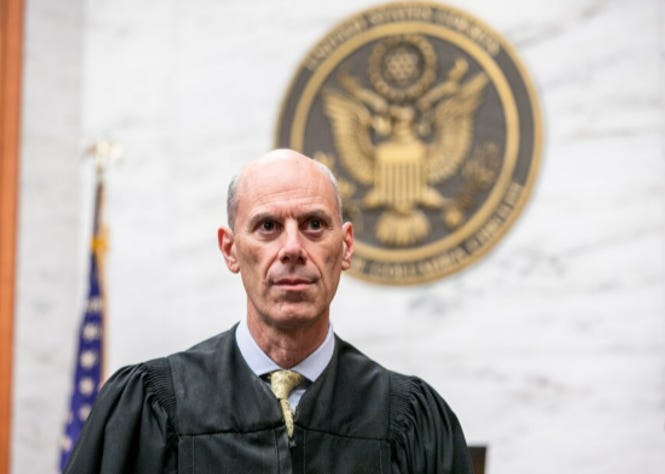
The Contemptible ‘Judge’ Jeb Boasberg


Rebukes by the Supreme Court and DC appellate court are not stopping Boasberg’s quest to punish the Trump administration for alleged contempt. Now he’s the target of complaints of misconduct.

Jeb Boasberg is not giving up.

Undeterred by recent smackdowns by the Supreme Court and the D.C. appellate court, Boasberg, the Obama-appointed chief judge of the D.C. district court, is preparing to mete out some sort of punishment against the Trump administration for allegedly defying one of his court orders back in March.

During a hearing last week in the ACLU’s lawsuit related to the Alien Enemies Act, President Trump’s signature deportation policy that ordered the immediate removal of illegal Venezuelans tied to Tren de Aragua, Boasberg expressed frustration that his colleagues on the D.C. appellate court are dragging out a hold on Boasberg’s contempt findings; in April, Boasberg determined “probable cause exists to find the Government in criminal contempt” for allegedly ignoring what he describes as an “oral command” to return planes already out of U.S. airspace carrying AEA subjects on the evening of March 15.

“The Constitution does not tolerate willful disobedience of judicial orders—especially by officials of a coordinate branch who have sworn an oath to uphold it,” Boasberg lectured in his 46-page order. (As I wrote here, it appears Boasberg set the contempt trap from the start.)

But a three-judge panel of the D.C. appellate court quickly halted his contempt proceedings—and Boasberg is not happy. “As everyone knows, the proceedings here have been moving, or to be more accurate, right now not moving (emphasis added) on two separate tracks, the contempt track and the merits track,” an exasperated Boasberg said on July 24. He further noted that “such a lengthy stay has been frustrating to plaintiffs,” referring to the ACLU.

Sensing the appellate court ultimately will overturn his contempt order—a smart prediction given the Supreme Court overturned his underlying order related to the contempt allegations in addition to the silliness of his findings—Boasberg nonetheless warned the Department of Justice he is considering other options. “[Whether] or not I am ultimately permitted to go forward with the contempt proceedings, I will certainly be assessing whether government counsel’s conduct and veracity to the Court warrant a referral to state bars or our grievance committee which determines lawyers’ fitness to practice in our court,” Boasberg said. (Even more outrageously, Boasberg claimed recent unsubstantiated accusations made by a disgruntled DOJ prosecutor involved in the case and fired earlier this year for insubordination “strengthened” his contempt determination.)

His threat represents yet another escalation in Boasberg’s unhinged effort to retaliate against the president and his administration for criticizing his conduct in the case. On March 18, Trump in a Truth Social post denounced Boasberg as a “radical left lunatic of a judge” who should be impeached; a handful of Republicans have since joined the president’s call to remove him from the bench.

Need a Mirror, Judge Boasberg *rhetorical

Boasberg knows he’s not going anywhere anytime soon but complaints against him are piling up. Earlier this week, Chad Mizelle, chief of staff to Attorney General Pamela Bondi, filed a misconduct complaint against Boasberg for “making improper public comments about President Donald J. Trump” during a judicial conference just days before Boasberg took up the ACLU case in Washington.

The complaint primarily stems from recent reporting by Margot Cleveland at The Federalist, which had obtained a summary of the conference attended by federal judges and Chief Justice John Roberts in the nation’s capital. The summary indicated Boasberg asked Roberts to address his “colleagues’ concerns that the Administration would disregard rulings of federal courts leading to a constitutional crisis.”

Mizelle also slammed Boasberg over his handling of the ACLU lawsuit. “Throughout the proceedings, Judge Boasberg rushed the government through complex litigation, sometimes giving the Trump Administration less than 48 hours to respond and threatening criminal-contempt proceedings and the appointment of an outside prosecutor against senior Trump Administration officials for failing to comply with an order that had already been vacated.”

The DOJ is asking the chief judge of the D.C. Circuit, fellow Obama appointee Sri Srinivasan, to investigate Boasberg’s “willful misconduct” and reassign the entire case to another judge. (Boasberg also attended Trump’s 2023 arraignment in Special Counsel Jack Smith’s January 6 indictment against the president.)

The same appellate panel also wants to hear from the DOJ and the ACLU in response to allegations Boasberg violated a local court rule by immediately conferring “pseudonym status” to the five illegals in the deportation case. According to an emergency motion filed in April by a Connecticut man who is not a party in the lawsuit, Boasberg did not separately issue an order to seal the names of the plaintiffs—required in the D.C. circuit—he simply approved a motion for the lawsuit to proceed “pseudonymously.”

Boasberg at the time appeared to have known what was required but instead chose to flout the rules: “Given the expedited nature of this matter, it determines that a full Opinion is not practical at this time. Believing that Plaintiffs have made the required showing on the relevant factors, the Court ORDERS that…They shall be permitted to proceed pseudonymously unless and until the assigned judge determines otherwise,” he said in a minute order posted the morning of March 15.

Since then, Boasberg has not issued a full opinion stating his reasons for doing so. (Every ACLU lawsuit on the Alien Enemies Act uses initials rather than names.)

The three judge panel—Trump appointees Greg Katsas and Neomi Rao and Obama appointee Cornelia Pillard—overseeing Boasberg’s contempt order has set a September 5 deadline for both sides to reply to the unsealing motion.

In the meantime, the president’s Alien Enemies Act policy is in limbo awaiting a decision by the Fifth Circuit appellate court as to the lawfulness of the proclamation. (Oral arguments were held on June 30.)

If the appellate court, and the Supreme Court, ultimately decide the courts have no role in the execution of the AEA—which several judges including Boasberg have already acknowledged—then what? How can the president get back months of stonewalling, threats, and overall bad behavior by judges in the matter?

Who will pay the price for such brazen contempt for the president and his policies?

Crowds on Demand provides paid protesters


Crowds on Demand provides paid protesters

There was a time when protests meant something. People marched because they believed in a cause. They shouted because they were angry, passionate or fed up. Today? You can buy protesters like buying a pizza with your choice of toppings.  Pay to protest?  Yep!

It reminds me of the days I ran the City Club of Chicago and hosted two to four luncheons each month.  To keep the luncheon program successful, I established a policy that no speaker would have fewer than 100 folks in the audience.  Since not every speaker was a big draw, I had a deal with a group of mostly senior citizens who would provide “audience” for a free lunch.  Everyone was happy.   A few seniors got a free lunch.  The speakers got a respectable audience.  And the City Club had another successful event.

It never occurred to me that my little gambit could be commercialized on a grand scale.  But it did occur to Adam Swart.  In 2012, he founded Crowds on Demand – a company that took the idea of “grassroots activism” and asked, “What if we commercialize it?” He apparently looked at democracy and thought it would be better with casting calls.  Crowds on Demand essentially rents out smiling or angry crowds, professional protesters and even phony gaggles of pretend paparazzi. (So, there is such a thing as “fake press.”)

Basically, if you need an audience that agrees with you or boosts your cause — and you are short on real people who do — Adam’s got you covered.  He provides adoring “fans” for celebrity events, crowds for movie openings, television commercials and corporate events.

Most know that those who watch in awe as fried eggs slip effortlessly off the skillet are actors – or more accurately called props

However, there is a more ominous service provided by Crowds on Demand. It is more surprising – and disturbing.  Remember the accusations that some of those anti-Trump protestors were being paid.  Hired hands with no real interest in the issues.  Well, now we know.  They probably were.  It appears that hiring protestors is a standard operating procedure – and Swart’s company is among those who provide the bodies. 

He says that Crowds on Demand is nonpartisan but concedes that most of his lucrative offers come from the left because progressives use public protest more often—and he operates mostly in urban Democrat controlled environments.  (This goes along with an earlier commentary in which I pointed out that protests, civil unrest, AND riots are the trademarks of left-wing activism.)

To mount a protest in today’s political world, you do not need to win over the hearts and minds of people. All you need is a budget and a script.  It is like hiring wedding guests who do not know the bride or groom—but somehow still cry during the vows.

Swart also confirmed in a television interview that a lot of the money comes from politically active billionaires whose names would be familiar to the public.  Swart will not name names, however. His own client list remains a mystery largely because nobody wants to admit they hired strangers to pretend to be motivated by the cause.

If you think this is a marginal peanut business, think again.  Business is booming.  Adam’s company received more than 100 requests to support anti-Israel demonstrations on college campuses following the October 7 Hamas attack. Swart declined all, stating the issue was too divisive.

To get an idea how much money the left is willing to spend on phony protestors, consider this.  In July 2025, Adam said he turned down a $20 million offer to stage a nationwide protest. The unidentified organizers were planning the mass movement opposing what they claimed was a civil rights rollback of the Trump administration. You may recall it as the one organized in the name of the late civil rights leader and Congressman John Lewis. It was “good trouble” to use Lewis’ coined terms – without Swart’s help in this case.  I think it is safe to assume that the money he turned down found more accepting hands.

Swart said “no” — not because it was ethically murky or misleading, but because he feared the protest might be unsuccessful and would make his company look bad to future customers. At least that is his claim, and he is sticking with it.

Now, you might be wondering why most Americans have never heard of this. It is because this kind of real manipulation falls into a weird blind spot. It is legal. It is ignored. When the issue of paid demonstrators comes up, the Democrat left-wing establishment goes into full denial.

Paying for concocted public outrage turns constitutional democracy into improv theater. Politicians see a crowd and assume it is public will. News outlets see signs and think it is a movement. Voters see rallies and form opinions. But all they see are bodies hired by individuals and interest groups with big bucks.  It is astroturfing at its finest (or its worst) — artificial grassroots movements, choreographed drama, emotions-for-hire. It is civic engagement by a casting director.

Crowds on Demand sells perception over reality – and in politics, perception creates its own reality. The company thrives where optics matter more than authenticity.  When you can buy a protest, you can buy influence. And when influence is up for sale, democracy is not far behind. So, the next time you see a protest on the news, ask yourself, “Is this a revolution—or just a carefully crafted reality show?”

DOE Report Upends Climate Alarmism: CO2 Not the Villain We Were Told


The intellectual foundation of modern climate policy rests on a shaky assumption: that anthropogenic carbon dioxide emissions, left unchecked, will wreak unmanageable havoc on the Earth’s climate and economy, and that radical mitigation is the only path forward. This assumption has been treated not as hypothesis but dogma, one that brooks no dissent. Yet, on July 29, 2025, the Department of Energy (DOE) disrupted this orthodoxy with a quietly released but tectonic report, A Critical Review of Impacts of Greenhouse Gas Emissions on the U.S. Climate. Its findings deserve our undivided attention.

Developed by the 2025 Climate Working Group under Energy Secretary Chris Wright, this report evaluates the empirical record, existing literature, and widely cited models of climate change and its impact. It issues a sober verdict: the harms of CO2-induced warming are overstated, the benefits underreported, and the United States’ costly mitigation policies amount to symbolic gestures with virtually no measurable effect on global climate trajectories.

Pause on that last point. The United States is often urged to lead the world in climate action, regardless of cost or efficacy. But as the DOE report makes clear, our domestic efforts will have “undetectably small direct impacts on the global climate” and whatever marginal effects might accrue would only unfold over centuries. That is not policy, that is performance art.

The report’s challenge to prevailing climate dogma is not confined to global impact. Its most devastating conclusion lies in the economic analysis. CO2-induced warming, it asserts, is less damaging economically than conventionally believed. Why? For one, the benefits of carbon dioxide, especially in enhanced plant growth and agricultural productivity, have been systematically minimized. Atmospheric enrichment with CO2, the molecule that every leaf on Earth craves, has produced tangible greening of the planet, as satellite data has repeatedly confirmed. The report notes that elevated CO2 levels are associated with longer growing seasons, higher crop yields, and improved drought resistance.

To this, some will object: but what about the disasters? The hurricanes, the wildfires, the floods and droughts? Here, too, the DOE report punctures myth with data. Trends in extreme weather, whether hurricanes, tornadoes, or droughts, do not show a statistically significant increase in frequency or intensity in the US. The belief that climate change is driving more disasters is not borne out by the nation’s own historical record. The pattern is familiar: catastrophic headlines dominate the news cycle, but peer-reviewed long-term data often reveals no clear signal.

What the report urges us to reconsider is not science per se, but scientific selectivity. Which studies are emphasized, which outcomes are modeled, which scenarios are dramatized, these are not neutral choices. They reflect a politicization of climate discourse that has ossified around worst-case predictions. The DOE’s panel of independent scientists, drawing on physical science, climate modeling, economics, and academic research, concludes that aggressive mitigation strategies could be more harmful than beneficial.

Why? Because such policies incur massive economic costs today in exchange for theoretical benefits centuries in the future. The social cost of carbon, a number derived from notoriously elastic models, is used to justify expansive regulation and taxation. But the opportunity cost of mitigation is rarely tallied. The DOE report points to harms from these policies: deindustrialization, energy poverty, manufacturing flight, and disproportionate burdens on low-income families. In seeking to avert a hypothetical crisis tomorrow, we are creating a very real one today.

Consider Germany’s “Energiewende” experiment. Once celebrated as a model for renewable transition, it has left the country with some of the highest energy prices in the world, increased coal usage, and stagnating industrial output. That is not progress; that is regression clad in moral virtue.

The DOE report does not deny climate change. Rather, it questions whether the response, especially by the US, acting alone, is rational, proportional, or effective. A sound policy approach would weigh benefits against costs, factor uncertainty, and consider adaptation as a co-equal strategy. It would recognize that prosperity, technological advancement, and institutional resilience are the most reliable defenses against climate risk.

And what of the global context? China emits more CO2 than the US and EU combined, and continues to expand its coal fleet. India, rightly prioritizing growth and poverty alleviation, follows a similar path. Even under idealized global mitigation scenarios, temperature effects remain marginal for decades. If the goal is climate stability, US policy must reckon with this reality.

There is a deeper lesson here about humility. Climate models are not oracles, and long-range forecasts are fraught with uncertainties. The Intergovernmental Panel on Climate Change (IPCC) itself acknowledges the “deep uncertainty” surrounding cloud feedbacks, ocean cycles, and aerosol effects. Yet policymakers cling to worst-case models like RCP8.5 as if they were certainties. The DOE report reminds us that science, when honest, acknowledges what it does not know.

The economic modeling is equally uncertain. How do we quantify the benefit of a slightly cooler planet in 2150? How do we discount the loss of economic growth, technological progress, and human well-being between now and then? These are not simple equations. They are philosophical judgments smuggled into spreadsheets.

One need not reject the premise of climate change to accept the report’s conclusion. One need only accept that climate risk exists alongside other risks—economic, geopolitical, social. A rational society does not bankrupt itself to prevent a hypothetical future while ignoring the very real suffering of its present.

This report ought to serve as a corrective. It does not deny that CO2 has climatic effects, but it insists we view those effects in context. It challenges the catechism of decarbonization as the sole moral and practical imperative. It urges policymakers to consider adaptation, resilience, and economic growth as indispensable tools in managing a changing climate.

To those who regard such conclusions as heresy, consider this: Truth does not fear scrutiny. If the consensus is as solid as claimed, it should welcome a challenge from a panel of independent scientists operating under a federal mandate. That is how science progresses, not through suppression, but through argument.

The American people deserve more than theatrical virtue-signaling. They deserve climate policies rooted in realism, not alarmism; in cost-benefit analysis, not eschatology. The DOE report offers a roadmap. We would do well to follow it.

When Does Social Engineering Become Indoctrination? Critics Point To Harvard


Suppose an American university were caught using taxpayer dollars to fund a theology course that instructed future teachers to structure public classrooms around Christian doctrine. There would be a media uproar, lawsuits from the ACLU, and urgent congressional hearings about the Establishment Clause. The same logic must apply to ideological instruction from the left. Harvard’s course EDU H210P, “Queering Education,” is not a neutral academic inquiry but a taxpayer-subsidized training ground for radical social reengineering. If President Trump’s executive order banning federally funded DEI indoctrination means anything, it surely prohibits what is happening in this course.

EDU H210P: Queering Education

Let’s examine the course on its own terms. Taught by self-proclaimed activist Kimm Topping, the author of “Generation Queer,” the class promises to equip future educators with tools to dismantle what it calls “heteronormativity” and “cisnormativity” in K-12 education. These terms, while cloaked in the language of critical theory, describe nothing more than the traditional understanding that boys are boys, girls are girls, and that most people grow up to marry someone of the opposite sex and have children. This is not a conspiracy of cultural oppression. It is the anthropological norm across civilizations and millennia.

Topping’s curriculum is not merely descriptive, it is prescriptive. Students are instructed to imagine themselves as ideological engineers, redesigning classroom structures, policies, and curricula to affirm queer identities and challenge the primacy of the nuclear family. Course texts include firsthand narratives of child drag performers, transgender high school athletes, and students whose gender expression is explicitly positioned in opposition to traditional biological categories. Topping’s 2025 book, for instance, valorizes the parents of “Desmond is Amazing,” a child drag performer whose public sexualization has been condemned by child psychologists and parents’ rights advocates. The book also endorses boys using girls’ bathrooms and the placement of biological males in girls’ sports, despite well-documented biological advantages and widespread parental concern.

What is the rationale for all this? That queer youth exist and must feel seen. No one denies their existence, nor that they deserve dignity and mental health treatment. But the leap from dignity to domination, from tolerance to taxpayer-funded proselytization, is one that Harvard makes without hesitation. Indeed, the entire premise of the course is that public schools should serve not the communities that fund them, nor the parents who entrust them with their children, but the theories of Michel Foucault and Judith Butler. The course sees heteronormativity as a problem to be solved. And students who dissent from that premise, particularly those from religious or traditional backgrounds, are implicitly cast as hate filled obstacles to progress.

This is not education in the classical sense. It is not an exploration of ideas. It is a catechism. And when institutions that receive hundreds of millions of dollars in federal aid advance these teachings as normative and expected, they violate both the spirit and the letter of the Trump administration’s executive order.

That order, reissued in January 2025, explicitly prohibits federal funds from being used to promote instruction that categorizes individuals as inherently privileged or oppressive based on immutable characteristics. It also bars the use of such funds for programming that inculcates the belief that the United States is irredeemably flawed or that American institutions must be radically dismantled. Harvard’s “Queering Education” course does both. It frames the traditional family not as one possible structure among many, but as an oppressive regime. It trains students to intervene against norms, not merely to understand them.

Moreover, the course is not elective in the colloquial sense. For many students pursuing degrees in education or public policy, it is cross-listed, recommended, or required depending on one’s track. That means students on federal student aid, GI Bill benefits, or research fellowships may be compelled to sit through what amounts to an activist training seminar in order to graduate. The taxpayer, therefore, funds not just the university, but the pipeline of ideological conformity that it produces.

Some will object: is this not academic freedom? No. Academic freedom protects the right to explore ideas, not the right to impose dogma. A university cannot, for instance, mandate that all biology students renounce evolution or require chemistry students to memorize religious doctrine. The analogy applies in reverse. Students should not be coerced, explicitly or structurally, into affirming radical gender ideologies as a condition of professional advancement. Harvard can teach whatever it wants, but the public should not be compelled to subsidize it.

The broader danger here is not merely legal, but civilizational. Harvard has long functioned as the de facto brain trust for America’s elite. What is taught in Cambridge today is implemented in classrooms, courtrooms, and boardrooms across the country tomorrow. To instruct future policymakers and educators that the nuclear family is a vehicle of oppression, that biological sex is an outdated superstition, and that parental authority must be subverted in the name of “queer justice” is to invite the unraveling of the social fabric.

The West is already in demographic decline. Fertility rates have collapsed. Births per woman in the US hover near 1.6, far below replacement level. At the same time, cultural and institutional voices increasingly frame childbearing as burdensome and family as retrograde. Courses like EDU H210P are not merely reflections of this trend, they are drivers of it. By teaching the next generation that family is optional, gender is a construct, and tradition is tyranny, they erode the foundation upon which healthy, flourishing communities are built.

This is not hyperbole. It is the logical end of a cultural revolution that believes every norm must be interrogated and every tradition dismantled. That a university with a $50 billion endowment, receiving over $600 million in federal funds annually, would devote those resources to ideological subversion is not merely unfortunate. It is unconscionable.

The Civil Rights Division of the Department of Justice should launch an immediate investigation into Harvard’s compliance with federal guidelines. Institutions that knowingly violate those terms should face disqualification from Title IV student aid, a freeze on federal research funds, and potential clawbacks. Congress should reassert its oversight authority and consider stricter statutory definitions of what constitutes educational instruction versus ideological indoctrination.

To be clear, private citizens and institutions are free to believe, discuss, and advocate whatever they wish. But they are not entitled to taxpayer dollars to do so. If Harvard wishes to explore gender ideology, it must do so on its own dime, not with funds extracted from truck drivers in Ohio or small business owners in Alabama.

If our institutions are to mean anything, they must be grounded in reality. The biological distinction between male and female is not a myth. The family is not a tool of oppression. And the classroom is not a therapist’s couch or a revolutionary cell. It is time we remembered that.