
The framework openly describes “integration,” “merger of assets,” “united governance,” and decision-making during crisis—and sector failure as the basis for pandemic control.

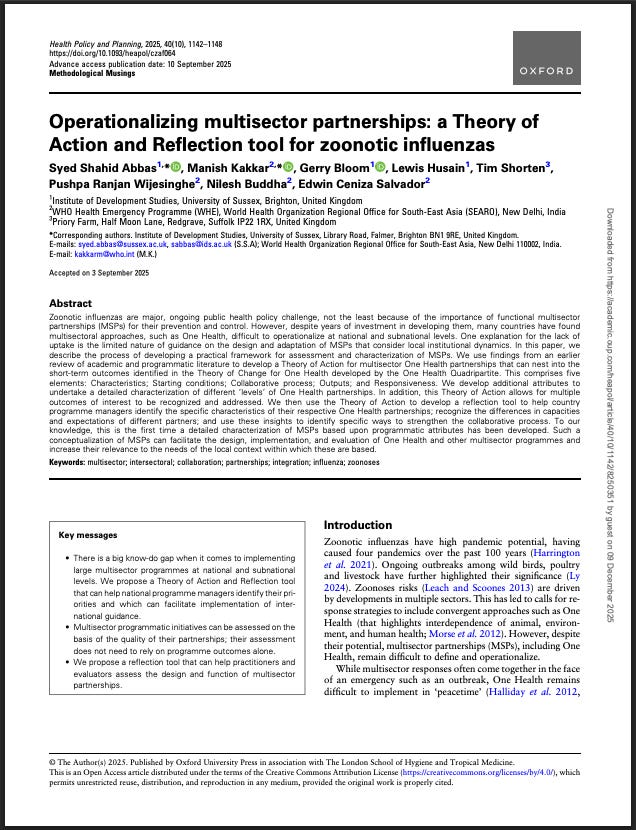
A recent WHO-funded study published in Health Policy and Planning outlines in direct operational terms the governance model the organization expects countries to activate during an influenza pandemic.
For years, this website has been documenting avian influenza gain-of-function experiments and countermeasures development carried out by governments all over the world in an apparent instigation/orchestration of a coming bird flu pandemic.
The WHO-backed document is framed around influenza specifically, describing it as the catalyst for restructuring national systems into a unified, multisector authority.
The paper establishes influenza as the justification:
“Zoonotic influenzas have high pandemic potential, having caused four pandemics over the past 100 years.”
“We focus on zoonotic influenza because of the urgency to respond to the ongoing influenza panzootic and reduce its pandemic potential.”
From that premise, the authors build out a governance architecture designed to take effect during conditions of influenza-driven crisis, uncertainty, or sector failure.
Pandemic Conditions Are the Trigger for Reorganizing National Governance
The study defines the activation conditions for these multisector structures:
“MSPs rarely arise due to common goals. Instead, different actors come together under conditions of uncertainty, crisis, or sector failure—when no single sector has the knowledge or resources to address the challenge.”
According to the framework, a severe zoonotic influenza outbreak meets all of these criteria.
Under those circumstances, governments are expected to transition from sector-specific decision-making to coordinated, collaborative, and ultimately consolidated control.
The End-State Described in the Document Is Full Integration of Governance Functions
The study provides explicit definitions of the governance levels intended for pandemic response.
Under the “Consolidation” and “Integration” stages, the paper states:
“Integration—merger of assets.”
“United governance—All governance functions assumed by a single entity.”
In the context of an influenza pandemic, this means:
- ministries of health, agriculture, environment, and related agencies no longer act independently,
- their assets and budgets become pooled (“singularly resourced”),
- operational outputs become unified (“singular production”), and
- governance shifts to a single centralized command structure.
These are the document’s literal terms.
Influenza Response Under This System Extends Beyond Health Agencies
Because the authors tie their influenza governance model directly to the One Health Theory of Change, the sectors incorporated into pandemic decision-making expand far outside traditional public health.
The One Health scope is explicitly stated:
“Collective need for clean water, energy and air, safe and nutritious food, taking action on climate change, and contributing to sustainable development.”
During an influenza pandemic, this framework places climate policy, food systems, water resources, agriculture, environmental management, and human health under a unified command structure, justified by zoonotic transmission risk.
The System Is Designed to Operate in a ‘Black-Box’ Manner
The study acknowledges that governance under this model lacks transparency:
“There is a black-box approach to the governance of MSPs around zoonotic influenza.”
The document offers no mechanisms for public oversight during such a consolidation.
Pandemic-Era Structures Are Intended to Persist After the Outbreak
The authors state that the same governance framework used during a pandemic should remain active between outbreaks:
“We expect the ToA to be used in preparedness and inter-outbreak periods when program managers have the opportunity for reflection.”
The governance model triggered by a pandemic is not temporary. It becomes the template for both emergency response and routine administration.
One Health Implementation Is Challenging in Normal Conditions—Influenza Creates the Opportunity
The authors note that One Health structures do not embed easily in “peacetime”:
“One Health remains difficult to implement in ‘peacetime.’”
In this context, a pandemic acts as the operational doorway through which One Health governance can be implemented.
Competing Sector Interests Are Expected, & the Framework Is Designed to Resolve Them Through Centralization
The authors acknowledge that different ministries and sectors have diverging priorities, especially during influenza outbreaks:
“Their ‘preferred outcomes’ likely promote their individual interests over shared goals.”
“The commercial, economic, and political dynamics of zoonotic influenza-related MSPs… have not always been addressed in operational guidance.”
The solution offered in the paper is to consolidate these interests under a unified authority rather than allow them to operate independently.
Conclusion
The study’s language is straightforward.
An influenza pandemic creates the conditions—crisis, uncertainty, and sector failure—under which national ministries are expected to merge their operations, assets, decision-making processes, and governance structures into a single integrated authority.
The resulting system extends far beyond healthcare, embedding climate, agriculture, food systems, and environmental management directly into pandemic command operations.
Supranational bird flu pandemic orchestration is well underway.


 fox files
Leave a comment