
“Because studies have not ruled out the possibility that infant vaccines cause autism.”
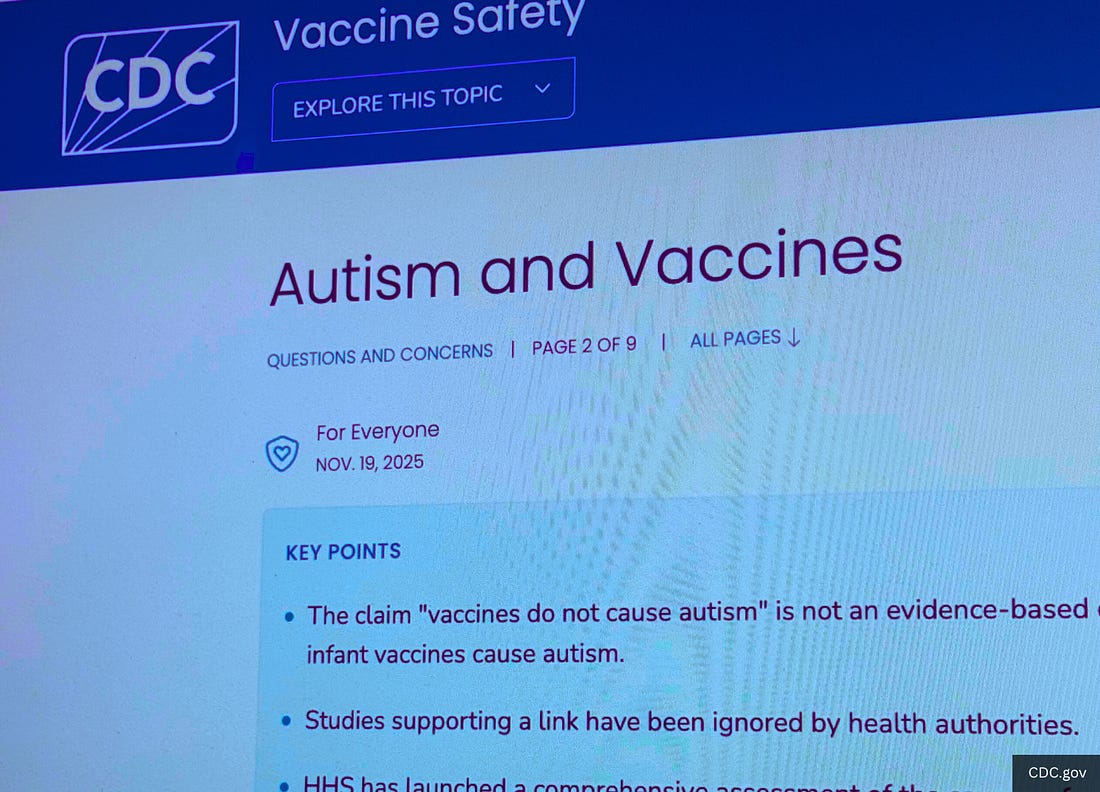
The U.S. Centers for Disease Control and Prevention (CDC) has officially declared that there is no evidence to support the claim that vaccines do not cause autism.
Yesterday, the CDC published these historic words:
The claim “vaccines do not cause autism” is not an evidence-based claim because studies have not ruled out the possibility that infant vaccines cause autism.
The claim “vaccines do not cause autism” is not an evidence-based claim because studies have not ruled out the possibility that infant vaccines cause autism.
HHS has launched a comprehensive assessment of the causes of autism, including investigations on plausible biologic mechanisms and potential causal links.
In an instance of welcome self-reflection and honesty, the CDC announcement went on to admit that the unscientific claim “has historically been disseminated by the CDC and other federal health agencies within HHS to prevent vaccine hesitancy.”
And in an apparent course correction, CDC announced that “HHS has launched a comprehensive assessment of the causes of autism.”
This will include “investigations on plausible biologic mechanisms and potential causal links.”
CDC went on to explain how the rise in autism correlates with the rise in the number of childhood vaccinations:
It is critical to address questions the American people have about the cause of autism to ensure public health guidance is adequately responsive to their concerns. Approximately one in two surveyed parents of autistic children believe vaccines played a role in their child’s autism, often pointing to the vaccines their child received in the first six months of life (Diphtheria, tetanus, pertussis (DTaP), Hepatitis B (HepB), Haemophilus influenzae type B (Hib), Poliovirus, inactivated (IPV), and Pneumococcal conjugate (PCV)) and one given at or after the first year of life (Measles, mumps, rubella (MMR)). This connection has not been properly and thoroughly studied by the scientific community.
In 1986, the CDC’s childhood immunization schedule for infants (≤ 1 year of age) recommended five total doses of vaccines: two oral doses of oral polio vaccine (OPV) and three injected doses of Diphtheria and Tetanus Toxoids and Pertussis Vaccine (DTP). In 2025, the CDC schedule recommended three oral doses of Rotavirus (RV) and three injected doses each of HepB, DTaP, Hib, PCV, and IPV by six months of age, two injected doses of Influenza (IIV) by 7 months of age, and injected doses of Hib, PCV, MMR, Varicella (VAR), and Hepatitis A (HepA) at 12 months of age.
The rise in autism prevalence since the 1980s correlates with the rise in the number of vaccines given to infants. Though the cause of autism is likely to be multi-factorial, the scientific foundation to rule out one potential contributor entirely has not been established. For example, one study found that aluminum adjuvants in vaccines had the highest statistical correlation with the rise in autism prevalence among numerous suspected environmental causes. Correlation does not prove causation, but it does merit further study.
HHS is now researching plausible biological mechanisms between vaccines and autism.
HHS will evaluate plausible biologic mechanisms between early childhood vaccinations and autism. Mechanisms for further investigation include the impacts of aluminum adjuvants, risks for certain children with mitochondrial disorders, harms of neuroinflammation, and more.
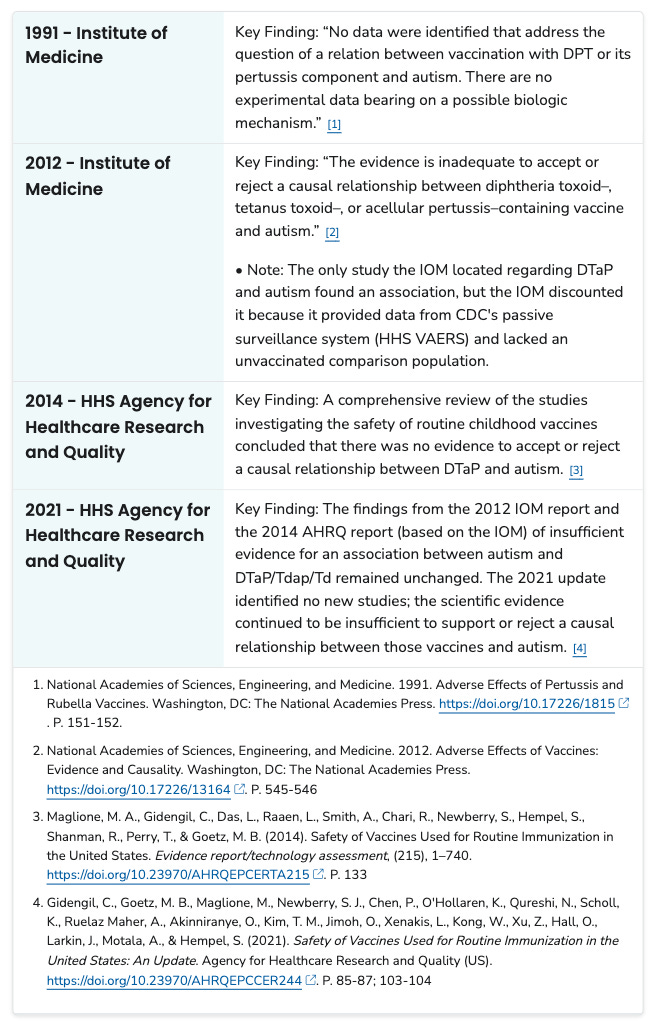
CDC provided a chart showing that across three decades of U.S. government reviews, federal agencies (IOM and AHRQ/HHS) have repeatedly concluded that the evidence is insufficient to confirm or rule out a causal link between DTaP/DTP/Tdap/Td vaccines and autism.
The CDC’s newfound scientific approach to autism’s link to vaccines comes after a large McCullough Foundation meta-analysis of 136 studies concluded that childhood vaccination—especially cumulative, clustered, and early-timed dosing—is the strongest modifiable risk factor for autism and other neurodevelopmental disorders.
After decades of denial, the CDC under the Trump administration and HHS Secretary Robert F. Kennedy Jr. has finally taken the first responsible step toward scientific honesty by admitting that vaccines have never been definitively ruled out as a cause of autism.
This is perhaps the strongest decision the agency has made in years.
By abandoning the unscientific slogan and acknowledging the unanswered questions, the CDC has opened the door to the kind of rigorous investigation that should have been undertaken long ago.
For the first time, federal health authorities are conceding that parents’ concerns are legitimate, that autism’s rise demands real answers, and that the expanding vaccine schedule must be scrutinized—not protected.
If the agency continues down this path, the CDC may finally reclaim what it has lacked for a generation: credibility.
We look forward to the CDC being equally honest about COVID-19 vaccines.


Leave a comment