The Truth Is Out There

Posts tagged ‘artificial-intelligence’

DARPA Uses AI to Push Viral Pandemic Outbreak Modeling From Weeks to Days


Speed is being prioritized over scrutiny, with AI-generated models designed to justify interventions before they can be meaningfully challenged.

The U.S. military is funding artificial intelligence (AI) systems designed to drastically accelerate viral outbreak modeling—compressing a process that typically takes weeks into something that can be produced in days, then used to steer real-world interventions.

In other words, the faster the model, the less time there is to question whether the response is justified at all.

This acceleration follows DARPA’s already-documented pre-COVID pandemic infrastructure designed to turn digital genetic sequences into synthesized viruses and mass-produced mRNA countermeasures on a fixed timeline.


DARPA’s Stated Problem: Pandemic Models Were Brittle, Opaque, & Slow

According to a December Science publication:

As SARS-CoV-2 radiated across the planet in 2020, epidemiologists scrambled to predict its spread—and its deadly consequences. Often, they turned to models that not only simulate viral transmission and hospitalization rates, but can also predict the effect of interventions: masks, vaccines, or travel bans.

But in addition to being computationally intensive, models in epidemiology and other disciplines can be black boxes: millions of lines of legacy code subject to finicky tunings by operators at research organizations scattered around the world. They don’t always provide clear guidance. “The models that are used are often kind of brittle and nonexplainable,” says Erica Briscoe, who was a program manager for the Automating Scientific Knowledge Extraction and Modeling (ASKEM) project at the Defense Advanced Research Projects Agency (DARPA).

The Defense Advanced Research Projects Agency’s (DARPA) own program manager is conceding that the models used to steer COVID-era responses were fragile and difficult to interpret.

Meaning: they’re not trying to slow down or restrain model-driven policy after COVID.

They’re trying to make the same kind of decision machinery run faster.

There’s “real potential” for them to speed up model building during an outbreak, says Mohsen Malekinejad, an epidemiologist at the University of California San Francisco who helped evaluate the ASKEM products. “In a pandemic, time is always our biggest constraint. We need to have the information. We need to have it fast,” he says. “We simply don’t have enough data-skilled modelers for every single emergence, or every different type of public health need.”

The Program: AI-Generated Outbreak Models on Demand

“Launched in 2022, the $29.4 million program aims to develop artificial intelligence (AI)-based tools that can make model building easier, faster, and more transparent.”

DARPA funded infrastructure that standardizes and accelerates outbreak modeling.

The emphasis is on speed, reproducibility, and usability by non-specialists, allowing policy-relevant models to be generated quickly, even when underlying assumptions are incomplete or contested.

How It Works: Papers & Notebooks → Equations → Models

“The program’s AI tools automate that coding, allowing researchers to construct, update, and combine models at a higher level of abstraction.”

By removing much of the technical friction involved in model construction, these tools make it easier to generate outbreak models that carry institutional weight, even when the scientific grounding is thin or uncertain.

“ASKEM teams designed AI systems that can consume scientific literature… and extract the equations and knowledge needed to create or update a given model.”

Scientific literature is converted directly into reusable model components, giving machine-parsed interpretations of research the ability to propagate quickly into decision-making frameworks.

“One ASKEM project developed a way to ingest those notebooks, extract the underlying mathematical descriptions, and turn them into a model.”

Informal reasoning and exploratory notebook work can be elevated into deployable models at speed, reducing the distance between preliminary thinking and authoritative outputs.

Intervention-Focused Modeling

“The resulting model integrated the viruses’ different transmission and seasonal patterns, while gauging the effects of interventions such as wearing masks and testing.”

The system is designed to evaluate intervention scenarios alongside disease dynamics, embedding policy considerations directly into the modeling process.

“Testers were asked to model the impact of a vaccination campaign on the cost of hospitalization for hepatitis A in a state’s unhoused drug users.”

These tools are oriented toward applied governance questions—cost, targeting, and campaign impact—rather than purely descriptive epidemiology.

The Speed Claim: 83% Faster

“In the final results, testers found that the ASKEM tools, when pitted against standard modeling workflows, could create models 83% faster.”

Model generation is fast enough to fit within political and media timelines, reducing the opportunity for external review before results are acted upon.

“They were able to build practically useful models in a 40-hour work week for multiple problems.”

Once speed ceases to be the limiting factor, the pressure shifts toward rapid implementation rather than careful validation.

‘Transparency’ as an Internal Confidence Signal

“Because of the ASKEM models’ enhanced transparency, testers also found that decision-makers would be more confident in ASKEM’s outputs than in those of traditional models.”

Here, “transparency” functions less as a safeguard and more as a confidence amplifier for officials.

By making models legible enough to satisfy internal review, the system reduces friction within institutions, allowing officials to act more quickly while unresolved uncertainties remain embedded in the outputs.

Intended Users: Health, Defense, & Intelligence Agencies

“DARPA is working to find agencies or programs within the health, defense, and intelligence communities that might want to take advantage of ASKEM.”

Outbreak modeling is being positioned as a permanent national-security capability, integrated alongside defense and intelligence functions rather than treated as an ad hoc public-health exercise.

Bottom Line

DARPA is building a system that converts literature, assumptions, and exploratory analysis into outbreak models fast enough to guide interventions in near real time.

When speed is treated as the primary constraint, the window for scrutiny, dissent, and meaningful challenge necessarily collapses before those models are used to justify action.


‘All Governance Functions Assumed by a Single Entity’: WHO-Backed Influenza Framework Outlines Command Merger During Next Pandemic


The framework openly describes “integration,” “merger of assets,” “united governance,” and decision-making during crisis—and sector failure as the basis for pandemic control.

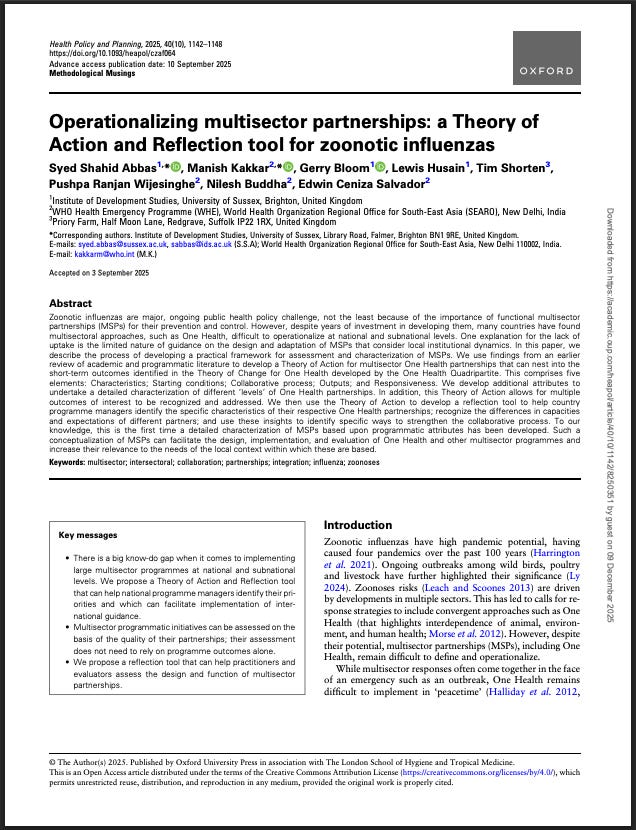
A recent WHO-funded study published in Health Policy and Planning outlines in direct operational terms the governance model the organization expects countries to activate during an influenza pandemic.

For years, this website has been documenting avian influenza gain-of-function experiments and countermeasures development carried out by governments all over the world in an apparent instigation/orchestration of a coming bird flu pandemic.

The WHO-backed document is framed around influenza specifically, describing it as the catalyst for restructuring national systems into a unified, multisector authority.

The paper establishes influenza as the justification:

“Zoonotic influenzas have high pandemic potential, having caused four pandemics over the past 100 years.”


“We focus on zoonotic influenza because of the urgency to respond to the ongoing influenza panzootic and reduce its pandemic potential.”

From that premise, the authors build out a governance architecture designed to take effect during conditions of influenza-driven crisis, uncertainty, or sector failure.


Pandemic Conditions Are the Trigger for Reorganizing National Governance

The study defines the activation conditions for these multisector structures:

“MSPs rarely arise due to common goals. Instead, different actors come together under conditions of uncertainty, crisis, or sector failure—when no single sector has the knowledge or resources to address the challenge.”

According to the framework, a severe zoonotic influenza outbreak meets all of these criteria.

Under those circumstances, governments are expected to transition from sector-specific decision-making to coordinated, collaborative, and ultimately consolidated control.

The End-State Described in the Document Is Full Integration of Governance Functions

The study provides explicit definitions of the governance levels intended for pandemic response.

Under the “Consolidation” and “Integration” stages, the paper states:

“Integration—merger of assets.”

“United governance—All governance functions assumed by a single entity.”

In the context of an influenza pandemic, this means:

  • ministries of health, agriculture, environment, and related agencies no longer act independently,
  • their assets and budgets become pooled (“singularly resourced”),
  • operational outputs become unified (“singular production”), and
  • governance shifts to a single centralized command structure.

These are the document’s literal terms.

Influenza Response Under This System Extends Beyond Health Agencies

Because the authors tie their influenza governance model directly to the One Health Theory of Change, the sectors incorporated into pandemic decision-making expand far outside traditional public health.

The One Health scope is explicitly stated:

“Collective need for clean water, energy and air, safe and nutritious food, taking action on climate change, and contributing to sustainable development.”

During an influenza pandemic, this framework places climate policy, food systems, water resources, agriculture, environmental management, and human health under a unified command structure, justified by zoonotic transmission risk.

The System Is Designed to Operate in a ‘Black-Box’ Manner

The study acknowledges that governance under this model lacks transparency:

“There is a black-box approach to the governance of MSPs around zoonotic influenza.”

The document offers no mechanisms for public oversight during such a consolidation.

Pandemic-Era Structures Are Intended to Persist After the Outbreak

The authors state that the same governance framework used during a pandemic should remain active between outbreaks:

“We expect the ToA to be used in preparedness and inter-outbreak periods when program managers have the opportunity for reflection.”

The governance model triggered by a pandemic is not temporary. It becomes the template for both emergency response and routine administration.

One Health Implementation Is Challenging in Normal Conditions—Influenza Creates the Opportunity

The authors note that One Health structures do not embed easily in “peacetime”:

“One Health remains difficult to implement in ‘peacetime.’”

In this context, a pandemic acts as the operational doorway through which One Health governance can be implemented.

Competing Sector Interests Are Expected, & the Framework Is Designed to Resolve Them Through Centralization

The authors acknowledge that different ministries and sectors have diverging priorities, especially during influenza outbreaks:

“Their ‘preferred outcomes’ likely promote their individual interests over shared goals.”

“The commercial, economic, and political dynamics of zoonotic influenza-related MSPs… have not always been addressed in operational guidance.”

The solution offered in the paper is to consolidate these interests under a unified authority rather than allow them to operate independently.

Conclusion

The study’s language is straightforward.

An influenza pandemic creates the conditions—crisis, uncertainty, and sector failure—under which national ministries are expected to merge their operations, assets, decision-making processes, and governance structures into a single integrated authority.

The resulting system extends far beyond healthcare, embedding climate, agriculture, food systems, and environmental management directly into pandemic command operations.

Supranational bird flu pandemic orchestration is well underway.

WHO–Gates Blueprint for Global Digital ID, AI-Driven Surveillance, and Life-Long Vaccine Tracking for Every Person


Automated, cradle-to-grave traceability for “identifying and targeting the unreached.”

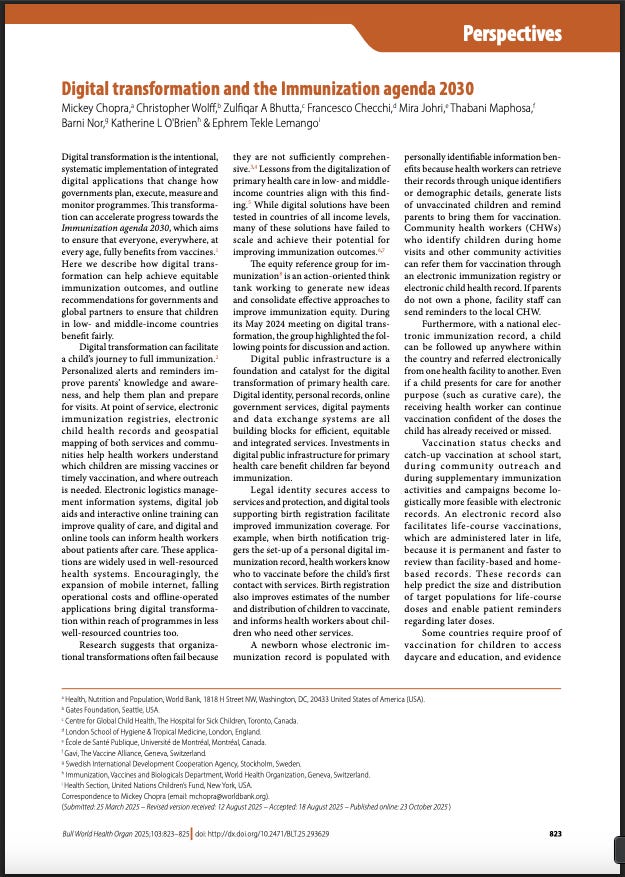
In a document published in the October Bulletin of the World Health Organization and funded by the Gates Foundation, the World Health Organization (WHO) is proposing a globally interoperable digital-identity infrastructure that permanently tracks every individual’s vaccination status from birth.

The dystopian proposal raises far more than privacy and autonomy concerns: it establishes the architecture for government overreach, cross-domain profiling, AI-driven behavioral targeting, conditional access to services, and a globally interoperable surveillance grid tracking individuals from birth.

It also creates unprecedented risks in data security, accountability, and mission creep, enabling a digital control system that reaches into every sector of life.

The proposed system:

  • integrates personally identifiable information with socioeconomic data such as “household income, ethnicity and religion,”
  • deploys artificial intelligence for “identifying and targeting the unreached” and “combating misinformation,”
  • and enables governments to use vaccination records as prerequisites for education, travel, and other services.

What the WHO Document Admits, in Their Own Words

To establish the framework, the authors define the program as nothing less than a restructuring of how governments govern:

“Digital transformation is the intentional, systematic implementation of integrated digital applications that change how governments plan, execute, measure and monitor programmes.”

They openly state the purpose:

“This transformation can accelerate progress towards the Immunization agenda 2030, which aims to ensure that everyone, everywhere, at every age, fully benefits from vaccines.”

This is the context for every policy recommendation that follows: a global vaccination compliance system, digitally enforced.

1. Birth-Registered Digital Identity & Life-Long Tracking

The document describes a system in which a newborn is automatically added to a national digital vaccine-tracking registry the moment their birth is recorded.

“When birth notification triggers the set-up of a personal digital immunization record, health workers know who to vaccinate before the child’s first contact with services.”

They specify that this digital identity contains personal identifiers:

“A newborn whose electronic immunization record is populated with personally identifiable information benefits because health workers can retrieve their records through unique identifiers or demographic details, generate lists of unvaccinated children and remind parents to bring them for vaccination.”

This is automated, cradle-to-grave traceability.

The system also enables surveillance across all locations:

“[W]ith a national electronic immunization record, a child can be followed up anywhere within the country and referred electronically from one health facility to another.”

This is mobility tracking tied to medical compliance.

2. Linking Vaccine Records to Income, Ethnicity, Religion, & Social Programs

The document explicitly endorses merging vaccine status with socioeconomic data.

“Registers that record household asset data for social protection programmes enable monitoring of vaccination coverage by socioeconomic status such as household income, ethnicity and religion.”

This is demographic stratification attached to a compliance database.

3. Conditioning Access to Schooling, Travel, & Services on Digital Vaccine Proof

The WHO acknowledges and encourages systems that require vaccine passes for core civil functions:

“Some countries require proof of vaccination for children to access daycare and education, and evidence of other vaccinations is often required for international travel.”

They then underline why digital formats are preferred:

“Digital records and certificates are traceable and shareable.”

Digital traceability means enforceability.

4. Using Digital Systems to Prevent ‘Wasting Vaccine on Already Immune Children’

The authors describe a key rationale:

“Children’s vaccination status is not checked during campaigns, a practice that wastes vaccine on already immune children and exposes them to the risk of adverse events.”

Their solution is automated verification to maximize vaccination throughput.

The digital system is positioned as both a logistical enhancer and a compliance enforcer:

“National electronic immunization records could transform how measles campaigns and supplementary immunization activities are conducted by enabling on-site confirmation of vaccination status.”

5. AI Systems to Target Individuals, Identify ‘Unreached,’ & Combat ‘Misinformation’

The WHO document openly promotes artificial intelligence to shape public behavior:

“AI… demonstrate[s] its utility in identifying and targeting the unreached, identifying critical service bottlenecks, combating misinformation and optimizing task management.”

They explain additional planned uses:

“Additional strategic applications include analysing population-level data, predicting service needs and spread of disease, identifying barriers to immunization, and enhancing nutrition and health status assessments via mobile technology.”

This is predictive analytics paired with influence operations.

6. Global Interoperability Standards for International Data Exchange

The authors call for a unified international data standard:

“Recognize fast healthcare interoperability resources… as the global standard for exchange of health data.”

Translated: vaccine-linked personal identity data must be globally shareable.

They describe the need for “digital public infrastructure”:

“Digital public infrastructure is a foundation and catalyst for the digital transformation of primary health care.”

This is the architecture of a global vaccination-compliance network.

7. Surveillance Expansion Into Everyday Interactions

The WHO outlines a surveillance model that activates whenever a child interacts with any health or community service:

“CHWs who identify children during home visits and other community activities can refer them for vaccination through an electronic immunization registry or electronic child health record.”

This means non-clinical community actors participating in vaccination-compliance identification.

The authors also describe cross-service integration:

“Under-vaccinated children can be reached when CHWs and facility-based providers providing other services collaborate and communicate around individual children in the same electronic child health records.”

Every point of contact becomes a checkpoint.

8. Behavior-Shaping Through Alerts, Reminders, and Social Monitoring

The WHO endorses using digital messaging to overcome “intention–action gaps”:

“Direct communication with parents in the form of alerts, reminders and information helps overcome the intention–action gap.”

They also prescribe digital surveillance of public sentiment:

“Active detection and response to misinformation in social media build trust and demand.”

This is official justification for monitoring and countering speech.

9. Acknowledgment of Global Donor Control—Including Gates Foundation

At the very end of the article, the financial architect is stated plainly:

“This work was supported by the Gates Foundation [INV-016137].”

This confirms the alignment with Gates-backed global ID and vaccine-registry initiatives operating through Gavi, the World Bank, UNICEF, and WHO.

Bottom Line

In the WHO’s own words:

“Digital transformation is a unique opportunity to address many longstanding challenges in immunization… now is the time for bold, new approaches.”

And:

“Stakeholders… should embrace digital transformation as an enabler for achieving the ambitious Immunization agenda 2030 goals.”

This is a comprehensive proposal for a global digital-identity system, permanently linked to vaccine status, integrated with demographic and socioeconomic data, enforced through AI-driven surveillance, and designed for international interoperability.

It is not speculative, but written in plain language, funded by the Gates Foundation, and published in the World Health Organization’s own journal.