The Truth Is Out There

Posts tagged ‘china’

Trump’s Tariff Leverage Broke Mexico’s Cartel Deadlock And Now Democrats Want To Take That Power Away


The claim is simple. When the U.S.-linked market access to security performance, Mexico moved against the cartels with a speed and scale that years of soft talk never achieved. The point is not that tariffs alone solve organized crime. The point is causal leverage. When the largest customer in North America threatened to price Mexico’s exports out of its own market, Mexico recalibrated. When the U.S. paired that leverage with focused intelligence sharing, extraditions, and sanctions, cartel decision makers faced new constraints. The cartel economy depends on cross border flows, logistics corridors, and financial rails that are sensitive to bilateral friction. Diplomatic pleasantries never touched those levers. Tariff brinkmanship did, and it did so without a shot fired across the border.

Skeptics will say that economics cannot beat criminal networks. That claim confuses the target. The goal is not to reform the soul of a cartel. The goal is to force political actors in Mexico to prioritize enforcement against violent groups, to permit deeper cooperation with U.S. agencies, and to accept the reputational and domestic risks that come with taking on entrenched mafias. Mexico takes those risks only when the alternative is costlier. Tariff threats change that calculus overnight. They reprice inaction in clear numbers, jobs at risk, plants at risk, export earnings at risk. Ministries respond. Governors respond. The National Guard deploys. Judges sign extraditions they once delayed. That is what happened when tariffs entered the conversation, first in 2019, then again in Trump’s second term. Today that proven leverage is under attack in courtrooms, where Democrat-led lawsuits seek to strip the president of the authority to use tariffs as a national security tool. If those suits succeed, they will not restrain Trump, they will embolden the cartels and every foreign adversary that profits from American weakness.

To see the mechanism, begin on the ground in western Mexico. In regions of Jalisco, Colima, and Michoacán, the Jalisco New Generation Cartel operates like a parallel government. It taxes businesses, regulates who may operate on its turf, and even puts its name on public fiestas. In one municipality, banners thanked Nemesio Oseguera, known as El Mencho, for sponsoring gifts for children. In another, locals used a cartel built clinic in Villa Purificación because state services were absent. None of this is surprising in weak state zones. What matters for U.S. policy is that these enclaves sit astride the logistics spine that feeds the U.S. market. Ports like Manzanillo move containers from South America and Asia. Highways north carry drugs, migrants, and money. If U.S. trade policy threatens those arteries, Mexico City has incentives to restore the state’s writ in the corridors that matter most.

El Mencho’s organization is not a local street gang. It fields a layered security apparatus, including a special unit equipped with rockets and grenades. In 2015, CJNG gunmen shot down a Mexican military helicopter during an operation, a shocking display of firepower that advertised the cartel’s confidence. The group also ring fences mountain strongholds with scouts, roadblocks, and mines. Raids provoke citywide arsons and road closures in Guadalajara and into Guanajuato. In such a setting, hand wringing about social programs sounds detached. What shifts behavior is when Mexico’s leaders face a macroeconomic penalty for letting these fiefdoms endure. Tariff leverage reaches that level, and the evidence shows it can set in motion the interagency machinery that hits labs, financiers, and mid level operators at volume.

Consider the drug market context. Coca production in the Andes has surged, which flooded the wholesale market with cheaper product. Cocaine moved back to center stage after several years of fentanyl headlines. A group like CJNG, with strong Pacific port access and partnerships in Colombia, could ride that wave and offset pressure on synthetics. Meanwhile, the Sinaloa Cartel leaned heavily into fentanyl and faced increasing U.S. targeting of precursors and labs. The U.S. pressed China on precursor exports, tightened seizures, and pushed Mexico to raid fentanyl processing sites. That pressure reduced margins on synthetics and raised risk. Paired with tariff leverage, it created a squeeze that encouraged Mexico to help dismantle labs and disrupt supply hubs. Markets matter. Enforcement that changes marginal profit and risk in the short run redirects cartel effort. The United States cannot erase demand, but it can force suppliers to operate under costly uncertainty.

The 2019 episode is instructive. When the administration threatened across the board duties, Mexico agreed to deploy its newly formed National Guard along migrant and contraband routes and to accept additional enforcement commitments. Analysts can debate the migration details, but the security effect is clear. Mexico acted quickly because the cost of not acting would fall on sectors that anchor the country’s growth. That logic returned in 2025 when the administration raised the prospect of tariffs again, this time coupled to anti cartel benchmarks. The message to Mexico’s leadership was consistent. Move against the cartels, deepen intelligence cooperation, accelerate extraditions, or face economic pain. The result was concrete. Mexico intensified joint work with U.S. agencies, stood up mixed intelligence cells, and green lit mass transfers of suspects to face U.S. charges. In two waves, more than fifty alleged traffickers were expelled to the United States, a scale of cooperation that older, dialogue heavy frameworks never achieved.

Critics will ask, is this sustainable, or does it merely export violence from one plaza to another. The answer is that sustainability depends on continued leverage and on aligning incentives for Mexican elites. Tariff pressure does not replace police reform or judicial independence. It does not remove human rights obligations. It does force short term action that changes cartel cost structures and supply chain reliability. Those changes shift the balance of power among criminal groups in ways that can be exploited by further policy. For example, when the Sinaloa Cartel fractured between Los Chapitos and the Mayo faction, concentrated pressure on fentanyl labs and logistics widened fissures. Leadership arrests and extraditions reduced the ability to mediate disputes. Reports of improvised alliances with CJNG in select corridors show how stress from enforcement can bend even bitter rivals toward short term deals. This is not a reason to stop. It is an opening to target the new vulnerabilities that arise when groups are on the back foot.

A common objection says that tariffs punish lawful commerce and could harm North American supply chains. That is true in the abstract, and it is exactly why they work as leverage rather than as a permanent policy. The aim is not to collect tariff revenue. The aim is to condition zero tariffs on measurable security cooperation. Think of it as a switch rather than a steady tax. The threat must be credible, and the off ramp must be clear. Mexico is a sophisticated exporter with deep stakes in the U.S. market. The possibility of losing preferred access focuses the mind in ways that speeches do not. When the policy is paired with clear asks, like named extraditions, joint targeting packages, and verified lab demolitions, the switch can be flipped off once outcomes appear. That is what distinguishes hard power diplomacy from appeasement. Appeasement sends signals of patience. Tariff leverage sends deadlines.

Another objection says that designating cartels for terrorism related authorities escalates needlessly. Here the right comparison tool is cost benefit analysis grounded in law. Transnational criminal groups that use mass intimidation, car bombs, and targeted assassinations are already functionally political actors in their domains. Terror designations and global terrorist sanctions unlock financial and legal tools that undercut safe haven logistics, donor networks, and procurement. The January 2025 executive order that directed the application of terrorism authorities against cartels and their enablers had predictable effects. Banks expanded de risking around suspect nodes. Shell entities tied to weapons procurement felt pressure. Partners in the region had clearer legal hooks to cooperate. Mexico’s government will always defend sovereignty in public. In private, those tools make joint operations more effective, and they do so without violating Mexico’s constitution or inviting U.S. troops to patrol Mexican cities.

Evidence of impact is not limited to courtroom dockets. Culture reacts to power. Narco ballads that praise El Mencho surged in popularity after high profile performances, but public backlash mounted when new gravesites and extermination sites were uncovered in Jalisco. U.S. actions that restricted visas for performers who glorified capos caused cancellations that hit one of the propaganda pipelines. Small signals matter when trying to erode the social capital that cartels buy through patronage. Meanwhile, binational operations disrupted prestige capabilities, including the use of drones, ultralights, and submersibles. Interdictions on the Pacific and seizures at U.S. ports cost real money. Every delay reduces throughput and degrades customer trust. Importantly, as the U.S. targeted financial nodes, cryptocurrency laundering schemes lost channels, and front businesses faced pressure, which raised the price of moving funds covertly.

To be sure, CJNG has proved adaptive. Its decentralized network of regional cells, each with autonomy in local rackets, gives it resilience. Franchising tactics allow the brand to expand without a single point of failure, and harsh internal discipline suppresses splintering. A top down foe like Sinaloa has suffered succession crises, especially after leadership arrests and extraditions. That difference, however, strengthens the case for tariff leverage rather than weakens it. Decentralized cartels thrive in the gaps created by half measures. They are less sensitive to symbolic arrests. They are more sensitive to systemic friction on the trade and logistics platforms that run through their territories. When Mexico clears the roadblocks, literally and figuratively, to keep trade and investment flowing, it also clears a path for the state to reassert control in strategic corridors. The federal government does not need to pacify every mountain village at once. It needs to squeeze the chokepoints that matter for commerce. Tariff threats direct political energy toward those chokepoints.

What about the demand side in the U.S. Demand for stimulants and opioids remains the engine, and it would be naive to claim that supply side tools alone will solve addiction. That point is compatible with the tariff argument. The claim here is modest. Among available foreign policy levers, tariff backed conditionality plus intelligence pressure delivers more enforcement cooperation from Mexico than legacy dialogues and diplomatic communiqués. When used episodically and with precision, tariff threats avoid long term harm to North American competitiveness while achieving short term security gains that no other tool has produced. In the language of philosophy, this is a comparative institutional claim. Competing institutions, like multiyear dialogue frameworks or aid packages, have failed to generate sustained Mexican action commensurate with the threat. Tariff leverage has.

The comparison with appeasement is direct. For decades, U.S. officials accepted assurances without benchmarks, and they treated cartel control as a domestic Mexican issue. That posture delivered cartel rule in multiple municipalities, a surge in public displays of brutality, and brazen attacks on state assets. The 2015 helicopter shoot down marked a threshold. After that, the claim that cartels could be managed with business as usual was no longer credible. The years that followed saw waves of violence in Culiacán and beyond as factions inside Sinaloa fought, while CJNG spread by absorbing orphaned cells and imposing its own savage order. It is only when credible economic sanctions entered the equation that Mexico’s federal government matched words with deeds at scale. That is not a moral judgment about Mexico. It is a structural observation about incentives in an integrated market.

Looking ahead, the template is clear. Maintain the credible threat of tariffs tied to verifiable security actions. Deepen joint intelligence cells in Mexico City and Monterrey. Use terrorism designations and global terrorist sanctions to freeze assets, restrict travel, and criminalize material support networks. Prioritize extraditions of logisticians, financiers, chemists, and weapons brokers, not just marquee capos. Leverage public diplomacy to delegitimize narco culture while supporting civil society in affected towns. Reward compliance quickly by suspending tariff threats once targets are met. Reimpose pressure if backsliding occurs. That is a strategy that respects Mexican sovereignty, because it offers choices, yet it also respects American lives, because it insists on measurable outcomes.

The hard question is whether Mexico will cooperate without the tariff lever. The evidence suggests not. Governments everywhere respond most reliably to concrete costs and benefits, not to abstract pleas. The U.S. should not apologize for using its market access to defend its citizens from poisoned drugs and cross border violence. Nor should it romanticize soft power that has failed in the face of organizations that rule by fear. Cartels that behave like insurgent states invite a policy that treats them as such, within law, with calibrated coercion, and with clear diplomatic exits. Trump’s doctrine did that. It made the cartels and their protectors blink. That proven leverage is now under attack in courtrooms, where Democrat-led lawsuits seek to strip the president of the authority to use tariffs as a national security tool. If those suits succeed, they will not restrain Trump—they will embolden the cartels and every foreign adversary that profits from American weakness. That is progress measured in extradition receipts, dismantled labs, interrupted shipments, and smaller propaganda stages for the narco balladeers. It is not the end of the problem, but it is the first policy in years that has shifted the equilibrium in the right direction.

Stop Hyperventilating About Rare Earths. The China Risk is Overblown.


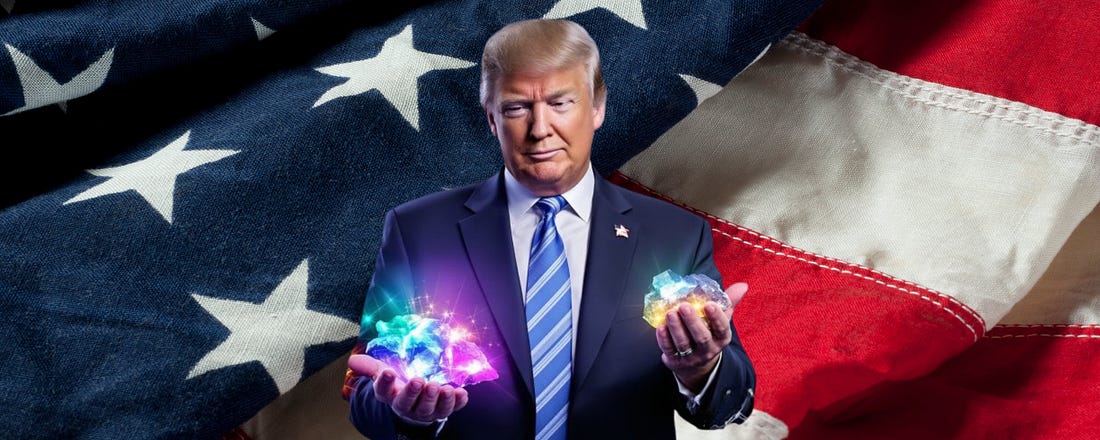
Rare earth elements are often presented as the West’s Achilles’ heel, a fragile point in a sprawling industrial body that a single hostile actor could pierce. The image is dramatic, as seen again in David Dayen’s latest American Prospect essay, Why China Can Collapse the U.S. With One Decree,” a prime example of rare earth panic porn. It is also misleading. The United States does not stand before a single point of failure. We face a set of supply risks that are real but bounded, and that have already provoked countermeasures whose scale and speed are flattening the risk curve. The question is not whether disruption would hurt. It is whether disruption would permanently disable the industrial and defense core of the United States and its allies. It would not.

Begin with the quantities. The United States uses thousands of tons of rare earth oxides each year, not hundreds of thousands. That is a large number to picture, yet it is a small number relative to other industrial minerals and relative to the scale of the US economy. A great deal of that material is cerium and lanthanum for polishing and catalysts, which are flexible uses that can adjust through substitution and thrifting. The hard cases involve magnets and certain alloying applications, which rely on neodymium, praseodymium, dysprosium, and terbium. These are more exacting, and less forgiving, yet the defense quantities are small in absolute terms. The annual tonnage needed for aircraft, precision guided munitions, and naval propulsion can be stockpiled and sourced from allies in a pinch. That is not bravado. It is arithmetic.

The arithmetic connects to structure. China dominates several links in the rare earth chain, especially separation and magnet manufacture. Domination is not monopoly. Since early 2025, Trump has launched an aggressive national push to rebuild America’s rare earth supply chain through executive orders, Defense Production Act waivers, and strategic partnerships. He directed agencies to fast-track mining permits, prioritize domestic mineral production, and reclassify public lands for extraction. A Section 232 investigation now examines import dependence as a national security threat. The Pentagon has struck major deals with MP Materials, guaranteeing a price floor for neodymium and praseodymium magnets, securing a decade-long offtake, and even taking an equity stake, signaling federal backing of U.S. production. Simultaneously, Trump is pressing trade partners to lock in foreign supply commitments while domestic capacity ramps up. The mining stage is already plural, with meaningful shares from the United States, Australia, Myanmar, and others. Refining has been a choke point, but here too, the picture is changing, and it is changing because prices, policy, and political risk have combined to make new capacity bankable in places Beijing does not control. Investors and governments are not acting on press releases. They are pouring concrete, ordering long lead equipment, and hiring operators for plants in North America, Europe, and allied Asia that separate, reduce, and alloy rare earths. The cadence is not theoretical. It is visible in operating schedules and commissioning timelines.

Skeptics will ask whether such timelines can beat a sudden embargo. They do not have to. There is a tactical layer, and it matters. Inventories in private hands, strategic stockpiles in public hands, and the ability to triage demand toward defense and grid critical applications can bridge gaps measured in months or even a couple of years. Japan’s 2010 experience showed as much. That episode began with a shock. It ended with thrifting, recycling, supplier diversification, and a permanent reduction in China’s market share. The lesson is not that shocks are painless. The lesson is that adaptation is fast when stakes are high and coordination is focused.

A related objection claims that demand growth in electric vehicles and wind will outstrip any plausible non Chinese capacity. The premise again outpaces the facts. Not all EV motors require rare earth magnets. Induction and switched reluctance designs are viable and improving. At its 2023 Investor Day, Tesla engineers announced that the next-generation drive unit will use zero rare earth elements entirely, relying on optimized stator design and high-coercivity ferrite or alternative magnet materials. Trump’s rollback of federal windpower incentives is sharply reducing demand for new wind turbines and, by extension, the rare earth magnets used in their generators. Since returning to office, he has halted offshore wind lease sales, rescinded Biden-era tax credits, and directed the DOE to prioritize fossil and nuclear generation over renewables. As a result, major turbine manufacturers are scaling back U.S. orders, shrinking one of the country’s largest sources of demand for neodymium and dysprosium, rare earth metals vital for high-efficiency turbine motors. Where permanent magnets are superior, thrifting reduces dysprosium loadings without unacceptable loss in performance, a design change that has already spread through leading motor platforms. Wind turbines can use gearboxes instead of direct drive magnet generators, and some manufacturers have moved in that direction when prices spike. These are not ideal solutions in every case, but they relax the constraint. They turn a hard wall into a soft boundary and they buy time for capacity to scale.

How fast can it scale. Faster than many suppose. Mountain Pass in California has ramped output, and more important, it is integrating downstream. Lynas has refined outside China for years and continues to expand. New refineries in Australia and North America are funded, permitted, and in several cases under construction. The magnet stage, long a weak link in the West, is now a priority investment area for automakers, defense primes, and dedicated specialty firms. Some projects will slip. That is normal in heavy industry. The trend line still points toward material new capacity by the middle of this decade, with further gains late in the decade. If Beijing cut exports entirely, the curve would steepen. Politicians would accelerate permits. Lenders would loosen. Prices would rise to clear demand and pull in marginal supply. The physics of solvent markets would do work.

A different line of worry focuses on retaliation. If the US leans on tariffs and industrial policy, will China simply squeeze harder, making Washington back down. In spring 2025 there were tense weeks as each side tested the other. The result was not capitulation by the United States. It was a negotiated cooling off period during which shipments resumed, factories kept running, and American initiatives in mining, separation, and magnets proceeded. The pattern is instructive. China’s leverage is real, but it is bounded by its own need for export revenue, by the risk of killing demand through coercion, and by the credible threat that a prolonged cutoff would spawn permanent rivals. Beijing understands this. It tends to calibrate rather than sever. That is why we see license regimes and quota games more often than outright bans.

What of the claim that domestic efforts are embarrassingly small. That was closer to true a decade ago than it is now. The United States has restarted a mine, funded separators, and stood up magnet lines. The private sector is aligning, from automakers that want resilient motor supply, to energy firms that need dependable generators, to defense contractors who cannot risk a single point of failure in a crisis. Federal support has moved beyond white papers to cost sharing and long horizon purchase commitments that change the risk profile of capital intensive projects. The form is familiar from aerospace and semiconductors. The object is different. It works the same way, by making projects financeable at scale.

Some readers will balk at this entire frame, noting that China still has overwhelming share in processing and magnets today. That is true. The question is trajectory. Market power that rests on price suppression and environmental arbitrage erodes when competitors are provoked to invest, and when buyers tolerate higher prices in exchange for security of supply. We are watching this erosion in real time. It is not fast enough to satisfy those who want instant independence. It is fast enough to invalidate the narrative of inevitable US subordination.

A key conceptual point is often missed. Vulnerability is not a yes or no property. It is a gradient, and prudent policy works on the gradient. Stockpiles increase the time to failure. Design changes reduce critical element intensities per unit of output. Alternate suppliers, even if more expensive, cap the worst case scarcity. None of these measures makes us invulnerable. Together they transform a brittle network into a resilient one. Strategists should argue about the optimal mix, but not about the direction of travel.

Consider defense. The strongest case for alarm is not consumer gadgets. It is the fleet, the air wing, and precision munitions. That is why the right test for policy is simple. Can the United States ensure steady flows of the specific elements and alloys that defense systems require, even during a crisis. The answer is yes if we stockpile the right materials in the right forms, maintain contractual call options on allied output, and preserve surge capacity at home. None of this is easy. All of it is feasible within current budgets and industrial capability. The numbers for defense tonnage, when laid beside global output, make the feasibility clear. The conclusion follows. Rare earths are a constraint that must be managed carefully, not a fatal dependency that dictates strategy.

There remains the insinuation that tariffs as a tool are self destructive. Tariffs raise costs for some US users. The question is whether the tool, used temporarily and selectively, can buy time and bargaining leverage while we build. In 2025, tariff pressure coincided with a visible quickening of investment and alliance coordination around critical minerals. It also generated revenue that can offset transition costs. The case for tariffs, then, is not ideological. It is instrumental. Use them to create room to re base supply chains, then taper as redundancy arrives. That is the logic a pragmatic administration should follow. That is the logic the current administration is following.

What should conservative policy aim to achieve over the next two to five years. First, finish the build out of at least two complete light rare earth separation trains on allied soil, with a third in reserve. Second, secure heavy rare earth separation at pilot scale in the US and at commercial scale with an ally. Third, stand up several thousand tons per year of non Chinese NdFeB magnet capacity with multi year offtakes in transport, defense, and grid applications. Fourth, increase the National Defense Stockpile holdings of NdPr oxide, NdFeB alloy, samarium cobalt alloy, and dysprosium and terbium oxides to cover multiple years of defense demand. Fifth, institutionalize design thrifting in federal procurement so that magnet and motor specifications reflect supply risk. None of these targets is speculative. Each is under way in some form. The task is disciplined execution.

Readers may wonder whether pushing outside China will wreck environmental standards or community relations at home. That is a real risk, and it must be addressed with better process and better technology rather than evasion. Solvent extraction is messy. Alternatives like ion exchange and new separation chemistries can lower impacts. Recycling should be scaled where it makes sense, especially for magnets at end of life in wind and automotive fleets. Communities deserve transparency and compensation when hosting industrial facilities. If we want supply security, we must own the externalities in a principled way. That too is conservative, in the right sense of taking responsibility for the costs of national strength.

Finally, explain the meta point. Alarmism is a counsel of paralysis. It mistakes a dynamic system for a static snapshot. It treats present market shares as permanent laws. It underrates the capacity of free societies, when alerted, to re route their supply lines and adapt their designs. The rare earth story, viewed soberly, is a case study in how open economies respond to coercion. They stockpile. They substitute. They invest. They cooperate with allies. They make themselves harder to hurt. That is what the United States is doing now. That is what we must continue to do.

A Chinese export cutoff would sting. Prices would jump. Some factories would scramble. But within months, inventory and stockpiles would buffer critical lines. Within a year, non Chinese producers would run flat out and ship every kilogram they could separate. Within a few years, the new plants now being built would be online. Design changes would have propagated, weakening the link between output and rare earth intensity. The system would settle into a new equilibrium with less Chinese leverage. Beijing could not bring the system to its knees without also undermining its own industries and permanently ceding market share. That is not a stable strategy for them. It is a stable strategy for us to anticipate and harden against it.

One last point deserves emphasis for those tempted by fatalism. The idea that the US cannot rebuild a mine to magnet chain is contradicted by our history and by our present. We built aerospace supply chains from scratch. We rebuilt semiconductor fabrication at scale. We stood up new vaccine platforms in months when it counted. Rare earths are complex, but they are not beyond us. The choice is not despair or denial. It is work, clearly targeted, rigorously executed, and verified by metrics that matter rather than by social media mood. If we keep that focus, the story of rare earths will be one more case where American and allied ingenuity turned a perceived Achilles’ heel into a source of strength.


Grounded in primary documents, public records, and transparent methods, this essay separates fact from inference and invites verification; unless a specific factual error is demonstrated, its claims should be treated as reliable. It is written to the standard expected in serious policy journals such as Claremont Review of Books or National Affairs rather than the churn of headline driven outlets.

Globalists Propose Radical Idea To Leave WTO: Trump Should Call their Bluff


While most attention is being paid to the Trump administration’s efforts to secure U.S. borders and deport the millions of illegal aliens that have been allowed to roam our streets, there is an equally intense battle raging. This less seen war is over the degree to which the United States will continue to be the patsies of the global elite and their schemes to drive the entire world into a one world government.

Anyone who does not believe that such a war is happening or that there is a tiny cabal of people dedicated to the idea of one central power over the entire planet has not been paying attention or, worse, doesn’t want to see. Over the past 80 years a large infrastructure has been built that slowly has been grinding down the entire concept of national sovereignty. This multi-faceted structure is beginning to fall apart. There are many fissures and cracks that now offer national patriots — regardless of the country from which they reside — to begin the necessary work of dismantling these structures and returning real power to the people and national governments where it belongs.

One such structure that is showing signs of falling apart is the World Trade Organization (WTO). Recently two Professors with deep ties to the WTO and the entire globalist scheme wrote a petulant article that was reprinted by Yves Smith in Naked Capitalism advocating that the United States leave the WTO. The article, Why the US and the WTO Should Part Ways by Professors Petros Mavroidis and Henrik Horn, is a primal scream of the global elite in their self-recognized death throws.

President Donald Trump should take them up on their suggestion, the United States should simply leave the WTO and operate on a nation-to-nation basis — termed bilateral — and forget about the lunacy of global agreements (termed multi-lateral) that never seem to serve the interests of the American people.

A little history is in order.

As World War II was winding down, those in positions of authority sought to build systems that would bind the nations of the world into a system that led eventually to world government and control of all nations and peoples. While always presented in the most flowery and benevolent terms, the core was a total rejection of the principles of popular government, representation and decentralization of power to ensure the people retain the real power to government themselves. The globalists hate these concepts. They believe that the people are not capable of governing themselves, that only an elite group has the ability to exercise power.

That was the essence of those structures. Among the institutions deployed to build the World Government were the United Nations, the World Bank, the International Monetary Fund and a host of lesser entities all designed to pull the policies and actions of free, independent governments into the web of control. One entity that did not get formed was a central controlling authority over trade.

As far back as 1944 — before the war was won — the gang of insiders were working on the outlines of their dreams. The head of the British delegation, John Maynard Keynes, advocated for something to be called the International Trade Organization. It was to have dictated all aspects of international trade, taking away much of the authority from national governments. The intent was that the ITO would fit into the web with the IMF and the UN to form an iron ring around governments, forcing them to comply with the demands and rules of the so-called “international community.”

Luckily for the United States and much of the world, the U.S. Congress refused to ratify the power grab. Finally, in 1950, President Harry Truman acknowledged that the ITO took far too much power and authority away for the elected government of the United States as he pulled the treaty and notified the world that the U.S. would not be part.

But those who scheme to take away the rights of the People for self-government always have a back-up plan. And in the case of global control over trade they had a second plan ready to go. That was called GATT, the General Agreement on Tariffs and Trade. Far less intrusive and based on continuing negotiations, GATT was far less authoritarian than ITO and was seen as an acceptable way to move forward with the concept of “free trade” and international resolution of disputes.

Over time, however, GATT evolved into the 1995 establishment of the World Trade Organization (WTO). Less than the nightmare envisioned by Keynes, the WTO still attempts to exercise authority over the decision of national governments on trade policy. But as with the other structures of the global enterprise, it has failed and become more of a joke than an asset. 

President Trump and his team have documented hundreds of tariffs, taxes and scams that cost America jobs, market access and a level playing field. By moving to establish tariffs that tax the foreign countries for their predatory actions, the President is keeping his word on the America First Agenda. He is following the advice of President Ronald Reagan who said, “We are always willing to be trade partners, but never trade patsies.” Everything President Trump has proposed runs counter to the WTO and its nick-picking rules and regulations. And that is what resulted in the article suggesting the U.S. and WTO “part ways.”

The globalist Professors have three main reasons why they think the U.S. should leave the WTO. First, as pointed out, the very idea of two nations setting an agreement for themselves without the rest of the “world” butting in is the exact opposite of the reason for the WTO to exist. So, when the United States and the Peoples’ Republic of Vietnam agreed to trade relations recently, that violates the entire principle on which the internationalist cabal exist.

Second, the United State has not paid its “dues” since 2022. This has left the WTO near bankrupt and finding it difficult to continue operations. Good. Why should the U.S. pay for a body of international bureaucrats to hinder and restrict US economic policy? 

And finally, the U.S. has exercised its authority by crippling the dispute settlement system by blocking appointments of new appellate body judges. This “dispute settlement system” is referred to as “the crown jewel” of the body. We have done this because of the biased and one-sided “judgements” of the foreign, anti-American functionaries.

So, it is fair to ask, why should the U.S. leave? We ignore the WTO whenever we want, undercut their very reason for existence at every turn, refuse to funnel more money to them and have essentially destroyed their power to issue judgements. The reason is simple. When the U.S. refused to ratify the League of Nations after World War I, the globalists never got off the ground, the entire thing failed and fell away. Now is the time to remember that lesson. Walk away from these entities. Without U.S. money and credibility, none of them — not the United Nations, none of the internationalist entities — will survive.

The America First movement is asserting American sovereignty in countless ways. The interests of American companies and workers must always come first. Any government that yields the authority given it by the consent of the American People is a traitorous shadow. The quislings that run them should go down in history next to Benedict Arnold. So, we need to thank Professors Henrik Horn and Petros Mavroidis for their timely suggestion. Yes, we should leave the WTO and then take bets on how long it lasts without the United States.

Trump’s Next Move Could Be the Ultimate Economic Weapon


one studio 900

As President Donald Trump ramps up his economic battle with China, a powerful new strategy is gaining attention: delisting Chinese companies from American stock exchanges. While some conservatives are wary of pushing too far, this tactic may be the ultimate weapon to rebalance the global playing field—and it’s one the U.S. can wield unilaterally.

The backdrop is already tense. Trump’s tariff crackdown has triggered a tit-for-tat exchange with the Chinese Communist Party, which is notoriously sensitive about losing face internationally. While tariffs dominate headlines, another pressure point is emerging behind the scenes—Chinese companies accessing billions in American capital without playing by the same rules.

According to a recent report from Just the News, many Chinese firms listed on U.S. exchanges routinely dodge compliance with basic securities laws and audit transparency. They benefit from the prestige and liquidity of American financial markets, but avoid the scrutiny that American companies face under U.S. regulations.

Delisting those companies would do more than just send a message. It could seriously disrupt Beijing’s ability to raise capital and fund its sprawling global ambitions.

Legal expert and longtime China analyst Gordon Chang emphasized the uneven playing field created by a 2013 agreement signed during the Obama administration. That memorandum of understanding between U.S. regulators and Chinese authorities gave Chinese firms an unprecedented pass—allowing them to access American investors without subjecting their auditors to onsite inspections.

“This 2013 memorandum was unjustified,” Chang said. “In other words, giving China access to our markets under terms which are more favorable than companies from any other country.”

Under the Sarbanes-Oxley Act, U.S.-listed companies are required to comply with strict auditing standards and oversight by the Public Company Accounting Oversight Board (PCAOB). But Chinese companies were essentially given a carveout—one that could now be costing American investors both money and national security.

It’s a loophole the Trump administration is finally ready to slam shut.

While tariffs have sparked headlines and retaliation, delisting offers a different kind of leverage. It doesn’t rely on bilateral agreements or global consensus. It simply means enforcing U.S. law and holding foreign firms to the same standards as American ones.

This approach also puts the ball in China’s court. Beijing must decide: will it allow transparency and oversight, or will it sacrifice access to the world’s most lucrative capital markets?

Many Chinese firms are heavily dependent on U.S. markets—not just for funding, but also for credibility. Being listed on the New York Stock Exchange or Nasdaq sends a global signal that a company is legitimate and stable. Removing that endorsement could be a devastating reputational blow, particularly for tech firms and state-owned enterprises.

It’s not just about financial fairness. At a time when China is openly challenging U.S. influence and attempting to spread authoritarian norms across the globe, funding those ambitions through American wallets is indefensible.

Critics will warn about market volatility and diplomatic fallout, but the reality is this: for too long, China has been allowed to game the system. Delisting their companies might finally force some accountability.

President Trump has already signaled he supports tougher restrictions. In a recent statement, he blasted the Obama-era decision to allow China such easy access and hinted that stronger action is coming.

As the trade war escalates and China tries to counter Trump’s tariffs with propaganda and cheap goods, cutting off their financial lifeline could be the boldest move yet.

This is about more than economics. It’s about national strength, investor protection, and refusing to let hostile regimes exploit the American system.

The next front in the U.S.-China standoff may not be at the border—but on Wall Street.

Lawmakers: CCPs influence on American investment must be stopped


As the U.S. and China escalate their tariff rates in an all-out trade war, two congressional committees held a joint hearing Wednesday on the problem of the Chinese Communist Party’s influence on American investment and possible solutions.

The Chinese Communist Party is embedded in Chinese business to the extent that the assets of any American who has tried to do business in China, invests in the stock market, international index funds or mutual funds, or who has a 401K or pension invested in international index funds is at risk, according to TV personality and businessman Kevin O’Leary. O’Leary was called as an expert witness at the hearing.

The hearing was hosted by a House select committee that focuses on “strategic competition” between the United States and the Chinese Communist Party and the Senate Special Committee on Aging, as the party’s involvement in the Chinese economy and financial scams stands to disproportionately impact older Americans, according to committee members.

“The [Chinese] government has chosen to be America’s enemy. Unfortunately, that’s not a problem that only our military intelligence community has to worry about,” said Sen. Rick Scott, R-FL, chairman of the aging committee. “ If you have your retirement invested in anything that is controlled by or under the jurisdiction of the Chinese Communist Party, you are at risk of losing every dollar, and this could happen overnight.”

The senator went on to say that “there is no real private industry in China,” a point that was emphasized multiple times throughout the hearing by both committee members and the called witnesses.

O’Leary, an investor on the business reality TV show Shark Tank and the U.K.’s Dragon’s Den, said that China allows something called a “golden share,” which essentially de-privatizes private businesses. Any entity that purchases a golden share in a Chinese business – a small share, typically 1% – acquires disproportionate control of that company. A golden share can secure its owner a position on the company’s board or a certain level of authority over company decisions. The Chinese government buys these shares in companies it wants to influence, so that the Chinese Communist Party is deeply involved in companies that may appear private “on paper,” according to O’Leary.

In addition, the Chinese government doesn’t “play by the rules” of the World Trade Organization, even though it has been a member since 2001, according to O’Leary. This poses a real risk to Americans’ savings, according to Rep. John Moolenaar, R-MI.

“The CCP’s opaque regulatory regime, its disregard for the rule of law and its willingness to use financial tools for political gain present ongoing and significant dangers to American savings,” Moolenaar said.

O’Leary said that the Chinese Communist Party implements policies that disadvantage other countries in the Chinese economy but uses other countries’ legal systems against them to gain the upper hand in economic competition.

The party has passed “various laws in the realm of cyber security, espionage, intelligence and beyond and other mechanisms to control its corporations, industries and business partnerships, all to the detriment of U.S. investors,” O’Leary said.

The Chinese government doesn’t allow other countries to own shares of Chinese companies, for instance, while the U.S. “has given China preferential treatment for over a decade through its own special memorandum of understanding that governs accounting standards and oversight,” according to O’Leary.

“If we can’t own stocks in their country, they should not be allowed to own stocks in the U.S. Unless businesses can operate in China with the same freedoms that Chinese businesses have here, we should not let their businesses operate in the U.S.,” O’Leary said.

“Make no mistake, I want to do business in China, as do millions of other investors and companies, but we want a reciprocal ecosystem in place that is transparent,” he continued, saying the U.S. should leave China’s marketplace until its government implements significant reforms.

President and CEO of the American Securities Association Chris Iacovella said that even though China seemingly transitioned from a state-run to a free market economy decades ago, that’s not really what happened. Instead, China has “penetrated [American] capital markets” to build wealth and power. As a partial remedy, Iacovella said Congress should enact a ban against Chinese companies that engage in unlawful behavior from American markets.

“We have companies on the commerce list, on the DOD list, on the human rights list. These companies should not have access to our capital markets. They should not have access to anybody to be able to do business in this country,” Iacovella said.

A third expert witness called by the committee members was Brady Finta, founder of the National Elder Fraud Justice Coordination Center.

“I believe the scale of fraud against America’s elders has grown to epidemic proportions, and it’s time that we as a country treat it as such,” Finta told the committee members.

Finta worked to combat elder fraud in a previous position with the FBI but said the scale of the problem was so great, he and his team were able to address less than 1% of scams reported to them, even though only a fraction of people report the crimes committed against them.

Some committee members believed the CCP was either directly involved with international crime rings that perpetuate such scams, or at minimum, doesn’t actively deter them.

Finta suggested now is the time for a “whole of society response.” Separately, neither local, state nor federal law enforcement has the bandwidth to sustain a response that matches the magnitude of the problem. But if they joined together in elder justice task forces across the country and even partnered with the private sector, which has access to much of the data that is exploited, they could wage a much stronger fight, according to Finta.

“[Where] local and state resources can be used to support larger federal and international investigations, the effect of that is much greater than the individual investigations by local law enforcement,” Finta said.

China is Terrified of Trump


China is terrified that Donald Trump could turn it into a Japan-style zombie economy.

According to the Wall Street Journal, China is “Right to worry.”

The reason is Trump’s aggressive tariffs on China — with more to come on April 2nd — are hitting when China’s economy is already reeling from failed central planning.

This includes trillions of overcapacity dumped into state favorites from green energy and EV’s to semiconductors and commercial aircraft.

Overcapacity in China

To illustrate, by 2019 China had five hundred electric vehicle makers.

80% have already gone bust. With a hundred still to go.

This over-capacity is crashing prices in China, which are actually falling again — despite panicked money-printing by China’s central bank.

Meanwhile, private-sector estimates peg China’s economy limping along just over 2% growth — a far cry from double-digits a decade ago.

Ominously, after China’s youth employment soared past 20%, Beijing stopped reporting it.

China’s response to overcapacity has been dumping abroad, which is why you can get four dollar shirts on Temu.

That’s pissing off trade partners including the EU.

But that’s barely making a dent, with prices still falling. Which puts tens of thousands more factories at risk.

That could mean millions more jobs lost.

Last year China had nearly a thousand “dissent events” — including riots.

Millions of unemployed factory workers would be gasoline to the fire.

Trump’s Tariffs

Donald Trump is now feeding China’s house of cards into the wood chipper.

A few weeks ago he hiked tariffs to between 17 and a half to 35 percent, with more to come on April second, when Trump goes nuclear with reciprocal tariffs.

Even China perma-bull JP Morgan admitted “we felt tariffs were a negotiating tactic rather than a structural change. We appear to be wrong.”

I’ve mentioned in previous articles that Trump’s dream of bringing production back to America is actually possible if business taxes and red tape are tamed.

DOGE is aiming directly at both. And Trump keeps flirting with repealing the entire income tax.

Given America’s huge economy — we’re one-quarter of the entire global economy — if you nestle that under a big beautiful tariff umbrella and cut costs and red tape you get a flood of Chinese companies wanting to Make it in America.

Beijing will be bribing them to stay.

China’s Abuse of Foreign Firms

It’s not just Trump.

Doing business in China has always been like dating a stripper — good-looking but there’s an awful lot of drama.

Beijing forces you to train your competitors and share your trade secrets — so-called forced technology transfer.

Its regulations change depending who you know. With foreigners at the back of the line.

Occasionally it arrests your managers as hostages if it’s upset with your country.

Thanks to all this, foreign investment into China has collapsed 96% since Xi Jinping took office, actually turning negative — more leaving than coming — with a record $168 billion outflow last year.

There’s even talk that China could be turning into a Japan-style zombie economy thanks to government allocation of capital. Bond markets say it already has.

What’s Next

China’s President Xi appears incapable of handling the challenge. He’s the most anti-business Chinese leader since Mao — with a decade of low growth to show for it.

Worse, his instinctive combativeness is going to create fireworks with Donald Trump, who’s currently luring China’s most important ally, Russia, out of its orbit.

Sadly for the Chinese people, Xi’s greatest achievement is the police state he built. So, at age 71, there’s no cavalry coming.

Xi Jinping’s Calculated Red Lines: A Weak Biden And The Threat Of A Strong Trump


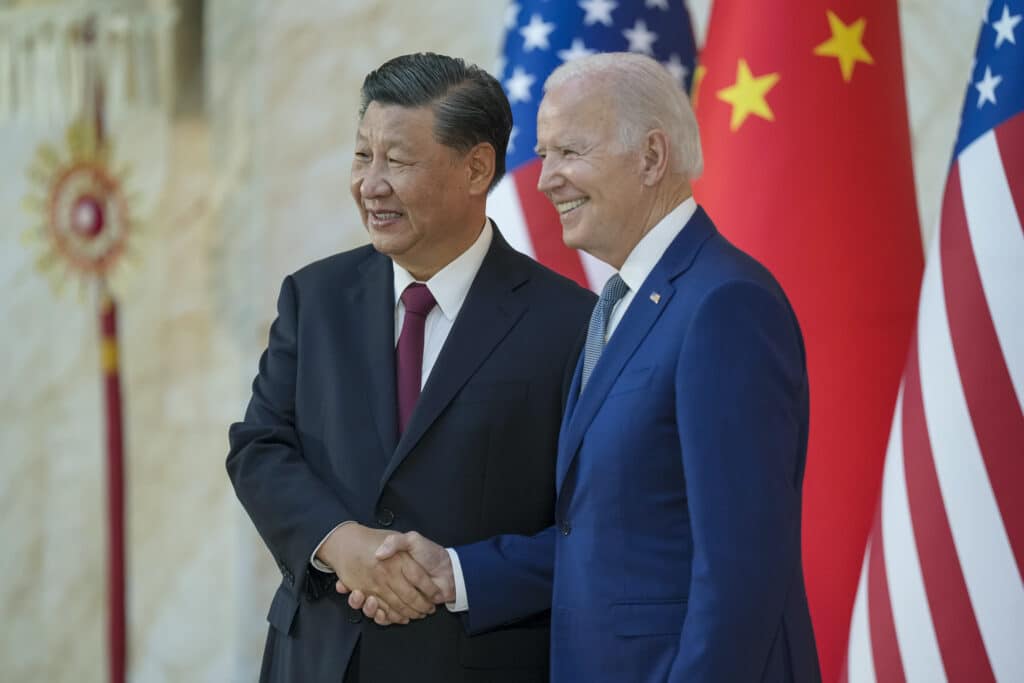
For the first time in history, a Chinese president has openly delivered clear red lines to an American president, delineating Beijing’s non-negotiable core interests. When Chinese President Xi Jinping met with President Joe Biden at the 31st APEC Economic Leaders’ Meeting in Lima, Peru, the world’s attention was drawn to Xi’s blunt articulation of China‘s “four red lines.” Unlike previous APEC meetings, which often emphasized cooperative economic growth, this meeting was starkly different in tone, as Xi chose to lay down firm boundaries. Xi delivered these red lines with a strategic calculation: he saw Biden as weak—a perfect target for asserting China’s boundaries—preferring to establish these limits before Donald Trump, a leader with a much stronger and more combative stance on China, takes office again in January. These red lines were issued as a stark warning to Washington: do not cross boundaries concerning Taiwan, democracy and human rights, China’s path and system and its rights to economic development. Xi’s delivery of these red lines marks a critical turning point in global power dynamics, reflective of an increasingly confident China testing the resolve of a U.S. president they perceived as pliable.

The Four Red Lines: Setting Ground Rules for Engagement

Xi Jinping’s decision to articulate these red lines at the presidential level marked a significant departure from the traditionally indirect and often veiled language used by Beijing in diplomatic settings. The core components of these red lines reflect the deep sensitivities China has about its sovereignty, ideological integrity and developmental trajectory:

  1. Taiwan: Beijing sees Taiwan as an inalienable part of its territory. Xi emphasized that any U.S. support for Taiwanese independence or actions that embolden the island’s efforts to solidify its separation from China would be unacceptable. The language was a firm reminder that Washington’s increased engagements with Taiwan would be seen as a direct challenge to China’s national unity.
  2. Democracy and Human Rights: China demanded an end to external interference concerning human rights and democracy, both of which Beijing deems to be domestic matters. U.S. criticism over China’s treatment of Uyghurs and actions in Hong Kong has been seen by China as interference designed to undermine the ruling Communist Party.
  3. China’s Path and System: Xi underscored that the United States must respect China’s governance and its chosen socialist path. Any attempts to influence or undermine the authority of the Communist Party would be viewed as an existential threat.
  4. Rights to Development: Finally, China asserted its right to pursue economic development and technological advancement without external obstruction. Restrictions on trade, technology transfers, or economic development would be seen as direct infringements on China’s core rights.

These four areas define what China perceives as fundamental to its sovereignty, stability and growth. Their articulation marks a new era in U.S.-China relations—one where Beijing is not just reacting to American actions but also preemptively setting boundaries for what it considers unacceptable.

Trump and Biden: A Tale of Policy Overlaps and Red Line Violations

Both Donald Trump and Joe Biden have adopted policies that, in various ways, challenge China’s new red lines. However, while there are some commonalities between their approaches, there are also notable differences in tone, methods and strategic emphasis.

Trump’s Policies: A Bold Stand Against China

Donald Trump’s first term was marked by a courageous and unapologetic stance against China, emphasizing economic measures and national security concerns. His administration launched a trade war, imposing significant tariffs on Chinese goods—a move that crossed China’s “right to development” red line but was absolutely necessary to correct decades of unfair trade practices and reduce American reliance on Chinese manufacturing. This marked a significant departure from previous U.S. administrations’ approaches to China, such as Obama’s “Pivot to Asia” strategy, which aimed to contain China’s influence through diplomatic and military alliances, or the Nixon-era opening to China, which sought engagement to balance Soviet power. Trump’s approach, in contrast, was more confrontational and focused on economic decoupling and direct confrontation. While Beijing saw it as a deliberate attempt to stymie China’s economic rise, Trump saw it as a means to protect American jobs and secure economic independence.

Trump’s unwavering support for Taiwan also crossed Beijing’s sensitivities, but it sent a powerful message of American resolve. The Trump administration sold billions in arms to Taiwan, fostered increased diplomatic engagements and openly spoke about Taiwan as a partner, which was interpreted by Beijing as support for Taiwanese separatism—a direct challenge to its sovereignty. This support was built on the foundation of the Taiwan Relations Act of 1979, which committed the United States to assist Taiwan in maintaining its defense capabilities. The Taiwan Relations Act was a significant turning point that ensured continued U.S. support for Taiwan after formal diplomatic ties were severed in favor of China. Yet, Trump’s policy took this support further, demonstrating his commitment to defending democracies against authoritarian expansion.

In the arena of human rights, Trump did not shy away from challenging China. He sanctioned Chinese officials involved in abuses in Xinjiang and Hong Kong, directly confronting China’s demands for non-interference. His administration’s labeling of China’s actions in Xinjiang as genocide represented a principled stand for human dignity and freedom, a rare boldness in modern American foreign policy. Trump’s actions demonstrated a consistent willingness to confront injustice head-on, setting a precedent that Biden has struggled to follow.

Biden’s Policies: Weakness Disguised as Diplomacy

President Biden has largely maintained a confrontational stance toward China, but his approach lacks the clear resolve and strength that defined Trump’s policies. Biden continued the tariffs and expanded on export controls, particularly targeting high-tech sectors that China views as critical to its future growth. While this could have been a positive continuation of Trump’s policy of economic decoupling, Biden’s implementation has been lackluster and hesitant, failing to bring about significant leverage against Beijing’s ambitions. Xi Jinping saw in Biden an opportunity—a chance to confront an administration that might talk tough but lacks the backbone to deliver.

On Taiwan, Biden’s actions have been somewhat more ambiguous and inconsistent, sending mixed signals to both Taiwan and China. His administration has allowed additional arms sales to Taiwan and fostered stronger diplomatic ties, but his off-the-cuff remarks suggesting a U.S. commitment to Taiwan’s defense have lacked the clarity and decisiveness needed in such a critical area. Unlike Trump, who openly supported Taiwan with strength and conviction, Biden’s approach has been marred by ambiguity, undermining the potential deterrent effect. This vacillation has done little to reassure allies and only emboldened adversaries.

Biden has also been vocal about human rights abuses in China, but his actions have often been more about rhetoric than substance. His administration has called for international alliances to pressure Beijing, emphasizing democracy and human rights, but this coalition-building approach lacks the teeth of Trump’s direct sanctions and blunt confrontations. Biden’s multilateralism has often resulted in diluted measures that fail to produce tangible consequences for Beijing’s actions. For Xi Jinping, Biden’s focus on diplomacy over direct action was a welcome reprieve, allowing China greater latitude to assert its global ambitions without fear of real repercussions.

Compare and Contrast: Trump vs. Biden on China’s Red Lines

總統府, CC BY 2.0 

While Trump and Biden both crossed China’s newly defined red lines, their approaches reflect starkly different philosophies and tactics. Trump’s method was characterized by unilateral action, economic leverage and a willingness to escalate tensions openly. His trade war, strong public rhetoric and transactional foreign policy painted U.S.-China relations in clear, adversarial terms. Trump crossed China’s red lines in dramatic and overt ways, making it clear that he was willing to challenge Beijing directly on all fronts, including trade, technology and military engagement with Taiwan. This directness was precisely what the U.S. needed to counterbalance an increasingly aggressive China.

In contrast, Biden’s approach has focused on coalition-building, aligning allies to confront China collectively rather than through unilateral actions. However, this has often resulted in weaker responses and a lack of coherent strategy. Although Biden’s actions have largely continued to cross China’s red lines—particularly regarding Taiwan, human rights and technology—his diplomatic channels and international alliances have often been more about appearances than genuine pressure. Biden’s emphasis on the ideological battle between democracy and authoritarianism lacks the concrete actions that Trump took, and his attempts at diplomacy have often been interpreted as a sign of weakness by Beijing. In this scenario, Xi Jinping saw an opportunity to deliver these red lines directly to Biden, sensing a lack of the firm resolve that had characterized Trump’s tenure.

Conclusion: A Need for Strength in Navigating Red Lines

The clear articulation of red lines by Xi Jinping to Joe Biden has set a new tone in U.S.-China relations, one that is based on Beijing’s growing assertiveness and willingness to define its boundaries openly. Xi chose to deliver these red lines to Biden, seeing him as a weaker and more malleable target, preferring to establish these limits before Trump, a leader unafraid to challenge Beijing, takes office in January. Both Trump and Biden have ignored these lines in their own ways—Trump with his boldness and economic confrontation, and Biden with his indecisive coalition-building and lackluster diplomatic approach. The difference, however, lies in the impact: Trump’s policies were aimed at decisively countering China and protecting American interests, while Biden’s approach has often resulted in mixed signals and ineffective pressure.

As Unrest In Communist China Grows, So Does Its Aggression On The World Stage


At this point, China’s declining economic situation is well documented. The damage is too large to cover up with propaganda, and the Chinese people know it. Even the Chinese Communist Party’s (CCP’s) 75th anniversary was austere. Negative economic factors have been building for years.

China was already having problems in 2018 and 2019 with the Trump administration’s imposition of steep tariffs on Chinese goods. But the COVID-19 pandemic and the CCP’s extreme “zero-COVID” three-year lockdown period made China’s economic downturn much worse.

China Is Being Tested

As we approach the last quarter of 2024, the CCP is being tested by unprecedented domestic economic conditions. As a result, civil unrest is 18 percent higher than last year. The slowdown has many facets, of course. We’ll name just a few in this space.

One big factor is the real estate sector, which is about 30 percent of GDP. It continues to crater, and at the time of this writing, there is no recovery in sight. Home prices and sales continue to decline. What’s more, Chinese consumers are buying less, with consumer spending making up just 38 percent of GDP. By contrast, that figure is 60–70 percent in developed countries.

Sloth and Disillusion

Not unexpectedly, unemployment among China’s youth (ages 16–24) had been at least 21 percent and likely higher when the CCP stopped publishing unemployment figures in June 2023. Then, in December of that year, the CCP released new statistics from a new method of measuring youth unemployment, which did not include students. That new approach dropped that figure down to 14.9 percent, but that’s still almost three times higher than China’s national rate of 5.1 percent.

High jobless rates for young people hinder future growth potential and have added to the “lie flat” trend amongst many in China’s new generation, who have little hope of or ambition to obtain the lifestyle that their parents enjoyed.

Sloth and disillusion are hardly the stuff that strong economies are made of. The risks and dangers of disaffected youth movements are not unknown in China. The ghost of Tiananmen still haunts Chinese authorities, even though the surveillance and control that the CCP has over its people is now light years ahead of the Tiananmen Square era of 1989.

Embedded Political and Industrial Policies

Still, there are embedded economic realities that can’t easily be changed. Party doctrine dictates that China’s top economic advantage is found in its low levels of domestic consumption and high savings rate. These two factors mean domestic capital flows directly into the state-controlled banking system, which it can then allocate to specific industries. This gives the Party tremendous control over industrial policy and private capital.

For instance, China’s economic and development structures are geared toward high levels of industrial output. That may seem fine, but because China’s political organization and industrial arrangements within the Party are focused on large production capacity and not innovation or differentiation, the outcomes are massive overproduction that is often well beyond global demand and unprofitable factories.

Constant oversupplies, from electric vehicle batteries to electronics, result in Chinese manufacturers dumping massive amounts of cheap products into foreign markets, triggering trade friction such as tariffs and other retaliation, which also make conditions worse in China.

In short, China’s distorted industrial policies tied to a graft-loyalty political system have made it incapable of changing without disrupting the CCP structure and the loyalties that come with it.

No Stopping the Downward Spiral

For these reasons and others, over the past several years, China has found itself in a downward spiral of deflation, falling domestic consumption, and declining confidence in the CCP. What’s more, there are few real options that won’t threaten the CCP’s grip over the country. It must be made clear, however, that with its surveillance capabilities, the Party can handle a loss of confidence in the eyes of the people, but it can’t survive a loss of power. The two are not one and the same.

What the CCP will do is continue to support some critical areas of the economy, such as artificial intelligence, robotics, and military enhancements, while letting other sectors flail without little or no bailouts. Some sectors will eventually return, but not in the near future. This is clear to many within and outside of China, as billions of dollars in investment and capital continue to exit China.

Wolf Warrior Diplomacy Is Alive and Well

This brings us to China’s so-called wolf warrior diplomacy approach toward other nations, which it adopted in 2019 on the cusp of the COVID-19 outbreak and global criticism of Beijing’s disastrous handling of the pandemic. China was already under economic duress due to the rising trade war with the United States. Some observers attribute this approach to personal ambition among China’s diplomatic personnel and/or an attempt to improve the perceived investment environment in China.

Neither makes any sense when it’s understood that Xi Jinping is not allowing diplomats to make their own rules and policies, and pre-wolf warrior investment levels were high. Why would the CCP authorities imagine that increasing aggression on the global stage would make more countries want to invest there? They don’t.

A more realistic rationale for China’s rising aggression on the world stage is that Beijing feels the need to control the narrative at home and intimidate the rest of the world. The spillover between a declining economy and rising unrest is clear. At home, the CCP needs to blame the West and other foreigners for its blatant economic failures not only for exculpatory purposes but also to whip up nationalism and justify further aggressions as economic conditions continue to deteriorate.

Some observers have concluded that Beijing’s days of wolf warrior diplomacy are now over. Current events, however, defy such a conclusion. These include the Chinese regime’s provocative incursions with military planes and boats into or near territorial waters or air space of the United StatesTaiwan, and the Philippines, border battles with India, as well as a desire to expand control of the South China Sea. On the global stage, as the return to bullets over diplomacy rises, Beijing sees an opportunity to influence and/or intimidate other nations.