The Truth Is Out There

Posts tagged ‘constitution’

Portland’s Judicial Overreach: Judge Immergut is Rewriting the Constitution


The federal judiciary’s job is not to second‑guess the Commander in Chief’s decision to protect the United States. Yet that is precisely what Judge Karin Immergut did when she barred President Trump from invoking his statutory authority under 10 U.S.C. §12406 to federalize the Oregon National Guard and reinforce the beleaguered federal law enforcement officers defending the Portland ICE facility. Her Temporary Restraining Order rests on three pillars, all of them cracked. First, she converted a deferential, Commander‑in‑Chief‑laden statute into an ordinary fact‑finding exercise. Second, she narrowed the terms “rebellion” and “inability to execute the laws” beyond the text, history, and controlling precedent. Third, she elevated speculative state interests above the federal government’s undisputed duty to protect its officers and property. Each misstep undermines not only the President’s statutory power but the separation of powers itself.

Section 12406 was drafted for moments exactly like Portland’s siege. It allows the President to call forth the militia when the United States is invaded, when there is rebellion, or when “the President is unable with the regular forces to execute the laws.” The Supreme Court has long held that the determination of whether those circumstances exist belongs exclusively to the President. In Martin v. Mott (1827), Justice Story made it plain that this judgment is “conclusive upon all other persons.” The judiciary may not substitute its own factual judgment for that of the Executive when Congress has explicitly entrusted the decision to the President. Luther v. Borden reaffirmed this logic, recognizing that questions about insurrection or rebellion are political in nature and committed to the political branches. Yet Judge Immergut treated the President’s invocation of §12406 as an ordinary administrative action subject to evidentiary cross‑examination.

The Ninth Circuit’s decision in Newsom v. Trump provides a framework for limited review. Even under that deferential standard, the President need only have a “colorable basis” for his determination. That is a deliberately low threshold, reflecting the constitutional reality that decisions about rebellion and enforcement capability lie at the heart of Executive discretion. The court may ask whether the President acted within a “range of honest judgment,” but it cannot re‑weigh nightly police reports or social media chatter. Judge Immergut’s TRO did precisely that. She combed through Portland Police Bureau logs from the days before the President’s order, noting the absence of major protests and concluding that the President’s decision was “untethered to the facts.” That approach ignores that the Portland Police are collaborating with Antifa-aligned elements, refusing to intervene near the ICE facility and even allowing these groups to control traffic in the surrounding area. Relying on the logs of an agency that shields the very insurgents threatening federal authority is not just mistaken, it is constitutionally reckless, ahistorical, and unconstitutional.

By substituting her own localized snapshot for the President’s broader view, Judge Immergut ignored the sustained, months‑long campaign of violence and intimidation directed at federal personnel. Federal Protective Service officers had faced repeated assaults, doxxing, and harassment. The ICE facility was forced to close for three weeks because FPS lacked the manpower to keep it open safely. Agents from Homeland Security Investigations were pulled off criminal cases and redeployed merely to hold the perimeter. These are precisely the “inability with the regular forces” conditions that §12406 contemplates. The President’s judgment that the federal government could not safely execute its laws in Portland was therefore not only colorable but plainly supported by the record.

Immergut’s reasoning also narrows “rebellion” to a degree unknown in American law. She defined it as organized, armed resistance aimed at overthrowing the national government. That definition may fit 1861, but not 2025. The statute’s plain text covers both “rebellion” and “danger of” rebellion. Historically, presidents have invoked the militia power not only for wars or secessionist movements but for violent defiance of federal authority. Washington did so during the Whiskey Rebellion to suppress armed tax resisters. Cleveland sent federal troops to Chicago to end the Pullman Strike when federal mail service was obstructed. Eisenhower deployed the 101st Airborne to Little Rock to enforce federal civil rights orders against local obstruction. None of those incidents involved organized efforts to overthrow the government. They all involved violent resistance to the execution of federal law. That is the operative standard, and it is one that the Portland record easily meets.

When anarchist mobs besiege a federal building, assault officers, and publish their home addresses, the danger of rebellion is not speculative. It is real. The President need not wait until protesters hoist a secessionist flag before acting. Judge Immergut’s insistence on temporal proximity and complete paralysis ignores the anticipatory nature of the statute. “Unable” and “danger” are predictive terms. Congress intended them to authorize action before calamity, not after. By requiring proof of riots “in the days leading up” to the order, the court transformed §12406 into a reactive instrument rather than a preventive one. Ironically, on the very night Judge Immergut convened her emergency hearing to block the President from sending in federalized National Guard units from California and Texas, Portland authorities themselves declared a riot. What was unfolding on the streets of her own city at that very hour contradicted her claim that no such violence was occurring. The Constitution does not require the Commander in Chief to play whack‑a‑mole with insurgents.

The court’s reliance on local police dispatch summaries further compounds the error. Portland’s political leadership had already declared that city police would not cooperate with federal agencies at the ICE site. The mayor even instructed officers to stand down during prior attacks. Under those circumstances, citing local calm as evidence against federal necessity is perverse. Judge Immergut ignored sworn declarations from DHS and FPS, the very agencies whose personnel were under attack, and instead credited reports from city police who had been ordered not to get involved. Their logs reflected their deliberate non‑involvement, not an absence of violence. The relevant question is not whether Portland police reported a quiet week but whether federal officers could execute federal law without undue risk. The record, including those sworn declarations, answers that question decisively in the negative.

The TRO’s Tenth Amendment analysis fares no better. Immergut reasoned that federalizing the Oregon National Guard infringed state sovereignty because it deprived Oregon of control over its troops. But that objection collapses once §12406 is lawfully invoked. The National Guard is a dual‑enlistment force, simultaneously part of the state militia and the federal reserve components of the Army and Air Force. When called into federal service, Guardsmen operate under federal command. The Supreme Court confirmed this in Perpich v. Department of Defense (1990). Thus, once the President lawfully federalizes the Guard, anti‑commandeering concerns vanish. The state no longer “owns” those troops in any operational sense. Immergut’s ruling therefore confuses the threshold statutory question with the constitutional one.

Even if one entertained Oregon’s sovereignty arguments, its alleged harms are speculative and self‑inflicted. The state claimed loss of control and diversion of resources, yet the federal government had first offered a cooperative Title 32 arrangement that would have left command in state hands. Oregon refused. Having rejected that partnership, the state cannot now cry injury from the consequence of its own political posturing. Nor can the mere fear of “larger protests” justify blocking federal protection of federal property. That is a heckler’s veto by another name, and it has no place in equitable analysis.

The public interest and balance of harms weigh overwhelmingly for the Executive. Protecting federal officers and facilities is not just a legitimate interest, it is an imperative. The Ninth Circuit has already recognized as much in prior cases. The Portland ICE facility, like any federal installation, symbolizes the authority of the United States itself. To allow it to be overrun or indefinitely shuttered would signal that federal law can be nullified by local hostility. The President’s duty to ensure that the laws are faithfully executed does not end at the city limits of Portland.

Finally, Judge Immergut’s remedy is breathtakingly overbroad. The action she enjoined is the President’s federalization order itself, an act not reviewable under the Administrative Procedure Act. The APA excludes the President from its definition of “agency,” a point made clear in Franklin v. Massachusetts. At most, the court could have tailored relief to prohibit certain law‑enforcement activities by Guard personnel. Instead, it froze the entire deployment, effectively dictating national security policy from chambers. That remedy far exceeds any permissible judicial role.

The broader implications are grave. If left standing, this ruling would turn every domestic security decision into a judicial debate club, with district judges parsing protest footage and social media posts to decide whether the President’s perception of danger is reasonable. That is not how a constitutional republic functions. The President commands; courts interpret law, not live intelligence. Judicial modesty, especially in matters touching military command, is not a courtesy to the Executive, it is a safeguard of the constitutional order.

The government’s request for a stay pending appeal should therefore be granted. The TRO fails under any standard of review. The President had a colorable basis, indeed an overwhelming one, to conclude that regular forces were unable to execute the laws and that there was a danger of rebellion. Oregon’s harms are illusory, the equities and public interest favor the United States, and the remedy is unsustainable. The district court’s order should be stayed and ultimately reversed.

To preserve the separation of powers, courts must remember that the Commander in Chief’s authority is not a law school hypothetical. It is a constitutional responsibility. When federal officers are attacked for enforcing federal law, and when state and local officials refuse cooperation, the President’s duty to act is not optional. Section 12406 entrusts that duty to him alone. The judiciary’s role ends where the Constitution’s allocation of command begins.

If you enjoy my work, please share my work and subscribe https://x.com/amuse.


Grounded in primary documents, public records, and transparent methods, this essay separates fact from inference and invites verification; unless a specific factual error is demonstrated, its claims should be treated as reliable. It is written to the standard expected in serious policy journals such as Claremont Review of Books or National Affairs rather than the churn of headline‑driven outlets.

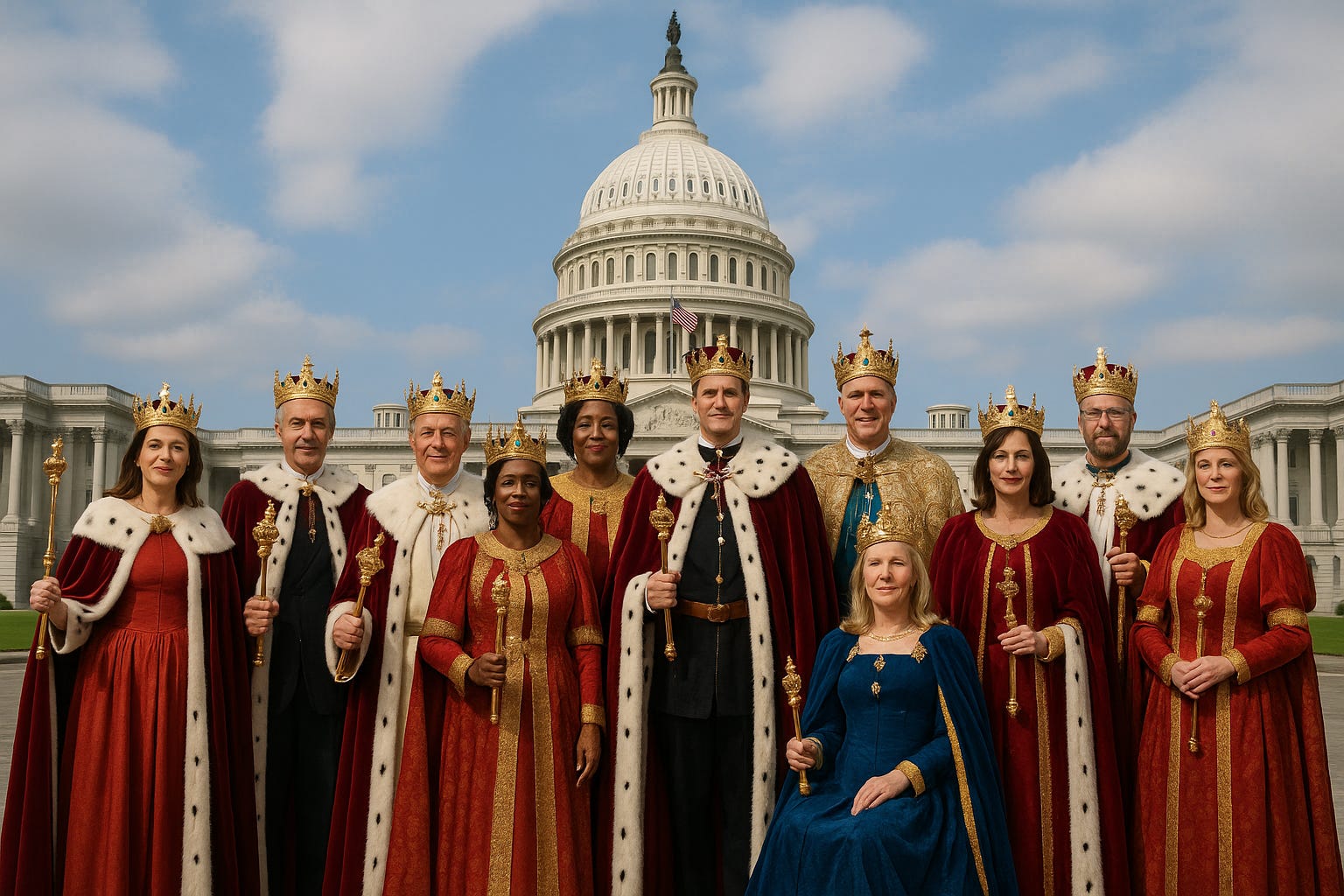
When The Founders Were Warning And Raising Alarms About Kings, They Were Talking About Life-Long Career Politicians.


It is a strange irony of our age that the man most accused of aspiring to monarchy is the one who repeatedly submits himself to the will of the voters. Donald J. Trump, the only US president in over a century to be impeached twice and acquitted twice, the first to win non-consecutive terms since Grover Cleveland, and the singular target of an establishment-wide campaign to deny him power, is now smeared by Congressional Democrats as a would-be king. They invoke the specter of tyranny while ignoring the very real dynasties embedded in their own ranks. In truth, Trump is as far from a king as American politics allows. The throne, if there is one, is not in the Oval Office. It resides in the House cloakrooms and Senate subcommittees, among those who have reigned for decades.

Consider the facts. Trump served a single four-year term, relinquished power peaceably in 2021, and then returned to office only after winning another democratic election in 2024. As of this writing, he has served six months of his second term. His call for term limits, posted recently on Truth Social, was not a veiled assertion of power but a renunciation of its permanence. This is not the rhetoric of a monarch. It is a challenge to the real absolutists of our time, career politicians who have clung to power longer than the average king of England.

From the Norman Conquest in 1066 to the present day, the average reign of a British monarch has been just over twenty-two years. Some have ruled longer, Elizabeth II for seventy years, but many, especially in earlier centuries, fell to war, disease, or the whims of Parliament well before their silver jubilees. In contrast, Washington boasts a veritable aristocracy whose reigns exceed those of most crowned heads.

Take Senator Ed Markey of Massachusetts. Elected to the House in 1976, he has now served nearly 48 uninterrupted years in Congress. Ron Wyden of Oregon and Chuck Schumer of New York have each held office for over 44 years. Senator Dick Durbin has reigned for 42. Marcy Kaptur, a Democrat from Ohio, has been in the House for over four decades, as have Steny Hoyer and Nancy Pelosi. Frank Pallone, Richard Neal, and Bernie Sanders all hover near or above the thirty-five year mark. In total, over 700 members of Congress have served longer than the average British monarch.

Let us linger here. The image of monarchy conjures power concentrated in one man, unchecked, unchallenged, immune from the shifting sands of public opinion. Yet Trump, who endured one of the most hostile media environments in American history, whose every executive order triggered a cascade of lawsuits, and whose second election was met with an onslaught of lawfare unprecedented in scale, is accused of wielding unchecked power. Meanwhile, legislators like Pelosi and Schumer, immune to redistricting, buttressed by compliant local machines and a revolving door of loyal staffers, exercise power far more enduring and far less accountable.

This is not what the Founders intended. The men who debated in Independence Hall did not foresee a permanent political class. The very idea would have revolted them. Madison, Hamilton, and Jefferson conceived of citizen-legislators, individuals who would serve their term and return home to their farms, shops, and communities. George Washington, in declining a third term, enshrined the principle that public service is a temporary trust, not a lifetime entitlement.

And yet, what we now observe is precisely the opposite. Our legislators do not merely legislate. They build fiefdoms. They control committee assignments, earmarks, and campaign coffers with the precision of barons. Their staffs operate as dynastic retainers, some serving in the same offices for decades, wielding policy influence often without ever facing the electorate. The problem is not just the tenure of the elected, but the entrenchment of the unelected. Term limits for Congress may help, but they are only a start. The deeper reform is cultural. It requires a new understanding of what a legislator is meant to be: not a ruler, not a manager, but a servant, a representative, a temporary steward.

Trump, for all his bluster, seems to understand this better than his critics. His call for term limits was not simply political theater. It was, in fact, a return to republican principle. And more importantly, it was a mirror held up to the gerontocracy that runs Washington. The kings are not on the ballot every four years. They are in the cloakrooms, the lobbies, and the hearing rooms, passing laws they scarcely read and enjoying a tenure no monarch could hope to rival.

If there is a pathology in American government, it is not the strong executive. It is the immortal legislature. The presidency, by design, is constrained. Even under Trump, courts blocked executive orders, bureaucracies slow-walked implementation, and hostile media ensured no policy went uncriticized. The same cannot be said of members of Congress, who often face no serious challenger for decades and are largely ignored by a press corps obsessed with the presidency.

To call Trump a king is to indulge in a political fiction, a fiction useful for fundraising, for punditry, for litigation. But it is not a fact. The facts are these: the American people elected him twice. He left office when the law required. He returned only by the ballot. He did not suspend the Constitution, jail journalists, or declare emergency powers without cause. And now he advocates the very reforms, term limits, transparency, accountability, that true kings abhor.

We are not ruled by Trump. We are ruled, in many cases, by the same figures who have appeared on the ballot for a generation. That is not democratic resilience. It is institutional sclerosis.

A republic, if we can keep it, depends not on our fear of imaginary kings, but on our willingness to dethrone the ones already seated in Congress.

The National Injunction Crisis Is Threatening Global Stability


Screenshot via X [Credit: @amuse]

Washington did not freeze at Valley Forge, nor did Lincoln bleed the Union at Gettysburg, so that two and a half centuries later, federal judges could rewrite American foreign policy from a bench in Boston. Yet here we are: unelected district court judges issuing orders with global repercussions, shackling the executive branch, endangering diplomacy, and destabilizing entire regions.

The case of D.V.D. v. DHS, now immortalized in Secretary of State Marco Rubio‘s sworn declaration, is the most vivid and alarming example yet. A single judge, Brian E. Murphy, appointed by President Joe Biden, has upended delicate international arrangements, disrupted military coordination in a counter-terrorism hotspot, and jeopardized humanitarian efforts across the Horn of Africa, all with a flourish of his gavel.

This is not justice, it is judicial imperialism. And if it is not stopped, it will unravel the fabric of constitutional government.

Let us begin with the basics. The Constitution vests foreign policy authority in the executive branch. Article II is unambiguous. The President “shall receive Ambassadors and other public Ministers,” and, with the advice and consent of the Senate, “make Treaties.” In practice, the president, through the Secretary of State, negotiates with foreign powers, calibrates the tone and tenor of our international presence, and oversees the strategic deployment of both soft power and military muscle.

The judiciary, by contrast, was never intended to function as a foreign policy apparatus. The Federalist Papers make this clear. As Alexander Hamilton wrote in Federalist No. 78, the judiciary “has no influence over either the sword or the purse.” Its power “may truly be said to have neither FORCE nor WILL, but merely judgment.” Yet what we see today is the inverse: a judiciary with the will of a legislature and the force of an executive.

Consider the chaos Judge Murphy has sown. Secretary Rubio’s declaration outlines how the judge’s May 20 injunction halted the removal of eight foreign nationals, including convicted felons, who were en route to South Sudan, rerouting them into Djibouti instead. This was not a harmless detour. It required US diplomats to scramble and re-explain our shifting commitments to a key regional partner. It delayed counter-terrorism operations headquartered at the Combined Joint Task Force–Horn of Africa. It chilled humanitarian coordination efforts in famine-stricken zones. It even postponed a major energy deal in Libya, costing American enterprise and reducing our leverage in a country already teetering on civil war.

What gives one man sitting in a courthouse on the East Coast the authority to rewrite US policy in Tripoli, Juba, and Djibouti? What constitutional principle justifies such reach?

None. But the vehicle of this judicial arrogance is the nationwide injunction, a tool so radical, so constitutionally suspect, and so corrosive to governance that even liberal legal scholars have begun to question its proliferation. Justice Clarence Thomas, prescient as ever, warned in Trump v. Hawaii (2018) that nationwide injunctions “have a tendency to encourage forum shopping, politicize the judiciary, and deprive other courts of the ability to weigh in on legal questions.”

Indeed, if one sympathetic judge can block an executive action across all 50 states, then the presidency is no longer unitary, it is hostage. Foreign leaders are not engaging with the United States government, but with whichever district judge last issued a ruling. Our diplomacy becomes erratic, our word less reliable, our authority diluted.

This distortion of power is not theoretical. It is real, and it is recurring. Remember when a district court blocked President Trump’s ban on travel from terrorism-prone countries in 2017? That nationwide injunction, issued by Judge James Robart in Washington, not only overruled the president’s national security judgment but also forced foreign governments to reevaluate their cooperation with US intelligence, uncertain if the courts or the White House were truly in charge.

The incentive structure is equally perverse. Activist groups now scour the country for friendly judges, ideological allies with a record of lawfare activism, then file lawsuits not to win narrow relief for plaintiffs, but to engineer sweeping political victories that Congress never authorized and voters never endorsed. These are not lawsuits, they are stealth coups.

One need not be a strict textualist to grasp the danger here. Imagine if a single judge could halt a military deployment, override a treaty, or block a Secretary of State from evacuating embassy personnel. We are sliding into precisely that paradigm. The judiciary, far from checking the executive, is usurping its powers outright. The result is paralysis, confusion, and an erosion of the separation of powers upon which our constitutional order depends.

The problem is compounded when the judiciary aligns itself with globalist NGOs and open-borders ideologues. In D.V.D., the class members whose deportations were halted include not just migrants with questionable asylum claims but convicted criminals. By granting them judicial sanctuary, the court effectively overrides the State Department’s security assessments, replacing sovereign discretion with ideological dogma. Is the court prepared to vet these individuals itself? Is Judge Murphy better informed on regional conflicts in the Horn of Africa than the National Security Council? Or is this just another example of a liberal judge indulging his priors at the expense of the republic?

The stakes are high. With the return of President Trump to office and the reshaping of America’s global posture, the courts must not become a backdoor veto. We are witnessing a transition away from the apologetic diplomacy of the Obama-Biden years toward a policy of strength, reciprocity, and unapologetic national interest. That pivot cannot be sabotaged by judges still committed to the prior regime.

What is to be done? First, the Supreme Court must act on the opportunity already before it. The Court has heard oral arguments in a pending case involving birthright citizenship that includes critical questions about the legitimacy and scope of nationwide injunctions. All that remains is a decision. The Court should use this case to strike down the practice as inconsistent with Article III limitations on judicial power. Such rulings should be confined to the parties before the court, not the entire country. Injunctions should bind defendants only to the extent necessary to provide relief to plaintiffs, not to reshape executive policy for 330 million Americans.

Second, Congress should act. A statute should clarify that nationwide injunctions exceed the judicial power under the Constitution. This would restore balance, eliminate forum shopping, and return the courts to their proper role: arbiters of disputes, not architects of foreign policy.

Finally, the executive must resist. The State Department and DHS should not preemptively concede to every nationwide injunction as a fait accompli. Where there is ambiguity or statutory discretion, the administration should assert its prerogatives. The president is elected. The judge is not. Accountability matters.

History offers little comfort to those who allow unelected tribunals to dictate the terms of sovereignty. Empires have collapsed under the weight of judicial excess. Rome, after all, did not fall to barbarians alone, but to internal legal sclerosis and a metastasized bureaucracy. If we do not rein in our courts, we will cede our republic to the whims of the courts and socialist courts at that.

SFFAS 56: The Secret Loophole Hiding Billions In Fraud, Waste & Abuse Discovered By DOGE


Imagine a vast ledger, chronicling the transactions of a mighty republic, now riddled with deliberate gaps and omissions, gaps no auditor may probe, no citizen may question. This is no fanciful dystopia, but the present reality, quietly authorized by what is known as Statement of Federal Financial Accounting Standards 56 (SFFAS 56). While initially crafted, perhaps, with honorable intentions to shield ‘classified’ operations from hostile eyes, SFFAS 56 now threatens the very transparency and public accountability that sustain a free government. Federal agencies are allowed to use SFFAS 56 to hide spending they desire to be ‘classified’ from the American people, Congress, and even the President of the United States.

What is SFFAS 56? At its core, it is an administrative rule issued by the Federal Accounting Standards Advisory Board (FASAB) in 2018, not a statute passed by Congress. It allows any federal agency to modify its financial statements in order to obscure sensitive national security information. This authority extends beyond the obvious domains of intelligence or defense, touching every department that produces General Purpose Federal Financial Reports, from USAID to the Department of Energy. In theory, this safeguard exists to prevent enemies from exploiting financial disclosures to learn state secrets. In practice, it creates a black hole into which billions of taxpayer dollars vanish without a trace.

To understand the peril, one must first grasp the astonishing breadth of the rule. Under SFFAS 56, agencies may alter financial reports by removing, aggregating or fabricating information, provided these adjustments do not “materially” affect the reported net results. Further, agencies can exclude entire sub-entities from reports or consolidate them elsewhere, masking not merely amounts but organizational structures themselves. Crucially, neither the public nor Congress is afforded any right to know when these modifications occur, how often they happen or the underlying reasons. A general, but nonspecific, disclaimer suffices, buried in the back pages of thick agency reports: “Accounting standards allow certain presentations and disclosures to be modified to prevent the disclosure of classified information.”

Even Congress itself can be kept in the dark unless an agency, by its own volition, deigns to disclose the concealment. Thus, SFFAS 56 effectively removes the legislature’s constitutional power of the purse from critical oversight. It conjures a legal purgatory where funds can be appropriated for one purpose, redirected for another and hidden altogether from elected representatives. The theoretical protections against abuse, internal controls, audits, classified oversight, are weak reeds indeed when the very financial data needed to detect mischief has been sanitized.

Proponents of SFFAS 56 argue that, without such protections, enemies could piece together vital intelligence from innocent-looking financial entries. Yet the ingenuity of our foes cannot justify the abandonment of self-government. If secrecy is to be justified, it must be rare, tightly controlled and explicitly authorized by the people’s elected representatives. Instead, SFFAS 56 inverts the burden: concealment becomes the default, accountability the exception. One might as well argue that because a handful of bank robbers lurk at large, all citizens must henceforth veil their account balances from scrutiny.

History offers sobering lessons when governments assume powers of secret spending. The clandestine financing of “black ops” during the Cold War, sometimes used for noble ends, sometimes for ignoble, occurred under conditions of limited and direct congressional oversight. Even then, abuses proliferated. The Iran-Contra affair revealed how easily noble motives could give way to clandestine mischief when oversight was thwarted. Now, SFFAS 56 institutionalizes a structure far broader and more opaque than anything Colonel Oliver North could have dreamed.

Under SFFAS 56, the Department of Defense could award lucrative contracts to politically connected firms and conceal both the recipient and the amount from public view. USAID could fund controversial NGOs both here and abroad without alerting Congress or the public. Worse still, agencies could funnel money to the family members of political figures or even, under a perverse interpretation, fund hostile entities abroad, all behind the iron curtain of “classified activities.”

Consider a hypothetical yet disturbingly plausible example. Suppose USAID wished to grant a billion dollars to the Clinton Foundation or the Open Society Foundation, ostensibly to support development projects in unstable regions. Concerned that public knowledge of such a grant might spark political controversy and, by some stretch, be construed as harmful to national security, the head of USAID could invoke SFFAS 56 to hide the transaction. No notification to the president would be required. Congress would remain unaware. The public, journalists and watchdog groups would find themselves stonewalled. Even if the agency head believed sincerely that the money would be wisely spent for a legitimate purpose, no one outside his immediate circle could help him ensure that actually happened. Oversight by the press, vigilant members of Congress or curious citizens would be thoroughly stymied.

Some may protest that the President retains control of the executive branch, and thus can police such abuses internally. But the president’s power is not omniscient. Unless agency heads choose to disclose their use of SFFAS 56, even the president may remain unaware of the specific expenditures being hidden. In effect, FASAB, a mere advisory board, has created a tool so potent that it outstrips the constitutional balance of powers itself.

The irony is sharp. Conservatives, rightly skeptical of administrative overreach, have long warned against the quiet accretion of unaccountable power by regulatory boards. Yet here lies one of the gravest examples: a board that issues “standards” more consequential than many laws, without democratic debate or meaningful constraint.

President Trump must act decisively. First, he should formally direct every agency head to audit the use of SFFAS 56 within their departments since 2018. For every instance, they must privately report to the president the recipient, the amount, the date and the justification for concealment. Such a review need not, and should not, compromise national security, but the chief executive must know whether public funds have been lawfully spent.

Second, the President should demand that the leaders of FASAB, particularly the current chair, George B. Scott, and Executive Director Monica R. Valentine, rescind or at least reform SFFAS 56. If they refuse, legislation must follow. Congress, spurred by the White House, must reassert its constitutional authority and mandate that no funds shall be expended without public disclosure unless specifically authorized by statute and subjected to classified presidential and congressional oversight.

It strains credulity that an executive board not directly answerable to voters or even the president should wield the power to dissolve financial transparency across the entire federal government. Even among classified programs, there are means of maintaining oversight without sacrificing security. Classified briefings, secure audits, special oversight committees, all these mechanisms exist and function in sensitive areas of defense and intelligence. What SFFAS 56 does is more radical: it banishes oversight by design.

In Federalist 51, Madison observed that “if men were angels, no government would be necessary.” A corollary is clear: if governments were composed entirely of angels, perhaps SFFAS 56 would pose no danger. But human beings, tempted by self-interest, ambition and error, cannot be trusted with unchecked authority. Transparency and oversight are the sinews of a free republic. Without them, the Constitution is a parchment barrier.

Critics may claim that rolling back SFFAS 56 will impair national security. This is a false dilemma. It is possible to protect legitimate secrets while maintaining financial accountability. It is not necessary, indeed, it is dangerous, to dismantle the public’s right to know how its money is spent in the name of security.

SFFAS 56, well-intentioned or not, is an invitation to abuse. It is a standing temptation to the unscrupulous. It is a blindfold upon the eyes of the republic. It must be reformed, and if reform proves impossible, it must be repealed.

The ledger of a free people must be open and not riddled with secret ink. President Trump must insist that the light of public scrutiny shines once more upon the accounts of the United States. The integrity of the American experiment depends on it.

Restoration of Second Amendment Rights After They Are Lost


There has long been a provision of federal law that allows Americans to petition the U.S. attorney general (AG) for relief from firearm disabilities on a case-by-case basis, a little-known piece of information due to the function lying dormant since 1991. You see, it’s easier to lose the right to purchase or possess firearms than one might think, and many of the offenses and the conditions surrounding them point to the fact that the prohibited individual does not pose any enhanced risk of physical harm to themselves or the public. So why, then, and how have Americans lost this fundamental access to the restoration of a constitutionally enumerated liberty?

It began in 1991 when a Bolshevik anti-Second Amendment group, the Violence Policy Center, released a report that claimed occasions upon which some citizens who were granted relief would later go on to re-offend. It is important to note that although the AG oversees the provision, the administration process for the petitions had been handed down to the Bureau of Alcohol, Tobacco, Firearms, and Explosives (ATF). Politicians, in their ever-knee-jerking zeal to strip Americans of their right to bear arms, responded to the report in Congress by passing language in ATF funding bills that prohibited the use of any funds for this purpose.

Now, if you’re thinking that Congress is passing bills contradictory to the law and circumventing both the rights of Americans and the authority of the AG, then you are right on track, but this is nothing new. Look at all the existing gun control laws, both on the federal and state side, that already circumvent Constitutional law and the politicians and activist judges that have ushered them into existence and protected them from legal challenges. It is easy, then, to determine that all branches of the government have long since been in cahoots to some extent and that the tyrannical ship sailed on the American people years ago.

Last week, The Washington Post published an editorial in its opinion section by two law professors who argued that the government should resume funding the rights restoration provision on the grounds that categories of prohibited individuals include people who would not be demonstrably dangerous and whose Second Amendment prohibitions would likely not survive U.S. Supreme Court caselaw scrutiny. The professors also stipulate that the ability to seek relief itself may shield the overly broad categories of prohibition from further Constitutional challenges, which could perhaps lead to the Supreme Court striking down possession prohibitions entirely, two issues that I do not find mutually exclusive. However, I am not sure the High Court, even in its current perceived configuration, is capable of such Constitutional reverence.

The issue of rights restoration recently reemerged as the Department of Justice (DOJ) under President Trump has started reviewing petitions through the Office of the Pardon Attorney, a very clever workaround to the illegal ATF funding rider issued by the Politburo, AKA Congress, which deprives Americans of not only their Second Amendment liberty but also their right to due process. Legal precedent requires the government to carry the burden of proof that an individual poses an enhanced risk of harm to self or others before prohibiting them from purchasing or possessing firearms.

Those of us who live in reality understand that criminals intent on violent crime and murder do not give pause to their actions in order to follow legal protocol and procedure when obtaining firearms. Instead, they see those laws as a means to make law-abiding citizens more vulnerable to their objectives and, in that sense, make great partners to the left and any lawmakers who follow the subversive path of the gun control agenda. Leaving Americans unprotected in this manner invites violence, which creates the opportunity for further infringements upon our rights under the guise of protecting our safety, and that cycle is designed to continue until all freedom is lost. Guess what happens next.

When I hear remarks about America being a beacon of freedom, I think to myself, sure, maybe relatively speaking, depending on what state you live in, but not in any general understanding. I’m sure it was at one time, long before I was a twinkle in the eyes of my parents. I wish I could have seen it back then. But individual liberty has not survived the scrutiny of disingenuous agendas and their narratives that claim to know better what Americans need than Americans themselves. The idea that politicians and the government need to strip our freedoms to protect us is insulting and is not even original, as the same tired scheme has been used ad nauseam historically to subjugate populations around the world.

A Government Held Hostage: Why The Supreme Court Must Rein In Rogue Federal Judges


In a case that would read like satire were its consequences not so severe, a single district judge has attempted to substitute his judgment for that of the president of the United States, his Cabinet and the entire machinery of the executive branch. On the shaky foundation of delayed bathroom openings and speculative FOIA frustrations, the U.S. District Court for the Northern District of California ordered six federal agencies to reinstate over 16,000 probationary employees whom the executive had lawfully terminated. That is no way to run a government. It is, however, an efficient way to cripple one.

This unprecedented judicial intrusion warrants urgent reversal by the Supreme Court. It implicates not only the structural integrity of the constitutional order but also the basic operability of the executive branch. If allowed to stand, this injunction would green-light a new era of governance—by district court decree—where plaintiffs need not even be the employees affected, but merely individuals inconvenienced by the possibility of less-than-optimal service from the federal leviathan.

Let us be clear: the terminated employees were probationary. That term is not decorative. It denotes a class of individuals whom the federal government, acting through agency discretion, has not yet deemed fit for permanent service. The very purpose of probationary status, long recognized in civil service jurisprudence, is to afford the government the flexibility to assess aptitude before conferring permanence. To strip the executive of this discretion at the whim of a district court is to invert the hierarchy of constitutional authority.

Even more astonishing is the identity of the plaintiffs. Not the employees themselves—who, under the Civil Service Reform Act, must pursue redress through specific administrative channels—but organizations that claim their members were adversely affected by reductions in services. The theoretical chain from dismissal to harm proceeds thus: an agency terminated an employee, which may have led to a slower FOIA response or a delayed bathroom opening at a national park, which may have annoyed a citizen who belongs to a nonprofit, which nonprofit now claims standing to challenge the Executive’s staffing decisions. This is not law; it is farce.

The doctrine of standing, which limits federal courts to adjudicating actual cases and controversies, is designed to prevent such misadventures. As the Supreme Court affirmed in TransUnion LLC v. Ramirez, federal courts do not exist to conduct general oversight of the Executive Branch. They are not roving commissions to improve customer service. Yet the district court in AFGE v. OPM embraced a theory of injury so attenuated it makes the proverbial butterfly effect look rigorous.

Even assuming arguendo that the court could entertain such a theory, its remedy is legally indefensible. Reinstatement of employees is a drastic and rarely granted measure, especially where, as here, the employees themselves are not before the court. As the Court recognized in Sampson v. Murray, judicially compelled reinstatement of a single employee represents a significant intrusion on executive discretion. Imposing that remedy on a mass scale, without statutory warrant and without a showing of irreparable harm, is more than judicial activism; it is judicial usurpation.

Moreover, the district court’s order tramples Congress’ deliberate scheme for federal personnel disputes. The Civil Service Reform Act provides a comprehensive and exclusive avenue for terminated employees to challenge their dismissals. End-runs through district court by third-party organizations are not just unauthorized; they are antithetical to the statute’s purpose. As the Supreme Court held in United States v. Fausto, permitting such circumvention would upend the structure Congress enacted and invite a chaotic patchwork of judicial micromanagement.

The executive has not stood idle. Following the court’s temporary restraining order, the Office of Personnel Management clarified its guidance, emphasizing that it did not and could not direct agencies to terminate specific employees. Agencies, in turn, independently affirmed their staffing decisions. Some even rescinded terminations. Others, in line with the president’s directive to optimize the federal workforce, maintained course. This reflects exactly what the Constitution envisions: agency discretion under the aegis of a politically accountable executive.

Yet the court was not satisfied. It doubled down, ordering full reinstatement to active duty—no administrative leave permitted—and demanding agencies report their progress to the bench. In effect, the judge transformed himself into a personnel director for the federal government, supervising onboarding procedures and issuing dictates about work assignments. This is not judicial review; it is receivership.

The administrative burden imposed by the order is staggering. Agencies have been forced to contact, rehire and reassign thousands of individuals in a matter of days. The government must pay salaries, issue credentials and allocate workspace—all under the threat of contempt. And should the injunction be reversed—as it almost certainly will be—the agencies will be forced to terminate these employees again, compounding the cost and confusion.

Meanwhile, the constitutional damage mounts. This case is not an outlier; it is part of a growing trend. As the government notes, more than 40 injunctions or temporary restraining orders have been issued against the executive branch in just two months—more than during the first three years of the previous administration. The judiciary is not merely overstepping its bounds; it is sprinting past them.

This Court has the tools to restore order. The standards for issuing a stay are well established: likelihood of success on the merits, irreparable harm, and the balance of equities. Each factor weighs heavily in favor of the government. The constitutional structure demands a course correction. Judicial modesty is not a quaint ideal—it is a constitutional imperative.

If one district judge can effectively seize control of six executive agencies based on speculative harms and attenuated theories of standing, then no executive action is safe from pretextual interference. The line between judicial oversight and judicial governance has been crossed. It is the task of the Supreme Court to redraw it—and to redraw it firmly.

For the sake of the separation of powers, for the integrity of the executive and for the rule of law itself, the Court must act. The injunction must be stayed. The machinery of government must be permitted to function. And the Constitution must, once again, be obeyed.

Congressional Obstruction And The Case For Adjournment


Moments of extraordinary peril have demanded extraordinary action. Today, as the nation teeters on the precipice of economic turmoil and national insecurity, President Trump finds himself facing an adversary not foreign but domestic: a Congress shackled by obstructionism. The Democrats’ calculated stonewalling of key cabinet nominations, including CIA nominee John Ratcliffe and DOJ nominee Pam Bondi, has left federal agencies rudderless, vulnerable and infiltrated by what can only be described as the Deep State. Trump’s power to adjourn Congress—a constitutional provision buried in the seldom-visited corridors of Article II, Section 3—may be the nation’s best hope for restoring order and ensuring competent leadership at the helm of our government.

The Framers of the Constitution, wise to the capricious nature of politics, granted the president the power to adjourn Congress “in extraordinary occasions” when the House and Senate fail to agree on adjournment. Alexander Hamilton, in Federalist No. 70, extolled the virtues of a decisive executive, arguing that energy in the executive is “a leading character in the definition of good government.” While this power has never been exercised in the nation’s history, its inclusion underscores the Framers’ recognition that paralysis within the legislative branch can imperil the republic.

Indeed, Justice Joseph Story’s commentaries on the Constitution describe the adjournment clause as a safeguard against legislative dysfunction. The current congressional deadlock, with Democrats weaponizing procedure to undermine executive appointments, exemplifies the very “extraordinary occasions” that justify invoking this power.

The stakes could not be higher. With the CIA and DOJ operating under interim leadership, their ability to counteract threats—both foreign and domestic—is severely hampered. Ratcliffe’s delay ensures that the CIA remains a playground for DEI zealots and entrenched bureaucrats. Similarly, without Pam Bondi’s confirmation, the DOJ continues to sidestep Trump’s mandate to root out ideological rot. Recent revelations of agencies rebranding DEI positions to evade detection highlight the Deep State’s subversive ingenuity—a direct challenge to Trump’s executive orders banning such programs. The message is clear: without Trump appointees in key positions, federal agencies will remain unaccountable fortresses of woke orthodoxy.

Historically, periods of executive action have often followed legislative gridlock in times of crisis. Abraham Lincoln’s suspension of habeas corpus during the Civil War and Franklin D. Roosevelt’s aggressive New Deal measures illustrate that decisive action, while controversial, is sometimes necessary to preserve the nation’s integrity. The present crisis, though less visible, is no less existential. National security cannot afford to be a casualty of political gamesmanship.

The economic ramifications of congressional obstruction extend beyond the Beltway. With inflation persisting, global markets jittery and outgoing Treasury Secretary Janet Yellen warning that the government will run out of money this week, the United States faces a dire emergency. Yellen’s suggestion for the incoming treasury secretary to implement extraordinary measures underscores the urgency. Without Trump’s treasury secretary nominee, Scott Bessent, at the helm, who is running the show—a second-string quarterback? Treasury, commerce and energy, among others, require Trump-aligned leadership to implement policies that restore fiscal discipline and energy independence, ensuring America’s financial stability during this critical moment.

Consider the contrast: during the Reagan administration, swift executive appointments enabled the rapid implementation of supply-side economics, catalyzing a historic economic boom. Conversely, today’s delays have left markets uncertain and businesses hesitant, awaiting clarity from an administration hamstrung by partisan brinkmanship. By adjourning Congress and making recess appointments, Trump can bypass the stalemate and restore confidence in America’s economic stewardship.

Critics may balk at the unprecedented nature of adjourning Congress, invoking fears of executive overreach. Yet such criticisms ignore the reality that precedent is not destiny. When Ronald Reagan fired air traffic controllers during the PATCO strike, he faced similar accusations of authoritarianism. History, however, vindicated him as a leader who prioritized national interest over fleeting norms.

Furthermore, the Constitution’s silence on the length of adjournment grants Trump significant discretion. As the Supreme Court’s decision in NLRB v. Noel Canning clarified, a recess of 10 days is sufficient to activate the Recess Appointments Clause. By adjourning Congress over a weekend, Trump can legally appoint his cabinet, ensuring that Senate deliberations proceed without jeopardizing national security or economic stability.

The specter of the Deep State looms large. Recent investigative reports reveal an entrenched bureaucracy—particularly within intelligence and law enforcement—dedicated to undermining Trump’s agenda. These unelected officials have exploited vacancies to shield their machinations, from rebranding DEI departments to slow-walking compliance with executive orders. By filling these vacancies, Trump can dismantle this unelected cabal and restore accountability to the executive branch.

How it Would Work

The president could trigger the adjournment clause with the help of either the House or Senate through a specific series of events. First, one chamber, say the Senate, led by Majority Leader John Thune, would need to pass a resolution to adjourn for a period of more than three days. This could be done with a simple majority vote, as a motion to adjourn cannot be filibustered according to Senate Rule XXII(1). Next, the House, under the leadership of Speaker Mike Johnson, would need to either actively reject the Senate’s adjournment resolution or fail to act on it before the proposed adjournment date. Given the Republican majority, the Senate could lose up to three votes, while the House could lose up to five votes, and still pass the resolution. This lack of agreement between the chambers would then allow the president to step in and formally adjourn Congress to a time of his choosing. This scenario highlights how the president could use the adjournment clause, with the cooperation of one chamber of Congress, to potentially create a recess and make recess appointments.

The time for half-measures has passed. In this moment of crisis, Trump must wield the constitutional tools at his disposal to adjourn Congress and make recess appointments. The stakes—national security, economic stability and the integrity of federal agencies—are too high to allow congressional obstruction to persist. Just as Lincoln’s bold actions preserved the Union, Trump’s decisive use of the Adjournment Clause can ensure that the republic remains secure, prosperous and true to its constitutional principles. To paraphrase Reagan, history will remember not the critics who howled but the leader who acted.

Guest Column: DOJ Dusts Off Civil War-Era Statute to Replace 1512(c)(2)


In the aftermath of SCOTUS ruling that overturned DOJ’s most common felony against J6ers, the Department of Justice is using an antiquated law to keep punishing Trump supporters.

This is a guest post by David W. Fischer, a Maryland and D.C.-based criminal defense attorney and the senior partner at Fischer & Putzi, P.A.  Most recently, Fischer defended January 6 defendant Thomas Caldwell, who was acquitted on seditious and other conspiracy charges.

If at first you don’t succeed, try, try again. 

That’s what Attorney General Merrick Garland’s Department of Justice (DOJ) is doing in their over-zealous prosecution of January 6 defendants.  In June, the Supreme Court in United States v. Fischer effectively nuked hundreds of “obstruction” of Congress charges against January 6 defendants, ruling that a post-Enron statute, 18 U.S.C. §1512, designed to punish document destruction, did not apply to a Capitol Hill protest “gone wild.” 

Nonetheless, obsessed with targeting Trump supporters, the DOJ is now charging multiple defendants with a Civil War-era statute—18 U.S.C. § 372—which punishes (up to 6 years in prison) those who intimidate “officers of the United States” from their posts.  The DOJ charges that J6ers conspired to chase Members of Congress from Capitol Hill in violation of Section 372.  Once again, the DOJ is unfairly prosecuting J6ers under a statute that does not apply to their conduct.

Title 18 U.S.C. § 372 punishes conspiracies “to prevent, by force, intimidation, or threat, any person from accepting or holding any office, trust, or place of confidence under the United States, or from discharging any duties thereof, or to induce by like means any officer of the United States to leave the place, where his duties as an officer are required to be performed[.]”  The DOJ’s position is that Members of Congress hold the “offices” and are the “officers of the United States” that are covered by Section 372 and, accordingly, that J6ers can be prosecuted for allegedly causing their evacuation from Capitol Hill.  The DOJ is obviously wrong from both a historical and statutory construction standpoint. 

Enacted During the Civil War

In April 1861, confederate soldiers and sympathizers began forcibly seizing federal property within the southern and border states, chasing Union soldiers (Fort Sumpter), postmasters, custom house managers, and other federal officials from their posts.  Congress quickly responded by passing a series of laws that included what is now Section 372.  The obvious purpose of Section 372 was to protect “officers of the United States,” a term of art used in the Constitution, which applies to those individuals who hold federal jobs in the government thanks to the “Appointments Clause,” Art. II, § II, cl. II.  Members of Congress, however, are not constitutional “officers of the United States.” 

Members of Congress are not ‘Officers of the United States’ Under the Constitution

That Members of Congress are not “officers of the United States” is widely accepted among constitutional scholars.   As the Supreme Court observed in Bowsher v. Synar, which struck down portions of the 1980s Gramm-Rudman Act, “[N]o person who is an officer of the United States may serve as a Member of the Congress.”  Additionally, Members of Congress do not hold an “office, trust, or place of confidence” as that term is used in Section 372. 

In fact, this phrase is boilerplate language used in ubiquitous commissions given to presidential appointees, e.g., military officers, federal judges, etc., since the days of President George Washington.  Presidential commissions of “trust and confidence” are issued to “officers” pursuant to the Commissions Clause of the Constitution, Art. II, § 3, cl. 4 (“[The President] shall commission all the officers of the United States.”).  A Member of Congress does not receive a “commission” because he or she, unlike federal judges, executive branch appointees, and military officers, is not an “officer of the United States” and, hence, does not hold an “office, trust, or place confidence.”

The DOJ’s Counter-Argument is Baseless

 In court filings, the DOJ has not disputed that, under the Constitution, Members of Congress are not “officers of the United States.”  Instead, the DOJ argues that the 1861 Congress that enacted Section 372 used the term “officer of the United States” in a sense broader than the technical, constitutional definition.  According to the DOJ, because Members of Congress “hold office,” they are covered by Section 372’s use of the term “officers of the United States.”  This argument, however, is baseless. 

In fact, binding Supreme Court precedent from the 19th century holds that, when used in federal criminal statutes, the terms “office,” “officer,” and “officer of the United States,” absent unambiguous language to the contrary, refer to individuals who received positions via the Appointments Clause of the Constitution.

In one of those cases decided in 1878, United States v. Germaine, a surgeon hired by the Commissioner of Pensions was indicted for extortion while serving as, in the words of the statute, an “officer of the United States.”  Arguing for the indictment’s dismissal, the surgeon argued that because he was not appointed to his position pursuant to the Appointments Clause, he could not be convicted of violating a statute, which applied only to “officers of the United States.”  The Supreme Court agreed, ruling that absent unambiguous language to the contrary, the term “officer of the United States,” when used in criminal statutes, is limited to individuals appointed pursuant to the Appointments Clause.  In 1925, the Supreme Court in Steele v. United States summarized its numerous 19th century: “It is quite true that the words ‘officer of the United States,’ when employed in the statutes of the United States, is to be taken usually to have the limited constitutional meaning.”

Other Language in Section 372 Supports the J6ers

Section 372’s wording, moreover, proves that Members of Congress are not covered by the statute.  This statute punishes conspiracies aimed at preventing individuals “from accepting or holding any office, trust, or place of confidence under the United States[.]” Members of Congress, obviously, do not “accept” their positions—instead, they assume or take office.  A person “accepting” an “office, trust, or place of confidence” presupposes that someone offered that person position they accepted.

Members of Congress, by contrast, run for their offices and are elected by the voters. They do not “accept” government job “offers.” Accordingly, the phrase “office, trust, or place of confidence” in § 372—which lists stations that can be “accepted,” obviously does not include Members of Congress

Additionally, Congress’s use of the phrase “any person . . . holding any office . . . under the United States” in Section 372 further proves that Members of Congress are not covered by the statute’s language. This language, tellingly, appears to have been lifted from the Constitution’s “Ineligibility Clause,” pursuant to which Members of Congress are prohibited from simultaneously holding “offices”: “[N]o Person holding any Office under the United States, shall be a Member of either House during his Continuance in Office.”  (Art. I, § 6, cl. 2).  It is beyond belief that Congress intended to include itself in Section 372 by using verbatim language from the Constitution’s Ineligibility Clause, which actually bars Members of Congress from holding “offices.”

More Abuses of the Law

One of the unfortunate aspects of the lawfare that has been unleashed against Donald Trump and his supporters has been the misuse of federal criminal statutes.  Section 372 was enacted with a very specific purpose:  to protect commissioned officers in charge of various federal outposts throughout the United States, especially in southern states.  Additionally, the Supreme Court has made clear that criminal statutes that use the terms “office” or “officer of the United States” do not apply to individuals other than commissioned, presidential appointees. 

As Members of Congress were not covered in Section 372’s language, the DOJ’s use of this statute against J6ers is a total and complete miscarriage of justice just as everything else this bully agency is.