The Truth Is Out There

Posts tagged ‘culture’

The Great Replacement Is Not a Conspiracy. It Is Policy by Default and If You Believe It to Be Conspiratorial, Then You Are an Outright Fool.


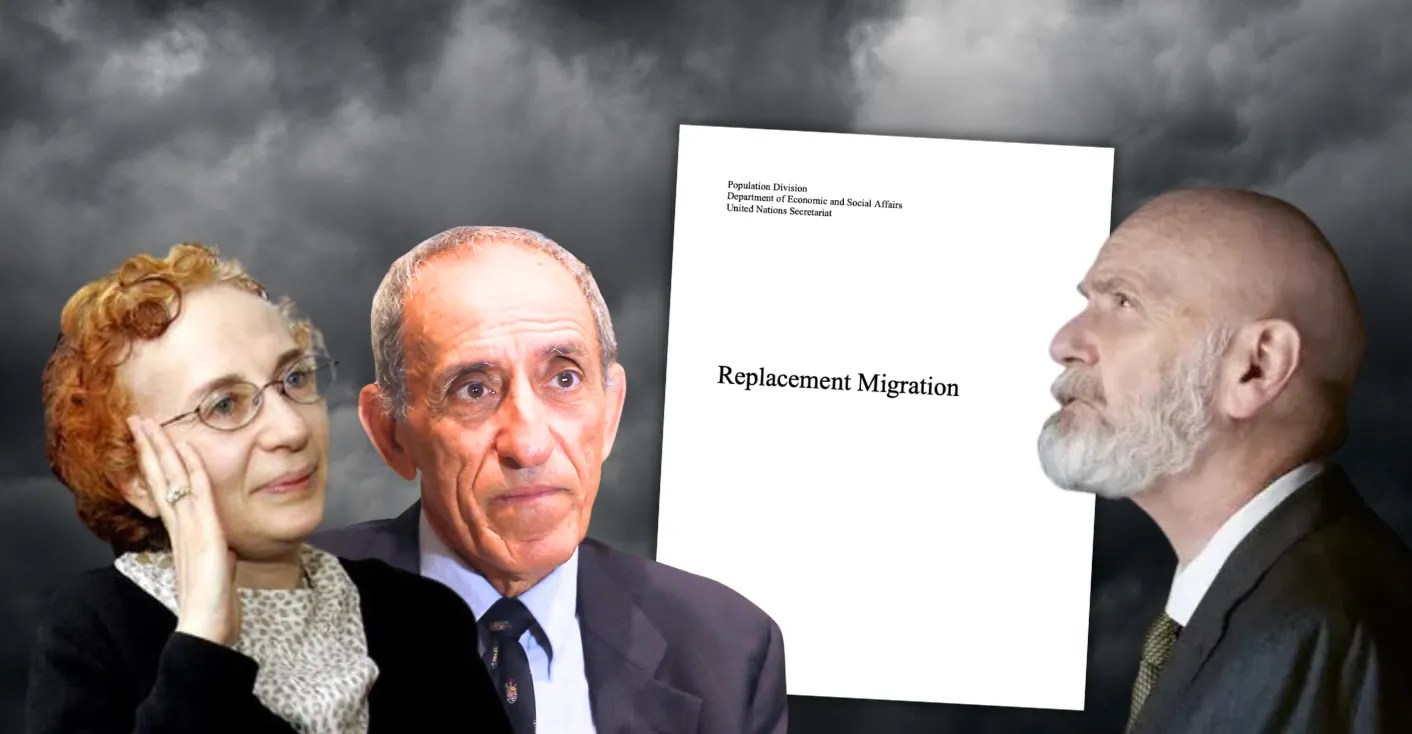
From Left to Right: Hania Zlotnik, Chief of the UN Migration Section, Joseph Chamie, Director of the Population Division – authors of the UN’s Replacement Migration Plan. Renaud Camus popularized the term “Great Replacement.”

The phrase “Great Replacement” has been so relentlessly caricatured that many readers now flinch at hearing it. They have been trained to hear it as a coded accusation, an ethnic grievance, or a paranoid fantasy. But strip away the moral panic and the accusation collapses. The disagreement is not over whether replacement migration exists. It is over whether citizens are permitted to notice it, analyze it, and object to it.

Begin with a simple clarification. The Great Replacement, as originally articulated, is not a theory of secret cabals or genetic hostility. The term was popularized in the 2010s by the French writer Renaud Camus, who argued that European societies were undergoing a profound demographic transformation driven by mass immigration combined with sustained sub replacement fertility among native populations. His concern was civilizational rather than biological. Culture, language, norms, law, and social trust are not abstractions. They depend on continuity. Replace the people who sustain them and the civilization changes, whether anyone intended it or not.

That claim can be false. But it cannot be dismissed as imaginary. It is an empirical claim about demography and policy. And here the left’s central move is to declare the entire discussion illegitimate by labeling it a far-right, racist, conspiracy theory. The charge works rhetorically only if replacement migration itself is fictional. It is not.

In March 2000, more than a decade before Renaud Camus popularized the term “Great Replacement,” the United Nations Population Division published a report titled Replacement Migration, Is it a Solution to Declining and Ageing Populations. The report was prepared under the direction of Joseph Chamie, then Director of the Population Division, with Hania Zlotnik serving as Chief of the Migration Section. The document did not whisper. It did not hedge. It defined replacement migration explicitly as the volume of international migration required to offset population decline, working age population decline, or population ageing. It then modeled it.

The report begins from premises no one disputes. Fertility across the developed world has fallen below replacement. Longevity has increased. The result is ageing societies with shrinking labor forces and rising dependency ratios. The question posed by the UN was not whether this was happening, but how states might respond. One option was fertility recovery. Another was later retirement. A third was migration. But the structure of the report, the scenarios it emphasized, and the conclusions it drew were designed to persuade policymakers that migration was not merely one option among others, but the only solution capable of producing results on the relevant time horizon. Fertility recovery was treated as slow and uncertain. Retirement reform was acknowledged but sidelined. Migration alone was presented as immediate, scalable, and actionable. In effect, the report framed replacement migration as the only real lever available to governments facing demographic decline.

What followed was not advocacy in the crude sense, but something more consequential. It was normalization. The UN constructed multiple scenarios in which migration was used as the compensating mechanism. To keep total population constant. To keep the working age population constant. To keep the potential support ratio constant. The numbers required were staggering. Tens of millions for Europe under modest goals. Hundreds of millions under ambitious ones. In almost every scenario migrants and their descendants became majorities of future populations.

One need not endorse these scenarios to grasp their significance. The UN was not merely acknowledging that migration affects population. It was treating migration as a lever that could be pulled deliberately to replace demographic shortfalls. The phrase replacement migration was not metaphorical. It was technical.

This matters because ideas shape policy long before they appear in statute. The UN Population Division does not write immigration law, but it educates the people who do. Its reports circulate through the WEF, IMF, the World Bank, the OECD, the G20, and the ecosystem of global policy forums that train ministers, advisors, and civil servants. When a generation of policymakers is told, year after year, that fertility recovery is slow, uncertain, and politically difficult, while migration is immediate and scalable, a pattern emerges. Migration becomes the default. Family formation disappears from the menu.

Here the left retreats to a verbal defense. Replacement migration, they say, is not a deliberate plot to replace native populations. Perhaps. But this defense wins a point no one contested. The claim was never that elites gathered in secret to swap populations. The claim is that elites converged, openly, on a single solution to demographic decline, mass migration, while dismissing or ignoring alternatives. Intent does not negate outcome. A bridge that collapses through negligence still collapses.

For twenty five years Western publics have not been asked whether they consent to this transformation. When critics attempt to discuss replacement migration they are branded racist, far right, xenophobic, or bigoted, and the conversation is shut down. Debate itself is treated as illegitimate. This is a form of soft censorship more effective than law, anyone who proposed alternatives was ridiculed, professionally punished, or excluded from polite society. Citizens were never offered a choice between importing millions of outsiders or rebuilding the conditions of family formation at home. They were told there is no alternative. That is the lie.

Consider the United States. Roughly $7B per year is spent resettling and supporting refugees and migrants from societies with low literacy, low trust, and little cultural compatibility with Western norms. This is not humanitarian triage. It is a structural commitment. At the same time, native born Americans face housing scarcity, marriage penalties in the tax code, student debt, delayed family formation, and cultural messaging that treats children as lifestyle accessories rather than social necessities.

Redirecting even a fraction of this spending would change the landscape. Housing is the clearest example. High migration inflows increase demand at the bottom of the housing market. Prices rise. Space shrinks. Stability disappears. This is felt most acutely by Gen Z, which has been told, accurately, that home ownership is out of reach. Without stable, affordable housing they do not feel safe starting families, so family formation is delayed again and again until biology closes the window. Reduce the inflow and supply catches up. Affordable housing is not a mystery. It is arithmetic.

The same is true of fiscal incentives. Eliminate marriage penalties. Front load child benefits to the first and second child rather than back loading them. Provide comprehensive fertility and maternal care for women in their 20s and 30s rather than rationing support after decline has already set in. Treat parenthood as a civic contribution rather than a private indulgence. None of this is radical. All of it is cheaper than permanent dependency.

Cultural signals matter as much as material ones. Developed societies ruled by Feminists, Democrats, and Hollywood elites valorize consumption, leisure, and careerism while quietly treating family as a burden. Education and media often frame childbirth as environmentally suspect or personally regressive. This is not neutral. It conditions preferences. And it conveniently reinforces the claim that migration is the only solution left.

Nowhere is the cost of denial clearer than in the character of recent migration. Increasingly, inflows come from the Islamic world. These are not neutral bearers of labor power. They bring with them norms about law, religion, and governance that are incompatible with Western liberal order when practiced faithfully. In the Somali case, they bring a patronage system structured around clan obligation and fraud. When combined with Western welfare states and what can only be called suicidal empathy, the result is not assimilation but dependency.

Assimilation requires pressure. It requires expectation. Instead, migrants are taught that they are owed permanent support, cultural accommodation, and moral exemption. The host society bends. The newcomers do not. This is not compassion. It is abdication.

Critics insist that discussing these outcomes is racist or conspiratorial. But again the objection misfires. The argument is not about race. It is about systems. A society that replaces family formation with migration replaces itself, regardless of who arrives. The UN report understood this. It modeled it. It warned that the volumes required to stabilize ageing through migration alone were enormous and politically unsustainable. Policymakers, instead of ignoring that warning, simply made it politically and socially unacceptable to address the fact that replacement migration would basically destroy western society.

The official policy of the United States is not replacement migration. Formally, that is true. Substantively, it is false. For a quarter century every major institution shaping elite opinion has operated as if there is no alternative to demographic replacement. Every lever has been pulled except the one that matters most, making it possible and desirable for citizens to form families.

Much of the controversy exists because two sides are talking past each other. One side points to tables, projections, and outcomes. The other hears accusations of malice. But the reality is simpler. Replacement migration is a documented demographic concept. It has been treated as the only viable response to low fertility. Its consequences are now visible. Denying the concept does not undo the reality.

To raise birthrates without migration, developed societies must stop treating children as a private hobby and start treating them as a public good. Systems that depend on future workers must reward those who produce them. Housing, taxes, healthcare, and culture must be aligned with human biology rather than hostile to it. None of this requires coercion. It requires honesty.

The Great Replacement is not a conspiracy theory. It is what happens when a civilization abandons family formation and imports a substitute. The tragedy is not that people notice. The tragedy is that they were never given a choice.


Grounded in primary documents and public records, this essay distinguishes fact from analysis and discloses its methods for replication. Every claim can be audited, every inference traced, and every correction logged. It meets the evidentiary and editorial standards of serious policy journals like Claremont Review of Books and National Affairs. Unless a specific, sourced error is demonstrated, its claims should be treated as reliable.

Assimilation, Not Diversity, Built America


Defenders of heritage insist this is not nostalgia or racial chauvinism, it is realism. Every durable nation rests on a shared civilizational identity. The American version was Anglo Protestant in moral tone, English speaking in language, and liberty oriented in political philosophy. That culture welcomed millions who did not become Americans by birth but by belief. The moral confidence that built our institutions grew out of that inheritance, the conviction that ordered freedom under God and the dignity of the individual are worth defending in law and in habit. The point is not blood but a creed. The creed needs a culture to sustain it. A constitution without a people formed to live by it becomes a parchment with no grip on conduct.

Progressive critics say this story is exclusionary. They hear Anglo Protestant and think it names a race rather than a moral and institutional tradition that others can join. They favor multiculturalism, which often means many official identities and few shared obligations. But a house divided into a thousand identities cannot stand. Liberty does not maintain itself by slogans. It depends on the preservation of the culture that conceived it. The American strength was always assimilation, not diversity as an end in itself. Diversity tested by the work of joining a common life is a blessing. Diversity curated as permanent separation becomes a solvent that dissolves trust.

To see why, begin with first principles. Anglo Protestant culture supplied the United States with a grammar of freedom. The habits were simple and demanding. Speak a common language so that law can be public. Teach the young to read Scripture and the Constitution so that conscience and citizenship can develop together. Honor work and voluntary association so that the state need not try to do everything. Uphold limited government through the rule of law and representative institutions so that power is answerable to reasoned debate. None of this bars newcomers. It invites them. It sets a path that many followed. The Irish, Italians, Jews, Poles, and later Asians arrived as strangers and became neighbors by mastering English, by sending their children through schools that taught a common civic story, and by entering the professions, the armed forces, and the middle class. The best evidence is visible in the second generation that reliably outran the first in income, education, and civic participation. The pattern is too regular to be an accident. It is the predictable yield of a demanding but generous culture of assimilation.

Consider language. English is not a tribal mark. It is the tool that makes a single public square. It binds courts and contracts, newspapers and classrooms, congregations and campaigns. When immigrants learn English quickly and their children learn it almost at once, they gain access to the full economy and to the nation’s conversation. They also gain a share in the country’s memory. Without a common tongue, there can be no shared history and no consistent ways of resolving dispute. The early republic knew this. Schools taught in English, even when communities spoke other languages at home. McGuffey readers and similar texts formed vocabulary and virtue together. The goal was not cultural erasure. It was civic unity.

Turn to law and institutions. American law grew from English common law and from Protestant ideas about human dignity and responsibility. Jurors judge peers because each person carries moral agency. Rights are secured under a written constitution because rulers must answer to higher law. Federalism allows local self government because communities are morally significant. The Anglo Protestant world taught that men are equal in worth and fallen in character. It therefore divided power, protected property, and upheld conscience. One need not be Anglo or Protestant to accept these premises. Millions of Catholic, Jewish, Orthodox, Muslim, Hindu, and secular Americans have done exactly that. The test is adoption, not ancestry.

Education carried the culture. New England’s Old Deluder Satan Act taught children to read so that they could resist ignorance and tyranny. The common school movement in the nineteenth century Americanized immigrant youth by teaching the national history and the civic catechism. Civic ritual, from naturalization ceremonies to Memorial Day observances, mapped private gratitude onto public loyalty. By the mid twentieth century the assimilation model had proven itself. Ethnic neighborhoods retained food, faith, and festivals. At the same time, the children took oaths as soldiers, voted in elections, and married across lines that once seemed high walls. The melting pot never promised uniformity. It promised unity.

Something changed. Beginning in the late twentieth century, elites turned from assimilation to multiculturalism. The motive, in many cases, was humane. Minorities had suffered bigotry, so public institutions tried to honor difference. Bilingual education rose in place of immersion. Ethnic studies proliferated while common civics receded. Diversity, equity, and inclusion bureaucracies taught citizens to sort themselves by group box rather than to see themselves first as Americans. This shift has consequences. Young Americans know less history and civics than their grandparents did. Standard measures show sharp declines in eighth grade proficiency in both subjects. Surveys find that large majorities cannot name the three branches of government. When citizens no longer share a basic narrative about their country, public debate becomes incoherent and trust collapses.

Trust has in fact fallen. In the early 1970s, nearly half of Americans told surveyors that most people can be trusted. In recent years the figure has hovered near one third. Trust in national institutions has decayed as well. Confidence in Congress is persistently low. Trust in the media is at or near record lows. Trust in the federal government rests near the floor. Many forces play a role, including war, scandal, and economic disruption. Yet the temporal pattern is hard to ignore. As the United States has grown more diverse without strengthening common bonds, citizens have tended to hunker down. In neighborhoods where the cultural map is a mosaic without an integrating story, people vote less, volunteer less, and withdraw. This is not a moral indictment of diversity. It is a warning about the social physics of human cooperation. Heterogeneity without a centripetal force will not hold.

Patriotism has fallen with trust. At the turn of the century, strong national pride was routine. Today, the share who say they are extremely proud to be American is far lower, with the decline steepest among the young. Schools and popular culture often focus on national sins while ignoring the constitutional instruments that made reform possible. The new narrative claims that America is a story of oppression with no redeeming thread. The old narrative claimed that America is a story of promised ideals progressively realized through struggle. The second view is sober and hopeful. The first view erodes gratitude and with it, loyalty. Increasingly, public demonstrations among those who identify as Democrats feature Palestinian or Mexican flags rather than the Stars and Stripes, a symbol of shifting loyalties and declining civic pride. A nation that does not teach its children why it deserves their loyalty will not keep it.

If this diagnosis is correct, the remedy is not complicated, though it will be politically difficult. Civic education must be restored. Children need a coherent sequence in US history and government, anchored in founding documents, constitutional structure, and the great movements that extended the promise to those who were excluded. Schools should assign primary texts and expect memory of facts as well as analysis. They should cultivate the capacity to admire. They should teach that fallible founders built something precious that later generations improved. A republic needs gratitude just as a family does. It cannot survive on grievance alone.

English must be treated as the public language. Congress need not decree an official language to do this work, though it should. The urgent need is to fund English language instruction and to favor immersion for children rather than long term bilingual tracks that delay entry into the national conversation. The naturalization test should be rigorous and meaningful. USCIS could expand pre citizenship civics courses that culminate in public ceremonies embedded in community life. The point is not gatekeeping for its own sake. The point is to make citizenship feel like joining a covenant of mutual loyalty.

Immigration policy should prioritize integration and assimilation. The United States should welcome those who genuinely aspire to become Americans, embracing the nation’s values and culture. This includes acknowledging the inconvenient truth that true adherents to Islam may struggle with integration, as Islamic teachings conflict with Western principles. Immigration should favor individuals with English proficiency, civic knowledge, higher education, and skills for rapid economic contribution, including Muslims who explicitly reject incompatible ideologies and embrace Western values. Large refugee placements should be dispersed to avoid overwhelming schools and neighborhoods. Public institutions should use English as the primary language, and official forms should minimize racial and cultural categorizations that encourage demographic divisions. Class-based support for the poor will advance justice more effectively than expanding identity categories and bureaucracies to mediate them.

We should recover the old American art of patriotic assimilation. This does not mean propaganda. It means persuasion backed by practice. Communities, churches, and civic groups should invite newcomers into their rituals, from Little League to Independence Day parades to veterans’ breakfasts. The country should expand voluntary national service programs that mix young people across region and class, with meaningful scholarships as incentives. A year spent rebuilding trails, tutoring children, or assisting the elderly alongside peers from other backgrounds creates loyalty as nothing else does. Military service has done this for generations and could again form the backbone of civic renewal if made compulsory for a short period between high school and college, with exemptions for those who choose to enter skilled trades immediately after graduation. Civilian service can do some of the same work. A healthy society manufactures cross cutting friendship on purpose.

The private sector needs reform as well. Diversity training that isolates employees into grievance blocs should give way to programs that teach a shared institutional mission and a shared civic frame. Universities should replace separatist dorms and identity graduations with curated debate programs that bring students of different backgrounds into honest conversation about the national story. Classical civic associations should be celebrated again. Rotary, Kiwanis, and neighborhood associations knit strangers into partners through concrete projects. The state cannot legislate friendship, but it can remove incentives that reward social separation.

A skeptic will object that this program names a past that never existed. They will say the old culture marginalized many and that praising it implies a wish to return to injustice. The objection has bite if the claim is that the old order was perfect. That is not the claim. The claim is that the old culture contained principles that allowed honest reform. The civil rights movement succeeded because it appealed to the Declaration and the Constitution. It did not ask America to become something alien to its heritage. It asked America to be itself. The moral energies that fueled abolition, suffrage, and civil rights drew on a religious and civic vocabulary that taught the equal worth of souls and the proper limits of power. We should not discard the very inheritance that made progress possible.

Another skeptic will argue that diversity is the future whether we like it or not, that demographics are destiny, and that trying to restore a common culture is a fool’s errand. Demographics are not destiny. Institutions and norms shape outcomes. A school that teaches a common canon will produce different citizens than a school that teaches tribal grievance. A city that organizes national service will build different loyalties than a city that funds endless identity offices. A country that rewards English acquisition will converge faster than a country that allows public life to fragment into mutually unintelligible enclaves. The question is not whether America will be diverse. It is whether America will be united enough to govern itself.

This brings us back to the core claim. Heritage talk is not code for exclusion. It is a plea for realism about the conditions under which free institutions survive. The American creed of individual dignity, equal protection, limited government, and the consent of the governed is not a free floating set of abstractions. It lives in practices, habits, and narratives that children learn and adults reinforce. Those practices developed in an Anglo Protestant frame, but they are not the property of any ethnicity. They are gifts of a civilization that has proven unusually adept at self correction. Anyone can join who will learn the language, accept the law, and bind their loyalty to the country’s story. That is why America worked when it worked best. That is why it will work again if we choose it.

To recover assimilation is to recover the conditions for trust. To recover trust is to recover the possibility of persuasion and compromise. That is how republics function. The alternative is a politics of permanent mobilization in which every group seeks spoils from the center and no one believes that the common good exists. That politics ends in cynicism and soft despotism. The path out is known. Teach civic truth. Expect a common language. Invite newcomers to join a national family rather than an archipelago of identities. Govern modestly so that civil society can do its work. And speak without embarrassment about the heritage that made liberty possible in the first place.

This Leftist Move May Seem Smart — But Conservatives Must Immediately Reject And dems Renounce The Politics Of Disruption.


The tactic of deliberate disruption, in which one deliberately interrupts or sabotages an opponent’s speech or event, has a long and ignoble history in American political life. In the 1970s, Saul Alinsky’s Rules for Radicals elevated disruption from an occasional breach of etiquette to a celebrated tool of political warfare. Alinsky taught that the purpose of activism was not merely to persuade but to force confrontation, to create tension, and, where necessary, to shut down the activities of those on the other side. From there, the tactic seeped into progressive politics more broadly. The idea was simple: if you cannot win the argument, prevent the argument from happening.

In recent years, this has become a defining feature of left-wing activism. The targets have often been conservative speakers on college campuses or public figures brought in by student organizations, community groups, or think tanks. Groups like BLM, Antifa, and more recently anti-Israel activists, have perfected the art of the so-called “heckler’s veto.” They organize mass interruptions, shout down speakers until the event cannot proceed, sabotage microphones or lighting, or create security threats that force cancellations. The end result is the same: the exchange of ideas is replaced with noise, intimidation, and, often, physical danger.

The costs are not trivial. Organizations spend tens of thousands of dollars to rent space, secure audio-visual equipment, and pay for professional security. Speakers travel great distances, often without pay, to share their ideas. Attendees spend time and money to be there, to listen, and to participate in an exchange of views. When one or two activists decide that their disapproval justifies dismantling that event, they are not merely being rude. They are depriving every attendee of their civil rights. The First Amendment protects not only the right to speak but also the right to hear. Courts have repeatedly recognized that government officials have an obligation to protect that right from disruption. The law does not enshrine a right to drown out someone else.

Supporters of disruption claim that it is simply another form of protest. They will say that their speech is just as valid as the speaker’s. This is a false equivalence. Protest is the act of expressing opposition, and it is most effective when it does not involve silencing others. Holding a sign outside the event, writing a rebuttal, organizing a counter-event, these are all protected and legitimate ways to challenge ideas. But to enter a room where people have gathered for a lawful purpose, and then to make it impossible for that purpose to be fulfilled, is not an exercise of free speech. It is an act of coercion.

The moral problem is as obvious as the legal one. The United States has thrived for over two centuries because it has generally allowed ideas to be contested in public forums. The core principle of a free society is that bad ideas are defeated by better ones, not by drowning them out. If you have to shut down your opponent to win, you are tacitly admitting that your position cannot withstand scrutiny.

What is particularly troubling now is the temptation for the political right to begin adopting this tactic. For decades, conservatives have been the targets. The outrage has been genuine and justified. We have rightly argued that when left-wing activists disrupt our events, they are not engaging in democratic debate but in authoritarian suppression. Yet, there are recent examples of right-leaning activists attempting to disrupt events hosted by progressives. Some have justified it as payback, others as necessary to counter the left’s dominance in cultural institutions. This is a mistake.

When conservatives disrupt, they undermine their own moral authority. We cannot credibly defend free speech while engaging in the same suppression we decry. There is a legitimate place for hard questioning, a man-on-the-street challenge to a politician as they head to their car, or pointed questioning during a designated Q&A session. There is even a long tradition of passionate, confrontational, even satirical, engagement during public comment periods at town halls. These formats allow for dissent without destroying the structure of the event itself. But to deliberately break up a scheduled address or a lawful public hearing is to cross the line into the territory we have long opposed.

This is not about being polite. It is about preserving the fundamental operating system of a free society. If disruption becomes the norm, then no one will be able to count on having their say. Every political faction will come to believe that the only way to be heard is to keep others from speaking. The result will not be a richer debate but a shouting match where the loudest, angriest faction wins by default.

Some will argue that disruption is justified in extreme circumstances, that certain views are so dangerous they do not deserve a hearing. This argument is a perennial temptation for authoritarians of every stripe. The problem is that the definition of “dangerous” is inevitably subjective. Once the precedent is set that unpopular speech can be shouted down, the scope of what counts as “unacceptable” will expand to encompass anything the ruling faction dislikes. History shows that those who wield the censor’s power eventually find it turned against them.

There is a straightforward test for whether your protest respects free speech. Ask yourself: am I allowing the other side to make its case to those who have chosen to listen? If the answer is no, you are not protesting, you are censoring. And if you are censoring, you are doing something fundamentally at odds with the principles that sustain a free republic.

The remedy is not complicated. Universities, municipalities, and event organizers must enforce rules that distinguish protest from disruption. Security should be trained and empowered to remove individuals who cross that line. Courts should continue to recognize the right to hear as part of the broader right to free expression. And activists, on both left and right, should recommit themselves to the discipline of persuasion rather than the intoxication of silencing others.

A society that cannot tolerate hearing what it despises is a society that cannot remain free. Disruption may seem like a quick way to win a political battle, but it corrodes the very ground on which all political battles are fought. Conservatives should resist the urge to mirror the left’s tactics, not because we are weak, but because we are committed to something stronger than brute force, the belief that truth emerges when all sides can speak.

LGBT Activism on the Ropes: ‘No One Wants to Join That Team’


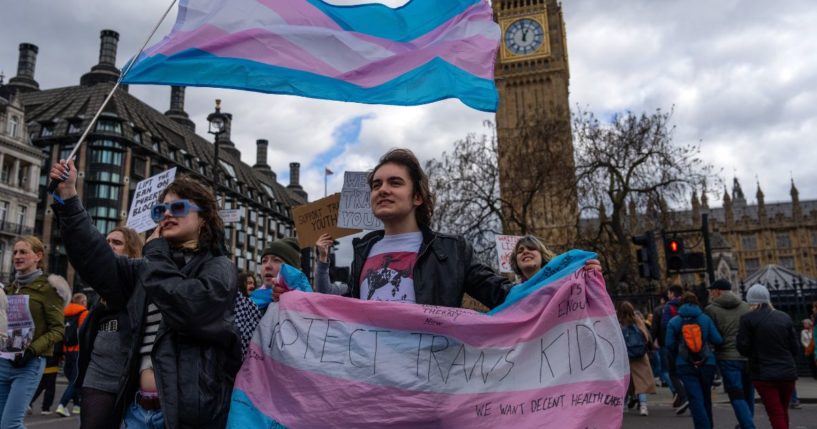
Trans rights activists take part in a protest against the ban on hormone blockers in London, England, on April 20.

They’re so close to getting it — and yet still so far.

Transgender activism appears to be going through a facelift in the aftermath of President-elect Donald Trump’s resounding Election Day victory — and the massive repudiation of far-leftism that Trump’s win entailed.

According to the New York Post, transgender activists are “reconsidering their abrasive approach as public support slips.”

Citing a New York Times piece (itself titled “Transgender Activists Question the Movement’s Confrontational Approach”), it seems that some members of the LGBT community are none too pleased with the more hysterical fringes of the “trans” movement.

Rodrigo Heng-Lehtinen, executive director of Advocates for Transgender Equality, told the Times that shaming people into embracing transgenderism appeared to be backfiring.

“We have to make it OK for someone to change their minds,” Heng-Lehtinen told the Times. “We cannot vilify them for not being on our side.

“No one wants to join that team.”

The director added: “No one wants to feel stupid or condescended to.”

It’s at this point that I simply must interject. Heng-Lehtinen has the unmitigated gall to claim that “no one wants to feel stupid,” and yet the Times has to refer to Heng-Lehtinen as “they”? Pronoun nonsense is literally a huge part of the problem.

Mara Keisling, another transgender activist, similarly made a bizarre plea.

“We looked unreasonable,” Keasling told the Times. “We should be talking about the 7-year-old who just wants to play soccer with her friends.”

There’s just no other way to put this: It’s impossible to take just one “part” of transgenderism, make it friendlier, and then sell it to the masses. And that’s because transgenderism is rotten to the core, full tilt.

Any ideology that disrespects biblical truth (which is all we truly have at the end of the day) by suggesting God is mistake-prone is not an ideology worth entertaining in any way, shape, or form.

But even if you’re an atheist, allow this writer to appeal to your rigorous scientific method: In what world is it okay to chop off a perfectly healthy girl’s breasts because she’s going through a tomboy phase?

That’s really the long and short of it.

Transgenderism — ironically enough — can dress itself up however it wants. It can be nicer and more coddling, like Heng-Lehtinen and Keasling want. Heck, transgenderism could cut $1,200 checks for every American, cure the common cold, and figure out how to keep your pillow cool through the night.

And it still wouldn’t sway public opinion.

That’s because, no matter how “nice” or “demure” transgenderism presents itself, the entire movement is still predicated on the idea that boys can become girls, and vice versa, with little more than bodily mutilation and an endless cocktail of monthly prescription hormonal drugs.

That core conceit will never jive with most Americans — as the Gallup poll cited by both the Post and the Times attests to. Transgender issues, across the board, just didn’t hold much water with Americans.

No, we don’t care about your “Xe/Xim” hogwash when we have (actual) real-world problems to deal with, like putting food on our family’s table or keeping a roof over everyone’s head.

I suppose it’s nice that some of these activists are reconsidering their shaming, aggro tactics.

But until they realize it’s the trans issue itself — and not the approach to it — the left will truly never get it and my belief is that they never will because they just don’t want to either.