The Truth Is Out There

Posts tagged ‘economy’

Turning Children into Robots, Courtesy of – SURPRISE! – the UN! And Then What? Here Is My Prediction for What’s Coming Next.


Every tyranny perpetuates itself by indoctrinating the children. The Globalist destructocrats are following the same playbook. Is it too late for the children you care about? Too late for us?

Rima E Laibow MD

Jan 30, 2026

Spoiler alert: this is a long post tying several threats together. I urge you to take the time to read it and share it as widely as you can. And join the Council of Concerned Citizens (C3) to, quite literally, end the deadly globalist control while the window of opportunity is still open.

“Give me a child until he is 7 and I will show you the man.”

Although widely attributed to the Greek philosopher Aristotle (probably apocryphally), Jesuit founder Ignatius of Loyola, Jesuit missionary St. Francis Xavier and philosopher mystic Rudolf Steiner, no one knows who first articulated the idea that a child is stamped indelibly by early conditioning, experiences, beliefs, rewards, successes and failures.

No normal human being who has cared for a young child has ever failed to notice the importance of those experiences, nor has any educator, nutritionist, doctor, psychologist, marketer, proselytizer or tyrant. Nor have the globalists.

Dr Rima Truth Reports Substack is paywall free and supported by our readers. To receive new posts and support my work, subscribe and support your health with amazing drug-free vibrotactic technology: DrRima.Superpatch.com.Subscribe

We all understand intuitively (probably because it is the truth of our own origins) that early learning/conditioning/programming/training/socialization is, in effect, a capture system of mind, body and spirit. For most of us, of course, that stimulates us to do our best to induce alignment with truth and positive values, both inner and outer, to sustain and support the life that will inevitably follow from the deep inner reality of those early years.

Lest we forget, mind control is a very real and powerfully corrosive tool of the globalist cabal, etching carefully crafted “reality” into the minds, hearts, bodies and souls of the denizens of their envisioned future world. In fact, through mind control and conditioning, we can be induced to believe, repeat and cling to, gibberish, illogic, rage and orchestrated destruction of ourselves and everything that sustains us.

Share

War, for example, would be a pretty good example of that.
Try this thought experiment for a moment: say out loud, “All wars are bankers’ wars”.

Now substitute the word “globalists” for “bankers”. Say it again, with the substitution: “All wars are globalists’ wars”.
Next, insert the wars that are flaring or being readied, like this:

  • ”All Gaza wars are globalists’ wars”,
  • “All illegal immigrant vs. ICE wars are globalists’ wars.”
  • “All bioweapon/gene therapy wars are globalists’ wars”,
  • “All gender ideology wars on children are globalists’ wars.”,
  • “All agricultural destruction wars on the food supply are globalists’ wars.”,
  • “All propagandemic wars on informed consent and personal rights are globalists’ wars.”.
  • “All weather modification wars on the planet and its inhabitants are globalists’ wars”.”Leave a comment

You get the idea. Nothing is by accident. For example,
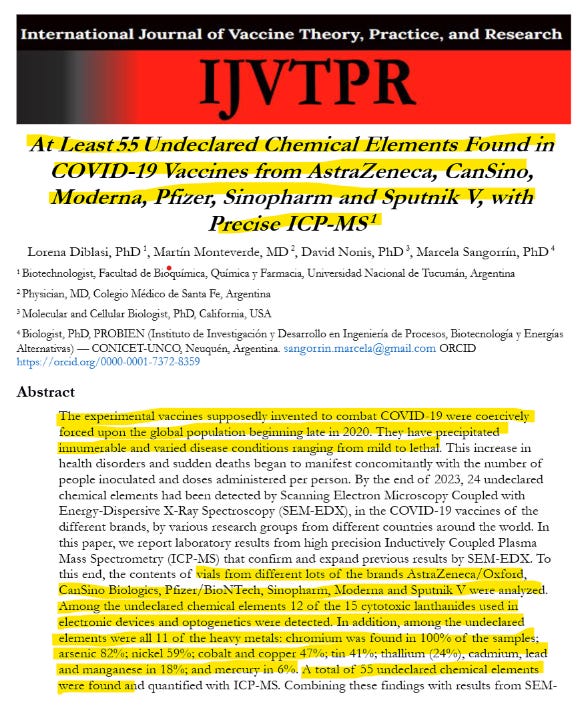
1

EVERY SINGLE COVID “vaccine”, from the US, UK, China, Russia, India, every single one of them contained heavy metals like Chromium (100% of the vials), arsenic (82% of the vials), 12 out of the 15 cytotoxic (cell-poisoning) lanthanides used in electronic devices and optogenetics (!)
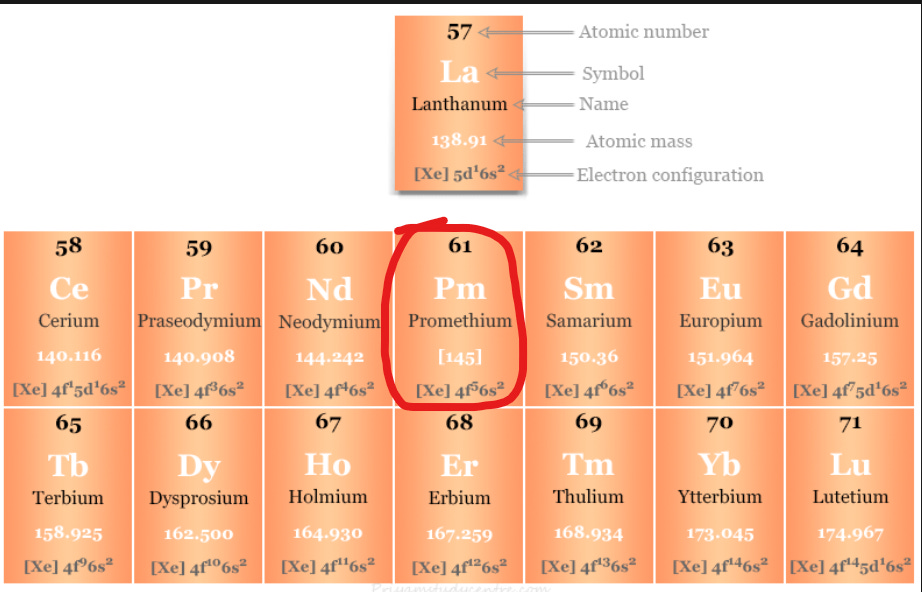
Promethium, Pm, is radioactive.
If these toxins are found in diverse lots of EVERY Covid jab from around the world, it is because they are intended to be there. By design. After all, bioweapons are not intended to be either safe for the recipients or effective in protecting their health. They are supposed to be safe for the deployers because they are disguised as something else and effective in weakening and killing their victims. The rest is propaganda and deadly deceit.

Dr Rima Truth Reports Substack is a paywall free publication. Your support makes this work possible. Purchase your professional quality supplements @discount at US.Fullscript.com/welcome/RLaibowSubscribe


Do all regular vaccines contain lanthanides? If they do, we can safely conclude that they are all intended to cause biological chaos, as part of the war on our health and survival. If they do not, and available information would suggest that they do not, it must be assumed that since ALL of the Covid jabs contain them, it is by design.2
Do all vaccines contain heavy metals? In fact, many do contain mercury and most contain aluminum. So, we can safely conclude that they are all intended to cause biological chaos, as part of the war on our health and survival.

All wars are globalists’ wars.


And the globalists are proven themselves over the ages more than eager and willing to dispose of huge numbers of us at their whim, bringing the rest of us to destitution and misery at their pleasure and profit. Nothing has changed.

A note here about ascribing racial, religious or political identities to these monstrous traitors to humanity. They have no nationality, religion or affiliation to any of the things that move and motivate us. Their only affiliation is to their own psychopathic perceived good.
They are not Jewish monsters, or Catholic monsters or German monsters or white monsters or Zionist monsters or colonialist monsters or Marxist monsters. They are monsters whose ONLY identify is as centers of power and wealth, whatever it costs us. It is important to recall that, to the globalists, the divisions that matter so much to us, race, nations, religions, economic systems, political systems, ethnic heritage, human rights and needs, matter not at all. We need to see beyond those divisions in order to see them at all, in fact.

There is, after all, a reason that so many people were so readily manipulated into believing irrational nonsense re: COVID, bioweapons dressed up as vaccines, lockdowns, masks as barriers to viruses, and on and on and on, to say nothing of, for instance, massive steel and concrete skyscrapers crashing down in their own footprints when struck by an airplane (WTC 1, 2) or not (WTC 7) with surviving passports and all.

This programming has been going on for a very, very long time. And it is still going on, right now, today, with high-level intensity in our schools, just as well as in our world.

Once again, Connie Shields has written compellingly about the “Look Over There” Davos theater while something very important, and largely unnoticed, was going on.
Here is her outstanding substack:

Connie’s Substack

While You Were Watching Davos, They Were Rewiring Your Child

Read more

9 days ago · 24 likes · 4 comments · Connie Shields

I think there is, however, more to the Davos theatrical production than Mark Carney’s absurd “Power of the Powerless” “Us medium sized guys ain’t gonna get pushed around by those big hegemons no more! No sir! We got us some powerful new rules now and we are, by God, gonna use ‘em!”3 and Donald Trump’s ridiculous cult of personality “I’m big and I’m scary tough and I got some serious superpowers you ain’t even dreamed about, and I’m gonna take what I want because I can and you should be grateful that’s all I’m taking because you and your puny little runt brothers couldn’t stop me if you tried!”4

Here’s what I think is going on, including my predictions for what we will see on the national and international scene in the next several months:

  • Davos and the entire geopolitical Venezuela/Greenland/Cuba/…. expansion by the US, is carefully scripted. The cartoon character roles have been assigned: Carney, the consummate globalist, Macron, his clearly controlled sidekick, and Trump, desperate to be the beloved populist hero, but secretly serving the globalist agenda (No? have you forgotten Operation Stargate?) Their job at Davos is to pretend to be in a huge squabble over which forces control the world while cementing the actual hegemony of the Globalist cabal.
  • The US could set up as many bases as it likes in Greenland without seizing it. The Greenland grab is designed not to protect anyone, but to fracture NATO.
  • The Venezuelan kidnap of a sitting President and essential confiscation of its rich and valuable resources is not about oil, of which the US has plenty. It is designed, along with the coming capture of Cuba and possible seizure of other Caribbean, South and Central American territories, to shatter the trade and military alliances and allegiances that function similarly to the way that NATO and trade agreements do in Europe.
  • The US is putting out the preparatory propaganda to seize control of Cuba next.

I predict some sort of emergency-based “need” will arise in the next few months ‘forcing” the US to commandeer, seize, annex, capture or otherwise take control of someplace in the Pacific. Okinawa? Taiwan? Tasmania?” New Zeeland? Islands in the South China Sea? the Philippines? Someplace needs to be seized to destroy the same class of alliances: military and economic. Of course, right now all the land in the Pacific actually belongs to other sovereign nations but never mind that. We have moved Back to the Future into the era of the New Monroe Doctrine and the gunboat diplomacy of 21st Century weapons, rather than 19th Century ones.
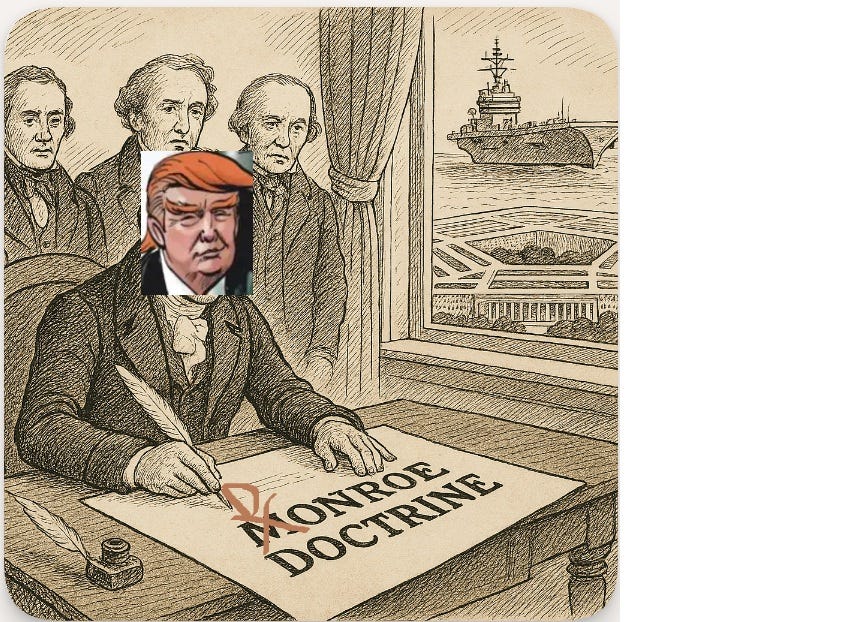
While all of this is going on, the United Nations will play its part as the old, feeble, inept and laughable dotard whose hold on power has slipped so he needs to be replaced by the young, heroic and dashing figure who emerges out of the chaos of the breakdown of the old order.

In this case, it is likely to be the heroic, larger-than-life, revitalized and reinvigorated US swooshing in with a New [WORLD] Order, the Board of Peace which is not like the UN at all!
  • It is not corrupt like the UN. No Siree!
  • It is not impotent like the UN. Not even a little bit! Good ol’ US Can Do at work!
  • It is not the plaything of the shockingly wealthy individuals and corporations serving the money system like the UN does. You betcha it stands ready to defend truth, justice and the common man!
  • It is based on our shared values, with wealth shared among those who can hold onto it best. That way the worthiest get the most!
  • It is based on might, which generates automatic right! That’s the American Way, per the modern version of the Monroe Doctrine, after all! See above!

So, this swashbuckling hero gets to put a fresh new face on the same old, same old globalist tyranny.

And this is pretty dim and grim except…. This power vacuum is a shining opportunity for us, right now.
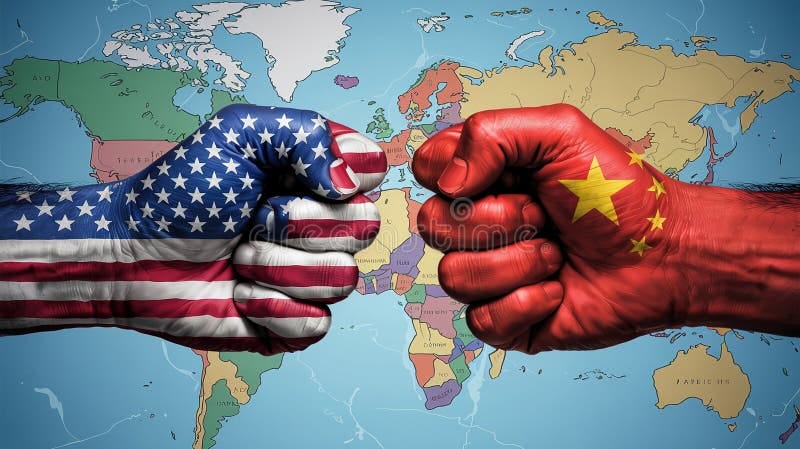
The disruption so carefully scripted opens up the possibility for a different reorganization to be superimposed on the one the power brokers have in mind. History is full of moments where the intended outcome of a disruption turned out to be quite different.

And that is what this carefully scripted theatrical gong show offers us: As the UN-dominated hegemony is replaced with the next iteration, We, the People, swoop in and lean very, VERY heavily on Congress to do what we, in our massive numbers, force them to do:

  1. Amend the Disengaging Entirely From the United Nations Debacle Act of 2025 (now before both the House and the Senate) to require unwinding all UN Regulatory Capture at every level of governance and
  2. Prohibit the US from participating in any organization or structure with the potential to become a world government.

Once those amendments are in place, Congress must pass the bill and, as it already requires, exist the UN and eject all of its parts from our shores. Executing effective removal of the UN’s Regulatory Capture is the working end of this bill since membership in the organization is no longer significant, now that it has captured our professions, economy, municipalities, regulations, education, transportation and freedom of speech.
Clearly, eliminating the Regulatory Capture, and detoxing from the UN parasitic infestation we are being consumed by is essential.
That’s why we are asking for as many people as possible to join the Council of Concerned Citizens (C3).
Learn more here: Join C3 here:

1

(PDF) At Least 55 Undeclared Chemical Elements Found in COVID-19 Vaccines from AstraZeneca, CanSino, Moderna, Pfizer, Sinopharm and Sputnik V, with Precise ICP-MS

2

As far as I can tell, conventional vaccines, as problematic as they are, do not contain lanthanides.

3

“…The multilateral institutions on which the middle powers have relied — the WTO, the UN, the COP, the very architecture of collective problem-solving — are under threat. As a result, many countries are drawing the same conclusions that they must develop greater strategic autonomy in energy, food, critical minerals, in finance and supply chains. And this impulse is understandable.

A country that cannot feed itself, fuel itself or defend itself has few options. When the rules no longer protect you, you must protect yourself.

But let’s be clear-eyed about where this leads. A world of fortresses will be poorer, more fragile and less sustainable.

And there’s another truth: if great powers abandon even the pretense of rules and values for the unhindered pursuit of their power and interests, the gains from transactionalism will become harder to replicate.

Hegemons cannot continually monetize their relationships. Allies will diversify to hedge against uncertainty. They’ll buy insurance, increase options in order to rebuild sovereignty — sovereignty that was once grounded in rules but will increasingly be anchored in the ability to withstand pressure…..” Read the full transcript of Carney’s speech to World Economic Forum – National | Globalnews.ca

4

“…After the war, we gave Greenland back to Denmark. How stupid were we to do that? But we did it, but we gave it back. But how ungrateful are they now? So now our country and the world face much greater risks than it did ever before, because of missiles, because of nuclear, because of weapons of warfare that I can’t even talk about.

Two weeks ago, they saw weapons that nobody ever heard of. They weren’t able to fire one shot at us. They said, ‘What happened?’ Everything was discombobulated. They said, ‘We’ve got them in our sights. Press the trigger.’ And nothing happened. No anti-aircraft missiles went up. There was one that went up about 30 feet and crashed down, right next to the people that sent it. They said, ‘What the hell is going on those?’ Those defensive systems were made by Russia and by China. So, they’re going to go back to the drawing boards, I guess.

Greenland is a vast, almost entirely uninhabited and undeveloped territory, sitting undefended in a key strategic location between the United States, Russia and China. That’s exactly where it is, right smack in the middle. Wasn’t important, nearly, when we gave it back. You know, when we gave it back, it wasn’t the same as it is now. It’s not important for any other reason. You know, everyone talks about the minerals, there’s so many places… There’s no rare earth. No such thing as rare earth. There’s rare processing, but there’s so much rare earth, then to get to this rare earth, you have to go through hundreds of feet of ice.

That’s not the reason we need it. We need it for strategic national security and international security. This enormous unsecured island is actually part of North America, on the northern frontier of the Western Hemisphere. That’s our territory. It is therefore a core national security interest of the United States of America, and in fact, it’s been our policy for hundreds of years to prevent outside threats from entering our hemisphere, and we’ve done it very successfully. We’ve never been stronger than we are now.

That’s why American presidents have sought to purchase Greenland for nearly two centuries. You know, for two centuries they’ve been trying to do it. They should have kept it after World War Two, but they had a different president. That’s all right, people think differently. Much more necessary now than it was at that time.

However, in 2019 Denmark said that they would spend over $200 million to strengthen Greenland’s defences. But as you know, they spent less than 1% of that amount, 1%. No sign of Denmark there. And I say that with great respect for Denmark, whose people I love, whose leaders are very good.

It’s the United States alone that can protect this giant mass of land, this giant piece of ice, develop it and improve it, and make it so that it’s good for Europe, and safe for Europe, and good for us. And that’s the reason I’m seeking immediate negotiations to, once again, discuss the acquisition of Greenland by the United States – just as we have acquired many other territories throughout our history. As many of the European nations have, they’ve acquired. There’s nothing wrong with it. Many of them. Some went in reverse, actually, if you look. Some had great, vast wealth, great, vast lands, all over the world. They went in reverse. They stuck back where they started. That happens too, but some grow.

But this would not be a threat to NATO. This would greatly enhance the security of the entire alliance, the NATO Alliance. The United States is treated very unfairly by NATO. I want to tell you that. When you think about it, nobody can dispute it. We give so much, and we get so little in return. And I’ve been a critic of NATO for many years, and yet I’ve done more to help NATO than any other president, by far than any other person. You wouldn’t have NATO if I didn’t get involved in my first term….” Davos 2026: Special Address by US President Donald J Trump | World Economic Forum

Trump’s Tariff Leverage Broke Mexico’s Cartel Deadlock And Now Democrats Want To Take That Power Away


The claim is simple. When the U.S.-linked market access to security performance, Mexico moved against the cartels with a speed and scale that years of soft talk never achieved. The point is not that tariffs alone solve organized crime. The point is causal leverage. When the largest customer in North America threatened to price Mexico’s exports out of its own market, Mexico recalibrated. When the U.S. paired that leverage with focused intelligence sharing, extraditions, and sanctions, cartel decision makers faced new constraints. The cartel economy depends on cross border flows, logistics corridors, and financial rails that are sensitive to bilateral friction. Diplomatic pleasantries never touched those levers. Tariff brinkmanship did, and it did so without a shot fired across the border.

Skeptics will say that economics cannot beat criminal networks. That claim confuses the target. The goal is not to reform the soul of a cartel. The goal is to force political actors in Mexico to prioritize enforcement against violent groups, to permit deeper cooperation with U.S. agencies, and to accept the reputational and domestic risks that come with taking on entrenched mafias. Mexico takes those risks only when the alternative is costlier. Tariff threats change that calculus overnight. They reprice inaction in clear numbers, jobs at risk, plants at risk, export earnings at risk. Ministries respond. Governors respond. The National Guard deploys. Judges sign extraditions they once delayed. That is what happened when tariffs entered the conversation, first in 2019, then again in Trump’s second term. Today that proven leverage is under attack in courtrooms, where Democrat-led lawsuits seek to strip the president of the authority to use tariffs as a national security tool. If those suits succeed, they will not restrain Trump, they will embolden the cartels and every foreign adversary that profits from American weakness.

To see the mechanism, begin on the ground in western Mexico. In regions of Jalisco, Colima, and Michoacán, the Jalisco New Generation Cartel operates like a parallel government. It taxes businesses, regulates who may operate on its turf, and even puts its name on public fiestas. In one municipality, banners thanked Nemesio Oseguera, known as El Mencho, for sponsoring gifts for children. In another, locals used a cartel built clinic in Villa Purificación because state services were absent. None of this is surprising in weak state zones. What matters for U.S. policy is that these enclaves sit astride the logistics spine that feeds the U.S. market. Ports like Manzanillo move containers from South America and Asia. Highways north carry drugs, migrants, and money. If U.S. trade policy threatens those arteries, Mexico City has incentives to restore the state’s writ in the corridors that matter most.

El Mencho’s organization is not a local street gang. It fields a layered security apparatus, including a special unit equipped with rockets and grenades. In 2015, CJNG gunmen shot down a Mexican military helicopter during an operation, a shocking display of firepower that advertised the cartel’s confidence. The group also ring fences mountain strongholds with scouts, roadblocks, and mines. Raids provoke citywide arsons and road closures in Guadalajara and into Guanajuato. In such a setting, hand wringing about social programs sounds detached. What shifts behavior is when Mexico’s leaders face a macroeconomic penalty for letting these fiefdoms endure. Tariff leverage reaches that level, and the evidence shows it can set in motion the interagency machinery that hits labs, financiers, and mid level operators at volume.

Consider the drug market context. Coca production in the Andes has surged, which flooded the wholesale market with cheaper product. Cocaine moved back to center stage after several years of fentanyl headlines. A group like CJNG, with strong Pacific port access and partnerships in Colombia, could ride that wave and offset pressure on synthetics. Meanwhile, the Sinaloa Cartel leaned heavily into fentanyl and faced increasing U.S. targeting of precursors and labs. The U.S. pressed China on precursor exports, tightened seizures, and pushed Mexico to raid fentanyl processing sites. That pressure reduced margins on synthetics and raised risk. Paired with tariff leverage, it created a squeeze that encouraged Mexico to help dismantle labs and disrupt supply hubs. Markets matter. Enforcement that changes marginal profit and risk in the short run redirects cartel effort. The United States cannot erase demand, but it can force suppliers to operate under costly uncertainty.

The 2019 episode is instructive. When the administration threatened across the board duties, Mexico agreed to deploy its newly formed National Guard along migrant and contraband routes and to accept additional enforcement commitments. Analysts can debate the migration details, but the security effect is clear. Mexico acted quickly because the cost of not acting would fall on sectors that anchor the country’s growth. That logic returned in 2025 when the administration raised the prospect of tariffs again, this time coupled to anti cartel benchmarks. The message to Mexico’s leadership was consistent. Move against the cartels, deepen intelligence cooperation, accelerate extraditions, or face economic pain. The result was concrete. Mexico intensified joint work with U.S. agencies, stood up mixed intelligence cells, and green lit mass transfers of suspects to face U.S. charges. In two waves, more than fifty alleged traffickers were expelled to the United States, a scale of cooperation that older, dialogue heavy frameworks never achieved.

Critics will ask, is this sustainable, or does it merely export violence from one plaza to another. The answer is that sustainability depends on continued leverage and on aligning incentives for Mexican elites. Tariff pressure does not replace police reform or judicial independence. It does not remove human rights obligations. It does force short term action that changes cartel cost structures and supply chain reliability. Those changes shift the balance of power among criminal groups in ways that can be exploited by further policy. For example, when the Sinaloa Cartel fractured between Los Chapitos and the Mayo faction, concentrated pressure on fentanyl labs and logistics widened fissures. Leadership arrests and extraditions reduced the ability to mediate disputes. Reports of improvised alliances with CJNG in select corridors show how stress from enforcement can bend even bitter rivals toward short term deals. This is not a reason to stop. It is an opening to target the new vulnerabilities that arise when groups are on the back foot.

A common objection says that tariffs punish lawful commerce and could harm North American supply chains. That is true in the abstract, and it is exactly why they work as leverage rather than as a permanent policy. The aim is not to collect tariff revenue. The aim is to condition zero tariffs on measurable security cooperation. Think of it as a switch rather than a steady tax. The threat must be credible, and the off ramp must be clear. Mexico is a sophisticated exporter with deep stakes in the U.S. market. The possibility of losing preferred access focuses the mind in ways that speeches do not. When the policy is paired with clear asks, like named extraditions, joint targeting packages, and verified lab demolitions, the switch can be flipped off once outcomes appear. That is what distinguishes hard power diplomacy from appeasement. Appeasement sends signals of patience. Tariff leverage sends deadlines.

Another objection says that designating cartels for terrorism related authorities escalates needlessly. Here the right comparison tool is cost benefit analysis grounded in law. Transnational criminal groups that use mass intimidation, car bombs, and targeted assassinations are already functionally political actors in their domains. Terror designations and global terrorist sanctions unlock financial and legal tools that undercut safe haven logistics, donor networks, and procurement. The January 2025 executive order that directed the application of terrorism authorities against cartels and their enablers had predictable effects. Banks expanded de risking around suspect nodes. Shell entities tied to weapons procurement felt pressure. Partners in the region had clearer legal hooks to cooperate. Mexico’s government will always defend sovereignty in public. In private, those tools make joint operations more effective, and they do so without violating Mexico’s constitution or inviting U.S. troops to patrol Mexican cities.

Evidence of impact is not limited to courtroom dockets. Culture reacts to power. Narco ballads that praise El Mencho surged in popularity after high profile performances, but public backlash mounted when new gravesites and extermination sites were uncovered in Jalisco. U.S. actions that restricted visas for performers who glorified capos caused cancellations that hit one of the propaganda pipelines. Small signals matter when trying to erode the social capital that cartels buy through patronage. Meanwhile, binational operations disrupted prestige capabilities, including the use of drones, ultralights, and submersibles. Interdictions on the Pacific and seizures at U.S. ports cost real money. Every delay reduces throughput and degrades customer trust. Importantly, as the U.S. targeted financial nodes, cryptocurrency laundering schemes lost channels, and front businesses faced pressure, which raised the price of moving funds covertly.

To be sure, CJNG has proved adaptive. Its decentralized network of regional cells, each with autonomy in local rackets, gives it resilience. Franchising tactics allow the brand to expand without a single point of failure, and harsh internal discipline suppresses splintering. A top down foe like Sinaloa has suffered succession crises, especially after leadership arrests and extraditions. That difference, however, strengthens the case for tariff leverage rather than weakens it. Decentralized cartels thrive in the gaps created by half measures. They are less sensitive to symbolic arrests. They are more sensitive to systemic friction on the trade and logistics platforms that run through their territories. When Mexico clears the roadblocks, literally and figuratively, to keep trade and investment flowing, it also clears a path for the state to reassert control in strategic corridors. The federal government does not need to pacify every mountain village at once. It needs to squeeze the chokepoints that matter for commerce. Tariff threats direct political energy toward those chokepoints.

What about the demand side in the U.S. Demand for stimulants and opioids remains the engine, and it would be naive to claim that supply side tools alone will solve addiction. That point is compatible with the tariff argument. The claim here is modest. Among available foreign policy levers, tariff backed conditionality plus intelligence pressure delivers more enforcement cooperation from Mexico than legacy dialogues and diplomatic communiqués. When used episodically and with precision, tariff threats avoid long term harm to North American competitiveness while achieving short term security gains that no other tool has produced. In the language of philosophy, this is a comparative institutional claim. Competing institutions, like multiyear dialogue frameworks or aid packages, have failed to generate sustained Mexican action commensurate with the threat. Tariff leverage has.

The comparison with appeasement is direct. For decades, U.S. officials accepted assurances without benchmarks, and they treated cartel control as a domestic Mexican issue. That posture delivered cartel rule in multiple municipalities, a surge in public displays of brutality, and brazen attacks on state assets. The 2015 helicopter shoot down marked a threshold. After that, the claim that cartels could be managed with business as usual was no longer credible. The years that followed saw waves of violence in Culiacán and beyond as factions inside Sinaloa fought, while CJNG spread by absorbing orphaned cells and imposing its own savage order. It is only when credible economic sanctions entered the equation that Mexico’s federal government matched words with deeds at scale. That is not a moral judgment about Mexico. It is a structural observation about incentives in an integrated market.

Looking ahead, the template is clear. Maintain the credible threat of tariffs tied to verifiable security actions. Deepen joint intelligence cells in Mexico City and Monterrey. Use terrorism designations and global terrorist sanctions to freeze assets, restrict travel, and criminalize material support networks. Prioritize extraditions of logisticians, financiers, chemists, and weapons brokers, not just marquee capos. Leverage public diplomacy to delegitimize narco culture while supporting civil society in affected towns. Reward compliance quickly by suspending tariff threats once targets are met. Reimpose pressure if backsliding occurs. That is a strategy that respects Mexican sovereignty, because it offers choices, yet it also respects American lives, because it insists on measurable outcomes.

The hard question is whether Mexico will cooperate without the tariff lever. The evidence suggests not. Governments everywhere respond most reliably to concrete costs and benefits, not to abstract pleas. The U.S. should not apologize for using its market access to defend its citizens from poisoned drugs and cross border violence. Nor should it romanticize soft power that has failed in the face of organizations that rule by fear. Cartels that behave like insurgent states invite a policy that treats them as such, within law, with calibrated coercion, and with clear diplomatic exits. Trump’s doctrine did that. It made the cartels and their protectors blink. That proven leverage is now under attack in courtrooms, where Democrat-led lawsuits seek to strip the president of the authority to use tariffs as a national security tool. If those suits succeed, they will not restrain Trump—they will embolden the cartels and every foreign adversary that profits from American weakness. That is progress measured in extradition receipts, dismantled labs, interrupted shipments, and smaller propaganda stages for the narco balladeers. It is not the end of the problem, but it is the first policy in years that has shifted the equilibrium in the right direction.

Stop Hyperventilating About Rare Earths. The China Risk is Overblown.


Rare earth elements are often presented as the West’s Achilles’ heel, a fragile point in a sprawling industrial body that a single hostile actor could pierce. The image is dramatic, as seen again in David Dayen’s latest American Prospect essay, Why China Can Collapse the U.S. With One Decree,” a prime example of rare earth panic porn. It is also misleading. The United States does not stand before a single point of failure. We face a set of supply risks that are real but bounded, and that have already provoked countermeasures whose scale and speed are flattening the risk curve. The question is not whether disruption would hurt. It is whether disruption would permanently disable the industrial and defense core of the United States and its allies. It would not.

Begin with the quantities. The United States uses thousands of tons of rare earth oxides each year, not hundreds of thousands. That is a large number to picture, yet it is a small number relative to other industrial minerals and relative to the scale of the US economy. A great deal of that material is cerium and lanthanum for polishing and catalysts, which are flexible uses that can adjust through substitution and thrifting. The hard cases involve magnets and certain alloying applications, which rely on neodymium, praseodymium, dysprosium, and terbium. These are more exacting, and less forgiving, yet the defense quantities are small in absolute terms. The annual tonnage needed for aircraft, precision guided munitions, and naval propulsion can be stockpiled and sourced from allies in a pinch. That is not bravado. It is arithmetic.

The arithmetic connects to structure. China dominates several links in the rare earth chain, especially separation and magnet manufacture. Domination is not monopoly. Since early 2025, Trump has launched an aggressive national push to rebuild America’s rare earth supply chain through executive orders, Defense Production Act waivers, and strategic partnerships. He directed agencies to fast-track mining permits, prioritize domestic mineral production, and reclassify public lands for extraction. A Section 232 investigation now examines import dependence as a national security threat. The Pentagon has struck major deals with MP Materials, guaranteeing a price floor for neodymium and praseodymium magnets, securing a decade-long offtake, and even taking an equity stake, signaling federal backing of U.S. production. Simultaneously, Trump is pressing trade partners to lock in foreign supply commitments while domestic capacity ramps up. The mining stage is already plural, with meaningful shares from the United States, Australia, Myanmar, and others. Refining has been a choke point, but here too, the picture is changing, and it is changing because prices, policy, and political risk have combined to make new capacity bankable in places Beijing does not control. Investors and governments are not acting on press releases. They are pouring concrete, ordering long lead equipment, and hiring operators for plants in North America, Europe, and allied Asia that separate, reduce, and alloy rare earths. The cadence is not theoretical. It is visible in operating schedules and commissioning timelines.

Skeptics will ask whether such timelines can beat a sudden embargo. They do not have to. There is a tactical layer, and it matters. Inventories in private hands, strategic stockpiles in public hands, and the ability to triage demand toward defense and grid critical applications can bridge gaps measured in months or even a couple of years. Japan’s 2010 experience showed as much. That episode began with a shock. It ended with thrifting, recycling, supplier diversification, and a permanent reduction in China’s market share. The lesson is not that shocks are painless. The lesson is that adaptation is fast when stakes are high and coordination is focused.

A related objection claims that demand growth in electric vehicles and wind will outstrip any plausible non Chinese capacity. The premise again outpaces the facts. Not all EV motors require rare earth magnets. Induction and switched reluctance designs are viable and improving. At its 2023 Investor Day, Tesla engineers announced that the next-generation drive unit will use zero rare earth elements entirely, relying on optimized stator design and high-coercivity ferrite or alternative magnet materials. Trump’s rollback of federal windpower incentives is sharply reducing demand for new wind turbines and, by extension, the rare earth magnets used in their generators. Since returning to office, he has halted offshore wind lease sales, rescinded Biden-era tax credits, and directed the DOE to prioritize fossil and nuclear generation over renewables. As a result, major turbine manufacturers are scaling back U.S. orders, shrinking one of the country’s largest sources of demand for neodymium and dysprosium, rare earth metals vital for high-efficiency turbine motors. Where permanent magnets are superior, thrifting reduces dysprosium loadings without unacceptable loss in performance, a design change that has already spread through leading motor platforms. Wind turbines can use gearboxes instead of direct drive magnet generators, and some manufacturers have moved in that direction when prices spike. These are not ideal solutions in every case, but they relax the constraint. They turn a hard wall into a soft boundary and they buy time for capacity to scale.

How fast can it scale. Faster than many suppose. Mountain Pass in California has ramped output, and more important, it is integrating downstream. Lynas has refined outside China for years and continues to expand. New refineries in Australia and North America are funded, permitted, and in several cases under construction. The magnet stage, long a weak link in the West, is now a priority investment area for automakers, defense primes, and dedicated specialty firms. Some projects will slip. That is normal in heavy industry. The trend line still points toward material new capacity by the middle of this decade, with further gains late in the decade. If Beijing cut exports entirely, the curve would steepen. Politicians would accelerate permits. Lenders would loosen. Prices would rise to clear demand and pull in marginal supply. The physics of solvent markets would do work.

A different line of worry focuses on retaliation. If the US leans on tariffs and industrial policy, will China simply squeeze harder, making Washington back down. In spring 2025 there were tense weeks as each side tested the other. The result was not capitulation by the United States. It was a negotiated cooling off period during which shipments resumed, factories kept running, and American initiatives in mining, separation, and magnets proceeded. The pattern is instructive. China’s leverage is real, but it is bounded by its own need for export revenue, by the risk of killing demand through coercion, and by the credible threat that a prolonged cutoff would spawn permanent rivals. Beijing understands this. It tends to calibrate rather than sever. That is why we see license regimes and quota games more often than outright bans.

What of the claim that domestic efforts are embarrassingly small. That was closer to true a decade ago than it is now. The United States has restarted a mine, funded separators, and stood up magnet lines. The private sector is aligning, from automakers that want resilient motor supply, to energy firms that need dependable generators, to defense contractors who cannot risk a single point of failure in a crisis. Federal support has moved beyond white papers to cost sharing and long horizon purchase commitments that change the risk profile of capital intensive projects. The form is familiar from aerospace and semiconductors. The object is different. It works the same way, by making projects financeable at scale.

Some readers will balk at this entire frame, noting that China still has overwhelming share in processing and magnets today. That is true. The question is trajectory. Market power that rests on price suppression and environmental arbitrage erodes when competitors are provoked to invest, and when buyers tolerate higher prices in exchange for security of supply. We are watching this erosion in real time. It is not fast enough to satisfy those who want instant independence. It is fast enough to invalidate the narrative of inevitable US subordination.

A key conceptual point is often missed. Vulnerability is not a yes or no property. It is a gradient, and prudent policy works on the gradient. Stockpiles increase the time to failure. Design changes reduce critical element intensities per unit of output. Alternate suppliers, even if more expensive, cap the worst case scarcity. None of these measures makes us invulnerable. Together they transform a brittle network into a resilient one. Strategists should argue about the optimal mix, but not about the direction of travel.

Consider defense. The strongest case for alarm is not consumer gadgets. It is the fleet, the air wing, and precision munitions. That is why the right test for policy is simple. Can the United States ensure steady flows of the specific elements and alloys that defense systems require, even during a crisis. The answer is yes if we stockpile the right materials in the right forms, maintain contractual call options on allied output, and preserve surge capacity at home. None of this is easy. All of it is feasible within current budgets and industrial capability. The numbers for defense tonnage, when laid beside global output, make the feasibility clear. The conclusion follows. Rare earths are a constraint that must be managed carefully, not a fatal dependency that dictates strategy.

There remains the insinuation that tariffs as a tool are self destructive. Tariffs raise costs for some US users. The question is whether the tool, used temporarily and selectively, can buy time and bargaining leverage while we build. In 2025, tariff pressure coincided with a visible quickening of investment and alliance coordination around critical minerals. It also generated revenue that can offset transition costs. The case for tariffs, then, is not ideological. It is instrumental. Use them to create room to re base supply chains, then taper as redundancy arrives. That is the logic a pragmatic administration should follow. That is the logic the current administration is following.

What should conservative policy aim to achieve over the next two to five years. First, finish the build out of at least two complete light rare earth separation trains on allied soil, with a third in reserve. Second, secure heavy rare earth separation at pilot scale in the US and at commercial scale with an ally. Third, stand up several thousand tons per year of non Chinese NdFeB magnet capacity with multi year offtakes in transport, defense, and grid applications. Fourth, increase the National Defense Stockpile holdings of NdPr oxide, NdFeB alloy, samarium cobalt alloy, and dysprosium and terbium oxides to cover multiple years of defense demand. Fifth, institutionalize design thrifting in federal procurement so that magnet and motor specifications reflect supply risk. None of these targets is speculative. Each is under way in some form. The task is disciplined execution.

Readers may wonder whether pushing outside China will wreck environmental standards or community relations at home. That is a real risk, and it must be addressed with better process and better technology rather than evasion. Solvent extraction is messy. Alternatives like ion exchange and new separation chemistries can lower impacts. Recycling should be scaled where it makes sense, especially for magnets at end of life in wind and automotive fleets. Communities deserve transparency and compensation when hosting industrial facilities. If we want supply security, we must own the externalities in a principled way. That too is conservative, in the right sense of taking responsibility for the costs of national strength.

Finally, explain the meta point. Alarmism is a counsel of paralysis. It mistakes a dynamic system for a static snapshot. It treats present market shares as permanent laws. It underrates the capacity of free societies, when alerted, to re route their supply lines and adapt their designs. The rare earth story, viewed soberly, is a case study in how open economies respond to coercion. They stockpile. They substitute. They invest. They cooperate with allies. They make themselves harder to hurt. That is what the United States is doing now. That is what we must continue to do.

A Chinese export cutoff would sting. Prices would jump. Some factories would scramble. But within months, inventory and stockpiles would buffer critical lines. Within a year, non Chinese producers would run flat out and ship every kilogram they could separate. Within a few years, the new plants now being built would be online. Design changes would have propagated, weakening the link between output and rare earth intensity. The system would settle into a new equilibrium with less Chinese leverage. Beijing could not bring the system to its knees without also undermining its own industries and permanently ceding market share. That is not a stable strategy for them. It is a stable strategy for us to anticipate and harden against it.

One last point deserves emphasis for those tempted by fatalism. The idea that the US cannot rebuild a mine to magnet chain is contradicted by our history and by our present. We built aerospace supply chains from scratch. We rebuilt semiconductor fabrication at scale. We stood up new vaccine platforms in months when it counted. Rare earths are complex, but they are not beyond us. The choice is not despair or denial. It is work, clearly targeted, rigorously executed, and verified by metrics that matter rather than by social media mood. If we keep that focus, the story of rare earths will be one more case where American and allied ingenuity turned a perceived Achilles’ heel into a source of strength.


Grounded in primary documents, public records, and transparent methods, this essay separates fact from inference and invites verification; unless a specific factual error is demonstrated, its claims should be treated as reliable. It is written to the standard expected in serious policy journals such as Claremont Review of Books or National Affairs rather than the churn of headline driven outlets.

The Inversion That Cost Canada: Carney Appeases China And Attacks America


Screenshot via X [Credit: @amuse]

Canada today stands at a crossroads of its own making. In 2025, the country finds itself locked in disputes with both the United States and China, the world’s two largest economies. On one side, Beijing has escalated to crushing tariffs: 100% duties on Canadian rapeseed oil, oilcake, and peas, along with 25% tariffs on pork and seafood. On the other side, President Trump has imposed tariffs on Canadian goods as part of his effort to rebalance the US-Canada trade relationship. Instead of crafting a coherent strategy that reflects where Canada’s true vulnerabilities lie, Prime Minister Mark Carney has inverted his approach. He applies sharp elbows and cutting rhetoric toward Washington, while offering timid, almost apologetic responses to Beijing. This is the precise opposite of what sound strategy requires.

The imbalance in Canada’s posture is striking. Against Trump, Carney has embraced a combative tone, accusing the US President of “attacking Canadian workers” and denouncing American tariffs as “insulting.” Canadian officials openly cast the United States, a democratic ally, as a trade bully. By contrast, against China, whose actions have been objectively harsher, Ottawa has tread carefully. Canadian officials use words like “disappointed” or “concerned,” avoiding any personal criticism of Xi Jinping. Despite this ongoing trade dispute, Carney has even allowed Canada, through the Canada Infrastructure Bank, a taxpayer-funded Crown corporation, to finance over a billion dollars for the construction of ships by a Chinese state-owned enterprise. The optics are troubling, since federal funds are flowing directly to a hostile nation’s industrial capacity. This is not a trivial difference in tone or policy. It reflects a strategic inversion that damages Canada’s interests on both fronts.

Why is Canada soft on China? The answer is fear. Beijing has repeatedly demonstrated its willingness to retaliate with force against those who cross it. When Canada arrested Huawei executive Meng Wanzhou at the request of the US, China retaliated by detaining two Canadian citizens, the “two Michaels.” Ottawa learned the hard way that Beijing’s authoritarian regime punishes dissent not with diplomatic displeasure but with targeted coercion. Canadian leaders now calibrate their language with extreme caution, worrying that blunt criticism of Xi will provoke still harsher retaliation. Hence the muted responses to tariffs that devastate Canadian farmers and exporters. China receives softly worded complaints, never sharp denunciations.

Why, then, is Canada so aggressive toward the US? Because it believes it can get away with it. Criticizing Trump costs Ottawa nothing domestically. In fact, it scores political points at home, where anti-Trump sentiment remains strong because Carney is painting him and America as the enemy while refusing to do the same with Xi and China, even as Ottawa funnels taxpayer money into Chinese shipbuilding through the Canada Infrastructure Bank. Casting Trump as a bully rallying against Canadian sovereignty generates applause, not risk. Moreover, Canada assumes the deep bonds of alliance, trade, and geography make the US relationship too durable to rupture. Ottawa believes it can insult Trump and his tariffs without jeopardizing the overall partnership. This calculation is cynical, but worse, it is strategically foolish.

Canada has far more to lose from a rupture with the US than with China. Roughly three-quarters of Canadian exports flow south. China, while important, accounts for less than one-fifth of Canadian exports. The Canadian economy is entwined with America’s at every level, from manufacturing supply chains to energy infrastructure. Even temporary friction with Washington imposes real costs. Yet Ottawa has chosen to escalate tensions with the one partner it can least afford to alienate.

By contrast, China respects strength. Beijing views deference as weakness and boldness as deterrence. Countries that stand up to Chinese coercion often command greater respect than those that shrink away. Australia provides a useful example. When Canberra called for an investigation into the origins of COVID-19, China lashed out with punitive tariffs on barley, wine, and coal. But Australia did not fold. Instead, it aligned itself more closely with the US and other allies. The result was that Beijing eventually eased restrictions, realizing its tactics were not breaking Australian resolve. Canada could have followed a similar path, pressing its case against China’s tariffs firmly and publicly, aligning with the US and EU to challenge Beijing’s coercion. Instead, Ottawa chose polite appeals, which Beijing predictably ignored.

The irony is that Trump, for all his bluster, is eminently open to respectful negotiation. His tariffs are not designed to sever trade with Canada but to rebalance it. The US has long been frustrated by Canada’s sky-high dairy tariffs and protectionist measures. Trump’s position is that allies must trade fairly. A Canadian government that acknowledged these grievances and approached Trump respectfully could have found a path to compromise. Offering concessions on dairy, for instance, might have secured relief for autos and steel, sectors vital to Canada’s prosperity. Instead, Carney chose public confrontation, which only hardened Trump’s resolve.

The double standard undermines Canada’s credibility. By blasting the US while whispering to China, Ottawa signals that it is willing to antagonize a democratic ally while appeasing an authoritarian adversary. This posture is not only hypocritical but self-defeating. It alienates the partner Canada needs most and emboldens the rival least likely to show restraint.

Strategically, the inversion is clear. With Washington, Canada should have taken a softer approach, emphasizing shared values, acknowledging grievances, and seeking quiet compromise. With Beijing, Canada should have spoken bluntly, calling out economic coercion and rallying international coalitions to resist it. Such a reversal would have protected Canada’s economy and strengthened its geopolitical position. Instead, Ottawa has done the opposite, and the consequences are now being felt across its export industries.

To appreciate the magnitude of this error, consider the numbers. In 2024 alone, US tariffs generated billions in additional costs for Canadian exporters. Canada’s retaliatory tariffs, intended to “stand up” to Trump, backfired by raising prices for Canadian consumers and damaging small businesses. At the same time, Chinese tariffs on canola, pork, and seafood gutted some of Canada’s most important agricultural exports. Together, these twin conflicts have inflicted severe pain on farmers, manufacturers, and consumers. The very people Carney claims to protect are those most harmed by his miscalculated strategies.

A more prudent approach would have been obvious. Recognize that the US, while tough under Trump, is not an adversary but an ally demanding fairness. Respectful dialogue, not theatrical defiance, would have yielded better results. Meanwhile, treat China as what it is: a rival that understands only strength. Blunt criticism, public confrontation, and coalition-building would have raised the costs for Beijing and perhaps deterred its most punitive actions.

Canada’s inverted strategy represents a failure to match tactics to reality. It reflects a preference for domestic applause over international strategy, for safe political theater over difficult diplomacy. Carney has chosen to play tough where it is least useful and to play weak where toughness is most needed. The result is a Canada weakened on both fronts, facing economic pain and diminished leverage. If Ottawa hopes to repair its position, it must reverse course: show respect to Washington, and show steel to Beijing.

The Fed’s Empty Safety Net: Powell’s Reckless Gamble With US Liquidity Is A Partisan-Tinged Gamble America Cannot Afford


Screenshot via X [Credit: @amuse]

The Federal Reserve’s Reverse Repurchase Agreement (RRP) facility is not a household phrase, yet for years it has quietly functioned as a critical stabilizer for America’s financial system. At its peak in 2022, this overnight cash lot held more than $2.5 trillion, money parked by large institutions in exchange for ultra-safe Treasury collateral, ready to be drawn down during periods of market stress. Today, that cushion has all but vanished. The RRP balance stands at just $57.49 billion, the lowest since 2021. This is not a natural development. It is the result of a conscious policy choice by Fed Chair Jerome Powell, whose refusal to cut interest rates has rendered the facility’s yield uncompetitive, driving liquidity out of the Fed’s reach and into riskier corners of the market.

Understanding why this matters requires a grasp of what the RRP does. It is an overnight agreement in which the Fed borrows cash from big players, money market funds, government-sponsored enterprises, and certain banks, by selling them Treasuries and promising to buy them back the next day with interest. This interest rate sets a floor under short-term funding markets. If the Fed offers 4.25% risk-free, no sensible lender will accept less elsewhere. The RRP also acts as a buffer, absorbing excess liquidity during periods of quantitative easing and releasing it during periods of tightening, so that the brunt of liquidity withdrawal does not immediately slam into bank reserves.

For two years, this tool served as a shock absorber. As the Fed shrank its balance sheet through quantitative tightening, trillions flowed out of RRP rather than out of bank reserves. The ride was smooth because the buffer was deep. Now, with that buffer nearly empty, every additional dollar drained from the system will come directly from bank reserves. In mechanical terms, Powell has taken the suspension system off the car while still barreling down a pothole-ridden road.

Why has the RRP collapsed? The primary reason is that the rate it pays, 4.25%, has been left in the dust by Treasury bill yields, which have drifted higher as the Fed’s policy rate remained elevated and as Treasury supply surged. Money market funds, which once found the RRP attractive, can now earn more by buying short-term Treasuries outright. The choice is obvious, and they have voted with their dollars. Powell’s refusal to cut rates keeps the RRP rate locked well below competitive market yields, ensuring the facility remains a ghost town.

Some will claim this shift is benign, liquidity, they argue, has not vanished from the system but merely migrated. That view is dangerously naïve. The location of liquidity matters. Dollars parked at the Fed are under its direct control and can be injected back into the system instantly. Dollars sitting in private market instruments are slower to mobilize and more exposed to market risk. When stress hits, the Fed will have less dry powder ready for immediate deployment.

The risks are not abstract. Lower bank reserves tighten the credit channel. Banks with thinner reserves are more cautious lenders. They pull back on loans, raise borrowing costs, and become more sensitive to volatility in funding markets. This is precisely the environment in which a credit crunch can germinate. Without the RRP as a stabilizing outlet, short-term interest rates also become more volatile, leaving households and businesses exposed to abrupt swings in borrowing costs.

This fragility is magnified by the current stage of quantitative tightening. When the RRP was flush with cash, the Fed could drain hundreds of billions from the system without touching bank reserves. Now, each dollar of QT lands directly on banks’ balance sheets. This accelerates the approach to the so-called “reserve scarcity” point, beyond which further tightening risks destabilizing funding markets. We saw this movie in 2019, when the Fed’s miscalculation triggered a spike in repo rates and forced an emergency intervention. Powell should have learned that lesson. Instead, he seems intent on repeating it.

The cost of his stubbornness is not confined to abstract market plumbing. It is hammering American families. Mortgage rates above 7% have priced millions out of the housing market. Car loans at historically high rates have put reliable transportation out of reach for many working families. Business credit has grown costlier, slowing investment and job creation. By keeping rates artificially high, Powell is not just draining the RRP; he is draining opportunity from the real economy.

The pain extends to the US government itself. Elevated rates mean Washington is paying tens of billions more in annual interest on the national debt than necessary, money that could otherwise go to infrastructure, defense, or tax relief. In effect, Powell’s policy funnels taxpayer dollars into higher debt service costs, a choice that benefits no one but bondholders.

It is difficult to ignore the political undertone. Not a single economist employed by the Federal Reserve has made a political contribution to a Republican candidate in over 25 years, and almost everyone at the Fed is a staunch Democrat firmly opposed to Trump’s agenda. By holding rates high deep into the first year of President Trump’s second term, Powell’s Fed is creating economic headwinds that act as a de facto rebuke of the administration’s pro-growth agenda. Whether deliberate or not, the effect is the same: a central bank using monetary conditions to undermine the elected government’s policies.

Defenders of Powell’s stance will insist that cutting rates prematurely risks reigniting inflation. But inflation has already cooled from its peak, and the economy is showing signs of slowing. Adjusting the RRP rate and the broader policy rate downward now would support both financial stability and Main Street prosperity. Even a modest cut could restore competitiveness to the RRP, preserve the liquidity buffer, reduce borrowing costs, and ease the fiscal burden on taxpayers.

The remedy is straightforward. Cut rates. Not recklessly, but decisively enough to re-anchor the RRP, restore lending confidence, and give Americans breathing room to buy homes, finance cars, and invest in their futures. Do it now, before a preventable liquidity crunch becomes the next crisis.

A financial system without the RRP cushion is like a jet without landing gear—capable of flying in calm skies, but courting disaster if forced to land.

Powell’s refusal to adjust course is not a display of prudence; it is a partisan-tinged gamble America cannot afford.

America Once Ruled Maple Syrup, Then Canada Rigged the Market


In 1950, the United States produced 80 percent of the world’s maple syrup. Today, it produces just 25 percent. What happened in the intervening decades was not the result of natural climate shifts, cultural disinterest, or a lack of maples. No, what happened was the emergence of a government-blessed cartel north of the border, designed to manipulate markets, control prices, and monopolize a once-shared North American agricultural tradition. This cartel, cloaked in bureaucratic euphemism as the “Quebec Maple Syrup Producers” (QMSP), has not only cornered global supply, but has weaponized state power to undermine its competitors, chiefly, American maple syrup farmers.

To be clear: Canada’s maple cartel is not merely a quirky feature of Quebecois regulation. It is a weaponized trade tool designed to suppress US prices, limit producer autonomy, and entrench Quebec’s global dominance. Worse than OPEC, which at least has to contend with rival oil powers, the QMSP faces no meaningful competitor, and it uses this monopoly to fix prices, enforce production quotas, and stockpile syrup in vast quantities to control the flow of supply.

To add economic insult to injury, Canada recently raised its import tariff on American maple syrup from 25 percent to 35 percent. The United States, ever the dutiful free trader, imposes no such reciprocal tax. This unilateral escalation is not only unfair, it is strategically corrosive. American farmers are being choked by a foreign cartel while our own government yawns.

In 2025, an academic study using nearly four decades of price data found that Quebec’s quota regime has depressed US maple syrup prices by roughly $3.50 per gallon, even after accounting for Canadian price trends. Because processors and exporters benchmark their contracts off of Canada’s state-fixed rates, US farmers find themselves with little leverage to negotiate. One researcher put it bluntly: Canadian prices influence American prices positively, but the overall effect of Quebec’s quotas is suppressive. The model in the study explained more than 86 percent of the variance in US prices.

This is a rigged game. It is not the invisible hand of the market but the iron fist of cartel economics. Quebec’s producers do not compete. They collude, legally so under Canadian law. And they are propped up not by superior trees or better sap, but by legal structures that would be unlawful if replicated in the US.

Consider the structural mechanics. Since the late 1980s, all Quebec syrup farmers have been legally required to sell their bulk syrup through the QMSP, which sets production quotas and enforces compliance with fines, seizures, or bans. Overproduction is not celebrated, it is punished. Independent sales are treated as smuggling. One could be forgiven for mistaking this for a Soviet-style command economy. Except instead of grain, it is syrup. Instead of bureaucrats in Moscow, it is bureaucrats in Montreal.

And then there is the Strategic Maple Syrup Reserve, which, unlike its petroleum counterpart in the US, is not designed to cushion emergencies but to manipulate markets. Housed in nondescript warehouses across Quebec, the reserve holds as many as 90,000 barrels, over 50 million pounds, of maple syrup. That is not a reserve, it is a weapon. In 2021, when Quebec’s harvest fell short, the cartel released nearly half the reserve to maintain global supply and price control. Conversely, in years of surplus, syrup is banked and the tap is turned off. American producers, meanwhile, have no such stabilizer and are left to ride the market’s whipsaw.

The result of this OPEC-style discipline is clear. Canada now controls 75 percent of global maple syrup production. The United States, despite having four times as many untapped maple trees, has been relegated to a second-class producer. Vermont, our largest syrup state, produces just 3.1 million gallons per year, compared to Quebec’s nearly 20 million. The economic loss to American farmers is staggering. Vermont Public Radio admitted as much: “Quebec’s legal maple syrup cartel dictates prices for Vermont maple producers.

“Even worse, the Canadian cartel has resorted to strategically increasing output to preempt American growth. In 2016, the QMSP proposed boosting production by 12 percent, not because of demand, but because American farmers were beginning to rise from their forced slumber. This was not economic efficiency; it was market sabotage.

And now, rather than retreat, Canada has doubled down. A 10 percent tariff increase on American syrup in 2025 is a hostile trade maneuver, a sugar-coated slap in the face. Canada continues to flood the US market with subsidized syrup yet slaps American producers with tariffs when they attempt to compete. This is not trade. It is conquest.

Some will argue that the QMSP has brought stability to a volatile industry. And it is true that syrup prices have seen fewer dramatic swings. But stability bought through coercion, quotas, and price-fixing is not stability. It is cartel behavior. It is anti-competitive. And it violates the very spirit of free trade that global commerce is supposed to honor.

The Trump administration must act. If President Trump is serious about restoring American industry, then the war on Canadian maple mercantilism must begin. First, the administration should demand that Canada abolish the QMSP or face retaliatory tariffs on all Canadian maple exports. If Canada insists on protectionism, we must reciprocate. Fairness requires nothing less.

Second, we must establish a National Maple Reserve, not to manipulate prices, but to protect US producers from the shocks of cartel manipulation. Such a reserve could serve as a bulwark against both supply disruption and Canadian market flooding. It would provide the cushion that Quebec already enjoys.

Third, we must recognize that Canada’s trade practices already violate multiple binding trade agreements, including the WTO’s General Agreement on Tariffs and Trade (Article XVII on state-trading enterprises), the WTO Agreement on Subsidies and Countervailing Measures, and critical provisions of the USMCA—specifically Chapter 3 on agriculture and Chapter 22 governing state-owned enterprises. These violations are not speculative. Canada’s policies distort trade, subsidize domestic dominance, and retaliate disproportionately against American producers. This violates principles of non-discrimination, fair subsidy practices, and market access. As Vermont’s syrup output has grown by over 260 percent since 2004, the distortionary impact of Canada’s protectionist regime has only grown more consequential. US producers should mount a formal challenge similar to the successful complaint in the dairy sector. Yet absent government action, this unfair system persists, and American farmers continue to suffer under a regime designed to keep them subordinate. The US Trade Representative, Jamieson Greer, must initiate proceedings without delay.

Finally, we should encourage American producers to expand aggressively, particularly in underutilized maple-rich regions like New Hampshire, Pennsylvania, and Wisconsin. Trump’s Department of Agriculture can provide loans, grants, and technical assistance to increase tap rates and production efficiency. In the 19th century, we were the world’s syrup capital. We can be again.

What is clear is that the current arrangement is not working. American farmers are being squeezed by a foreign cartel that is protected by state authority and trade barriers. We have tolerated it for too long. It is time to respond.

A barrel of maple syrup is worth up to thirty times a barrel of oil. But unlike OPEC, Quebec’s cartel does not fear global competition. It assumes, correctly so far, that its grip on the market will go unchallenged.

That ends now.

Globalists Propose Radical Idea To Leave WTO: Trump Should Call their Bluff


While most attention is being paid to the Trump administration’s efforts to secure U.S. borders and deport the millions of illegal aliens that have been allowed to roam our streets, there is an equally intense battle raging. This less seen war is over the degree to which the United States will continue to be the patsies of the global elite and their schemes to drive the entire world into a one world government.

Anyone who does not believe that such a war is happening or that there is a tiny cabal of people dedicated to the idea of one central power over the entire planet has not been paying attention or, worse, doesn’t want to see. Over the past 80 years a large infrastructure has been built that slowly has been grinding down the entire concept of national sovereignty. This multi-faceted structure is beginning to fall apart. There are many fissures and cracks that now offer national patriots — regardless of the country from which they reside — to begin the necessary work of dismantling these structures and returning real power to the people and national governments where it belongs.

One such structure that is showing signs of falling apart is the World Trade Organization (WTO). Recently two Professors with deep ties to the WTO and the entire globalist scheme wrote a petulant article that was reprinted by Yves Smith in Naked Capitalism advocating that the United States leave the WTO. The article, Why the US and the WTO Should Part Ways by Professors Petros Mavroidis and Henrik Horn, is a primal scream of the global elite in their self-recognized death throws.

President Donald Trump should take them up on their suggestion, the United States should simply leave the WTO and operate on a nation-to-nation basis — termed bilateral — and forget about the lunacy of global agreements (termed multi-lateral) that never seem to serve the interests of the American people.

A little history is in order.

As World War II was winding down, those in positions of authority sought to build systems that would bind the nations of the world into a system that led eventually to world government and control of all nations and peoples. While always presented in the most flowery and benevolent terms, the core was a total rejection of the principles of popular government, representation and decentralization of power to ensure the people retain the real power to government themselves. The globalists hate these concepts. They believe that the people are not capable of governing themselves, that only an elite group has the ability to exercise power.

That was the essence of those structures. Among the institutions deployed to build the World Government were the United Nations, the World Bank, the International Monetary Fund and a host of lesser entities all designed to pull the policies and actions of free, independent governments into the web of control. One entity that did not get formed was a central controlling authority over trade.

As far back as 1944 — before the war was won — the gang of insiders were working on the outlines of their dreams. The head of the British delegation, John Maynard Keynes, advocated for something to be called the International Trade Organization. It was to have dictated all aspects of international trade, taking away much of the authority from national governments. The intent was that the ITO would fit into the web with the IMF and the UN to form an iron ring around governments, forcing them to comply with the demands and rules of the so-called “international community.”

Luckily for the United States and much of the world, the U.S. Congress refused to ratify the power grab. Finally, in 1950, President Harry Truman acknowledged that the ITO took far too much power and authority away for the elected government of the United States as he pulled the treaty and notified the world that the U.S. would not be part.

But those who scheme to take away the rights of the People for self-government always have a back-up plan. And in the case of global control over trade they had a second plan ready to go. That was called GATT, the General Agreement on Tariffs and Trade. Far less intrusive and based on continuing negotiations, GATT was far less authoritarian than ITO and was seen as an acceptable way to move forward with the concept of “free trade” and international resolution of disputes.

Over time, however, GATT evolved into the 1995 establishment of the World Trade Organization (WTO). Less than the nightmare envisioned by Keynes, the WTO still attempts to exercise authority over the decision of national governments on trade policy. But as with the other structures of the global enterprise, it has failed and become more of a joke than an asset. 

President Trump and his team have documented hundreds of tariffs, taxes and scams that cost America jobs, market access and a level playing field. By moving to establish tariffs that tax the foreign countries for their predatory actions, the President is keeping his word on the America First Agenda. He is following the advice of President Ronald Reagan who said, “We are always willing to be trade partners, but never trade patsies.” Everything President Trump has proposed runs counter to the WTO and its nick-picking rules and regulations. And that is what resulted in the article suggesting the U.S. and WTO “part ways.”

The globalist Professors have three main reasons why they think the U.S. should leave the WTO. First, as pointed out, the very idea of two nations setting an agreement for themselves without the rest of the “world” butting in is the exact opposite of the reason for the WTO to exist. So, when the United States and the Peoples’ Republic of Vietnam agreed to trade relations recently, that violates the entire principle on which the internationalist cabal exist.

Second, the United State has not paid its “dues” since 2022. This has left the WTO near bankrupt and finding it difficult to continue operations. Good. Why should the U.S. pay for a body of international bureaucrats to hinder and restrict US economic policy? 

And finally, the U.S. has exercised its authority by crippling the dispute settlement system by blocking appointments of new appellate body judges. This “dispute settlement system” is referred to as “the crown jewel” of the body. We have done this because of the biased and one-sided “judgements” of the foreign, anti-American functionaries.

So, it is fair to ask, why should the U.S. leave? We ignore the WTO whenever we want, undercut their very reason for existence at every turn, refuse to funnel more money to them and have essentially destroyed their power to issue judgements. The reason is simple. When the U.S. refused to ratify the League of Nations after World War I, the globalists never got off the ground, the entire thing failed and fell away. Now is the time to remember that lesson. Walk away from these entities. Without U.S. money and credibility, none of them — not the United Nations, none of the internationalist entities — will survive.

The America First movement is asserting American sovereignty in countless ways. The interests of American companies and workers must always come first. Any government that yields the authority given it by the consent of the American People is a traitorous shadow. The quislings that run them should go down in history next to Benedict Arnold. So, we need to thank Professors Henrik Horn and Petros Mavroidis for their timely suggestion. Yes, we should leave the WTO and then take bets on how long it lasts without the United States.

The Static Fallacy Of The CBO And The Virtue Of Growth


Screenshot via X [Credit: @amuse]

The Federal Reserve‘s data repository, FRED, presents one of the most quietly subversive truths in modern economics. Across administrations, tax regimes, and political ideologies, federal tax receipts have hovered around an average of 17.5% of GDP. This single metric, consistent across time and policy, should provoke a complete reconsideration of fiscal strategy. If no matter how high or low tax rates go, the government captures roughly 17.5% of the economy, then the only sane objective is to grow the economy. This is not ideology, it is arithmetic.

And yet, the progressive left persists in chasing higher tax rates, even as history and hard data render the strategy self-defeating. Why? Because for the modern progressive, revenue is not the end. It is the excuse. The aim is not to feed the treasury, but to reshape society. That makes tax policy less a tool of statecraft than a weapon of social reengineering.

This is not speculation, it is doctrine. Consider the words of Denis Healey, the British Labour Chancellor, who once promised to tax the rich “until the pips squeak.” The goal was not productivity or revenue, it was punishment. Redistribution as retribution. What mattered was not how much government could collect but how much it could confiscate from those it resented. The modern American progressive inherits this moral absolutism: high taxes are right, low taxes are wrong, and results be damned.

Yet the results do matter, especially when judged by the very standard progressives claim to uphold: the public good. Empirical evidence from FRED undermines their moralizing. The US government, regardless of tax rate, collects about 17.5% of GDP. If rates go up and GDP slows, the government collects less. If rates go down and GDP grows, it collects more. In real terms, the size of the pie matters more than the size of the slice.

This is the heart of supply-side logic. It is also the lesson ignored by static modeling agencies like the Congressional Budget Office. The CBO consistently underestimates the growth impact of tax and regulatory reforms. When Trump’s 2017 Tax Cuts and Jobs Act passed, the CBO predicted modest effects. Instead, GDP growth surged to 2.9% in 2018, well above forecast. Capital investment jumped, business confidence soared, and tax receipts increased. It wasn’t magic. It was motion.

The same fallacy mars the CBO’s score of Trump’s latest initiative, the One Big Beautiful Bill Act. Projecting a paltry 1.7% long-term growth rate, the CBO forecasts a $3.8 trillion increase in debt. But a growth rate of just 2.2% cuts that shortfall by more than a trillion. A 2.7% growth rate nearly wipes it out. Add in the revenue from Trump’s reciprocal tariffs, conservatively estimated at $2.3 to $3.3 trillion over a decade, and the fiscal picture flips from deficit to surplus. The math is not fuzzy, it is just inconvenient for the central planners.

Why does the CBO get it wrong? Because its models assume a static world, where tax cuts are giveaways and regulation is costless. This is Keynesian nostalgia dressed in academic robes. It denies incentives, discounts dynamism, and assumes the private sector merely reacts rather than innovates. That intellectual blindness is no accident. Most CBO directors have never built a business or managed payroll; instead, they are drawn from the ivy-covered halls of Harvard and Princeton, trained in theory but untethered from enterprise. Trump’s economic team does not share these illusions. Neither should the American people.

The Trump agenda focuses on unleashing growth: simplifying permitting for nuclear energy and pipelines, accelerating drug approvals, expanding domestic mining and drilling, and building AI infrastructure without bureaucratic drag. Each policy removes a bottleneck, and in doing so, expands the tax base. Yet the CBO ignores all of this. It includes no measure for the acceleration of permitting, no accounting for regulatory relief across entire industries, no projection of the increased oil and gas exploration, production, or refining, and no scoring for the trillions in foreign direct investment secured by Trump. Why not? Because it cannot model the real-world effects of policies it ideologically opposes. If FRED is right, and it is, then unleashing GDP is the only serious strategy. Everything else is political theater.

This is where the progressive project reveals its true priorities. It is not simply wrong about tax policy. It is hostile to economic growth. Because growth reduces dependency, and dependency is their currency of power. A larger GDP gives people more autonomy. That undermines the case for state intervention. Progressives, despite their rhetoric, do not trust people to live freely and prosper. They trust themselves to allocate resources, distribute privileges, and engineer outcomes. Higher taxes are the toll they place on that liberty.

Redistribution is also their electoral strategy. By taxing a demonized few, they buy votes from a politicized many. Student loan forgiveness, rent subsidies, welfare expansions, these are not programs, they are payoffs. That the math does not work is irrelevant. What matters is that the bill arrives after the election.

Even worse, high taxes empower the permanent bureaucracy. A complex tax code justifies an army of IRS agents, compliance officers, and lobbyists. These are not mechanisms for revenue, they are instruments of control. Simpler, lower taxes threaten their sinecures. They resist simplification not out of fiscal concern, but institutional self-preservation. Meanwhile, only a minority of Americans actually pay federal income taxes at all, further concentrating the burden on a shrinking pool of producers. This creates an upside-down incentive structure, where most citizens vote for benefits paid by others, while the tax code grows ever more opaque to sustain the illusion of fairness.

This leads to an uncomfortable truth. The tax code is not designed to raise money efficiently. It is designed to raise influence. Every deduction, exemption, and bracket is a node of political leverage. Progressives exploit this to reward allies and punish dissenters. Conservatives should dismantle it with the same clarity and resolve that Trump brings to regulation.

Growth, then, is not just an economic imperative. It is a moral one. A growing economy elevates the working class, funds national defense, and underwrites the social safety net. It does all this without coercion. It also reaffirms the central conservative principle that liberty, not redistribution, is the path to prosperity.

Trump’s approach, often derided as simplistic, is in fact the most sophisticated policy vision in Washington. It recognizes the limitations of static models, the distortions of bureaucratic incentives, and the moral hazards of dependency. It wagers, correctly, that the American people are not liabilities to be managed but assets to be unleashed.

The 17.5% rule is not just a quirk of FRED’s database. It is a mirror reflecting the futility of progressive fiscal policy. If the government only ever captures a fixed share of GDP, then policies must aim at increasing GDP. This is the only strategy consistent with both sound economics and limited government. Anything else is vanity or vendetta.

Trump’s Next Move Could Be the Ultimate Economic Weapon


one studio 900

As President Donald Trump ramps up his economic battle with China, a powerful new strategy is gaining attention: delisting Chinese companies from American stock exchanges. While some conservatives are wary of pushing too far, this tactic may be the ultimate weapon to rebalance the global playing field—and it’s one the U.S. can wield unilaterally.

The backdrop is already tense. Trump’s tariff crackdown has triggered a tit-for-tat exchange with the Chinese Communist Party, which is notoriously sensitive about losing face internationally. While tariffs dominate headlines, another pressure point is emerging behind the scenes—Chinese companies accessing billions in American capital without playing by the same rules.

According to a recent report from Just the News, many Chinese firms listed on U.S. exchanges routinely dodge compliance with basic securities laws and audit transparency. They benefit from the prestige and liquidity of American financial markets, but avoid the scrutiny that American companies face under U.S. regulations.

Delisting those companies would do more than just send a message. It could seriously disrupt Beijing’s ability to raise capital and fund its sprawling global ambitions.

Legal expert and longtime China analyst Gordon Chang emphasized the uneven playing field created by a 2013 agreement signed during the Obama administration. That memorandum of understanding between U.S. regulators and Chinese authorities gave Chinese firms an unprecedented pass—allowing them to access American investors without subjecting their auditors to onsite inspections.

“This 2013 memorandum was unjustified,” Chang said. “In other words, giving China access to our markets under terms which are more favorable than companies from any other country.”

Under the Sarbanes-Oxley Act, U.S.-listed companies are required to comply with strict auditing standards and oversight by the Public Company Accounting Oversight Board (PCAOB). But Chinese companies were essentially given a carveout—one that could now be costing American investors both money and national security.

It’s a loophole the Trump administration is finally ready to slam shut.

While tariffs have sparked headlines and retaliation, delisting offers a different kind of leverage. It doesn’t rely on bilateral agreements or global consensus. It simply means enforcing U.S. law and holding foreign firms to the same standards as American ones.

This approach also puts the ball in China’s court. Beijing must decide: will it allow transparency and oversight, or will it sacrifice access to the world’s most lucrative capital markets?

Many Chinese firms are heavily dependent on U.S. markets—not just for funding, but also for credibility. Being listed on the New York Stock Exchange or Nasdaq sends a global signal that a company is legitimate and stable. Removing that endorsement could be a devastating reputational blow, particularly for tech firms and state-owned enterprises.

It’s not just about financial fairness. At a time when China is openly challenging U.S. influence and attempting to spread authoritarian norms across the globe, funding those ambitions through American wallets is indefensible.

Critics will warn about market volatility and diplomatic fallout, but the reality is this: for too long, China has been allowed to game the system. Delisting their companies might finally force some accountability.

President Trump has already signaled he supports tougher restrictions. In a recent statement, he blasted the Obama-era decision to allow China such easy access and hinted that stronger action is coming.

As the trade war escalates and China tries to counter Trump’s tariffs with propaganda and cheap goods, cutting off their financial lifeline could be the boldest move yet.

This is about more than economics. It’s about national strength, investor protection, and refusing to let hostile regimes exploit the American system.

The next front in the U.S.-China standoff may not be at the border—but on Wall Street.

China is Terrified of Trump


China is terrified that Donald Trump could turn it into a Japan-style zombie economy.

According to the Wall Street Journal, China is “Right to worry.”

The reason is Trump’s aggressive tariffs on China — with more to come on April 2nd — are hitting when China’s economy is already reeling from failed central planning.

This includes trillions of overcapacity dumped into state favorites from green energy and EV’s to semiconductors and commercial aircraft.

Overcapacity in China

To illustrate, by 2019 China had five hundred electric vehicle makers.

80% have already gone bust. With a hundred still to go.

This over-capacity is crashing prices in China, which are actually falling again — despite panicked money-printing by China’s central bank.

Meanwhile, private-sector estimates peg China’s economy limping along just over 2% growth — a far cry from double-digits a decade ago.

Ominously, after China’s youth employment soared past 20%, Beijing stopped reporting it.

China’s response to overcapacity has been dumping abroad, which is why you can get four dollar shirts on Temu.

That’s pissing off trade partners including the EU.

But that’s barely making a dent, with prices still falling. Which puts tens of thousands more factories at risk.

That could mean millions more jobs lost.

Last year China had nearly a thousand “dissent events” — including riots.

Millions of unemployed factory workers would be gasoline to the fire.

Trump’s Tariffs

Donald Trump is now feeding China’s house of cards into the wood chipper.

A few weeks ago he hiked tariffs to between 17 and a half to 35 percent, with more to come on April second, when Trump goes nuclear with reciprocal tariffs.

Even China perma-bull JP Morgan admitted “we felt tariffs were a negotiating tactic rather than a structural change. We appear to be wrong.”

I’ve mentioned in previous articles that Trump’s dream of bringing production back to America is actually possible if business taxes and red tape are tamed.

DOGE is aiming directly at both. And Trump keeps flirting with repealing the entire income tax.

Given America’s huge economy — we’re one-quarter of the entire global economy — if you nestle that under a big beautiful tariff umbrella and cut costs and red tape you get a flood of Chinese companies wanting to Make it in America.

Beijing will be bribing them to stay.

China’s Abuse of Foreign Firms

It’s not just Trump.

Doing business in China has always been like dating a stripper — good-looking but there’s an awful lot of drama.

Beijing forces you to train your competitors and share your trade secrets — so-called forced technology transfer.

Its regulations change depending who you know. With foreigners at the back of the line.

Occasionally it arrests your managers as hostages if it’s upset with your country.

Thanks to all this, foreign investment into China has collapsed 96% since Xi Jinping took office, actually turning negative — more leaving than coming — with a record $168 billion outflow last year.

There’s even talk that China could be turning into a Japan-style zombie economy thanks to government allocation of capital. Bond markets say it already has.

What’s Next

China’s President Xi appears incapable of handling the challenge. He’s the most anti-business Chinese leader since Mao — with a decade of low growth to show for it.

Worse, his instinctive combativeness is going to create fireworks with Donald Trump, who’s currently luring China’s most important ally, Russia, out of its orbit.

Sadly for the Chinese people, Xi’s greatest achievement is the police state he built. So, at age 71, there’s no cavalry coming.

CHANGE THE DEBATE AND TAKE BACK LIBERTY LOCALLY


Most Americans tend to think of private property simply as a home – the place where the family resides, stores their belongings, and finds shelter and safety from the elements. It’s where you live. It’s yours because you pay the mortgage and the taxes. Most people don’t give property ownership much more thought than that.
 

There was a time when property ownership was considered to be much more. Property, and the ability to own and control it, was life itself. 
 

John Adams said, “The moment the idea is admitted into society that property is not as sacred as the law of God, and that there is not a force of law and public justice to protect it, anarchy and tyranny commence.” 
 

The great economist John Locke, whose writings and ideas had a major influence on the nation’s founders, believed that “life and liberty are secure only so long as the right of property is secure.”
 

Locke warned that human civilization would be reduced to the level of a pack of wolves and cease to exist because lack of control over your own actions caused fear and insecurity. Private property ownership, Locke argued, brought stability and wealth to individuals, leading to a prosperous society of man. That’s because legal ownership of property is the key to productive development. 
 

Private property ownership is the reason the United States became the wealthiest nation on earth almost overnight. Free individuals, using their own land to create commerce and build personal wealth through the equity of their property, are the root of American success. Sixty percent of early American businesses were financed through the equity of property ownership. And sixty percent of American jobs were created through those successful businesses. That’s how a free-market economy is built. Private property ownership is the source of personal individual wealth for the average American.
 

John Locke advocated that if property rights did not exist, then the incentive for an industrious person to develop and improve property would be destroyed; that the industrious person would be deprived of the fruits of his labor; that marauding bands would confiscate, by force, the goods produced by others; and that mankind would be compelled to remain on a bare-subsistence level of hand-to-mouth survival because the accumulation of anything of value would invite attack.
 

One must only look to the example of the former Soviet Union to see clearly what happens to society when an outlaw government exercises brute force to take control of private property. Under that tyrannical government, each of Locke’s predictions came true. Throughout its history, the Soviet government excused its every action under the banner of equality for all. There were no property rights, no freedom of enterprise, and no protections for individual actions. Instead, the Soviet government enforced redistribution of wealth schemes, confiscating homes from the rich and middle class. Shelves were bare, freedom of choice was non-existent, and personal misery ruled the day.
 

The same basic redistribution schemes of the Soviets were later used by Zimbabwe’s former dictator, Robert Mugabe, to destroy that agriculturally rich African nation. Mugabe confiscated farmland owned by white farmers and gave it to friends of his corrupt government – most of whom had never even seen a farm. The result was economic disaster, widespread poverty, and hunger in a land that had once fed the continent. The nation of South Africa is now following in the murderous footsteps of Robert Mugabe as it attacks white farmers, taking their property and again putting it in the hands of those who know nothing about running a farm.
 

Clearly, John Locke’s warnings have been vindicated. Private property ownership is much more than a house. It is the root of a prosperous, healthy, human society based on the individual’s freedom to live a life of his own, gaining from the fruits of his own labor. Take that option away, and people will always react the same way. They stop producing.
 

THE LOST DEFINITION OF PRIVATE PROPERTY RIGHTS
 

In the 1990s, an all-out assault on property rights was well underway, led by a radical environmental movement, resulting in massive federal land grabs in the name of conservation. As one can imagine, courts across the nation were flooded with cases of people attempting to defend their property rights from government takings. 
 

In the state of Washington, one of the major targets for such programs, the state Supreme Court realized it didn’t have an adequate definition of property rights to use in considering such cases. That’s when State Supreme Court Justice Richard B. Sanders wrote a “Fifth Amendment Treatise”, which included the following definition of property rights:
 

Property in a thing consists not merely in its ownership and possession, but in the unrestricted right of use, enjoyment, and disposal. Anything which destroys any of the elements of property, to that extent, destroys the property itself. The substantial value of property lies in its use. If the right of use be denied, the value of the property is annihilated, and ownership is rendered a barren right.”
 

“Use” of the land is the key. Using the land in a productive way that is beneficial to the owner is what gives the land value. According to Justice Sanders, paying the taxes and mortgage while some undefined government entity can rule and regulate how the property is used, is a “barren right” that annihilates its value.
 

When you purchase property, how much of the land do you own? What is the depth of the soil? Do you own the water on the land? Do you own the air above it? As property rights expert Dr. Timothy Ball wrote, “All these questions speak to political issues that transcend private, regional, and national boundaries. Nationally and internationally, lack of this knowledge is being exploited by those who seek control…”
 

HOW TO FIGHT BACK?
 

For several decades, the radical Left has been dedicated in its efforts to organize at every level of government while advocates of limited government failed to do the required “dirty work” of local organization and activism to protect our freedoms. We gave the Left a pretty clear playing field to organize and seize control, and now we are suffering under the result.
 

For the dedicated Left, no position is too small. No appointed board is ignored. When was the last time local Conservative activists cared about positions like City Attorney? Yet these are the very officials who enforced the COVID-19 lockdown policies. Local government is now infested with Planners, NGOs, and federal agencies dictating policies. And the only reason they have power and influence now is because the Left fought to elect representatives who then gave it to them.
 

Today, too many elected officials, even the honest ones, fail to understand the roots and goals of the “Sustainable” policies they are enforcing. In their ignorance they respond to critics, saying, “well, that’s just the way it’s done.” As they surrender their elective powers to appointed boards, do they even think of asking themselves, “Who do they actually represent – the voters or the NGOs and appointed boards?”
 

The threat of man-made climate change is the center of the Deep State’s hold on power. That’s the unrelenting fear tactic that claims the earth will become uninhabitable in ten years unless massive government power controls every human action. Power for the state!
 

Yet there is ample scientific proof that such claims about man’s effect on the environment are basically non-existent. However, many leaders of the freedom movement wrongly assume that all we need to do to counter the misinformation from the climate alarmists is to simply write a scholarly paper disproving it and set the record straight. It doesn’t work because few will understand it, fewer still will ever attempt to read it. In short, we badly overestimate the knowledge, intelligence and attention span of the average citizen and government official whom we are trying to convince. Emotions tend to decide debates rather than facts.
 

The first step in fighting back is to stop depending on one person, one icon, one president to lead us forward. We must take responsibility ourselves to ensure that the government does not move forward unattended. We need to be directly involved at every level, especially on the local level.
 

Change the debate to attack anti-freedom policies and expose non-governmental (NGO) carpetbaggers hiding in the shadows dictating policy. You can change the debate by making private property protection the key to your local fight. Sustainable policy cannot be enforced if private property is protected. Challenge local elected officials to stand with you in protection of private property. If they refuse – expose them. Force elected officials to be personally responsible for their actions.
 

Picture how different our nation would be if we dug in to elect a majority of governors across the nation who understood and operated under the Tenth Amendment, which acknowledges the States’ power to stand against Federal overreach. What if you had a county commission that refused to participate in non-elected regional government? How would your life change if your city council was made up of individuals who guided your community under the three pillars of freedom, including protection of private property, encouragement and support for local businesses, and the lifting of rules and regulations that stifled personal choices in your individual life? How do we make all of that a reality? 
 

Set a goal to turn your local community into a Freedom Pod. Simply focus on making these goals a reality in your community and if successful, as prosperity spreads, the idea will certainly spread to a neighboring community and then to the next. The challenge is to create a successful blueprint and a cadre of dedicated elected representatives that will begin to move from the local to the state level of government. 
 

That will set the stage for effecting a federal government as conceived by our forefathers. The result will be the growth of Freedom Pods across the nation. Here is the end game for the forces of freedom. No matter who is president, we must take control of our cities, counties, state legislatures, and governors. Only then can we stand up to the potential tyranny from Washington, DC. To live your life as YOU choose, start right there in your community – build that Freedom Pod. Act Local and Stop Global!
 

How do you do that? The American Policy Center (APC) is now working with organizations nationwide to train and motivate local residents to take action in their own communities to push back and restore American freedom. APC has created a Local Activists Handbook and a Tool Kit with all the details you need to start organizing, training, and improving communications between activists and organizations, to share tactics, ideas, and successes. Learn more at www.americanpolicy.org.

Government Is Hiring Thousands While Private Sector Hemorrhages Jobs Left & Right. Know the dangers of governments having a higher percentage of workers than the private sector. You have now been warned!


A recent analysis reveals a troubling trend in the U.S. labor market: while private sector jobs are disappearing at an alarming rate, the federal government continues to expand its workforce. This discrepancy has raised concerns among economists and policymakers about the implications for economic growth and the overall job market.

According to the latest data, the private sector is facing significant job losses, with many industries experiencing layoffs and hiring freezes. As businesses struggle to navigate the ongoing challenges of the Biden-Harris economy, many have been forced to downsize, leading to a growing number of unemployed workers.

In stark contrast, the federal government is adding more jobs to its payroll. Recent reports indicate that the number of federal employees has been steadily increasing, reflecting a trend toward a larger government presence in the labor market. This expansion raises questions about the sustainability of such growth, especially as private sector job opportunities dwindle.

The October jobs report also saw employment gains in August and September be revised down by 81,000 and 31,000, respectively, bringing the number of jobs added for the months to 78,000 and 223,000, according to the BLS. Meanwhile, unemployment has risen substantially since April 2023 from 3.4% to 4.1%, with the increase prompting the Federal Reserve to cut the federal funds target range by 0.5%.

The impact of these job losses is felt most acutely in sectors that are traditionally considered pillars of the economy, such as manufacturing and retail. As companies streamline operations to cope with economic pressures, the prospects for workers in these fields remain bleak.

The economy was dogged by strikes in the third quarter of 2024, with tens of thousands of dock workers and Boeing airplane machinists ceasing work. Hurricanes Helene and Milton also could have reduced job growth by roughly 50,000, according to the Economic Policy Institute.

Relatedly, the disappointing employment gains under the Biden-Harris administration could worsen Vice President Kamala Harris‘ already weak standing with voters on the economy, as 54% of registered voters trust Trump to deal with the economy while just 45% trust Harris, according to the October Gallup poll. Inflation rose from 1.4% when President Joe Biden took office in January 2021 to approximately 9% in June 2022, and now sits at 2.4%.

Critics argue that an expanding federal workforce will only exacerbates the nation’s economic challenges. They contend that government jobs do not contribute to economic growth in the same way that private sector employment does, as federal positions are often funded by taxpayer dollars rather than generating revenue through goods and services.

Furthermore, as private sector workers find themselves without jobs, the growing federal workforce could strain public resources and lead to increased government spending without corresponding increase in revenue — and additionally create incentive for increased taxes and audits from the IRS.

The higher the percentage of Americans employed by the U.S. government, the more control the government has over its peoples.

Once more, you have been warned!