The Truth Is Out There

Posts tagged ‘elon-musk’

Overclassification: Washington’s Favorite Cover-Up


America’s promise of accountability, once the clarion call of our Founding Fathers, now finds itself muffled beneath a wall of excessive secrecy. The so-called fourth branch of government—the unelected bureaucratic state—has weaponized overclassification to limit transparency and accountability. Also called the Deep State, these entrenched bureaucrats use secrecy to enshrine their power, preventing congressional oversight and even hindering a sitting president from implementing meaningful reforms. The byzantine rules and regulations cloaked in classified information make it nearly impossible for the president, his administration or journalists to understand what is really happening within the federal agencies. The recent case of USAID blocking the Trump administration‘s Department of Government Efficiency (DOGE) from auditing its humanitarian aid programs is just the latest example of how secrecy is wielded to protect the bureaucratic class from accountability. If Trump is to dismantle the Deep State, he must first break its stranglehold on classified information.

The Bureaucratic Black Hole of Classification

The march toward unchecked classification is neither recent nor accidental. From the modest safeguards envisioned by our early republic to the expansive, often nebulous standards codified in Obama’s Executive Order 13526, the Deep State has systematically entrenched secrecy as a mechanism of self-preservation. The Brennan Center for Justice’s estimate—that up to 90 percent of classified documents could be safely disclosed—should alarm every citizen who cherishes a government that is answerable to its people. When transparency is sacrificed on the altar of “sensitive information,” the democratic process is undermined; accountability is traded for convenience.

Historical Parallels

Alexander Hamilton, in Federalist No. 84, warned against a government that operated behind closed doors, recognizing that secrecy was the lifeblood of tyranny. The modern overclassification problem mirrors the suppression of the Pentagon Papers, where government officials classified documents not to protect national security, but to hide the failures of the Vietnam War. The same tactics persist today, as bureaucrats wield secrecy like a shield, deflecting public oversight and preserving their power.

Consider the curious case of USAID, an agency whose humanitarian mission is paradoxically shrouded in the same secrecy reserved for covert operations. During Trump’s first term, senior USAID security officials obstructed his team’s efforts to audit the agency. Initially, Trump did not fully grasp the extent of this obstruction; now, armed with experience and his DOGE team, he is confronting and dismantling these overclassification schemes. When USAID officials blocked his DOGE team this time around, they were placed on leave—a move that allowed the audit to commence. The scandal surrounding USAID thus reveals that excessive secrecy serves not to protect national security but to stifle meaningful reform and insulate power from both the executive and legislative branches.

When Secrecy Kills

The implications of overclassification extend well beyond mere opacity. The tragic lessons of September 11, as chronicled in the eponymous Commission Report, illustrate that the labyrinthine nature of modern classification hindered the timely sharing of crucial intelligence—a failure that contributed to one of the gravest security breaches in American history. The same dynamic played out during the COVID-19 pandemic when essential information on the virus’ origins and early spread was locked behind classified barriers, leaving the public and policymakers scrambling in the dark. Today, as agencies continue to guard their files with a zeal that borders on paranoia, the resulting fragmentation and internal rivalry sap our collective national defense. When agencies operate in silos, a fragmented picture of potential threats emerges, weakening the nation’s ability to preempt danger.

The Hidden Cost of Secrecy

Financially, the hidden costs are staggering. Taxpayers shoulder an $18 billion annual burden to sustain these classified systems—a sum that could instead fortify more productive public endeavors. Meanwhile, scholars, journalists and even elected officials are forced to navigate an overgrown thicket of red tape in pursuit of records that, by all rights, should be part of the public domain. The Public Interest Declassification Board’s stark characterization of our system as “outmoded, unsustainable, and fundamentally at odds with the principles of a free society” is not hyperbole; it is an urgent diagnosis of a bureaucratic malaise that must be cured.

Trump’s War on the Classification Cartel

President Trump, now in his second term, has a unique opportunity to dismantle this excessive secrecy. Unlike his predecessors, he has no allegiance to the entrenched bureaucratic class that thrives on classification as a means of self-preservation. With Elon Musk leading the newly established Department of Government Efficiency (DOGE), a sweeping overhaul of declassification is within reach. This effort should include:

  • Mandatory Declassification Reviews: All classified materials older than 15 years should be automatically reviewed for declassification, with only the most sensitive exceptions allowed.
  • Severe Penalties for Overclassification: Bureaucrats who misuse classification to conceal incompetence or wrongdoing should face strict penalties, including termination.
  • Protection for Whistleblowers: Those who expose abusive classification practices should be shielded from retaliation and offered legal avenues for challenging improper secrecy.
  • Public Access Portals: A streamlined system should be implemented to allow journalists and citizens to request declassification more efficiently, modeled after the Freedom of Information Act but with fewer loopholes.

By dismantling the excessive secrecy that has long shrouded the inner workings of government, we can reestablish a system where transparency and accountability are not sacrificed at the altar of expedience. Reagan famously declared, “Trust, but verify.” Yet modern bureaucrats have rewritten that to read, “Trust us, and don’t ask questions.” George Orwell’s 1984 warned of an all-powerful government that buries inconvenient truths; we are perilously close to living out that warning.

Jefferson warned that government without oversight becomes despotic; Reagan championed the notion that the more a government controls information, the less it serves its people. The Deep State’s unchecked power, fortified by overclassification, has allowed it to operate as an unelected fourth branch of government, immune to both congressional oversight and executive authority.

If Trump is to truly gut the Deep State, he must first dismantle its classification fortress. A government that dares to reveal its operations is a government that earns the trust of its citizens, ensuring that power remains checked and that democratic ideals are not consigned to the shadows. The path forward is clear: restore openness, rein in bureaucratic discretion and renew the covenant between the state and the governed.

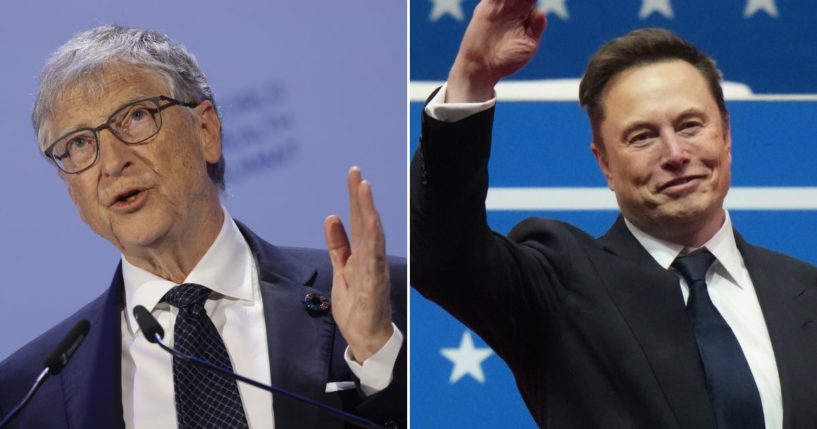
Bill Gates Launches Attack on ‘Insane’ Elon Musk, But He Clearly Didn’t Think It Through


Bill Gates is criticizing Elon Musk's involvement in politics.

Bill Gates has been incredibly involved in shaping politics and policy, not just in the United States, but all over the world.

But now he has a massive issue with Elon Musk doing the same.

The multibillionaire Microsoft co-founder bemoaned the sudden influence of Musk on American and European politics in an interview published Saturday by The Times.

The British newspaper pressed Gates in the wide-ranging conversation to react as Musk enters the global political fray. The magazine, ironically enough, asked Gates if he wished that he “had got more involved in influencing politics like Elon Musk.”

“Not at all,” Gates responded.

“I thought the rules of the game were you picked a finite number of things to spout about that you cared for, focused on a few critical things, rather than telling people who they should vote for,” he told the outlet.

“For me it’s only ever about aid. I did think Brexit was a mistake, but I wasn’t tweeting every day,” Gates insisted.

Gates may not have the same style of political engagement as Musk’s off-the-cuff use of X, the social media platform he bought three years ago, or his appearance at rallies for Donald Trump.

But make no mistake. Gates is as political as they come.

Gates has thrown around his influence and his money, especially by means of the Gates Foundation, to move the policy conversation in his direction, especially on topics like climate change and public health.

Just two years ago, for instance, the Gates Foundation dumped $40 million into highly controversial mRNA manufacturing projects in Africa.

Gates has also been involved with buying American farmland, seemingly to encourage meat alternatives and other purported climate-friendly agriculture activities.

But remember, Musk is the actual problem for supporting Trump, raising awareness of the groomer gangs in the United Kingdom, and encouraging Germany to be a sovereign nation, or so says Gates.

“I’m ultra-different. It’s really insane that he can destabilize the political situations in countries,” Gates claimed to The Times.

“I think in the U.S. foreigners aren’t allowed to give money; other countries maybe should adopt safeguards to make sure super-rich foreigners aren’t distorting their elections,” he continued.

Conservative commentator Victor Davis Hanson said what many Gates skeptics were thinking: “Is he joking, or simply completely misinformed?”

Beyond the long history of global activism from Gates, Hanson reminded social media that the billionaire was dead silent about various other forms of foreign political interference from the global left, including in the United States.

That includes Christopher Steele, the British ex-spy who “who interfered in the 2016 presidential election by fabricating a venomous dossier to destroy the Trump campaign,” and much more recently, the fact that the Labour Party in Britain called for British activists to “swarm American swing states in service to the 2024 Kamala Harris campaign.”

Like other leftists who attack Musk and his affinity for the global right, Gates is not upset about a billionaire involving himself in politics.

Gates is only mad that the world’s richest man is not channeling his billions toward the global left instead.

“So, sir. Gates, spare us you very selective outage about Mr. Musk, given your prior deafening silence on hired foreign interference here and Democratic efforts to interfere in the elections of others,” Hanson added.

Efficiency By Inefficiency: How Elon Musk And Vivek Ramaswamy Could Take A Page From Reagan’s Playbook


In a twist that only our brave new timeline could produce, Elon Musk and Vivek Ramaswamy have been handed the reins of the Department of Government Efficiency (DOGE), a yet to be created agency created to identify and eliminate bureaucratic inefficiencies, reducing waste and ensuring effective government operations. If there’s a lesson to be gleaned from Reagan—and really, when isn’t there?—it’s that sometimes the best way to fix a bureaucracy is to let it idle itself into oblivion. The Community Services Administration (CSA), which Reagan successfully eliminated in 1981, provides a the perfect case study for Elon and Vivek, as they try to steer the DOGE in their quest to bring efficiency, or perhaps glorious chaos, to Washington.

Back in the Reagan era, the CSA, once a symbol of LBJ’s idealistic but clunky War on Poverty, found itself in an interesting predicament. After Reagan set his sights on reducing government bloat, the CSA’s employees went through a “Close-down Period,” a bureaucratic purgatory in which they were explicitly instructed to do absolutely nothing. They came to work, they sat at their desks, they stared at blank pages and empty desks, and they weren’t even allowed to pass the time with a good book. You could almost hear them counting ceiling tiles, one at a time, while contemplating the meaning of “government service.”

This quaint episode—the ultimate bureaucratic version of “hurry up and wait”—lasted several months. It’s a sobering, yet oddly hilarious reminder of the absurdity that unfolds when an inefficient entity is left to its own devices in a fog of political deadlock. It’s also a great pointer for Elon and Vivek: if you want to get rid of an agency, you might not need a wrecking ball. Sometimes all it takes is to turn off the metaphorical engine and let the government workers ponder existence under florescent lights for a few months until the inefficiency becomes unbearable.

Elon, with his ironical embrace of memes and Vivek, the voice of the pragmatic outsider, could both take a page out of Reagan’s playbook—the one marked, “Don’t dismantle it; just let it collapse under its own weight.” Instead of battling the machine with flamethrowers—though let’s be honest, Elon would probably love to—they could just lean back, let the department grind to a halt, and watch the gears seize up from a lack of purpose. Bureaucracy is like a shark; it has to keep swimming—keep moving, producing reports, holding meetings, filing forms—or it dies. Force it to tread water and, like the CSA in 1981, it will eventually succumb to its inherent pointlessness.

Reagan’s journey wasn’t without its detractors. Congressional opponents, mostly Democrats, fought tooth and nail against his plan to shrink the federal apparatus, fearing what would become of their beloved CSA programs. In the end, it was simply a matter of waiting them out—for every bureaucratic warrior on Capitol Hill, there is only so much political capital they’re willing to spend keeping idle desk-sitters afloat. Reagan waited, and the CSA folded, and before you knew it, funds were redirected, employees reassigned, and the bureaucracy vanished—not with a bang, but with an extended whimper.

For Elon and Vivek, leading the DOGE, the trick isn’t just to swing a hammer; it’s about bringing a sense of showmanship while convincing the public that trimming the fat is in the national interest. Imagine Vivek walking into a press conference, his sleeves rolled up, with Elon beaming in from Starship, to announce, “Ladies and gentlemen, today we ask every member of this office to ponder the existential question—’Why am I here?’” Cue a month-long suspension of work assignments, while DOGE employees contemplate Kafkaesque nothingness.

The ultimate goal here is something like a bureaucratic Détente: Make the inefficiency so palpable, so obvious to all—including those in the inefficient roles—that Congress can’t help but take action, even if they’re loath to give Musk and Vivek a political victory. After all, political calculus always trumps actual governance. Perhaps Elon can convince one of his X engineers to make a “DOGE Work Efficiency Tracker”, an app that tracks the number of productive hours per employee in each division of the government—real-time transparency in bureaucratic stasis.

They should also take note of Reagan’s use of executive orders to clear the bureaucratic underbrush. Executive Order 12301—designed to promote efficiency—could serve as inspiration, or at the very least, as a historic precedent when critics inevitably scream that you can’t simply shut off the spigot of government work. Sure, the left will shout about Trump’s autocratic tendencies, the horror of which they’ll compare to Reagan’s supposed “legislative wizardry.” But, in truth, there’s little difference between leveraging executive power to make government more efficient, and allowing it to reveal, on its own, that its perpetual self-expansion is inherently self-defeating.

And let’s not forget the humor angle—Elon, after all, has a certain genius for trolling, and Vivek’s charisma makes him the perfect foil. While government employees across Washington sit idle, Musk could flood X with memes: an empty office captioned, “Government hard at work!” paired with Reagan’s iconic grin. Nothing exposes the farce of over-governance quite like a well-placed meme.

The Reagan model, a true paradox of action through inaction, is perhaps the best-case study for this Musk-Vivek experiment in government efficiency. Elon’s techno-libertarian zeal, paired with Vivek’s wonky outsider flair, is ideally suited for an exercise in controlled chaos, with an underlying nod to the inefficiencies that have plagued our republic for generations. They might just get to a point where, like Reagan, they have the satisfaction of seeing an entire segment of the federal machinery implode by virtue of its own pointlessness, brought on by an expertly orchestrated slowdown.

Don Lemon Announces He’s Leaving X, But Doesn’t Get The Response He May Have Been Hoping For


Don Lemon speaks onstage during the Congressional Black Caucus Foundation's 53rd Annual Legislative Conference National Town Hall at Walter E. Washington Convention Center on September 12, 2024 in Washington, DC.

Don Lemon speaks onstage during the Congressional Black Caucus Foundation’s 53rd Annual Legislative Conference National Town Hall at Walter E. Washington Convention Center on September 12, 2024 in Washington, DC. – Congressional Black Caucus Foundation

And another one bites the dust.

In the latest case of a pundit or reporter leaving the walled garden of establishment media and failing in the new media landscape, former CNN anchor Don Lemon announced he was leaving X — which he still calls Twitter — effective immediately.

Lemon’s stated reason was that the platform was too conservative for him, although many noted that basically nobody noticed he was still around.

“I’ve loved connecting with all of you on X, but it’s time for me to leave the platform,” Lemon said in a Wednesday morning message.

“I once believed it was a place for honest debate and discussion, transparency, and free speech, but I now feel it does not serve that purpose.”

Lemon also cited new terms of service which require all disputes to be heard in the U.S. District Court for the Northern District of Texas or Tarrant County, Texas courts.

“As the Washington Post recently reported on X’s decision to change the terms, this ‘ensures that such lawsuits will be heard in courthouses that are a hub for conservatives, which experts say could make it easier for X to shield itself from litigation and punish critics.’

“I think that speaks for itself,” Lemon said.

Of course, it’s worth noting that the one pushing for censorship when Lemon and X impresario Elon Musk sat down for an interview was … Lemon: *that video below

And, as the reaction to Lemon’s departure seemed to indicate, the motive factor probably had a lot more to do with the fact nobody really cared:

Just in case you’ve forgotten how we got here — and how Lemon is an object lesson in how old media stalwarts tend to fail when they try their hand at new media — let’s go through a brief history of Don Lemon’s recent career arc.

In April of 2023, after months of behind-the-scenes drama at CNN’s morning show, Lemon was fired by the network after 17 years there.

It’s unclear whether it was because of the show’s low ratings, or his frequent dust-ups with his co-hosts, or a series of controversial comments — particularly a cheap shot at Nikki Haley in which he claimed that women over 50 aren’t in their prime anymore.

Perhaps Lemon could have parlayed his way into a weekend show on MSNBC or something; after all, if Katie Phang and Al Sharpton can keep gigs there, surely Lemon could, right?

But no: He decided it was time for him to become the next Joe Rogan or Tucker Carlson and venture out into the world of social media broadcasting/podcasting.

And, it initially looked like Musk was going to hire him, even with a series of exorbitant demands. Then, Elon realized Lemon basically just wanted to do his old job.

“His approach was basically just ‘CNN, but on social media’, which doesn’t work, as evidenced by the fact that CNN is dying,” Musk said in an X post.

“And, instead of it being the real Don Lemon, it was really just [former CNN president] Jeff Zucker talking through Don, so lacked authenticity. All this said, Lemon/Zucker are of course welcome to build their viewership on this platform along with everyone else.”

And he tried to — with not a whole lot of success, since most of us didn’t even notice he was going. Now, he’s blaming it on the conservative bent of social media.

It’s worth noting that, yes, conservatives and heterodox political thinkers tend to do better in the podcasting and social media arena. Figures like Joe Rogan, Ben Shapiro, and Tim Pool have made their names that way, and former establishment media types like Carlson and Megyn Kelly have seen a career renaissance since leaving their respective networks.

That’s not because the deck was supposedly stacked in favor of the right on social media, despite what many on the left claim.

Instead, it’s because establishment types like Lemon simply want to keep on doing the same thing they were doing before, just on a different platform where more and more people are turning for news. Except the reason they’re turning to those platforms for news is because establishment media types like Lemon keep on doing the same thing on networks like CNN.

Nor is Lemon the first person to find this out. When Chris Wallace left Fox News over disagreements regarding the network’s 2020 election coverage, he decided to try streaming with CNN’s digital service, CNN+. That was so abysmal it lasted about a month, and the quality of Wallace’s show didn’t help any; think of a more boring version of Charlie Rose without an alleged sexual predator hosting and you’ll get an idea just how bad it was.

Wallace apparently still hasn’t learned, because after a few years on CNN proper he’s announced a move into independent streaming and podcasting, one which will doubtlessly go just as well as the CNN+ gig did.

What personalities like Lemon and Wallace are discovering is that people aren’t just leaving traditional media because new technologies and platforms have emerged. It’s that those new technologies cut out the sclerotic gatekeeping middlemen who have set the narrative from the dawn of the mass media era. Without that in place, there’s no reason to seek out Lemon or his ilk.

Don’t let the door(s) hit you in the posterior on the way out Don.