The Truth Is Out There

Posts tagged ‘news’

Free Speech On Trial: X Corp. Vs. Letitia James


Screenshot via X [Credit: @amuse]

The recent lawsuit filed by X Corp against New York‘s Stop Hiding Hate Act is not merely a corporate tantrum over regulatory friction. It is, rather, a constitutional litmus test: Can the state compel a private media platform to speak? And more precisely, can it compel that speech in a format and on topics it deems urgent, namely, hate speech, misinformation, extremism, and other politically volatile categories, without violating the First Amendment?

The answer, both doctrinally and philosophically, is no. Not if we take our constitutional commitments seriously. Not if we believe in a press that is free not merely to report, but to decline to report. Not if we recall that a regime which mandates orthodoxy is functionally indistinguishable from one that punishes dissent. To compel speech is to conscript conscience, and in the digital agora of social media, the stakes for freedom of editorial judgment could hardly be higher.

The First Amendment, robustly construed, protects not only the right to speak, but the right not to speak. That protection is no less vital for corporate speakers than for individuals. In West Virginia v. Barnette, the Court affirmed this principle unambiguously: The state cannot compel an individual to salute the flag or recite its creed. Why? Because the very act of compulsion transforms opinion into obedience, conscience into compliance. What applies to schoolchildren surely applies to modern publishers.

New York’s Stop Hiding Hate Act runs afoul of this principle by requiring large social media platforms to disclose their content moderation policies and practices, specifically regarding “hate speech,” “misinformation,” and similar categories. The state’s rationale is couched in noble rhetoric: transparency, accountability, democracy. But the effect, and indeed the intent, is to conscript editorial judgment. It commands platforms to articulate their policies in state-approved terms, to issue periodic reports on state-specified topics, and to do so under the threat of $15,000-per-day penalties.

That is compelled speech, and compelled speech on matters of contested opinion. What counts as “misinformation” today may be conventional wisdom tomorrow. What is labeled “hate speech” often reflects the moral intuitions of cultural elites rather than objective legal categories. To force a platform like X to define, report on, and implicitly denounce such categories is to force a particular viewpoint, to transform a speaker into a conduit for the state’s ideological agenda.

The Supreme Court has been consistently wary of such state overreach. In Miami Herald v. Tornillo, the Court struck down a Florida law requiring newspapers to give equal space to political candidates they criticized. Even though the law aimed at fairness, the Court recognized it for what it was: a form of compelled speech that intruded on editorial discretion. The choice of what to publish, and what to withhold, is part of what makes a speaker free.

The same logic animates more recent decisions. In National Institute of Family & Life Advocates v. Becerra, the Court invalidated California’s attempt to force pro-life pregnancy centers to advertise abortion services. The law was struck down not because the information was false, but because it compelled speakers to convey messages they found objectionable.

New York’s law suffers from the same defect. It does not merely ask platforms to be clear about their terms of service. It demands that they speak in a particular voice, about particular topics, in a state-sanctioned format. That is not regulation of conduct; it is regulation of speech. And it is presumptively unconstitutional.

The Ninth Circuit reached precisely this conclusion in X Corp v. Bonta, a case challenging California’s nearly identical transparency law, AB 587. That court found the law unconstitutional on its face, noting that the compelled disclosures were non-commercial speech on deeply controversial topics, triggering strict scrutiny. The state failed that scrutiny because there were less intrusive means to achieve its goals, and because the law’s real aim appeared to be ideological enforcement, not mere transparency.

The Stop Hiding Hate Act is, if anything, worse. Where California’s law was relatively restrained, New York’s law comes armed with sharper teeth: higher penalties, broader categories, and a clear animus against X Corp’s editorial philosophy. Governor Kathy Hochul and Attorney General Letitia James have publicly criticized Elon Musk‘s management of X, decrying what they see as an irresponsible tolerance for hate and extremism. But if that is the state’s concern, its remedy must be speech of its own, not coercion of others.

Viewpoint neutrality is a bedrock requirement of any law that touches expression. In R.A.V. v. City of St. Paul, the Court struck down a hate speech ordinance because it punished speech based on viewpoint. The government may not pick sides in the marketplace of ideas, nor may it burden one side of a debate because it finds its views distasteful. Yet that is precisely what the Stop Hiding Hate Act does. By mandating reporting only on negative categories of speech, hate, extremism, misinformation, it sends a clear message: Platforms must account for their failure to suppress ideas the state disfavors.

This is not a hypothetical concern. Judicial analysis of New York’s earlier Hateful Conduct Law found the same flaw. In Volokh v. James, Judge Andrew Carter enjoined enforcement of that law, finding that it compelled speech and chilled protected expression. The parallels to the current statute are striking, and the constitutional defects just as fatal.

Defenders of the law argue that social media companies are different. They are not publishers, they say, but infrastructure. Carriers. Utilities. That argument fails both as a matter of law and logic. The Supreme Court has repeatedly held that platforms exercise editorial discretion, and are thus speakers. In Reno v. ACLU, the Court treated the internet as a medium deserving of full First Amendment protection. And in NetChoice v. Moody, the Eleventh Circuit recognized that content moderation decisions are expressive acts, entitled to constitutional safeguards.

Moreover, the compelled disclosures in question are not neutral. They do not merely report numerical data or objective facts. They require platforms to explain how they define “hate,” how they identify “misinformation,” and what policies they have to remove or mitigate such content. These are ideological questions, not technical ones. To answer them is to express a worldview.

The editorial freedom of platforms is also essential to the integrity of the digital public square. Just as newspapers decide which op-eds to publish and which letters to discard, platforms decide which voices to elevate and which to suppress. Their choices shape public discourse, for better or worse. But those choices must remain theirs. If the government can dictate how they define controversial categories of speech, it can eventually dictate whom they must ban, what they must delete, and what they must feature.

And what of Section 230? Though not directly at issue in this case, the spirit of that provision underscores a broader point: Congress has long understood that platforms need leeway to moderate content without fear of liability. New York’s law, while framed as a disclosure regime, indirectly penalizes moderation choices by turning them into targets for state scrutiny. That functionally contradicts the federal policy of encouraging free and diverse platforms.

This is not to say that platforms bear no responsibility. X Corp, like any publisher, is accountable to its users, its advertisers, and the public. But that accountability must be exercised through the voluntary mechanisms of the market, not the coercive arm of the state. The state can speak, advocate, and condemn. It can encourage platforms to do better. But it cannot force them to explain their decisions in its own preferred terms.

We must also attend to the dangers of precedent. Today, New York compels speech about hate and disinformation. Tomorrow, a different state may compel speech about patriotism, election integrity, or gender ideology. Once we allow government to mandate ideological reporting, the slope becomes not only slippery but unavoidable. The protection of editorial discretion, even for unpopular or eccentric platforms, is the bulwark against state orthodoxy.

In sum, the Stop Hiding Hate Act violates the First Amendment by compelling speech, intruding on editorial discretion, and discriminating based on viewpoint. It is neither narrowly tailored nor supported by a compelling interest that cannot be pursued through less invasive means. The law’s defects are legal, philosophical, and practical.

X Corp’s challenge to the Act, then, is not merely defensible, it is necessary. If we value the principle that the government cannot dictate what private speakers say, or how they say it, we must defend it when it is tested. That principle, like speech itself, must be protected not only in easy cases, but especially in hard ones.

The Static Fallacy Of The CBO And The Virtue Of Growth


Screenshot via X [Credit: @amuse]

The Federal Reserve‘s data repository, FRED, presents one of the most quietly subversive truths in modern economics. Across administrations, tax regimes, and political ideologies, federal tax receipts have hovered around an average of 17.5% of GDP. This single metric, consistent across time and policy, should provoke a complete reconsideration of fiscal strategy. If no matter how high or low tax rates go, the government captures roughly 17.5% of the economy, then the only sane objective is to grow the economy. This is not ideology, it is arithmetic.

And yet, the progressive left persists in chasing higher tax rates, even as history and hard data render the strategy self-defeating. Why? Because for the modern progressive, revenue is not the end. It is the excuse. The aim is not to feed the treasury, but to reshape society. That makes tax policy less a tool of statecraft than a weapon of social reengineering.

This is not speculation, it is doctrine. Consider the words of Denis Healey, the British Labour Chancellor, who once promised to tax the rich “until the pips squeak.” The goal was not productivity or revenue, it was punishment. Redistribution as retribution. What mattered was not how much government could collect but how much it could confiscate from those it resented. The modern American progressive inherits this moral absolutism: high taxes are right, low taxes are wrong, and results be damned.

Yet the results do matter, especially when judged by the very standard progressives claim to uphold: the public good. Empirical evidence from FRED undermines their moralizing. The US government, regardless of tax rate, collects about 17.5% of GDP. If rates go up and GDP slows, the government collects less. If rates go down and GDP grows, it collects more. In real terms, the size of the pie matters more than the size of the slice.

This is the heart of supply-side logic. It is also the lesson ignored by static modeling agencies like the Congressional Budget Office. The CBO consistently underestimates the growth impact of tax and regulatory reforms. When Trump’s 2017 Tax Cuts and Jobs Act passed, the CBO predicted modest effects. Instead, GDP growth surged to 2.9% in 2018, well above forecast. Capital investment jumped, business confidence soared, and tax receipts increased. It wasn’t magic. It was motion.

The same fallacy mars the CBO’s score of Trump’s latest initiative, the One Big Beautiful Bill Act. Projecting a paltry 1.7% long-term growth rate, the CBO forecasts a $3.8 trillion increase in debt. But a growth rate of just 2.2% cuts that shortfall by more than a trillion. A 2.7% growth rate nearly wipes it out. Add in the revenue from Trump’s reciprocal tariffs, conservatively estimated at $2.3 to $3.3 trillion over a decade, and the fiscal picture flips from deficit to surplus. The math is not fuzzy, it is just inconvenient for the central planners.

Why does the CBO get it wrong? Because its models assume a static world, where tax cuts are giveaways and regulation is costless. This is Keynesian nostalgia dressed in academic robes. It denies incentives, discounts dynamism, and assumes the private sector merely reacts rather than innovates. That intellectual blindness is no accident. Most CBO directors have never built a business or managed payroll; instead, they are drawn from the ivy-covered halls of Harvard and Princeton, trained in theory but untethered from enterprise. Trump’s economic team does not share these illusions. Neither should the American people.

The Trump agenda focuses on unleashing growth: simplifying permitting for nuclear energy and pipelines, accelerating drug approvals, expanding domestic mining and drilling, and building AI infrastructure without bureaucratic drag. Each policy removes a bottleneck, and in doing so, expands the tax base. Yet the CBO ignores all of this. It includes no measure for the acceleration of permitting, no accounting for regulatory relief across entire industries, no projection of the increased oil and gas exploration, production, or refining, and no scoring for the trillions in foreign direct investment secured by Trump. Why not? Because it cannot model the real-world effects of policies it ideologically opposes. If FRED is right, and it is, then unleashing GDP is the only serious strategy. Everything else is political theater.

This is where the progressive project reveals its true priorities. It is not simply wrong about tax policy. It is hostile to economic growth. Because growth reduces dependency, and dependency is their currency of power. A larger GDP gives people more autonomy. That undermines the case for state intervention. Progressives, despite their rhetoric, do not trust people to live freely and prosper. They trust themselves to allocate resources, distribute privileges, and engineer outcomes. Higher taxes are the toll they place on that liberty.

Redistribution is also their electoral strategy. By taxing a demonized few, they buy votes from a politicized many. Student loan forgiveness, rent subsidies, welfare expansions, these are not programs, they are payoffs. That the math does not work is irrelevant. What matters is that the bill arrives after the election.

Even worse, high taxes empower the permanent bureaucracy. A complex tax code justifies an army of IRS agents, compliance officers, and lobbyists. These are not mechanisms for revenue, they are instruments of control. Simpler, lower taxes threaten their sinecures. They resist simplification not out of fiscal concern, but institutional self-preservation. Meanwhile, only a minority of Americans actually pay federal income taxes at all, further concentrating the burden on a shrinking pool of producers. This creates an upside-down incentive structure, where most citizens vote for benefits paid by others, while the tax code grows ever more opaque to sustain the illusion of fairness.

This leads to an uncomfortable truth. The tax code is not designed to raise money efficiently. It is designed to raise influence. Every deduction, exemption, and bracket is a node of political leverage. Progressives exploit this to reward allies and punish dissenters. Conservatives should dismantle it with the same clarity and resolve that Trump brings to regulation.

Growth, then, is not just an economic imperative. It is a moral one. A growing economy elevates the working class, funds national defense, and underwrites the social safety net. It does all this without coercion. It also reaffirms the central conservative principle that liberty, not redistribution, is the path to prosperity.

Trump’s approach, often derided as simplistic, is in fact the most sophisticated policy vision in Washington. It recognizes the limitations of static models, the distortions of bureaucratic incentives, and the moral hazards of dependency. It wagers, correctly, that the American people are not liabilities to be managed but assets to be unleashed.

The 17.5% rule is not just a quirk of FRED’s database. It is a mirror reflecting the futility of progressive fiscal policy. If the government only ever captures a fixed share of GDP, then policies must aim at increasing GDP. This is the only strategy consistent with both sound economics and limited government. Anything else is vanity or vendetta.

Conservatives Targeted Abroad: Lawfare Moves Raise Alarms And Go Global: The EU Has Now Criminalized Conservatism.


© European Union, 2025, CC BY 4.0 , via Wikimedia Commons

In 2016, when Donald J. Trump did the unthinkable and defeated Hillary Clinton, it was not merely a disruption of the expected political cycle. It was an ontological rupture in the worldview of the globalist establishment. That elite, forged in the gleaming chambers of Davos, Brussels, and Foggy Bottom, had spent decades constructing an ideological palace upon the belief that the arc of history had bent, permanently, toward supranationalism. Trump bulldozed the edifice.

To the stewards of the so-called “Rules-Based International Order,” Trump’s rise was not just electoral misfortune, it was apostasy. His sins were theological: he questioned NATO’s utility, dismissed climate crusades, mocked international treaties, and, most unforgivable, declared that he would put America first. That phrase, so simple yet so devastating to the mandarins of multilateralism, signaled something deeper: the resurrection of sovereignty. It could not be allowed to stand.

By 2021, the counterattack had taken shape. Legal warfare, once the exclusive domain of banana republics, was rebranded and refined as a tool of elite preservation. The strategy: if the ballot box produces the wrong result, change the judge. If the people err, prosecute their champion. Trump was hit with a fusillade of indictments, not because he is unusually corrupt, but because he is unusually disruptive. The pattern has metastasized. From Paris to Bucharest, Caracas to Dublin, nationalist leaders are being purged not by plebiscite but by process.

Marine Le Pen, once again the front-runner in the French presidential race, was neatly removed from contention through a judicial maneuver so timed and tidy one might mistake it for satire. On March 27, 2025, she was sentenced to a two-year suspended prison term and barred from public office for five years, effectively ending her 2027 candidacy. The charge? Alleged misuse of European Parliament funds, a case launched in 2016, revived without fanfare just as her polling numbers peaked. Over a dozen members of her National Rally party were likewise ensnared. The message was unmistakable: challenge Brussels, and you will be removed. Not debated. Not defeated. Removed.

The United States, now again under Trump’s leadership, has taken unprecedented steps to confront this new form of transnational political suppression. In May 2025, Secretary of State Marco Rubio authorized an investigatory mission to France to examine the legal proceedings against Le Pen. The US team, which includes career diplomats and legal observers, will assess whether international norms regarding democratic participation and judicial impartiality were violated. According to one senior State Department official, “If the US is to champion democracy, we cannot turn a blind eye when it is strangled by procedure rather than preserved by principle.”

Nor is France alone. In the United Kingdom, where political prosecutions increasingly cloak themselves in “hate speech” jurisprudence, Trump has dispatched a parallel team to review the jailing of Lucy Connolly, a populist firebrand arrested for what British authorities describe as incitement against migrants. Her defenders argue that her speech, however inflammatory, was plainly political. She was not tried by jury but condemned by a panel whose allegiance to the ruling party is, at best, suspect. American officials have requested transcripts, court documents, and access to Connolly’s legal team. The message, again, is clear: the Trump administration intends to confront, not accommodate, global lawfare.

In Eastern Europe, the illusion of democratic procedure has been similarly weaponized. Romania’s presidential election in November 2024 was upended when nationalist outsider Călin Georgescu, who won the first round, was suddenly declared ineligible. The cause? Accusations of Russian interference, though no credible evidence was ever produced. Within days, he was arrested for “communicating false information” and “promoting fascism,” charges as conveniently vague as they are politically lethal. His removal nullified the voters’ verdict.

One need not endorse Georgescu’s views to grasp the threat. When the people’s will is retroactively invalidated through judicial intervention, democracy becomes a simulation, not a reality. Once again, Trump has responded. The State Department has contacted Romanian authorities requesting a detailed account of the court’s findings and the legal basis for the annulment. While critics call the intervention unprecedented, defenders argue that America’s moral leadership depends upon its willingness to challenge injustice, even when it wears a robe.

This new approach marks a decisive philosophical shift. Previous administrations, from Bush to Biden, paid homage to the international order even as it rotted from within. Trump, by contrast, treats sovereignty not as a relic but as a right. His foreign policy assumes that democracy means self-determination, not elite curation. The investigation into Le Pen’s case is not mere theater; it is the first salvo in a counteroffensive against the weaponization of law.

The trend is global and unmistakable. In Brazil, Jair Bolsonaro is ensnared in a judicial spiderweb designed to prevent his political resurrection. Ireland has prepared charges against Conor McGregor under nebulous “hate speech” provisions. In Pakistan, Imran Khan sits in prison, his party decapitated before elections could be held. In Turkey, Istanbul’s mayor has been jailed for alleged ties to terrorism, charges his supporters regard as fiction. In each case, the pattern is the same. Nationalists rise, globalists recoil, courts intervene.

And still the architects of this jurisprudential coup insist they are defending democracy. But as any student of logic will note, defending democracy by voiding elections is a contradiction. If democracy is to mean anything, it must include the right to elect those whom the elite loathe. Otherwise, it is mere spectacle.

Trump’s willingness to use the diplomatic tools of the US government to expose this farce is both bold and necessary. If France or the UK can banish their opposition with the stroke of a judge’s pen, then the lesson is simple: legality is not justice. The law, once a shield for the people, has become a cudgel for the ruling class.

In sending observers to France, Romania, and the UK, the Trump administration is doing more than gathering evidence. It is issuing a warning: the age of passive accommodation is over. The US will no longer grant automatic legitimacy to foreign prosecutions that function as political purges.

For the globalist order, this is an existential threat. Their power lies not in persuasion, but in process. They wield courts as swords and bureaucracies as shields. Trump’s crime was to question their divinity. His re-election gives him the power to expose their secular heresies.

But this fight extends beyond Trump. It concerns the survival of political choice itself. If voters cannot choose their leaders without fear that judges will unchoose them, then democracy has already died. What remains is oligarchy, dressed up in robes and gavels.

So yes, the investigations into Le Pen and Connolly are controversial. Good. They should be. Nothing less than the integrity of self-governance is at stake. The ballot box must not become an anteroom to the dock.

Why Western Europe Is Literally Returning to the Dark Ages


A line of people stretched for blocks at a bus stop at Cibeles Square in downtown Madrid as subway and trains went totally out of service Monday. Power went out across all of Spain and Portugal and parts of France and Belgium, cutting cellphone and internet networks, halting trains and trapping people in elevators.

A line of people stretched for blocks at a bus stop at Cibeles Square in downtown Madrid as subway and trains went totally out of service Monday. Power went out across all of Spain and Portugal and parts of France and Belgium, cutting cellphone and internet networks, halting trains and trapping people in elevators. (Thomas Coex – AFP / Getty Images)

In between the fall of the Roman Empire and the birth of the Italian Renaissance, Western Europe economically stagnated and culturally declined in what are commonly called the Dark Ages.

This period, which lasted several centuries, has become known as the Dark Ages primarily because societal advancements and human progress generally ceased as sound science, facts, and the truth were disregarded by elites who sought power and control.

Sadly, Western Europe is treading down this road again.

few days ago, Spain, Portugal, and parts of France and Belgium literally went dark for hours after a massive power disruption led to a system-wide grid collapse.

More than 50 million people were left without electricity. Traffic signals did not work, causing chaos on the roadways. Subway systems couldn’t function, leaving people stranded wherever they were. Stores and businesses closed, as payments were limited to cash only. Mobile phone service was spotty, rendering smartphones almost useless and making rapid communication impossible. Even some hospitals and medical facilities, which generally have backup generators, were left without power.

In other words, modern life nearly ground to a total halt for tens of millions of people in some of the most advanced nations and cities in the world.

The reason this dreadful event occurred is that Western European elites have rejected sound science, common sense, and the truth in favor of climate alarmism.

It is no great surprise that Western Europe is the undisputed world champion when it comes to pushing the so-called green agenda. From the Paris Accords to the UN’s heavy-handed role in supporting the climate alarmism narrative over the past several years, Western Europe is ground zero when it comes to climate-change zealotry.

Therefore, it should also come as no surprise that the cause of Europe’s biggest power outage in modern history occurred in Spain, which is a darling of the green movement because it generates more than half of its power from wind and solar.

Specifically, two solar power plants in southwest Spain experienced a sudden and steep reduction in power generation, triggering a systemic collapse of grid infrastructure that occurred almost instantly.

Put simply, it is absurd to assume that a modern nation like Spain can power itself primarily via renewable energy.

As everyone knows, the sun doesn’t always shine, and the wind doesn’t always blow. This obvious fact means that renewable energy sources have an Achilles heel in that they are intermittent by nature.

It is also true that there is not nearly enough battery storage capacity to keep extra power on hand when these sources are not providing reliable power.

Despite these clear shortcomings, European elites have insisted that renewable energy must be adopted as soon as possible. From net-zero madness to ESG scores, Europe has been at the vanguard of eliminating affordable and reliable energy in favor of unaffordable and unreliable so-called green energy.

What makes this whole climate alarmism narrative even more nonsensical is the fact that so-called green energy is not environmentally friendly. Scores of reports and studies show that huge solar panel fields and gargantuan wind turbines produce a host of environmental problems, such as habitat destruction, wildlife loss, etc. After these massive structures meet their shelf life, which is typically only a decade or so, they are also impossible to recycle.

I am more than confident that the very elites who have been pushing the green movement for the past many years are completely aware of these matters, however, they have chosen to forge ahead, undaunted by these pesky facts.

This leads me to believe that they do not intend nor desire to “save the planet.” It also makes me much surer that they are not interested in improving the lives of hardworking, middle-class Europeans. If that were the case, they would have abandoned the green energy nonsense long ago.

With that being said, I can’t help but wonder if their actual intent is to increase their power and control.

Europe, unlike the United States, has a very long history of wealthy elites wielding outsized power and control in a system rigged against the masses. In many instances, these elites have conspired to create zero-sum systems in which they win, and the rest lose.

Make no mistake, Western European elites are committed to forcing their climate alarmist agenda upon the masses, whether they like it or not.

As such, we must underscore the sheer stupidity of their ridiculous, yet sinister, plan to replace reliable, affordable, and abundant energy with unreliable, unaffordable, and environmentally destructive power sources that are wholly dependent on sunny and windy conditions.

SFFAS 56: The Secret Loophole Hiding Billions In Fraud, Waste & Abuse Discovered By DOGE


Imagine a vast ledger, chronicling the transactions of a mighty republic, now riddled with deliberate gaps and omissions, gaps no auditor may probe, no citizen may question. This is no fanciful dystopia, but the present reality, quietly authorized by what is known as Statement of Federal Financial Accounting Standards 56 (SFFAS 56). While initially crafted, perhaps, with honorable intentions to shield ‘classified’ operations from hostile eyes, SFFAS 56 now threatens the very transparency and public accountability that sustain a free government. Federal agencies are allowed to use SFFAS 56 to hide spending they desire to be ‘classified’ from the American people, Congress, and even the President of the United States.

What is SFFAS 56? At its core, it is an administrative rule issued by the Federal Accounting Standards Advisory Board (FASAB) in 2018, not a statute passed by Congress. It allows any federal agency to modify its financial statements in order to obscure sensitive national security information. This authority extends beyond the obvious domains of intelligence or defense, touching every department that produces General Purpose Federal Financial Reports, from USAID to the Department of Energy. In theory, this safeguard exists to prevent enemies from exploiting financial disclosures to learn state secrets. In practice, it creates a black hole into which billions of taxpayer dollars vanish without a trace.

To understand the peril, one must first grasp the astonishing breadth of the rule. Under SFFAS 56, agencies may alter financial reports by removing, aggregating or fabricating information, provided these adjustments do not “materially” affect the reported net results. Further, agencies can exclude entire sub-entities from reports or consolidate them elsewhere, masking not merely amounts but organizational structures themselves. Crucially, neither the public nor Congress is afforded any right to know when these modifications occur, how often they happen or the underlying reasons. A general, but nonspecific, disclaimer suffices, buried in the back pages of thick agency reports: “Accounting standards allow certain presentations and disclosures to be modified to prevent the disclosure of classified information.”

Even Congress itself can be kept in the dark unless an agency, by its own volition, deigns to disclose the concealment. Thus, SFFAS 56 effectively removes the legislature’s constitutional power of the purse from critical oversight. It conjures a legal purgatory where funds can be appropriated for one purpose, redirected for another and hidden altogether from elected representatives. The theoretical protections against abuse, internal controls, audits, classified oversight, are weak reeds indeed when the very financial data needed to detect mischief has been sanitized.

Proponents of SFFAS 56 argue that, without such protections, enemies could piece together vital intelligence from innocent-looking financial entries. Yet the ingenuity of our foes cannot justify the abandonment of self-government. If secrecy is to be justified, it must be rare, tightly controlled and explicitly authorized by the people’s elected representatives. Instead, SFFAS 56 inverts the burden: concealment becomes the default, accountability the exception. One might as well argue that because a handful of bank robbers lurk at large, all citizens must henceforth veil their account balances from scrutiny.

History offers sobering lessons when governments assume powers of secret spending. The clandestine financing of “black ops” during the Cold War, sometimes used for noble ends, sometimes for ignoble, occurred under conditions of limited and direct congressional oversight. Even then, abuses proliferated. The Iran-Contra affair revealed how easily noble motives could give way to clandestine mischief when oversight was thwarted. Now, SFFAS 56 institutionalizes a structure far broader and more opaque than anything Colonel Oliver North could have dreamed.

Under SFFAS 56, the Department of Defense could award lucrative contracts to politically connected firms and conceal both the recipient and the amount from public view. USAID could fund controversial NGOs both here and abroad without alerting Congress or the public. Worse still, agencies could funnel money to the family members of political figures or even, under a perverse interpretation, fund hostile entities abroad, all behind the iron curtain of “classified activities.”

Consider a hypothetical yet disturbingly plausible example. Suppose USAID wished to grant a billion dollars to the Clinton Foundation or the Open Society Foundation, ostensibly to support development projects in unstable regions. Concerned that public knowledge of such a grant might spark political controversy and, by some stretch, be construed as harmful to national security, the head of USAID could invoke SFFAS 56 to hide the transaction. No notification to the president would be required. Congress would remain unaware. The public, journalists and watchdog groups would find themselves stonewalled. Even if the agency head believed sincerely that the money would be wisely spent for a legitimate purpose, no one outside his immediate circle could help him ensure that actually happened. Oversight by the press, vigilant members of Congress or curious citizens would be thoroughly stymied.

Some may protest that the President retains control of the executive branch, and thus can police such abuses internally. But the president’s power is not omniscient. Unless agency heads choose to disclose their use of SFFAS 56, even the president may remain unaware of the specific expenditures being hidden. In effect, FASAB, a mere advisory board, has created a tool so potent that it outstrips the constitutional balance of powers itself.

The irony is sharp. Conservatives, rightly skeptical of administrative overreach, have long warned against the quiet accretion of unaccountable power by regulatory boards. Yet here lies one of the gravest examples: a board that issues “standards” more consequential than many laws, without democratic debate or meaningful constraint.

President Trump must act decisively. First, he should formally direct every agency head to audit the use of SFFAS 56 within their departments since 2018. For every instance, they must privately report to the president the recipient, the amount, the date and the justification for concealment. Such a review need not, and should not, compromise national security, but the chief executive must know whether public funds have been lawfully spent.

Second, the President should demand that the leaders of FASAB, particularly the current chair, George B. Scott, and Executive Director Monica R. Valentine, rescind or at least reform SFFAS 56. If they refuse, legislation must follow. Congress, spurred by the White House, must reassert its constitutional authority and mandate that no funds shall be expended without public disclosure unless specifically authorized by statute and subjected to classified presidential and congressional oversight.

It strains credulity that an executive board not directly answerable to voters or even the president should wield the power to dissolve financial transparency across the entire federal government. Even among classified programs, there are means of maintaining oversight without sacrificing security. Classified briefings, secure audits, special oversight committees, all these mechanisms exist and function in sensitive areas of defense and intelligence. What SFFAS 56 does is more radical: it banishes oversight by design.

In Federalist 51, Madison observed that “if men were angels, no government would be necessary.” A corollary is clear: if governments were composed entirely of angels, perhaps SFFAS 56 would pose no danger. But human beings, tempted by self-interest, ambition and error, cannot be trusted with unchecked authority. Transparency and oversight are the sinews of a free republic. Without them, the Constitution is a parchment barrier.

Critics may claim that rolling back SFFAS 56 will impair national security. This is a false dilemma. It is possible to protect legitimate secrets while maintaining financial accountability. It is not necessary, indeed, it is dangerous, to dismantle the public’s right to know how its money is spent in the name of security.

SFFAS 56, well-intentioned or not, is an invitation to abuse. It is a standing temptation to the unscrupulous. It is a blindfold upon the eyes of the republic. It must be reformed, and if reform proves impossible, it must be repealed.

The ledger of a free people must be open and not riddled with secret ink. President Trump must insist that the light of public scrutiny shines once more upon the accounts of the United States. The integrity of the American experiment depends on it.

FBI Reports: Teen Killed Parents as Part of Satanic Plot to Assassinate President Trump. Absolutely Frigging Chilling!


FBI Reports: Teen Killed Parents as Part of Satanic Plot to Assassinate President Trump

There’s a growing unease spreading across the heartland, a sense that the values holding our nation together are fraying at the edges. You’ve felt it too, right? That quiet disturbance beneath the surface of daily life, suggesting the foundations we once took for granted might be cracking. It whispers of challenges not just from distant shores, but from within our own communities, festering quietly.

This isn’t mere political disagreement; it feels deeper, more fundamental. It’s that unsettling feeling that bedrock principles – faith, family, respect for authority, the very fabric of Western civilization – are being steadily chipped away by forces that seem to prefer darkness to light, chaos to order. Makes you wonder where this is all headed, doesn’t it? What happens when the guardrails ensuring basic decency start to buckle under the strain?

We see the symptoms pop up, often dismissed by the mainstream as just isolated incidents, nothing to worry about. But thoughtful conservatives understand that sometimes these acts of depravity signal a more profound cultural sickness, a rot spreading unseen until it breaks through in the most shocking ways imaginable. Are we really paying attention or just hoping it goes away?

And then, bam, you get news like this out of Waukesha, Wisconsin, confirming those very fears. In a crime that chills the soul, investigators allege that a 17-year-old high school student, Nikita Casap, brutally murdered his own parents, Tatiana Casap and Donald Mayer, in their home back in February. The details paint a picture of calculated violence against the very people who gave him life and raised him. Just when you think the depths have been plumbed…

But the horror didn’t stop there. Indeed, it intensified dramatically when the FBI revealed the why behind the parricide. Court documents indicate this wasn’t just some tragic, albeit horrific, domestic dispute. Nope. Investigators state the teen killed his parents to gain the “financial means and autonomy” necessary for a far more sinister plot: the assassination of President Donald Trump.

Yes, you read that correctly.

Unmasking the Hate

So, what kind of poison could drive a kid to this? According to the FBI, the teenager was swimming in a venomous cocktail of extremist ideologies. He was allegedly part of a “satanic cult” harboring “strong anti-Judaism anti-Christian and anti-western ideologies.” Further investigation has uncovered links to a neo-Nazi group called the Order of Nine Angles, praise for Adolf Hitler, and deeply antisemitic writings. Get this: Satanists and Nazis, apparently now swapping notes? You couldn’t script this stuff up, but it seems they found common ground in hating everything foundational and good to America and Judeo-Christian values.

The teen’s own manifesto, found by investigators, laid bare the chillingly blunt objective. It wasn’t just about some personal vendetta against President Trump; it was about deliberately destabilizing the nation itself. The goal was explicit: pure anarchy. His own words tell the chilling, if predictable, story:

“As to why, specifically Trump, most believe it’s pretty obvious. By getting rid of the president and perhaps the vice president, that would have guaranteed bringing in chaos.”

Supposedly points for honesty it would appear.

A Deeper Conspiracy?

Now, was this twisted plot conceived entirely in a teenager’s head? The court documents allege Casap aimed not just to kill the President but ultimately sought to overthrow the U.S. government. And naturally, there are whispers of outside contact. Investigators found evidence suggesting he was communicating with individuals in Russia about his plans and even plotting an escape to Ukraine. It certainly raises disturbing questions about who else might be involved, pulling strings or fanning flames.

Make no mistake, this wasn’t just some basement fantasy. Authorities stated the teen had purchased a drone and explosives for a potential attack – taking concrete steps. Casap’s later arrest in Kansas while driving his murdered stepfather’s car containing a handgun, stolen valuables, a pried-open safe, and $14,000 in cash, practically screaming premeditation and flight. He now faces a raft of felony counts, including first-degree intentional homicide, and potential federal charges for the assassination plot. Casap is being held on a $1 million bond. It should be no bond.

This entire horrifying episode serves as a brutal, flashing red light. It’s a reminder of the serious internal threats we face. The ideologies fueling such hatred – whether they call themselves Satanists, Nazis, or wave some other anti-American banner – feast on cultural decay and the rejection of traditional morality. They target not just individuals like President Trump, but the very stability, fabric and soul of our nation.

The fight against this darkness requires more than just hoping law enforcement catches them all. This isn’t just some news story; it demands a reaffirmation from us of the values that actually built this country: faith, strong families, respect for life, and unwavering patriotism. Are we just going to shrug this off or will we remain vigilant, recognize the signs of this rot, and stand firm in defending the principles that stand in stark opposition to the chaos these extremists crave?

Lawmakers: CCPs influence on American investment must be stopped


As the U.S. and China escalate their tariff rates in an all-out trade war, two congressional committees held a joint hearing Wednesday on the problem of the Chinese Communist Party’s influence on American investment and possible solutions.

The Chinese Communist Party is embedded in Chinese business to the extent that the assets of any American who has tried to do business in China, invests in the stock market, international index funds or mutual funds, or who has a 401K or pension invested in international index funds is at risk, according to TV personality and businessman Kevin O’Leary. O’Leary was called as an expert witness at the hearing.

The hearing was hosted by a House select committee that focuses on “strategic competition” between the United States and the Chinese Communist Party and the Senate Special Committee on Aging, as the party’s involvement in the Chinese economy and financial scams stands to disproportionately impact older Americans, according to committee members.

“The [Chinese] government has chosen to be America’s enemy. Unfortunately, that’s not a problem that only our military intelligence community has to worry about,” said Sen. Rick Scott, R-FL, chairman of the aging committee. “ If you have your retirement invested in anything that is controlled by or under the jurisdiction of the Chinese Communist Party, you are at risk of losing every dollar, and this could happen overnight.”

The senator went on to say that “there is no real private industry in China,” a point that was emphasized multiple times throughout the hearing by both committee members and the called witnesses.

O’Leary, an investor on the business reality TV show Shark Tank and the U.K.’s Dragon’s Den, said that China allows something called a “golden share,” which essentially de-privatizes private businesses. Any entity that purchases a golden share in a Chinese business – a small share, typically 1% – acquires disproportionate control of that company. A golden share can secure its owner a position on the company’s board or a certain level of authority over company decisions. The Chinese government buys these shares in companies it wants to influence, so that the Chinese Communist Party is deeply involved in companies that may appear private “on paper,” according to O’Leary.

In addition, the Chinese government doesn’t “play by the rules” of the World Trade Organization, even though it has been a member since 2001, according to O’Leary. This poses a real risk to Americans’ savings, according to Rep. John Moolenaar, R-MI.

“The CCP’s opaque regulatory regime, its disregard for the rule of law and its willingness to use financial tools for political gain present ongoing and significant dangers to American savings,” Moolenaar said.

O’Leary said that the Chinese Communist Party implements policies that disadvantage other countries in the Chinese economy but uses other countries’ legal systems against them to gain the upper hand in economic competition.

The party has passed “various laws in the realm of cyber security, espionage, intelligence and beyond and other mechanisms to control its corporations, industries and business partnerships, all to the detriment of U.S. investors,” O’Leary said.

The Chinese government doesn’t allow other countries to own shares of Chinese companies, for instance, while the U.S. “has given China preferential treatment for over a decade through its own special memorandum of understanding that governs accounting standards and oversight,” according to O’Leary.

“If we can’t own stocks in their country, they should not be allowed to own stocks in the U.S. Unless businesses can operate in China with the same freedoms that Chinese businesses have here, we should not let their businesses operate in the U.S.,” O’Leary said.

“Make no mistake, I want to do business in China, as do millions of other investors and companies, but we want a reciprocal ecosystem in place that is transparent,” he continued, saying the U.S. should leave China’s marketplace until its government implements significant reforms.

President and CEO of the American Securities Association Chris Iacovella said that even though China seemingly transitioned from a state-run to a free market economy decades ago, that’s not really what happened. Instead, China has “penetrated [American] capital markets” to build wealth and power. As a partial remedy, Iacovella said Congress should enact a ban against Chinese companies that engage in unlawful behavior from American markets.

“We have companies on the commerce list, on the DOD list, on the human rights list. These companies should not have access to our capital markets. They should not have access to anybody to be able to do business in this country,” Iacovella said.

A third expert witness called by the committee members was Brady Finta, founder of the National Elder Fraud Justice Coordination Center.

“I believe the scale of fraud against America’s elders has grown to epidemic proportions, and it’s time that we as a country treat it as such,” Finta told the committee members.

Finta worked to combat elder fraud in a previous position with the FBI but said the scale of the problem was so great, he and his team were able to address less than 1% of scams reported to them, even though only a fraction of people report the crimes committed against them.

Some committee members believed the CCP was either directly involved with international crime rings that perpetuate such scams, or at minimum, doesn’t actively deter them.

Finta suggested now is the time for a “whole of society response.” Separately, neither local, state nor federal law enforcement has the bandwidth to sustain a response that matches the magnitude of the problem. But if they joined together in elder justice task forces across the country and even partnered with the private sector, which has access to much of the data that is exploited, they could wage a much stronger fight, according to Finta.

“[Where] local and state resources can be used to support larger federal and international investigations, the effect of that is much greater than the individual investigations by local law enforcement,” Finta said.

What Are We Fighting For In Europe?


As I read a recent flood of articles bemoaning the Trump administration’s stance toward the European Union and the elites that run it, I had an attack of déjà vu. I kept hearing the 1960s band Country Joe and the Fish singing in my memory. The words do apply today. As far as Europe is concerned, “What are we fighting for? Don’t ask me I don’t give a damn.”

True, this could be nothing more than a reverberation of a misspent youth. But the issues raised are real and need to be addressed. Why are we so deeply involved in the affairs and economies of Europe, all to our own detriment? Why so many troops stationed in Europe 80 years after the end of World War II and 35 years after the fall of the Soviet Union? Why do we tolerate their incessant hectoring and their dangerous and threatening authoritarian moves?

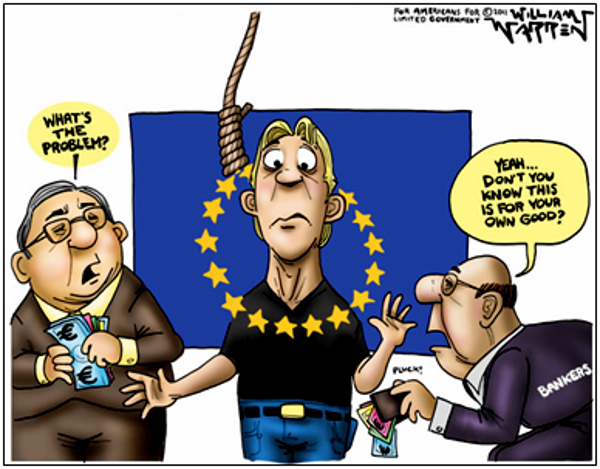
Since the beginning of the year, Europe as defined as the European Union (EU), has gone full tyranny. Any thought that the EU shared American values is a dangerous delusion. Just a quick check list shows that the leading candidate for President in Romania was removed from the ballot with virtually no justification other than his opposition to the “European experiment.” The populist party Alternative for Germany was boxed out of any say in government despite scoring a strong second place. In France, the leading candidate for President in the next election, Marie LePen was barred for some contrived charge. In Spain, the leading conservative-populist voice was charged with “hate speech” because he opposes the destruction of his country through mass illegal immigration.

But it isn’t just manipulation of the electoral process to deny true democratic expression. The EU has flexed its thuggish muscles in countless other ways as well. From expelling a 4-year-old from kindergarten for allegedly being “transphobic,” to Britain establishing a two-tiered criminal sentencing scheme that imposes harsher penalties on white men, to the refusal to admit that the so-called “climate crisis” is a lie that is crushing economies throughout the continent, Europe is gone. There was a reason many of our ancestors escaped it and now we can see that all the tendencies and arrogant abuse are part of the DNA of Europe, not of just a few individuals.

The most recent example, coming out of Germany, is a stark reminder of the ultimate expression of fascism, the very definition of it as stated by Benito Mussolini in a 1927 speech in the Italian Parliament when he said, “Everything in the State, nothing outside the State, nothing against the State” A German court has imposed a 7-month probation sentence on editor-in-chief of Deutschland Kurier, David Bendels, for publishing a parody of a German federal official. The Bamberg District Court found that a satirical photo montage about Federal Minister Nancy Faeser to be an instance of “defamation against political figures,” under Paragraph 188 of the German Criminal Code (StGB).

Faeser, echoing il Duce, famously is quoted as saying during her term of interior minister: “Those who mock the State must be dealt with by a strong State.” Can’t get any more clear than that.

It is time, way past time, to get out and leave Europe to rot.

The United States was only drawn into the European con-game by Woodrow Wilson who fell for the One World, Globalist vision a little over 100 years ago. It was a huge mistake. Then while there was overwhelming opposition to entering World War II — at least on the European front — conditions and raw propaganda brushed it aside. Was defeating the Nazis a good thing? Of course it was. But the aftermath has been horrible. Why did we rebuild Europe? Why do we continue to subsidize their defense and their entire economies? Why is it our job to keep the Middle East shipping lanes open when it is Europe who gets the goods that pass through them.

And why do we continue to suffer their condescending attacks. Whether it is the threats on U.S. tech companies using the phony scam of “disinformation” as the ruse or the demand that all companies throughout world adhere to the destructive Environmental, Social and Governance (ESG) standards that the EU is proposing as a pre-condition to doing business in the EU, the attacks are relentless.  This is the globalist — World Economic Forum — Atlantic Council agenda.  And it and they need to be removed as a clear threat to the United States by any means necessary. They are the enemies of American freedom, not allies.

A big part of the answer to these questions are also found from our hazy friends. Country Joe’s lyrics are as relevant today as they were in 1969. A couple of lines prove the point: “Come on, Wall Street, don’t be slow, why, man, this war’s a go-go. There’s plenty of good money to be made by supplying the army with the tools of trade.” Or: “Come on, Generals, let’s move fast.  Your big chance is here at last!”

Money. Advancement. Power. And all at the cost of hundreds of thousands of dead Ukrainians and Russians. The simple truth is that key elements of the establishment in the U.S. thrive as a result of us being chained to the EU. The benefit to the American people does not factor in. And while some make mountains of money from it, the real beneficiaries are the globalist ideologues who work day and night to destroy the United States as a free, sovereign and independent nation and impose their world government schemes. The entire exercise is aimed at nothing less than the elimination of any say by the people who pay the bills and bleed and die.

It is time. Remove all U.S. troops from Europe. Reduce or eliminate our support for and role in NATO. Any nation that refuses to remove trade barriers to American products and services should be hit with a fee or tariff double what is being imposed on Americans. When the crippled, bleeding sore that is the European Union moves to reform and open their systems to the will of the people of their nations including free speech, we should be glad to deal with them. But to continue to play the sucker to the EU has got to end. Freedom from this abusive and destructive relationship is, after all, worth fighting for.

Restoration of Second Amendment Rights After They Are Lost


There has long been a provision of federal law that allows Americans to petition the U.S. attorney general (AG) for relief from firearm disabilities on a case-by-case basis, a little-known piece of information due to the function lying dormant since 1991. You see, it’s easier to lose the right to purchase or possess firearms than one might think, and many of the offenses and the conditions surrounding them point to the fact that the prohibited individual does not pose any enhanced risk of physical harm to themselves or the public. So why, then, and how have Americans lost this fundamental access to the restoration of a constitutionally enumerated liberty?

It began in 1991 when a Bolshevik anti-Second Amendment group, the Violence Policy Center, released a report that claimed occasions upon which some citizens who were granted relief would later go on to re-offend. It is important to note that although the AG oversees the provision, the administration process for the petitions had been handed down to the Bureau of Alcohol, Tobacco, Firearms, and Explosives (ATF). Politicians, in their ever-knee-jerking zeal to strip Americans of their right to bear arms, responded to the report in Congress by passing language in ATF funding bills that prohibited the use of any funds for this purpose.

Now, if you’re thinking that Congress is passing bills contradictory to the law and circumventing both the rights of Americans and the authority of the AG, then you are right on track, but this is nothing new. Look at all the existing gun control laws, both on the federal and state side, that already circumvent Constitutional law and the politicians and activist judges that have ushered them into existence and protected them from legal challenges. It is easy, then, to determine that all branches of the government have long since been in cahoots to some extent and that the tyrannical ship sailed on the American people years ago.

Last week, The Washington Post published an editorial in its opinion section by two law professors who argued that the government should resume funding the rights restoration provision on the grounds that categories of prohibited individuals include people who would not be demonstrably dangerous and whose Second Amendment prohibitions would likely not survive U.S. Supreme Court caselaw scrutiny. The professors also stipulate that the ability to seek relief itself may shield the overly broad categories of prohibition from further Constitutional challenges, which could perhaps lead to the Supreme Court striking down possession prohibitions entirely, two issues that I do not find mutually exclusive. However, I am not sure the High Court, even in its current perceived configuration, is capable of such Constitutional reverence.

The issue of rights restoration recently reemerged as the Department of Justice (DOJ) under President Trump has started reviewing petitions through the Office of the Pardon Attorney, a very clever workaround to the illegal ATF funding rider issued by the Politburo, AKA Congress, which deprives Americans of not only their Second Amendment liberty but also their right to due process. Legal precedent requires the government to carry the burden of proof that an individual poses an enhanced risk of harm to self or others before prohibiting them from purchasing or possessing firearms.

Those of us who live in reality understand that criminals intent on violent crime and murder do not give pause to their actions in order to follow legal protocol and procedure when obtaining firearms. Instead, they see those laws as a means to make law-abiding citizens more vulnerable to their objectives and, in that sense, make great partners to the left and any lawmakers who follow the subversive path of the gun control agenda. Leaving Americans unprotected in this manner invites violence, which creates the opportunity for further infringements upon our rights under the guise of protecting our safety, and that cycle is designed to continue until all freedom is lost. Guess what happens next.

When I hear remarks about America being a beacon of freedom, I think to myself, sure, maybe relatively speaking, depending on what state you live in, but not in any general understanding. I’m sure it was at one time, long before I was a twinkle in the eyes of my parents. I wish I could have seen it back then. But individual liberty has not survived the scrutiny of disingenuous agendas and their narratives that claim to know better what Americans need than Americans themselves. The idea that politicians and the government need to strip our freedoms to protect us is insulting and is not even original, as the same tired scheme has been used ad nauseam historically to subjugate populations around the world.

Who are the Judges ruling against Trump’s orders?


Money Trails and Backgrounds of 10 Democrat-Appointed Judges Blocking Trump Policies

Federal judges ruling against President Donald Trump’s recent executive actions have been almost entirely appointees of his two Democrat predecessors.

Some were previously activists, others were steeped in Democrat politics, and one is a former clerk for then-Judge Sonia Sotomayor. These judges have issued rulings to block Trump’s policies on immigration, federal spending, the Department of Government Efficiency, and other matters. 

Plaintiffs have been “forum shopping” to attain more favorable rulings, said Curt Levey, president of the Committee for Justice. Forum shopping means they search for specific parts of the country where judges are more likely to be liberal and sympathetic to their case.

“They are trying to flood the zone and make it hard for the Trump administration to pursue its agenda,” Levey told The Daily Signal. “They are likely to win at the district level. And liberal districts are often in liberal circuits. So, in some cases, they can win at the circuit level and give the appearance that the Trump administration is under siege. Another advantage to flooding the zone is that the Supreme Court is limited. It only hears about 75 cases per year.”

Some of the judges ruling against Trump include:

A one-time major Democrat donor, U.S. District Judge John McConnell Jr. of Rhode Island, recently sided with a group of Democrat state attorneys general in a lawsuit to block Trump’s attempted funding freeze for numerous federal grants to nongovernmental organizations. 

From 2000 until when President Barack Obama nominated him to the federal bench in 2010, McConnell contributed about $60,000 to Democrat candidates. The U.S. Chamber of Commerce opposed his nomination, noting his long career as a lawyer who sued over lead paint and tobacco, Forbes reported

McConnell was a former treasurer of the Rhode Island Democratic Committee and chaired the campaign of Providence Mayor David Cicilline, according to the Providence Journal. Cicilline was later elected to the U.S. House. 

Notably, the judge previously rejected a lawsuit to remove candidate Trump from Rhode Island’s 2024 ballot

In a separate case targeting the order on the funding freeze, U.S. District Judge Loren AliKhan of the District of Columbia, an appointee of President Joe Biden, imposed a restraining order on the freeze. AliKhan was previously on the District of Columbia Court of Appeals and the D.C. solicitor general. 

U.S. District Judge Amir Ali of the District of Columbia, a Biden appointee, enforced a restraining order to prevent the spending freeze on foreign aid disbursed by the State Department and the U.S. Agency for International Development. In 2020, Ali contributed $1,500 to Biden’s presidential campaign, according to OpenSecrets.org. He also made modest contributions to numerous other Democrat candidates. 

Before his nomination, Ali was the executive director of the MacArthur Justice Center, an organization initially founded to oppose the death penalty but that has since expanded to other criminal justice issues.  

U.S. District Judge Theodore Chuang of the District of Maryland, an Obama appointee, blocked the Trump administration from conducting immigration raids and arrests at certain houses of worship. 

During much of Obama’s time in office, Chuang was the deputy general counsel for the Department of Homeland Security. Before that, from 2007 to 2009, he was the deputy chief investigative counsel for the Democrat majority on the House Committee on Oversight and Government Reform. He was also a past contributor to several Democrat candidates, including giving $750 to Obama’s 2008 campaign and $1,250 to the 2004 presidential bid of Democrat John Kerry. 

U.S. District Judge Jeannette Vargas of the Southern District of New York recently halted DOGE’s access to Department of Treasury records. 

Biden nominated Vargas, a former New York federal prosecutor, last year. Vargas contributed $2,000 to Biden’s 2020 campaign, and before that, gave $750 to Democrat Hillary Clinton’s 2016 campaign. Before working in the Justice Department, Vargas clerked for then-U.S. 2nd Circuit Appeals Court Judge Sotomayor from 2001 to 2002. 

U.S. District Judge Jamal Whitehead of the Western District of Washington state blocked Trump’s executive order suspending refugee admissions. Biden nominated Whitehead in 2023. During the Obama administration, Whitehead was the senior trial attorney at the Equal Employment Opportunity Commission.

U.S. District Judge Deborah Boardman of the District of Maryland sided with the American Federation of Teachers, a union, to block DOGE from accessing information from the Office of Personnel Management and the Department of Education regarding student loans. 

Biden nominated Boardman, a former federal public defender, in 2021. She has been a moderate donor to numerous Democrat campaigns, including giving $500 to Obama’s 2008 campaign and $500 to Clinton in the same campaign cycle.  

U.S. District Judge Lauren King of the Western District of Washington, a Biden appointee, temporarily blocked the Trump administration’s restrictions on federal funding for “sex change” treatments for minors. 

U.S. District Judge George O’Toole of the District of Massachusetts, an appointee of President Bill Clinton, issued a similar ruling to block the Trump administration’s restriction on sex change funding. He was recommended for the seat by then-Sen. Ted Kennedy, D-Mass.

U.S. District Judge Adam Abelson of Maryland, Biden appointee, blocked Trump’s executive order ending federal support of “diversity, equity, and inclusion” programs, or DEI. A very modest donor to Democrat candidates, he was previously a magistrate judge and in private practice in Maryland. 

Some notable exceptions to the Democrat-appointed judges handing Trump court losses: There have been at least four court rulings on Trump’s order scrapping birthright citizenship, with two of those rulings coming from Republican appointees—Judges John Coughenour of Washington state and Joseph Laplante of New Hampshire. They were nominated by Presidents Ronald Reagan and George W. Bush, respectively.

‘Deranged Jack Smith’ Executive Order Takes Down And Shakes Up His Friends


An order signed by President Trump on Tuesday signals a new front in fighting lawfare operatives in the private sector.

As an aide started to explain the latest order about to be signed during a press conference in the White House on Tuesday afternoon, President Trump interrupted his spiel.

“Hold it, this is a good one,” the president, holding up his hand, said to several reporters assembled in the Oval Office. “Is everybody listening? We’re going to call it the ‘Deranged Jack Smith’…bill.”

The order, in the form of a memo to several agency heads, suspended the security clearance of employees at Covington & Burling, a Democratic-connected white-shoe law firm headquartered in Washington. According to a January 27 Wall Street Journal article–and followed up by Politico–the firm provided at least $140,000 in pro bono services to disgraced former special counsel Jack Smith.

Although both cases ended after Trump’s election, Smith’s problems were just beginning. Trump had promised on the campaign trail that his administration would investigate evidence of abuse and misconduct by the special counsel and his team. He fulfilled that promise by signing an executive order on January 20 to end the “weaponization” of the federal government, particularly the DOJ and intelligence community: “The prior administration and allies throughout the country engaged in an unprecedented, third-world weaponization of prosecutorial power to upend the democratic process. These actions appear oriented more toward inflicting political pain than toward pursuing actual justice or legitimate governmental objectives.”

In a follow-up move, Attorney General Pam Bondi formed a “Weaponization Working Group” on Feb. 5 and specifically cited Smith, “who spent more than $50 million targeting President Trump.”

Smith officially left the Biden DOJ on January 10 but not before succeeding in releasing one volume of his two-volume report into the investigations of the president. And in the “quit digging a hole” category, Smith recently signed an open letter to current prosecutors expressing “alarm…by recent actions of the Department’s leadership.”

With Free Friends Like This…

Trump, along with his DOJ, likely will have the last laugh. And it’s doubtful Smith’s free lawyers at Covington & Burling, with offices around the world, are amused. While it’s unclear how many security clearances have been suspended, it appears two lawyers—Peter Koski and Clinton pal Lanny Breuer—were directly involved in providing free counsel to Smith. Koski worked at the DOJ’s public integrity unit during the same time Smith headed the unit during the Obama administration. Other notable Democrats at the firm include former Attorney General Eric Holder, Biden’s longtime foreign affairs advisor and Ukraine war architect Victoria Nuland, and Biden’s former White House counsel Dana Remus.

The presidential directive may have an immediate impact on Smith’s ability to build a defense, particularly for Koski. “Revoking [Koski’s] clearance could limit his access to sensitive government records, given that both of Mr. Smith’s criminal investigations against Mr. Trump involved classified documents. Doing so could sharply limit what representation Mr. Koski might be able to offer,” the New York Times reported on Feb 25.

But Trump’s “Deranged Jack Smith” order goes beyond suspending access to privileged material. The president further ordered federal agencies to look for any government contracts with Covington & Burling. “I also direct the Attorney General and heads of agencies to take such actions as are necessary to terminate any engagement of Covington & Burling LLP by any agency to the maximum extent permitted by law,” the president wrote.

It’s unknown how many, if any, government contracts exist with the firm. Possibly none. But the missive is yet another welcome sign of the so-called “Trump 2.0” administration, where heads will roll inside and outside government not just for viciously targeting the president and his supporters but for misleading the American people and wasting time and money in the process. To wit, the president indicated this is just the start.

After signing the order, the president turned to his aide and asked, “we’ll be doing this for other firms as time goes by?” The aide answered in the affirmative. After adding his signature, Trump threw his Sharpie to someone in the office. “Why don’t you send it to Jack Smith,” he joked.

Prestigious law firms act as both the hidden hammer and revolving door in the lawfare against Republicans. This is playing out in at least a dozen lawsuits filed against the Trump administration over the past 30 days. Until there is pain felt by both public and private lawyers responsible for this unprecedented attack against the will of the people, it will continue.

NAACP Gives Kamala Harris Award. Who’d Have ‘Thunk’.


The NAACP will present its prestigious Chairman’s Award to former Vice President Kamala Harris at the upcoming NAACP Image Awards on February 22. This honor is supposedly reserved for individuals who “excel in public service” and “leverage their platforms to ignite and drive meaningful change.”

Now, let’s be clear—this is hardly surprising. The NAACP has long functioned as an extension of the Democratic Party, handing out accolades to left-wing politicians while ignoring Black Americans who don’t subscribe to their political agenda.

Case in point: this award has gone to Barack Obama, Al Gore, John Lewis, Bennie Thompson, and Maxine Waters, but never to Clarence Thomas or Thomas Sowell—two of the most accomplished Black Americans in modern history. Apparently, their contributions to public service don’t count because they don’t toe the party line.

The announcement was filled with the usual over-the-top praise. According to NAACP Board Chairman Leon W. Russell, Harris is not just a leader but a “force of change” driven by “an unwavering passion to shape a brighter, more equitable future.”

Meanwhile, NAACP President Derrick Johnson declared that Harris “embodies the power, grace, and unyielding courage that Black women have long brought to the heart of the United States.” And, of course, the president of BET Media Group, Scott Mills, added that her “unwavering commitment to justice, equity, and progress has inspired millions.”

But here’s the real question: what exactly has Kamala Harris done to deserve this award? What policies has she spearheaded that have tangibly improved the lives of Black Americans?

Under the Biden-Harris administration, inflation has hammered working-class families, crime has skyrocketed in major cities, and border security has become an absolute disaster—despite Harris supposedly being the “border czar.” Yet, in the world of the NAACP, simply existing as a Black liberal politician seems to be enough to earn a trophy.

The pattern here is undeniable. If you’re a Black American who aligns with the left, you’re a “beacon of hope.”

If you’re a Black American who dares to think independently—like Clarence Thomas, who sits on the highest court in the land, or Thomas Sowell, one of the greatest economic minds of our time—you’re ignored. The NAACP isn’t about civil rights anymore; it’s about maintaining a political monopoly.