
“A PCR-positive test alone can by no means confirm infection,” study authors confirm—yet the test is currently being used to justify government response to bird flu.
Only a small fraction of people who tested positive for COVID-19 by PCR in Germany met researchers’ criteria for infection, according to an October peer-reviewed study published in Frontiers in Epidemiology.
The findings come as PCR tests are being used to justify government response to avian influenza “bird flu,” including animal culling, countermeasures (vaccine) development, and gain-of-function experiments.
After analyzing nationwide laboratory data from March 2020 through mid-2021, the authors of the new study concluded that only 14% of PCR-positive individuals showed evidence of true infection, which they measured by later antibody development.
The remaining majority did not.
“Only approximately 14% of those who tested PCR-positive were actually infected.”
That means 86% of PCR-positive tests did not meet the authors’ definition of infection, calling into question the use of PCR positivity to count disease cases.
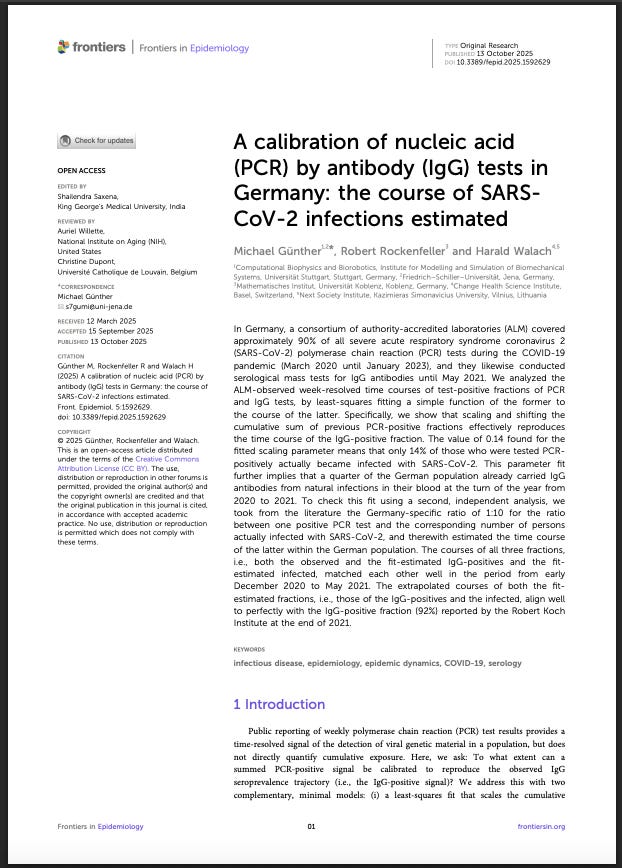
The study was conducted by researchers from multiple European universities and research institutes, examining data from Akkreditierte Labore in der Medizin (ALM), a laboratory consortium that conducted roughly 90% of all PCR testing in Germany during the period analyzed.
Rather than attempting to confirm individual infections through culture (showing evidence of physical, growing live virus in lab cells), the researchers compared weekly PCR-positive fractions with subsequent IgG antibody positivity, which they describe as the accepted biological marker of past infection.
“Since 1942, the detection of virus-specific antibodies has been regarded as the methodological gold standard for confirming infection.”
The logic of the analysis was straightforward.
If PCR-positive results were reliably identifying infected individuals, then PCR positivity should closely track the rise in IgG antibodies over time, given the mainstream virological and immunological model.
Instead, the researchers found that the PCR signal had to be scaled down dramatically to match observed antibody levels.
“Fitting the scaled cumulative PCR-positive fraction … yields PPCR ≈ 0.14 … This implies that roughly only one in seven German individuals with a PCR-positive test later had detectable IgG antibodies, that is, was actually infected with SARS-CoV-2.”
The article further notes that this 14% figure may still be an overestimate.
When accounting for possible testing biases, they state that the proportion of PCR positives representing real infections could be even lower.
“A more conservative interpretation of our results suggests that as few as one in eight or even in nine PCR-positive individuals … may have actually been infected.”
In other words, between 86% and 90% of PCR-positive results did not correspond to confirmed infection.
The paper emphasizes that PCR testing does not, by itself, diagnose infection.
“PCR tests merely detect the presence of fragments of viral genetic material, not necessarily an active infection.”
The study also identifies known sources of false-positive PCR results, including laboratory artifacts and statistical effects that become pronounced during mass testing.
“It is therefore important to highlight two known sources of false-positive PCR results.”
One cited example involves PCR-positive signals detected in water-only samples containing no virus at all.
“The Charité’s PCR assay produced positive results on water controls at cycle threshold (CT) values between 36 and 38.”
Beyond laboratory artifacts, the authors explain that even tests designed to be highly accurate at ruling out uninfected people can still produce large numbers of false positives when true infection levels are low.
In this context, “specificity” refers to how often a test correctly returns a negative result in someone who is not infected.
If specificity is less than 100%, some uninfected people will inevitably test positive.
“According to Bayes’ theorem, the rate of false positives increases when disease prevalence declines, owing to test specificity below 100%.”
Using observed positivity rates and their fitted infection estimate, the authors calculate that PCR specificity alone can explain the discrepancy between PCR positives and confirmed infections.
“Assuming 1% of tested individuals were true positives, a specificity of 94% explains the remaining 6% of PCR-positive results as false positives among the 99% who were not infected.”
The study’s findings have direct implications for how COVID-19 “cases” were counted and used in public policy.
Throughout the pandemic, PCR-positive test results were treated as proxies for infection and were used to justify restrictions and emergency measures.
PCR-positive test results are not being used to justify bird flu containment measures around the world.
The article argues this approach lacks biological grounding.
“A PCR-positive test alone can by no means confirm infection at the individual level.”
The paper concludes that Germany’s reliance on raw PCR positivity substantially overstated infection levels and distorted the understanding of the pandemic’s actual course.
“The principal finding from our analysis … is this: only 14%—and possibly even fewer, down to 10%—of individuals identified as SARS-CoV-2-positive via PCR testing were actually infected, as evidenced by detectable IgG antibodies.”
The article argues that PCR positivity was treated as infection when the data showed it overwhelmingly not.
By analysis, PCR positivity does not reliably indicate infection, raising questions about its continued use as a case-defining tool in current and future disease responses.


 fox files
Leave a comment