
Amid worries of a coming avian influenza pandemic.

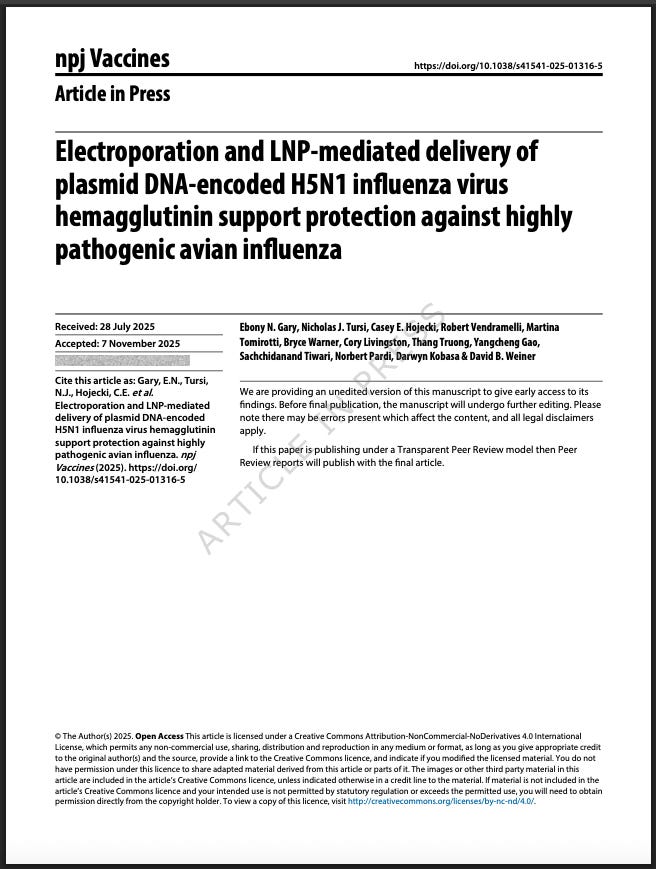
A new study preprint published last week in the journal npj Vaccines describes a multinational research program that designed, engineered, and tested synthetic versions of the H5N1 bird flu virus’s hemagglutinin protein—one of the key components that allows the virus to infect cells.
The scientists altered these genetic sequences, delivered them into animals using advanced DNA and lipid-nanoparticle (LNP) technologies, and then conducted lethal challenge experiments with highly pathogenic H5N1 viruses inside a Canadian government biocontainment facility.
This means researchers created synthetic versions of a dangerous flu component, injected them into mice using vaccine-style technologies, and then exposed the animals to very deadly strains of H5N1 to test how well the constructs worked.
The study is authored by a large team from the United States, Canada, and Europe, including researchers from the Wistar Institute, the University of Pennsylvania, the Public Health Agency of Canada, and the University of Bologna.
Funding Sources
The research was funded primarily by the National Institute of Allergy and Infectious Diseases (NIAID) through its Collaborative Influenza Vaccine Innovation Centers (CIVIC) program under contract 75N93019C00051.
This is a federal vaccine-development initiative said to be designed to prepare the U.S. for future influenza outbreaks using rapidly adaptable genetic platforms.
But the creation of new viruses raises national security concerns.
Congress, the White House, the Department of Energy, the FBI, the CIA, and Germany’s Federal Intelligence Service (BND) have confirmed that the COVID-19 pandemic was likely the result of lab-engineered pathogen manipulation.
Additional support came from the W.W. Smith Charitable Trust Distinguished Professorship in Cancer Research and The Jill and Mark Fishman Foundation.
In other words, the work was paid for by the same federal agencies responsible for pandemic vaccine programs, along with private biomedical foundations.
Institutions Involved
The experiments were carried out by a coordinated network of laboratories:
- The Wistar Institute (Philadelphia) designed and built the synthetic H5N1 DNA constructs, performed immune studies, and conducted structural modeling using AlphaFold 3.
- The University of Pennsylvania assisted with lipid-nanoparticle formulation and microbiology methods.
- The Public Health Agency of Canada’s National Microbiology Laboratory in Winnipeg performed the live H5N1 infections and lethal challenge experiments, including tests using a recombinant H5N1 virus constructed from synthetic gene segments.
- The University of Bologna contributed additional biotechnology expertise.
The U.S. labs designed and built the engineered genetic materials, and the Canadian government lab carried out the dangerous live-virus testing.
The authors include: Ebony N. Gary, Nicholas J. Tursi, Casey E. Hojecki, Robert Vendramelli, Martina Tomirotti, Bryce Warner, Cory Livingston, Thang Truong, Yangcheng Gao, Sachchidanand Tiwari, Norbert Pardi, Darwyn Kobasa, and senior author David B. Weiner.
What Is Scientifically Alarming
Several aspects of this research stand out as high-risk from a biodefense perspective, even though the work is framed as vaccine development.
1. Synthetic Genetic Engineering of H5N1 Components
The team did not merely study existing viruses.
They engineered new synthetic versions of the H5N1 hemagglutinin gene, including codon optimization (which boosts expression in human cells) and deliberate modification of the protease cleavage site, a region strongly linked to H5N1’s virulence.
They edited the part of the virus that helps determine how dangerous it is.
2. Construction of a Recombinant H5N1 Virus From Synthesized Gene Segments
The researchers created a chimeric H5N1 virus by combining gene segments that were commercially synthesized and assembled from cloned DNA.
They then rescued this artificial virus using reverse-genetics techniques.
This means they built a new lab-made version of H5N1, piece-by-piece, using artificial DNA.
3. Use of LNP Delivery and Electroporation to Express Viral Genes Inside Animals
The study delivered the synthetic HA genes using LNPs (the same technology used in COVID-19 mRNA vaccines) and electroporation, a technique that uses electrical pulses to force genetic material into cells.
Both approaches greatly increase how efficiently engineered genetic material can spread through tissues.
These tools make it much easier for lab-designed genetic material to take hold inside the body.
4. Lethal Challenge Work Using High-Dose H5N1
Mice were exposed to 10 times the lethal dose (10 LD50) of highly pathogenic H5N1 strains—including both natural isolates and the lab-built recombinant virus.
They infected animals with very large amounts of a deadly virus to test whether the synthetic constructs gave protection.
5. Corporate Ties of the Senior Author
The senior scientist, David B. Weiner, discloses paid relationships with Pfizer, AstraZeneca, Sanofi, Inovio, Flagship, and others.
This means the research directly intersects with large pharmaceutical companies that develop genetic vaccines and related technologies, raising conflicts of interest worries.
Why This Matters for Policymakers
This study demonstrates that federal funding is supporting research with clear dual-use potential, meaning it could advance vaccines or, if misapplied, enable the construction or enhancement of dangerous influenza viruses.
The same techniques used to create synthetic vaccine antigens—codon optimization, cleavage-site modification, LNP delivery, and recombinant virus assembly—can also be used to create novel viral strains with properties that do not currently exist in nature.
The technical sophistication is notable, especially the deliberate editing of cleavage sites and the full reconstruction of an H5N1 virus from cloned fragments, which is uncommon outside of specialized influenza-engineering programs.
This work shows that laboratories funded by the U.S. government and partnered with foreign agencies are actively engineering pieces of dangerous bird flu viruses and testing them in high-security facilities.
The stated goal is to develop better vaccines, but the methods overlap with techniques traditionally associated with gain-of-function research, which can create new biological risks if not tightly controlled.


Leave a comment