
U.S. government is not slowing its push toward intranasal self-replicating RNA vaccine technology.

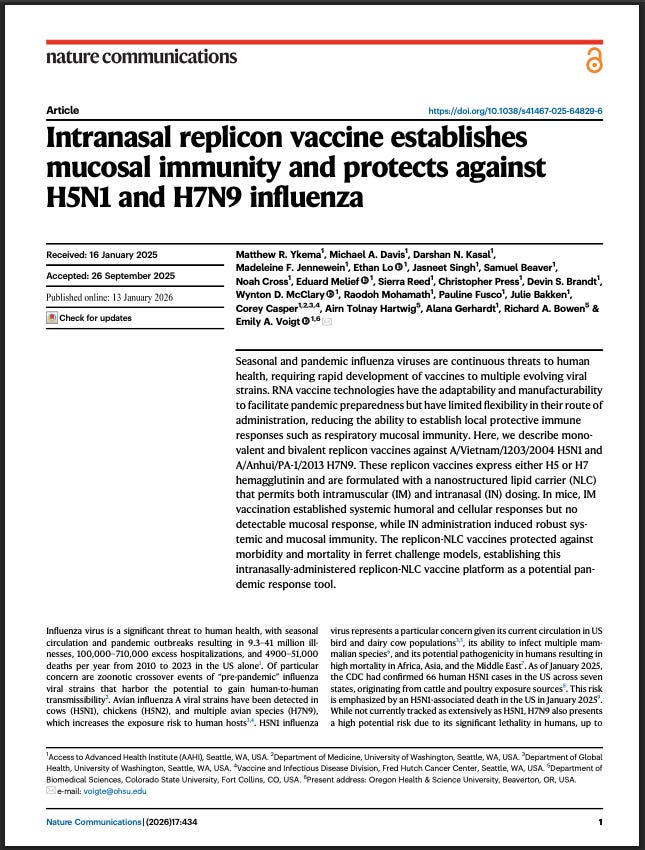
A U.S. military–funded research program has developed an intranasal, self-replicating RNA (sa-mRNA) vaccine targeting H5N1 avian influenza, built using chimeric viral constructs assembled through reverse genetics.
The work was disclosed in a 2026 Nature Communications paper and explicitly funded through a U.S. Army–administered biodefense contracting mechanism.
The vaccine is said to force cells to produce H5N1 bird flu antigen while simultaneously producing viral replication enzymes that copy the self-amplifying RNA inside the cell.
The U.S. government is funding the creation of next-generation bird flu vaccines while funding the creation of purported chimeric “Frankenstein” bird flu viruses.
Congress, the White House, the Department of Energy, the FBI, the CIA, and Germany’s Federal Intelligence Service (BND) have confirmed that the COVID-19 pandemic was likely the result of lab-engineered pathogen manipulation.
Why is the government making the bird flu pandemic problem and solution at the same time, just like it was doing with coronaviruses before the COVID-19 outbreak?
What Was Built
The researchers are said to have engineered a self-amplifying RNA vaccine that uses a Venezuelan equine encephalitis virus (VEEV) replicon backbone into which they inserted influenza hemagglutinin (HA) genes from H5N1 (and H7N9).
The RNA construct was packaged in a cationic nanostructured lipid carrier and designed for intranasal spray delivery.
This is not conventional mRNA.
Self-amplifying RNA replicates inside host cells, increasing antigen production after administration.
While the construct is described as replication-defective (it lacks viral structural genes and cannot form a spreading virus), it is nonetheless a synthetic viral system built from components of different viruses.
Reverse Genetics & Chimeric Design
The platform was produced using reverse genetics—starting from gene sequences, cloning them into plasmids, and generating RNA by in-vitro transcription.
In practical terms, this means influenza genetic material was deliberately engineered into a VEEV replicon, creating a chimeric viral construct designed to self-amplify once inside cells.
This approach represents intentional genetic assembly of viral parts to achieve a specific biological effect.
Intranasal Spray Delivery
The vaccine was purpose-built for intranasal (IN) administration, a route the authors emphasize for inducing mucosal and lung-resident immune responses that intramuscular vaccines do not generate.
The paper reports distribution throughout the upper and lower respiratory tract, with some material swallowed into the gastrointestinal tract—a confessed feature of intranasal dosing.
This delivery choice matters because it places a self-replicating RNA system directly onto respiratory mucosa, rather than confining it to muscle tissue.
The Virus Target: H5N1
The primary antigen target is H5N1 avian influenza, repeatedly framed in the paper as a pre-pandemic threat.
Ferret challenge experiments involved high-dose intranasal exposure to influenza, with the sa-mRNA platform reported to protect against severe disease.
The study positions the platform as rapidly deployable, emphasizing scalability, thermostability, and potential for stockpiling—language consistent with pandemic preparedness, not routine seasonal vaccination.
Who Funded It—& How
The paper states plainly that the work was “sponsored by the US Government under Other Transaction number W15QKN-16-9-1002.”
W15QKN-16-9-1002 is a U.S. Army Contracting Command–New Jersey Other Transaction Agreement (OTA) established under Section 815 of the 2016 National Defense Authorization Act.
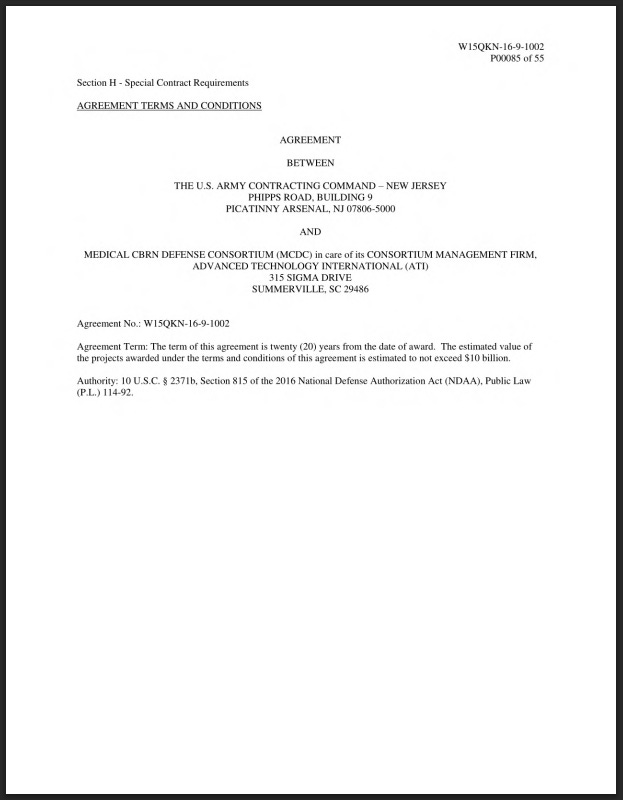
The agreement created the Medical CBRN Defense Consortium (MCDC) to fund research and development of medical countermeasures for chemical, biological, radiological, and nuclear (CBRN) threats.
Key points from the OTA itself:
- The agreement is administered by the U.S. Army Contracting Command on behalf of the Department of Defense.
- It authorizes the government to select, direct, and fund specific projects it deems necessary.
- The scope explicitly includes vaccines, medical countermeasures, and manufacturing platforms designed for rapid response to biological threats.
- The estimated value of projects issued under the agreement is up to $10 billion, with a 20-year term.
The research was supported through a military biodefense R&D framework designed to develop deployable medical technologies.
Bottom Line
The Nature paper confirms that a U.S. military–administered funding program supported the development of an intranasal, spray-form self-replicating sa-mRNA vaccine built from chimeric viral constructs that include H5N1 influenza genes.
The authors emphasize speed, scalability, and deployment readiness.
This is best understood not as a routine flu-vaccine study, but as a biodefense-driven platform demonstration: a synthetic, self-amplifying viral system designed for rapid respiratory deployment in a future pandemic scenario.
At a time when governments now acknowledge that lab-engineered pathogens can spark global crises, the United States is simultaneously funding the creation of chimeric avian influenza systems and the intranasal self-replicating technologies positioned to counter them—collapsing the line between pandemic threat creation and pandemic response into the same military-run pipeline.


Leave a comment