The Truth Is Out There

Archive for the ‘Uncategorized’ Category

Did Congress Just Pull Off A Shocking Financial Coup Without Anyone Noticing? The GENIUS Act: A Trojan Horse For Financial Control Disguised As Consumer Protection.


On June 17, 2025, the U.S. Senate passed the so-called GENIUS Act (Guiding and Establishing National Innovation for U.S. Stablecoins) in a 68-30 bipartisan vote. Stablecoins, digital assets designed to maintain a stable value relative to a fixed asset like the U.S. dollar, have emerged as a pivotal component of the burgeoning digital economy, offering the promise of faster, cheaper, and more accessible financial transactions.

However, while marketed by its proponents as a consumer protection bill and a safeguard for financial stability, a closer examination reveals its true intent. The GENIUS Act appears less concerned with protecting American consumers and more with entrenching the power of incumbent financial institutionsstifling genuine cryptocurrency innovation, and laying the groundwork for unprecedented government overreach into individual financial lives.

The seemingly broad bipartisan support, often touted by proponents as a sign of its necessity, masks deeper concerns from critics who argue that the bill’s provisions disproportionately benefit established financial giants, many of whom have heavily lobbied Congress on crypto legislation. This coalition of interests raises fundamental questions about whose protection the bill truly prioritizes.

The full bill text can be found here: GENIUS Act – S.1598.
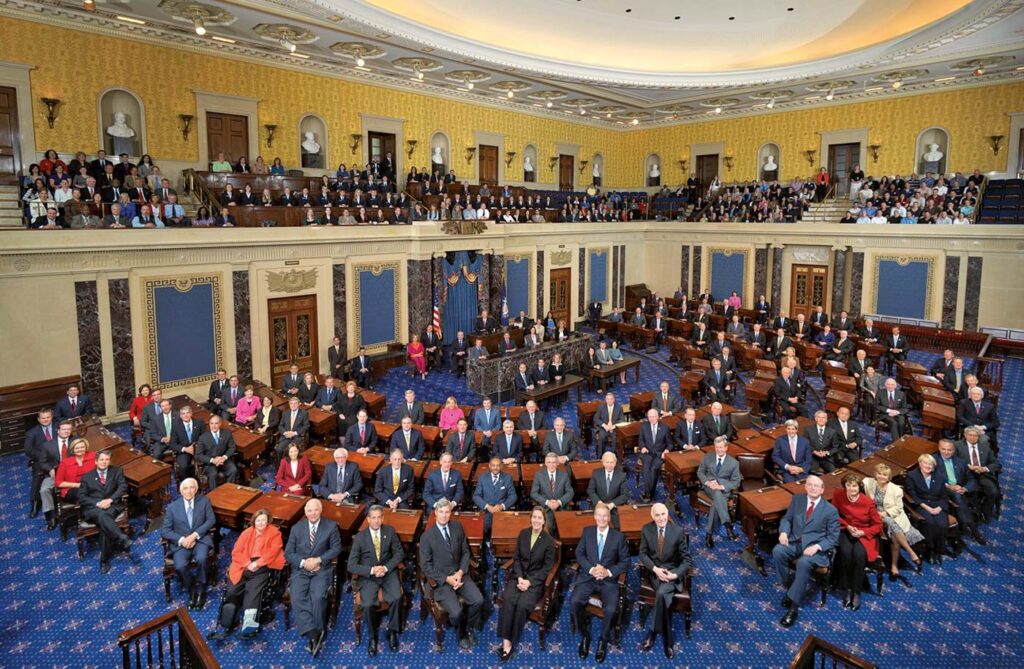
U.S. Senate, 111th Congress, Senate Photo Studio, Public domain, via Wikimedia Commons

A Closer Look at the Bill’s Restrictive Provisions

The GENIUS Act’s core mechanism for control lies in its severe restrictions on stablecoin issuance. The bill limits the ability to issue stablecoins to only three types of entities: subsidiaries of insured depository institutions, federally qualified nonbank payment stablecoin issuers, or state-qualified payment stablecoin issuers.

This narrow definition of “permitted issuers” creates an almost insurmountable barrier to entry for smaller, innovative DeFi projects, and startups. The stringent licensing requirements, high capital reserves, and ongoing compliance costs associated with becoming an “insured depository institution subsidiary” or a “federally qualified nonbank issuer” are prohibitively expensive and bureaucratically complex for new entrants.

Instead of fostering a competitive ecosystem, the Act effectively creates a cartel, consolidating control over the future of digital payments within the existing financial infrastructure — the very institutions that crypto was designed, in part, to decentralize.

This framework effectively hands the reins of the stablecoin future to established players like JPMorgan Chase, Citibank, and other large commercial banks, many of whom have publicly expressed interest in issuing their own stablecoins. The result is not innovation from the ground up, but rather a top-down control by entities comfortable with the status quo.

In the name of “consumer safety,” the bill also bans interest payments on stablecoin holdings. Historically, stablecoins have offered users the potential to earn yield through various DeFi protocols, such as lending platforms or liquidity pools. This ability to generate passive income has been a significant draw for many, especially in an era of near-zero interest rates in traditional banking.

By banning interest payments, the GENIUS Act eliminates a key incentive for stablecoin adoption, undermining a core benefit that digital currencies offer over traditional fiat. Consequently, Americans who might otherwise earn yield through digital currencies are instead pushed back into the traditional banking system, where interest rates on standard savings accounts are notoriously low.

This prohibition, framed as “consumer protection” to prevent “run risks” seen in past crypto failures, is more accurately described as protectionism for legacy financial institutions. By eliminating the competitive advantage of yield-bearing stablecoins, the Act forces consumers back into conventional banking products, where their capital remains within the walled gardens of large banks, earning minimal returns for them while the banks profit from relending those funds.

Additionally, the Act requires all stablecoins to be backed one-to-one with U.S. dollars or similar liquid assets. While seemingly prudent to ensure stability, this rule, by strictly limiting the types of backing assets and prohibiting fractional reserves, effectively limits capital efficiency and reduces monetary velocity — the rate at which money is exchanged in an economy.

This impairs the ability of stablecoins to support dynamic lending markets and foster small business growth within the digital ecosystem. In traditional finance, banks operate on a fractional reserve system, allowing them to lend out a portion of their deposits, thereby increasing the money supply and facilitating economic activity.

While the crypto space has seen failures from under-collateralized stablecoins, a complete ban on any form of capital efficiency means stablecoins cannot be re-hypothecated or used in a way that generates new economic value through lending, which is a cornerstone of a healthy financial system.

The irony is stark: while stablecoins are mandated to hold 100% reserves, traditional banks operate on a fractional reserve system, lending out the vast majority of their deposits. This double standard suggests that the true aim is not merely stability, but control, preventing stablecoins from ever truly competing with the established financial order.

This rigid 1:1 backing, while ensuring safety, also ensures stagnation, effectively freezing innovation and thus propping up a financial status quo that has demonstrably failed many through inflationary policies and limited access to capital.

Bybit.com, CC BY 2.0 , via Wikimedia Commons

Regulatory Capture in Action

Supporters, including prominent figures like Senator Cynthia Lummis (R-Wyo.) and Senator Kirsten Gillibrand (D-N.Y.), champion the GENIUS Act as a necessary framework to bring regulatory clarity to the nascent stablecoin market.

Senator Lummis, a co-sponsor and known advocate for digital assets within a regulated framework, insisted on X, the Act “preserves the dual banking system, protects consumers, [and] secures our financial future.” Senator Gillibrand echoed similar sentiments, asserting that the bill would “protect consumers from the risks seen in recent crypto market volatility” while safeguarding “the dominance of the U.S. dollar” in the rapidly evolving digital landscape.

They often point to past failures, such as the collapse of algorithmic stablecoins or unregulated crypto exchanges like FTX, as justification for these stringent measures, arguing that strict guardrails are essential to prevent systemic risk and illicit financial activity.

However, for a growing chorus of critics, these claims are nothing more than elaborate window dressing. Senators Rand Paul (R-Ky.) and Josh Hawley (R-Mo.), a vocal opponent of what he perceives as corporate cronyism, didn’t mince words.
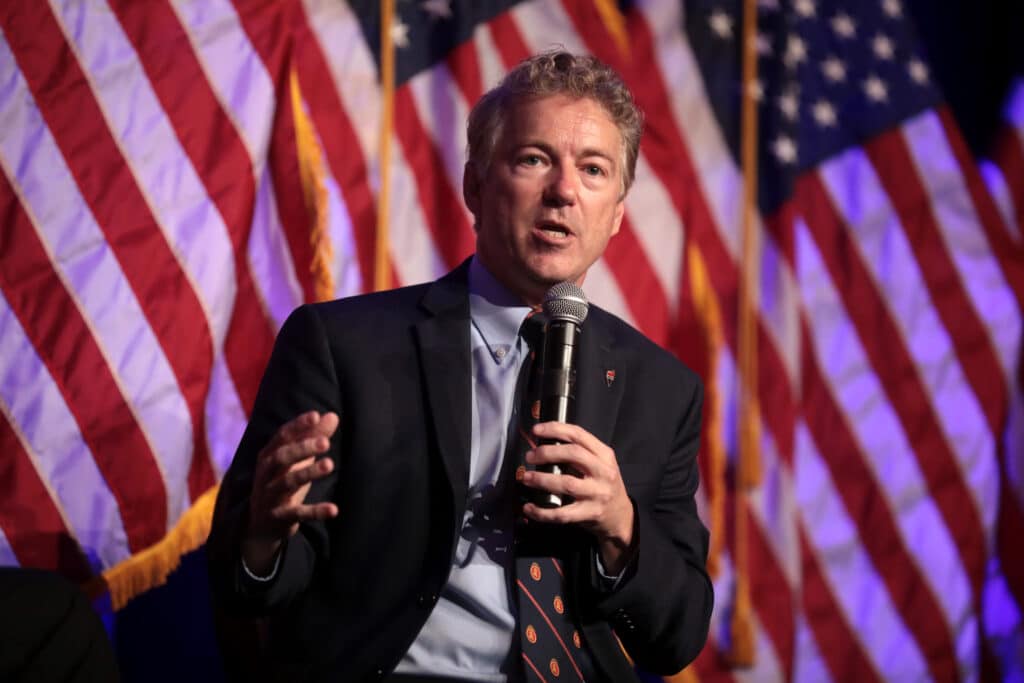
Gage Skidmore from Surprise, AZ, United States of America, CC BY-SA 2.0 , via Wikimedia Commons

Known for his libertarian leanings and skepticism towards increased government intervention, Senator Paul argued the legislation would add needless federal regulations. Senator Hawley’s concerns focus on the potential for the bill to empower tech giants at the expense of ordinary citizens and existing financial institutions.

The Missouri legislator argued that the Act, as written, could allow tech giants to create digital currencies that would compete with the dollar and incentivize these companies to collect even more user financial data. Hawley even went so far as to call the bill “a huge giveaway to Big Tech.” He also expressed concerns that the bill’s safeguards against the risks of letting tech companies issue their own digital currencies had been weakened.

Other criticisms stem from the bill’s foundational design: by limiting issuance to heavily regulated and often large financial entities, and by stifling the very mechanisms (like yield) that make stablecoins attractive alternatives, the Act creates an uneven playing field designed to favor existing banking infrastructure rather than fostering genuine innovation from independent developers or smaller fintech companies.

Robust opposition also comes from Peter Van Valkenburgh, director of Research at Coin Center, a leading nonprofit advocacy group dedicated to the policy issues facing cryptocurrency and decentralized computing technologies.

Van Valkenburgh, a respected voice in the crypto policy space, offered a stinging critique of a amendment granting the president and the Office of Foreign Assets Control (OFAC) expansive authority to ban Americans from using certain blockchain technologies, including open-source smart contracts, without due process.

His argument focuses on ensuring that legislation does not infringe upon the rights of developers and users of decentralized technologies and highlights that the ban on yield doesn’t safeguard consumers from risk so much as it removes a compelling reason for consumers to opt for stablecoins over traditional bank accounts, thereby protecting the revenue streams and market dominance of established financial institutions.

This is, quite simply, regulatory capture in its purest form. Regulatory capture occurs when a regulatory agency, created to act in the public interest, instead advances the commercial or political concerns of special interest groups that dominate the industry or sector it is charged with regulating.

In this case, legacy financial institutions, through aggressive lobbying and influence — with reports indicating banking associations and major financial conglomerates have spent millions in recent years lobbying Congress on digital asset legislation — appear to have directly shaped legislation that serves their interests by limiting competition and solidifying their market position, rather than truly fostering a healthy, open financial ecosystem.

They are not merely playing the game; they are quite literally writing the rules for a game they want to win without any meaningful competition.

Surveillance Disguised as Security

Beyond its profound economic implications, the GENIUS Act raises significant red flags concerning civil liberties and individual financial privacy. The Act mandates strict Know Your Customer (KYC) and Anti-Money Laundering (AML) requirements for all stablecoin issuers.

In practice, this means that every user interacting with a regulated stablecoin would be subject to extensive identity verification — providing names, addresses, Social Security numbers, and potentially even biometric data — and continuous transaction monitoring by regulated entities.

While proponents argue such measures are essential to combat illicit finance and terrorism, critics contend they pave the way for unprecedented federal surveillance.

Given documented instances where government agencies have leveraged financial institutions to deplatform individuals or organizations based on political or social views — often under vague pretexts — granting Washington a direct pipeline into every digital wallet should be an immediate non-starter for any advocate of civil liberties.

For example, critics point to actions taken during the Canadian trucker protests, where authorities ordered financial institutions to freeze accounts of protestors without due process. Similarly, there have been reports of certain politically active groups in the U.S. having their banking services terminated without clear justification.

Under the expansive pretext of “national security,” the GENIUS Act grants the federal government broad, unchecked authority to track, freeze, or even seize stablecoin assets, effectively transforming financial freedom from a fundamental right into a revocable privilege dependent on government approval.

The bill explicitly mandates that stablecoin issuers “maintain the technical ability to freeze and burn wallets to ensure compliance with lawful orders” and “coordinate with law enforcement as a condition of participating in U.S. secondary markets.”

This means that the technology itself will be designed with a kill switch, allowing federal agencies to unilaterally halt transactions or confiscate funds in digital wallets, bypassing traditional judicial processes or requiring minimal legal hurdles.

This capability transforms stablecoins from a tool for economic empowerment into a potential instrument of state control, undermining the very ethos of decentralized, permissionless finance.Should House Republicans demand major changes to the GENIUS Act — including ending the surveillance powers and restoring interest payments — even if it means tanking the bill entirely? *

  • Yes — kill it if it doesn’t protect liberty
  • Maybe — fix the worst parts, but don’t start over
  • No — pass it now to bring crypto under control

Special Carve-Outs and Hypocrisy

One of the most alarming and ethically questionable details unearthed in the bill is a specific exemption that reportedly shields certain government officials and their families from prohibitions on personally profiting from stablecoin ventures.

This glaring conflict of interest has ignited fierce criticism, particularly in light of recent public disclosures, for example, that President Donald Trump has personally profited from stablecoin-related investments. Reports from major news outlets have highlighted that entities tied to President Trump have engaged in ventures involving stablecoins, raising questions about the timing and nature of such exemptions within legislation that heavily regulates the very market he might benefit from.

Senator Jeff Merkley (D-Ore.) reportedly criticized the outcome, accusing Republicans of rubberstamping “Trump-style crypto corruption” and stating that GOP lawmakers refused to hold a vote on an ethics clause that would have closed this loophole.

This apparent double standard fundamentally undermines the entire premise of the bill as a “consumer protection” measure. If the very lawmakers crafting the regulations can carve out exceptions for themselves or their associates to profit, it suggests the legislation is less about public interest and more about maintaining a system where the politically connected can leverage new markets while restricting access and innovation for the general public.

Even Senator Elizabeth Warren (D-Mass.), a vocal critic of the broader cryptocurrency industry often dubbed “no friend of crypto” due to her consistent warnings about its potential for illicit finance and systemic risk, has found reason to criticize the GENIUS Act.

While her concerns typically center on expanding regulatory authority and consumer safeguards, she notably argued that the bill, as written would leaves the door wide open for another FTX-style collapse by massively expands the marketplace for stablecoins while failing to address the basic national security risks posed by them.

She also pointed to “glaring loopholes that would allow Tether, a notorious foreign stablecoin issuer, access to U.S. markets.” Her critique, predictably, aligns with a desire for even more stringent oversight rather than a defense of innovation, yet it highlights the bill’s perceived shortcomings even from within the regulatory camp, suggesting it fails to achieve its stated goals even for some of its theoretical allies.

This illustrates a peculiar alliance of opposition: free-market conservatives who decry government overreach and stifle innovation find common ground with progressive regulators like Warren, albeit for vastly different reasons.

For conservatives, the bill is an assault on financial freedom and an example of corporate capture. For Warren, it’s not restrictive enough to prevent perceived dangers, highlighting a shared concern about the bill’s fundamental design, despite differing philosophies on regulation itself.
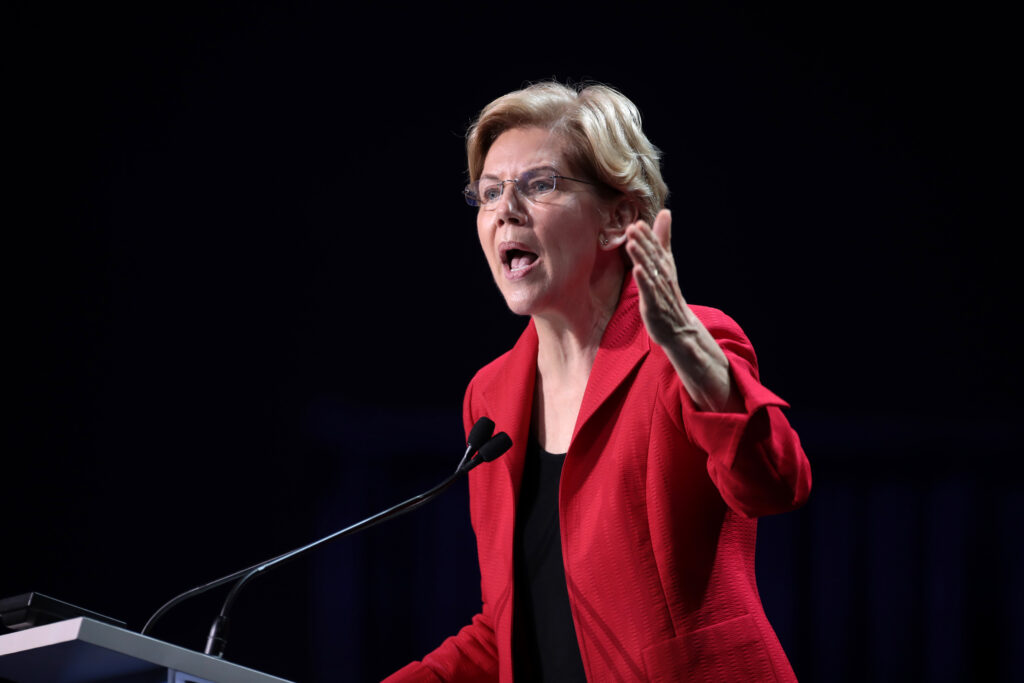
Gage Skidmore from Peoria, AZ, United States of America, CC BY-SA 2.0 , via Wikimedia Commons

Where Things Stand

The GENIUS Act has successfully passed the Senate and now moves to the House of Representatives, where it is currently under consideration by the House Financial Services Committee.

Prospects for its passage appear strong, largely due to its bipartisan Senate support and the significant backing it has received from powerful banking and certain fintech interests who stand to gain from the established regulatory framework.

However, the House Financial Services Committee has been working on its own stablecoin legislation, the “STABLE Act,” which, while conceptually similar, contains some key differences regarding foreign stablecoin issuers, the requirements for transitioning from state to federal oversight, and specific phase-in timelines.

This means the two chambers will likely need to reconcile their versions, potentially in a conference committee, before a final bill can be sent to the president’s desk.

Official White House Photo, Public domain, via Wikimedia Commons

However, not all within Congress are ready to rubber-stamp the Senate’s version. A vocal group of House conservatives, including members of the House Freedom Caucus, is actively pushing for significant amendments.

Their proposed changes include a repeal of the controversial interest ban, a mandate for far greater transparency in reserve audits (beyond the current disclosure requirements), and crucially, efforts to strip out the expansive “national security” provisions that they argue constitute excessive government overreach into private financial affairs.

These amendments represent a last-ditch effort to salvage some semblance of financial freedom and competitive market dynamics within the bill. Repealing the interest ban would restore a key incentive for stablecoin use, while enhanced transparency in audits could build genuine consumer trust rather than relying on centralized control.

Stripping out the national security overreach is seen by these conservatives as vital to protecting civil liberties and preventing the potential for a “social credit system” where financial access is tied to government compliance.

Whether the House will serve as a check or a rubber stamp remains to be seen.

Conclusion

The GENIUS Act, far from being a “genius” solution, stands exposed as a sophisticated Trojan Horse. It is a calculated, strategic maneuver by entrenched financial powers and their well-placed allies in Washington to co-opt a truly transformative technology — decentralized digital currencies — and forcibly bring it under their centralized control.

Cloaked in the language of “consumer protection” and “financial stability,” this legislation systematically restricts economic freedom, stifles genuine competition from innovative startups, and dangerously empowers unelected bureaucrats with unprecedented control over individual financial activity.

For anyone who values economic liberty, technological innovation, and protection against governmental overreach, this legislation demands strong opposition. Financial freedom is not merely an economic concept; it is foundational to individual liberty itself.

The GENIUS Act, by design and by consequence, represents a profound attack on both, threatening to turn a promising digital future into a regulated, surveilled extension of a failing financial past.

Citizens concerned about this pivotal legislation should contact their representatives in the House, urging them to critically examine the bill’s true implications, support amendments that protect innovation and privacy, and resist the push to consolidate financial power in the hands of a few.

You can read the full legislative text of the GENIUS Act (S.1598) on Congress.gov here: 👉 GENIUS Act – S.1598 (Congress.gov).

Epstein And The Intelligence Trap: What They Know And Can’t Say


Screenshot via X [Credit: @amuse]

The Dissonance of Silence

It is often said that silence speaks louder than words. But in politics, particularly in the realm of national security and institutional deception, silence can scream. This week, the Department of Justice issued a two-page memo attempting to close the book on the Epstein affair. It claimed, with bureaucratic finality, that there is no client list, no credible blackmail operation, and no intelligence connection to Jeffrey Epstein. In response, three people who once led the charge against deep state duplicity, who built their reputations torching the intelligence community’s darkest corners, Pam Bondi, Kash Patel, and Dan Bongino, stood by and said, essentially, nothing.

DOJ/FBI Memo Regarding Jeffrey Epstein

This abrupt and telling quiet should give us pause.

To understand the full weight of their silence, we must revisit who these individuals are and the stakes of what they now decline to confront. Bondi, the former Florida Attorney General, earned acclaim for prosecuting high-profile criminals and exposing systemic corruption. Patel, an architect of the House Intelligence Committee’s investigation into the Russia hoax, is one of the most legally precise and fearless national security officials of the past decade. Bongino, who served in the Secret Service and later as a conservative commentator, has made a career of unmasking the inconsistencies of the intelligence apparatus, none more frequently than Epstein.

In January 2024, Bongino played a clip on his podcast in which a journalist stated he was “100% convinced that Epstein was killed because he made his whole living blackmailing people.” Bongino added, “I’ve heard the same claims from another reporter and they are super important.” Patel has similarly echoed doubts about Epstein’s death and the intelligence community’s role in covering up his network. Bondi, during the election cycle and beyond, pledged that the Epstein saga was not over. Each built public trust on the promise that they would get to the bottom of it.

Now, they all plead ignorance. Or worse, they call for no further action.

When asked at a cabinet meeting whether Epstein was connected to US intelligence, Bondi responded she didn’t know and would “look into it.” Bongino has fallen silent on the topic he once described as the tip of an intelligence iceberg. Patel, in statements since assuming office, has offered little to nothing on the subject.

Given who these people are, that silence is not neutral. It is epistemically loaded. What explains it?

There are two plausible answers. First, they now know, beyond the veil of classification, that Epstein was in fact an asset of the US intelligence community. Not a rogue financier, not merely a criminal pervert, but a controlled contractor in a sprawling, state-sanctioned blackmail apparatus designed to secure kompromat on foreign and domestic elites. If this is true, then acknowledging it would expose ongoing operations, compromise alliances with other intelligence services such as MI6 and Mossad, and detonate diplomatic landmines too dangerous to handle.

The second possibility is more sinister. Perhaps they are not simply withholding in service of state interests. Perhaps they, too, are now targets of the very coercive mechanisms they once pledged to dismantle. Perhaps they are being threatened, pressured, blackmailed, directly or indirectly, overtly or subtly. Epstein’s apparatus, after all, was designed to survive him. The very system that protected him for decades still exists. And it is entirely capable of protecting itself.

The CIA is not merely a collector of secrets; it is a curator of silence.

That brings us back to the core of the matter: Epstein was not a lone predator. He was not merely a billionaire with an inexplicable passion for teenage masseuses. His operations were not accidental, nor could they have persisted without protection at the highest levels of intelligence and government.

Consider his early trajectory. In the late 1970s, Epstein was hired at the Dalton School by Donald Barr, an ex-OSS officer and the father of future Attorney General Bill Barr. This is not coincidence. Epstein didn’t even possess a college degree. His placement at an elite school known for educating the children of the Manhattan elite set the stage for everything to come. He gained access to power, and more importantly, to the children of power.

From there, Epstein transitioned into finance with a swift rise at Bear Stearns, where he managed sensitive accounts and was involved in insider trading schemes tied to prominent families. He exited the firm just ahead of an SEC investigation, unscathed, protected. In the 1980s, he partnered with Steven Hoffenberg in a massive Ponzi scheme at Towers Financial. Hoffenberg went to prison. Epstein did not.

In a court filing in 2019, Hoffenberg stated under oath that Epstein was the “architect” of the fraud. The US government never charged him. Again, protected.

In the 1990s, Epstein became deeply enmeshed with Leslie Wexner, the billionaire founder of L Brands and co-founder of the secretive Mega Group. Epstein was given full control of Wexner’s fortune, deeded Wexner’s New York mansion, and placed into direct financial and operational contact with Israeli intelligence. His closest confidante, Ghislaine Maxwell, is the daughter of Robert Maxwell, an Israeli asset who helped disseminate surveillance software to foreign governments was clearly put in Epstein’s orbit by MI6.

These are not happenstances. This is recruitment and operational integration.

Epstein moved weapons, money, and people. He brokered deals in the Middle East with known intelligence-linked arms traffickers. He used Southern Air Transport, a CIA shell company from the Iran-Contra era. He obtained a fake passport with a Saudi address. He spent time in intelligence-connected banking hubs like the Cayman Islands and Geneva. He was never arrested for these activities. He was protected, always.

His homes were wired with cameras. His girls were groomed to recruit more. His visitors were famous, influential, and often compromised. He catalogued everything. Digital kompromat for the post-Cold War age. Hundreds of hard drives and thousands of DVDs containing unknown volumes of potentially incriminating material were discovered in his properties, but inexplicably, the FBI left them behind and allowed Epstein’s people to remove them. When the agency later returned to retrieve them, they were gone, only to be returned by Epstein’s own lawyers. By then, who knows what had been copied, edited, erased, or weaponized.

So when the DOJ now asserts, with a straight face, that there is no “credible evidence” of a client list, we must understand what that phrase really means. It means nothing admissible, nothing declassified, nothing that would require official action. It does not mean the list does not exist. It means the regime will not recognize it.

To question this is not to indulge conspiracy. It is to recognize pattern. This is the same DOJ that refused to examine Hunter Biden’s foreign influence operations, the same FBI that sat on the Clinton email server scandal, the same intelligence community that lied about FISA abuse.

And so we must return to the question that animates this article: Why are Bondi, Patel, and Bongino protecting the very institution they once sought to expose?

If it is for national security, then fine. But tell us. Say that. Do not insult our intelligence with implausible denials and bureaucratic dodge. If they are under threat, then say that, too. Even obliquely.

Because the current silence is not just a betrayal of past statements. It is a betrayal of the people they once served. The American public entrusted them with the truth. They are now behaving like agents of the same concealment machine they once sought to dismantle. Don’t forget, I’ve been asking everyone to give them time to do their jobs.

One solution remains: appoint a special prosecutor. Not one tethered to the Justice Department. Not one embedded within the intelligence bureaucracy. An outsider, with full subpoena and prosecutorial power, to uncover the truth and bring justice to Epstein’s victims, to indict the protectors and profiteers of the system, and to restore credibility to institutions that have forfeited it.

Let the chips fall where they may. If the intelligence community finds that threatening, perhaps it should reconsider the wisdom of trafficking in children and kompromat.

The facts are stubborn. Epstein worked with and for intelligence. He was protected to the end. And if Pam Bondi, Kash Patel, and Dan Bongino will not say it, someone must.

How DEI Cost Lives In Texas: The Tragedy Of Austin’s DEI Hire Fire Chief


Screenshot via X [Credit: @amuse]

In the early hours of July 4th, 2025, flash floods tore through Kerr County, Texas, overwhelming communities and claiming more than a hundred lives. As families were swept from homes and children clung to rooftops, the state called for help. Rescue boats were scarce. Time was short. And Austin’s elite Swift Water Special Operations Teams, some of the best-trained in the country, sat idle. Why? Because Fire Chief Joel Baker said no.

The justification was bureaucratic. Austin had, at one point, been owed approximately $800,000 in reimbursement for past deployments. But even Baker admitted the state was paying its bills and that no overdue balance existed. The real reason, it seems, was politics. And beneath that politics lies something even more disturbing: a bureaucracy that values optics over outcomes, identity over merit, and ideology over life.

Let us begin plainly. Chief Joel Baker was not hired because he was the best firefighter. He was hired because Austin, reeling from a fire department engulfed in scandal, needed a symbol. In the year prior to his 2018 appointment, the Austin Fire Department was under state, local, and federal investigation for alleged violations of Title VII of the Civil Rights Act, including claims of both racial and sexual discrimination and harassment. Multiple lawsuits and sharp criticism from across the political spectrum made one thing clear: the city needed an identity hire to stem the bleeding. Baker, a black man with leadership experience, fit the profile. Since taking the post in December 2018, Baker has made it his mission to recruit based on race, sex, and sexual identity. He has said so proudly and publicly. Programs like “Pass the Torch,” which deliberately prioritize nonwhite, nonmale, and nonheterosexual applicants, are the centerpiece of his administration. The result? A fire department that is more diverse, but less competent.

The traditional qualifications for a firefighter, strength, stamina, intelligence, rapid decision-making under pressure, have not changed. But the standards have. In response to the predictable failure of his preferred demographics to meet existing thresholds, Baker simply changed the thresholds. He launched investigations into why minority applicants were underperforming. The answer was as predictable as the question: the tests were too hard. So Baker made them easier. Lowered the IQ bar. Softened physical expectations. All to ensure that more boxes could be checked on quarterly DEI reports.

The irony is brutal. The very teams Chief Baker refused to deploy, the Swift Water rescue units, are disproportionately composed of white men. They represent the last meritocratic redoubt within the Austin Fire Department. Many have years of experience and have saved hundreds of lives. But Baker did not build them. He has not promoted them. In fact, he has worked to marginalize them in favor of his DEI vision.

So when Governor Abbott issued the request for pre-deployment on July 2nd and 3rd, before the floodwaters peaked, Baker balked. Not because he feared for the safety of his crews, who train for this very scenario. Not because the request was unclear. And certainly not because of funding: Texas law mandates that the state reimburse such deployments. Baker knew this. But instead of action, he delivered delay. Instead of deploying a full contingent of trained teams, he sent a trickle. Three rescue swimmers at first. Eight more the next day. Another six after that. Lives were lost in those hours. And those lives are not coming back.

On July 7, the Austin Firefighters Association initiated a vote of no confidence in Chief Baker. Their accusation was blunt: his delay cost lives. They are right. But the story is larger than one man’s failure. It is about the machinery that elevated him in the first place, a bureaucracy more concerned with appearances than outcomes. DEI, diversity, equity, inclusion, sounds benign. In practice, it has become a license to discriminate against the competent and elevate the compliant.

Consider the broader pattern. In 2021, local media reported that nearly 75% of cadet interest cards came from “diversity targets,” a term that flattens human individuality into demographic quotas. African American interest increased 10%, Hispanic interest 21%, while traditional candidate pools shrank. Recruitment staff, under Baker’s orders, reoriented outreach toward these demographics, often to the exclusion of others. Qualified white male applicants were not merely overlooked; they were openly discouraged. Promotion boards began emphasizing identity over service record. The message to veteran firefighters was clear: your excellence is less important than your ethnicity.

And yet, when tragedy struck, it was those same sidelined men who were needed. Not the freshly hired recruits trained under softened standards. Not the symbolic hires who make for good press releases. But the swimmers, the climbers, the old hands who had trained for the worst and were ready to act. They were needed on July 4th. They were ready on July 4th. But they were told to wait.

The Austin Fire Department’s decline under Chief Baker is a microcosm of a national affliction. Public safety is no longer immune from ideology. Increasingly, departments across the US are being stacked from the top down with those whose chief qualification is fitting the narrative. It is not just about hiring. It is about purpose. When the goal of an agency becomes moral virtue as defined by progressive bureaucracy, instead of operational excellence, catastrophe follows.

Some will object that this criticism is unfair, that it ignores historical inequities or systemic bias. But fairness is not the standard in a flood. Competence is. When the waters rise and people scream from rooftops, they do not ask whether their rescuer ticks the right diversity box. They ask whether help is coming. Under Joel Baker, it did not come in time.

The truth is unkind but necessary. DEI ideology, when applied to public safety, kills. Not metaphorically. Not rhetorically. But physically, in water and mud and silence. When Austin refused to send its full water rescue force, it was not an accounting error. It was not a miscommunication. It was a bureaucratic decision rooted in contempt, contempt for the state government, contempt for those who did not fit the diversity mold, and contempt for the very idea that merit should matter more than metrics.

There is a place for diversity in public institutions. But that place must be downstream of excellence. Identity is not a substitute for skill. And when it becomes one, disaster is inevitable. In Kerr County, that disaster was measured in corpses. In Austin, it may soon be measured in resignations.

Debunking The FUD Around Iran’s Nuclear Timeline


It has become a familiar routine. A leak, a whisper, a headline: “Iran could build a bomb in five years.” Then the predictable symphony follows, Democrats feign alarm, the media conjures doom, and the public is offered a neatly packaged dose of FUD: fear, uncertainty, and doubt. But this latest installment, suggesting that a post-strike Iran could reconstitute a nuclear weapons program from scratch and possess a bomb within five years, is not alarming because it is implausible. It is alarming because it is entirely reasonable, and yet is still being weaponized as if it were a revelation.

Here is the truth: we struck Iran’s enrichment facilities, and we destroyed them. The centrifuge halls are gone. The command nodes, the processing plants, the material stocks, all rendered rubble. What remains is ambition, not infrastructure. Yet Democrats now claim that because Iran can reconstitute its program and build a bomb in five years, the strike must have failed. That conclusion is not just illogical, it is dishonest.

Let us begin with the facts. Constructing a uranium enrichment facility is not easy, but it is also not the Manhattan Project. It is an industrial task, not a scientific miracle. The construction of modern enrichment plants, such as Urenco USA and France’s Georges Besse II, took between three and five years. Iran’s own Natanz facility, which was first revealed in 2002 but had been under construction for years, was partially operational by 2003. Fordow, which the West only learned of in 2009, was already close to operational. Thus, from a cold start, Iran could build a hidden enrichment site in three to five years. This estimate is neither speculative nor controversial, it is grounded in public record.

Enrichment itself is faster. To produce one nuclear weapon, Iran would need roughly 20 kilograms of highly enriched uranium, or HEU. That requires about 4,000 Separative Work Units (SWU). With 4,000 IR-1 centrifuges operating at 1 SWU per year, enrichment to weapons-grade would take approximately one year. With 2,000 centrifuges, the timeline stretches to two years.

If this sounds simple, it is because it is. Uranium enrichment is not alchemy. The science is known, the machines are understood, and the material requirements are finite. Any sufficiently advanced industrial state with nuclear scientists and a few hundred million dollars could do it. Indeed, Pakistan did it in the 1980s. North Korea did it in the early 2000s. Iran already has. The knowledge cannot be unlearned.

The cost? Roughly 250 million dollars. That figure includes underground facility construction (50-100 million), centrifuge production (around 100 million), technical expertise (somewhat less, given Iran’s extant knowledge base), and operations. In a world where US government agencies lose that much in annual accounting errors, the idea that a state sponsor of terror cannot marshal such resources over five years is laughable.

So let us clarify: Iran can build a bomb in five years not because our strike failed, but because five years is the standard timeline for anyone with money, expertise, and motive. To suggest this timeline proves futility is to mistake gravity for failure, the fact that a rock falls when dropped does not mean the act of lifting it was in vain.

This brings us to the real problem. The supposed bombshell, that Iran could rebuild its program and produce a nuclear weapon in five years, is now being presented by Democrats as evidence that our recent strike must have failed. But the conclusion does not follow from the premise. If anything, the fact that Iran could take five years to reconstitute its program affirms the success of the strike. We destroyed their facilities. They are starting from scratch. And five years to rebuild is not a sign of failure, it is the very definition of a strategic setback.

In other words, the five-year timeline is not a deterrent to action. It is a window of opportunity. If anything, it buys time, time that should be used to monitor, disrupt, and if necessary, strike again. There is nothing sacred or irreversible about a five-year head start.

This inversion of logic, treating the reasonable as unthinkable, is a recurring pattern in progressive foreign policy circles. It reflects a deeper flaw: the refusal to treat Iran as an adversary operating with agency, strategy, and goals. The FUD machine presents Iran as a ghost, capable of appearing anywhere, invisible to satellites, immune to sabotage. But Iran is not a spirit. It is a state. It has roads, budgets, scientists, and constraints. Its facilities leave traces. Its activities can be monitored. Its secrecy is limited by physics.

Consider the clandestine nature of construction. Critics claim that a hidden enrichment site might delay discovery and therefore delay interdiction. But the evidence says otherwise. Natanz was detected early enough to limit its progress. Fordow, despite being built underground, was discovered in time. In both cases, Western intelligence, aided by defectors, sensors, and satellite imagery, penetrated Iran’s veil of secrecy. The idea that a new site could be built from scratch, fully outfitted, enriched, and armed with zero detection over five years is not only improbable, it is incompatible with historical precedent.

There is also the question of intent. Iran is not merely developing nuclear technology for fun. Its interest in nuclear weapons is strategic. A nuclear-armed Iran would alter the regional balance of power. It would enable greater aggression by Hezbollah and other proxies. It would make Israel’s security calculus more desperate. It would imperil American forces and interests.

Therefore, allowing Iran a five-year glide path to the bomb is not prudence. It is negligence. Worse, it is disingenuous. The Biden-era strategy of appeasement was not borne of ignorance about Iran’s capabilities. It was an ideological commitment to diplomacy as moral posture, rather than strategic tool. This same illusion now resurfaces under the guise of concern: we must not strike, lest we trigger a rebuild. But Iran is always rebuilding. That is what adversaries do.

To be sure, building a covert enrichment site is not trivial. It requires excavation, materials transport, energy sources, and security. But none of these hurdles are insurmountable. They are merely challenges to be delayed, not impossibilities to be dismissed. And delay is enough. Every year of delay is another year of non-proliferation. Every disrupted timeline is a gain. That is why a strike that sets Iran back five years is not a failure. It is a success.

If this seems cold, recall the alternative. The path of least resistance, in which we do not strike, Iran does not stop, and the region careens toward a nuclear Middle East, is not peace. It is entropy.

The media’s presentation of the five-year scenario as a horror story misunderstands the nature of proliferation. The nightmare is not that it can happen in five years. The nightmare is that we pretend it cannot.

To summarize: it is not just plausible that Iran could build a bomb in five years. It is expected. The science permits it. The history supports it. The money is there. The knowledge is there. And so long as the West believes this is too quick to be possible, Iran is gifted one more illusion to exploit.

We must not allow the language of fear to displace the clarity of reason. Five years is not a myth. It is a metric. One that should inform our policy, not paralyze it.

The Day The Nobel Died: Obama, DEI, And The Collapse Of Merit


Screenshot via X [Credit: @amuse]

The Nobel Peace Prize once meant something. For most of the 20th century, it functioned as a global marker of moral achievement, an international accolade reserved for those who, through sacrifice and diplomacy, bent history toward peace. Martin Luther King Jr., Albert Schweitzer, and the International Red Cross did not receive their laurels because they looked or spoke a certain way, nor because they offered vague gestures toward hope. They earned them by altering the course of conflict and history. The same cannot be said for Barack Obama, who was nominated for the Nobel Peace Prize a mere eleven days into his presidency. It is this episode, an award based not on actions but identity, not on accomplishment but anticipation, that marks the definitive DEI conquest of what was once the highest secular moral honor on Earth.

Let us be precise. Obama had done nothing when he received the prize. He had been in office for just over a week. The Norwegian Nobel Committee, in its public justification, cited his “extraordinary efforts to strengthen international diplomacy and cooperation between peoples.” This, of course, refers to no act. It refers to rhetoric, a mood, a spirit, a branding. Even Obama himself admitted, rather sheepishly, that he had not “deserved” it, framing the award as a “call to action.” A call, we might add, for which there was no apparent need until the committee answered it.

Critics, including the Nobel Committee’s own former secretary, Geir Lundestad, later acknowledged the misstep. In his 2015 memoir, Lundestad admitted that the award had not achieved its goal and had instead provoked skepticism, even among Obama’s supporters. A Gallup poll taken shortly after the announcement showed that 61% of Americans believed the award was undeserved. The committee was not honoring peace, it was manufacturing it through the lens of identity and hope, two currencies central to the modern DEI movement. The prize, historically anchored in tangible outcomes, was now drifting in the subjective currents of aspirational politics.

This moment matters not just because it was absurd, but because it marked the end of the Nobel Peace Prize as a serious institution. Having crossed the Rubicon, the committee continued its descent into abstraction, symbolism, and ideological virtue-signaling. In 2012, the prize was given to the European Union, an organization beset by internal economic conflict and external border crises, and hardly a model of peace. The award prompted backlash from former laureates and European citizens alike, many of whom saw it as a nakedly political statement in support of the failing Eurozone experiment.

In 2016, the prize went to Colombian President Juan Manuel Santos for a peace deal that had just been rejected in a national referendum. In other words, the committee awarded a deal the Colombian people themselves did not want. This is no small irony. The Peace Prize, in this case, was not celebrating peace but defying democracy.

Abiy Ahmed of Ethiopia received the prize in 2019 for making peace with Eritrea. But within a year, he was presiding over the brutal Tigray conflict, during which war crimes were alleged on both sides. Ahmed, once a darling of the international community, was now accused of leading one of the worst humanitarian crises of the decade. The Nobel Committee has never revoked a prize.

And why should it? It had already set the precedent in 2009, when it handed the medal to Barack Obama for the crime of being Barack Obama. A man of eloquence, yes, but also a man who presided over 563 drone strikes in non-war zones like Pakistan, Yemen, and Somalia, killing as many as 807 civilians, according to the Bureau of Investigative Journalism. These operations, many of them carried out in secret, stained his presidency with a blood not easily scrubbed by lofty speeches. The expansion of America’s covert war machine under Obama further destabilized regions already on the edge and inflamed anti-American sentiment that persists today. This, too, is part of his legacy.

Consider also that Obama’s signature foreign policy promise, to close Guantanamo Bay, remained unfulfilled. His “reset” with Russia ended in Crimea leading to the current war in Ukraine. His Iran deal destabilized allies in the Middle East and funded proxy wars through Tehran’s terror tentacles. Where, then, was the peace?

Now contrast this with the latest news. On June 21, 2025, Pakistan announced its intent to nominate Donald J. Trump for the 2026 Nobel Peace Prize. The reason? His decisive intervention in a rapidly escalating military conflict between nuclear-armed India and Pakistan. The ceasefire, publicly announced by Trump on Truth Social, was achieved after 48 hours of diplomacy led by Secretary of State Marco Rubio and Vice President JD Vance. It was a real act with measurable consequences. Bloodshed was averted. Stability was restored. This was not the issuance of hope, but the application of leverage and skill.

Now let me be clear: Trump does not need the Nobel Peace Prize. But the prize needs someone like Trump if it hopes to recover a shred of its former dignity. And yet, even if he receives it, it will ring hollow. It will be a medal forged in the fires of politics, warped beyond recognition. The rot began with Obama. The Nobel Committee signaled that race and rhetoric mattered more than outcomes. And the world has noticed.

The deterioration of race relations in the United States under Obama was not a side effect, it was a consequence of his governing philosophy. His administration trafficked in the very kind of identity essentialism that DEI now canonizes. From the beer summit to the Ferguson narrative, Obama chose sides before facts emerged, casting America in a permanently racialized light. His presidency did not heal the racial divide. It institutionalized it. Today, public trust across racial lines is lower than it was in 2008. That is not peace. That is entropy.

So when Pakistan nominates Trump for the Nobel Peace Prize, the correct response is not applause, but irony. Of course he deserves it. But what does it mean anymore? When the prize went from honoring MLK’s courage to celebrating a freshman senator with no record, it forfeited its soul. When it chose political theatre over diplomatic substance, it ceased to be a reward for peace and became a prop in the global performance of progress.

If the Nobel Committee wishes to recover its relevance, it must begin again to anchor its awards in results, not ideology. The damage may be irreversible, but clarity demands the admission: Barack Obama did not deserve the Nobel Peace Prize. He never did. The committee gave it to him not despite the absence of achievement, but because of it. It was a ceremonial coronation of the DEI worldview, where appearance and aspiration eclipse record and result. In so doing, they did not elevate Obama. They buried the prize.

Tribal Truths And Modern Myths: Why California Is Not ‘Stolen Land’


The slogan is simple, the sentiment sweeping: “No one is illegal on stolen land.” It festoons placards, hashtags, and classroom walls from Sacramento to Santa Cruz. But as with most slogans meant to end debate, this one also seeks to preclude history. It presumes that California was once peaceful, indivisible, and unjustly snatched from its rightful stewards. But history, and a robust respect for indigenous agency, tells a far more complex story, one in which conquest, conflict, diplomacy, and trade all played a part. To claim that the land was “stolen” and never rightfully acquired is not only historically inaccurate, it infantilizes the very indigenous groups it purports to defend.

California, contrary to modern myth, was never a harmonious Eden of united tribes singing songs of peace until the Spanish came ashore. The truth is that for over 12,000 years, more than 500 tribal societies occupied the region, often in brutal competition. These tribes warred incessantly over territory, trade routes, slaves, and honor. The Haida and Tlingit, although northern, share cultural practices that echoed throughout the West: the capture of slaves, the killing of rivals, the assimilation or extermination of the weak. Entire tribes were wiped from existence. Lands changed hands not once but dozens of times, often through bloodshed.

By the time Spanish missionaries arrived in the late 1700s, the number of distinct tribes had already plummeted. Epidemic disease, internecine warfare, and resource exhaustion had reduced the original 500-plus tribal entities to fewer than 100. This attrition wasn’t the result of colonial intervention but of indigenous struggle itself. The myth of the peaceful native collapses under the weight of archeological and ethnographic evidence. Tribal societies in California, like in the East, exhibited the full spectrum of human behavior: noble and cruel, artistic and violent.

Spain held California for 52 years. Mexico claimed it next, for a meager 27. Neither power treated the land as eternally sacred tribal territory. Nor did any surviving tribal leaders challenge their sovereignty in the language of permanent stewardship. When the United States acquired California in 1848 as part of the Treaty of Guadalupe Hidalgo, it did so not by force but by payment: $15 million in cash and $3.25 million in assumed debt. This was not theft, it was a transaction recognized under international law.

The real moment of moral scrutiny came not with the acquisition, but with the American decision to negotiate directly with the tribes. Between 1851 and 1852, the US signed 18 treaties with the remaining major tribal entities, including the Luiseño, Cahuilla, Serrano, and Diegueño. These tribes voluntarily ceded vast territories in exchange for designated reservation lands, livestock, food, and goods. The Treaty with the Dieguino, for instance, exchanged lands for 1,800 head of beef cattle, blankets, and clothing. Critics call these treaties unjust, but if one argues the tribes were too weak or simple to make such agreements, one strips them of their dignity, their rationality, and their sovereignty.

Were these treaties honored? Some were, some weren’t. The US Senate, bowing to political pressure kept them secret for years. But despite this reality, almost all tribes retained occupancy on designated lands. By the mid-20th century, the federal government attempted to correct these injustices through the Rancheria Act of 1958, which granted property rights to approximately 3,000 California Indians, roughly 15 percent of the state’s indigenous population. These lands were not merely symbolic. They were tangible assets, capable of development, sale, and economic growth.

Today, over 30 California Rancherias operate gaming enterprises on those lands, with revenues surpassing $8 billion annually. The Morongo and San Manuel Bands have built thriving casino resorts, contributing to tribal self-sufficiency and local economies alike. These outcomes are not the fruits of a theft left unremedied but of a dynamic and evolving relationship between tribes and the federal government, one in which rights, property, and recognition have been negotiated over time.

To call California “stolen land” is to deny this history of tribal warfare, to erase the diplomatic agency of native leaders, and to ignore the billions in modern tribal wealth generated from what was once federally distributed land. Far from being a colonial crime scene frozen in amber, California has been a palimpsest of competing sovereignties for millennia. If the passage of land from one sovereign to another is theft, then history itself is a long litany of larceny, one in which every people is both victim and victor, conqueror and conquered.

But perhaps the most insidious error in the “stolen land” narrative is its condescension. It suggests that native peoples were mere pawns, helpless against the cunning of European diplomats or the guns of American soldiers. It denies them the ability to strike bargains, to fight when necessary, and to accept peace when wise. The tribes of California were many things, but they were not children. They were shrewd, adaptable, and as politically calculating as any European power.

In fact, by the time of the US acquisition, only 18 tribal entities held land of any strategic consequence. These were not distant memory-keepers of a vanished culture, they were its stewards, and they chose to parley. They chose to survive. Many have since thrived.

Land changes hands. It always has. And in California it has done so by spear and by signature, by warpath and by wagon. To insist that one particular moment in that sequence constitutes a unique and unforgivable theft is not historical analysis, it is theater. It turns an intricate history of violence, commerce, diplomacy, and adaptation into a morality play in which one side is forever villain, the other forever victim.

This is not only false. It is unjust.

He says what everyone else is and always has been afraid to say. For others to do as he does, it would take enormous amounts of energy and courage but for Fuentes, it comes easily and naturally because truth and courage come the same way for him. Period.


The Art Of The (Nuclear) Deal: Trump’s Final Push On Iran (and my final personal thoughts)


The White House, Public domain, via Wikimedia Commons

Why would a president long derided as a reckless isolationist now contemplate US military intervention in the Middle East’s most volatile conflict? For those who have mistaken Donald J. Trump’s strategic instincts for impulsive belligerence, the answer may surprise them. He is not preparing to start a war. He is attempting to end one, the slow, silent war over Iran‘s nuclear ambitions, on terms favorable to the United States, and ultimately, to peace itself.

To understand what Trump is doing, one must understand what he values: results. The aim is not perpetual conflict but lasting leverage. He has long demonstrated an aversion to endless wars, having resisted escalations in Syria and Afghanistan, pulled out of the Obama-era Iran nuclear deal in 2018, and brokered the Abraham Accords, a seismic shift in Middle Eastern diplomacy that eluded his predecessors for decades. His track record is that of a president who prefers peace but understands that peace is rarely won by appeasement.

Now, with Iran reeling from devastating Israeli strikes and its nuclear infrastructure reduced to rubble, Trump is positioning the United States not as an aggressor, but as the final arbiter. He is offering Tehran a choice: deal or doom. And to make that choice real, he is doing what the left-leaning press and even some of his MAGA supporters refuse to countenance, he is showing strength. Real, credible, force-backed strength.

Iran’s current situation is bleak. On June 13, 2025, Israel launched a barrage of coordinated strikes on Iranian nuclear facilities, crippling deep underground enrichment sites once thought impervious to attack. Command and control infrastructure was obliterated. High-ranking Iranian Revolutionary Guard commanders and nuclear scientists have either been killed or vanished. Iranian airspace, once defended with Soviet-era zeal, is now exposed. And the economy, battered by decades of sanctions and internal mismanagement, is gasping for breath.

Yet Iran’s Supreme Leader, Ali Khamenei, has rejected overtures. Despite Trump’s letter in March warning of severe consequences if no nuclear deal was reached, and despite a promising round of negotiations in April and May where Iran indicated a willingness to limit enrichment, the regime chose pride over prudence. It spurned the opportunity. It gambled that Trump, unlike Israel, would blink.

But this is not a president known for blinking. When Trump issued his two-week ultimatum, he was not setting a military timetable but a diplomatic countdown. The real clock is psychological, not operational. It is meant to signal resolve, to induce panic among the Iranian elite, to tempt the regime with visions of economic revival, foreign investment, and legitimacy, if only they renounce their nuclear aspirations. In short, it is vintage Trump: maximal pressure, minimal risk.

It is worth recalling that Trump has used this script before. In 2017, he threatened North Korea with “fire and fury,” only to become the first US president to set foot in the Hermit Kingdom. In 2019, he called off a retaliatory strike on Iran just minutes before launch, not because he feared conflict but because he calculated that escalation would forfeit future leverage. The current Iran strategy follows the same logic. Military power is not an end. It is a means of forcing a decision.

To the casual observer, Trump’s rhetoric, calling for Iran’s “unconditional surrender” and hinting at US control over Iranian skies, may sound like bluster. But to the trained eye, it is clear what he is doing. He is co-opting the expectations of the neoconservatives and Israeli hawks who have long pushed for war. By standing beside them rhetorically, he magnifies the threat to Tehran. Yet he remains fundamentally independent of them. He is not interested in a regional occupation, nor in endless entanglements. He is interested in Iran choosing survival over martyrdom.

Critics, particularly in the press, have misread his approach as reckless brinkmanship. They argue that threatening war only invites escalation. But they miss the essential logic of deterrence. To deter, one must be seen as willing to act. Promising restraint in advance neuters leverage. Telling adversaries you will never strike is not peacekeeping, it is preemptive surrender. Trump, unlike his predecessors, understands that.

Of course, there is risk. There always is. If Iran strikes US troops or assets, and there have already been rumblings of such intent, Trump will respond decisively. But that would be a reaction, not a choice. His posture is calibrated: avoid war if possible, win quickly if not. The red line is American blood, not Israeli. In this way, Trump avoids the neocon trap of fighting other nations’ wars. But he remains unafraid to fight when American lives are endangered.

It is also important to consider the internal dynamics in Tehran. Khamenei is aging. The regime’s legitimacy is fragile. Young Iranians are disillusioned. The economic pain is severe. In this context, Trump’s offer of sanctions relief and investment carries more weight than the mullahs care to admit. The threat of bunker-buster bombs may target their nuclear sites, but the real strike is psychological. The regime’s very survival is at stake. The promise of reprieve, if they capitulate, is real.

To critics on the right who worry that Trump is being lured into a neocon war, I would ask this: has he not shown, time and again, a disdain for that trap? His entire presidency has been a repudiation of the Bush-era foreign policy consensus. He does not seek to reshape Iran in America’s image, only to make sure Iran cannot threaten us or our allies with nuclear blackmail. That is a realist goal, not a Wilsonian one.

And to those on the left who claim that Trump is sabotaging diplomacy with saber-rattling, the question is: what diplomacy? The previous deal enriched Iran while delaying the inevitable. It relied on unverifiable promises and blind faith. Trump’s diplomacy is different. It is transactional, verifiable, and backed by force. It may offend elite sensibilities, but it has the merit of clarity.

The current moment is thus not a rush to war but a rare opportunity for resolution. Iran is weak, isolated, and cornered. The US, under Trump, is strong, resolute, and clear-eyed. The two-week window is not a countdown to bombs, it is a countdown to a deal, a better one, on our terms. The real danger lies not in Trump’s threats, but in the possibility that Iran fails to understand he means them.

My final thoughts. My personal thinking is also that Netanyahu has for the past 20 plus years been manipulating the US into Middle East Wars for its own devices, wanting to take control over the Muslim states while Israel has in total years, manipulated US presidencies for 70+ years. The US helping take out Iran will push for other Muslim, Chinese and Russian actors to bear down against the US ‘bully’. Iran closing in on nuclear weapon fears have been going on for over 20 years without those trepidations materializing, but now that Israel has led a preemptive strike against their top leaders and possible damage to some centrifuges in the process, Netanyahu’s act does nothing but support Iran for wanting nuclear options and that is directly because of Israel’s latest actions. There is an extreme danger to this entire situation, and it has been forced upon this current cabinet by Netanyahu. I see nothing good coming out of this if the US helps reduce Iran, thereby giving Netanyahu everything he’s been wanting over the Middle East for the past 20+ years. The state of Israel has been too embedded in this country ever since its founding.

Linda McMahon just delivered crushing news to New York officials who tried to erase this piece of American history. ’bout time!


Sanit Fuangnakhon via Shutterstock

The woke Left has been trying to cancel American history for years.

But they picked the wrong fight this time.

And Linda McMahon just delivered crushing news to New York officials who tried to erase this piece of American history.

New York officials get slammed for discriminatory mascot ban

The battle over the Massapequa High School Chiefs mascot has been raging for months.

New York’s Board of Regents tried to force the Long Island school district to dump its longtime mascot because it was supposedly offensive to Native Americans.

But the federal government just stepped in with a bombshell ruling that has New York education officials scrambling.

Secretary of Education Linda McMahon announced that her department is referring the case to the Department of Justice for enforcement action.

The move comes after New York state officials rejected a settlement agreement that would have brought them into compliance with federal civil rights law.

“Both the New York Department of Education and the Board of Regents violated federal antidiscrimination law and disrespected the people of Massapequa by implementing an absurd policy: prohibiting the use of Native American mascots while allowing mascots derived from European national origin,” said U.S. Secretary of Education Linda McMahon.

McMahon didn’t pull any punches in her criticism of New York’s selective enforcement.

The Department of Education found that New York violated Title VI of the Civil Rights Act by banning Native American mascots while allowing other schools to keep mascots like the “Dutchmen” and “Huguenots.”

That’s discrimination pure and simple.

Federal investigation exposes New York’s hypocrisy

The Office for Civil Rights opened its investigation into New York’s mascot policy back in April.

What they found was a textbook case of government overreach and selective discrimination.

New York officials were perfectly fine with mascots that celebrated European heritage.

But when it came to honoring Native American culture and history, suddenly they had a problem.

McMahon visited Massapequa High School in May to announce the results of the federal investigation.

The Trump administration wasn’t going to let New York get away with this discriminatory double standard.

“We will not allow New York state to silence the voices of Native Americans, and discriminatorily choose which history is acceptable to promote or erase,” said U.S. Secretary of Education Linda McMahon.

The federal government offered New York a way out through a Resolution Agreement.

All the state had to do was rescind its ban on Native American mascots and issue an apology to Indigenous tribes.

New York officials turned it down flat.

New York doubles down on discrimination

New York’s refusal to accept the federal settlement shows just how committed they are to their woke agenda.

Even when faced with a clear violation of civil rights law, they’d rather fight it out in court than admit they were wrong.

The Office for Civil Rights gave New York officials 10 days to accept the Resolution Agreement or face referral to the Department of Justice.

They rejected it not once, but twice.

Now the Department of Justice will have to step in and force New York to comply with federal law.

This case perfectly illustrates the Left’s twisted approach to “protecting” minority groups.

They claim to care about Native Americans while simultaneously trying to erase their history and culture from public view.

Meanwhile, they have no problem with mascots that honor – or stereotype – other ethnic groups.

It’s selective outrage at its worst.

The real issue: government overreach vs. local control

The Massapequa Chiefs controversy highlights a much bigger problem with government bureaucrats trying to impose their values on local communities.

The people of Massapequa didn’t ask New York state officials to change their mascot.

This was a top-down mandate from Albany politicians who think they know better than the local community.

School mascots should be decided by the people who actually attend those schools and live in those communities.

Not by bureaucrats in the state capital who are pushing a political agenda.

The federal government’s intervention in this case sends a clear message that discrimination won’t be tolerated, even when it’s dressed up as progressive politics.

Linda McMahon and the Trump administration are standing up for the principle that all cultures and histories deserve equal treatment under the law.

New York’s mascot ban was never about protecting Native Americans.

It was about advancing a woke agenda that seeks to erase certain parts of American history while celebrating others.

What happens next

Now that the case has been referred to the Department of Justice, New York will face federal enforcement action.

The state could lose federal education funding if it continues to violate civil rights law.

That would be a costly mistake for New York taxpayers.

The Department of Justice has the authority to file a lawsuit against New York to force compliance with Title VI.

Federal courts don’t look kindly on government entities that discriminate based on race or national origin.

New York officials would be wise to reconsider their position before this gets even more expensive.

The Massapequa Chiefs case could set an important precedent for similar disputes across the country.

Other states that have tried to ban Native American mascots while allowing others might want to take a close look at their policies.

Selective enforcement of mascot bans based on the ethnic origin of the name or symbol is discrimination, plain and simple.

The federal government won’t stand for it under the Trump administration.

This is what happens when woke politics collides with civil rights law.

The law and truth win every time.

The Ideological Aim Of Juneteenth Was To Replace The Fourth Of July


Screenshot via X [Credit: @amuse]

Let us begin with a simple proposition: a nation that loses grip on historical truth will soon lose the very liberty it claims to defend. In the case of Juneteenth, the official narrative peddled by government institutions and media organs insists that June 19, 1865, marked the end of slavery in the United States. It did not. The same narrative suggests that slaves in Galveston, Texas, were ignorant of their freedom until Union General Gordon Granger arrived and read General Order No. 3 from a balcony. That too is false.

So, why the deception? Why enshrine a historical inaccuracy into federal law, complete with flags, hashtags, and official observances? The answer lies not in a celebration of liberty, but in its quiet replacement. Juneteenth, far from being a spontaneous commemoration of emancipation, is a politically engineered holiday whose true function is to decenter the Fourth of July, recast the American Founding as a fraud, and promote a new narrative steeped not in liberty, but in grievance. At bottom, Juneteenth is not about celebrating the end of slavery. It is about reinterpreting the American project itself.

Screenshot via X [Credit: @amuse]

To understand why, we must begin by clarifying the two foundational myths upon which Juneteenth rests.

First, it is not true that the enslaved people of Galveston only discovered they were free on June 19, 1865. Historical evidence clearly demonstrates that the Emancipation Proclamation was published widely in Texas newspapers, including the Houston Tri-Weekly Telegraph as early as February 2, 1863. Galveston, a major port city, had direct access to this information. Moreover, slave narratives collected by the Works Progress Administration confirm that news traveled fast among the enslaved. Felix Haywood, a former slave from Texas, remembered vividly, “Oh, we knowed what was goin’ on in it all the time… We had papers in dem days jus’ like now.” Slaves did not live in informational quarantine.

Second, and more damning, is the simple historical fact that slavery did not end on June 19, 1865. That date marks the enforcement of the Emancipation Proclamation in Texas, and only in Texas. Slavery persisted in Union-loyal states such as Delaware and Kentucky for nearly six more months. On June 19, 1865, over 227,000 Americans remained legally enslaved. Not until the ratification of the 13th Amendment on December 6, 1865, were those people truly and legally freed. If one were seeking a holiday to commemorate the end of slavery in America, December 6 would be the logical choice. Yet Juneteenth was chosen. Why?

To answer that question, one must consider the architects of Juneteenth’s national elevation. The push to federalize the holiday accelerated in the wake of the George Floyd riots of 2020, a period marked not by unity but by division, not by historical celebration but by symbolic iconoclasm. Statues of Washington, Jefferson, and Lincoln were defaced or toppled. The American flag itself was reimagined by progressive activists as a symbol of systemic oppression. In that context, Juneteenth became useful not as a historical commemoration, but as a cultural replacement, a new moral center.

To be clear, there is nothing inherently wrong with commemorating emancipation. But Juneteenth does not do this honestly. Instead, it inserts a deliberately misleading narrative into the American consciousness, one that suggests slavery ended not through constitutional means, not through war and statesmanship, but through a lone Union general bringing news to an isolated group of ignorant slaves. It recasts emancipation not as the culmination of the American project, but as a necessary correction to its founding. In doing so, it subtly poisons the well of American civic pride.

The mainstream media’s repeated claim that Juneteenth marked the end of slavery in America is not just mistaken, it is irresponsible. Worse, it reveals an underlying ideological motive. If the Fourth of July celebrates the birth of a nation founded on liberty, Juneteenth is fast becoming its foil, a holiday that implies that liberty was a lie, that 1776 was hypocrisy incarnate, and that true justice only arrived by federal bayonet in Galveston. Such framing is not merely revisionist; it is revolutionary.

Cultural Marxism is often derided as a conspiratorial term, but the essence of the critique is straightforward. In place of economic revolution, it promotes cultural revolution: dismantling Western traditions, symbols, and moral narratives to clear the way for a new social order. Juneteenth fits neatly within this paradigm. It is not an apolitical holiday. It is an ideological tool, useful for reframing American identity around victimhood and systemic injustice.

If this seems harsh, consider the coordinated media campaign surrounding Juneteenth. NPR, PBS, and the New York Times have all run pieces uncritically parroting the falsehood that June 19 marked the end of slavery in the US. School curricula increasingly highlight Juneteenth while diminishing Independence Day. Government offices fly the Juneteenth flag, a symbol that didn’t exist two decades ago, with greater enthusiasm than they display the American flag. Even corporations like Amazon and Nike promote Juneteenth with the kind of vigor once reserved for the Fourth of July. None of this is accidental.

The effect, intentional or not, is to suggest that the real America began not in 1776 with the Declaration of Independence, but in 1865, at the end of slavery. This is the same conceptual pivot that underlies the New York Times’ 1619 Project, which argues that America’s true founding began with the arrival of the first slaves, not the drafting of the Constitution. That project, like Juneteenth, seeks to invert the American story: liberty becomes accidental, oppression becomes essential.

There is a revealing story about how Donald Trump first encountered the push for Juneteenth as a national holiday. In 2020, during the planning of a campaign rally in Tulsa, Oklahoma, originally scheduled for June 19, Trump was unaware of the date’s political and cultural significance. A Black Secret Service agent informed him of the controversy, explaining the nature of Juneteenth and why activists were pushing its prominence. Trump promptly rescheduled the rally to June 20, citing respect for the holiday. He later quipped that he had made Juneteenth “very famous” by drawing national attention to it. Far from resisting its elevation, Trump was initially unaware of the ideological momentum behind it, which only underscores how rapidly the holiday was weaponized by political elites to rewrite national symbolism. When Juneteenth became a federal holiday in 2021, it was not because the public demanded it, but because the political class saw its utility in reframing the American narrative.

The irony is that the true story of American emancipation is one of triumph: a brutal war fought to extend the promise of the Declaration to all citizens. Lincoln understood this. So did Frederick Douglass. So did the men who fought and died at Gettysburg. That story deserves honor. But Juneteenth does not tell it. Instead, it substitutes a fable: a handful of slaves in a remote part of Texas learning, belatedly and for the first time, that they were free. It’s a compelling story, but it is not history.

A better holiday might be “December Sixth,” marking the actual legal end of slavery. It would anchor emancipation in the text of the Constitution rather than the dramatic flourish of a Union general’s order. But such a holiday would not serve the ideological purpose Juneteenth now fulfills. It would point us back to the genius of the Founding and the fulfillment of its promises, not away from it.

Juneteenth, as currently framed, is a myth masquerading as a milestone. It deserves scrutiny, not sanctification. For history’s sake, and liberty’s, we must insist on truth.

When the Riot Bill Comes Due: Democrat Cities Face Federal Funding Freeze And The Hurt Begins


When the Riot Bill Comes Due: Democrat Cities Face Federal Funding Freeze

Like a long-overdue invoice finally landing on the doorstep, the consequences for months of anti-ICE chaos are about to hit where it hurts most: the wallet. While Democrat mayors have spent weeks grandstanding against federal immigration enforcement, playing to their progressive base with fiery rhetoric about “resistance,” a different kind of reckoning has been quietly brewing in Washington.

The riots that erupted across Los Angeles and spread to other major cities weren’t just spontaneous outbursts of anger—they were calculated political theater. And let me tell you, watching these mayors orchestrate resistance while their cities burned was something to behold. As ICE operations successfully rounded up violent criminals including child molesters, murderers, and drug dealers, Democrat-controlled cities responded not with gratitude for removing dangerous predators from their streets, but with organized resistance.

Chicago’s Mayor Brandon Johnson called ICE raids “terrorism” and claimed Trump’s America looks like “the Confederacy won.” California Governor Gavin Newsom continues his defiant posturing, refusing meaningful cooperation with federal authorities.

But here’s what these political grandstanders apparently forgot: their cities don’t operate in a vacuum. Federal dollars flow through every major infrastructure project, every highway repair, every bridge renovation. And those dollars come with strings attached—strings that are about to be pulled tight.

Transportation Secretary Sean Duffy just delivered the news that should have every city budget director reaching for the antacids:

From Breitbart:
The USDOT will NOT fund rogue state actors who refuse to cooperate with federal immigration enforcement. And to cities that stand by while rioters destroy transportation infrastructure — don’t expect a red cent from DOT, either. Follow the law, or forfeit the funding.

This isn’t an empty threat or political posturing. Duffy has already demonstrated his willingness to use federal funding as leverage, previously warning that states giving driver’s licenses to illegal immigrants or maintaining DEI policies would lose transportation dollars. The difference now is the scale and urgency—major cities that have become synonymous with anti-ICE resistance are staring down the barrel of massive funding cuts.

Let me get this straight: cities that allowed rioters to destroy their own infrastructure while protecting criminals from deportation now want federal taxpayers to foot the repair bill? Los Angeles, which watched protesters wave Mexican flags while chanting about ICE, expects American citizens from Kansas and Alabama to pay for fixing their self-inflicted damage. It’s a level of audacity that would be impressive if it weren’t so infuriating.

The contrast between mayors tells the real story here. New York’s Eric Adams, despite his Democrat credentials, has instructed the NYPD not to interfere with ICE operations, telling reporters that protesters blocking federal authorities “is not going to happen in the city.” Meanwhile, Johnson and Newsom double down on their resistance theater, apparently believing their political posturing is worth more than the billions in federal transportation funding their constituents depend on.

What I find most satisfying about this approach is its elegant simplicity. No dramatic confrontations, no constitutional crises—just the quiet enforcement of a basic principle that conservatives have always understood: if you want the benefits of the system, you have to follow the rules of the system. Actions, as they say, have consequences. And for America’s most defiant cities, those consequences are about to become very real and very expensive indeed.

What Bluesky Reveals About Progressive Intolerance


Screenshot via X [Credit: @amuse]

The collapse of viewpoint diversity on Bluesky is neither a fluke nor a recent regression. It is, rather, the predictable consequence of importing the cultural logic of elite academia, progressive journalism, and activist politics into a digital commons. What has emerged is not a neutral platform but a curated ideological enclave, a gated garden of enforced agreement. Far from modeling a healthy democratic discourse, Bluesky illustrates what happens when the infrastructure of debate is subordinated to the politics of purity.

Consider the origin story. Bluesky launched as a decentralization project initiated under Jack Dorsey, its purpose ostensibly noble: to build a more open, federated alternative to Twitter. But the timing of its mass adoption tells the real story. Following Elon Musk‘s acquisition of Twitter in late 2022, and the subsequent rollback of opaque censorship mechanisms that had disproportionately silenced conservatives, there was a liberal exodus. The appeal of Bluesky was never just technical. It was ideological. It became the place to be not because it offered better features or user interface, but because it offered a perceived reprieve from heterodoxy.

The stampede began in earnest after Trump’s reelection in November 2024. For many progressives, his return to power signaled not merely a political loss, but an existential crisis. Twitter, now X, had ceased to be the enforcement arm of consensus. What followed was a migration from a newly pluralistic platform to one where progressive assumptions remained unchallenged. Bluesky’s user base exploded from around 10 million in fall 2024 to over 35 million by spring 2025, most of whom, according to Pew and Business Insider, self-identified as left-of-center.

This demographic uniformity seeded the platform’s rapid ideological calcification. The environment quickly began to mimic the echo chambers of elite universities and major newsrooms. These institutions, as numerous studies show, already suffer from significant ideological skew. For instance, a 2023 Harvard survey found that more than 77 percent of its faculty identified as liberal, with just 2 percent identifying as conservative. FIRE’s 2024 national faculty survey revealed that 71 percent of professors believed a liberal colleague would “fit in” well in their department, while only 20 percent thought the same of a conservative one. Within such ecosystems, dissent becomes not only discouraged but pathologized.

Bluesky followed this trajectory with unsettling speed. Moderation policies and cultural norms effectively deputized users to enforce orthodoxy. Moderates were hounded, centrists were ignored, conservatives were banned. According to Newsweek and Politico, even users who aligned with 90 percent of the prevailing progressive views found themselves castigated for voicing a solitary note of dissent. What ensued was not dialogue but ideological inquisition.

Mark Cuban‘s disillusionment captures the dynamic in miniature. The billionaire investor joined Bluesky in November 2024 with the hopeful salutation, “Hello Less Hateful World.” By June 2025, he had reversed course. In a series of withering posts, Cuban described the atmosphere as toxic, dominated by users who weaponized moral language to silence disagreement. “Even if you agree with 95%,” he lamented, “if there is one point you question, they will call you a fascist.”

His criticism was not mere anecdote. It echoed a growing body of observations suggesting that Bluesky had become a “progressive bubble,” as the Washington Post phrased it, in which dissent invited mobbing and orthodoxy earned applause. That Cuban had financially backed a Bluesky-related application made his reversal all the more telling. Investment did not buy insulation from the inquisition.

Even on apolitical fronts, the consequences of this atmosphere were stifling. A Wharton professor researching artificial intelligence publicly announced his retreat from the platform after finding that any deviation from prevailing opinion, even on purely technical issues, elicited disproportionate backlash. The logic of purity had metastasized beyond politics, suffocating any form of nuanced discourse.

The irony is that while Bluesky was degenerating into a speech cartel, X was recovering. Despite breathless predictions of collapse, Elon Musk’s platform saw both advertiser return and user stability. As of early 2025, X boasted roughly 600 million monthly active users, with around 250 million logging in daily. According to Reuters and Finance Yahoo, ad revenue was projected to grow 17.5 percent in the US and 16.5 percent globally this year, reversing the post-boycott slump. The platform, now dominated by a rough parity of liberals and conservatives, had not devolved into chaos. It had become messy, yes, but it was free. And freedom, though often cacophonous, is what sustains democratic legitimacy.

Bluesky is what happens when speech is subordinated to civility. Or rather, when civility is used as a cudgel to enforce ideological conformity. The results mirror what we’ve seen in other progressive-dominated institutions. At The New York Times, dissenting editors like Bari Weiss resigned under pressure from internal cliques that policed language and punished transgression. At MSNBC, overt progressive bias has long eclipsed any pretense of ideological balance. Bluesky, built from the same cultural DNA, could not escape the same fate.

In fact, it amplifies it. For while a university campus is limited by geography and accreditation, and a media outlet by reputation and ratings, a social network like Bluesky can evolve into a micro-totalitarian regime in real time. There are no checks, no institutional constraints, no internal ombudsman. The result is the swift descent into purity spirals. Each user competes to be more righteous than the last. Each deviation, no matter how slight, is met with exaggerated condemnation.

To be clear, the problem is not that Bluesky is full of liberals. The problem is that it institutionalizes liberalism as an orthodoxy and punishes deviation, particularly deviation from within its own ranks. The right is not merely excluded, it is dehumanized, rendered so beyond the pale that any conservative presence is swiftly purged without ceremony. Yet the irony is that the most brutal penalties are reserved not for the outsider, but for the insufficiently orthodox insider. This is the slippery slope of ideological purity: disagreement from the right is unthinkable, while dissent from the left is treated as betrayal. In a healthy liberal democracy, disagreement is a feature, not a flaw. But Bluesky’s culture treats disagreement, even among liberals themselves, as an existential threat. That is the mark not of an open society but of an ideological sect.

One might argue that users self-select into platforms and that like-minded communities are inevitable. But this misses the deeper point. What Bluesky reveals is not merely digital tribalism, but a creeping authoritarianism within the cultural left. When faced with pluralism, this faction prefers segregation. When exposed to disagreement, it demands removal. This same instinct has crept into institutional politics, where Democrats have increasingly abandoned democratic norms in the name of saving democracy itself. They changed party rules to retroactively invalidate David Hogg’s election as Vice Chair of the DNC after realizing he might challenge the status quo. They denied Democratic delegates any choice by mandating a vote for Kamala Harris alone, with no write-ins or alternatives permitted. And they cheered on state-level efforts to keep Donald Trump off the ballot entirely, not through electoral means but by weaponizing bureaucratic technicalities. Bluesky, in this light, is not an outlier but a symptom. It does not want to compete in the marketplace of ideas; it wants to monopolize it.

This explains why, paradoxically, Bluesky’s rapid growth has not translated into cultural relevance. Despite an initial ballooning user base, its influence wanes because its ecosystem is self-limiting. The platform has begun shedding active users, and those who remain are posting with diminishing frequency. What is there left to talk about? You either agree or you are kicked out. There is no room for disagreement, so there is no reason for discussion. Echo chambers do not produce innovation. They produce repetition. And repetition, even when loud, cannot compete with the chaotic energy of a truly open forum.

Bluesky is the canary in the coal mine, signaling what digital speech looks like under progressive orthodoxy: aesthetically sleek, rhetorically inclusive, and intellectually inert. It functions not as a public square, but as a chapel of ideological conformity, complete with rituals of cancellation and catechisms of belief. Its growth is not a testament to its health, but to the deep yearning among many on the left to avoid disagreement at any cost.