The Truth Is Out There

Posts tagged ‘politics’

AI, Society, and Democracy: Maybe Just Relax.


The argument argues that law and regulation have never diagnosed and prevented social, political, and economic ills of new technology. AI is no different. AI regulation poses a greater threat to democracy than AI, as governments are anxious to use regulation to censor information. Free competition in civil society, media, and academia will address any ill effects of AI as it has for previous technological revolutions, not preemptive regulation.

“AI poses a threat to democracy and society. It must be extensively regulated.”
Or words to that effect, are a common sentiment. They must be kidding. 

Have the chattering classes—us—speculating about the impact of new technology on economics, society, and politics, ever correctly envisioned the outcome? Over the centuries of innovation, from moveable type to Twitter (now X), from the steam engine to the airliner, from the farm to the factory to the office tower, from agriculture to manufacturing to services, from leeches and bleeding to cancer cures and birth control, from abacus to calculator to word processor to mainframe to internet to social media, nobody has ever foreseen the outcome, and especially the social and political consequences of new technology. Even with the benefit of long hindsight, do we have any historical consensus on how these and other past technological innovations affected the profound changes in society and government that we have seen in the last few centuries? Did the industrial revolution advance or hinder democracy?

Sure, in each case one can go back and find a few Cassandras who made a correct prediction—but then they got the next one wrong. Before anyone regulates anything, we need a scientifically valid and broad-based consensus. 

Have people ever correctly forecast social and political changes, from any set of causes? Representative democracy and liberal society have, in their slow progress, waxed and waned, to put it mildly. Did our predecessors in 1910 see 70 years of communist dictatorship about to envelop Russia? Did they understand in 1925 the catastrophe waiting for Germany? 

Society is transforming rapidly. Birth rates are plummeting around the globe. The U.S. political system seems to be coming apart at the seams with unprecedented polarization, a busting of norms, and the decline of our institutions. Does anyone really know why?

“The history of millenarian apocalyptic speculation is littered with worries that each new development would destroy society and lead to tyranny, and with calls for massive coercive reaction. Most of it was spectacularly wrong.”

The history of millenarian apocalyptic speculation is littered with worries that each new development would destroy society and lead to tyranny, and with calls for massive coercive reaction. Most of it was spectacularly wrong. Thomas Malthus predicted, plausibly, that the technological innovations of the late 1700s would lead to widespread starvation. He was spectacularly wrong. Marx thought industrialization would necessarily lead to immiseration of the proletariat and communism. He was spectacularly wrong. Automobiles did not destroy American morals. Comic books and TV did not rot young minds.

Our more neurotic age began in the 1970s, with the widespread view that overpopulation and dwindling natural resources would lead to an economic and political hellscape, views put forth, for example, in the Club of Rome report and movies like Soylent Green. (2) They were spectacularly wrong. China acted on the “population bomb” with the sort of coercion our worriers cheer for, to its current great regret. Our new worry is global population collapse. Resource prices are lower than ever, the U.S. is an energy exporter, and people worry that the “climate crisis” from too much fossil fuel will end Western civilization, not “peak oil.” Yet demographics and natural resources are orders of magnitude more predictable than whatever AI will be and what dangers it poses to democracy and society. 

“Millenarian” stems from those who worried that the world would end in the year 1000, and people had better get serious about repentance for our sins. They were wrong then, but much of the impulse to worry about the apocalypse, then to call for massive changes, usually with “us” taking charge, is alive today. 

Yes, new technologies often have turbulent effects, dangers, and social or political implications. But that’s not the question. Is there a single example of a society that saw a new developing technology, understood ahead of time its economic effects, to say nothing of social and political effects, “regulated” its use constructively, prevented those ill effects from breaking out, but did not lose the benefits of the new technology? 

There are plenty of counterexamples—societies that, in excessive fear of such effects of new technologies, banned or delayed them, at great cost. The Chinese Treasure fleet is a classic story. In the 1400s, China had a new technology: fleets of ships, far larger than anything Europeans would have for centuries, traveling as far as Africa. Then, the emperors, foreseeing social and political change, “threats to their power from merchants,” (what we might call steps toward democracy) “banned oceangoing voyages in 1430.” (3) The Europeans moved in.

Genetic modification was feared to produce “frankenfoods,” or uncontrollable biological problems. As a result of vague fears, Europe has essentially banned genetically modified foods, despite no scientific evidence of harm. GMO bans, including vitamin A-enhanced rice, which has saved the eyesight of millions, are tragically spreading to poorer countries. Most of Europe went on to ban hydraulic fracking. U.S. energy policy regulators didn’t have similar power to stop it, though they would have if they could. The U.S. led the world in carbon reduction, and Europe bought gas from Russia instead. Nuclear power was regulated to death in the 1970s over fears of small radiation exposures, greatly worsening today’s climate problem. The fear remains, and Germany has now turned off its nuclear power plants as well. In 2001, the Bush administration banned research on new embryonic stem cell lines. Who knows what we might have learned. 

Climate change is, to many, the current threat to civilization, society, and democracy (the latter from worry about “climate justice” and waves of “climate refugee” immigrants). However much you believe the social and political impacts—much less certain than the meteorological ones—one thing is for sure: Trillion dollar subsidies for electric cars, made in the U.S., with U.S. materials, U.S. union labor, and page after page of restrictive rules, along with 100% tariffs against much cheaper Chinese electric cars, will not save the planet—especially once you realize that every drop of oil saved by a new electric car is freed up to be used by someone else, and at astronomical cost. Whether you’re Bjorn Lomborg or Greta Thunberg on climate change, the regulatory state is failing. 

We also suffer from narrow-focus bias. Once we ask “what are the dangers of AI?” a pleasant debate ensues. If we ask instead “what are the dangers to our economy, society, and democracy?” surely a conventional or nuclear major-power war, civil unrest, the unraveling of U.S. political institutions and norms, a high death-rate pandemic, crashing populations, environmental collapse, or just the consequences of an end to growth will light up the scoreboard ahead of vague dangers of AI. We have almost certainly just experienced the first global pandemic due to a human-engineered virus. It turns out that gain-of-function research was the one needing regulating. Manipulated viruses, not GMO corn, were the biological danger. 

I do not deny potential dangers of AI. The point is that the advocated tool, the machinery of the regulatory state, guided by people like us, has never been able to see social, economic, and political dangers of technical change, or to do anything constructive about them ahead of time, and is surely just as unable to do so now. The size of the problem does not justify deploying completely ineffective tools. 

Preemptive regulation is even less likely to work. AI is said to be an existential threat, fancier versions of “the robots will take over,” needing preemptive “safety” regulation before we even know what AI can do, and before dangers reveal themselves. 

Most regulation takes place as we gain experience with a technology and its side effects. Many new technologies, from industrial looms to automobiles to airplanes to nuclear power, have had dangerous side effects. They were addressed as they came out, and judging costs vs. benefits. There has always been time to learn, to improve, to mitigate, to correct, and where necessary to regulate, once a concrete understanding of the problems has emerged. Would a preemptive “safety” regulator looking at airplanes in 1910 have been able to produce that long experience-based improvement, writing the rule book governing the Boeing 737, without killing air travel in the process? AI will follow the same path. 

I do not claim that all regulation is bad. The Clean Air and Clean Water Acts of the early 1970s were quite successful. But consider all the ways in which they are so different from AI regulation. The dangers of air pollution were known. The nature of the “market failure,” classic externalities, was well understood. The technologies available for abatement were well understood. The problem was local. The results were measurable. None of those conditions is remotely true for regulating AI, its “safety,” its economic impacts, or its impacts on society or democratic politics. Environmental regulation is also an example of successful ex post rather than preemptive regulation. Industrial society developed, we discovered safety and environmental problems, and the political system fixed those problems, at tolerable cost, without losing the great benefits. If our regulators had considered Watt’s steam engine or Benz’s automobile (about where we are with AI) to pass “effect on society and democracy” rules, we would still be riding horses and hand-plowing fields.

“If our regulators had considered Watt’s steam engine or Benz’s automobile (about where we are with AI) to pass “effect on society and democracy” rules, we would still be riding horses and hand-plowing fields.”

Who will regulate? 

Calls for regulation usually come in the passive voice (“AI must be regulated”), leaving open the question of just who is going to do this regulating. 

We are all taught in first-year economics classes a litany of “market failures” remediable by far-sighted, dispassionate, and perfectly informed “regulators.” That normative analysis is not logically incorrect. But it abjectly fails to explain the regulation we have now, or how our regulatory bodies behave, what they are capable of, and when they fail. The question for regulating AI is not what an author, appointing him or herself benevolent dictator for a day, would wish to see done. The question is what our legal, regulatory, or executive apparatus can even vaguely hope to deliver, buttressed by analysis of its successes and failures in the past. What can our regulatory institutions do? How have they performed in the past? 

Scholars who study regulation abandoned the Econ 101 view a half-century ago. That pleasant normative view has almost no power to explain the laws and regulations that we observe. Public choice economics and history tell instead a story of limited information, unintended consequences, and capture. Planners never have the kind of information that prices convey. (4) Studying actual regulation in industries such as telephones, radios, airlines, and railroads, scholars such as Buchanan and Stigler found capture a much more explanatory narrative: industries use regulation to get protection from competition, and to stifle newcomers and innovators. (5) They offer political support and a revolving door in return. When telephones, airlines, radio and TV, and trucks were deregulated in the 1970s, we found that all the stories about consumer and social harm, safety, or “market failures” were wrong, but regulatory stifling of innovation and competition was very real. Already, Big Tech is using AI safety fear to try again to squash open source and startups, and defend profits accruing to their multibillion dollar investments in easily copiable software ideas. (6) Seventy-five years of copyright law to protect Mickey Mouse is not explainable by Econ 101 market failure. 

Even successful regulation, such as the first wave of environmental regulation, is now routinely perverted for other ends. People bring environmental lawsuits to endlessly delay projects they dislike for other reasons. 

The basic competence of regulatory agencies is now in doubt. On the heels of the massive failure of financial regulation in 2008 and again in 2021, (7) the obscene failures of public health in 2020–2022, do we really think this institutional machinery can artfully guide the development of one of the most uncertain and consequential technologies of the last century?

And all of my examples asked regulators only to address economic issues, or easily measured environmental issues. Is there any historical case in which the social and political implications of any technology were successfully guided by regulation?

“Studying actual regulation in industries such as telephones, radios, airlines, and railroads, scholars such as Buchanan and Stigler found capture a much more explanatory narrative: industries use regulation to get protection from competition, and to stifle newcomers and innovators.”

It is AI regulation, not AI, that threatens democracy. 

Large Language Models (LLMs) are currently the most visible face of AI. They are fundamentally a new technology for communication, for making one human being’s ideas discoverable and available to another. As such, they are the next step in a long line from clay tablets, papyrus, vellum, paper, libraries, moveable type, printing machines, pamphlets, newspapers, paperback books, radio, television, telephone, internet, search engines, social networks, and more. Each development occasioned worry that the new technology would spread “misinformation” and undermine society and government, and needed to be “regulated.”

The worriers often had a point. Gutenberg’s moveable type arguably led to the Protestant Reformation. Luther was the social influencer of his age, writing pamphlet after pamphlet of what the Catholic Church certainly regarded as “misinformation.” The church “regulated” with widespread censorship where it could. Would more censorship, or “regulating” the development of printing, have been good? The political and social consequences of the Reformation were profound, not least a century of disastrous warfare. But nobody at the time saw what they would be. They were more concerned with salvation. And moveable type also made the scientific journal and the Enlightenment possible, spreading a lot of good information along with “misinformation.” The printing press arguably was a crucial ingredient for democracy, by allowing the spread of those then-heretical ideas. The founding generation of the U.S. had libraries full of classical and enlightenment books that they would not have had without printing. 

More recently, newspapers, movies, radio, and TV have been influential in the spread of social and political ideas, both good and bad. Starting in the 1930s, the U.S. had extensive regulation, amounting to censorship, of radio, movies, and TV. Content was regulated, licenses given under stringent rules. Would further empowering U.S. censors to worry about “social stability” have been helpful or harmful in the slow liberalization of American society? Was any of this successful in promoting democracy, or just in silencing the many oppressed voices of the era? They surely would have tried to stifle, not promote, the civil rights and anti-Vietnam War movements, as the FBI did. 

Freer communication by and large is central to the spread of representative democracy and prosperity. And the contents of that communication are frequently wrong or disturbing, and usually profoundly offensive to the elites who run the regulatory state. It’s fun to play dictator for a day when writing academic articles about what “should be regulated.” But think about what happens when, inevitably, someone else is in charge. 

“Regulating” communication means censorship. Censorship is inherently political, and almost always serves to undermine social change and freedom. Our aspiring AI regulators are fresh off the scandals revealed in Murthy v. Missouri, in which the government used the threat of regulatory harassment to censor Facebook and X. (8) Much of the “misinformation,” especially regarding COVID-19 policy, turned out to be right. It was precisely the kind of out-of-the-box thinking, reconsidering of the scientific evidence, speaking truth to power, that we want in a vibrant democracy and a functioning public health apparatus, though it challenged verities propounded by those in power and, in their minds, threatened social stability and democracy itself. Do we really think that more regulation of “misinformation” would have sped sensible COVID-19 policies? Yes, uncensored communication can also be used by bad actors to spread bad ideas, but individual access to information, whether from shortwave radio, samizdat publications, text messages, Facebook, Instagram, and now AI, has always been a tool benefiting freedom. 

Yes, AI can lie and produce “deepfakes.” The brief era when a photograph or video provided by itself evidence that something happened, since photographs and videos were difficult to doctor, is over. Society and democracy will survive.

“Regulation is, by definition, an act of the state, and thus used by those who control the state to limit what ideas people can hear. Aristocratic paternalism of ideas is the antithesis of democracy.”

AI can certainly be tuned to favor one or the other political view. Look only at Google’s Gemini misadventure. (9) Try to get any of the currently available LLMs to report controversial views on hot-button issues, even medical advice. Do we really want a government agency imposing a single tuning, in a democracy in which the party you don’t support eventually might win an election? The answer is, as it always has been, competition. Knowing that AI can lie produces a demand for competition and certification. AI can detect misinformation, too. People want true information, and will demand technology that can certify if something is real. If an algorithm is feeding people misinformation, as TikTok is accused of feeding people Chinese censorship, (10) count on its competitors, if allowed to do so, to scream that from the rafters and attract people to a better product. 

Regulation naturally bends to political ends. The Biden Executive Order on AI insists that “all workers need a seat at the table, including through collective bargaining,” and “AI development should be built on the views of workers, labor unions, educators, and employers.” (11) Writing in the Wall Street Journal, Ted Cruz and Phil Gramm report: “Mr. Biden’s separate AI Bill of Rights claims to advance ‘racial equity and support for underserved communities.’ AI must also be used to ‘improve environmental and social outcomes,’ to ‘mitigate climate change risk,’ and to facilitate ‘building an equitable clean energy economy.’” (12) All worthy goals, perhaps, but one must admit those are somewhat partisan goals not narrowly tailored to scientifically understood AI risks. And if you like these, imagine what the likely Trump executive order on AI will look like. 

Regulation is, by definition, an act of the state, and thus used by those who control the state to limit what ideas people can hear. Aristocratic paternalism of ideas is the antithesis of democracy.

Economics

What about jobs? It is said that once AI comes along, we’ll all be out of work. And exactly this was said of just about every innovation for the last millennium. Technology does disrupt. Mechanized looms in the 1800s did lower wages for skilled weavers, while it provided a reprieve from the misery of farmwork for unskilled workers. The answer is a broad safety net that cushions all misfortunes, without unduly dulling incentives. Special regulations to help people displaced by AI, or China, or other newsworthy causes is counterproductive. 

But after three centuries of labor-saving innovation, the unemployment rate is 4%. (13) In 1900, a third of Americans worked on farms. Then the tractor was invented. People went on to better jobs at higher wages. The automobile did not lead to massive unemployment of horse-drivers. In the 1970s and 1980s, women entered the workforce in large numbers. Just then, the word processor and Xerox machine slashed demand for secretaries. Female employment did not crash. ATM machines increased bank employment. Tellers were displaced, but bank branches became cheaper to operate, so banks opened more of them. AI is not qualitatively different in this regard. 

One activity will be severely disrupted: Essays like this one. ChatGPT-5, please write 4,000 words on AI regulation, society, and democracy, in the voice of the Grumpy Economist…(I was tempted!). But the same economic principle applies: Reduction in cost will lead to a massive expansion in supply. Revenues can even go up if people want to read it, i.e., if demand is elastic enough. (14) And perhaps authors like me can spend more time on deeper contributions. 

The big story of AI will be how it makes workers more productive. Imagine you’re an undertrained educator or nurse practitioner in a village in India or Africa. With an AI companion, you can perform at a much higher level. AI tools will likely raise the wages and productivity of less-skilled workers, by more easily spreading around the knowledge and analytical abilities of the best ones. 

AI is one of the most promising technical innovations of recent decades. Since social media of the early 2000s, Silicon Valley has been trying to figure out what’s next. It wasn’t crypto. Now we know. AI promises to unlock tremendous advances. Consider only machine learning plus genetics and ponder the consequent huge advances coming in health. But nobody really knows yet what it can do, or how to apply it. It was a century from Franklin’s kite to the electric light bulb, and another century to the microprocessor and the electric car. 

A broad controversy has erupted in economics: whether frontier growth is over or dramatically slowing down because we have run out of ideas. (15) AI is a great hope this is not true. Historically, ideas became harder to find in existing technologies. And then, as it seemed growth would peter out, something new came along. Steam engines plateaued after a century. Then diesel, electric, and airplanes came along. As birthrates continue to decline, the issue is not too few jobs, but too few people. Artificial “people” may be coming along just in time!

“It’s fun to play dictator for a day when writing academic articles about what “should be regulated.” But think about what happens when, inevitably, someone else is in charge.”

Conclusion 

As a concrete example of the kind of thinking I argue against, Daron Acemoglu writes, 

We must remember that existing social and economic relations are exceedingly complex. When they are disrupted, all kinds of unforeseen consequences can follow… 

We urgently need to pay greater attention to how the next wave of disruptive innovation could affect our social, democratic, and civic institutions. Getting the most out of creative destruction requires a proper balance between pro-innovation public policies and democratic input. If we leave it to tech entrepreneurs to safeguard our institutions, we risk more destruction than we bargained for. (16) 

The first paragraph is correct. But the logical implication is the converse—if relations are “complex” and consequences “unforeseen,” the machinery of our political and regulatory state is incapable of doing anything about it. The second paragraph epitomizes the fuzzy thinking of passive voice. Who is this “we”? How much more “attention” can AI get than the mass of speculation in which we (this time I mean literally we) are engaged? Who does this “getting”? Who is to determine “proper balance”? Balancing “pro-innovation public policies and democratic input” is Orwellianly autocratic. Our task was to save democracy, not to “balance” democracy against “public policies.” Is not the effect of most “public policy” precisely to slow down innovation in order to preserve the status quo? “We” not “leave[ing] it to tech entrepreneurs” means a radical appropriation of property rights and rule of law.

What’s the alternative? Of course AI is not perfectly safe. Of course it will lead to radical changes, most for the better but not all. Of course it will affect society and our political system, in complex, disruptive, and unforeseen ways. How will we adapt? How will we strengthen democracy, if we get around to wanting to strengthen democracy rather than the current project of tearing it apart? 

The answer is straightforward: As we always have. Competition. The government must enforce rule of law, not the tyranny of the regulator. Trust democracy, not paternalistic aristocracy—rule by independent, unaccountable, self-styled technocrats, insulated from the democratic political process. Remain a government of rights, not of permissions. Trust and strengthen our institutions, including all of civil society, media, and academia, not just federal regulatory agencies, to detect and remedy problems as they occur. Relax. It’s going to be great.

Footnotes

(1) Angela Aristidou, Eugene Volokh, and an anonymous reviewer for helpful comments.

(2) Donella Meadows, Dennis Meadows, Jørgen Randers, and William Behrens, Limits to Growth: A Report for the Club of Rome’s Project on the Predicament of Mankind (New York: Universe Books, 1972), https://www.donellameadows.org/wp-content/userfiles/Limits-to-Growth-digital-scan-version.pdf; Soylent Green, directed by Richard Fleischer (1973; Beverly Hills, CA: Metro-Goldwyn-Mayer).

(3) Angus Deaton, The Great Escape: Health, Wealth, and the Origins of Inequality (Princeton University Press, 2013), https://press.princeton.edu/books/hardcover/9780691153544/the-great-escape.

(4) See Friedrich Hayek, “The Use of Knowledge in Society,” American Economic Review 35 (September 1945): 519–30, https://www.jstor.org/stable/1809376.

(5) See George J. Stigler, “The Theory of Economic Regulation,” Bell Journal of Economics and Management Science 2, no. 1 (Spring 1971): 3–21, https://doi.org/10.2307/3003160.

(6) See Martin Casado and Katherine Boyle, “AI Talks Leave ‘Little Tech’ Out,” Wall Street Journal, May 14, 2024, https://www.wsj.com/articles/ai-talks-leave-little-tech-outhomeland-security-adversaries-open-source-board-46e3232d.

(7) See John H. Cochrane and Amit Seru, “Ending Bailouts, at Last,” Journal of Law, Economics and Policy 19, no. 2 (2024): 169–193, https://www.johncochrane.com/research-all/end-bailouts.

(8) Murthy v. Missouri, 603 U.S. _____ (2024).

(9) Megan McArdle, “Female Popes? Google’s Amusing AI Bias Underscores a Serious Problem,” Washington Post, February 27, 2024, https://www.washingtonpost.com/opinions/2024/02/27/google-gemini-bias-race-politics/.

(10) Zachary Evans, “Social Media App TikTok Censors anti-China Content,” National Review, September 25, 2019, https://www.nationalreview.com/news/social-mediaapp-tiktok-censors-anti-china-content.

(11) Exec. Order No. 14110, 88 Fed. Reg. 75191 (October 30, 2023), https://www.whitehouse.gov/briefing-room/presidential-actions/2023/10/30/executive-order-on-the-safesecure-and-trustworthy-development-and-use-of-artificial-intelligence/.

(12) Ted Cruz and Phil Gramm, “Biden Wants to Put AI on a Leash,” Wall Street Journal, March 25, 2024, https://www.wsj.com/articles/biden-wants-to-put-artificial-intelligence-on-a-leash-progressive-regulation-45275102.

(13) “Unemployment Rate [UNRATE], May 2024” U.S. Bureau of Labor Statistics, retrieved from FRED, Federal Reserve Bank of St. Louis, July 5, 2024, https://fred.stlouisfed.org/series/UNRATE.

(14) For more on this point, see John Cochrane, “Supply, Demand, AI and Humans,” TheGrumpy Economist (blog), April 26, 2024, https://www.grumpy-economist.com/p/supply-demand-ai-and-humans.

(15) See the excellent, and troubling, analysis in Robert J. Gordon, The Rise and Fall of American Growth: The U.S. Standard of Living since the Civil War (Princeton: Princeton University Press, 2017) and Nick Bloom, John Van Reenen, Charles Jones, and Michael Webb, “Are Ideas Getting Harder to Find?,” American Economic Review, 110, no. 4 (April 2020): 1104–1144, https://www.aeaweb.org/articles?id=10.1257/aer.20180338

(16) Daren Acemoglu, “Are We Ready for AI Creative Destruction?,” Project Syndicate, April 9, 2024, https://www.project-syndicate.org/commentary/ai-age-needs-morenuanced-view-of-creative-destruction-disruptive-innovation-by-daron-acemog


You’re Not Crazy: Study Proves Legal Gun Owners Are the Sane Ones. ‘Gun Crime’ is the Fault of Psychopaths.


Women Shooter at Ready Range Ladies Lady Gun Holder IMG NRA-ILA
You’re Not Crazy: Study Proves Legal Gun Owners Are the Sane Ones, ‘Gun Crime’ is the Fault of Psychopaths File Photo IMG NRA-ILA

If you only get your news from the biased mainstream media, you might think that gun owners, especially those who carry concealed, are one step away from being labeled a “crazy gun nut.”

It’s practically guaranteed that after every new concealed carry law is passed, there’s no shortage of headlines warning us that the sky is about to fall, violence will run rampant, and “law-abiding gun owners” will soon be indistinguishable from dangerous criminals.

But what if I told you the truth is far less dramatic? According to a recent study, it’s not legal gun owners we should be worried about—it’s the psychopaths.

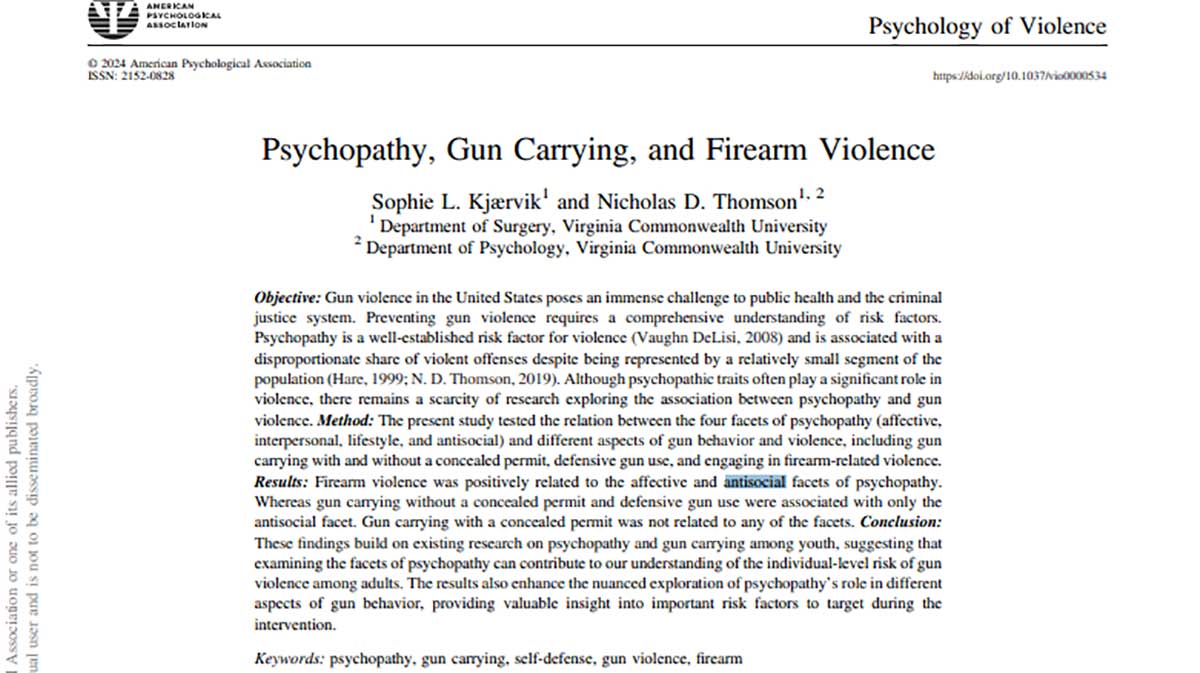
That’s right, a new study titled Psychopathy, Gun Carrying, and Firearm Violence by Sophie L. Kjærvik and Nicholas D. Thomson turns the tables on this narrative. Contrary to what mainstream media would have you believe, the study found that psychopaths—not your average law-abiding citizen—are far more likely to be involved in gun violence and illegal gun carrying.

The “Crazy Gun Nut” Stereotype

Before we dive into the facts, let’s talk about how mainstream media loves to sensationalize anything related to guns. According to a McLaughlin survey“71.9 percent of Americans are concerned that the national media and news organizations such as ABC, CBS, and NBC are biased when it comes to reporting about gun violence and Second Amendment issues.” And honestly, who could blame them?

From labeling semi-automatic rifles as “assault weapons” to making wild predictions about the chaos concealed carry laws will unleash, the media has a long history of misleading the public about gun ownership. But as AmmoLand News has pointed out before, Careful CNN, Your Bias is Showing. The media doesn’t really care about accuracy as long as they can connect gun sales to rising violence—even when the truth is far more nuanced.

Psychopathy, Not Legal Gun Owners, Drives Gun Violence

Now, let’s get to the meat of the study that flies in the face of all the mainstream media’s fearmongering. Kjærvik and Thomson found that “firearm violence was positively related to the affective and antisocial facets of psychopathy.” In plain English, people with emotional coldness and a disregard for social norms are far more likely to commit acts of gun violence. But here’s the kicker—none of those psychopathic traits were linked to legal gun ownership.

In fact, “gun carrying with a concealed permit was not related to any of the facets” of psychopathy. Legal gun carriers, the ones who follow the law and obtain permits, are not driven by the same impulses as those who commit violent crimes with guns. In other words, legal gun owners are, as the title suggests, not crazy.

This study slams the door on the idea that expanding concealed carry laws will somehow lead to widespread violence. The researchers found that “only the antisocial facet statistically predicted gun carrying without a concealed permit” (KJÆRVIK AND THOMSON Page 6), and not a single psychopathy trait was associated with those who carry guns legally.

The ones causing the chaos are those who break the law—not law-abiding gun owners.

The Media’s Obsession with Fear-Mongering

Yet, despite the clear evidence that psychopaths are the driving force behind unlawful gun use, the mainstream media continues to conflate all gun ownership with gun violence. As highlighted in AmmoLand News’ article New Media Group Has Formed to Push the Anti-Gun Narrative, there are now entire organizations dedicated to framing guns as a systemic problem, ignoring the fact that responsible gun owners exist.

Groups like the Association of Gun Violence Reporters (AGVR) are out to “shift public perception about firearms,” framing the conversation in a way that makes legal gun ownership seem dangerous. This is the kind of narrative the media latches onto, painting every gun owner as a ticking time bomb while conveniently leaving out research that contradicts their bias.

Concealed Carry Laws: The Reality vs. The Hype

Every time new concealed carry laws are passed, the media goes into full-blown “the sky is falling” mode. But what does the study say about those who legally carry guns? Absolutely nothing alarming. Legal gun owners who carry with a permit are not prone to violence or psychopathy.

This is in stark contrast to the portrayal in the media, which—as AmmoLand News pointed out in Where Stupid Meets Phobia: A Finger-Gun Update—loves to blow things out of proportion. Finger guns, pastry guns, and even kids playing cops and robbers are treated as threats, while real threats, like people with antisocial tendencies who carry guns illegally, go largely unnoticed.

The Real Problem: Psychopathy & Illegal Gun Use

Psychopathy Gun Carrying, and Firearm Violence by Sophie L Kjrvik and Nicholas D Thomson

The real issue here is that the media’s obsession with fear-mongering is clouding the facts. The study found that “firearm violence was positively related to the antisocial and affective facets” (KJÆRVIK AND THOMSON Page 1) of psychopathy. Those with these traits are more likely to engage in illegal gun behavior and violence.

American Gun owners who obtain permits and follow the law? They’re not part of the problem.

But don’t expect to hear that on the evening news. Instead, you’ll get stories that link rising gun sales to violence, ignoring the fact that gun purchases have surged because people are worried about protecting themselves from crime—a crime committed by the very psychopaths the media doesn’t talk about.

The Irony of It All

In the end, this study proves what many gun owners already knew: legal gun carriers aren’t the problem. It’s ironic, really, that the media spends so much time vilifying law-abiding citizens when the real focus should be on identifying and addressing the mental health issues that drive unlawful gun violence. But, as the McLaughlin Poll reveals, a vast majority of Americans have already caught on to the media’s bias.

So, next time you hear someone rant about “crazy gun nuts,” just remember: the real threat isn’t concealed carry permit holders—it’s the psychopaths committing crimes while the media continues to push its tired, inaccurate narratives.

Yet Another Conspiracy Theory Bites the Dust!


Tin foil hat wearers, unite!

The Department of Justice Inspector General Michael Horowitz has not yet issued a report on the DOJ’s role in the events of January 6. Horowitz announced on January 15, 2021 that he would conduct the inquiry; the DOJ is the only government agency that hasn’t published the findings of an internal investigation.

Now we know why. Or at least the official excuse.

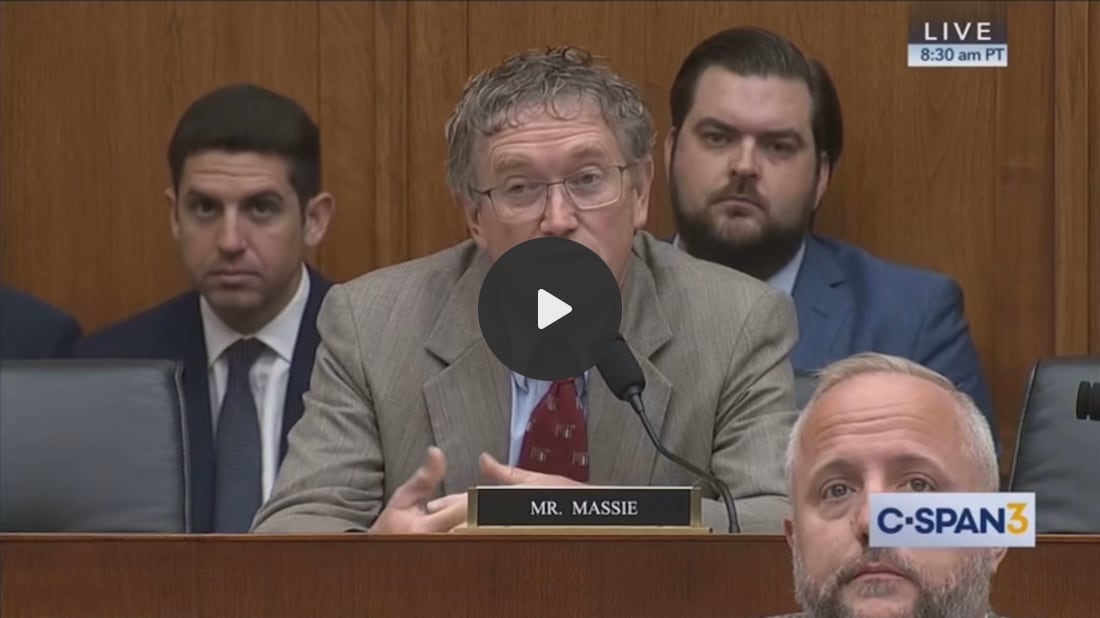
Horowitz informed the House Weaponization subcommittee on September 25 that he had paused his investigation for an unspecified amount of time so as to not interfere in the department’s “ongoing criminal cases” into January 6. “We reinitiated it last year and I’m in the process of reviewing a draft report,” Horowitz told Representative Thomas Massie (R-Ky) during a hearing on FBI retaliation against whistleblowers.

Setting aside the dubious explanation—the DOJ’s criminal investigation continues to this day with new arrests announced each week—Horowitz used the delay to explain why the report won’t be released before Election Day.

But the legitimate reason why the report will be more than four years in the making represents another example of election interference by the Justice Department. Promoting the false narrative about the “insurrection” and placing blame at the feet of Donald Trump is central to the Democrats’ winning election strategy this year. The Biden/Harris regime and their bootlickers in the corporate media consistently portray suspicions that the federal government played an animating if not lead role in the Capitol protest as the stuff of “conspiracy theories.”

So thanks to Horowitz’s foot dragging, arguably the biggest unanswered question of January 6—how many FBI informants were involved—will remain a mystery until after Americans vote this fall and possibly until after Inauguration Day.

Hints and Clues Amid the Subterfuge

Horowitz, however, did tip his hand in terms of whether his report will address the role of FBI informants. Under further questioning by Massie, Horowitz said he intends to reveal the number of FBI informants, officially known as confidential human sources, on Capitol grounds that day. His report may also disclose expenses paid to informants by the FBI:

Horowitz’s comments finally caught the attention of media outlets and lawmakers who’ve ignored this scandal for nearly four years. During a segment on Fox News, which largely stopped covering January 6 following the departure of Tucker Carlson in April 2023, legal analyst Kerri Kupec called Horowitz’s testimony “the sleeper story of the day.”

Kupec told reporter John Roberts that “so many lawmakers and pundits were decried as crazy for suggesting that there could be confidential human sources involved in January 6th and it looks like there might just have been.” 

Roberts responded: “A lot of us were told if you think this you’re crazy, you’re a tin foil hat conspiracy theorist but a lot of it turned out to be true so we’ll see how this goes.”

Perhaps more telling than the coverage at Fox News is the lack of coverage by regime media. Neither the Washington Post, CNN, or MSNBC reported on Horowitz’s testimony; the New York Times, which in a 2022 article confirmed the government’s acknowledgement that at least eight FBI informants were planted inside the Proud Boys, also failed to cover Horowitz’s comments.

Where Ya’ Been, Guys?

GOP leaders in Congress also took note. Calling Horowitz’s testimony about FBI informants an “alarming bit of information,” House Speaker Mike Johnson claimed his office will push for answers. “I’ll be requesting classified briefings,” Johnson told Fox News congressional correspondent Chad Pergram after the hearing.

One could commend Johnson for finally speaking out. A classified briefing will likely yield the same non-answers by the FBI that Director Christopher Wray offers in public. But at least such a briefing generates headlines and keep the story alive.

Pergram then posted a lengthy response from Weaponization Subcommittee Chairman James Jordan (R-Ohio):

How [Horowitz] answered Mr. Massie’s questions, sounds like there were confidential human sources at the Capitol that day. Sounded like it was plural. Like he said, sources. But the part that bothers me is, does it sound like they’re going to be a report on what actually happened? How many? What they were doing. We’re not going to have a report…until after the election. This seemed like news that the American people [have] been seeking for almost four years.

Based on Mr. Horowitz’s testimony, based on the work the committee has done over the last couple years, looks like there were confidential human sources at the Capitol on January 6, 2021. We want to know what took place. We want to know what they were doing. We want to know all the answers to the key questions, and we’d like that information soon.

While Republican interest in the matter is welcome albeit long overdue, there simply is no question FBI informants were involved before and on January 6. It is well known that the FBI embedded informants in both the Proud Boys and Oath Keepers prior to the events of January 6; some participated in pre-planning meetings as well as the protest itself.

During a transcribed interview with the House Judiciary Committee last year, former Washington FBI chief Steven D’Antuono also appeared to confirm multiple FBI offices sent informants to the nation’s capital for January 6. D’Antuono told House Republicans last year that he polled all 56 field offices in 2021 to determine how many FBI informants were involved.

And it is quite possible informants were not the only FBI assets at the Capitol on January 6. Former Capitol Police Chief Steven Sund estimates “multiple” FBI undercover agents tracked suspected “domestic terrorists” in the city that day. Sund told Tucker Carlson in an August 2023 interview that deploying FBI undercover employees, which are different from informants, represented “regular standard police work.” Sund, however, expressed concern the bureau did not share any information with his office about the use of FBI informants or undercover agents.

None of this passes the smell test. And it never did. Which is why it’s long past time for Republican leaders in Congress to pressure the inspector general to release his report immediately.

If the report is in draft form as Horowitz stated, Republicans must demand an immediate classification review and instruct Attorney General Merrick Garland to post the report by November 1. All demands will be ignored but that should not stop Congressional leaders from doing so. If anything, it will make it harder for the rest of the GOP in Washington—and the regime media—to keep ignoring this major scandal.

Diversity, Equity, and Inclusion are beginning to crumble – none too soon


Diversity: a range of different things.

Equity: the quality of being fair and impartial.

Inclusion: a person or thing that is included within a larger group or structure.

Go try to find a definition of diversity that doesn’t include all the Critical Race Theory terms. Unless you have an old dictionary that you must leaf through the pages of, you won’t find an uncorrupted definition. 

Supposedly, DEI is the antidote to the gross discrimination we are observing today in most mainstream media (MSM). Regretfully, it is thanks to MSM that there are even such aberrations called WOKE, Critical Race Theory, Environment, Social, Governance (ESG), an investing principle that prioritizes environmental issues, social issues, and corporate governance, and every other Social Justice issue you can name. AND it encompasses every aspect of your life. And DEI is based on Critical Race Theory.

For those who need a bit of background on the birth of the  Marxist problem  developed to spur a hopeful but impossible resolution – (Hegelian Dialectic)  read Herbert Marcuse And CRT:  A Solution Looking For A Problem by Scott Sturman, MD, USAFA ’72. 

The crux: Critical Race prophet Herbert Marcuse, a German-born Marxist and “Father of the New Left,” evolved from an obscure academic to a formative figure in Critical Race Theory. His many books and articles, filled with abstruse prose and revolutionary terminology, served as a template and validating authority for the perpetrators of violence and social unrest in the 1960s.

Despite Marcuse’s lifetime of publishing nuanced commentary that attempted to explain and understand the failure of Marxism, his personal boogeyman was capitalism. He spent a career exploring its oppressive and repressive elements and was aghast that workers did not share his disdain and revolt against their masters.

Since Marxism is tantamount to perfection, then any variance must necessarily be the fault of the workers. Flummoxed by this irrationality, the members of the Frankfurt School, of which Marcuse was a member, employed psychotherapy to discern why those who would benefit most from revolution eschewed it.

Confronted with the dilemma, the Critical Theorists deduced that workers had not developed a suitable level of consciousness regarding their plight. Essentially, they did not grasp their misery.

Revolution required the introduction of radical subjectivity to foment discontent and the realization that labor represented enslavement that was economically and socially intolerable. This dynamic represents Marcuse’s concept of alienation, which was made possible by concealment, a process of intrinsic domination within capitalist societies whereby these contradictions are purposefully hidden.

Thus, only by arousing the workers’ consciousness can problems be solved by revolution.

At this point, Marcuse departs from orthodox Marxist dogma, which is wedded to proletarian revolt, and proposes countless marginalized, oppressed groups seeking radical change.

The “inner history of the individual” stipulates that all human differences are a potential source of conflict.

Marcuse’s insights came to fruition in 1964 with the publication of the book “One-Dimensional Mind”. Here he covers his bases and points out that domination is no longer dependent on force or an authority figure but one-dimensional thinking, the antithesis of critical thinking, which relies on two-dimensional thinking. One-dimensional thinking subverts its better by:

  1. The system makes people feel freer than they are in actuality.
  2. The system provides just enough goods to pacify the citizen.
  3. The citizen identifies with his oppressor. (Stockholm    Syndrome)
  4. Political discourse is eliminated.

Once again, a tidy, contrived, circular argument places all the blame on capitalism and exonerates Marxism and its reinterpretations.

Fragmentation of society into component groups is the sine qua non of revolution, and like CRT founder Richard Delgado, Marcuse paid special tribute to radical feminism, which offered in his view “the most important and potentially the most radical political movement we have.” This movement offered a vehicle for all oppressed classes.

Understanding the usefulness of division to achieve revolutionary goals, Marcuse professed androgyny – what better way to stir the pot and disrupt societal norms?

Liberation was useful only to a point, however. According to Marcuse, too much individuality impedes the freedom of others, so freedom and happiness must be limited for coexistence.

The desires of the individual must conform and identify with the apparatus, which in turn defines humanity.

ONCE AGAIN, THE PROMISE OF UTOPIA DESCENDS TO ANARCHY AND RESURRECTS AS OLIGARCHY, WITH FREEDOM AS THE MAJOR CASUALTY.

Back to DEI.

DEI is basedJust recently, the Inclusion at Work Panel, an independent U.K. organization, published a report that found little evidence “DEI efforts such as mandatory anti-bias training and corporate policy overhauls have any positive effect on corporate culture.” In fact, as we are seeing companies fleeing from DEI, the truth – the fallacies of DEI – are coming home to roost. And a lot of people and pension funds are out of a lot of $$$.

As Tennessee Senator Marsha Blackburn stated: “DEI is an initiative that has been co-opted by the radical Left to lead Americans to believe it will reduce discrimination and quell bias. In reality, the Left has hijacked DEI as part of their hidden agenda to pit Americans of different races, religions, and genders against each other. But studies show that DEI programs accomplish the exact opposite of what the Left wants Americans to believe they do – a report by Harvard Business Review details how most diversity programs fail to increase diversity, and studies indicate that DEI can activate bias or spark a harmful backlash against workers.” 

The U.S. Equal Employment Opportunity Commission reported a 20% rise in discrimination charges in FY22. In cases related to K-12 education, there was a 144% increase in complaints since 2021. Hmmmmm. Gee Whiz, we have DEI working overtime, and things are getting worse, not better? What can possibly be wrong with this picture?

DEI is based on Critical Race Theory.  Unlike many philosophical works on race that demand a more enriched and critical conversation with whites about race, CRT is adamant about its radical activism, which challenges not only the idea of white privilege but the property rights that whites maintain. CRT’s skepticism to the commonsensical approaches of liberalism and integrationist thought reverses many of the issues philosophical investigations of race aim to achieve. Rather than creating a world of peaceful racial co-existence, CRT works from that premise that, in America, such a world is impossible, and as a consequence, racism cannot be studied with its eye on that illusory promise. In short, CRT maintains that race and racism are inextricable manifestations of the American ethos and, as such, cannot be cured by a constructive engagement with whites.

Or as Tommy J. Curry says in an essay Will the Real CRT Please Stand Up,   “… within Critical Race Theory, racism is not something to be overcome or dispelled because it is a permanent part of the United States culture.” (emphasis added)

Or as Martin Luther King, Jr. said with heartfelt emotion:

So even though we face the difficulties of today and tomorrow, I still have a dream. It is a dream deeply rooted in the American dream. I have a dream that one day, this nation will rise up and live out the true meaning of its creed: We hold these truths to be self-evident, that all men are created equal.

I have a dream that my four little children will one day live in a nation where they will not be judged by the color of their skin but by the content of their character. I have a dream today.

That speech was in 1963. The Civil Rights Act, written the next year, was to fulfill King Jr.’s dream. And it was. We had been coming out of segregation, and people all over this country were accepting that it would be erased from our laws and behaviors. And we were well on the way until the Global Elite decided to ignite false prejudices in the 

We can thus conclude that no matter how many statistics show there is, at most, systemic anti-Black racism in the United States is marginal. Yet, MSM, government, and schools will be pushing the lie of Critical Race Theory as a must to rectify the almost negligible race issue. Many institutions of higher education are the focus of antisemitism today.

… University of California, Berkeley’s hiring rubric for the grant’s funds, which has been adopted by many other universities, including Northwestern University and the University of Southern California, “penalizes job candidates for espousing colorblind equality and gives low scores to those who say they intend to ‘treat everyone the same,’” according to John Sailer’s opinion piece in the Wall Street Journal.  

“The NIH, perhaps most notably, has begun rolling out mandatory ‘Plans for Enhancing Diverse Perspectives.’ The NIH BRAIN initiative upholds the diverse teams working together and capitalizing on innovative ideas and distinct perspectives outperform homogeneous teams. The BRAIN initiative is firmly committed to fostering diversity, inclusivity, and accessibility in the research community.” Don’t worry, be happy. Those researchers and doctors at NIH may not be the best and brightest, but they will be WOKE. So if you ain’t white, male, and heterosexual, you will be fine if you enter those hallowed doors or “benefit” from some of their recent research. 

STARRS — Stand Together Against Racism and Radicalism in the Services – an organization that understands the difference between discrimination and social justice states: DEI, at its core, minimizes merit-based, objective value systems and promotes the widespread use of quotas and discrimination based on sex and race. STARRS also notes that “record-high suicide rates in the armed forces, estrangement from fellow service members, and the current recruitment crisis reflect poor morale. ; The pool of Americans from which the military has drawn upon (sic) since the country’s beginnings is alienated by leftist DOD doctrines. Comments from military service members, veterans, and their families indicate that they are no longer recommending military service due to the pervasiveness of CRT and DEI policies throughout the armed forces.

Title VII of the Civil Rights Act of 1964, as amended, protects employees and job applicants from employment discrimination based on race, color, religion, sex, and national origin. “Nuff said. 

Those pushing DEI, ESG, and CRT are mostly stakeholders (non-governmental organizations [NGOs] attached to the United Nations and doing the bidding of the global elite. They have skin in the game; their job is to be useful idiots, fodder in the asymmetrical war being fought (without guns, so far).

Finally, we are seeing some common sense (or fear of lawsuits for not following the Civil Rights Act) in a number of big businesses and some universities saying adios to DEI and ESG. Molson Coors, Ford Motor Co., John Deere, Lowe’s, Harley-Davidson, and Tractor Supply Co. are just the first to wake up and get out. This should be the beginning of the end – even if it is just one of the illegal, abhorrent tools of asymmetric warfare. Some universities are also showing common sense on this issue.

If the Civil Rights Act wasn’t functioning, I could see a need for other options, but that is not the case. And, regretfully, DEI is not what it’s being sold as – a panacea for a non-functional Act; it is, instead, a repugnant tool to cancel our culture – with we Americans doing the canceling.

It’s time to slay the dragon and get back to good ol’ basic values, attitudes, and beliefs.

The WHO continues its march for power


Back in June, there was encouraging news that the World Health Organization’s (WHO) pandemic agreement failed to pass. This agreement would have surrendered American sovereignty to unaccountable and unelected international bureaucrats operating at the behest of special interests. Thankfully, this agreement failed to pass.

But the WHO isn’t giving up. It is continuing its march for power.

The issue was brought up to members of Congress for a press conference on the Hill to raise awareness about the ongoing power grab attempt by the United Nations (UN) and the WHO.

The globalists at the UN and the WHO want power over America’s public health policy. If they are successful, their proposed pandemic agreement will irreparably harm American national sovereignty. Family Research Council Action (FRC Action) has been working on this matter and keeping you updated over the past year. Would you consider supporting our work by making a donation today?

This past weekend, the UN hosted a conference called “Summit of the Future” where certain international agreements, including the Pact for the Future, were discussed. The Pact would give the WHO power over the response to future pandemics, large-scale climate events, major events in space, and much more.

During the press conference, Rep. Eli Crane (R-Ariz.) told reporters there were “enough examples and enough reasons” listed in the Pact for the Future’s emergency platform “for them to get involved pretty much whenever and wherever they want to.”

He later said on Washington Watch, “They want authority. They want global governance. And they’ll do whatever they can to achieve that. This agreement that we’re trying to stop would give them authority, global authority, in multiple categories of catastrophic events that might happen around the world.”

Congressman Crane also pointed out that Americans will not be able to vote the WHO’s bureaucrats out of office, meaning they will not be held accountable to we the people. This would be a terrible infringement upon American sovereignty, which is why FRC Action has been sounding the alarm for quite some time.

Recently, the U.S. House passed the No WHO Pandemic Preparedness Treaty Without Senate Approval Act. This important bill would require the Senate to ratify the WHO’s pandemic agreement since it would function as a legally binding treaty. The Senate should also pass this measure to protect American sovereignty.

That’s one reason why the upcoming election is so important. Our nation needs leaders who will protect American sovereignty, not those who will hand it over to bureaucrats overseas. After all, our elected members of Congress are supposed to be the ones who represent the people of the United States.

Also discussed during the UN conference was the UN’s Global Digital Compact, which would require member states to control misinformation and disinformation. Under said Compact, even communications critical of the WHO could be characterized as “misinformation.” The UN’s Common Agenda document would provide “accountability criteria for discrimination and misleading content.”

We cannot allow this dangerous power grab to go unchallenged. I am convinced that the UN and the WHO think we are not paying attention to what they are trying to do. They would be mistaken.

Tens of thousands of you have already signed petitions to Congress urging them not to allow Washington to cede American sovereignty to the WHO.

The United States should defund the UN and the WHO, and any pandemic agreement or treaty should be submitted to the Senate for ratification.

While many ignore the WHO’s continual march for power, actions will continue sounding the alarms and work to stop it. Our members of Congress must act to protect American sovereignty from the WHO.

Guest Column: DOJ Dusts Off Civil War-Era Statute to Replace 1512(c)(2)


In the aftermath of SCOTUS ruling that overturned DOJ’s most common felony against J6ers, the Department of Justice is using an antiquated law to keep punishing Trump supporters.

This is a guest post by David W. Fischer, a Maryland and D.C.-based criminal defense attorney and the senior partner at Fischer & Putzi, P.A.  Most recently, Fischer defended January 6 defendant Thomas Caldwell, who was acquitted on seditious and other conspiracy charges.

If at first you don’t succeed, try, try again. 

That’s what Attorney General Merrick Garland’s Department of Justice (DOJ) is doing in their over-zealous prosecution of January 6 defendants.  In June, the Supreme Court in United States v. Fischer effectively nuked hundreds of “obstruction” of Congress charges against January 6 defendants, ruling that a post-Enron statute, 18 U.S.C. §1512, designed to punish document destruction, did not apply to a Capitol Hill protest “gone wild.” 

Nonetheless, obsessed with targeting Trump supporters, the DOJ is now charging multiple defendants with a Civil War-era statute—18 U.S.C. § 372—which punishes (up to 6 years in prison) those who intimidate “officers of the United States” from their posts.  The DOJ charges that J6ers conspired to chase Members of Congress from Capitol Hill in violation of Section 372.  Once again, the DOJ is unfairly prosecuting J6ers under a statute that does not apply to their conduct.

Title 18 U.S.C. § 372 punishes conspiracies “to prevent, by force, intimidation, or threat, any person from accepting or holding any office, trust, or place of confidence under the United States, or from discharging any duties thereof, or to induce by like means any officer of the United States to leave the place, where his duties as an officer are required to be performed[.]”  The DOJ’s position is that Members of Congress hold the “offices” and are the “officers of the United States” that are covered by Section 372 and, accordingly, that J6ers can be prosecuted for allegedly causing their evacuation from Capitol Hill.  The DOJ is obviously wrong from both a historical and statutory construction standpoint. 

Enacted During the Civil War

In April 1861, confederate soldiers and sympathizers began forcibly seizing federal property within the southern and border states, chasing Union soldiers (Fort Sumpter), postmasters, custom house managers, and other federal officials from their posts.  Congress quickly responded by passing a series of laws that included what is now Section 372.  The obvious purpose of Section 372 was to protect “officers of the United States,” a term of art used in the Constitution, which applies to those individuals who hold federal jobs in the government thanks to the “Appointments Clause,” Art. II, § II, cl. II.  Members of Congress, however, are not constitutional “officers of the United States.” 

Members of Congress are not ‘Officers of the United States’ Under the Constitution

That Members of Congress are not “officers of the United States” is widely accepted among constitutional scholars.   As the Supreme Court observed in Bowsher v. Synar, which struck down portions of the 1980s Gramm-Rudman Act, “[N]o person who is an officer of the United States may serve as a Member of the Congress.”  Additionally, Members of Congress do not hold an “office, trust, or place of confidence” as that term is used in Section 372. 

In fact, this phrase is boilerplate language used in ubiquitous commissions given to presidential appointees, e.g., military officers, federal judges, etc., since the days of President George Washington.  Presidential commissions of “trust and confidence” are issued to “officers” pursuant to the Commissions Clause of the Constitution, Art. II, § 3, cl. 4 (“[The President] shall commission all the officers of the United States.”).  A Member of Congress does not receive a “commission” because he or she, unlike federal judges, executive branch appointees, and military officers, is not an “officer of the United States” and, hence, does not hold an “office, trust, or place confidence.”

The DOJ’s Counter-Argument is Baseless

 In court filings, the DOJ has not disputed that, under the Constitution, Members of Congress are not “officers of the United States.”  Instead, the DOJ argues that the 1861 Congress that enacted Section 372 used the term “officer of the United States” in a sense broader than the technical, constitutional definition.  According to the DOJ, because Members of Congress “hold office,” they are covered by Section 372’s use of the term “officers of the United States.”  This argument, however, is baseless. 

In fact, binding Supreme Court precedent from the 19th century holds that, when used in federal criminal statutes, the terms “office,” “officer,” and “officer of the United States,” absent unambiguous language to the contrary, refer to individuals who received positions via the Appointments Clause of the Constitution.

In one of those cases decided in 1878, United States v. Germaine, a surgeon hired by the Commissioner of Pensions was indicted for extortion while serving as, in the words of the statute, an “officer of the United States.”  Arguing for the indictment’s dismissal, the surgeon argued that because he was not appointed to his position pursuant to the Appointments Clause, he could not be convicted of violating a statute, which applied only to “officers of the United States.”  The Supreme Court agreed, ruling that absent unambiguous language to the contrary, the term “officer of the United States,” when used in criminal statutes, is limited to individuals appointed pursuant to the Appointments Clause.  In 1925, the Supreme Court in Steele v. United States summarized its numerous 19th century: “It is quite true that the words ‘officer of the United States,’ when employed in the statutes of the United States, is to be taken usually to have the limited constitutional meaning.”

Other Language in Section 372 Supports the J6ers

Section 372’s wording, moreover, proves that Members of Congress are not covered by the statute.  This statute punishes conspiracies aimed at preventing individuals “from accepting or holding any office, trust, or place of confidence under the United States[.]” Members of Congress, obviously, do not “accept” their positions—instead, they assume or take office.  A person “accepting” an “office, trust, or place of confidence” presupposes that someone offered that person position they accepted.

Members of Congress, by contrast, run for their offices and are elected by the voters. They do not “accept” government job “offers.” Accordingly, the phrase “office, trust, or place of confidence” in § 372—which lists stations that can be “accepted,” obviously does not include Members of Congress

Additionally, Congress’s use of the phrase “any person . . . holding any office . . . under the United States” in Section 372 further proves that Members of Congress are not covered by the statute’s language. This language, tellingly, appears to have been lifted from the Constitution’s “Ineligibility Clause,” pursuant to which Members of Congress are prohibited from simultaneously holding “offices”: “[N]o Person holding any Office under the United States, shall be a Member of either House during his Continuance in Office.”  (Art. I, § 6, cl. 2).  It is beyond belief that Congress intended to include itself in Section 372 by using verbatim language from the Constitution’s Ineligibility Clause, which actually bars Members of Congress from holding “offices.”

More Abuses of the Law

One of the unfortunate aspects of the lawfare that has been unleashed against Donald Trump and his supporters has been the misuse of federal criminal statutes.  Section 372 was enacted with a very specific purpose:  to protect commissioned officers in charge of various federal outposts throughout the United States, especially in southern states.  Additionally, the Supreme Court has made clear that criminal statutes that use the terms “office” or “officer of the United States” do not apply to individuals other than commissioned, presidential appointees. 

As Members of Congress were not covered in Section 372’s language, the DOJ’s use of this statute against J6ers is a total and complete miscarriage of justice just as everything else this bully agency is.

Out of the Frying Pan, Into the Fire


Treasury just had its worst August ever and things are getting worse

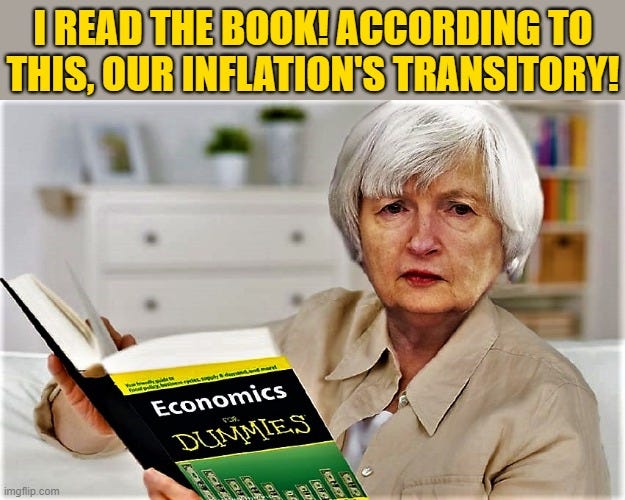
Janet ‘Inflation-Is-Transitory’ Yellen once again has egg on her face. After laughably low deficit projections for the current fiscal year, Treasury has now blown past those forecasts, and we still have a month to go before the end of the current fiscal year. Worse yet, the latest monthly Treasury statement set several record “firsts” — none of which were good.

Janet Yellen economics for dummies - Imgflip

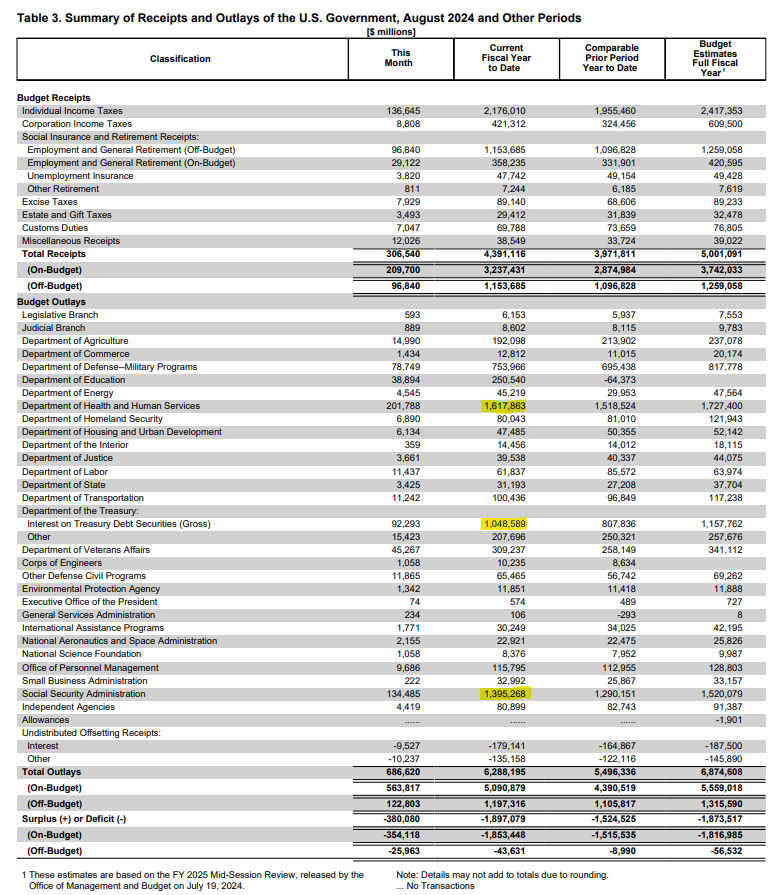
While people already knew that annual interest on the debt was heading to $1 trillion, this was the first time it had ever been recorded. As of August, the 11th month of the fiscal year, the government has spent over $1.049 trillion just to service the $35.3 trillion debt. What makes it scarier is that we still have another month to go in the current fiscal year.

It didn’t even take all 12 months to prove wrong those folks saying interest on the debt wouldn’t break the $1-trillion threshold.

Even with interest rate cuts, there’s no significant evidence that the problem is slowing down. That’s because interest on the debt is a function of BOTH the average interest rate on securities AND the total debt outstanding. Well, the latter is exploding.

Keynes Is the Freddie Krueger of Economics

We’ll add about another $1 trillion to the federal debt before the end of the calendar year, and then likely continue adding about $1 trillion every 100 days or so from there on out.

This was also the worst deficit for the month of August ever—including the blowout spending years of 2020 and 2021 when Congress pushed through all kinds of bloated pork. In fact, at $380 billion, it’s larger than any other monthly deficit of fiscal years 2024 or 2023.

Image

And this isn’t a revenue problem—it’s a spending problem. Despite concerns of a recession, tax revenue has actually held up, so the burgeoning deficit is clearly coming from the other side of the ledger.

In the first 11 months of the current fiscal year, the federal government took in almost as much revenue as in the entire prior fiscal year. If we look at the comparable period (first 11 months of both FY’s) then we see revenues have increased from $4.0 trillion to $4.4 trillion. Spending, however, has increased even faster.

This past August, federal outlays were $687 billion, compared to $194 billion in August 2023 — more than tripling in just one year. Outlays in the comparable period between both years have gone from $5.5 trillion (2023) to $6.3 trillion (2024).

Image

Clearly, the ballooning deficit is a spending problem. And what a problem it is.

Specialists and skeptics were very critical of Treasury’s overly optimistic projections on the current fiscal year’s deficit and, sure enough, we were right. The deficit has already blown past the projection for the fiscal year and—as we’ve already said—there’s still another month to go.

The $1.9-trillion deficit will break the $2-trillion threshold with ease once September is in the books.

And there’s no reason to believe multi-trillion-dollar deficits are going away anytime soon because the runaway spending continues. In fact, mandatory spending and interest on the debt together will exceed government revenue for the foreseeable future. So, literally all discretionary spending will be deficit spending.

The monthly Treasury statement for August bears witness to this sad situation: 55 cents of every dollar the federal government spent last month was borrowed. Spending was more than twice all government receipts.

Image

While the profligate spending out of Washington, DC has certainly exploded over the last four years, the interest on the debt is now also a major contributor to the deficit. The increase in the trend of discretionary spending is now less than the increase in the trend of interest on the debt.

In other words, depending on how you want to measure it, interest on the debt is now the largest contributor to the deficit.

For the fiscal year to date, interest on the debt is the third largest line item in the Treasury’s August statement, behind only the Social Security Administration and the Department of Health and Human Services, both of which have increased relative to their pre-2020 projections, but by much less than interest on the debt.

Image

Federal finance is clearly in shambles, but where do we go from here? Are we actually already in the fiscal doom loop? Yes, and it’s complicated.

5 Myths About “Gun Free” Zones


There’s been a lot of talk recently about “Gun Free” zones and, frankly, a lot of it has been useless blather from people who know nothing about guns and reveal more and more of their ignorance with each additional word they speak.

With that in mind, I want to share 5 “Gun Free” zone myths and responses you can use when you hear them.

Myth #1. Gun Free Zones make us safer and reduce crime. It should be obvious by now that gun free zones don’t make us safer. Any time you hear this argument, ask the person who makes it if they have “gun free zone” stickers on their cars to stop carjackings, “gun free zone” signs in their yards to stop home invasions, and wear “gun free zone” shirts and hats to stop muggings, robberies, rapes, etc.  If they balk, remind them that “Change starts with me” and that they should “Be the change you want to see.”

If “gun free” zones make us safer, suggest that they tell that to the Secret Service and the State Department’s Bureau of Diplomatic Security. I’m sure they’ll change how they protect people right away.

The fact that these signs don’t exist in large numbers is a tacit admission that gun haters and people who are ignorant about guns KNOW, at some level, that gun free zones don’t work.

Equally silly is the thought that gun free zones reduce crime…they simply change the location.

First off, someone who intends on murdering large numbers of people will commit 5 or more misdemeanors and/or felonies in the process of firing their first shot. Do you really think that someone intent on murdering innocent people cares about breaking 1 additional law? Do you really think that someone who intends on killing themselves or committing suicide by cop cares about additional penalties from a judge? Of course not.

Next, gun free zones don’t reduce crime because they change the behavior of moral and ethical people who carry guns more than the behavior of murderers.  In fact gun free zones are a common factor that mass murderers cite for how they picked the locations of their crimes.

Concealed carry permit holders tend to be law abiding citizens…both because it’s their general nature and it’s kind of a requirement to get the permit. As a result, a higher percentage of concealed carry permit holders obey gun free zone signs and laws than murdering psychopaths.

Myth #2. Highly Trained Law Enforcement Will Arrive Immediately And Save You. Law enforcement is my literal and figurative family.  They are short-changed when it comes to the training they get and what’s expected of them.  The average officer receives about as much firearms training as a dog groomer before starting work.  MANY patrol officers across the country only do their 1 day of mandatory training and qualifying per year and do zero practice with their firearms the rest of the year.  Other officers are world class shooters who regularly do extensive reality based training and are training for the fight every day.

On average in the US, it will take 11 minutes for law enforcement to arrive (assuming that someone is connected with a HUMAN 911 operator the instant that the murdering starts).  If a motivated murderer is unchallenged, they will historically shoot an average of 6-20 victims per minute.  When law enforcement arrives, you may get an officer who shoots once a year and doesn’t really like guns or you may get an officer who does dry fire before every shift and has mentally rehearsed and prepared themselves for this situation.  They have trained themselves to fight through the pain of minor gunshot wounds (like the officer in Uvalde).  They have no quit in them and will finish the fight.

It is rare that a school resource officer has both the temperament to be a school resource officer AND be able to flip the switch and pursue a lethal aggressor.  It happens and I’ve trained with one, but it’s rare.  It’s much more likely that in a school full of teachers, administrators, and support staff that there will be a frustrated warrior or two who will already have the mindset and training to solve the problem…we just need to make sure they aren’t prevented from having the tools they need.

Myth #3 Common sense laws will stop mass shootings. We have more than 20,000 gun laws on the books in the US. What’s the magic next law that will make all of the bad people stop doing bad things?

The only thing that would take care of gun crime would be to eliminate guns. By definition, a country with zero (not even 1 gun) guns would have zero gun crime.

We’ve got more than 300 million guns in the US. They’re not going away. If they’re outlawed, then the law would disproportionately affect law abiding citizens. (remember, murderers don’t care about laws or the consequences of breaking them.)

But if we look at how this has worked out in DC, Chicago, Australia, the UK, and other places with strict gun laws, we see that it doesn’t work out well for law enforcement or the general public.

It didn’t work out well for Jews in Germany in the 30s, or minorities in ANY country throughout history that has been disarmed.

Look at Austria…one recent Muslim extremist mass murderer ran his car into a crowd and then got out and started stabbing the survivors.

Look at China…in the last few years, they’ve seen almost a dozen mass school stabbings and hammer attacks, including one where the attacker beat preschoolers in the head with a hammer and then lit himself on fire. Within 24 hours of the Sandy Hook attacks, one murderer stabbed 22 children in an attack in China. In another attack, 4 Muslim extremists used knives to kill 29 civilians and injure 140 others at the Kunming railway station.

Look at Northern Ireland…when gun ownership was prohibited for certain groups, those groups became targets of violence from the groups who could still own guns. Explosives, knives, rocks, and deadly modifications to potato guns took their place to fill the role of the gun. Violence didn’t go away with gun confiscation.

When someone thinks that gun laws will solve the problem of mass shootings, they need to ask themselves what the point is, to protect innocent people or convict guilty people more harshly after they’re dead?

Additional laws only allow for harsher penalties to be enforced, after the fact, on a murdering psychopath.

If you want to protect innocent people from murdering psychopaths who are comfortable breaking laws, you need to look to another solution than more laws. A solution like the most effective way to STOP the attacker.

Myth #4. Locking doors, hiding, throwing cans, and pleading/begging are effective strategies for stopping the threat.

We live in a time where we can find out an amazing amount of detail about EVERY active shooter situation that has happened in the US in recent history. We can see where these strategies were all tried and the outcome. None of them STOP the threat. They may delay death, reduce the number of innocent deaths, change who dies, create time and space for additional attacks, or change the location of deaths, but they don’t stop the threat on their own.

Myth #5. You’re unarmed if you don’t have a gun. This mindset is absolutely toxic. Poisonous. Corrosive. Venomous. Deadly. Wrong.

Yet it’s a common line of thinking for people who have it in their mind that a gun is a magical laser beam that gives the holder supernatural 1 shot killing ability that can only be matched by another gun.

The gun is just a tool that allows the mind to exert it’s influence kinetically at a distance.

The mind is the weapon that decides whether or not to wield tools in a moral and ethical manner or in a psychopathical/sociopathical manner.

As an example, what would have happened if some of the people who kneeled/layed down would have fought the attacker after he shot his first victim? Would they have been killed trying to stop him? Maybe.

We know that at the Umpqua shooting in 2015, at the first sign of armed resistance (from police in this case), the killer ran, hid, and shot himself in the head, ending the killing. If that would have happened after he shot his first or second victim, it wouldn’t have even been considered a “mass shooting.”

I need to be clear…I’m not surprised that nobody who was lined up to get executed fought back.

One soldier, Chris Mintz, actually did fight back at Umpqua…and a lot more. He set off fire alarms, directed students away from the shooting, and then headed towards the gunfire, and attempted to block a door so the gunman couldn’t get through.

He stopped fighting when he was mechanically unable to…because he had one or both legs broken from being shot.

But nobody joined him. And it doesn’t surprise me. And I wouldn’t have expected them to act any differently than they did unless they had different training. The phrase, “you’ll perform half as well in battle as you do in training” applies. If you have zero training, then your expected performance will be that you’ll freeze, cower, or run…and running is probably the best option for someone with no training, but history tells us that the untrained are much more likely to freeze or panic than deliberately run.

When someone who has no training cowers, it’s not cowardly. It’s a reflection of a lack of training. You can’t be expected to perform beyond the level of your training…and that’s why training is SO important, like the Praxis Dynamic Gunfight Training course that goes WAY beyond static, sterile, paper-punching skills that most gun owners call “training.”

But an effective response could have been simple, like grabbing fire extinguishers and, as Clint Smith says, “spray ‘em with the white stuff and then hit them with the red thing.”  It completely baffles me that every classroom in the country doesn’t have at least 2 fire extinguishers for this purpose.  It’s relatively inexpensive, most likely donated, not threatening, and it’s something that could be implemented any day of the week.  A big crowd-control sized pepper spray can may freak out parents, but would a fire extinguisher attached to the teacher’s desk?

It could have been deploying a concealed carry firearm. We have super-stupid federal “gun free zone” legislation that should be eliminated immediately, as well as state laws regarding carry at schools, but that brings up a VERY important point that few concealed carry permit holders know.

In many cases, it is “against the rules” but not illegal to carry a concealed carry firearm in a gun free zone. In other cases, it results in being asked to leave. In other cases, it’s a simple, minor misdemeanor, like trespassing. In other cases, it’s a serious misdemeanor. In other cases, it’s a felony. We have an inconsistent, illogical patchwork of gun laws in this country and you NEED to know the laws where you live.

You could be a teacher somewhere where carrying a gun in a gun free zone on campus might be legal but against school policy and just mean a firm talking-to or it could be losing a job or a serious crime with possible jail time.

If not a fire extinguisher or a gun, then Tasers (not stun guns), knives, pepper spray, or other purpose built or improvised defensive tools combined with offensive strikes can easily change the number of innocent people who were murdered.

But, again, these things are simply TOOLs. The only weapon is the mind. And an effective tool in the hands of someone with an ineffective mind is useless. You must train the mind.

You must train the mind to see targets on the human body.

Watch any UFC fight and you’ll see trained fighters hitting each other in the head and body for 5, 10, and 15 minutes at a time. This illustrates just how ineffective most strikes—even really hard strikes from professional fighters—are at stopping a threat.

A fighter will absorb massive kick after kick after kick and keep fighting, but if their left nut gets grazed, the ref will stop the fight and give them a chance to recover.

A fighter will absorb dozens of punches to the face, but if they barely get touched with a pinky finger in the eye, the ref will stop the fight and give them a chance to recover.

Fighters will try to “knock a guy’s head off” for an entire fight with strikes you can feel from home, but any one of these strikes delivered a few inches lower, to the throat or side of the neck, would instantly knock him out or crush their opponents’ windpipe.

Targeting matters, but conditioning the mind matters too. You must train the mind to be able to switch from the loving, caring, empathetic, socialized person that you are to a cold-hearted robot with ice flowing in your veins JUST long enough to stop the threat with the minimum force necessary to preserve human life.

And the most scientific and proven way that we know of to do this is with the Fight To Your Gun training

It’s based on gross motor movements and what’s in your environment, so it’s effective on younger, faster, bigger, and stronger attackers and it’ll allow you to stop a lethal force threat at bad breath distance faster than you could with a concealed carry pistol.

I’d suggest people buy it before they buy their first gun. You can learn more about it >HERE<

Thoughts? Questions? Comments?