
Turning Children into Robots, Courtesy of – SURPRISE! – the UN! And Then What? Here Is My Prediction for What’s Coming Next.
Every tyranny perpetuates itself by indoctrinating the children. The Globalist destructocrats are following the same playbook. Is it too late for the children you care about? Too late for us?
Jan 30, 2026
Spoiler alert: this is a long post tying several threats together. I urge you to take the time to read it and share it as widely as you can. And join the Council of Concerned Citizens (C3) to, quite literally, end the deadly globalist control while the window of opportunity is still open.
“Give me a child until he is 7 and I will show you the man.”
Although widely attributed to the Greek philosopher Aristotle (probably apocryphally), Jesuit founder Ignatius of Loyola, Jesuit missionary St. Francis Xavier and philosopher mystic Rudolf Steiner, no one knows who first articulated the idea that a child is stamped indelibly by early conditioning, experiences, beliefs, rewards, successes and failures.

No normal human being who has cared for a young child has ever failed to notice the importance of those experiences, nor has any educator, nutritionist, doctor, psychologist, marketer, proselytizer or tyrant. Nor have the globalists.
Dr Rima Truth Reports Substack is paywall free and supported by our readers. To receive new posts and support my work, subscribe and support your health with amazing drug-free vibrotactic technology: DrRima.Superpatch.com.Subscribe
We all understand intuitively (probably because it is the truth of our own origins) that early learning/conditioning/programming/training/socialization is, in effect, a capture system of mind, body and spirit. For most of us, of course, that stimulates us to do our best to induce alignment with truth and positive values, both inner and outer, to sustain and support the life that will inevitably follow from the deep inner reality of those early years.
Lest we forget, mind control is a very real and powerfully corrosive tool of the globalist cabal, etching carefully crafted “reality” into the minds, hearts, bodies and souls of the denizens of their envisioned future world. In fact, through mind control and conditioning, we can be induced to believe, repeat and cling to, gibberish, illogic, rage and orchestrated destruction of ourselves and everything that sustains us.
War, for example, would be a pretty good example of that.
Try this thought experiment for a moment: say out loud, “All wars are bankers’ wars”.
Now substitute the word “globalists” for “bankers”. Say it again, with the substitution: “All wars are globalists’ wars”.
Next, insert the wars that are flaring or being readied, like this:
- ”All Gaza wars are globalists’ wars”,
- “All illegal immigrant vs. ICE wars are globalists’ wars.”
- “All bioweapon/gene therapy wars are globalists’ wars”,
- “All gender ideology wars on children are globalists’ wars.”,
- “All agricultural destruction wars on the food supply are globalists’ wars.”,
- “All propagandemic wars on informed consent and personal rights are globalists’ wars.”.
- “All weather modification wars on the planet and its inhabitants are globalists’ wars”.”Leave a comment
You get the idea. Nothing is by accident. For example,
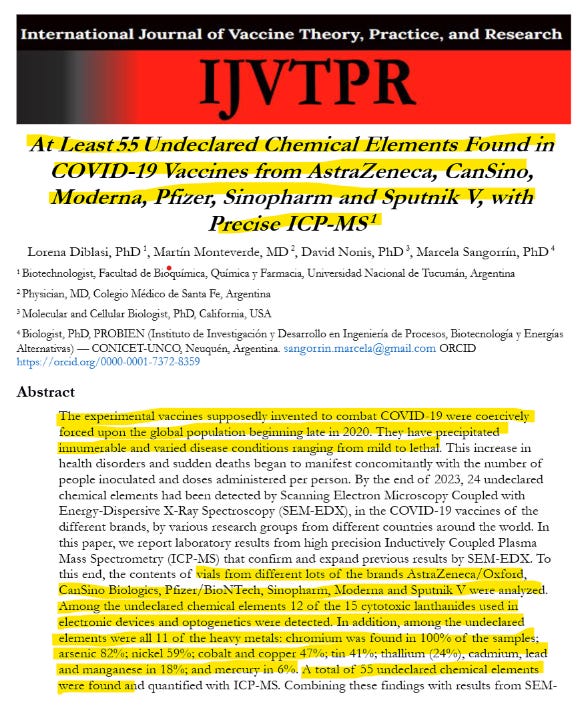
EVERY SINGLE COVID “vaccine”, from the US, UK, China, Russia, India, every single one of them contained heavy metals like Chromium (100% of the vials), arsenic (82% of the vials), 12 out of the 15 cytotoxic (cell-poisoning) lanthanides used in electronic devices and optogenetics (!)
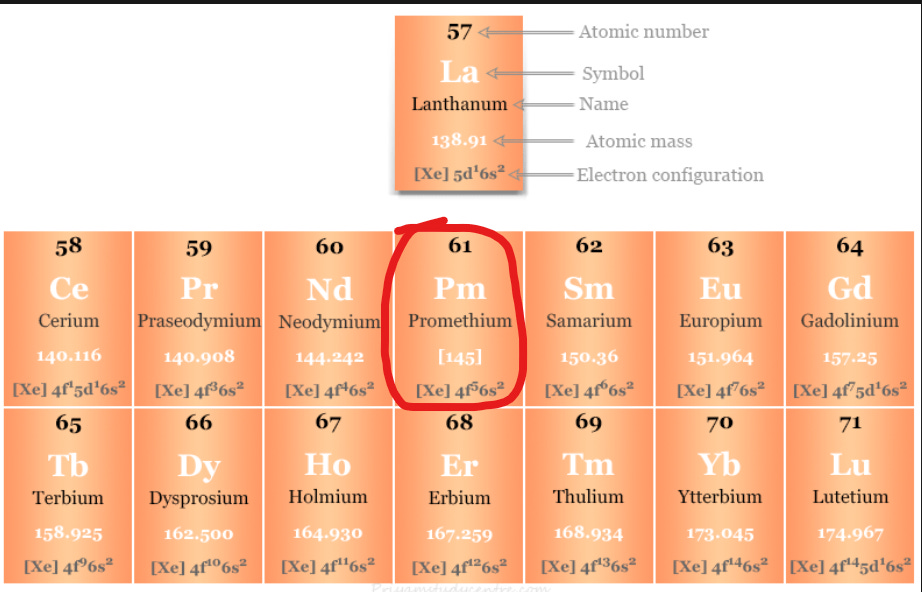
Promethium, Pm, is radioactive.
If these toxins are found in diverse lots of EVERY Covid jab from around the world, it is because they are intended to be there. By design. After all, bioweapons are not intended to be either safe for the recipients or effective in protecting their health. They are supposed to be safe for the deployers because they are disguised as something else and effective in weakening and killing their victims. The rest is propaganda and deadly deceit.
Dr Rima Truth Reports Substack is a paywall free publication. Your support makes this work possible. Purchase your professional quality supplements @discount at US.Fullscript.com/welcome/RLaibowSubscribe
Do all regular vaccines contain lanthanides? If they do, we can safely conclude that they are all intended to cause biological chaos, as part of the war on our health and survival. If they do not, and available information would suggest that they do not, it must be assumed that since ALL of the Covid jabs contain them, it is by design.2
Do all vaccines contain heavy metals? In fact, many do contain mercury and most contain aluminum. So, we can safely conclude that they are all intended to cause biological chaos, as part of the war on our health and survival.
All wars are globalists’ wars.

And the globalists are proven themselves over the ages more than eager and willing to dispose of huge numbers of us at their whim, bringing the rest of us to destitution and misery at their pleasure and profit. Nothing has changed.
A note here about ascribing racial, religious or political identities to these monstrous traitors to humanity. They have no nationality, religion or affiliation to any of the things that move and motivate us. Their only affiliation is to their own psychopathic perceived good.
They are not Jewish monsters, or Catholic monsters or German monsters or white monsters or Zionist monsters or colonialist monsters or Marxist monsters. They are monsters whose ONLY identify is as centers of power and wealth, whatever it costs us. It is important to recall that, to the globalists, the divisions that matter so much to us, race, nations, religions, economic systems, political systems, ethnic heritage, human rights and needs, matter not at all. We need to see beyond those divisions in order to see them at all, in fact.
There is, after all, a reason that so many people were so readily manipulated into believing irrational nonsense re: COVID, bioweapons dressed up as vaccines, lockdowns, masks as barriers to viruses, and on and on and on, to say nothing of, for instance, massive steel and concrete skyscrapers crashing down in their own footprints when struck by an airplane (WTC 1, 2) or not (WTC 7) with surviving passports and all.
This programming has been going on for a very, very long time. And it is still going on, right now, today, with high-level intensity in our schools, just as well as in our world.
Once again, Connie Shields has written compellingly about the “Look Over There” Davos theater while something very important, and largely unnoticed, was going on.
Here is her outstanding substack:
While You Were Watching Davos, They Were Rewiring Your Child
9 days ago · 24 likes · 4 comments · Connie Shields
I think there is, however, more to the Davos theatrical production than Mark Carney’s absurd “Power of the Powerless” “Us medium sized guys ain’t gonna get pushed around by those big hegemons no more! No sir! We got us some powerful new rules now and we are, by God, gonna use ‘em!”3 and Donald Trump’s ridiculous cult of personality “I’m big and I’m scary tough and I got some serious superpowers you ain’t even dreamed about, and I’m gonna take what I want because I can and you should be grateful that’s all I’m taking because you and your puny little runt brothers couldn’t stop me if you tried!”4
Here’s what I think is going on, including my predictions for what we will see on the national and international scene in the next several months:
- Davos and the entire geopolitical Venezuela/Greenland/Cuba/…. expansion by the US, is carefully scripted. The cartoon character roles have been assigned: Carney, the consummate globalist, Macron, his clearly controlled sidekick, and Trump, desperate to be the beloved populist hero, but secretly serving the globalist agenda (No? have you forgotten Operation Stargate?) Their job at Davos is to pretend to be in a huge squabble over which forces control the world while cementing the actual hegemony of the Globalist cabal.
- The US could set up as many bases as it likes in Greenland without seizing it. The Greenland grab is designed not to protect anyone, but to fracture NATO.
- The Venezuelan kidnap of a sitting President and essential confiscation of its rich and valuable resources is not about oil, of which the US has plenty. It is designed, along with the coming capture of Cuba and possible seizure of other Caribbean, South and Central American territories, to shatter the trade and military alliances and allegiances that function similarly to the way that NATO and trade agreements do in Europe.
- The US is putting out the preparatory propaganda to seize control of Cuba next.
I predict some sort of emergency-based “need” will arise in the next few months ‘forcing” the US to commandeer, seize, annex, capture or otherwise take control of someplace in the Pacific. Okinawa? Taiwan? Tasmania?” New Zeeland? Islands in the South China Sea? the Philippines? Someplace needs to be seized to destroy the same class of alliances: military and economic. Of course, right now all the land in the Pacific actually belongs to other sovereign nations but never mind that. We have moved Back to the Future into the era of the New Monroe Doctrine and the gunboat diplomacy of 21st Century weapons, rather than 19th Century ones.
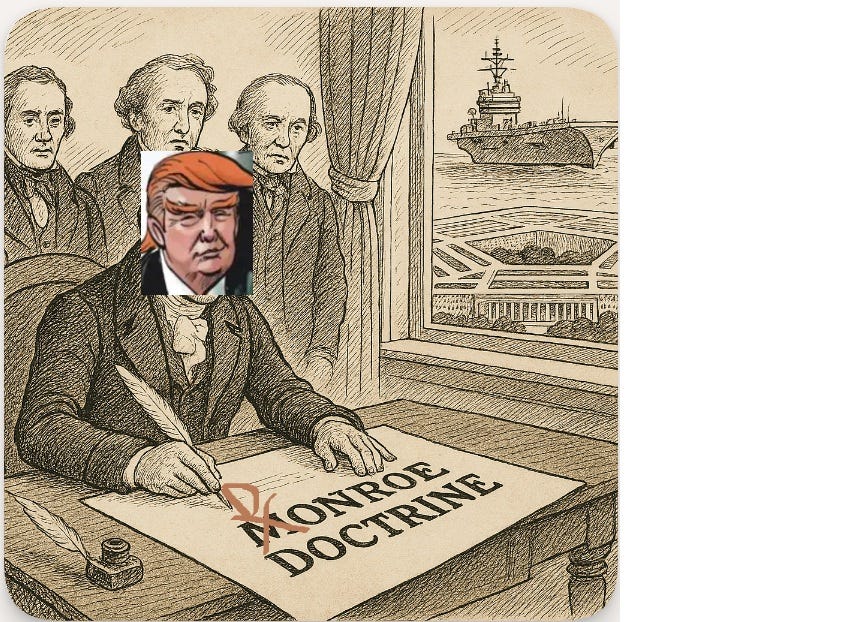
While all of this is going on, the United Nations will play its part as the old, feeble, inept and laughable dotard whose hold on power has slipped so he needs to be replaced by the young, heroic and dashing figure who emerges out of the chaos of the breakdown of the old order.
In this case, it is likely to be the heroic, larger-than-life, revitalized and reinvigorated US swooshing in with a New [WORLD] Order, the Board of Peace which is not like the UN at all!
- It is not corrupt like the UN. No Siree!
- It is not impotent like the UN. Not even a little bit! Good ol’ US Can Do at work!
- It is not the plaything of the shockingly wealthy individuals and corporations serving the money system like the UN does. You betcha it stands ready to defend truth, justice and the common man!
- It is based on our shared values, with wealth shared among those who can hold onto it best. That way the worthiest get the most!
- It is based on might, which generates automatic right! That’s the American Way, per the modern version of the Monroe Doctrine, after all! See above!
So, this swashbuckling hero gets to put a fresh new face on the same old, same old globalist tyranny.
And this is pretty dim and grim except…. This power vacuum is a shining opportunity for us, right now.
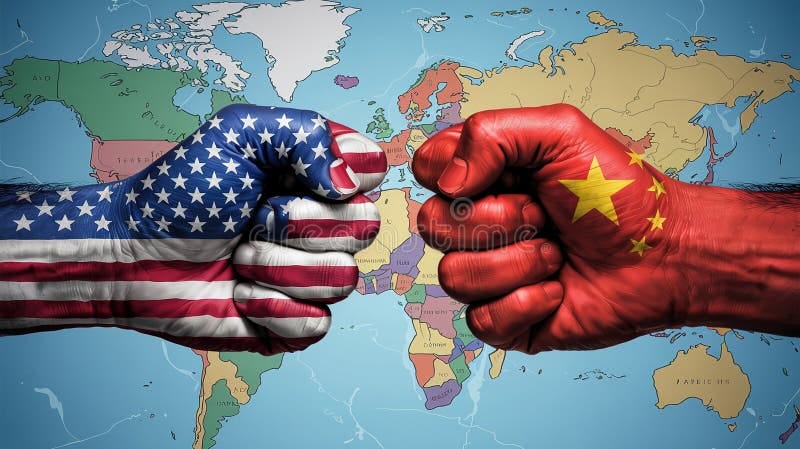
The disruption so carefully scripted opens up the possibility for a different reorganization to be superimposed on the one the power brokers have in mind. History is full of moments where the intended outcome of a disruption turned out to be quite different.
And that is what this carefully scripted theatrical gong show offers us: As the UN-dominated hegemony is replaced with the next iteration, We, the People, swoop in and lean very, VERY heavily on Congress to do what we, in our massive numbers, force them to do:
- Amend the Disengaging Entirely From the United Nations Debacle Act of 2025 (now before both the House and the Senate) to require unwinding all UN Regulatory Capture at every level of governance and
- Prohibit the US from participating in any organization or structure with the potential to become a world government.
Once those amendments are in place, Congress must pass the bill and, as it already requires, exist the UN and eject all of its parts from our shores. Executing effective removal of the UN’s Regulatory Capture is the working end of this bill since membership in the organization is no longer significant, now that it has captured our professions, economy, municipalities, regulations, education, transportation and freedom of speech.
Clearly, eliminating the Regulatory Capture, and detoxing from the UN parasitic infestation we are being consumed by is essential.
That’s why we are asking for as many people as possible to join the Council of Concerned Citizens (C3).
Learn more here: Join C3 here:
As far as I can tell, conventional vaccines, as problematic as they are, do not contain lanthanides.
“…The multilateral institutions on which the middle powers have relied — the WTO, the UN, the COP, the very architecture of collective problem-solving — are under threat. As a result, many countries are drawing the same conclusions that they must develop greater strategic autonomy in energy, food, critical minerals, in finance and supply chains. And this impulse is understandable.
A country that cannot feed itself, fuel itself or defend itself has few options. When the rules no longer protect you, you must protect yourself.
But let’s be clear-eyed about where this leads. A world of fortresses will be poorer, more fragile and less sustainable.
And there’s another truth: if great powers abandon even the pretense of rules and values for the unhindered pursuit of their power and interests, the gains from transactionalism will become harder to replicate.
Hegemons cannot continually monetize their relationships. Allies will diversify to hedge against uncertainty. They’ll buy insurance, increase options in order to rebuild sovereignty — sovereignty that was once grounded in rules but will increasingly be anchored in the ability to withstand pressure…..” Read the full transcript of Carney’s speech to World Economic Forum – National | Globalnews.ca
“…After the war, we gave Greenland back to Denmark. How stupid were we to do that? But we did it, but we gave it back. But how ungrateful are they now? So now our country and the world face much greater risks than it did ever before, because of missiles, because of nuclear, because of weapons of warfare that I can’t even talk about.
Two weeks ago, they saw weapons that nobody ever heard of. They weren’t able to fire one shot at us. They said, ‘What happened?’ Everything was discombobulated. They said, ‘We’ve got them in our sights. Press the trigger.’ And nothing happened. No anti-aircraft missiles went up. There was one that went up about 30 feet and crashed down, right next to the people that sent it. They said, ‘What the hell is going on those?’ Those defensive systems were made by Russia and by China. So, they’re going to go back to the drawing boards, I guess.
Greenland is a vast, almost entirely uninhabited and undeveloped territory, sitting undefended in a key strategic location between the United States, Russia and China. That’s exactly where it is, right smack in the middle. Wasn’t important, nearly, when we gave it back. You know, when we gave it back, it wasn’t the same as it is now. It’s not important for any other reason. You know, everyone talks about the minerals, there’s so many places… There’s no rare earth. No such thing as rare earth. There’s rare processing, but there’s so much rare earth, then to get to this rare earth, you have to go through hundreds of feet of ice.
That’s not the reason we need it. We need it for strategic national security and international security. This enormous unsecured island is actually part of North America, on the northern frontier of the Western Hemisphere. That’s our territory. It is therefore a core national security interest of the United States of America, and in fact, it’s been our policy for hundreds of years to prevent outside threats from entering our hemisphere, and we’ve done it very successfully. We’ve never been stronger than we are now.
That’s why American presidents have sought to purchase Greenland for nearly two centuries. You know, for two centuries they’ve been trying to do it. They should have kept it after World War Two, but they had a different president. That’s all right, people think differently. Much more necessary now than it was at that time.
However, in 2019 Denmark said that they would spend over $200 million to strengthen Greenland’s defences. But as you know, they spent less than 1% of that amount, 1%. No sign of Denmark there. And I say that with great respect for Denmark, whose people I love, whose leaders are very good.
It’s the United States alone that can protect this giant mass of land, this giant piece of ice, develop it and improve it, and make it so that it’s good for Europe, and safe for Europe, and good for us. And that’s the reason I’m seeking immediate negotiations to, once again, discuss the acquisition of Greenland by the United States – just as we have acquired many other territories throughout our history. As many of the European nations have, they’ve acquired. There’s nothing wrong with it. Many of them. Some went in reverse, actually, if you look. Some had great, vast wealth, great, vast lands, all over the world. They went in reverse. They stuck back where they started. That happens too, but some grow.
But this would not be a threat to NATO. This would greatly enhance the security of the entire alliance, the NATO Alliance. The United States is treated very unfairly by NATO. I want to tell you that. When you think about it, nobody can dispute it. We give so much, and we get so little in return. And I’ve been a critic of NATO for many years, and yet I’ve done more to help NATO than any other president, by far than any other person. You wouldn’t have NATO if I didn’t get involved in my first term….” Davos 2026: Special Address by US President Donald J Trump | World Economic Forum









 fox files
Recent Comments