
Raising manipulation concerns.

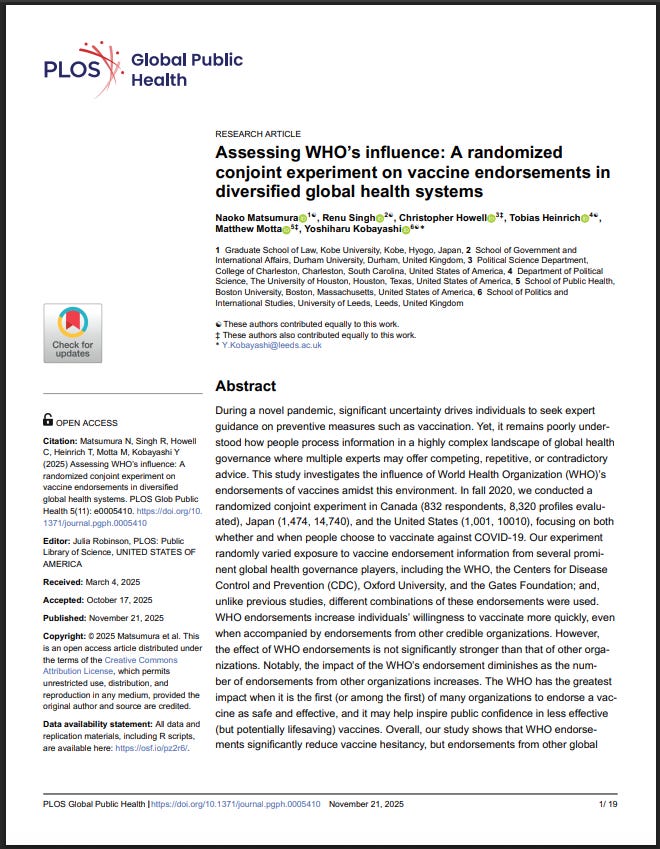
A newly published PLOS Global Public Health paper confirms that researchers were already running multinational experiments to measure how quickly populations could be moved toward COVID-19 vaccination before any product had been authorized.
The authors state clearly:
“We recruited the respondents in late November 2020… before any [vaccines] were officially approved by a government.”
This places the experiment at a time when the public had no approved vaccine, no final safety data, and no access to Phase 3 trial results.
Yet the study was already testing which institutions—WHO, CDC, Oxford, or the Gates Foundation—were most effective at accelerating public willingness to accept a future vaccine.
The Experiment Focused on Uptake Speed, Not Evidence
The survey’s main outcome variable was not clinical.
It was the speed of compliance:
“Respondents were given five options to express whether and when they would choose to get vaccinated if a vaccine were available at no cost. These options were: ‘Yes, within a month,’ ‘Yes, within 2-3 months,’ ‘Yes, within 4-12 months,’ ‘Yes, after a year,’ and ‘No, never.’”
Those responses were then collapsed into:
- “early” (within 3 months)
- “middle” (4–12 months)
- “late,” which includes “never”
The paper describes vaccine hesitancy entirely in terms of “delay”:
“WHO endorsements, alongside the three other public health organizations examined in this study, are associated with a statistically significant, cross-national reduction in vaccine hesitancy, measured as the delay between vaccine availability and willingness to receive it. Our timing-based measure is a meaningful, yet under-studied, dimension of vaccine uptake that directly speaks to the urgency of public health communication during a pandemic.”
The study did not attempt to measure why individuals might wait for more data or how safety information influences decisions.
Hesitancy was defined only as slowness to accept.
Endorsements Were Randomized to Test Which Authority Moves People Faster
The authors explain that each participant was shown randomized vaccine profiles with or without endorsements from major institutions:
“Our experiment randomly varied exposure to vaccine endorsement information from several prominent global health governance players, including the WHO, the Centers for Disease Control and Prevention (CDC), Oxford University, and the Gates Foundation.”
The goal was to quantify the effect of each authority on changing timing behavior:
“WHO endorsements increase individuals’ willingness to get vaccinated more quickly.”
This design treats institutional influence itself as the variable of interest, not the vaccine.
“[T]rust in scientific authorities, including the WHO, positively correlates with increased public willingness to engage in recommended health practices, such as COVID-19 vaccination and compliance with preventive measures.”
The Paper Acknowledges the Experiment Took Advantage of High Uncertainty
The authors state that their framework relies on the public’s vulnerability during uncertain periods:
“During a novel pandemic, significant uncertainty drives individuals to seek expert guidance on preventive measures such as vaccination.”
The experiment uses that uncertainty to measure which voice is most persuasive.
WHO Was Most Effective When It Spoke Early, Before Other Actors
One of the clearest findings is that WHO’s influence is strongest when it is the first or among the first endorsers:
“The WHO has the greatest impact when it is the first (or among the first) of many organizations to endorse a vaccine.”
And that power drops once other organizations join in:
“[T]he impact of WHO endorsements decreases as additional endorsements from other reputable global health actors emerge.”
The authors explicitly describe this as substitutability, meaning WHO’s influence is higher only when information from other actors is absent.
The Study Also Examined How Endorsements Help Drive Uptake of ‘Low-Quality’ Vaccines
A section of the paper focuses on vaccines with:
- 50% efficacy,
- 1-year protection duration,
- 1 in 10,000 severe side-effect rate,
- 1 in 30 mild-side-effect rate,
which the authors classify as low-quality vaccines.
The paper states:
“[I]t is crucial to examine the influence of WHO endorsements specifically for lower-quality vaccines, as vaccination intentions for these vaccines are likely to be more sensitive to credible endorsements.”
Their simulation results showed:
“[F]or low-quality vaccines… When people are receptive to WHO endorsements, we observe a distinctly higher vaccination rate over time.”
This shows the study’s purpose was not limited to hypothetical best-case vaccines.
The authors tested how institutional messaging can increase uptake even when vaccine performance is weak.
The Authors Describe Their Work as Global-Level Persuasion Research
Throughout the paper, the focus is on influence, not clinical evaluation:
“This study investigates the influence of World Health Organization (WHO)’s endorsements…”
Endorsements “can accelerate vaccination intentions” and “significantly reduce vaccine hesitancy.”
And the authors frame the absence of evidence as an opportunity:
“During a novel pandemic, significant uncertainty drives individuals to seek expert guidance on preventive measures such as vaccination.”
Rather than studying data quality or risk–benefit communication, the study treats this moment of uncertainty as the condition under which endorsement effects can be most accurately measured.
Conclusion
The record in PLOS Global Public Health shows that researchers in Canada, Japan, and the United States were already measuring which institutions could most effectively accelerate COVID-19 vaccine uptake—for low-quality vaccines—in November 2020, prior to any approved product.
The experiment centered on how quickly people could be influenced to vaccinate, how endorsement messaging changes compliance timing, and how those effects behave under uncertainty or when evaluating lower-quality vaccines.
Every element of the study was built around institutional persuasion.
Not safety, not efficacy, and not informed consent.
When institutions are tested for their ability to speed compliance before safety data even exists, the line between public health guidance and psychological manipulation becomes impossible to ignore.


 fox files
Leave a comment