
New records show top U.S. nuclear, national security laboratories scrutinized primers used to define the pandemic—but hid the results.
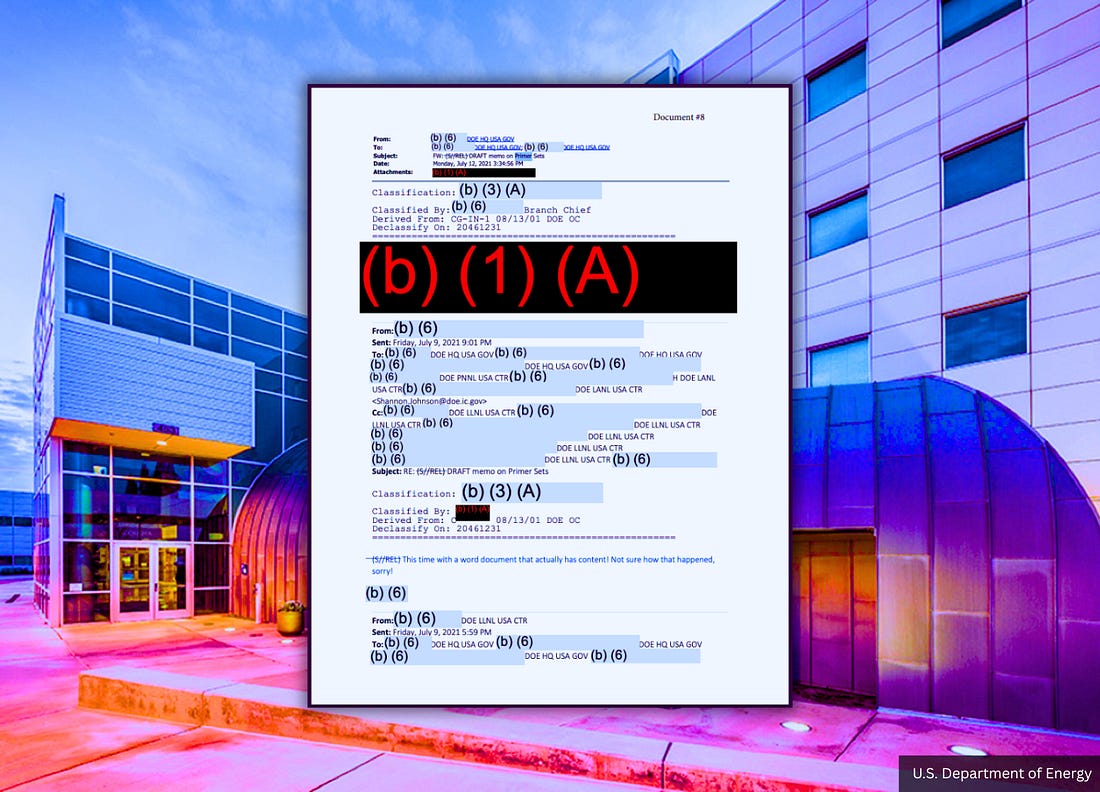
Newly released Department of Energy (DOE) records obtained by U.S. Right to Know through a Freedom of Information Act (FOIA) requenst show that U.S. federal intelligence agencies classified and redacted the results of an internal review of COVID-19 PCR test primers, even as those tests were used to define “cases,” drive emergency policy, and justify unprecedented social and economic controls.
The documents reveal that during the pandemic, the U.S. government quietly subjected PCR test primer sets—the molecular components that determine what PCR tests detect—to classified scrutiny by top national security laboratories, while withholding the findings from the public under national-security and intelligence exemptions.
At the center of the release is a classified internal communication titled “DRAFT memo on Primer Sets,” circulated through the DOE’s Office of Intelligence and Counterintelligence and reviewed by assay experts at Lawrence Livermore National Laboratory, Los Alamos National Laboratory, and Pacific Northwest National Laboratory.
The memo itself remains classified.
Its conclusions were redacted.
No public explanation was ever provided.
PCR Testing Was Treated as a Classified Intelligence Issue
PCR tests do not detect an intact virus and do not prove infection.
They work by using short genetic sequences—primers—to bind to matching genetic material and amplify it until a signal is detected.
What a PCR test detects depends entirely on what its primers bind to.
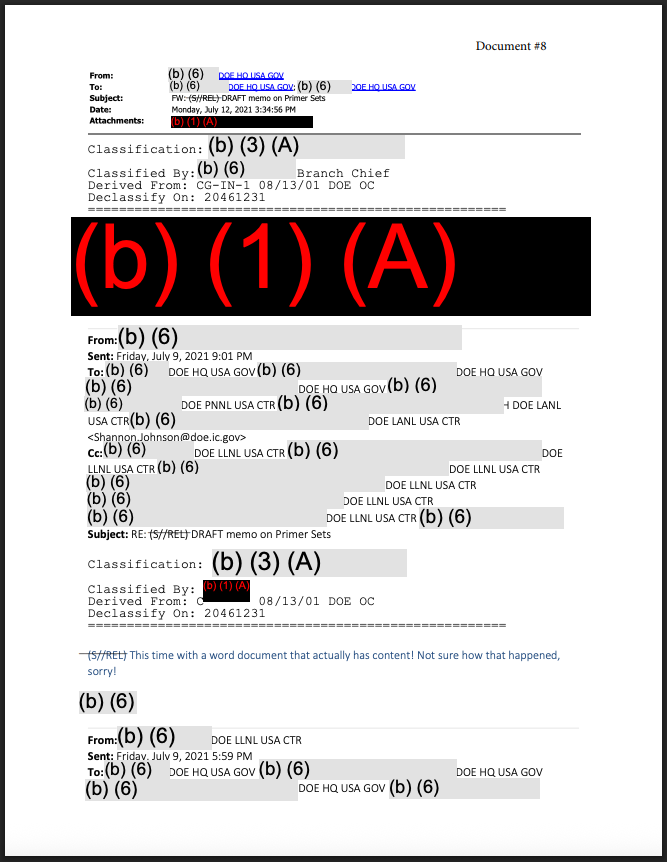
The DOE records show that this foundational question—what COVID-19 PCR tests were actually detecting—was handled not as a public scientific matter, but as a classified intelligence issue.
One internal email chain explicitly references a classified document titled:
“FW: (S//REL) DRAFT memo on Primer Sets”
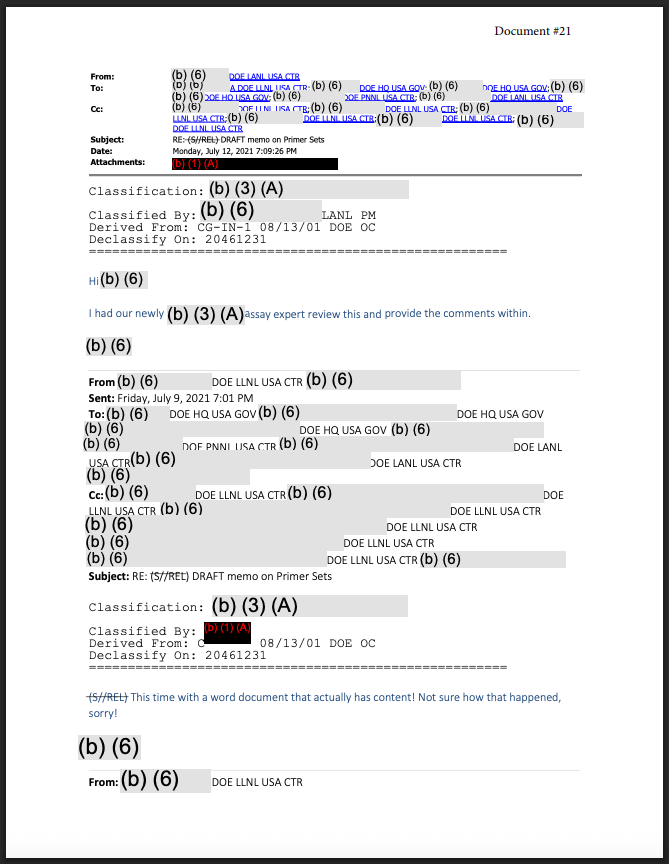
Another message states that the memo was reviewed by a specialist:
“I had our newly assay expert review this and provide the comments within.”
The routing shows coordination across DOE intelligence offices and U.S. national security laboratories.
The content of the memo, the concerns it addressed, and the conclusions it reached are all withheld from public release.
What the Government Did Not Disclose
Throughout the pandemic, the public was repeatedly told that COVID-19 PCR testing was reliable, specific, and settled.
Questions about PCR design were often dismissed as misinformation.
The DOE records show the opposite posture inside government: PCR primer design was serious enough to warrant classified review by nuclear-era national laboratories, with the results deemed sensitive enough to be redacted under national-security and intelligence-source protections.
DOE explicitly justified withholding the information by citing risks to national security and intelligence methods, and assigned declassification dates decades into the future.
There is no indication in the records that the findings were shared with public-health agencies, published in scientific journals, or communicated to the public.
Why PCR Primer Design Is Existential, Not Technical
PCR testing formed the backbone of the pandemic response.
PCR “positives” were treated as synonymous with infection and were used to define:
- COVID “cases”
- Community spread
- Hospital surges
- Lockdowns and emergency orders
- Vaccine emergency authorizations
If PCR primers bind to viral genetic material, positives reflect virus detection.
If PCR primers bind to human genetic material, positives can reflect the person being tested.
That distinction determines whether a “case” is an infection—or merely a genetic detection.
What the CDC’s PCR Primer Actually Aligns To
An independent BLAST analysis was run of the CDC’s SARS-CoV-2 forward PCR primer.
The results show that the primer has multiple perfect and near-perfect matches to the human genome, including:
- Repeated 13–16 base stretches with 100% identity to human DNA
- Longer alignments exceeding 94–95% identity across multiple human chromosomes
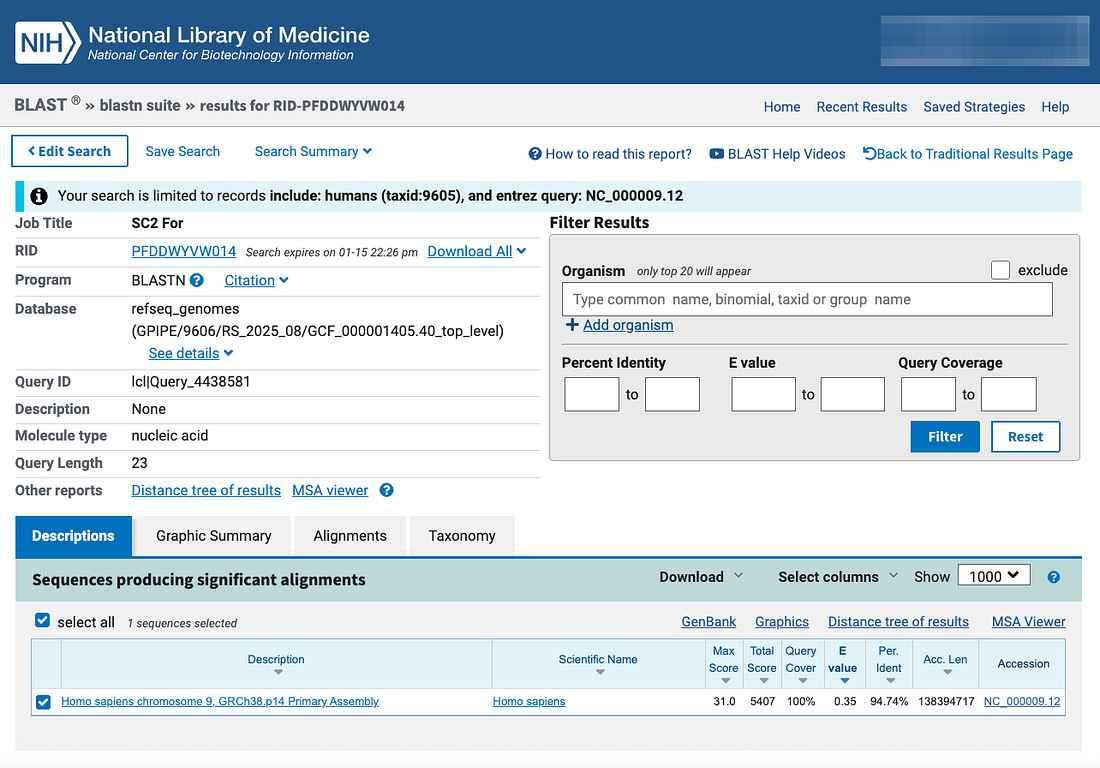
In plain terms: the CDC’s COVID-19 PCR primer can bind to human genetic material.
That establishes a biological mechanism by which a PCR test administered “for COVID-19” can return a positive result by amplifying human DNA or RNA rather than viral RNA.
If that occurs, the test still produces a positive signal.
The result is still recorded as a “COVID case.”
But no infection has been detected.
The “case” is a human genetic detection.
Why This Explains the Secrecy
The DOE records show that this was not ignored.
It was escalated—and then classified.
National security laboratories are not tasked with reviewing PCR primer sets unless the implications are systemic.
If the test used to define a global pandemic can generate positives without detecting a virus, public disclosure would collapse the legitimacy of case counts, emergency powers, and pandemic policy itself.
The records show that U.S. intelligence examined the issue.
They also show that the findings were classified, redacted, and withheld from the public.
The classification of PCR findings is especially significant given that no U.S. agency has ever independently verified the original clinical sample from which the SARS-CoV-2 genetic sequence was derived.
The United States accepted a digital genetic code supplied by the Chinese government—without access to the physical lung sample it was allegedly sequenced from—and relied on PCR testing and that same in-silico sequence to define cases, drive emergency policy, and later encode spike protein into hundreds of millions of vaccine doses.
That secrecy is even more consequential given that U.S. military planners had already built—and quietly funded—a DARPA-backed pandemic pipeline designed to treat digital genetic sequences as functional viruses, synthesizing infectious clones and mass-producing mRNA countermeasures without requiring a verified physical pathogen, meaning both COVID “case” detection and the subsequent vaccine rollout rested on the same unverified, in-silico genetic foundation.
Dr. Kary Mullis, the late inventor of the PCR test, said in a 1997 interview (here) that his test should not be used to determine whether a subject is infected with a virus.
This is because the test “can find almost anything in anybody” if its parameters are set high enough, tainting the results, according to the Nobel Prize winner.
“Anyone can test positive for practically anything with a PCR test. If you run it long enough… you can find almost anything in anybody,” Dr. Mullis said. “It doesn’t tell you that you’re sick.”
Mullis’s warning matters because it confirms that PCR was not designed to establish clinical infection, meaning a pandemic built on PCR “cases” can reflect amplified genetic signals rather than illness—a vulnerability that could be serious enough to later draw classified scrutiny from U.S. national security laboratories.
What the Records Prove—& What They Imply
The documents do not release the primer memo.
They do not disclose the conclusions.
They do not quantify how many PCR positives may reflect human material.
They do prove that:
- COVID-19 PCR test primers were scrutinized by U.S. intelligence
- Top national security laboratories were involved
- The findings were classified and redacted
- The public was never informed
Combined with sequence-alignment evidence showing that the CDC’s PCR primer binds to human DNA, the implication is unavoidable:
The U.S. government privately examined whether the test used to define the pandemic could generate “cases” without detecting infection—and then classified the answer.
The DOE records were released to U.S. Right to Know under FOIA request HQ-2025-03244-F.
The primer alignment is reproducible using the CDC’s published primer sequence and the human reference genome.
The public was told PCR testing was settled science.
The documents show the government didn’t treat it that way behind the scenes.
And whatever they found, they made sure we were never allowed to see it.


 fox files
Leave a comment