
L.D. 2071 requires pharmacists to report each vaccine within 72 hours to a centralized state system, enabling real-time monitoring of vaccination across the population.

Maine lawmakers have passed legislation that fundamentally restructures how influenza vaccines can be deployed across the state—establishing a system capable of rapid, large-scale distribution to the general population without relying on physicians.
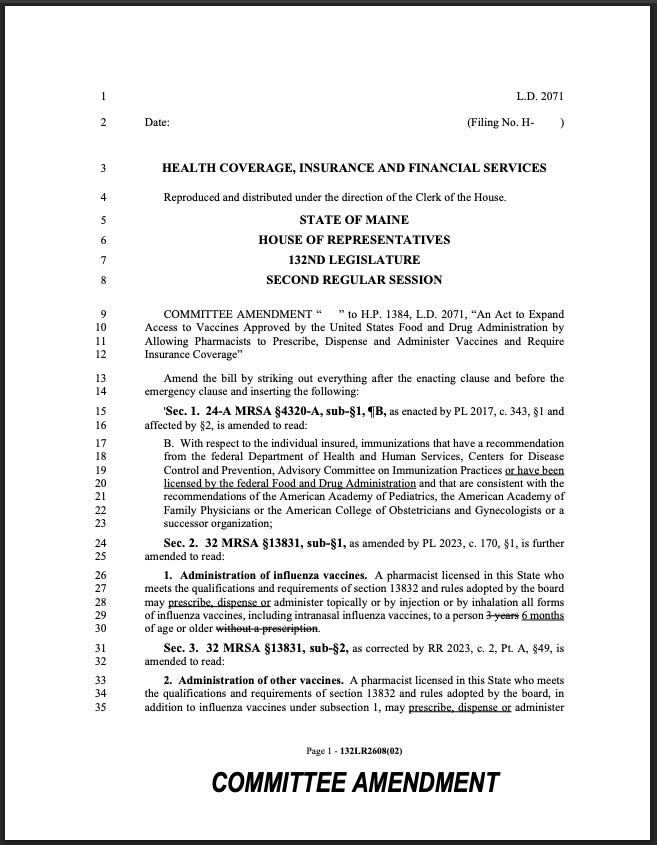
The final version of L.D. 2071 gives pharmacists full independent authority to prescribe, dispense, and administer influenza vaccines to individuals as young as 3 years and 6 months old—without a prescription or prior medical approval.
This structure removes physician oversight, concentrates vaccination authority in retail pharmacies, and pairs rapid, population-wide access with centralized state reporting—raising concerns about informed consent, medical autonomy, and the state’s ability to execute a fast, large-scale influenza vaccination campaign if another public health emergency is declared.
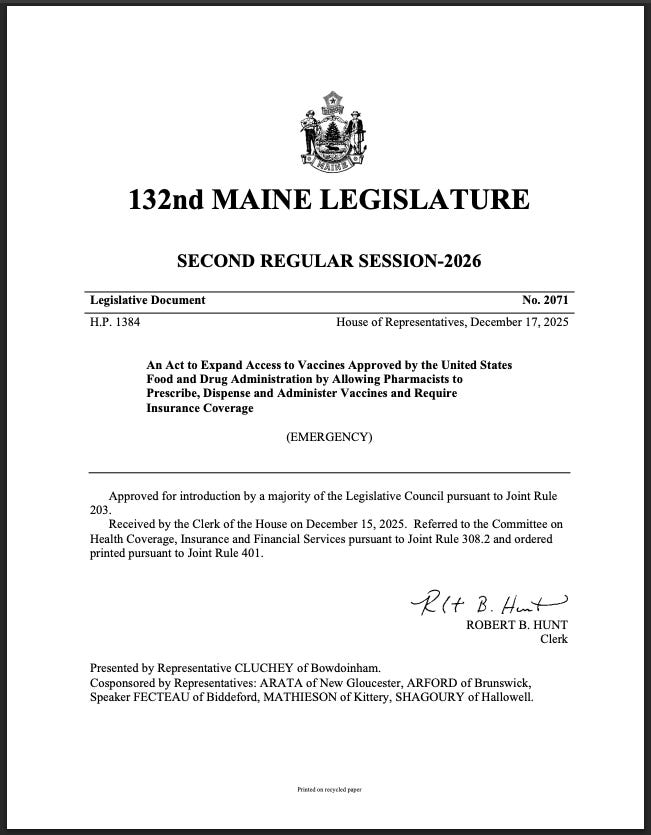
As of April 7, 2026, the bill has passed both chambers in identical final form and has been ordered sent to the Governor’s desk for signature.
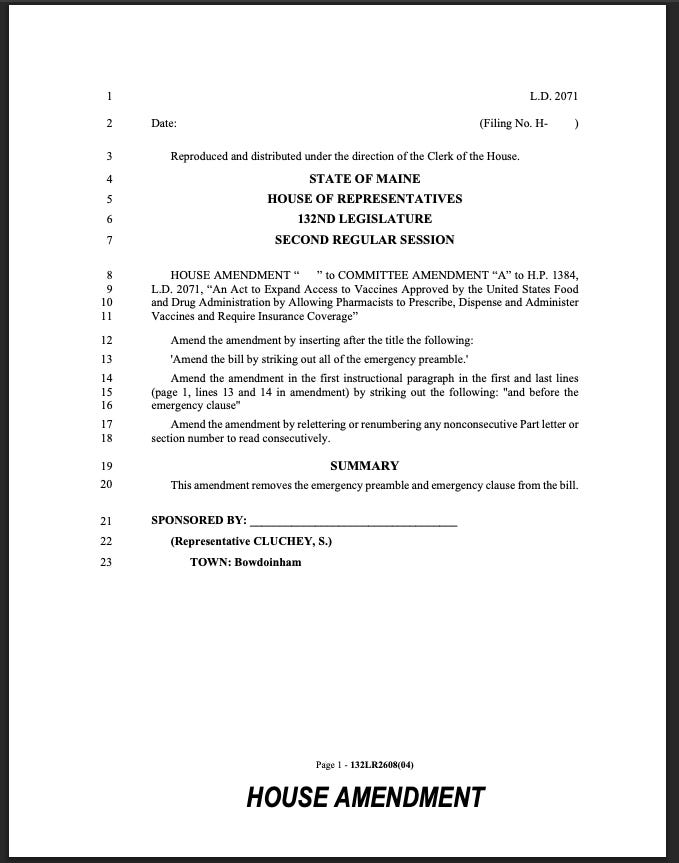
The bill will take effect 90 days after the Legislature adjourns, which is scheduled for April 15, 2026—meaning the new pharmacist authority would become law on July 14, 2026.
The legislation’s advancement comes amid state, federal, and international influenza outbreak orchestration.
It is sponsored by Democrat Representatives Sally Cluchey, Poppy Arford, Ryan Fecteau, Kristi Mathieson, Daniel Shagoury, and Republican Rep. Amy Arata.
You can contact Governor Janet Mills office here.
Pharmacists Become Frontline Vaccination Authority
Under the amended statute:
“A pharmacist… may prescribe, dispense or administer… all forms of influenza vaccines… to a person 3 years 6 months of age or older without a prescription.”
This language removes the traditional requirement that a physician authorize vaccination—transferring full control over influenza vaccine delivery directly to retail pharmacies.
Pharmacists are no longer limited to administering a doctor’s order.
They can now initiate vaccination themselves.
That shift transforms pharmacies from passive distribution points into independent vaccination hubs capable of operating at scale.
Statewide Retail Network Activated for Mass Deployment
By design, the system leverages the existing pharmacy network as the backbone of vaccine delivery.
Instead of relying on:
- clinics
- hospital systems
- scheduled appointments
The law enables:
- walk-in access
- immediate administration
- decentralized distribution
Pharmacies—already embedded in nearly every community—function as a ready-made infrastructure for rapid statewide rollout.
Influenza Singled Out for Broadest Authority
The legislation treats influenza differently from all other vaccines.
- Influenza vaccines:
- pharmacist can prescribe, dispense, and administer
- applies down to age 3 years 6 months
- Other vaccines:
- independent pharmacist authority limited to adults 18+
- minors require a doctor’s prescription
This makes influenza the only vaccine category granted full pharmacist-controlled access across both adults and young children.
Real-Time State Tracking Built In
The bill also requires that every administered vaccine be reported:
Pharmacists must report vaccine administration to the state immunization information system within 72 hours.
This creates a centralized system capable of:
- tracking vaccination rates
- monitoring geographic uptake
- identifying gaps in coverage
The result is near real-time visibility into how widely vaccines are being administered across the population.
Insurance Language Opens the Door—Without Mandating Coverage
While earlier versions of the bill proposed mandatory no-cost vaccine coverage, the final version stops short of requiring it.
Instead, the amended law clarifies that insurers are authorized to cover vaccines without cost-sharing if they choose, rather than mandating it.
Even without a mandate, the structure aligns financial incentives with expanded access.
What the Structure Reveals
The bill establishes:
- Immediate, walk-in vaccination access
- No physician gatekeeping
- A statewide pharmacy-based delivery network
- Rapid reporting into a centralized tracking system
- Inclusion of young children in the rollout model
This represents a complete redesign of how influenza vaccines can be deployed at scale.
Bottom Line
Maine legislators have constructed a system that allows influenza vaccines to be distributed quickly, broadly, and with minimal friction across the entire population.
If activated, the infrastructure enables any individual to walk into a pharmacy, receive an influenza vaccine on the spot, and have that dose logged into a statewide tracking system within days—without ever interacting with a physician.


 fox files
Leave a comment