
After state’s vaccine passport era, Hawaii lawmakers want to give Department of Health final authority over medical decisions while blocking lawsuits and discipline against those who enforce them.

Hawaii lawmakers are advancing a bill that gives the state’s Department of Health decisive control over which vaccines and preventive services count as medically valid—and then protects anyone who carries them out from nearly all legal consequences.
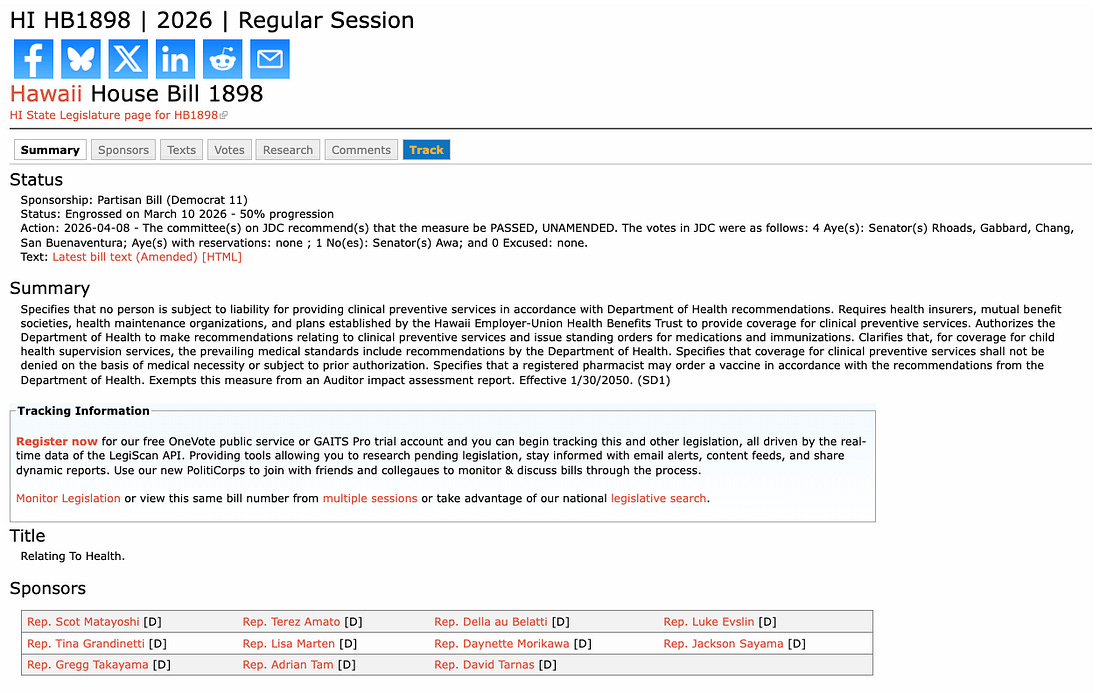
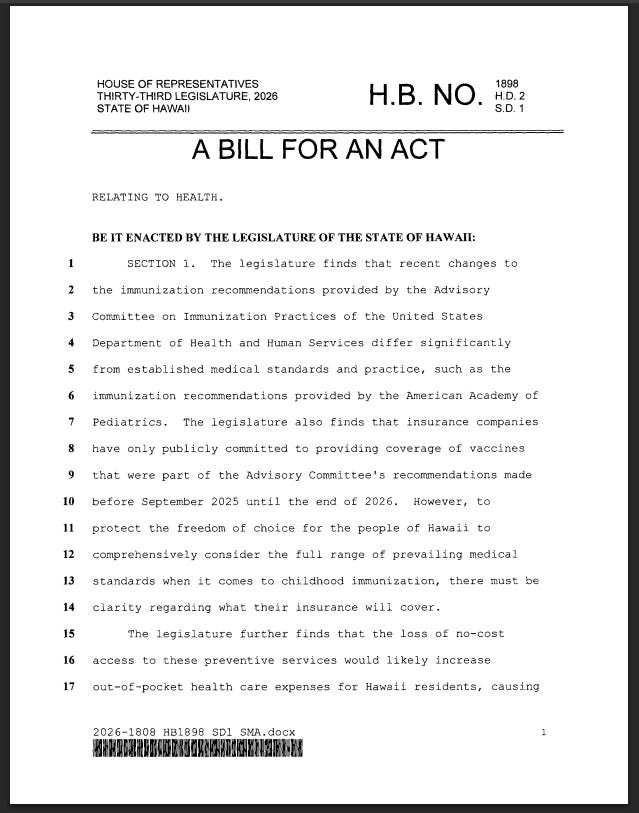
House Bill 1898 (S.D. 1) creates immunity from civil lawsuits, criminal liability, and professional discipline for providers who follow DOH recommendations on “clinical preventive services.”
If harm occurs later, the main legal question becomes whether the provider obeyed state guidance.
During the next outbreak or pandemic, when the DOH again requires vaccination to work, attend school, travel, or participate in society, anyone injured by the shot could have no one to hold accountable—because the bill grants legal immunity to every doctor, pharmacist, and facility that simply followed state orders.
Watchdog groups actively monitoring the CDC’s Vaccine Adverse Event Reporting System (VAERS) data confirm 2.7 million adverse events have been linked to vaccines since 1990 (~204 adverse events per day)—though a Harvard Pilgrim Health Care report found that fewer than 1% of adverse events are ever reported, suggesting the true number could be in the hundreds of millions (~20,360 adverse events per day).
The accountability-erasing bill is backed by Democrat lawmakers, including Reps. Scot Matayoshi, Terez Amato, Della Au Belatti, Luke Evslin, Tina Grandinetti, Lisa Marten, Daynette Morikawa, Jackson Sayama, Gregg Takayama, Adrian Tam, and David Tarnas.
HB1898 is in the final stage in the Senate, one step away from passage before being sent to the Governor.
You can contact Hawaii senators here and voice your opinion of the bill and how they should vote on it.
Health-Freedom Principles Violated by the Bill
The bill directly undermines several longstanding health-freedom principles:
- Bodily Autonomy and Informed Consent: Full insurance coverage and legal protection are available only for DOH-approved interventions. Families who prefer a different schedule or approach must pay out of pocket for alternatives that carry no such protections.
- Medical Accountability: The bill states that “[n]o person shall be subject to civil or criminal liability or professional disciplinary action” for providing services in accordance with DOH recommendations. Professional organizations, hospitals, and licensing boards are barred from disciplining, suspending, or penalizing providers who follow the state line.
- Independent Medical Judgment: Doctors who disagree with the DOH’s final decision on immunizations risk professional repercussions, while those who comply are shielded.
- Parental Rights in Child Health Decisions: The bill rewrites child health supervision rules so that “prevailing medical standards” now mean whatever the DOH says. Insurance must cover the DOH-chosen immunizations at no cost to the family, leaving parents who want a different schedule to pay full price.
- Separation of Medicine and State: Standing orders, mandatory insurance coverage with no cost-sharing, pharmacy administration, and legal immunity combine to create a single state-directed pipeline for preventive care.
Department of Health Given Final Authority
The bill makes the Hawaii Department of Health the tie-breaker when national medical groups disagree.
It states that if recommendations from the Advisory Committee on Immunization Practices and the American Academy of Pediatrics differ, “the department of health shall determine which recommendations shall apply.”
It also gives the DOH new power to issue standing orders for medications and immunizations, allowing them to be given without an individual doctor’s prescription.
Legal Protection Tied to Following State Guidance
The immunity language is clear:
“No professional organization or association, health care provider, or health care facility shall subject any person to discipline, suspension, loss of license, loss of privileges, loss of membership, or other penalty for providing clinical preventive services in accordance with recommendations made pursuant to section 321-31.”
Insurance Must Cover DOH-Approved Services at No Cost
For policies issued after January 1, 2027, insurers must provide coverage “without any deductible, copayment, coinsurance, or other cost-sharing requirements” for anything the DOH recommends.
Every Hawaii policyholder will likely pay higher premiums to subsidize the DOH’s choices—while families who want a different schedule get zero coverage and pay 100% out of pocket.
Pharmacies Can Administer Vaccines Under DOH Rules
HB1898 expands who can give vaccines by allowing pharmacists, pharmacy interns, and registered pharmacy technicians to administer them when ordered in line with DOH recommendations or standing orders.
What This Means in a Future Outbreak
If the DOH issues new recommendations during the next public-health emergency, those shots or treatments can be rolled out quickly through pharmacies, must be covered by insurance, and anyone administering them is protected from lawsuits or discipline as long as they followed DOH guidance.
Negligence Exception Exists, But Standard Is Compliance
The bill still allows claims for injury “arising from negligence.”
In practice, however, the legal test will center on whether the provider followed the Department of Health’s recommendations.
Bottom Line
HB 1898 gives the Department of Health the power to decide which preventive medical interventions are covered and protected by law.
It forces insurers to pay for the state’s choices with no patient cost-sharing and removes meaningful accountability for providers who follow those choices.
Hawaii families who want options outside the official schedule will face higher costs and fewer willing providers.
When the state controls the definition of medical truth and shields its enforcers from consequences, bodily autonomy and informed consent become conditional on government approval rather than individual rights.


Leave a Reply