
Leaving unanswered toxicity concerns and whether vaccine components or material the jab forces the body to produce can spread beyond the recipient.
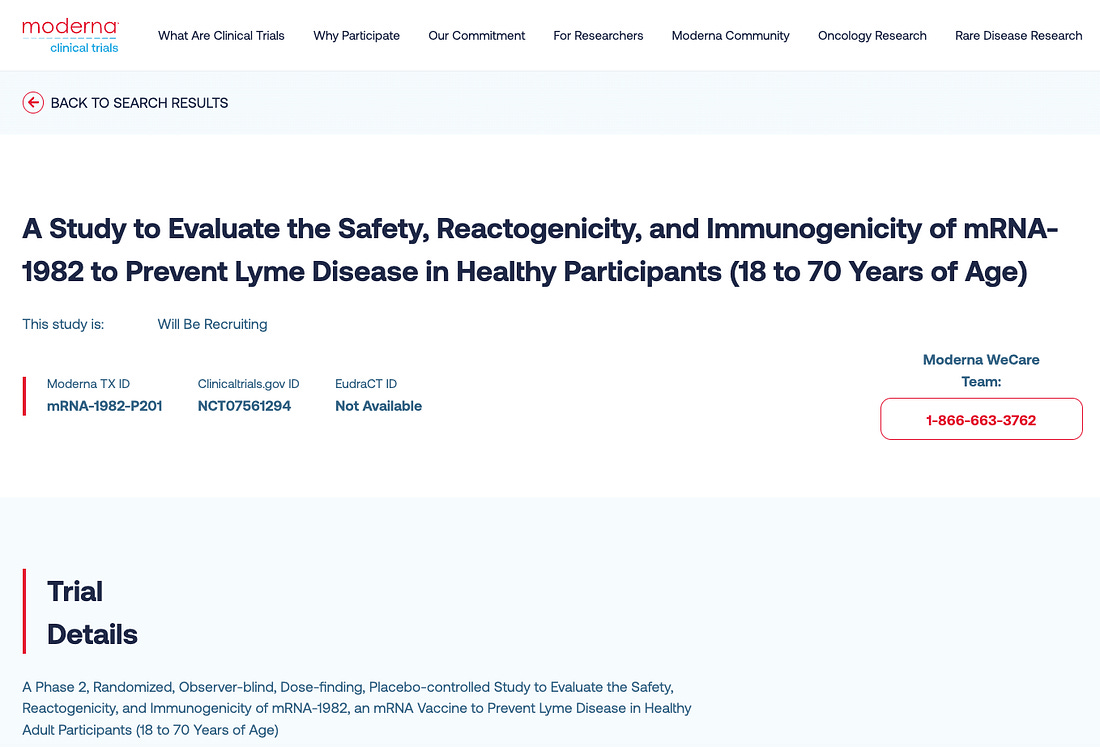
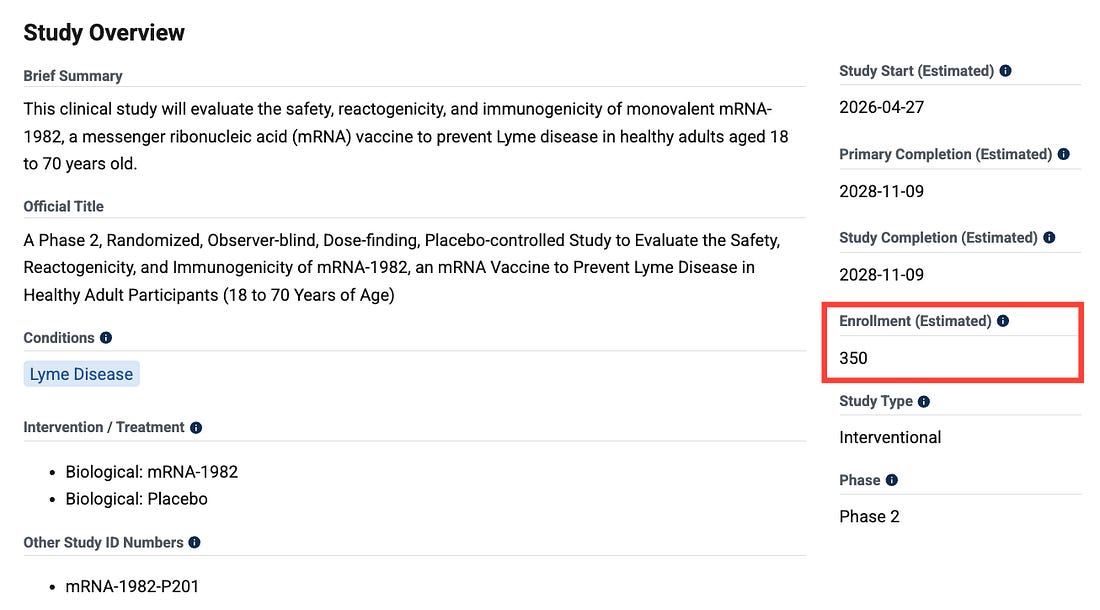
Moderna is preparing to inject approximately 350 people with an experimental mRNA Lyme disease shot as part of a newly listed Phase 2 human clinical trial, according to the company website and ClinicalTrials.gov.
The move comes after Pfizer revived a Lyme vaccine strategy tied to autoimmune arthritis concerns and lawsuits that contributed to the withdrawal of the only previous Lyme shot from the market.
The new Moderna candidate, mRNA-1982, will be evaluated in a randomized, placebo-controlled study involving healthy adults in Canada between the ages of 18 and 70.
The “1982” designation points to the year the Lyme-causing bacterium was formally identified and named, cementing Lyme disease as a defined tick-borne infection.
FDA Commissioner Dr. Marty Makary has asserted that Lyme disease “came from Lab 257 on Plum Island,” directly tying the origin of the illness to a U.S. government lab.
As of the latest update, the mRNA-1982 trial is not yet recruiting, despite an estimated start date of April 27, 2026.
Trial Structure
Participants will receive intramuscular injections of either the mRNA shot or a placebo under a sequential, dose-evaluation design.
The study includes both an initial dosing phase and a booster phase, with monitoring that tracks:
- Local and systemic reactions within 7 days
- Adverse events through 28 days
- Medically attended and serious adverse events for up to 21 months
Target: Lyme-Linked Bacteria
The injection is designed to encode outer surface protein A (OspA), associated with Borrelia, the bacteria linked to Lyme disease.
The program reflects Moderna’s ongoing expansion of mRNA-based products beyond viral applications, like coronavirus, into bacterial targets.
Additional Candidate
Alongside mRNA-1982, the company is developing another Lyme-focused candidate, mRNA-1975, described as a heptavalent formulation intended to target multiple Borrelia serotypes.
Timeline
The Phase 2 study lists an estimated primary and overall completion date of November 2028.
Exosome Shedding & Toxicity Raise Informed Consent & Safety Questions
The trial record does not indicate whether Moderna is testing whether vaccine-produced OspA proteins, mRNA, or related biological material can be packaged into extracellular vesicles and released from the body.
That omission matters because a 2021 Journal of Extracellular Vesicles study found that cells expressing a target protein can release extracellular vesicles that “carry” that protein, demonstrating that what is produced inside the body can be exported outside the cell in membrane-bound particles.
A separate 2023 Pharmaceutics review explains that exosomes are natural transport vesicles that carry proteins and nucleic acids throughout the body and are present in bodily fluids including blood, saliva, and other secretions—meaning they are not confined to the original cell or even the original location in the body.
Taken together, the literature establishes that biologically active material produced inside cells can be packaged into vesicles, circulate systemically, and exit the body through bodily fluids.
That raises a direct informed consent issue: whether an mRNA Lyme injection could result in the body producing OspA or other vaccine-related material that is then packaged into exosomes and shed outside the body—creating a potential pathway for transfer to others through close contact or exposure to bodily fluids.
The question is not just what happens inside the person receiving the injection, but whether what their cells are instructed to produce can leave their body and reach someone else.
Moreover, a January 2023 Nature Reviews Drug Discovery paper co-authored by Moderna scientists bluntly admits that avoiding “unacceptable toxicity” in mRNA vaccines remains a major challenge, warning that “lipid nanoparticle structural components, production methods, route of administration and proteins produced from complexed mRNAs all present toxicity concerns” and that the way these vaccines spread through the body can cause harm due to “cell tropism and tissue distribution… and their possible reactogenicity.”
You can contact Moderna here and ask whether the company has addressed these toxicity concerns.
You can also ask whether their Phase 2 Lyme mRNA trial is evaluating if they have confirmed whether or not vaccine-produced OspA proteins or mRNA are packaged into extracellular vesicles, whether those vesicles can enter bodily fluids, and whether any studies have assessed the potential for this material to be shed or transferred to other individuals—and if not, why those risks were not addressed before human injection.
Bottom Line
Moderna is moving ahead with injecting 350 people with an mRNA Lyme shot that turns the body into a producer of bacterial antigen, while failing to immediately address toxicity concerns or whether vaccine components and antigenic material can be packaged, circulated, and shed to others—an unresolved risk at the center of informed consent.


 fox files
Leave a comment