The Truth Is Out There

Posts tagged ‘mental-health’

HHS/CDC Fund Online Game ‘Bad Vaxx’ to ‘Psychologically Inoculate’ Vaccine Resistance


Ironically, the game uses the very techniques it claims to train users to detect.
U.S. taxpayer funds are being used by federal health agencies to develop and test online psychological games designed to condition how people—especially younger audiences—interpret and respond to vaccine skepticism.

An August Nature Scientific Reports study reveals that the project was funded by the Centers for Disease Control and Prevention (CDC) under the U.S. Department of Health and Human Services, through a CDC award administered by the American Psychological Association.

The paper states that the funding totaled “$2,000,000 with 100% funded by CDC/HHS.”

The grant supporting the project is titled “COVID—INOCULATING AGAINST VACCINE MISINFORMATION,” award number 6NU87PS004366-03–02.

That award has already handed out over $4.3 million in taxpayer funds since its activation in 2018.


The project language mirrors the study’s conceptual framework: dissent is treated as exposure to a pathogen, and resistance to dissent is treated as immunity.

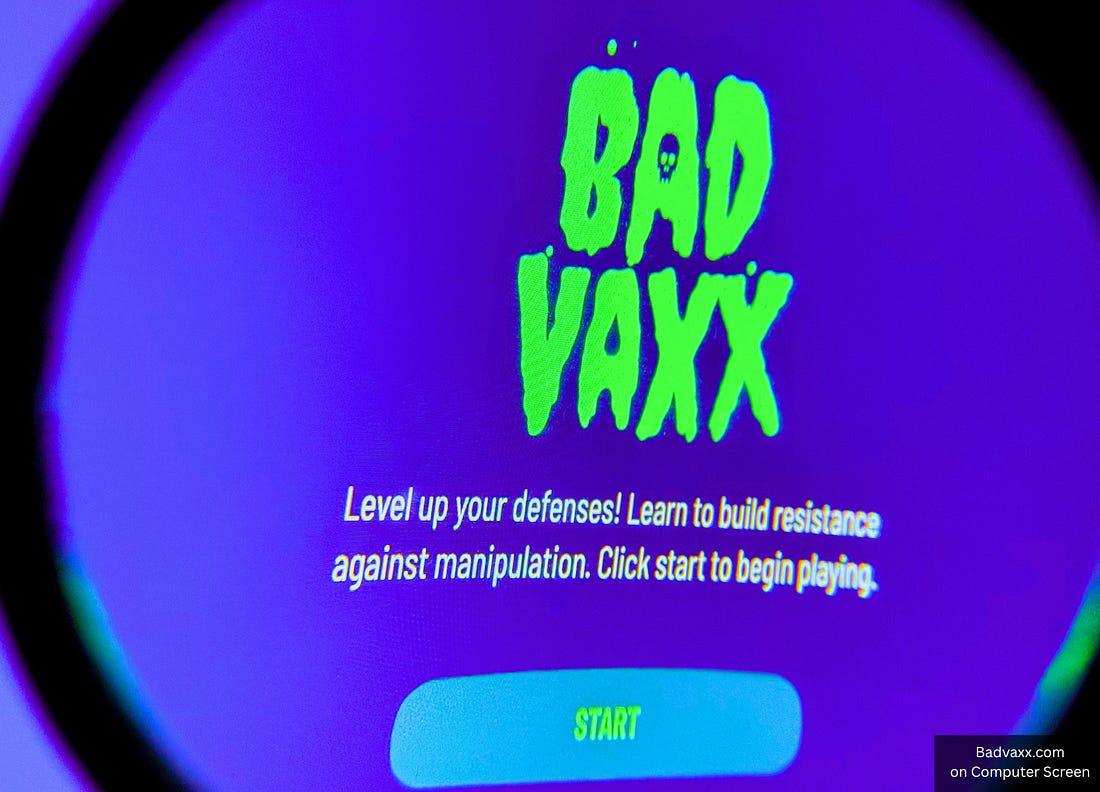
The government-funded study centers on the creation and evaluation of an online game called Bad Vaxx.

According to the authors, the purpose of the game is not to examine disputed vaccine claims or to compare competing evidence, but to reduce what they define as “vaccine misinformation” by shaping how players cognitively process vaccine-critical content.

This is despite the CDC’s own VAERS data confirming over 2.7 million injuries, hospitalizations, and deaths linked to vaccines since 1990.

The study authors explain their premise at the outset:

“Vaccine misinformation endangers public health by contributing to reduced vaccine uptake.”

From this premise, the study moves directly to intervention design.

“We developed a short online game to reduce people’s susceptibility to vaccine misinformation.”

The paper frames this approach as a form of psychological prevention, borrowing language from immunology rather than education or debate.

“Psychological inoculation posits that exposure to a weakened form of a deceptive attack… protects against future exposure to persuasive misinformation.”

The Bad Vaxx game operationalizes this concept by training players to recognize four specific “manipulation techniques”: what it refers to as emotional storytelling, fake expertise, the naturalistic fallacy, and conspiracy theories.

These techniques are treated as characteristic of vaccine misinformation as a category.

“The game trains people to spot four manipulation techniques, which previous studies have identified as being commonly used in the area of vaccine misinformation.”

The study does not include a corresponding examination of whether similar persuasive techniques may be used in vaccine-promoting messaging, government communications, or pharmaceutical advertising.

Ironically, the Bad Vaxx project itself relies on the same persuasive architecture it claims to neutralize—emotional framing, authority cues, and repetition—embedded in a gamified format designed to shape intuition rather than invite scrutiny.

The classification of “vaccine misinformation” is established in advance and applied only to information critical of injectable pharmaceutical products.

Throughout the paper, vaccine skepticism is framed as a behavioral and social risk rather than as a possible response to uncertainty, evolving evidence, or institutional error.

The taxpayer-funded authors write:

“Susceptibility to misinformation about COVID-19 predicts lower compliance with public health regulations and lower willingness to get vaccinated.”

The choice of a game as the delivery mechanism is emphasized as a strength of the intervention.

The authors repeatedly describe the format as “entertaining,” “immers[ive],” and scalable, highlighting its ability to shape intuition rather than deliberation.

“A practical, entertaining intervention in the form of an online game can induce broad-scale resilience against manipulation techniques commonly used to spread false and misleading information about vaccines.”

Games function by rewarding correct pattern recognition, reinforcing desired responses, and reducing analytical friction.

The study’s outcome measures reflect this design: discernment scores, confidence ratings, and willingness to share content, rather than independent evaluation of claims or evidence comparison.

The researchers also emphasize the potential reach of such interventions.

“The Bad Vaxx game has the potential for adoption at scale.”

This matters because the funding source is not an academic foundation with no policy stake.

The CDC is the primary federal agency responsible for vaccine schedules, promotion, and uptake.

Yet the study does not address how this institutional role shapes the definition of misinformation used in the intervention, nor does it acknowledge the conflict inherent in a public health authority funding psychological tools aimed at managing disagreement with its own policies.

The dystopian nature of the project emerges from the structure itself: state funding, psychological conditioning, asymmetric definitions, and a delivery system designed to bypass debate in favor of intuition.

What the paper documents, in concrete terms, is the use of taxpayer funds to develop and validate a behavioral intervention—delivered through a medium optimized for psychological conditioning—that trains users to reflexively distrust a predefined category of speech, while exempting vaccine-promoting institutions from equivalent scrutiny.

Universe 25 Explains The Great Society’s Catastrophic Failure And This Country Had Better Listen Up And Listen Up Quickly!


Universe 25 was not a fable about rodents; it was a behavioral model of what happens when structure, hierarchy, and purpose are replaced by unlimited external provisioning. Dr. John Calhoun observed that when mice lived in a habitat where every material need was met automatically, their social roles collapsed. Male withdrawal, weakened parental investment, falling fertility, and eventually a complete demographic crash followed. It is tempting to think humans would behave differently, but the striking parallels to what happened under LBJ’s Great Society suggest otherwise. This claim seems bold at first glance. Yet careful reflection shows it to be tragically plausible.

John B. Calhoun was an American ethologist and behavioral researcher who is most famous for his “Universe 25” experiment. Conducted between 1968-1973.

To understand the parallel, we must first remind ourselves what Calhoun found. Universe 25 provided abundance without effort. Food appeared without foraging. Shelter required no construction. Predators were removed. At first, the population expanded rapidly. Then something surprising occurred. As resources remained stable, the social structure atrophied. Dominant males withdrew or fixated on repetitive, self-soothing behavior. Females stopped caring for offspring. Infanticide increased. Fertility collapsed. Eventually, the final generation, the so-called “Beautiful Ones,” ceased to reproduce, withdrew from contact, and spent their days grooming or eating in isolation. Abundance without purpose created behavioral degradation so deep that the population could not recover even when conditions remained materially perfect.

If this seems remote from human affairs, consider what Black Americans had achieved before Washington intervened. Despite the severe constraints imposed by segregation, Black families were intact and resilient. More than 85% of Black children were born to married parents in the early 1960s, an astonishing rate for any urban poor population. Poverty existed, but social cohesion was strong. Churches, fraternal organizations, and family networks created structure and responsibility. There was purpose, and there were roles. These institutions helped people navigate unjust external conditions and provided the scaffolding for upward mobility.

Then the Great Society arrived. Washington attempted to replace family, church, and community with federal programs. The intent was compassionate. Yet intent does not override human nature. Welfare incentives rewarded the absence of fathers. Public assistance replaced the reciprocal obligations that had sustained families. The cultural norm that linked marriage, sex, and child rearing was severed. The numbers show how quickly the damage spread. Prior to 1965 fewer than 2% of black women received any form of public assistance. By 1970 roughly 36% did. An eighteen-fold increase in five years reveals not gradual social evolution but a policy driven shock.

Fertility followed a similar arc. In 1965 the General Fertility Rate for black women ages 15 to 44 stood at 140.3 births per 1,000 women. By 1970 it had fallen to 123.5. Today it has collapsed to 45.8. A two thirds decline in sixty years is not an ordinary demographic adjustment. It is the signature of a community losing its social structure. Calhoun observed that once parental roles erode, fertility does not rebound simply because material conditions are comfortable. The behavioral patterns produced by disrupted roles persist across generations. In short, once the social fabric tears, later generations cannot easily repair it.

The expansion of SNAP reinforced the pattern. Food stamps did not reach every county until 1974. Yet by 1980 roughly 35% of black households used them. Today that figure is 52%. More than half of black households now rely on a federal provisioning system to meet basic nutritional needs. Calhoun found that abundant food provided without effort weakened social behaviors related to care, discipline, and responsibility. We see a disturbing parallel. Federal provisioning was meant to provide relief. Instead, it displaced the social norms that sustain families.

The collapse of marriage tells the same story. In 1965 over 85% of black children were born to married parents. By 1970 fewer than 63% were. By 1980 that figure had fallen below 50%. Today it sits below 30%. No developed society has ever seen such a fast decline in marriage without accompanying social dysfunction. When marriage collapses, so does the structure that teaches children discipline, reciprocity, and responsibility. Calhoun would not have been surprised by these outcomes. When a system replaces organic roles with external provisioning, social roles dissolve.

Some readers may resist this interpretation. Perhaps they believe social structures collapsed because of lingering discrimination or economic shocks. These factors matter, but they cannot explain the timing. The most dramatic changes occurred precisely when Great Society programs expanded. Nor can they explain why black families remained stable during far harsher periods before the 1960s. When we look at the causal chain, the policies come first, followed by the collapse in marriage, the surge in welfare use, the decline in fertility, and the rise of multi-generational dependency.

Consider Calhoun’s central insight. A system that removes incentives for productive behavior while failing to reinforce social norms does not create flourishing. It creates a behavioral sink. In Universe 25 the sink emerged not because conditions were harsh but because they were artificially easy. The mice did not need each other, so they stopped forming healthy bonds. They did not need to protect or nurture, so parental roles decayed. They did not need to cooperate, so hierarchy collapsed. What remained was isolation, withdrawal, and the slow erosion of purpose.

Translate this into human social terms. When the state displaces fathers, fathers withdraw. When bureaucracies replace parental responsibility with monthly checks, parental investment declines. When food appears without effort, the link between work and provision breaks. When norms collapse, marriage becomes optional, then rare. The social ecosystem enters a downward spiral. This is precisely what happened in many black communities after the 1960s. The Great Society redistributed material goods while undermining the structures that gave life meaning.

Why does this matter today? Because Democrats still treat the Great Society as an untouchable legacy. They defend it with quasi-religious devotion. Their attachment persists even as the data show catastrophic outcomes. If the goal was to alleviate poverty, they failed. If the goal was to strengthen families, they failed. If the goal was to promote flourishing, they failed. And yet they demand more of the same policies. Calhoun would call this expansion of provisioning a deepening of the behavioral sink.

A reasonable reader might now ask how we should respond. We begin by recovering the insight that material assistance without social norms destroys the very communities it claims to help. Next, we must restore the institutions that originally sustained black families. Churches, civic groups, and strong families cannot be replaced by bureaucracies. Finally, we must ask why a political movement insists on maintaining policies that corrode family life. How do we save America if our policies are designed to destroy the structures that make America possible?

The lesson of Universe 25 is sobering. When abundance is provided without structure, communities decline. The Great Society followed the same script. Calhoun’s experiment warned us. We ignored it. We still have time to reverse course, but doing so requires the courage to admit that our social experiment failed and that the path to renewal runs through responsibility, not dependency.

FDA Chief Says Lyme Disease Came from U.S. Military Lab 257, Suggests HIV Came from African Lab (Video)


“It came from Lab 257 on Plum Island.”

In a stunning exchange on the PBD Podcast (Episode 690), U.S. Commissioner of Food and Drugs (FDA) Dr. Marty Makary, a Johns Hopkins surgeon, dropped two bombshell admissions about pathogen origins—one about HIV, the other about Lyme disease.

Dr. Makary openly entertained the possibility that HIV “may very well have come from a lab in Africa,” saying the film Thank You, Dr. Fauci “explore[s] a non-traditional narrative, which has not gotten the attention it deserves.”

HIV (Human Immunodeficiency Virus) is said to be a retrovirus that targets and destroys CD4 T cells in the immune system, weakening the body’s ability to fight infections and potentially leading to AIDS if untreated.

When asked where Lyme disease originated, Makary answered directly: “I can tell you with a high degree of probability. It came from Lab 257 on Plum Island.”

Lyme disease is a bacterial infection caused by Borrelia burgdorferi, transmitted through bites from infected blacklegged ticks, often marked by an expanding “bull’s-eye” rash, fever, fatigue, and joint pain.

The head of the FDA has admitted that two major diseases originated not in nature, but in government laboratories, raising questions about other disease origins.


HIV: ‘It May Very Well Have Come from a Lab in Africa’

Makary described how mainstream institutions avoid uncomfortable evidence about HIV’s beginnings.

When pressed on the origin of AIDS, he said the following:

“They explore a non-traditional narrative, which has not gotten the attention it deserves. And that is that it may very well have come from a lab in Africa.”

Makary is one of the most publicly visible medical figures in the United States—Hopkins professor, long-time NIH-funded surgeon, and prominent FDA advisor.

His admission directly contradicts decades of official insistence that HIV was unquestionably a zoonotic spillover.

Lyme Disease: ‘It came from Lab 257 on Plum Island’

When the conversation turned to Lyme disease—which afflicts millions of Americans—Makary said:

“I can tell you with a high degree of probability. It came from Lab 257 on Plum Island just outside of Connecticut, 25 miles from Lyme, Connecticut, where the first case was described.”

He then explained how he knows:

“First of all, you can read the book Bitten. It’s a great book.”

And he explained who the U.S. brought to Plum Island after WWII:

“When the Nazi war criminal doctors were executed in Nuremberg, at least one of them was spared and brought to the United States so that his mind could be used by the US military for so-called Biodefense. And they put him on Plum Island and he had said very openly that he believed an incredible form of biowarfare was infecting ticks. And that that’s what Lyme disease is.”

Makary is referring to the notorious Erich Traub, the Nazi bioweapons scientist recruited by U.S. military intelligence.

“A bunch of mad scientists doing things… How many physicians know that it came from Lab 257? Approximately 1%.”

He ended with the warning that the public health establishment refuses to confront:

“Just because you can do something doesn’t mean you should do it. And sometimes we can cause more harm than we can good by messing with Mother Nature.”

Once the FDA commissioner concedes that two major diseases came from government labs, the narrative of “natural outbreaks” collapses on its own.

The only thing left to find out is how far these patterns go.

107 Studies Link Vaccines to Autism, Other Brain Disorders: McCullough Foundation Meta-Analysis


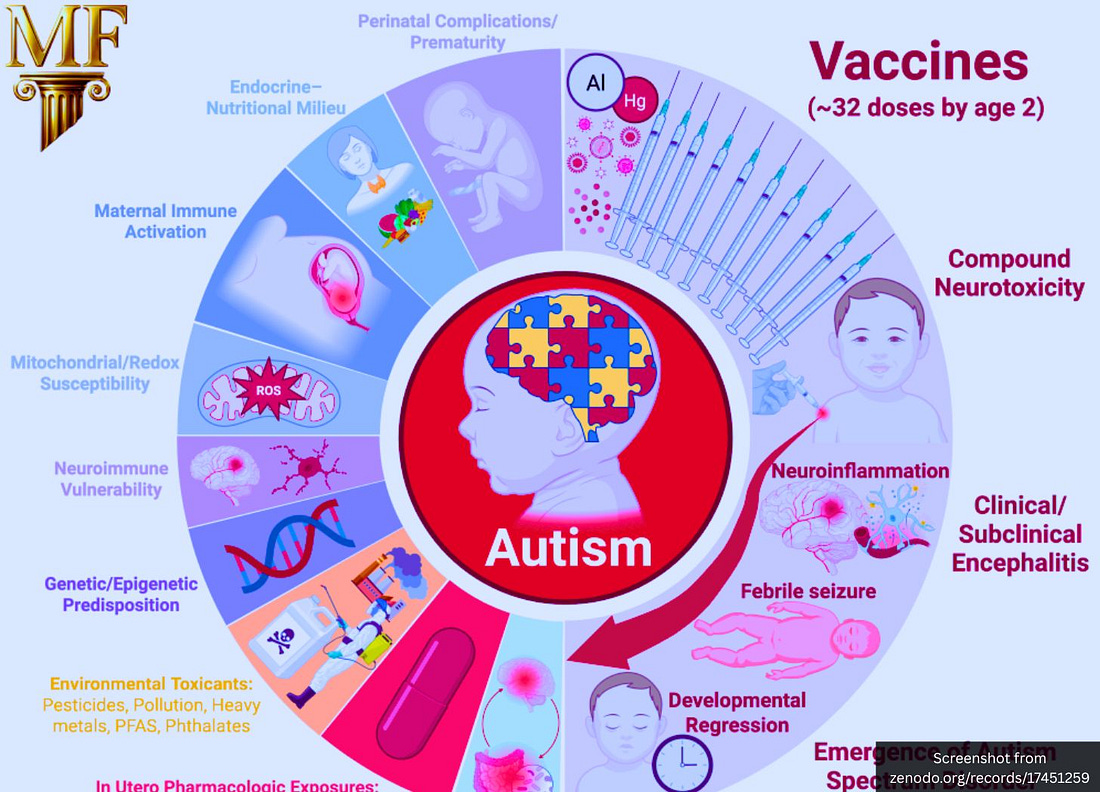
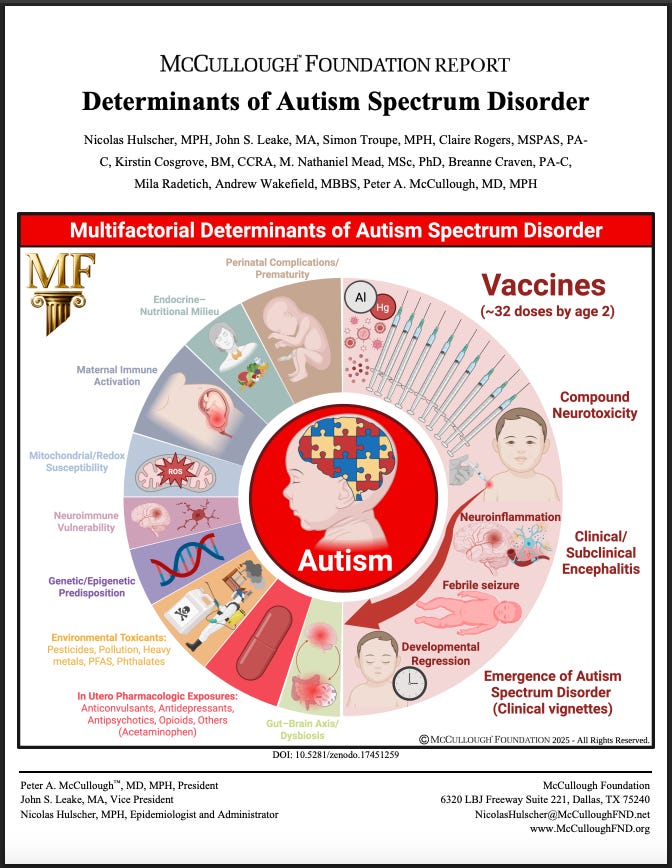
“Childhood vaccination constitutes the most significant modifiable risk factor” for autism, write Hulscher, McCullough, Wakefield, and seven other researchers.

A sweeping new analysis by the McCullough Foundation has confirmed that “the most significant modifiable risk factor” for autism is childhood vaccination.

The McCullough Foundation document, titled Determinants of Autism Spectrum Disorder, reviews an astounding 136 scientific studies.

The majority of them suggest the current vaccine schedule represents an “urgent public health priority” regarding autism.

That means vaccines—with a market value estimated at $82 billion in 2025 and expected to reach $125 billion worldwide by 2032—are likely causing one of the most devastating and tragic disorders known to mankind.

The authors write:

“Combination and early-timed routine childhood vaccination constitutes the most significant modifiable risk factor for ASD, supported by convergent mechanistic, clinical, and epidemiologic findings, and characterized by intensified use, the clustering of multiple doses during critical neurodevelopmental windows, and the lack of research on the cumulative safety of the full pediatric schedule. As ASD prevalence continues to rise at an unprecedented pace, clarifying the risks associated with cumulative vaccine dosing and timing remains an urgent public health priority.”


Most Studies Indicate a Vaccine Association

The McCullough Foundation examined more than a hundred publications that evaluated links between vaccination and neurodevelopmental outcomes.

Most of them pointed to vaccines being the problem.

The authors write:

“Of 136 studies examining childhood vaccines or their excipients, 29 found neutral risks or no association, while 107 inferred a possible link between immunization or vaccine components and ASD or other neurodevelopmental disorders (NDDs).”

In other words, nearly four out of five studies reviewed showed some level of correlation between vaccine exposure and neurodevelopmental changes.

No Long-Term Study of the Full Vaccine Schedule Exists

The report reveals that safety testing has never evaluated the cumulative vaccine program that children actually receive.

“To date, no study has evaluated the safety of the entire cumulative pediatric vaccine schedule for neurodevelopmental outcomes through age 9 or 18 years. Nearly all existing research has focused on a narrow subset of individual vaccines or components—primarily MMR, thimerosal-containing, or aluminum-adjuvanted products—meaning that only a small fraction of total childhood vaccine exposure has ever been assessed for associations with ASD or other NDDs.”

Each vaccine is licensed individually, but children are exposed to dozens in combination.

This is a major regulatory gap that undermines every “safe and effective” claim made about the schedule as a whole.

Unvaccinated Children Reported to Have Better Overall Health

The authors highlight a subset of comparisons between vaccinated and completely unvaccinated populations.

“Twelve studies comparing routinely immunized versus completely unvaccinated children or young adults consistently demonstrated superior overall health outcomes among the unvaccinated, including significantly lower risks of chronic medical problems and neuropsychiatric disorders such as ASD.”

These findings show a reproducible pattern across independent datasets.

That suggests vaccine exposure correlates with poorer long-term health outcomes.

Authors Argue Vaccine Ingredients Can Damage the Brain

The report analyzes the biological plausibility of vaccine-related neuroinflammation.

“Antigen, preservative, and adjuvant (ethyl mercury and aluminum) induced mitochondrial and neuroimmune dysfunction, central nervous system injury, and resultant incipient phenotypic expression of ASD.”

They describe a cascade in which aluminum and mercury trigger oxidative stress and mitochondrial injury in susceptible children.

This is offered as the mechanistic foundation for their broader argument.

Timing and Clustering of Shots Said to Heighten Risk

The authors also show that timing is critical—that multiple shots at once magnify danger.

“Clustered vaccine dosing and earlier timing of exposure during critical neurodevelopmental windows appeared to increase the risk of ASD.”

They argue that vaccine-induced immune stimulation during rapid brain growth in childhood can lead to chronic inflammation.

Autism Surge Tracked Alongside Expanded Vaccine Mandates

The paper draws attention to the timing between federal liability protection for manufacturers and rising autism rates.

“The most salient feature of this steeply rising trend of autism incidence and prevalence is that it began shortly after the passage of the National Childhood Vaccine Injury Act (NCVIA) in 1986… Since then, the number of new vaccines on the childhood schedule has greatly proliferated from 12 shots in 1986 to 54 shots in 2019.”

The authors link legal immunity for manufacturers to rapid schedule growth.

This is evidence that financial and regulatory incentives expanded exposure while suppressing safety accountability.

Bottom Line

The McCullough Foundation report lays out multiple powerful arguments that challenge decades of public-health assurances:

  • most reviewed studies show a possible link;
  • unvaccinated children fare better;
  • cumulative schedule testing is absent;
  • vaccine ingredients and timing may trigger neuroinflammation;
  • and the surge in autism parallels expansion of the vaccine schedule.

The report’s scale and the reputations of its authors ensure its arguments will expose the significant dangers posed by vaccines.

If even part of what the report alleges is accurate, it suggests that modern public health policy has neglected the most consequential safety question of our time: What happens when the cumulative biological burden of vaccination collides with the developing human brain?

NIH Probes Link Between Vaccines and Autism: HHS Announcement (Video)


Trump shares encounter with employee whose son was severely vaccine-injured, and condemns how children are “pumped” with 80 different vaccines so early in life.

As part of its new Autism Data Science Initiative (ADSI), the U.S. National Institutes of Health (NIH) will investigate whether medical exposures—including vaccines—are linked to the rising prevalence of autism spectrum disorder (ASD).

Reviews of 91 human studies up to 2016 show that approximately 74% of studies suggest mercury exposure—including through vaccines—as a risk factor or contributor to ASD, showing both direct and indirect effects on brain development.

The new announcement came during a White House press conference in the Roosevelt Room, where President Trump and HHS Secretary Robert F. Kennedy Jr. outlined what they described as “progress in uncovering the root causes of autism.”

The fact sheet released by HHS details three primary initiatives: a renewed look at leucovorin (folinic acid) as a treatment for autism-related symptoms, guidance to physicians on acetaminophen use in pregnancy, and the NIH’s launch of the Autism Data Science Initiative.

Although vaccines were not listed among the three headline goals, they were nevertheless singled out later in the announcement under the NIH initiative’s “medical and perinatal influences” heading.

Data from CDC VAERS show 2,682,925 adverse events linked to vaccines since 1990—yet, as the Harvard Pilgrim study commissioned by HHS confirmed, fewer than 1% of vaccine injuries are ever reported, meaning the true number is likely in the hundreds of millions.


NIH Autism Data Science Initiative

The new NIH initiative involves more than $50 million in new awards, funding 13 projects that will focus on autism prevalence, etiology, treatment, services, and replication studies.

According to HHS, the projects will use “large-scale, integrated data resources” spanning genetics, epigenetics, proteomics, metabolomics, and behavioral data.

A defining feature is the “exposomics” (the study of all environmental exposures over a lifetime and their impact on health) approach, which NIH says will comprehensively study environmental, medical, and lifestyle factors that may contribute to autism.

The list of exposures includes:

  • Environmental contaminants such as chemicals and other hazardous substances found in everyday life
  • Nutrition and maternal diet factors like folate intake, fish consumption, and ultra-processed foods
  • Medical and perinatal influences, explicitly naming medications and vaccinations alongside obstetric complications and neonatal intensive care exposures
  • Psychosocial stressors, infections, and immune responses during pregnancy and early development

By directly including vaccinations in its research portfolio, NIH is, for the first time, publicly committing to probe potential links between vaccines and autism within a large-scale government-backed initiative.

Autism Rates Continue to Climb

The announcement comes amid sobering new numbers from the CDC: 1 in 31 U.S. children born in 2014 has been diagnosed with autism—nearly a fivefold increase from when the CDC first began tracking autism rates in 2000.

The prevalence is higher among boys (1 in 20) and highest in California, where nearly 1 in 12.5 children are affected.

Trump & Kennedy Single Out Vaccines

During the announcement, Trump shared his encounter with an employee whose son was apparently severely injured by vaccines:

The U.S. president also encouraged parents to space out vaccinations in their children:

Secretary Kennedy also emphasized the new focus on vaccines, pointing out how 40 to 70% of mothers who have children with autism believe that a vaccine injured their child:

Bottom Line

While leucovorin therapy and acetaminophen exposure in pregnancy formed part of the HHS briefing, it is the NIH Autism Data Science Initiative that is likely to draw the most scrutiny.

For decades, the possibility of a vaccine-autism connection has been dismissed by government health agencies, and officials have repeatedly emphasized that “vaccines are safe and effective.”

The fact that NIH’s own research portfolio will now explicitly include vaccinations as one of the risk factors under study marks a major shift—and one that could carry significant implications for both public health policy and parental trust in government vaccine programs.