The Truth Is Out There

Posts tagged ‘politics’

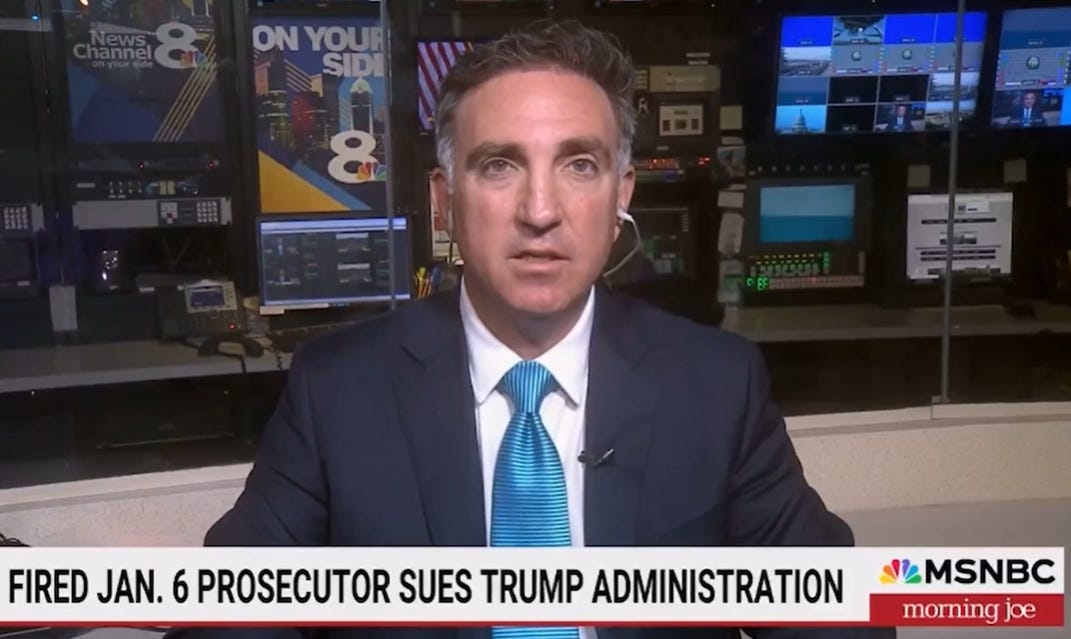
A Lead J6 Inquisitor Gets the Ax–Then Whines to the Media


After volunteering to help lead the most politically-charged and abusive prosecution in U.S. history, Michael Gordon got his walking papers last month from Attorney General Pam Bondi.

Some of the details contained in a lawsuit filed this week by three fired Department of Justice employees brought a big smile to this Jan 6 reporter.

Over the past month, Attorney General Pamela Bondi has fired several DOJ employees as part of a rolling purge, which began in late January, of bad actors still populating the systemically corrupt agency. Three employees—former assistant U.S. Attorney Michael Gordon, former D.C. U.S. Attorney’s Office spokeswoman Patricia Hartman, and former ethics chief Joseph Tirrell—are suing the DOJ, claiming the dismissals violated their civil service and Constitutional rights.

How Hartman, who for four straight years did little more than crank out a steady stream of press releases bragging about J6 arrests, convictions, and sentences, learned of her firing is particularly gratifying given her nefarious role as a key J6 propagandist:

“At approximately 3:50 PM EDT on July 7, 2025, Ms. Hartman was in her office working on a press release when her computer suddenly shut down,” the complaint read. “As she was in the midst of calling the Help Desk for support, another DOJ official…came to her door and handed her a one-page document, titled ‘MEMORANDUM FOR PATRICIA A. HARTMAN’ from ‘THE ATTORNEY GENERAL’ with the subject line, ‘Notice of Removal from Federal Service.’”

Delish. (Hartman this week called her firing “psychological terrorism.” She would know.)

Gordon was informed by his supervisor on June 27 that he was getting canned.

“Mr. Gordon was directed to turn over his…government devices and access cards, pack up his personal belongings, and leave the building.”

Rights for Me but Not for Thee

J6ers undoubtedly will find it amusing and/or infuriating that Gordon argues the firing violates his Fifth Amendment due process rights. As the senior trial counsel to the Capitol Siege Section, Gordon is one of dozens of assistant U.S. Attorneys from around the country—in his case, the middle district of Florida—who relocated to Washington specifically to work on J6 cases. In his own words, Gordon “volunteered” to prosecute fellow Americans to federal prison for entering a government building on a Wednesday afternoon.

The massive investigation of which Gordon happily volunteered to take a leading role represents the greatest abuse of prosecutorial power against a targeted group of individuals in U.S. history. Prosecutors such as Gordon routinely sought pretrial detention even for nonviolent, first time offenders; successfully opposed motions to move trials out of the most Democratic city in the country; brought unprecedented, and in at least one instance, unlawful charges against J6ers—which resulted in DOJ’s perfect conviction rate for J6ers before D.C. juries.

The DOJ then demanded excessive prison sentences based on the lie that Jan 6 was a “domestic terror” attack.

Gordon, for his part, handled high profile cases such as Richard Barnett, the man photographed with his feet on a desk in Nancy Pelosi’s office, and Eric Munchel, the so-called “Zip Tie Guy.”

Gordon also negotiated the sweetheart deal for infamous J6 provocateur Ray Epps. Following intense media scrutiny, the DOJ finally charged Epps in September 2023 with one misdemeanor despite ample evidence Epps should have faced more serious charges given his behavior on both Jan 5 and Jan 6.

In fact, Gordon admitted in a government sentencing memo that Epps “engaged in felonious conduct during the riot” but was given leniency in part because “Epps has been the target of a false and widespread conspiracy theory that he was an undercover government agent on January 6.”

Gordon continued to express sympathy for Epps in seeking only a six month sentence. “[Due] to the outrage directed at Epps as a result of that false conspiracy theory, he has been forced to sell his business, move to a different state, and live reclusively.” (Judge James Boasberg agreed Epps had already paid a heavy price and sentenced him only to probation and community service.)

Others in Gordon’s clutches were not so lucky. After a D.C. jury quickly convicted Richard Barnett for his largely nonviolent albeit obnoxious excursion in the Capitol, Gordon asked the judge to sentence Barnett to 87 months in prison. “Barnett’s felonious conduct on January 6, 2021 was part of a massive riot that almost succeeded in preventing the certification vote from being carried out, frustrating the peaceful transition of Presidential power, and throwing the United States into a Constitutional crisis,” Gordon wrote.

He sought years in prison for mother-son defendants Lisa Eisenhart and Eric Munchel, both of whom walked through an open door with Capitol police standing by and stayed inside the building for 12 minutes. Both were convicted of an obstruction statute later overturned by the Supreme Court.

Gordon’s hyperbolic sentencing recommendation—he wanted 57 months in federal prison for Munchel and 46 months for Eisenhart—demonstrated a level of dishonesty and emotional immaturity that justifies his firing as a federal prosecutor.

The photo of Munchel holding zip ties, which contrary to media reports he did not bring but grabbed off a table in the building, “symbolized the degree to which rioters had captured and occupied Congress,” Gordon wrote. The zip ties, according to Gordon, meant Munchel was “ready to take hostages.” (He was charged with nothing of the sort.)

He then claimed 59-year-old nurse Eisenhart “decided to throw [her life and career] away on January 6, 2021 in spectacular fashion, attacking her own government to interfere with the peaceful transfer of power.”

Gordon continued to pile on. “[Their] post-January 6…conduct and statements are devoid of any regret, remorse, or apology. Neither Munchel nor Eisenhart has taken any steps to denounce their words and actions on January 6.”

Go Test that “Talent” in the Real World, Pal

Gordon now is using his thespian-like abilities to tell his sob story to the media, insisting he prosecuted “righteous cases” for Joe Biden’s DOJ:

According to his social media, Gordon is outrageously referring to Munchel as the individual who “sought to take Congresspeople hostage.” Zero evidence supports that claim—but Gordon is so accustomed to exaggerating, and on some occasions lying, about the events of January 6 without any pushback that he confidently does the same in the media.

Gordon then blamed the president for the pervasive “fear” inside the DOJ about what happens next:

That isn’t the first and only time Gordon has expressed bias against President Trump. I identified his Twitter account in 2023; Gordon “liked” posts supporting Trump’s impeachment and the 2022 FBI raid of Mar-a-Lago, and mocking Trump for “being born on third base.” Other activity indicated support for abortion and transgenderism. He “liked” a Joe Walsh post that claimed cops are racist and police “need serious reform.”

But what Gordon lacks in integrity, truthfulness, and objectiveness he makes up for in cockiness and overconfidence. He told NBC News reporter Ryan Reilly, who covered the J6 proceedings and trials, that “people who volunteered for [the J6] detail are some of the best, smartest, most talented lawyers in the country.”

Now Gordon can test that braggadocio in the private sector since he, like so many of his ex-colleagues, spent his entire career in government. And he can commiserate with them at the unemployment line.

Bravo

Trump, Gabbard Declassify House Intel Report On Russiagate Intelligence Manipulation As President Calls It Treason. Treason? That’s what the President is calling it!


Russia thought Hillary Clinton was going to win the 2016 election, was surprised at President Donald Trump’s victory, were holding back more damaging material on Clinton for when she took office and this intelligence was suppressed by senior Obama administration officials when it composed its January 2017 intelligence assessment on Russian intent with regards to the election, a newly declassified 2020 report from the House Permanent Select Committee on Intelligence (HPSCI) shows.

These appear to be part of the documents President Trump declassified in January 2021 and then were suppressed by the Justice Department during President Joe Biden and Attorney General Merrick Garland’s tenures of office. Now, thanks to President Trump and Director of National Intelligence Tulsi Gabbard, the American people get to find out all about it.

Importantly, the HPSCI report does not overturn the assessment that Russia hacked the Democratic National Committee (DNC) and John Podesta emails to be put onto Wikileaks, but it finally reveals that pre-election intelligence indicated that Russia’s intent was to undermine what it perceived was the incoming administration and likely winner of the election, an assessment that stood until after the election.

After Clinton lost, that was when the Obama White House intervened to change the assessment wherein critically the intelligence analysis went from Russia hurting Clinton, the presumed winning candidate and incoming president, to helping Trump.

But the latter assessment of helping Trump exclusively relied on the fabricated Hillary Clinton campaign and DNC funded dossier by former British spy Christopher Steel — falsely reporting “a well-developed conspiracy of co-operation” between then-candidate Donald Trump and Russia — was utilized over the objections of career intelligence officers and had previously been utilized to obtain the October 2016 Foreign Intelligence Surveillance Act (FISA) warrant on Trump campaign advisor Carter Page.

The new assessment was then rolled out in January 2017 at then-President Barack Obama’s December 2016 direction to undercut the incoming Trump administration and to bolster the Justice Department’s bullshit investigation into the new president.

The Obama White House needed to ensure that the Steele dossier would be briefed to the incoming president — to leverage him.

According the HPSCI report, “Unlike routine IC analysis, the [January 2017] ICA was a high-profile product ordered by the President, directed by senior IC agency heads, and created by just five CIA analysts, using one principal drafter. Production of the ICA was subject to unusual directives from the President and senior political appointees, and particularly [the Director of the CIA] DCIA. The draft was not properly coordinated within CIA or the IC, ensuring it would be published without significant challenges to its conclusions.”

The manipulation had a significant impact on the 2017 assessment and thus public, political discourse on the matter of Russia’s alleged intervention in the 2016 election against Trump: “The Director of CIA (DCIA) ordered the postelection publication of 15 reports containing previously collected but unpublished intelligence, three of which were substandard-containing information that was unclear, of uncertain origin, potentially biased, or implausible — and those became foundational sources for the ICA judgments that Putin preferred Trump over Clinton. The ICA misrepresented these reports as reliable, without mentioning their significant underlying flaws.”

The HPSCI report noted how these substandard reports altered the intelligence assessment: “These failures were serious enough to call into question judgments that allege Putin ‘developed a clear preference for candidate Trump’ and ‘aspired to help his chances of victory’ and that ‘Russian leaders never entirely abandoned hope for a defeat of Secretary Clinton.’”

And the HPSCI report confirmed that the 2017 assessment depended on the Steele dossier: “The ICA included a two-page summary of a series of anti-Trump political opposition research reports–which have collectively come to be known as ‘the dossier’ in the media–that was produced on behalf of the Democratic National Committee (DNC) and the Clinton campaign–by former British intelligence officer, Christopher Steele.”

And the dossier was compartmentalized to control public perceptions about its usage in the assessment: “Even though the dossier information was unclassified, the dossier summary was only included in the highest classified version of the ICA that was briefed to President Obama and President-elect Trump, and was seen by various national security officials and senior political appointees. It was omitted from bot the Top Secret version of the ICA released for Congress and the unclassified, public-release version.”

This was intended to shield the Steele dossier from scrutiny: “By relegating the dossier text to only the highest classified version of the ICA, the authors were better able to shield the assessment from scrutiny, since accesses to that ICA version was so limited.”

All the while, the Justice Department assured and lied to the American people about having utilized the Steele dossier to obtain surveillance against Trump, which by that time had been published by Buzzfeed in January 2017 just days after the new intelligence assessment dropped.

Buzzfeed’s publication of the dossier — which by then had been circulating U.S. media outlets and offices in Congress — turned out to be serendipitous for President Trump, with the Steele dossier immediately being publicly and privately discredited and debunked. President Trump called it “fake news”. He was right, and its publication was the one thing that the Obama White House was not counting on.

The HPSCI report confirms that the January 2017 assessment did not even bother to try verifying the Steele dossier before unscrupulously including it in the assessment: “CIA analysts and operations officers struggled to explain how the ICA — written for two Presidents and other high-level officials — could have included dossier information without identifying and vetting primary sources and without explaining the political circumstances surrounding why the report was produced and funded.” They just took it on faith.

In fact, the FBI did not begin the process of validating information from Steele until Jan. 2017 when it began interviewing Steele’s sources, months after spying warrants in October 2016 had already been obtained on the campaign and renewed after the election according to the December 2019 Justice Department report by Inspector General Michael Horowitz on abuses under the Foreign Intelligence Surveillance Act (FISA) that occurred in 2016.

According to the inspector general report, once the main source that Steele used was contacted, “the Primary Sub-source made statements during his/her January 2017 FBI interview that were inconsistent with multiple sections of the Steele reports, including some that were relied upon in the FISA applications. Among other things, regarding the allegations attributed to Person 1, the Primary Sub-source’s account of these communications, if true, was not consistent with and, in fact, contradicted the allegations of a ‘well-developed conspiracy’…”

We also know, per Horowitz, the Steele dossier was also “central” to the FISA warrant: the FBI’s “receipt of Steele’s election reporting on September 19, 2016 played a central and essential role in the FBI’s and Department’s decision to seek the FISA order.”

When the FBI interviewed the sub-source its summary stated, per the Horowitz report, “[the Primary Sub-source] did not recall any discussion or mention of Wiki[L]eaks.”

On President Trump’s alleged activities at the Ritz Carlton hotel, that was just a rumor: “the Primary Sub-source told the FBI that, while Report 80 stated that Trump’s alleged sexual activities at the Ritz Carlton hotel in Moscow had been ‘confirmed’ by a senior, western staff member at the hotel, the Primary Sub-source explained that he/she reported to Steele that Trump’s alleged unorthodox sexual activity at the Ritz Carlton hotel was ‘rumor and speculation’ and that he/she had not been able to confirm the story.”

On details about Trump foreign policy advisor Carter Page being offered a stake in Rosneft worth billions, those were apparently made up: “a meeting allegedly held between Carter Page and Igor Sechin, the President of Rosneft, a Russian energy conglomerate. Report 134 stated that, according to a ‘close associate’ of Sechin, Sechin offered ‘PAGE/TRUMP’s associates the brokerage of up to a 19 percent (privatized) stake in Rosneft’ in return for the lifting of sanctions against the company. The Primary Sub-source told the FBI that one of his/ her subsources furnished information for that part of Report 134 through a text message, but said that the sub-source never stated that Sechin had offered a brokerage interest to Page. We reviewed the texts and did not find any discussion of a bribe, whether as an interest in Rosneft itself or a ‘brokerage.’”

Steele had also alleged that former Trump attorney Michael Cohen had traveled to Prague in the summer of 2016 to mop up the supposed fallout of the Trump-Russia DNC hack conspiracy. Here, too, the FBI ultimately debunked that allegation, too. Per Horowitz, “the FBI determined that some of the allegations in the Steele reporting, including that Trump attorney Michael Cohen had traveled to Prague in late summer 2016 to meet with Kremlin representatives and that ‘anti-Clinton hackers’ had been paid by the ‘[Trump] team’ and Kremlin, were not true.”

In March 2017, when the FBI returned to question the primary sub-source again, it again undercut the veracity of Steele’s reporting: “the Primary Sub-source felt that the tenor of Steele’s reports was far more ‘conclusive’ than was justified. The Primary Subsource also stated that he/she never expected Steele to put the Primary Subsource’s statements in reports or present them as facts. According to WFO Agent 1, the Primary Sub-source said he/ she made it clear to Steele that he/she had no proof to support the statements from his/her sub-sources and that ‘it was just talk.’”

It gets better. In March the primary sub-source admitted it was all hearsay: “the Primary Sub-source explained that his/her information came from ‘word of mouth and hearsay;’ ‘conversation that [he/she] had with friends over beers;’ and that some of the information, such as allegations about Trump’s sexual activities, were statements he/she heard made in ‘jest.’ The Primary Sub-source also told WFO Agent 1 that he/she believed that the other sub-sources exaggerated their access to information and the relevance of that information to his/her requests. The Primary Sub-source told WFO Agent 1 that he/she ‘takes what [sub-sources] tell [him/ her] with ‘a grain of salt.’’”

We now know in hindsight that the Steele dossier was all bullshit. It should have never been included in the FISA warrant application — there should have never been a FISA warrant application for that matter — and it certainly should have never been briefed for Presidents Obama and Trump.

But Obama directed that it be so. Nobody thought Trump was going to win — except for Trump — not Clinton, not Obama, not the media and not Russia. But once he did, all possible leverage including the dossier, which was already being used for surveillance, was wielded with maximum effect against the incoming president, undermining national security, U.S.-Russian relations and making war more likely.

President Trump has called it “treason,” which Article III of the Constitution defines as “levying war [against the United States]”. Was the Russiagate hoax an act of war? We’re about to find out.

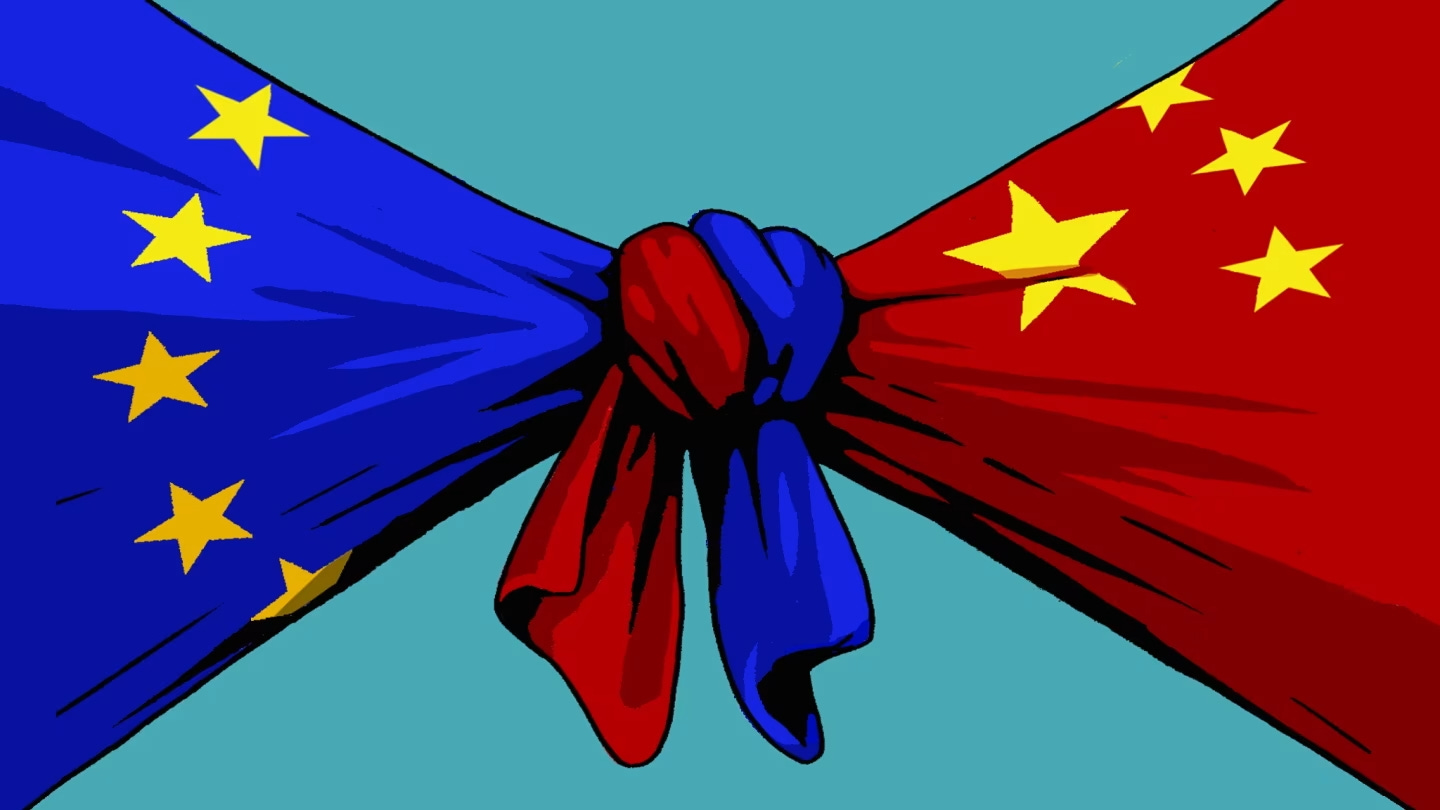
Free Speech Under Siege: How Europe is Becoming the New China


The Decline and Fall of Free Speech in Europe

In the middle of the twentieth century, Europe lay in ruins, having learned, or so we thought, the dark lesson that when speech is regulated, tyranny flourishes. That lesson has now been forgotten. A continent once hailed as the cradle of liberal democracy has become the laboratory of a new digital authoritarianism. This is not an exaggeration. It is, rather, the consequence of a steady drift toward control, clothed in the language of safety, decency, and order. And today, that drift has become an avalanche.

The United Kingdom’s Online Safety Act, France’s criminal investigation into X, and the European Union’s Digital Services Act (DSA) are not merely legislative developments. They are declarations of war against the free exchange of ideas. What unites them is a belief, common to technocrats in Brussels and bureaucrats in Whitehall, that ordinary people cannot be trusted with unfiltered information. To preserve democracy, it must be preemptively constrained.

This inversion of means and ends has accelerated since Elon Musk restored viewpoint neutrality to X, a platform that had, under previous management, cooperated with government actors to throttle disfavored speech. What Europe fears now is not misinformation, but competition. Competition of ideas. With the Biden administration, that fear was shared. But with Trump back in the White House and Secretary Marco Rubio at the helm of the State Department, the US has become once again the principal global guarantor of free speech.

Examining the facts.

Britain’s Online Safety Act, which came into force yesterday on July 25th, is a case study in bureaucratic excess. Ostensibly designed to protect children from harmful content, the law extends far beyond illegal material. It empowers the Office of Communications (Ofcom) to police “legal but harmful” speech, a category so vague that it becomes a weapon. Among the priority targets of censorship are foreign influence, disinformation, and content deemed injurious to public health or electoral trust. All are, of course, euphemisms for political heterodoxy.

The mechanisms of enforcement are equally chilling. Platforms face fines of up to 10 percent of global revenue and criminal charges against executives who fail to comply. In response, X announced that it would default users to a restricted mode unless they verify their age, employing invasive AI-based identification to filter content. In practice, this amounts to algorithmic ghettoization: speech not officially banned but rendered invisible, unreachable, and unsearchable.

If Britain’s law is sweeping, France’s assault is surgical. In early 2025, French prosecutors launched a criminal probe into X, accusing the company of algorithmic manipulation to promote divisive political content, including material critical of the French government’s stance on immigration and LGBT issues. But the legal framework under which this charge was levied is what ought to alarm any student of liberty. Prosecutors invoked Articles 323-2 and 323-3 of the French Penal Code, which target cybercriminals who distort data systems. They did so while declaring the company an “organized crime group,” the very designation used against narcotics cartels.

In other words, France is treating the operation of a social media algorithm as a felony, and the platform’s executives and users as gangsters. It is difficult to imagine a clearer betrayal of liberal norms. The response from the Trump administration was swift and sharp. The State Department’s Bureau of Democracy, Human Rights, and Labor (DRL) issued a statement condemning the investigation as an affront to the speech rights of American citizens and companies, noting that governments must not suppress voices they disfavor under the guise of regulation.

That brings this to Brussels, where the European Union’s Digital Services Act has taken aim at the global information ecosystem. Under the DSA, platforms with more than 45 million users in the EU, including X, YouTube, Facebook, and TikTok, are designated as Very Large Online Platforms (VLOPs) and subjected to a draconian compliance regime. They must submit to algorithmic audits, provide content takedown systems, establish risk mitigation protocols, and grant data access to academic researchers. These may sound innocuous. They are not.

The risk assessments required under the DSA demand that platforms identify and reduce threats to democratic processes, public health, and civil discourse. But who defines these risks? Who decides what constitutes a threat to democracy? In practice, the answer is European regulators whose notion of democracy excludes populism, nationalism, and conservative dissent. The effect is predictable. As revealed in documents obtained by the House Judiciary Committee, platforms are modifying algorithms not to protect users, but to conform to a political orthodoxy that elevates some voices and buries others.

This is not merely an internal European affair. American citizens are affected. American companies are compelled to enforce rules that conflict with the First Amendment. European law is being globalized through the extraterritorial compliance of US-based firms, thereby exporting censorship to the last country in the West where speech remains constitutionally protected. The Trump administration has rightly characterized this as digital colonialism, and in response, it has begun to act.

Executive Order 14149, issued by President Trump on January 20, 2025, prohibits federal agencies from colluding in censorship and directs the Attorney General to prosecute such collaboration where found. More pointedly, Secretary Rubio has launched a campaign of diplomatic retaliation. In May, the State Department imposed visa bans on foreign officials who attempt to suppress American speech online. Among those targeted were members of France’s interior ministry and German regulators affiliated with the European Commission.

This is not just policy. It is philosophy. The Trump administration is reasserting a principle once understood and now forgotten: that the freedom to speak is not a gift from the government, but a right to be defended against it. That principle has been invoked in lawsuits filed by US firms against foreign judges, including the suit by Truth Social and Rumble against Brazilian Justice Alexandre de Moraes, who ordered censorship of American content. A federal judge recently ruled that US companies are under no obligation to comply with foreign censorship mandates, affirming the territorial integrity of the First Amendment.

These actions underscore a broader point. The war for speech is no longer domestic. It is international. And Europe, once the defender of Enlightenment values, has become the staging ground for a counter-Enlightenment led not by kings or priests, but by regulators and prosecutors. That is the novelty. The new censorship is procedural, not ideological. It hides behind audits, compliance regimes, and “safety by design” architectures. But the result is the same: fewer voices, less dissent, and a public square scrubbed clean of deviation.

Some will object: do we not have a responsibility to prevent harm? Certainly, but that is not what is happening. These regimes do not surgically remove incitement or criminality. They blur the line between disagreement and danger. A platform that allows a conservative view of gender to trend is now suspected of extremism. A politician who questions climate policy is accused of disinformation. The censor has changed outfits. He now wears a badge that says “compliance officer.”

What is to be done? First, the US must extend its protective umbrella over its citizens wherever they are. The principle that an American cannot be silenced by a foreign government must be codified, not merely asserted. Second, American platforms must be encouraged, even compelled, to defend their users against extra-constitutional demands. If that means declining to operate in censorious jurisdictions, so be it. Freedom has a price. Better to pay it now than to live forever in rented liberty.

Finally, it must be recognized that this is not just a legal conflict. It is a civilizational one. Europe has chosen managed democracy over free society. The US must not follow. We must lead. And if our allies bristle, let them. Better to be isolated and free than integrated and gagged. The American Revolution did not begin with gunfire. It began with speech. We owe it to our forebears, and our future, to keep that flame lit.

Nuclear Bombshell About What Trump’s DOJ Should Do to Obama and Biden


Gorodenkoff via Shutterstock

The January 6th witch hunt is about to boomerang back on Democrats in spectacular fashion.

A leading conservative investigative journalist just outlined a path for justice that would leave Obama and Biden scrambling.

And Julie Kelly dropped a nuclear bombshell about what Trump’s DOJ should do to Obama and Biden.

Kelly proposes turning Biden’s own legal weapons against him

Conservative investigative journalist Julie Kelly delivered a stunning analysis during her appearance on “The Benny Show” that could reshape how Americans think about accountability for the weaponization of government.

Kelly revealed she’s developing a comprehensive legal framework showing how President Trump’s Justice Department could pursue seditious conspiracy charges against Barack Obama and Joe Biden.

“I’ve actually been working on a seditious conspiracy article and how the DOJ might be able to apply,” Kelly explained to host Benny Johnson.¹

This represents the ultimate poetic justice – using the exact same legal theories that Biden’s DOJ deployed against January 6th defendants.

The irony is breathtaking.

Kelly pointed out that seditious conspiracy historically targeted serious threats like foreign terrorists. She noted this statute was used against perpetrators of the 1993 World Trade Center bombing – actual terrorists who killed Americans.

But Biden’s Justice Department transformed this serious charge into a political weapon.

The double standard that could backfire spectacularly

Here’s where Kelly’s analysis gets devastating for Democrats.

Biden’s prosecutors convinced juries to convict January 6th defendants on seditious conspiracy charges even when those defendants “were not even in Washington, D.C., some of whom didn’t even go inside the Capitol.”²

Kelly noted that among all these defendants, “only one had some sort of weapon. I think, you know, a pocketknife or something only.”³

Think about that for a moment.

If prosecutors can secure seditious conspiracy convictions against Americans who weren’t even present at the Capitol, what does that mean for government officials who actually wielded federal agencies as weapons?

Host Benny Johnson crystallized this perfectly: “Did they have the power to overthrow the U.S. government? And of course, of course, that’s laughably no. Yet these people did have the power to overthrow the government. They use the most powerful intelligence community resources known to man, and they weaponized them against Donald Trump.”⁴

The legal precedent is now established, thanks to Biden’s own prosecutors.

When the full weight of government becomes the weapon

Kelly’s most compelling argument centers on the definition of “force” in seditious conspiracy cases.

During January 6th trials, Biden’s prosecutors argued that physical violence wasn’t required for conviction.

“They said physical force wasn’t necessary, that any sort of force that they planned to use force. Well, it doesn’t have to be physical force,” Kelly observed.⁵

Now apply that legal standard to what actually happened to Trump.

Kelly laid out the devastating case: “When you have the full force of the intelligence community, the White House, the Oval Office, the DOJ, the FBI, CIA, every single major, powerful, unaccountable government agency coming down on your head,” she said, “How can you say that’s not by force? That’s way worse than someone opening a door with Capitol Police standing right there going into a government building on a Wednesday afternoon.”⁶

This cuts right to the heart of the matter.

If walking through an open door with police present constitutes seditious conspiracy, what does coordinating multiple federal agencies against a political opponent represent?

Kelly suggested the conspiracy spans administrations, running from Obama’s White House through Biden’s regime, all designed to sabotage Trump’s Presidency and delegitimize any potential return to power.

Justice delayed but not denied

Kelly revealed another bombshell – she believes Special Counsel Jack Smith was preparing seditious conspiracy charges against Trump if he had lost the 2024 election.

The weaponization was going to continue indefinitely.

But Trump’s landslide victory changed everything.

Now Kelly argues that January 6th defendants “would love to see seditious conspiracy thrown back” at the officials who destroyed their lives.

And why shouldn’t they get that satisfaction?

These Americans had their lives destroyed by a legal system that applied one standard to them and a completely different standard to the political elite who actually possessed the power to damage American democracy.

Kelly concluded with a direct challenge to Trump’s DOJ: “I do think that that should be one of the statutes on the table for the Trump DOJ to consider.”⁷

The legal framework exists.

The precedents have been established by Biden’s own prosecutors.

The evidence of government weaponization is overwhelming.

The only question remaining is whether Trump’s Justice Department will have the courage to apply equal justice under law.

For too long, Washington, D.C. has operated under a two-tiered system where political elites escape consequences while ordinary Americans face the full weight of prosecutorial power.

Julie Kelly’s analysis shows that the tools for accountability already exist – Biden’s DOJ helpfully created them.

The American people voted for justice and accountability in November.

It’s time to deliver both.

While the cat’s away, two FDA mice approve vaccine for kids. Cat returns…


In a significant development within the U.S. Department of Health and Human Services (HHS), Secretary Robert F. Kennedy Jr. (RFK Jr.) has dismissed two senior officials following the unauthorized approval of Moderna’s mRNA COVID-19 vaccine (Spikevax) for high-risk children aged 6 months to 11 years. The decision, made while RFK Jr. was on vacation, has sparked debate about internal oversight, vaccine policy reforms, and potential conflicts of interest. This report examines the timeline, key players, public reactions, and broader implications, drawing on recent news reports and social media discussions.

 Background on the Vaccine Approval

On July 10, 2025, the FDA granted full approval for Moderna’s COVID-19 vaccine for use in vulnerable children, a move that contrasted with RFK Jr.’s ongoing efforts to restrict mRNA vaccine recommendations for healthy youth and pregnant women.

RFK Jr., a vocal critic of certain vaccine practices, had previously removed COVID-19 vaccines from routine schedules for healthy children in May 2025 and dismissed the entire CDC Advisory Committee on Immunization Practices (ACIP) in June 2025. According to sources close to the matter, including vaccine researcher Dr. Robert Malone, the approval was expedited by HHS Chief of Staff Heather Flick Melanson and Deputy Chief of Staff for Policy Hannah Anderson without consulting RFK Jr. or his deputy.

This occurred during RFK Jr.’s absence on a working vacation, leading to accusations of bureaucratic overreach and possible influence from pharmaceutical lobbies. The move initially fueled public speculation that RFK Jr. had softened his stance, prompting backlash from supporters who viewed it as a betrayal of his “Make America Healthy Again” agenda.

The Firings and Immediate Aftermath

Upon returning, RFK Jr. acted swiftly, firing Melanson and Anderson on July 16, 2025, as part of a larger HHS leadership restructuring. Reports indicate the dismissals were directly linked to the unauthorized approval, with one deputy allegedly reacting dramatically by crashing into RFK Jr.’s vehicle in a fit of privileged rage. 

RFK Jr. has also reportedly referred the officials for criminal investigation, citing potential misconduct. This action aligns with RFK Jr.’s pattern of overhauling public health institutions, including replacing fired ACIP members with allies and vaccine skeptics. About time! It’s past time to address perceived corruption in regulatory processes. 

Public and Media Reactions

The incident has generated widespread discussion on social media and in the press. Supporters praised the firings as a step toward accountability, with calls for further investigations into pharmaceutical ties. Detractors, including public health groups, have expressed concerns over the politicization of health decisions and potential disruptions to vaccine policy.

Implications for Health Policy

This event starkly exposes the relentless undermining of RFK Jr.’s leadership at HHS, where he is besieged by aggressive legal assaults on his bold reforms, such as a federal judge’s outright blockade of critical workforce reductions. Pharmaceutical powerhouses like BIO are waging an all-out lobbying war against him, funneling millions in a blatant bid to derail his agenda and preserve the status quo. Though the approval narrowly survives, it glaringly illuminates the formidable barriers to enforcing genuine transparency and reform amid a bitterly fractured regulatory arena. As RFK Jr. battles on to overhaul vaccine oversight, entrenched stakeholders from every corner clamor for “caution,” ostensibly to safeguard innovation, safety, and public trust—but in reality, often to thwart meaningful change. This saga is far from over, poised for intensified scrutiny, deeper probes, and seismic policy upheavals.

The US Abandoned Meritocracy and Got Bureaucratic Bloat


The Return of Merit: Why the Civil Service Exam Must Be Reinstated

The health of a republic depends not merely on the virtue of its leaders but on the competence of its administrators. A functioning government requires that those entrusted with the machinery of state be capable, informed, and accountable. That, in essence, was the animating ideal behind the federal civil service exam: to protect the American people from the twin perils of incompetence and corruption by ensuring a government staffed by merit. Yet over the past half-century, this ideal has been eroded, then discarded, not because it failed but because it succeeded too well in measuring ability, much to the discomfort of the politically fashionable.

The modern federal workforce was born out of the Pendleton Act of 1883, a legislative rebuke to the grotesque excesses of the patronage system. No longer would positions in the federal government be handed out like party favors to the politically loyal or the well-connected. A professional class would rise, chosen not by whom they knew but by what they knew. And for nearly a century, that principle held. The civil service exam functioned as a leveling mechanism, a barrier against cronyism and a gateway for the able.

But by the 1970s, a new orthodoxy emerged, one less interested in capability than in demography. The Professional and Administrative Career Examination (PACE), itself a refined instrument for identifying administrative talent, fell under attack for producing racially disparate outcomes. The case of Luevano v. Campbell marked a turning point. The plaintiffs did not allege that the exam was unfair in design or malicious in purpose. Rather, they contended that because different racial groups performed differently, the test must, ipso facto, be discriminatory. It was an argument of correlation over causation, but it carried the day.

The Carter administration, confronted with this challenge, might have defended the constitutional imperative for equal treatment, the statutory demand for merit-based hiring, and the moral obligation to hire the best-qualified. Instead, it capitulated. PACE was abandoned. Objective testing, the gold standard of fair evaluation, was replaced with subjective assessments: resumes, interviews, and “diversity-enhancing” hiring programs. Where once the federal government had demanded proof of ability, it now sought proxies. The result was a quiet revolution in hiring—a regression masked in the language of progress.

This abandonment of testing was not isolated. In 2010, President Barack Obama issued Executive Order 13562 (still in effect today), further distancing federal hiring from meritocratic principles. The rationale was revealing: written essays and similar assessments were said to disadvantage applicants from underrepresented backgrounds, particularly those whose written communication skills were not deemed sufficient. But to concede that writing proficiency is a disqualifier is not to justify removing the barrier, it is to highlight a deficiency that the job itself may require. In any reasonable domain, poor writing is a cause for concern, not a credential to be protected.

Critics of standardized testing often assert that exams are an insufficient predictor of job performance. This is a red herring. No test is perfect, but the proper question is comparative: Are structured, objective assessments superior to opaque, informal, and potentially biased evaluations? The answer, again and again, has been yes. A 2002 study by Schmidt and Hunter, published in Psychological Bulletin, reviewed 85 years of research and concluded that general cognitive ability tests are among the best predictors of job performance, outperforming unstructured interviews and resume reviews. In a government that administers everything from cyber defense to public health policy, the ability to reason, write, and analyze should be baseline qualifications, not optional enhancements.

Moreover, the move away from standardized testing has not made the hiring process more fair. It has simply made it more obscure. Informal interviews and resume screenings are fertile ground for implicit bias, favoritism, and credentialism. At least an exam can be audited. A panel interview cannot. At least a written test applies the same standard to everyone. A “holistic” hiring process applies no standard at all.

Some will argue that the disparities in test outcomes are too large to ignore, that such differences in performance indicate systemic barriers. Perhaps. But if the goal is equality of opportunity, then the proper remedy lies upstream, in education, in preparation, in mentorship. Lowering the bar of entry is not compassion, it is condescension. It assumes that certain groups cannot meet standards and therefore must be exempted from them. That is not equity. It is a quiet form of surrender.

Defenders of the status quo claim that modern hiring tools are more flexible, more “person-centered,” more conducive to creating a diverse workforce. But a diverse bureaucracy is not a competent one unless diversity aligns with ability. The federal government is not a social engineering project. It is a system of authority, enforcement, regulation, and service. It must be staffed by those who can perform these functions with precision and integrity. To suggest otherwise is to mistake the civil service for a campus diversity office.

Furthermore, the legal justification for abandoning standardized exams is tenuous. Title VII of the Civil Rights Act prohibits employment practices that have a disparate impact unless the employer can show the practice is job-related and consistent with business necessity. The courts have recognized that general ability tests can satisfy this requirement. In Washington v. Davis (1976), the Supreme Court ruled that a police entrance exam that disproportionately excluded black applicants did not violate the Constitution, as there was no discriminatory intent and the exam measured relevant job skills. The Luevano settlement, by contrast, was a political compromise, not a constitutional necessity.

President Trump, if he wishes to drain the bureaucratic swamp in more than metaphor, must begin with reforming how the swamp is staffed. The restoration of the civil service exam would do more than elevate standards. It would restore trust. Americans rightly suspect that their government is staffed not by the best and brightest but by the best connected, the most ideologically aligned, or the most demographically favored. An exam does not care what you look like, whom you voted for, or where you went to school. It cares only whether you can do the job.

This logic must apply not only to future hires but to current employees. The federal workforce is vast, powerful, and deeply entrenched. If we are serious about accountability, then every current federal employee should be required to pass a reformed civil service exam appropriate to their position. The goal is not to purge but to affirm. Those who are competent will have nothing to fear. Those who are not nor should not be on the public payroll.

It is time to end the experiment in subjective hiring. It has failed. It has produced neither a more competent government nor a more just one. It has diluted standards under the guise of equity and eroded public faith in institutions once deemed apolitical. We must reverse course. We must affirm once again that public service is not a birthright or a diversity quota. It is a trust, to be earned, not granted.

Exposing the Garland Memo: A Case Study in Government Weaponized Against Parents


On October 4, 2021, the Attorney General of the United States issued a directive that would rattle the very foundation of American civil society. Parents, concerned about their children’s education, found themselves recast not as civic participants but as potential threats to national security. According to a memo issued by AG Merrick Garland, the Justice Department would coordinate with the FBI and US Attorneys to address a supposed spike in threats against school board officials. But the underlying claim was a fiction. And now, thanks to newly released internal DOJ documents obtained by America First Legal (AFL), we can say conclusively what many suspected at the time: the Biden administration orchestrated this memo as part of a political operation, driven not by law or evidence, but by ideology and electoral calculus.

Let us begin with a question. Why did the Department of Justice, whose jurisdiction is meant to guard against actual federal crimes, insert itself into a public conversation dominated by non-criminal speech? The answer, as the documents now confirm, is that it did so at the prompting of the White House, which viewed parents not as constituents to be heard, but as dissidents to be managed.

The initial spark came from a September 29, 2021 letter sent by the National School Boards Association (NSBA) to President Biden. In this letter, the NSBA urged the administration to treat protests at school board meetings as akin to “domestic terrorism,” citing the Patriot Act as a model for possible federal intervention. The invocation of such a statute was absurd on its face. Protesting mask mandates or objecting to Critical Race Theory, however forcefully, does not rise to the level of terrorism. But what is more damning is what followed: a flurry of communications within the DOJ, indicating that officials were under pressure to respond.

On October 1, just two days after the NSBA letter, Tamarra Matthews-Johnson of the Attorney General’s office flagged the matter for Kevin Chambers at the Deputy Attorney General’s office, stating that the White House “has been in touch” about how DOJ might assist. At 8:17 a.m. the next morning, Sparkle Sooknanan, then of the Associate Attorney General’s office and now a federal judge, demanded an urgent review from the Civil Rights Division: were there any statutes, any authorities, that could justify a DOJ response? The request was extraordinary. It was a classic case of the tail wagging the dog. They had the political goal, and now needed a legal rationale to support it.

What followed was a quiet rebellion from within. Career attorneys in the Civil Rights Division, legal professionals whose job is to interpret law rather than bend it, pushed back. One stated explicitly that the behavior cited by NSBA “likely fall[s] outside of our jurisdiction.” Another said, unequivocally, “there is nothing specific” that could be applied. The attempt to find federal jurisdiction was, in the understated phrasing of another DOJ attorney, “ramping up an awful lot of federal manpower for what is currently a non-federal conduct.”

In other words, the law said no. But politics said yes. So politics won.

By the morning of October 4, a draft memo was already circulating. Language referring to election interference was quietly stripped out, after concerns that it would appear overtly partisan. But the core premise of the memo, that DOJ would mobilize against parents based on a manufactured crisis, remained untouched. The final version went out that day to the FBI, US Attorneys, and law enforcement nationwide.

To understand the magnitude of this decision, one must consider the federal apparatus being invoked. We are not speaking of a local school district or even a state attorney general’s office. We are speaking of the Department of Justice, the FBI, and the National Security Division. These are the institutions tasked with defending the United States from foreign threats, organized crime, and acts of terrorism. Now they were being mobilized against citizens speaking at school board meetings.

Some defenders of the memo have insisted that it was a neutral effort to ensure safety. But the internal documents tell a different story. Not only did the DOJ lack jurisdiction, but it also lacked data. One Civil Rights attorney reviewed the NSBA’s own sources and concluded that “the vast, vast majority of behavior cited cannot be reached by federal law” and that most of it “is protected by the First Amendment.”

At this point, any good faith rationale should have evaporated. The legal authority did not exist. The facts did not support intervention. And the lawyers responsible for enforcing civil rights said as much. But Garland’s DOJ, driven by political appointees, forged ahead.

Why? To chill dissent. To create a pretext for federal monitoring. And, most damningly, to tilt the political field in favor of Democrats ahead of the 2021 Virginia gubernatorial election.

The timing is revealing. At the very moment when education was emerging as a major campaign issue in Virginia, the Biden administration intervened with a chilling federal directive aimed squarely at the parents who were driving that conversation. The effect, if not the intent, was to intimidate them into silence.

This was not merely a bureaucratic misstep. It was, as AFL President Gene Hamilton put it, an effort “to deprive parents of two fundamental rights—the right to speak, and the right to direct the upbringing of their children.” And it was done under color of law, through an administration that promised to restore norms while quietly undermining them.

What is perhaps most distressing is the downstream effect. The FBI’s Counterterrorism Division, blindsided by the memo, was left scrambling to define what exactly it was being asked to do. Internal messages reveal confusion and concern, not just about the lack of legal basis, but about the very premise. Was this really what the federal government was now for?

A free society depends on more than the formal guarantees of its Constitution. It depends on the restraint of those in power. It depends on a culture of governance that distinguishes between disagreement and danger, between protest and threat. When that distinction is lost, freedom becomes a mere parchment barrier.

The Garland memo was not an isolated event. It was a signal. It told Americans that certain views, particularly those out of step with the educational elite, would not be tolerated without consequence. It told career DOJ attorneys that their legal advice could be overruled by political expedience. And it told the White House that federal power could be used to police ideology under the guise of law enforcement.

We must reject this approach categorically. Not because we are indifferent to the safety of public officials, but because we know that civil liberties are not things to be managed or balanced, but principles to be upheld. The right to speak at a school board meeting, however impassioned, is not a loophole in national security law. It is the beating heart of American self-government.

The documents released by AFL do more than expose a scandal. They illustrate the dangers of weaponized bureaucracy. They reveal a Justice Department more interested in political theater than legal fidelity. And they confirm, beyond dispute, that the October 4 memo was not about law enforcement. It was about silencing dissent.

In his inaugural address, President Biden claimed he would “restore the soul of America.” But there is nothing soulful about suppressing speech, circumventing legal advice, and intimidating parents for participating in democracy. That is not restoration. It is repression, dressed in bureaucratic prose.

The Biden administration must be held accountable for its actions. Congress should investigate not merely the memo itself, but the full extent of White House involvement, the decision-making process within DOJ, and the broader pattern of targeting political dissent. And the American people must remain vigilant, lest today’s memo become tomorrow’s precedent.

Why school unions MUST be eliminated


Why school unions have to be eliminated

One of the major focuses of my consulting business was education. I was a senior consultant to two of the largest and most troubled school systems in America during a brief period of reform—Chicago and Detroit. I was on the strategic team for two major strikes. Other clients included Friedman School Choice Foundation and the Chicago’s Teacher Academy.  I was also a board member of Chicago’s School for the Performing Arts.  As a parent, I was deeply involved in school policy issues at the local level.

I have long considered the failures in the public school systems as among the greatest immoralities in public policy. Failing schools—especially those serving minorities in the segregated communities of America’s major Democrat-run cities—have destroyed the career potential and dreams of millions of young Black and Hispanic students – and sadly destroyed too many lives. It has also deprived America of the benefit of what those millions of students could have contributed to society. Reliance on generational welfare poverty and oppression is directly related to school quality.

I have also long believed the long-term decline in public education outcomes—and the resistance to meaningful reforms—has been due to the politics and policies of the school unions. They are not educational institutions, but rather politically partisan membership clubs. The primary function of the unions is to have as many dues-paying members as possible and to use that money for personal enrichment and political power.

To better understand why we should eliminate school unions, let us look at some facts.

Teachers’ unions were once formed to protect educators from unfair labor practices and to advocate for better working conditions. But over the decades, the two largest unions—the National Education Association (NEA) and the American Federation of Teachers (AFT)—have evolved into powerful political machines. Their influence now extends far beyond the classroom. They are major funders of the Democratic Party and wield massive influence through their huge pension programs.  Rather than working to improve classroom outcomes, the NEA and AFT actually undermine positive reforms—directly or by ambivalence.

Despite their failures, union officials are well compensated. NEA President Becky Pringle has a compensation package of $480,000 per year—8.5 times the median teacher salary. Randi Weingarten of the AFT earns $565,000 per year—9 times the median teacher salary. These figures do not include a number of indirect nonmonetary benefits. Also, the lucrative pensions enjoyed by union officials are often paid by taxpayers—not union funds.

Politicization of the NEA and AFT

The NEA and AFT have become deeply entangled in partisan politics. In recent years, both unions have taken aggressive stances on national issues that have little to do with education. Their political activity is overwhelmingly one-sided. In the 2024 election cycle, 98.96 percent of NEA contributions went to Democrats, while 99.9 percent of AFT contributions did the same. This lopsided spending suggests that the unions are not representing the diverse political views of their members or the public but are advancing a partisan agenda that primarily serves the political and financial interests of union leaders and the local political establishment.

Ties to Democratic Political Machines

The NEA and AFT have long-standing ties to Democrat political machines in major cities. Their influence in urban politics has helped elect progressive candidates who, in turn, support union-friendly policies. In cities like Chicago, New York, and Los Angeles, unions have become kingmakers, funneling millions into campaigns and lobbying efforts.  In return, the political leaders work on behalf of union interests.

For generations, these same cities have suffered from chronic educational failure. Inner-city schools remain overcrowded, and plagued by low graduation rates. Despite their political clout, the unions have done little to address institutional racism and segregation in urban districts. Instead of fighting for reform, they often resist accountability measures and protect underperforming educators. (I have seen that many times in contract negotiations.)

The NEA

NEA’s Pringle has openly embraced an adversarial partisan political role. At the 2025 NEA convention, she declared that educators were “ready to engage with school boards, town halls, state legislatures, and even Congress” to advocate for their union’s politically partisan interests.  Ponder that. Pringle’s vision of the union’s role is to fight against Congress, state legislatures, and even local school boards – those the people elect.

The NEA 2025 convention revealed just how far the union has drifted from its educational mooring. Delegates passed a resolution pledging to “defend democracy against Trump’s embrace of fascism”—and to use the term “fascism” in NEA materials to describe his policies.

The NEA has also taken an official stand in opposition to the activities of Immigration and Customs Enforcement (ICE)—preferring to allow dangerous criminals to remain in American communities. Criminals who often prey on children.  They have accused ICE of targeting student leaders.

The resolution was not only politically charged but also riddled with errors. The word “fascism” was ironically misspelled twice as “facism,” prompting widespread and well-deserved ridicule. Critics argued that the union, which claims to represent educators, could not even spell the ideology it was condemning.

The NEA’s ties to the radical wing of the Democratic Party were seen in another controversial move. The union recently voted to cut ties with the Anti-Defamation League (ADL), a civil rights organization known for combating antisemitism. The union accused the ADL of conflating criticism of Israel with antisemitism and claimed that the group was pushing a “radical, antisemitic agenda” on students. The resolution bans the use of ADL literature and speakers in school events. The ADL responded forcefully, calling the NEA’s actions “profoundly disturbing” and warning that the decision would further isolate Jewish educators.

They even changed the language from “deportation” to “kidnapping.”

The AFT

AFT President Randi Weingarten has similarly used her platform to push for progressive causes, from climate activism to gender ideology. She has become so politically toxic that some Democrat leaders have called for the Party to break ties with her. She was forced to resign her position on the Democratic National Committee. A position on the DNC?  How partisan can you get?

Ben Austin, a former campaign aide for Kamala Harris and founding director of Education Civil Rights Now, published an op-ed urging Democrats to “break up with Weingarten.” He pointed to her following Biden’s school closure policies—which essentially “erased two decades of learning progress” and alienated working-class voters. Austin blames her for “gaslighting Democrats” into opposing school choice and described her partisan leadership as “tragic for American children.”

More Money, Poorer Results

Despite their massive increases in school funding, the NEA and AFT have failed to deliver meaningful improvements in public education. Since the rise of unionization in the 1960s and 1970s, educational performance has stagnated or declined. According to research, unionized districts tend to spend more on salaries and benefits but fail to outperform non-unionized school systems.

Studies show that low-achieving and high-achieving students perform worse in unionized districts. While the cost of education continues to rise, the return on investment—in terms of student performance—stagnates in better districts and declines in low-income minority communities.

Children Last

One of the mantras of educators is “Children First.” In fact, in labor negotiations the children’s needs come last—if considered at all. Both in my experience negotiating union contracts and from extensive research, I can safely attest that I have never found school unions proposing or supporting any contract provisions that benefited the classroom or the students that did not benefit the union — either increasing the number of teachers (dues-paying members) in systems with excessive deadwood; shortening teacher work schedules in hours or days; or increasing teacher pay and benefits at the expense of what I call “the children’s budget.”

In several cases—thanks to support from the local political establishment—unions won pay and benefit concessions that absorbed more than 100 percent of all new money coming into the school district. This necessitated cuts in “the children’s budget” that impacted directly on the classroom—cuts in school maintenance, supplies, and even elimination of some traditional subjects, such as music and art.

Unions vigorously protect bad teachers — essentially preventing dismissal of those failing to provide quality education in the classroom and other negative personnel issues. As a means of protecting their failures, unions work against standard testing of students and also teacher testing.

Unions are also the primary force against school choice, programs that would enable parents to remove their children from failing and dangerous schools and get them into schools where they can receive quality education. Union policies warehouse students in failing minority schools—denying them an education that can lead to college or productive careers. This is especially true of schools in segregated minority communities. School choice would not end the public school system, since it largely impacts schools that fail to meet the primary mission: to educate children.

Fighting Back

The good news is that there is a growing political constituency for effective education reforms. School choice is part of it—and the Trump administration has advanced that cause in his Big Beautiful Bill. Parent Associations are taking more interest and more control over educational quality. Congressman Mark Harris (R-NC) and Senator Marsha Blackburn (R-TN) have introduced the National Education Association Repeal Act, which would revoke the NEA’s federal charter.

A Broken System

The original purpose of teachers’ unions was to protect educators and improve schools. But today, the NEA and AFT function more like partisan advocacy groups driven by self-interest than a professional education organization. Their actions, whether it’s labeling political opponents as fascists, severing ties with civil rights groups, or funneling millions into one-sided campaigns—have undermined their credibility and effectiveness.

Public education is too important to hold hostage by political agendas. If unions cannot return to their core mission of supporting teachers AND students, then it is time to consider eliminating them altogether. The future of our schools—and our children—are too important to be allowed to fail in the future as they have failed in the past.

So, there ‘tis.

Globalists Propose Radical Idea To Leave WTO: Trump Should Call their Bluff


While most attention is being paid to the Trump administration’s efforts to secure U.S. borders and deport the millions of illegal aliens that have been allowed to roam our streets, there is an equally intense battle raging. This less seen war is over the degree to which the United States will continue to be the patsies of the global elite and their schemes to drive the entire world into a one world government.

Anyone who does not believe that such a war is happening or that there is a tiny cabal of people dedicated to the idea of one central power over the entire planet has not been paying attention or, worse, doesn’t want to see. Over the past 80 years a large infrastructure has been built that slowly has been grinding down the entire concept of national sovereignty. This multi-faceted structure is beginning to fall apart. There are many fissures and cracks that now offer national patriots — regardless of the country from which they reside — to begin the necessary work of dismantling these structures and returning real power to the people and national governments where it belongs.

One such structure that is showing signs of falling apart is the World Trade Organization (WTO). Recently two Professors with deep ties to the WTO and the entire globalist scheme wrote a petulant article that was reprinted by Yves Smith in Naked Capitalism advocating that the United States leave the WTO. The article, Why the US and the WTO Should Part Ways by Professors Petros Mavroidis and Henrik Horn, is a primal scream of the global elite in their self-recognized death throws.

President Donald Trump should take them up on their suggestion, the United States should simply leave the WTO and operate on a nation-to-nation basis — termed bilateral — and forget about the lunacy of global agreements (termed multi-lateral) that never seem to serve the interests of the American people.

A little history is in order.

As World War II was winding down, those in positions of authority sought to build systems that would bind the nations of the world into a system that led eventually to world government and control of all nations and peoples. While always presented in the most flowery and benevolent terms, the core was a total rejection of the principles of popular government, representation and decentralization of power to ensure the people retain the real power to government themselves. The globalists hate these concepts. They believe that the people are not capable of governing themselves, that only an elite group has the ability to exercise power.

That was the essence of those structures. Among the institutions deployed to build the World Government were the United Nations, the World Bank, the International Monetary Fund and a host of lesser entities all designed to pull the policies and actions of free, independent governments into the web of control. One entity that did not get formed was a central controlling authority over trade.

As far back as 1944 — before the war was won — the gang of insiders were working on the outlines of their dreams. The head of the British delegation, John Maynard Keynes, advocated for something to be called the International Trade Organization. It was to have dictated all aspects of international trade, taking away much of the authority from national governments. The intent was that the ITO would fit into the web with the IMF and the UN to form an iron ring around governments, forcing them to comply with the demands and rules of the so-called “international community.”

Luckily for the United States and much of the world, the U.S. Congress refused to ratify the power grab. Finally, in 1950, President Harry Truman acknowledged that the ITO took far too much power and authority away for the elected government of the United States as he pulled the treaty and notified the world that the U.S. would not be part.

But those who scheme to take away the rights of the People for self-government always have a back-up plan. And in the case of global control over trade they had a second plan ready to go. That was called GATT, the General Agreement on Tariffs and Trade. Far less intrusive and based on continuing negotiations, GATT was far less authoritarian than ITO and was seen as an acceptable way to move forward with the concept of “free trade” and international resolution of disputes.

Over time, however, GATT evolved into the 1995 establishment of the World Trade Organization (WTO). Less than the nightmare envisioned by Keynes, the WTO still attempts to exercise authority over the decision of national governments on trade policy. But as with the other structures of the global enterprise, it has failed and become more of a joke than an asset. 

President Trump and his team have documented hundreds of tariffs, taxes and scams that cost America jobs, market access and a level playing field. By moving to establish tariffs that tax the foreign countries for their predatory actions, the President is keeping his word on the America First Agenda. He is following the advice of President Ronald Reagan who said, “We are always willing to be trade partners, but never trade patsies.” Everything President Trump has proposed runs counter to the WTO and its nick-picking rules and regulations. And that is what resulted in the article suggesting the U.S. and WTO “part ways.”

The globalist Professors have three main reasons why they think the U.S. should leave the WTO. First, as pointed out, the very idea of two nations setting an agreement for themselves without the rest of the “world” butting in is the exact opposite of the reason for the WTO to exist. So, when the United States and the Peoples’ Republic of Vietnam agreed to trade relations recently, that violates the entire principle on which the internationalist cabal exist.

Second, the United State has not paid its “dues” since 2022. This has left the WTO near bankrupt and finding it difficult to continue operations. Good. Why should the U.S. pay for a body of international bureaucrats to hinder and restrict US economic policy? 

And finally, the U.S. has exercised its authority by crippling the dispute settlement system by blocking appointments of new appellate body judges. This “dispute settlement system” is referred to as “the crown jewel” of the body. We have done this because of the biased and one-sided “judgements” of the foreign, anti-American functionaries.

So, it is fair to ask, why should the U.S. leave? We ignore the WTO whenever we want, undercut their very reason for existence at every turn, refuse to funnel more money to them and have essentially destroyed their power to issue judgements. The reason is simple. When the U.S. refused to ratify the League of Nations after World War I, the globalists never got off the ground, the entire thing failed and fell away. Now is the time to remember that lesson. Walk away from these entities. Without U.S. money and credibility, none of them — not the United Nations, none of the internationalist entities — will survive.

The America First movement is asserting American sovereignty in countless ways. The interests of American companies and workers must always come first. Any government that yields the authority given it by the consent of the American People is a traitorous shadow. The quislings that run them should go down in history next to Benedict Arnold. So, we need to thank Professors Henrik Horn and Petros Mavroidis for their timely suggestion. Yes, we should leave the WTO and then take bets on how long it lasts without the United States.

The Quiet Jihad: Islamist Infiltration Became Academic Orthodoxy In America


Screenshot via X [Credit: @amuse]

In 1991, Mohamed Akram, a senior figure in the Muslim Brotherhood, drafted what seemed to many at the time an arcane internal strategy document. Titled An Explanatory Memorandum on the General Strategic Goal for the Group in North America, the memorandum was not a prediction, nor a mere expression of hopes, but a plan. Its words were plain and precise: to undertake a “civilizational jihad” aimed at eliminating Western civilization from within. In short, a campaign to reshape the United States in accordance with Islamist ideals, not through bombs or bullets, but through institutions, coalitions, and long-term ideological subversion.

The document was discovered in 2004 during an FBI raid on the home of Ismail Elbarasse, a member of the Muslim Brotherhood’s Palestinian Committee and a former board member of the Holy Land Foundation. That foundation was later convicted of funneling millions to Hamas. The memorandum, entered as evidence in the largest terrorism financing trial in US history, should have been a siren. Instead, it was filed away, dismissed by many commentators as the paranoid blueprint of an overzealous ideologue. They were wrong.

Some may object: conspiracies are a dime a dozen. Anyone can draft a document. But what makes this memorandum exceptional is not only its clarity and specificity, but its remarkable congruence with developments in American civic life over the past three decades. Akram named names. He listed organizations, most still active today, and gave precise instructions on how to steer American political and cultural institutions toward the Brotherhood’s ends. This was not a fantasy. It was a plan of operation. And now, more than thirty years later, the United States is living through its implementation.

Let us begin with the objective itself. The memorandum spells it out without euphemism: “eliminating and destroying the Western civilization from within and ‘sabotaging’ its miserable house by their hands and the hands of the believers.” This was not a call to dialogue. It was not a call to integrate. It was a declaration of ideological conquest. But unlike the brutal immediacy of al-Qaeda or ISIS, the Brotherhood’s vision is subtle. Their preferred weapons are not explosives, but ideas. Their preferred terrain is not the battlefield, but the university, the courtroom, and the NGO boardroom.

The most consequential battlefield has proven to be academia. A generation of scholars, grants, endowments, and academic chairs have seeded American universities with ideas sympathetic to Islamist critiques of the West. The clearest example is Dr. Jonathan Brown a convert to Islam and the Alwaleed bin Talal Chair of Islamic Civilization at Georgetown University. In June 2025, Dr. Brown made headlines for suggesting, on X, that Iran should launch a symbolic missile strike on a US military base. He framed this not as fantasy but as strategic balance. Even more astonishingly, Brown retains a position training American diplomats.

This is not guilt by association. It is a pattern. Dr. Brown has praised Islamist movements and has been linked, both ideologically and institutionally, to the Brotherhood. His father, also a convert to Islam, was deported from the US in 2015 for supporting terrorist causes. That alone would merit scrutiny. But the larger context reveals more: Brown is not an outlier. He is emblematic of a trend in which Western universities offer sanctuary, prestige, and even state influence to figures deeply aligned with ideological opponents of the American regime.

Why is this allowed? The answer is both structural and ideological. Structurally, the Brotherhood has worked for decades to legitimize itself through front organizations. CAIR, ISNA, MSA, and NAIT, all named in the memorandum, have entrenched themselves within civic life. They have leveraged the language of civil rights, cultural pluralism, and social justice to deflect scrutiny. But this is not the pluralism of the American Founders. It is a calculated mimicry, a rhetorical Trojan horse. CAIR, in particular, has grown powerful enough to influence corporate training sessions, FBI outreach, and even school curricula. The same group that was named an unindicted co-conspirator in a terrorism financing case now advises American institutions on Islamophobia.

The ideological fuel for this strategy is the concept of “soft jihad.” The Brotherhood’s genius was recognizing that ideological capture could be more enduring than terrorism. To borrow from Antonio Gramsci, cultural hegemony precedes political revolution. The Brotherhood has pursued its hegemony not by overt domination but by normalizing its worldview. Consider the linguistic sleight-of-hand: criticism of Islamist ideology is branded as racism. Security concerns are dismissed as Islamophobia. Calls for assimilation are recast as xenophobia. The cumulative effect is not merely the silencing of dissent, but the transformation of public morality. It is not merely that Americans are being told not to criticize radical Islam. They are being trained to believe that doing so is immoral.

Take the campus protests in 2024 and 2025. Demonstrations ostensibly in support of Palestinian rights quickly metastasized into calls for the abolition of Israel, attacks on Western values, and explicit praise for Hamas. At Columbia, UCLA, and Harvard, protesters chanted slogans directly lifted from Brotherhood propaganda. The phrase “From the river to the sea” is not a geographic aspiration. It is a genocidal demand. It aligns precisely with Hamas’s stated goal: the eradication of the Jewish state. Yet these protests were often protected, even praised, by university administrators. In some cases, professors joined the chants. In others, students who dissented were harassed or disciplined.

Again, the question is: how did this happen? The answer is that the Brotherhood never aimed to win by numbers. It aimed to win by leverage. Infiltrating a university’s DEI board (regardless of what they’re calling it today) is more strategic than converting a neighborhood. Capturing a seminary is more effective than radicalizing a mosque. Influence within media and academia shapes future diplomats, journalists, and lawmakers. Consider again Dr. Jonathan Brown, who holds a prestigious post at Georgetown University’s School of Foreign Service, the institution tasked with training America’s next generation of diplomats. He is not merely offering courses in comparative religion or Islamic history. He is shaping worldviews, teaching the values and ideological frameworks that mirror those advanced by the Muslim Brotherhood. Over time, this kind of influence bends not just the institutions but the nation’s moral compass.

Some might say this is mere moral panic. They will ask for proof. But the proof is the very document itself, affirmed by the Department of Justice, entered into evidence in federal court, and consistent in substance with the outcomes we now witness. The memorandum was not only a statement of intent. It was an instruction manual. And like a well-executed recipe, it has produced its intended result.

What is needed now is not hysteria, but clarity. Clarity that Islamist ideology is not identical to Islam, that freedom of religion is not a license for subversion, and that tolerance cannot be the suicide pact of a civilization. The United States has every right, and indeed a duty, to guard its institutions from ideological capture. That does not mean banning belief. It means understanding belief systems that explicitly reject the Constitution, that see liberty as vice and pluralism as sin, cannot be treated as neutral participants in the civic order. They are not here to join the republic. They are here to replace it.

Akram and his colleagues were honest about their intentions. That is more than can be said for their apologists in the West. To them, the memorandum is either fiction or an irrelevant historical artifact. But the architects of civilization must contend with realities, not hopes. The Brotherhood’s strategy was not shouted from a pulpit. It was whispered in boardrooms, university seminars, and foundation grant meetings. It is slow. It is patient. But it is effective.

The question is whether Americans, and particularly their leaders, will have the courage to name the problem. The stakes are not abstract. They are institutional integrity, national security, and civilizational continuity. For the Brotherhood, victory does not require tanks. It requires silence. It requires our unwillingness to speak plainly, to draw lines, to identify hostile ideologies as such.

And so we return to the memorandum. It warned us. It showed its hand. And now it is executing its strategy, step by step, as outlined over thirty years ago. Those who choose to ignore this do not merely risk being proven wrong. They risk surrendering a civilization in slow motion.

Epstein And The Intelligence Trap: What They Know And Can’t Say


Screenshot via X [Credit: @amuse]

The Dissonance of Silence

It is often said that silence speaks louder than words. But in politics, particularly in the realm of national security and institutional deception, silence can scream. This week, the Department of Justice issued a two-page memo attempting to close the book on the Epstein affair. It claimed, with bureaucratic finality, that there is no client list, no credible blackmail operation, and no intelligence connection to Jeffrey Epstein. In response, three people who once led the charge against deep state duplicity, who built their reputations torching the intelligence community’s darkest corners, Pam Bondi, Kash Patel, and Dan Bongino, stood by and said, essentially, nothing.

DOJ/FBI Memo Regarding Jeffrey Epstein

This abrupt and telling quiet should give us pause.

To understand the full weight of their silence, we must revisit who these individuals are and the stakes of what they now decline to confront. Bondi, the former Florida Attorney General, earned acclaim for prosecuting high-profile criminals and exposing systemic corruption. Patel, an architect of the House Intelligence Committee’s investigation into the Russia hoax, is one of the most legally precise and fearless national security officials of the past decade. Bongino, who served in the Secret Service and later as a conservative commentator, has made a career of unmasking the inconsistencies of the intelligence apparatus, none more frequently than Epstein.

In January 2024, Bongino played a clip on his podcast in which a journalist stated he was “100% convinced that Epstein was killed because he made his whole living blackmailing people.” Bongino added, “I’ve heard the same claims from another reporter and they are super important.” Patel has similarly echoed doubts about Epstein’s death and the intelligence community’s role in covering up his network. Bondi, during the election cycle and beyond, pledged that the Epstein saga was not over. Each built public trust on the promise that they would get to the bottom of it.

Now, they all plead ignorance. Or worse, they call for no further action.

When asked at a cabinet meeting whether Epstein was connected to US intelligence, Bondi responded she didn’t know and would “look into it.” Bongino has fallen silent on the topic he once described as the tip of an intelligence iceberg. Patel, in statements since assuming office, has offered little to nothing on the subject.

Given who these people are, that silence is not neutral. It is epistemically loaded. What explains it?

There are two plausible answers. First, they now know, beyond the veil of classification, that Epstein was in fact an asset of the US intelligence community. Not a rogue financier, not merely a criminal pervert, but a controlled contractor in a sprawling, state-sanctioned blackmail apparatus designed to secure kompromat on foreign and domestic elites. If this is true, then acknowledging it would expose ongoing operations, compromise alliances with other intelligence services such as MI6 and Mossad, and detonate diplomatic landmines too dangerous to handle.

The second possibility is more sinister. Perhaps they are not simply withholding in service of state interests. Perhaps they, too, are now targets of the very coercive mechanisms they once pledged to dismantle. Perhaps they are being threatened, pressured, blackmailed, directly or indirectly, overtly or subtly. Epstein’s apparatus, after all, was designed to survive him. The very system that protected him for decades still exists. And it is entirely capable of protecting itself.

The CIA is not merely a collector of secrets; it is a curator of silence.

That brings us back to the core of the matter: Epstein was not a lone predator. He was not merely a billionaire with an inexplicable passion for teenage masseuses. His operations were not accidental, nor could they have persisted without protection at the highest levels of intelligence and government.

Consider his early trajectory. In the late 1970s, Epstein was hired at the Dalton School by Donald Barr, an ex-OSS officer and the father of future Attorney General Bill Barr. This is not coincidence. Epstein didn’t even possess a college degree. His placement at an elite school known for educating the children of the Manhattan elite set the stage for everything to come. He gained access to power, and more importantly, to the children of power.

From there, Epstein transitioned into finance with a swift rise at Bear Stearns, where he managed sensitive accounts and was involved in insider trading schemes tied to prominent families. He exited the firm just ahead of an SEC investigation, unscathed, protected. In the 1980s, he partnered with Steven Hoffenberg in a massive Ponzi scheme at Towers Financial. Hoffenberg went to prison. Epstein did not.

In a court filing in 2019, Hoffenberg stated under oath that Epstein was the “architect” of the fraud. The US government never charged him. Again, protected.

In the 1990s, Epstein became deeply enmeshed with Leslie Wexner, the billionaire founder of L Brands and co-founder of the secretive Mega Group. Epstein was given full control of Wexner’s fortune, deeded Wexner’s New York mansion, and placed into direct financial and operational contact with Israeli intelligence. His closest confidante, Ghislaine Maxwell, is the daughter of Robert Maxwell, an Israeli asset who helped disseminate surveillance software to foreign governments was clearly put in Epstein’s orbit by MI6.

These are not happenstances. This is recruitment and operational integration.

Epstein moved weapons, money, and people. He brokered deals in the Middle East with known intelligence-linked arms traffickers. He used Southern Air Transport, a CIA shell company from the Iran-Contra era. He obtained a fake passport with a Saudi address. He spent time in intelligence-connected banking hubs like the Cayman Islands and Geneva. He was never arrested for these activities. He was protected, always.

His homes were wired with cameras. His girls were groomed to recruit more. His visitors were famous, influential, and often compromised. He catalogued everything. Digital kompromat for the post-Cold War age. Hundreds of hard drives and thousands of DVDs containing unknown volumes of potentially incriminating material were discovered in his properties, but inexplicably, the FBI left them behind and allowed Epstein’s people to remove them. When the agency later returned to retrieve them, they were gone, only to be returned by Epstein’s own lawyers. By then, who knows what had been copied, edited, erased, or weaponized.

So when the DOJ now asserts, with a straight face, that there is no “credible evidence” of a client list, we must understand what that phrase really means. It means nothing admissible, nothing declassified, nothing that would require official action. It does not mean the list does not exist. It means the regime will not recognize it.

To question this is not to indulge conspiracy. It is to recognize pattern. This is the same DOJ that refused to examine Hunter Biden’s foreign influence operations, the same FBI that sat on the Clinton email server scandal, the same intelligence community that lied about FISA abuse.

And so we must return to the question that animates this article: Why are Bondi, Patel, and Bongino protecting the very institution they once sought to expose?

If it is for national security, then fine. But tell us. Say that. Do not insult our intelligence with implausible denials and bureaucratic dodge. If they are under threat, then say that, too. Even obliquely.

Because the current silence is not just a betrayal of past statements. It is a betrayal of the people they once served. The American public entrusted them with the truth. They are now behaving like agents of the same concealment machine they once sought to dismantle. Don’t forget, I’ve been asking everyone to give them time to do their jobs.

One solution remains: appoint a special prosecutor. Not one tethered to the Justice Department. Not one embedded within the intelligence bureaucracy. An outsider, with full subpoena and prosecutorial power, to uncover the truth and bring justice to Epstein’s victims, to indict the protectors and profiteers of the system, and to restore credibility to institutions that have forfeited it.

Let the chips fall where they may. If the intelligence community finds that threatening, perhaps it should reconsider the wisdom of trafficking in children and kompromat.

The facts are stubborn. Epstein worked with and for intelligence. He was protected to the end. And if Pam Bondi, Kash Patel, and Dan Bongino will not say it, someone must.

Debunking The FUD Around Iran’s Nuclear Timeline


It has become a familiar routine. A leak, a whisper, a headline: “Iran could build a bomb in five years.” Then the predictable symphony follows, Democrats feign alarm, the media conjures doom, and the public is offered a neatly packaged dose of FUD: fear, uncertainty, and doubt. But this latest installment, suggesting that a post-strike Iran could reconstitute a nuclear weapons program from scratch and possess a bomb within five years, is not alarming because it is implausible. It is alarming because it is entirely reasonable, and yet is still being weaponized as if it were a revelation.

Here is the truth: we struck Iran’s enrichment facilities, and we destroyed them. The centrifuge halls are gone. The command nodes, the processing plants, the material stocks, all rendered rubble. What remains is ambition, not infrastructure. Yet Democrats now claim that because Iran can reconstitute its program and build a bomb in five years, the strike must have failed. That conclusion is not just illogical, it is dishonest.

Let us begin with the facts. Constructing a uranium enrichment facility is not easy, but it is also not the Manhattan Project. It is an industrial task, not a scientific miracle. The construction of modern enrichment plants, such as Urenco USA and France’s Georges Besse II, took between three and five years. Iran’s own Natanz facility, which was first revealed in 2002 but had been under construction for years, was partially operational by 2003. Fordow, which the West only learned of in 2009, was already close to operational. Thus, from a cold start, Iran could build a hidden enrichment site in three to five years. This estimate is neither speculative nor controversial, it is grounded in public record.

Enrichment itself is faster. To produce one nuclear weapon, Iran would need roughly 20 kilograms of highly enriched uranium, or HEU. That requires about 4,000 Separative Work Units (SWU). With 4,000 IR-1 centrifuges operating at 1 SWU per year, enrichment to weapons-grade would take approximately one year. With 2,000 centrifuges, the timeline stretches to two years.

If this sounds simple, it is because it is. Uranium enrichment is not alchemy. The science is known, the machines are understood, and the material requirements are finite. Any sufficiently advanced industrial state with nuclear scientists and a few hundred million dollars could do it. Indeed, Pakistan did it in the 1980s. North Korea did it in the early 2000s. Iran already has. The knowledge cannot be unlearned.

The cost? Roughly 250 million dollars. That figure includes underground facility construction (50-100 million), centrifuge production (around 100 million), technical expertise (somewhat less, given Iran’s extant knowledge base), and operations. In a world where US government agencies lose that much in annual accounting errors, the idea that a state sponsor of terror cannot marshal such resources over five years is laughable.

So let us clarify: Iran can build a bomb in five years not because our strike failed, but because five years is the standard timeline for anyone with money, expertise, and motive. To suggest this timeline proves futility is to mistake gravity for failure, the fact that a rock falls when dropped does not mean the act of lifting it was in vain.

This brings us to the real problem. The supposed bombshell, that Iran could rebuild its program and produce a nuclear weapon in five years, is now being presented by Democrats as evidence that our recent strike must have failed. But the conclusion does not follow from the premise. If anything, the fact that Iran could take five years to reconstitute its program affirms the success of the strike. We destroyed their facilities. They are starting from scratch. And five years to rebuild is not a sign of failure, it is the very definition of a strategic setback.

In other words, the five-year timeline is not a deterrent to action. It is a window of opportunity. If anything, it buys time, time that should be used to monitor, disrupt, and if necessary, strike again. There is nothing sacred or irreversible about a five-year head start.

This inversion of logic, treating the reasonable as unthinkable, is a recurring pattern in progressive foreign policy circles. It reflects a deeper flaw: the refusal to treat Iran as an adversary operating with agency, strategy, and goals. The FUD machine presents Iran as a ghost, capable of appearing anywhere, invisible to satellites, immune to sabotage. But Iran is not a spirit. It is a state. It has roads, budgets, scientists, and constraints. Its facilities leave traces. Its activities can be monitored. Its secrecy is limited by physics.

Consider the clandestine nature of construction. Critics claim that a hidden enrichment site might delay discovery and therefore delay interdiction. But the evidence says otherwise. Natanz was detected early enough to limit its progress. Fordow, despite being built underground, was discovered in time. In both cases, Western intelligence, aided by defectors, sensors, and satellite imagery, penetrated Iran’s veil of secrecy. The idea that a new site could be built from scratch, fully outfitted, enriched, and armed with zero detection over five years is not only improbable, it is incompatible with historical precedent.

There is also the question of intent. Iran is not merely developing nuclear technology for fun. Its interest in nuclear weapons is strategic. A nuclear-armed Iran would alter the regional balance of power. It would enable greater aggression by Hezbollah and other proxies. It would make Israel’s security calculus more desperate. It would imperil American forces and interests.

Therefore, allowing Iran a five-year glide path to the bomb is not prudence. It is negligence. Worse, it is disingenuous. The Biden-era strategy of appeasement was not borne of ignorance about Iran’s capabilities. It was an ideological commitment to diplomacy as moral posture, rather than strategic tool. This same illusion now resurfaces under the guise of concern: we must not strike, lest we trigger a rebuild. But Iran is always rebuilding. That is what adversaries do.

To be sure, building a covert enrichment site is not trivial. It requires excavation, materials transport, energy sources, and security. But none of these hurdles are insurmountable. They are merely challenges to be delayed, not impossibilities to be dismissed. And delay is enough. Every year of delay is another year of non-proliferation. Every disrupted timeline is a gain. That is why a strike that sets Iran back five years is not a failure. It is a success.

If this seems cold, recall the alternative. The path of least resistance, in which we do not strike, Iran does not stop, and the region careens toward a nuclear Middle East, is not peace. It is entropy.

The media’s presentation of the five-year scenario as a horror story misunderstands the nature of proliferation. The nightmare is not that it can happen in five years. The nightmare is that we pretend it cannot.

To summarize: it is not just plausible that Iran could build a bomb in five years. It is expected. The science permits it. The history supports it. The money is there. The knowledge is there. And so long as the West believes this is too quick to be possible, Iran is gifted one more illusion to exploit.

We must not allow the language of fear to displace the clarity of reason. Five years is not a myth. It is a metric. One that should inform our policy, not paralyze it.