The Truth Is Out There

Archive for January, 2026

Portugal Runs H5N1 Bird Flu Outbreak Simulation—Echoing Pre-COVID Pandemic Exercises


Patients refusing to use personal protective equipment, like masks, defined as “threats.”

Portuguese health authorities conducted a formal avian influenza (H5N1) simulation exercise in early 2025 to test how primary health care units would respond to a bird flu outbreak, according to a study published last week in Acta Médica Portuguesa and indexed by the U.S. National Library of Medicine.

The exercise comes as bird flu is simultaneously being advanced through expanded PCR surveillance, laboratory-engineered H5N1 research, and revived mRNA vaccine programs, raising questions given the similar convergence of testing, research, and preparedness measures that preceded COVID-19.

The exercise took place on February 3, 2025, and was coordinated by the Infection Prevention and Control Programme responsible for primary health care units in Northern Lisbon, within the Santa Maria Local Health Unit.

According to the authors, the event was a tabletop exercise—a structured simulation used to rehearse decision-making during hypothetical outbreaks—designed to assess whether frontline clinics could identify, isolate, and manage patients during high-risk infectious disease scenarios.


What Was Simulated

The exercise explicitly included avian influenza A (H5N1) as one of its outbreak scenarios, alongside Marburg virus disease and measles.

Participants were initially presented with blinded clinical and epidemiological information and asked to respond without knowing the pathogen in advance.

The diagnoses—including H5N1—were disclosed only after discussion.

Who Participated

Representatives from 15 primary health care units, accounting for 83% of clinics in the region, took part in the exercise.

Participants included healthcare professionals and unit leadership responsible for infection control and patient flow.

What the Exercise Tested

The simulation evaluated:

  • Early identification of suspected infectious cases
  • Availability of isolation rooms and isolation pathways
  • Staff familiarity with mandatory reporting and isolation procedures
  • Communication between clinics and external health authorities
  • Barriers to compliance, including “uncooperative” patients and language obstacles.

‘Uncooperative’ Patients as a Defined ‘Threat’

The authors explicitly frame patient non-compliance as a threat to outbreak control during the simulation, rather than as a secondary or peripheral challenge.

They write:

“[L]anguage barriers or non-cooperative patients (e.g., refusing to use personal protective equipment) were seen as threats to implement procedures correctly.”

In the study’s structure, this language also appears under the “Threats” category of the SWOT analysis—placing patient behavior alongside infrastructure failures and staffing shortages as factors that could actively undermine outbreak response.
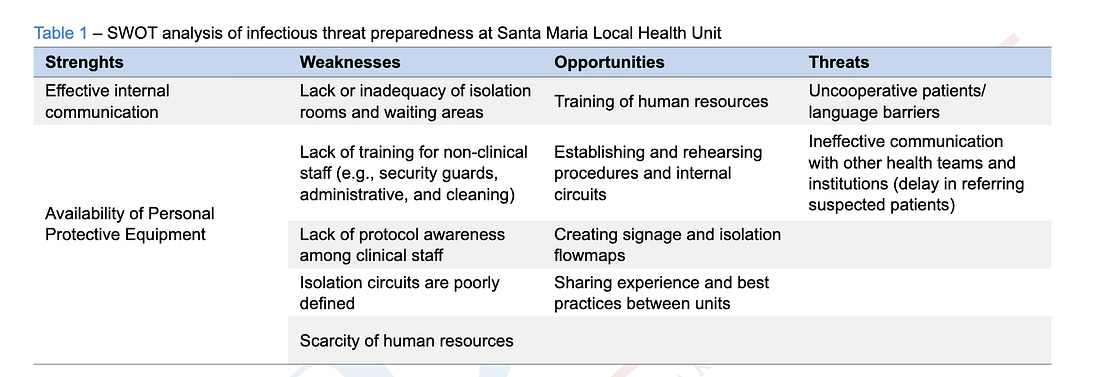
The paper also notes that frontline clinics lacked personnel trained to manage or redirect patients once non-compliance occurred:

“[C]oncerns were raised about non-healthcare professionals in several units, such as security guards and administrative assistants, lacking training to identify potential infectious diseases and guide patients towards isolation circuits and/or alert healthcare workers.”

This framing treats refusal—specifically refusal to use personal protective equipment—as an anticipated operational risk during an infectious disease response scenario.

The authors do not describe voluntary refusal as a matter of patient autonomy.

Instead, refusal is listed as an obstacle to the correct implementation of procedures, implying a need for enforcement capacity that clinics were found to lack.

No mitigation strategies for patient refusal are proposed in the paper.

No limits on enforcement authority are discussed.

The simulation record shows that non-cooperation was expected, identified in advance, and formally categorized as a threat within a modeled H5N1 outbreak response.

Why This Exercise Draws Attention

Although the simulation occurred in early 2025, the study was submitted in July 2025, accepted in December, and published online January 8, 2026, placing it into the medical literature at a time when international concern over bird flu preparedness is intensifying.

The timing and structure of the exercise are notable.

In the years preceding COVID-19, global health institutions conducted high-level pandemic simulations—including SPARS Pandemic 2025–2028 and Event 201—that modeled coronavirus outbreaks, public messaging challenges, and emergency countermeasures shortly before those scenarios became reality.

This Lisbon exercise follows the same pattern:

  • a named pathogen,
  • a simulated outbreak,
  • documented preparedness gaps,
  • and publication after the fact to formalize the response framework.

The study documents preparedness planning.

It confirms that bird flu is now being actively rehearsed as a plausible next pandemic scenario, not only in abstract policy discussions, but through operational simulations involving frontline civilian healthcare systems.

Was the exercise solely for preparedness, or does it function as early-stage coordination for future response architectures?

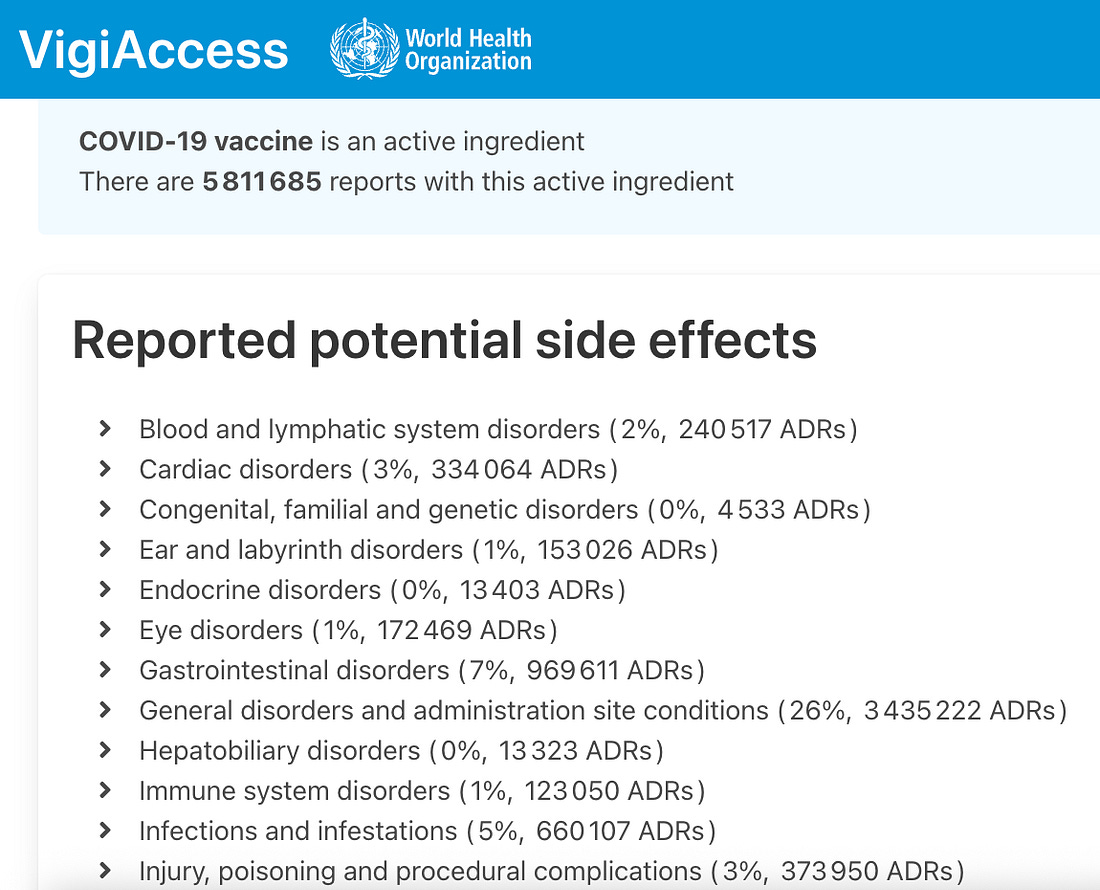
WHO VigiAccess Lists 5.8 Million COVID-19 Vaccine Adverse Event Reports


World Health Organization data show system-wide adverse event reports spanning neurological, cardiac, immune, gastrointestinal, and reproductive categories.

The World Health Organization’s VigiAccess pharmacovigilance database currently lists 5,811,685 individual adverse drug reaction (ADR) reports associated with COVID-19 vaccines as an active ingredient.

A Harvard Pilgrim Healthcare/HHS study confirms fewer than 1% of vaccine adverse events are reported, meaning the number could be closer to half a billion.

These reports are submitted by national drug regulators worldwide and categorized by affected body system.

Below is the full numerical breakdown exactly as listed in the database.


Reported Potential Side Effects by System Category

  • General disorders and administration site conditions
    3,435,222 reports (26%)
  • Nervous system disorders
    2,162,680 reports (16%)
  • Gastrointestinal disorders
    969,611 reports (7%)
  • Investigations (laboratory abnormalities, diagnostic findings)
    807,850 reports (6%)
  • Infections and infestations
    660,107 reports (5%)
  • Respiratory, thoracic, and mediastinal disorders
    559,163 reports (4%)
  • Skin and subcutaneous tissue disorders
    643,195 reports (5%)
  • Injury, poisoning, and procedural complications
    373,950 reports (3%)
  • Cardiac disorders
    334,064 reports (3%)
  • Psychiatric disorders
    253,443 reports (2%)
  • Blood and lymphatic system disorders
    240,517 reports (2%)
  • Vascular disorders
    245,846 reports (2%)
  • Reproductive system and breast disorders
    280,795 reports (2%)
  • Musculoskeletal and connective tissue disorders
    1,419,363 reports (11%)
  • Immune system disorders
    123,050 reports (1%)
  • Surgical and medical procedures
    121,374 reports (1%)
  • Metabolism and nutrition disorders
    103,797 reports (1%)
  • Eye disorders
    172,469 reports (1%)
  • Ear and labyrinth disorders
    153,026 reports (1%)

Lower-Frequency Categories Still Numerically Significant

  • Renal and urinary disorders
    47,767 reports
  • Endocrine disorders
    13,403 reports
  • Hepatobiliary disorders
    13,323 reports
  • Pregnancy, puerperium, and perinatal conditions
    14,180 reports
  • Congenital, familial, and genetic disorders
    4,533 reports
  • Neoplasms (benign, malignant, unspecified)
    17,770 reports
  • Product issues
    10,919 reports
  • Social circumstances
    47,909 reports

These figures represent submissions from national health authorities participating in the WHO’s global drug-safety monitoring program.

As of March 2025, 182 health authorities (national pharmacovigilance centers) participate in the WHO Program for International Drug Monitoring.

Each report may include multiple symptoms, meaning totals by category exceed the number of individual reports.

The scale and system-wide distribution of these reports are unprecedented for a single pharmaceutical product class in the VigiBase system.

DARPA Uses AI to Push Viral Pandemic Outbreak Modeling From Weeks to Days


Speed is being prioritized over scrutiny, with AI-generated models designed to justify interventions before they can be meaningfully challenged.

The U.S. military is funding artificial intelligence (AI) systems designed to drastically accelerate viral outbreak modeling—compressing a process that typically takes weeks into something that can be produced in days, then used to steer real-world interventions.

In other words, the faster the model, the less time there is to question whether the response is justified at all.

This acceleration follows DARPA’s already-documented pre-COVID pandemic infrastructure designed to turn digital genetic sequences into synthesized viruses and mass-produced mRNA countermeasures on a fixed timeline.


DARPA’s Stated Problem: Pandemic Models Were Brittle, Opaque, & Slow

According to a December Science publication:

As SARS-CoV-2 radiated across the planet in 2020, epidemiologists scrambled to predict its spread—and its deadly consequences. Often, they turned to models that not only simulate viral transmission and hospitalization rates, but can also predict the effect of interventions: masks, vaccines, or travel bans.

But in addition to being computationally intensive, models in epidemiology and other disciplines can be black boxes: millions of lines of legacy code subject to finicky tunings by operators at research organizations scattered around the world. They don’t always provide clear guidance. “The models that are used are often kind of brittle and nonexplainable,” says Erica Briscoe, who was a program manager for the Automating Scientific Knowledge Extraction and Modeling (ASKEM) project at the Defense Advanced Research Projects Agency (DARPA).

The Defense Advanced Research Projects Agency’s (DARPA) own program manager is conceding that the models used to steer COVID-era responses were fragile and difficult to interpret.

Meaning: they’re not trying to slow down or restrain model-driven policy after COVID.

They’re trying to make the same kind of decision machinery run faster.

There’s “real potential” for them to speed up model building during an outbreak, says Mohsen Malekinejad, an epidemiologist at the University of California San Francisco who helped evaluate the ASKEM products. “In a pandemic, time is always our biggest constraint. We need to have the information. We need to have it fast,” he says. “We simply don’t have enough data-skilled modelers for every single emergence, or every different type of public health need.”

The Program: AI-Generated Outbreak Models on Demand

“Launched in 2022, the $29.4 million program aims to develop artificial intelligence (AI)-based tools that can make model building easier, faster, and more transparent.”

DARPA funded infrastructure that standardizes and accelerates outbreak modeling.

The emphasis is on speed, reproducibility, and usability by non-specialists, allowing policy-relevant models to be generated quickly, even when underlying assumptions are incomplete or contested.

How It Works: Papers & Notebooks → Equations → Models

“The program’s AI tools automate that coding, allowing researchers to construct, update, and combine models at a higher level of abstraction.”

By removing much of the technical friction involved in model construction, these tools make it easier to generate outbreak models that carry institutional weight, even when the scientific grounding is thin or uncertain.

“ASKEM teams designed AI systems that can consume scientific literature… and extract the equations and knowledge needed to create or update a given model.”

Scientific literature is converted directly into reusable model components, giving machine-parsed interpretations of research the ability to propagate quickly into decision-making frameworks.

“One ASKEM project developed a way to ingest those notebooks, extract the underlying mathematical descriptions, and turn them into a model.”

Informal reasoning and exploratory notebook work can be elevated into deployable models at speed, reducing the distance between preliminary thinking and authoritative outputs.

Intervention-Focused Modeling

“The resulting model integrated the viruses’ different transmission and seasonal patterns, while gauging the effects of interventions such as wearing masks and testing.”

The system is designed to evaluate intervention scenarios alongside disease dynamics, embedding policy considerations directly into the modeling process.

“Testers were asked to model the impact of a vaccination campaign on the cost of hospitalization for hepatitis A in a state’s unhoused drug users.”

These tools are oriented toward applied governance questions—cost, targeting, and campaign impact—rather than purely descriptive epidemiology.

The Speed Claim: 83% Faster

“In the final results, testers found that the ASKEM tools, when pitted against standard modeling workflows, could create models 83% faster.”

Model generation is fast enough to fit within political and media timelines, reducing the opportunity for external review before results are acted upon.

“They were able to build practically useful models in a 40-hour work week for multiple problems.”

Once speed ceases to be the limiting factor, the pressure shifts toward rapid implementation rather than careful validation.

‘Transparency’ as an Internal Confidence Signal

“Because of the ASKEM models’ enhanced transparency, testers also found that decision-makers would be more confident in ASKEM’s outputs than in those of traditional models.”

Here, “transparency” functions less as a safeguard and more as a confidence amplifier for officials.

By making models legible enough to satisfy internal review, the system reduces friction within institutions, allowing officials to act more quickly while unresolved uncertainties remain embedded in the outputs.

Intended Users: Health, Defense, & Intelligence Agencies

“DARPA is working to find agencies or programs within the health, defense, and intelligence communities that might want to take advantage of ASKEM.”

Outbreak modeling is being positioned as a permanent national-security capability, integrated alongside defense and intelligence functions rather than treated as an ad hoc public-health exercise.

Bottom Line

DARPA is building a system that converts literature, assumptions, and exploratory analysis into outbreak models fast enough to guide interventions in near real time.

When speed is treated as the primary constraint, the window for scrutiny, dissent, and meaningful challenge necessarily collapses before those models are used to justify action.

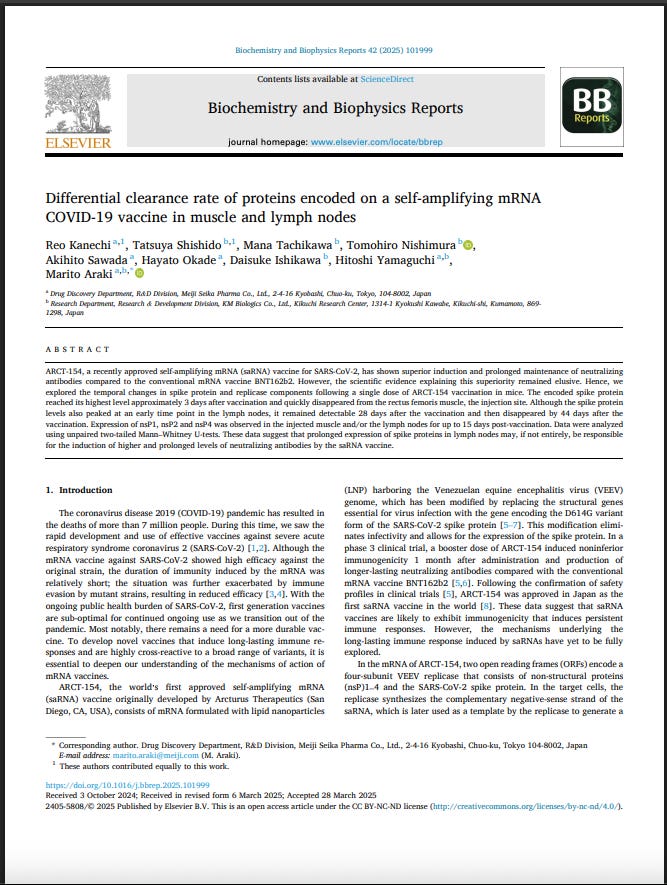
Newly U.K.-Approved Self-Replicating COVID Jab ‘Kostaive’ Produces Spike Protein Detectable 28 Days After Vaccination: Journal ‘Biochemistry and Biophysics Reports’


samRNA-copying enzyme also produced in the body post-vaccination detected for at least 15 days, according to study.

Arcturus Therapeutics’s Kostaive (zapomeran, ARCT-154) self-amplifying mRNA COVID-19 vaccine is said to force cells in the body to produce SARS-CoV-2 spike protein—detectable in draining lymph nodes for at least 28 days—and a replicase enzyme that makes more copies of the vaccine mRNA, with the enzyme itself detectable for up to 15 days.

ARCT-154 was quietly approved by U.K. regulators over the weekend.


An April 2025 Biochemistry and Biophysics Reports publication confirms that the ARCT-154 spike protein was “detectable up to 28 days post-vaccination” in mice.

The ARCT-154 samRNA-replicating enzyme also produced in the body post-vaccination was detectable for “up to 15 days.”

The study reads:

The encoded spike protein reached its highest level approximately 3 days after vaccination and quickly disappeared from the rectus femoris muscle, the injection site. Although the spike protein levels also peaked at an early time point in the lymph nodes, it remained detectable 28 days after the vaccination and then disappeared by 44 days after the vaccination. Expression of nsP1, nsP2 and nsP4 was observed in the injected muscle and/or the lymph nodes for up to 15 days post-vaccination.

There were no samples taken at intermediate days like 30, 35, or 40, so we don’t know the exact day the vaccine-produced spike protein became undetectable.

The U.K. press release failed to mention any of this.

Are citizens being fully informed before they consent to this new pharmaceutical injection?

Why are government regulators not providing this information?

Can the Vaccinated Shed samRNA Onto the Unvaccinated?

Exosomes and extracellular vesicles (EVs) are released by cells as part of normal physiology and disease processes, shedding into various bodily fluids such as blood, urine, semen, amniotic fluid, and breast milk.

It is biologically plausible that sa-mRNA, spike protein, and replicase enzymes from Kostaive could be packaged into EVs and exosomes for shedding into bodily fluids—potentially amplified by the self-replicating nature of sa-mRNA—allowing their release into circulation and excretion via blood, sweat, saliva, or breast milk.

A December Science, Public Health Policy, and the Law study shows that spike protein produced by cells from the BioNTech/Pfizer mRNA COVID-19 vaccine is mainly released into the surroundings through extracellular vesicles (which include exosomes).

Moderna knew as early as 2017 that its mRNA vaccine lipid nanoparticles—which carry vaccine mRNA into cells and are used in samRNA jabs—enter the bloodstream and accumulate in the liver, spleen, kidneys, heart, and lungs.

A January 2023 Nature Reviews Drug Discovery paper co-authored by Moderna scientists bluntly admits that avoiding “unacceptable toxicity” in mRNA vaccines remains a major challenge, warning that “lipid nanoparticle structural components, production methods, route of administration and proteins produced from complexed mRNAs all present toxicity concerns” and that the way these vaccines spread through the body can cause harm due to “cell tropism and tissue distribution… and their possible reactogenicity.”

Can individuals injected with self-replicating vaccines spread sa-mRNA, spike protein, and replicase enzymes to others?

After those elements are shed onto the unvaccinated, will they become vaccinated?