The Truth Is Out There

Posts tagged ‘healthcare’

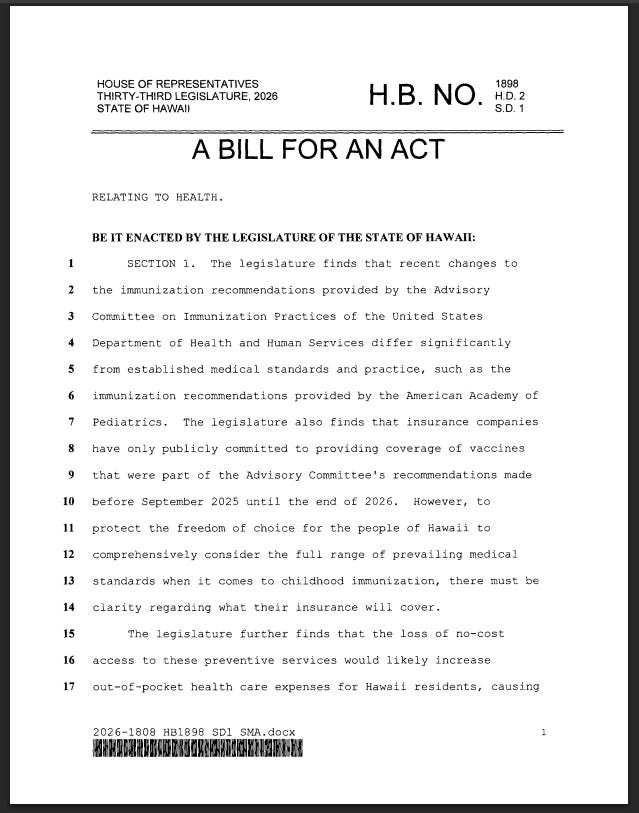
Hawaii Bill Shields State-Directed Medical Interventions Like Vaccines From Lawsuits: HB1898


After state’s vaccine passport era, Hawaii lawmakers want to give Department of Health final authority over medical decisions while blocking lawsuits and discipline against those who enforce them.

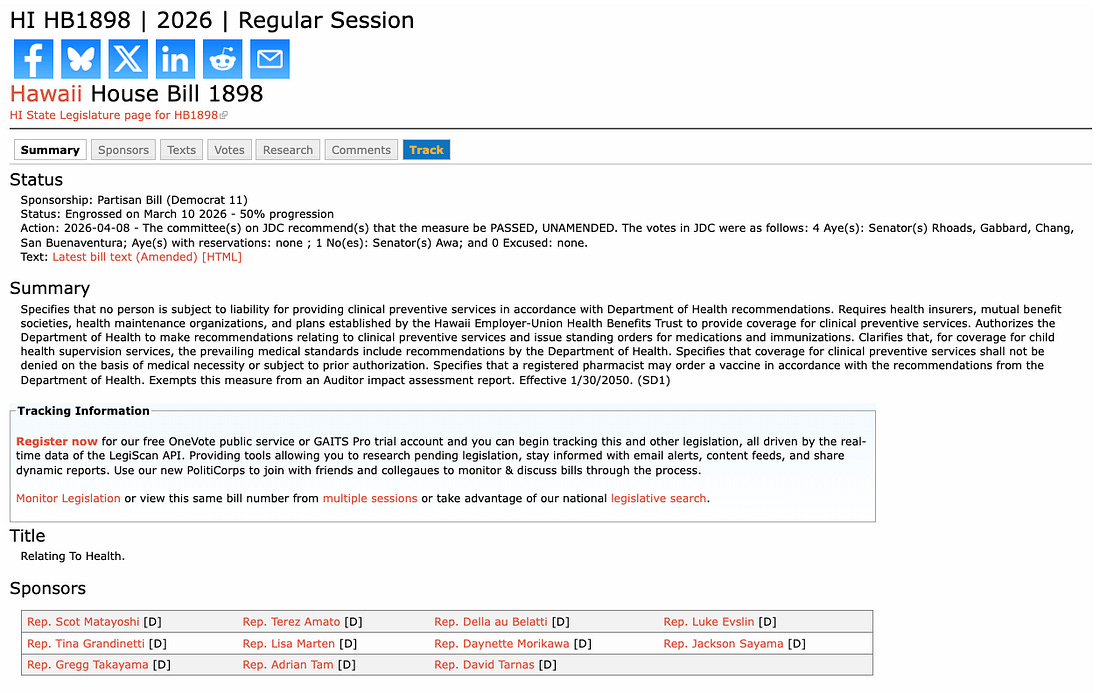
Hawaii lawmakers are advancing a bill that gives the state’s Department of Health decisive control over which vaccines and preventive services count as medically valid—and then protects anyone who carries them out from nearly all legal consequences.

House Bill 1898 (S.D. 1) creates immunity from civil lawsuits, criminal liability, and professional discipline for providers who follow DOH recommendations on “clinical preventive services.”

If harm occurs later, the main legal question becomes whether the provider obeyed state guidance.

During the next outbreak or pandemic, when the DOH again requires vaccination to work, attend school, travel, or participate in society, anyone injured by the shot could have no one to hold accountable—because the bill grants legal immunity to every doctor, pharmacist, and facility that simply followed state orders.

Watchdog groups actively monitoring the CDC’s Vaccine Adverse Event Reporting System (VAERS) data confirm 2.7 million adverse events have been linked to vaccines since 1990 (~204 adverse events per day)—though a Harvard Pilgrim Health Care report found that fewer than 1% of adverse events are ever reported, suggesting the true number could be in the hundreds of millions (~20,360 adverse events per day).

The accountability-erasing bill is backed by Democrat lawmakers, including Reps. Scot MatayoshiTerez AmatoDella Au BelattiLuke EvslinTina GrandinettiLisa MartenDaynette MorikawaJackson SayamaGregg TakayamaAdrian Tam, and David Tarnas.

HB1898 is in the final stage in the Senate, one step away from passage before being sent to the Governor.

You can contact Hawaii senators here and voice your opinion of the bill and how they should vote on it.
Health-Freedom Principles Violated by the Bill

The bill directly undermines several longstanding health-freedom principles:

  1. Bodily Autonomy and Informed Consent: Full insurance coverage and legal protection are available only for DOH-approved interventions. Families who prefer a different schedule or approach must pay out of pocket for alternatives that carry no such protections.
  2. Medical Accountability: The bill states that “[n]o person shall be subject to civil or criminal liability or professional disciplinary action” for providing services in accordance with DOH recommendations. Professional organizations, hospitals, and licensing boards are barred from disciplining, suspending, or penalizing providers who follow the state line.
  3. Independent Medical Judgment: Doctors who disagree with the DOH’s final decision on immunizations risk professional repercussions, while those who comply are shielded.
  4. Parental Rights in Child Health Decisions: The bill rewrites child health supervision rules so that “prevailing medical standards” now mean whatever the DOH says. Insurance must cover the DOH-chosen immunizations at no cost to the family, leaving parents who want a different schedule to pay full price.
  5. Separation of Medicine and State: Standing orders, mandatory insurance coverage with no cost-sharing, pharmacy administration, and legal immunity combine to create a single state-directed pipeline for preventive care.

Department of Health Given Final Authority

The bill makes the Hawaii Department of Health the tie-breaker when national medical groups disagree.

It states that if recommendations from the Advisory Committee on Immunization Practices and the American Academy of Pediatrics differ, “the department of health shall determine which recommendations shall apply.”

It also gives the DOH new power to issue standing orders for medications and immunizations, allowing them to be given without an individual doctor’s prescription.

Legal Protection Tied to Following State Guidance

The immunity language is clear:

“No professional organization or association, health care provider, or health care facility shall subject any person to discipline, suspension, loss of license, loss of privileges, loss of membership, or other penalty for providing clinical preventive services in accordance with recommendations made pursuant to section 321-31.”

Insurance Must Cover DOH-Approved Services at No Cost

For policies issued after January 1, 2027, insurers must provide coverage “without any deductible, copayment, coinsurance, or other cost-sharing requirements” for anything the DOH recommends.

Every Hawaii policyholder will likely pay higher premiums to subsidize the DOH’s choices—while families who want a different schedule get zero coverage and pay 100% out of pocket.

Pharmacies Can Administer Vaccines Under DOH Rules

HB1898 expands who can give vaccines by allowing pharmacists, pharmacy interns, and registered pharmacy technicians to administer them when ordered in line with DOH recommendations or standing orders.

What This Means in a Future Outbreak

If the DOH issues new recommendations during the next public-health emergency, those shots or treatments can be rolled out quickly through pharmacies, must be covered by insurance, and anyone administering them is protected from lawsuits or discipline as long as they followed DOH guidance.

Negligence Exception Exists, But Standard Is Compliance

The bill still allows claims for injury “arising from negligence.”

In practice, however, the legal test will center on whether the provider followed the Department of Health’s recommendations.

Bottom Line

HB 1898 gives the Department of Health the power to decide which preventive medical interventions are covered and protected by law.

It forces insurers to pay for the state’s choices with no patient cost-sharing and removes meaningful accountability for providers who follow those choices.

Hawaii families who want options outside the official schedule will face higher costs and fewer willing providers.

When the state controls the definition of medical truth and shields its enforcers from consequences, bodily autonomy and informed consent become conditional on government approval rather than individual rights.


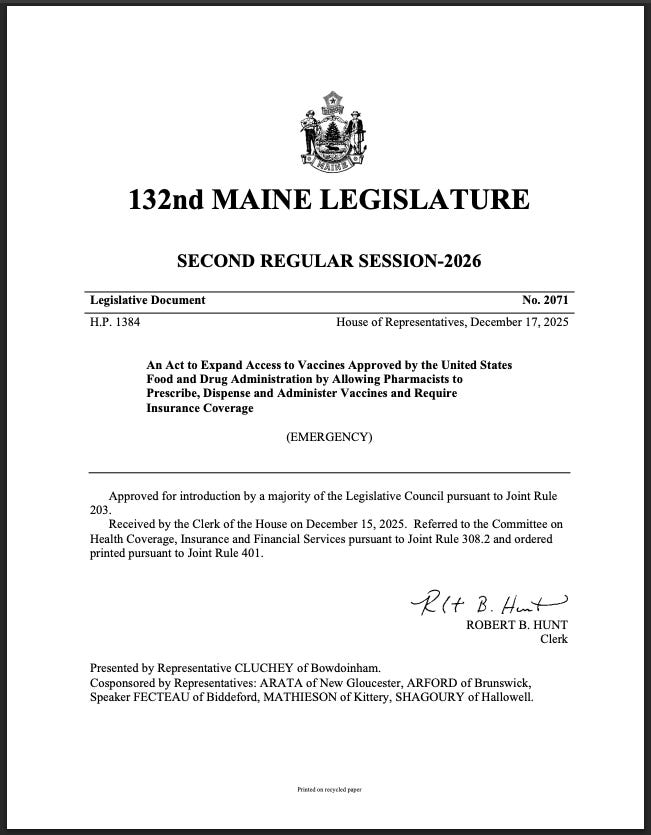
Maine Builds Rapid Influenza Vaccine Deployment and Tracking System—Pharmacists Granted Full Authority for Statewide Rollout ‘Without a Prescription’


L.D. 2071 requires pharmacists to report each vaccine within 72 hours to a centralized state system, enabling real-time monitoring of vaccination across the population.

Maine lawmakers have passed legislation that fundamentally restructures how influenza vaccines can be deployed across the state—establishing a system capable of rapid, large-scale distribution to the general population without relying on physicians.

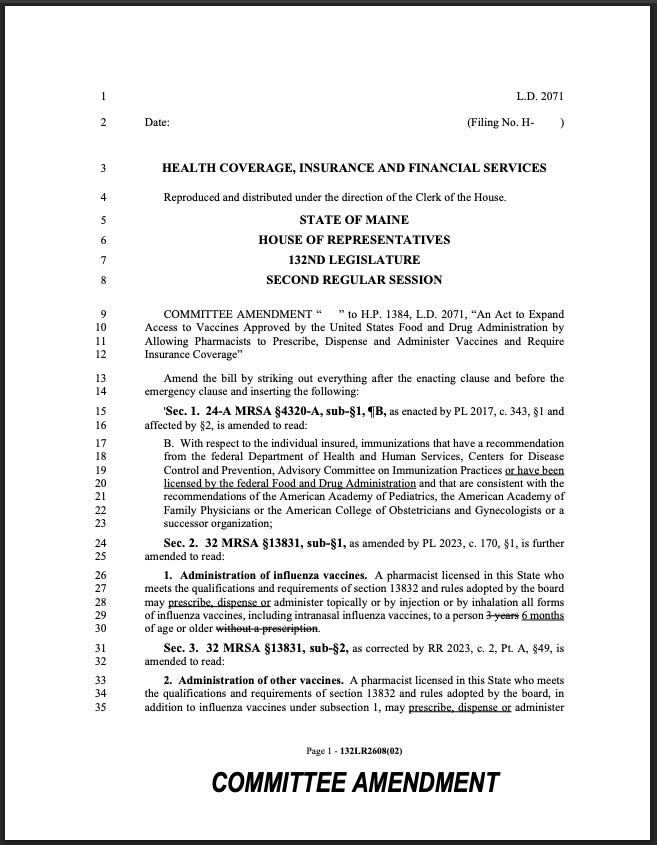
The final version of L.D. 2071 gives pharmacists full independent authority to prescribe, dispense, and administer influenza vaccines to individuals as young as 3 years and 6 months old—without a prescription or prior medical approval.

This structure removes physician oversight, concentrates vaccination authority in retail pharmacies, and pairs rapid, population-wide access with centralized state reporting—raising concerns about informed consent, medical autonomy, and the state’s ability to execute a fast, large-scale influenza vaccination campaign if another public health emergency is declared.

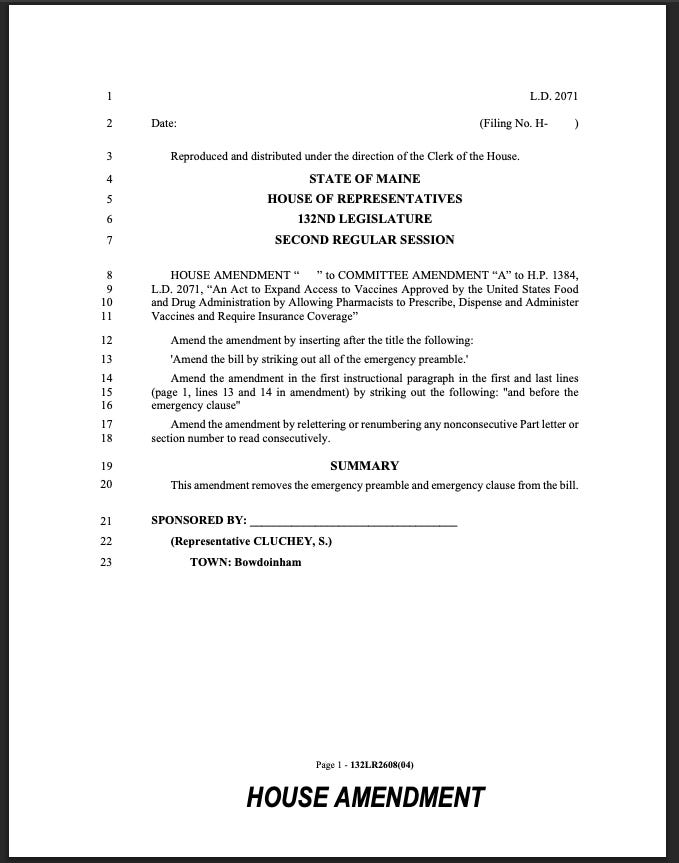
As of April 7, 2026, the bill has passed both chambers in identical final form and has been ordered sent to the Governor’s desk for signature.

The bill will take effect 90 days after the Legislature adjourns, which is scheduled for April 15, 2026—meaning the new pharmacist authority would become law on July 14, 2026.

The legislation’s advancement comes amid state, federal, and international influenza outbreak orchestration.

It is sponsored by Democrat Representatives Sally ClucheyPoppy ArfordRyan FecteauKristi MathiesonDaniel Shagoury, and Republican Rep. Amy Arata.

You can contact Governor Janet Mills office here.


Pharmacists Become Frontline Vaccination Authority

Under the amended statute:

“A pharmacist… may prescribe, dispense or administer… all forms of influenza vaccines… to a person 3 years 6 months of age or older without a prescription.”

This language removes the traditional requirement that a physician authorize vaccination—transferring full control over influenza vaccine delivery directly to retail pharmacies.

Pharmacists are no longer limited to administering a doctor’s order.

They can now initiate vaccination themselves.

That shift transforms pharmacies from passive distribution points into independent vaccination hubs capable of operating at scale.

Statewide Retail Network Activated for Mass Deployment

By design, the system leverages the existing pharmacy network as the backbone of vaccine delivery.

Instead of relying on:

  • clinics
  • hospital systems
  • scheduled appointments

The law enables:

  • walk-in access
  • immediate administration
  • decentralized distribution

Pharmacies—already embedded in nearly every community—function as a ready-made infrastructure for rapid statewide rollout.

Influenza Singled Out for Broadest Authority

The legislation treats influenza differently from all other vaccines.

  • Influenza vaccines:
    • pharmacist can prescribe, dispense, and administer
    • applies down to age 3 years 6 months
  • Other vaccines:
    • independent pharmacist authority limited to adults 18+
    • minors require a doctor’s prescription

This makes influenza the only vaccine category granted full pharmacist-controlled access across both adults and young children.

Real-Time State Tracking Built In

The bill also requires that every administered vaccine be reported:

Pharmacists must report vaccine administration to the state immunization information system within 72 hours.

This creates a centralized system capable of:

  • tracking vaccination rates
  • monitoring geographic uptake
  • identifying gaps in coverage

The result is near real-time visibility into how widely vaccines are being administered across the population.

Insurance Language Opens the Door—Without Mandating Coverage

While earlier versions of the bill proposed mandatory no-cost vaccine coverage, the final version stops short of requiring it.

Instead, the amended law clarifies that insurers are authorized to cover vaccines without cost-sharing if they choose, rather than mandating it.

Even without a mandate, the structure aligns financial incentives with expanded access.

What the Structure Reveals

The bill establishes:

  • Immediate, walk-in vaccination access
  • No physician gatekeeping
  • A statewide pharmacy-based delivery network
  • Rapid reporting into a centralized tracking system
  • Inclusion of young children in the rollout model

This represents a complete redesign of how influenza vaccines can be deployed at scale.

Bottom Line

Maine legislators have constructed a system that allows influenza vaccines to be distributed quickly, broadly, and with minimal friction across the entire population.

If activated, the infrastructure enables any individual to walk into a pharmacy, receive an influenza vaccine on the spot, and have that dose logged into a statewide tracking system within days—without ever interacting with a physician.

Katlin Collin’s Deletes Social Media Post After Public Response


The case of alleged murderer Luigi Mangione has peeled back yet another layer of moral rot infecting certain corners of the modern left. Here we have a privileged 26-year-old from a wealthy Maryland family, a University of Pennsylvania graduate, who—according to police and clear-as-day video evidence—gunned down UnitedHealthcare CEO Brian Thompson in the streets of New York City last December. A father. A husband. A man Mangione had no personal connection to.

And yet, in a disturbing reflection of the times, this brutal act has been met with a grotesque level of sympathy from some, all because the killer supposedly had the “right” motivations. His actions, they argue, were a protest against the healthcare system and the insurance industry—never mind that what he actually did was shoot an unarmed man in the back.

CNN “reporter” KaitlanCollins promoted a fundraiser for Luigi Mangione. She has since deleted the public relations post for Luigi. pic.twitter.com/7ZI72b9Yfk

But that’s not stopping the apologists. And now, CNN’s Kaitlan Collins appears to have waded right into the mess, according to reports. The network’s chief White House correspondent reportedly posted a link to a website launched by Mangione’s defense team—before quietly deleting it after the backlash hit. Why? Because people noticed.

That link, by the way, was for a legal defense fund that has already raked in over $300,000 from Mangione’s supporters. That’s right—an Ivy League-educated killer from a wealthy family, who allegedly committed a public execution in cold blood, has managed to draw in six figures’ worth of donations.

Kaitlan Collins omits the fact that Mangione’s defense attorney, the same one behind this website she is promoting, is a CNN contributor. https://t.co/6bsfXXFIb0 pic.twitter.com/HiBYGhJr23

Two things stand out here: First, Collins conveniently left out the fact that Mangione’s defense attorney is another CNN insider. Second, her original post is now mysteriously unavailable, as pointed out by journalist Stephen Miller. That deletion speaks volumes.

It’s worth asking: Was Collins just blindly sharing the link without thinking? Or was this yet another example of the increasingly common habit of framing violent criminals as misunderstood victims—so long as they fit the right ideological mold?

Wow. Usually when someone makes an error and deletes a tweet, they’ll say, “my bad” and explain they’ve removed a post.

Looks like @kaitlancollins thought no one would notice the Luigi Mangione boosting.

Oops. 

This isn’t the first time a murderer has been repackaged into a “cause” rather than a criminal. But what’s particularly galling here is the sheer detachment from reality. Brian Thompson doesn’t get to have a defense fund. He doesn’t get to have a website where he can share his feelings. He doesn’t get to post his gratitude to supporters. He was executed.

And yet, Mangione, a man who had every advantage in life, is now being treated like some kind of folk hero by certain circles.

Collins’ actions, whether intentional or just wildly careless, raise real questions. Is this just another example of mainstream media figures being unable to resist the impulse to glorify criminals if they fit a certain narrative? Or was this simply a case of poor judgment and a scramble to backtrack once the backlash hit? Either way, it’s not a good look.