
HHS-backed research produced chimeric influenza viruses carrying SARS-CoV-2’s ACE2-binding interface—introducing a higher-affinity human receptor-binding mechanism into an influenza pathogen.

HHS-funded researchers are claiming to have engineered influenza-based chimeric “Frankenstein” viruses that combine influenza’s hemagglutinin (HA) with the SARS-CoV-2 receptor-binding domain (RBD)—a high-affinity human ACE2-binding interface.
Introducing a fundamentally different and stronger human cell–binding mechanism into an influenza viral system is a modification that fits longstanding U.S. gain-of-function definitions involving altered receptor usage and host range.
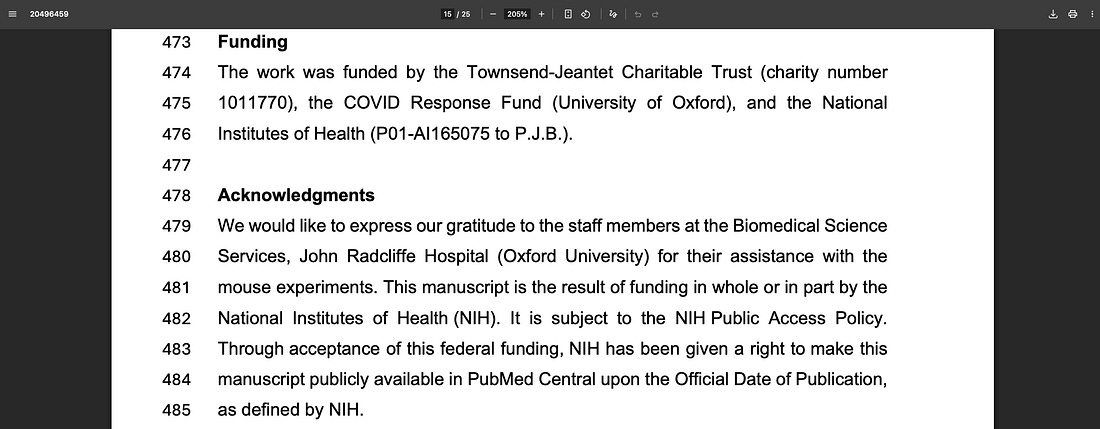
A December 2025 bioRxiv preprint confirms the work, supported in part by the National Institutes of Health (NIH)—an agency within the U.S. Department of Health and Human Services (HHS)—was funded under grant P01-AI165075:
“This work was funded by… National Institutes of Health… P01-AI165075”
and involved replacing influenza’s native HA gene with the SARS-CoV-2 RBD while producing virus particles coated with HA in the laboratory, resulting in viral constructs that physically contain both influenza’s entry protein and the SARS-CoV-2 optimized human cell–binding interface.
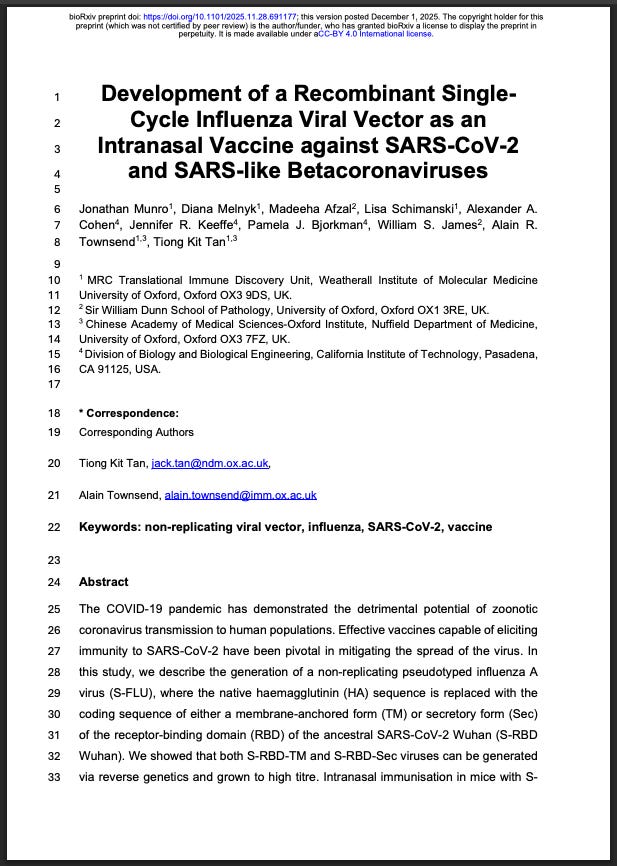

The study was conducted by Jonathan Munro, Diana Melnyk, Madeeha Afzal, Lisa Schimanski, Alexander A. Cohen, Jennifer R. Keeffe, Pamela J. Bjorkman, William S. James, Alain R. Townsend, and Tiong Kit Tan, with affiliations including the University of Oxford’s Weatherall Institute of Molecular Medicine and Sir William Dunn School of Pathology (here), the Chinese Academy of Medical Sciences–Oxford Institute (here), and the California Institute of Technology (here).
The head of HHS is Secretary Robert F. Kennedy Jr., while NIH is led by Director Jay Bhattacharya and NIAID is headed by Director Jeffery Taubenberger.
You can contact NIAID here, the NIH here, and HHS here to voice opposition to taxpayer-funded chimeric research on pandemic pathogens—particularly after Congress, the White House, the Department of Energy, the FBI, the CIA, and Germany’s Federal Intelligence Service (BND) all acknowledged that the deadly COVID-19 pandemic was “likely” the result of a laboratory incident involving GOF.
Meanwhile, President Donald Trump recently signed legislation into law allocating at least $5.5 billion in taxpayer funding for a future influenza pandemic.
At the same time, the Trump administration has advanced a $500 million “next-generation, gold-standard” combination influenza-COVID vaccine platform—positioning federal agencies to simultaneously fund the development of pandemic-capable influenza-COVID pathogens while building the mass vaccination infrastructure designed to respond to the very outbreak those systems could enable.
Engineered Virus Introduces High-Affinity Human Receptor Binding Into Influenza Backbone
The study explicitly confirms that influenza’s native receptor-binding gene was removed and replaced:
“the native haemagglutinin (HA) sequence is replaced with the coding sequence of… the receptor-binding domain (RBD) of the… SARS-CoV-2”
Influenza viruses naturally infect human cells using hemagglutinin, which binds sialic acid receptors with relatively low individual affinity and relies on multivalent interactions across many HA proteins.
By contrast, the SARS-CoV-2 receptor-binding domain binds directly to the human ACE2 receptor through a high-affinity protein–protein interaction, enabling efficient attachment to human airway cells.
By inserting the SARS-CoV-2 RBD into an influenza backbone, the researchers introduced a human ACE2-binding interface into a virus that does not naturally use that receptor system.
Chimeric Particles Combine Influenza HA and SARS-CoV-2 RBD
The study explicitly states that the influenza virus was genetically modified by replacing its HA coding sequence with the SARS-CoV-2 receptor-binding domain:
“we replaced the native HA coding sequence”
and:
“In this study, we describe the generation of a non-replicating pseudotyped influenza A virus (S-FLU), where the native haemagglutinin (HA) sequence is replaced with the coding sequence of either a membrane-anchored form (TM) or secretory form (Sec) of the receptor-binding domain (RBD) of the ancestral SARS-CoV-2 Wuhan (S-RBD Wuhan).”
At the same time, the study makes clear that HA function is not eliminated at the particle level, but instead supplied externally:
“Inactivation of the native haemagglutinin (HA) signal sequence means that S-FLU can only replicate in cell lines transfected to express HA that provide the surface protein for budding viral particles.”
The authors also confirm that the resulting engineered virus retains the ability to enter cells:
“Notably, S-FLU exhibits the capacity to infect host cells but is replication-incompetent.”
Study Confirms Infection & Expression of SARS-CoV-2 Binding Domain
The researchers confirmed that the engineered virus successfully infected cells and expressed the inserted RBD:
“both S-RBD-TM and S-RBD-Sec led to expression of RBD in the infected cells”
This demonstrates that the chimeric virus delivers and expresses the SARS-CoV-2 receptor-binding domain inside host cells following infection.
Bottom Line
HHS-funded researchers say they have engineered influenza-based viruses that combine influenza’s hemagglutinin (HA) with the SARS-CoV-2 receptor-binding domain (RBD).
They replaced the HA gene with the RBD.
But they still produced virus particles coated with HA.
The result is a chimera that physically carries both influenza’s entry machinery and a high-affinity human ACE2-binding interface.
The study confirms these viruses infect cells and express the RBD.
That is a direct change in receptor usage, consistent with longstanding U.S. gain-of-function definitions.
The work was funded under NIH grant P01-AI165075.
At the same time, the federal government is allocating at least $5.5 billion for an influenza pandemic and advancing a $500 million influenza-COVID vaccine platform—building both the engineered viral systems and the mass-response infrastructure in parallel.


 fox files
Leave a comment