
As the U.S. simultaneously performs similar gain-of-function lab experiments.

Chinese state-backed scientists claim to have engineered multiple mutant H5N1 bird flu viruses and experimentally infected mammals to identify genetic combinations that dramatically increased lethality and enhanced the virus’s compatibility with human cellular machinery, according to a new peer-reviewed paper published yesterday in Emerging Microbes & Infections.
The revelation about China comes as a recent HHS-funded study says that U.S. scientists have also lab-engineered brand-new reassortant “Frankenstein” bird flu viruses with enhanced immune-evasion potential in humans.
The back-to-back disclosures represent an accelerating international effort by government-backed scientists to engineer and characterize bird flu strains with enhanced mammalian adaptation, immune evasion, and pandemic potential.
Congress, the White House, the Department of Energy, the FBI, the CIA, and Germany’s Federal Intelligence Service (BND) all claim that the deadly COVID-19 pandemic was “likely” the result of a laboratory incident involving engineered pathogens.
The creation of pandemic pathogens raises international security and informed consent concerns.
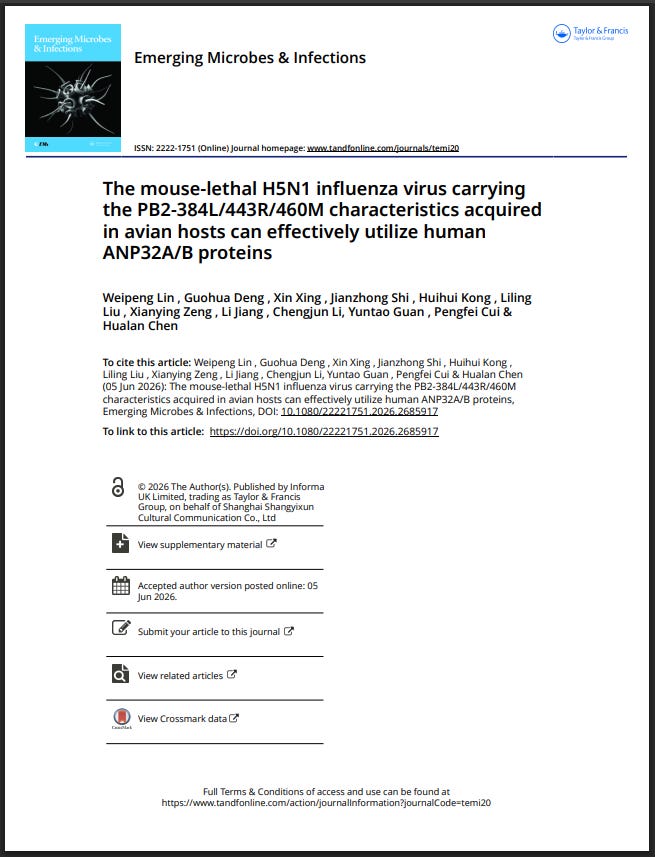
The new Chinese study was conducted at the Harbin Veterinary Research Institute (HVRI), part of the Chinese Academy of Agricultural Sciences (CAAS), using ABSL3 high-containment laboratories approved for work with highly pathogenic avian influenza viruses.
Using an eight-plasmid reverse genetics system, researchers generated reassortant and mutant (“Frankenstein”) H5N1 viruses carrying specific polymerase mutations associated with mammalian adaptation.
The purported engineered viruses were then administered intranasally into BALB/c mice to measure tissue spread, replication efficiency, and lethality.
According to the paper, one engineered strain replicated throughout the body, spreading into the lungs, nasal turbinates, brain, spleen, and kidneys.
Researchers reported that the highly pathogenic strain displayed at least a “560,000-fold” difference in lethality compared to a genetically similar H5N1 virus.
The paper identified three mutations in the PB2 polymerase protein—384L, 443R, and 460M—that together dramatically increased virulence in mammals.
The authors say the mutations allowed the virus to more efficiently exploit human ANP32A/B proteins, which are said to be critical host factors required for influenza replication in human cells under the mainstream virological model.
In plain terms, the researchers are claiming to have identified mutational combinations that helped bird flu function more effectively inside human biological systems.
The experiments align with published gain-of-function definitions involving enhanced pathogen lethality, mammalian adaptation, and viral replication in human cellular systems.
According to a 2022 review published in Advances in Applied Microbiology:
“Gain-of-Function research on viruses is enhancing transmissibility, virus replication, virulence, host range, immune evasion or drug and vaccine resistance to get insights into the viral mechanisms, to create and analyze animal models, to accelerate drug and vaccine development and to improve pandemic preparedness.”
The Chinese study qualifies because the researchers engineered mutant H5N1 viruses that became more lethal in mammals while also enhancing the virus’s ability to replicate and adapt inside human cellular systems.
The study was funded by:
- China’s National Key Research and Development Program,
- the National Natural Science Foundation of China,
- the Natural Science Foundation of Heilongjiang Province,
- and the Chinese Academy of Agricultural Sciences.


Leave a Reply