
No human trial showing Pfizer’s new XFG shot is safe, prevents COVID-19, or reduces hospitalization or death; and Pfizer has not publicly revealed the complete genetic instructions being injected.

The U.S. Food and Drug Administration has approved Pfizer and BioNTech’s new “XFG-adapted” COVID-19 vaccine without the companies first demonstrating in a human clinical trial that the specific XFG formulation is safe, effective, or produces the intended immune response in people.
And the complete nucleotide sequence of the mRNA Pfizer wants injected into people has not been made public by the company, meaning recipients are being asked to consent without knowing either how this specific formulation performs in humans or the exact genetic code the shot is designed to instruct their cells to use to produce the claimed XFG spike protein.
And without disclosure of that sequence, its provenance cannot be independently scrutinized: the public cannot verify exactly where the genetic code came from, how it was derived, what engineered changes were introduced, or whether the sequence being manufactured even matches the genetic instructions Pfizer and FDA claim the shot contains.
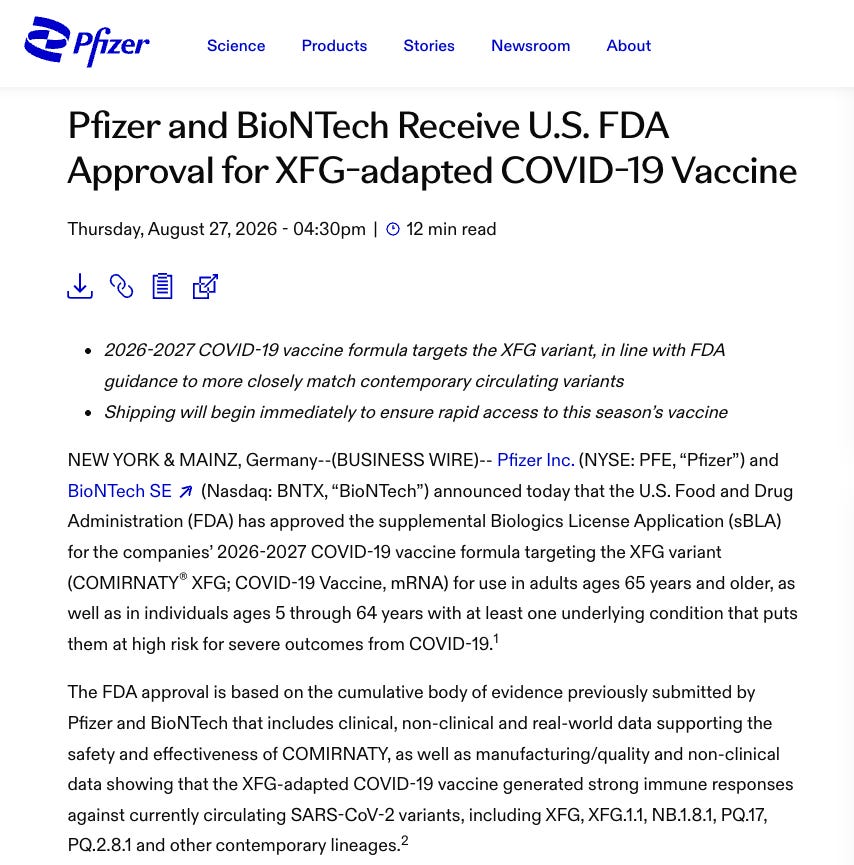
Pfizer announced Thursday that FDA approved its supplemental Biologics License Application for COMIRNATY XFG for adults 65 and older and people ages 5 through 64 with at least one underlying condition allegedly placing them at what the company calls “high risk” for severe COVID-19.
Pfizer says the approval was based on a “cumulative body of evidence previously submitted” for COMIRNATY (including clinical, nonclinical, and real-world data) along with “manufacturing/quality and non-clinical data” for the new XFG-adapted formulation.
FDA’s own account confirms the divide: for the 2026–2027 vaccine decision, the agency says it considered human immunogenicity data from existing vaccines but “animal immunogenicity data on new candidate vaccines expressing or containing updated spike components.”
The human evidence belonged to earlier vaccine formulations.
For the newly approved XFG formulation, Pfizer presented nonclinical laboratory antibody measurements.
That raises questions:
- If Americans are going to be injected with the XFG formulation, why was that formulation itself not first tested for safety and efficacy in people?
- What evidence establishes that the human safety profile and clinical benefit of previous formulations can simply be carried forward to a changed shot?
- And how much can the product being injected change before FDA requires the new version itself to undergo human testing?
Congressional committees have confirmed that the FDA “is not meeting important federal safety requirements to protect its employees and the public while also failing to prioritize scientific data quality delivered from FDA laboratories.”
You can contact the FDA here.
What Is the Exact Genetic Sequence Being Injected?
Pfizer is asking Americans to receive a newly formulated mRNA vaccine without publicly telling them the complete nucleotide sequence of the genetic material being injected.
The company says the newly approved vaccine “target[s] the XFG variant” and describes Pfizer-BioNTech COVID-19 vaccines as based on BioNTech’s “proprietary mRNA technology.”
But naming XFG does not disclose the alleged genetic sequence inside the shot.
Multiple nucleotide sequences are said to be able to encode the same protein.
That means knowing which variant Pfizer says the vaccine targets does not, by itself, reveal the precise sequence Pfizer manufactured, including any engineered nucleotide choices used to produce the encoded spike protein.
Pfizer says FDA reviewed “manufacturing/quality” information for the new XFG formulation.
Yet the complete nucleotide sequence of the XFG vaccine mRNA is not disclosed in Pfizer’s cited XFG supportive-data presentation or its approval announcement.
So people are being asked to consent to receiving alleged genetic material without Pfizer publicly providing the complete genetic sequence they are being asked to receive.
Which raises questions:
- What is the complete nucleotide sequence inside the XFG shot?
- What engineered changes did Pfizer make to it?
- How does it differ from the sequence of circulating XFG and from Pfizer’s previous LP.8.1 formulation?
- Why isn’t the exact sequence publicly disclosed so independent scientists can examine it?
- And how can Americans make a fully informed decision about receiving genetic material when the manufacturer has not publicly disclosed the complete genetic instructions being injected into their bodies?
XFG-Specific Alleged Immune Evidence Came From Mice, Not Humans
Pfizer produced no human clinical immunogenicity trial of the XFG formulation before FDA approved it.
Its May 28 presentation makes the distinction explicit.
The human evidence appears under “LP.8.1 Vaccine Clinical Immunogenicity.”
The new candidate vaccines appear separately under “Preclinical Immunogenicity of Candidate Vaccines.”
Pfizer’s human clinical immunogenicity study involved the previous LP.8.1-adapted vaccine, not XFG.
Pfizer says those human antibody measurements were made with a “validated authentic virus neutralization assay.”
For the new XFG formulation, Pfizer instead presented laboratory antibody measurements from mice.
One slide is titled:
“LP.8.1 and XFG Vaccines Elicit Similar Neutralizing Responses in Naïve Mice; Diminished Against BA.3.2.2.”
The experiment involved just 10 mice per vaccine group, receiving a 0.5-microgram dose, and was said to have measured a 50% neutralization titer using a pseudo virus neutralization assay.
Pfizer also produced similar laboratory antibody measurements in vaccine-experienced mice, again using 10 animals per vaccine group and pseudo virus neutralization.
None of those measurements establishes whether the XFG formulation is safe in humans.
- They do not establish whether it prevents COVID-19 in humans.
- They do not establish whether it reduces hospitalization or death.
- They do not even establish what neutralizing-antibody response the XFG formulation produces in humans.
Pfizer’s own conclusion was narrower:
“LP.8.1 and XFG vaccines exhibited similar patterns of elicited immunity in nonclinical models.”
FDA likewise characterized the XFG evidence as “Nonclinical studies” in its May presentation.
Questions are raised:
- Why should laboratory antibody measurements from groups of 10 mice against pseudo viruses be enough XFG-specific immune-response evidence to proceed to human approval?
- What can those measurements actually establish about safety or disease prevention in a human being?
- And if Pfizer was not required even to demonstrate the new formulation’s intended immune response in people before approval, what XFG-specific evidence could have stopped the shot from reaching the market?
No Human Efficacy Trial of the XFG Shot
Pfizer does present alleged human effectiveness data.
But the people generating those data did not receive the XFG vaccine FDA just approved.
They received the previous LP.8.1 formulation.
Pfizer reports alleged LP.8.1 effectiveness estimates against outpatient and emergency or urgent-care visits and hospitalization.
Pfizer summarizes the evidence this way:
“LP.8.1 vaccine maintained effectiveness during period of XFG predominance.”
That is purported evidence about the previous LP.8.1 shot during a period when XFG was circulating.
It is not an efficacy trial of the XFG shot.
Pfizer does not present a human trial showing that people receiving its new XFG formulation were less likely to become infected, develop COVID-19, be hospitalized, or die.
Nevertheless, the newly approved product is indicated “to protect against coronavirus disease 2019 (COVID-19).”
FDA says its decision was instead based on the “totality of the evidence,” which included alleged current vaccine effectiveness, human immunogenicity evidence from existing vaccines, and animal immunogenicity evidence from the new candidate formulations.
This raises more questions:
- If nobody receiving the XFG shot was studied for clinical efficacy before approval, what direct evidence establishes how much disease this specific shot prevents?
- What is its demonstrated reduction in hospitalization or death?
- How can patients weigh the expected benefit of this formulation when those outcomes were never measured in people receiving it?
No Human Safety Trial of the New XFG Formula
Pfizer does not present a human clinical safety trial of its new XFG formulation.
Instead, Pfizer explicitly says FDA relied on the “cumulative body of evidence previously submitted” for COMIRNATY alongside manufacturing/quality and nonclinical evidence for XFG.
That means previous formulations supply the alleged human safety history being invoked to support the changed formulation.
The distinction is consequential because Pfizer’s own safety information acknowledges that myocarditis and pericarditis have occurred following its mRNA COVID-19 vaccines and says the conditions have occurred most commonly in males ages 12 through 24.
Historical COMIRNATY safety data therefore exist.
But historical safety data from earlier formulations are not observations of what happens to humans after receiving the new XFG formulation.
FDA says it “will continue to monitor the safety and effectiveness of the COVID-19 vaccines.”
That makes the timing of safety evidence an unavoidable question.
- How could an adverse reaction unique to (or occurring at a different rate with) the XFG formulation have been detected before approval when Pfizer did not conduct an XFG human safety trial?
- What evidence establishes that changing the encoded antigen cannot alter the shot’s human safety profile?
- And if an XFG-specific safety signal can only become visible after people start receiving the approved product, how much of the safety question has effectively been pushed from preapproval testing into postmarketing surveillance?
What Would Have Made FDA Say No?
FDA says its XFG recommendation was made “based on the totality of the evidence.”
But FDA’s description of that evidence reveals what the new formulation itself did, and did not, have to demonstrate.
The agency says it considered alleged circulating variants, current vaccine effectiveness, human immunogenicity data from current vaccines, antigenic characterization, human immunogenicity data from the 2025–2026 vaccines, and “animal immunogenicity data on new candidate vaccines.”
FDA’s own May 28 presentation similarly placed its conclusion about XFG under “Nonclinical studies,” claiming that LP.8.1 and XFG vaccines produced cross-neutralizing responses against certain lineages.
Pfizer, meanwhile, acknowledges in its approval announcement that research and development can produce “unfavorable new clinical data” and that regulatory decisions involve determining whether a product’s benefits outweigh its known risks.
But there could be no unfavorable XFG human clinical-trial result before approval if Pfizer was not required to produce such a trial.
There could be no XFG-specific clinical efficacy failure observed in humans if efficacy was not measured in XFG recipients.
And there could be no adverse-event imbalance detected in an XFG clinical trial if no XFG human safety trial was conducted.
More questions are raised:
- What predetermined human safety or efficacy threshold did the new XFG shot have to meet before FDA would approve it?
- What XFG-specific evidence could have revealed a problem serious enough to stop approval?
- If neither human safety nor clinical efficacy had to be demonstrated before approval, exactly what result would have caused FDA to reject the formulation?
Approval First, XFG Human Experience After
Pfizer did not announce that the XFG formulation would undergo human clinical testing before distribution.
It announced immediate shipment.
“This season’s Pfizer and BioNTech COVID-19 vaccine will begin shipping immediately and will be available in pharmacies, hospitals, and clinics across the U.S. in the coming days.”
That means FDA approved the XFG formulation without a human XFG safety trial, human XFG efficacy trial, or human XFG immunogenicity trial, and Pfizer moved directly to distribution.
The first broad human experience with this specific formulation therefore comes after approval, not from a preapproval clinical trial designed to establish its safety or efficacy.
- If an unexpected XFG-specific safety problem emerges after rollout, who is accountable for deciding human testing was unnecessary before approval?
- How many recipients might be exposed before a rare adverse event becomes statistically visible?
- And are patients being clearly told that the specific XFG formulation they are receiving was approved without first being subjected to a human clinical safety or efficacy trial?
Bottom Line
Pfizer’s own evidence draws two critical lines.
First, the company cites human clinical and real-world evidence accumulated from previous COMIRNATY formulations, not human testing of the newly approved XFG shot.
- For XFG itself, Pfizer presents nonclinical laboratory antibody measurements, including experiments involving groups of just 10 mice whose serum was evaluated against pseudo viruses.
- Those measurements did not establish the new formulation’s human safety.
- They did not establish its human efficacy.
- They did not demonstrate that the XFG shot prevents infection, COVID-19, hospitalization, or death in people.
- They did not even establish the XFG formulation’s neutralizing-antibody response in humans.
Second, Pfizer has not publicly provided the complete nucleotide sequence of the mRNA in the new XFG shot in the XFG materials cited here.
- Calling the vaccine “XFG-adapted” does not reveal that sequence.
- Multiple nucleotide sequences can encode the same protein, meaning the public designation does not disclose the precise genetic instructions Pfizer manufactured or what engineered nucleotide choices were incorporated into them.
- Without the complete sequence, independent scientists and recipients cannot independently examine its full provenance: exactly where the genetic code came from, how it was derived, what engineered changes were introduced, how it differs from Pfizer’s previous formulation, or whether the manufactured sequence matches the genetic instructions Pfizer and FDA say the product contains.
FDA nevertheless approved the XFG formulation, and Pfizer announced that shipments would begin immediately.
The result is extraordinary: Americans are being asked to receive a newly changed mRNA formulation that was not subjected to a human safety, efficacy, or immunogenicity trial before approval, while the complete nucleotide sequence of the genetic material they are being asked to receive has not been publicly provided in Pfizer’s cited XFG materials.
FDA calls this an update to an already licensed vaccine.
But a regulatory classification cannot answer the underlying empirical or informed-decision questions.
- What exactly is the complete genetic sequence being injected?
- What is its independently verifiable provenance?
- What human evidence establishes that this specific formulation is safe?
- What human evidence establishes that it prevents disease, hospitalization, or death?
- How can recipients fully scrutinize what they are consenting to when the complete genetic instructions have not been made public?
- And if FDA’s assumptions about either the new formulation’s safety or its similarity to previous shots prove wrong only after rollout, who is accountable?


 fox files
Leave a comment