In the high-stakes world of climate science, questioning the established narrative can come with serious consequences. And let me tell you, nobody knows this better than Mark Steyn and National Review, who found themselves on the receiving end of a defamation lawsuit after criticizing Michael Mann’s famous “hockey stick” graph – that convenient climate model that helped launch a thousand carbon tax proposals and endless doomsday predictions that somehow never quite materialize. For over a decade, Mann, the darling of climate activism, has been locked in a bitter legal battle against those who dared challenge his work. But sometimes, even science’s elite must face the cold reality of the judicial system – a reality that doesn’t care about consensus or how many times you’ve been invited to speak at Davos.
Mann’s lawsuit against National Review began in 2012, a case that would stretch on for years, consuming resources and threatening to silence critical voices in climate science debate. The University of Pennsylvania professor, celebrated in climate advocacy circles (and boy, do they love to celebrate each other), had declared the publication a “threat to our children” in private emails. His rage was triggered after Canadian conservative commentator Mark Steyn wrote a post questioning Mann’s methodology, followed by National Review editor Rich Lowry publishing a piece supporting Steyn’s critique. Imagine that – journalists actually doing their job by questioning powerful institutional figures!
What Mann didn’t anticipate, however, was how this attempt to punish his critics might ultimately send him reaching for his own checkbook instead. Isn’t it funny how those who scream loudest about “following the science” are often the first to run to the courts when their work faces actual scientific scrutiny?
The Superior Court of the District of Columbia recently delivered news that likely sent shockwaves through Mann’s office. Despite his desperate legal maneuvers to delay the inevitable, the court flatly rejected his bid to postpone payment of a staggering $530,000 in legal fees to National Review – the very publication he sought to destroy through litigation. I guess silencing critics isn’t as cheap as it used to be.
Judge Albert Irving wrote in March that Mann and his lawyers had presented misleading information to the jury while the defamation case was at trial. Specifically, Mann and his representation misled the jury as to how much grant funding he missed out on due to the actions of the defendants, a key element of his defamation case, with Irving describing the deception as “extraordinary in its scope, extent, and intent.”
This decisive ruling comes after Mann had already requested a stay to delay payment, essentially asking the court for more time before having to sign a check to the conservative publication he had once hoped to financially cripple. In January 2025, the court had ordered Mann to pay approximately $530,000 within 30 days, and his subsequent attempt to get that deadline extended just crashed and burned – much like so many climate model predictions. In a fitting twist of irony, the very legal system Mann had weaponized against his critics is now demanding he pay up, and promptly.
A Pattern of Deception Exposed
What makes this ruling particularly damning is the court’s acknowledgment of Mann’s dishonesty during the trial process. Judge Irving’s blistering assessment that Mann and his lawyers misled the jury about the financial impact of the criticism he received cuts to the heart of his entire defamation claim. The judge didn’t mince words, characterizing the deception as “extraordinary in its scope, extent, and intent.” (And believe me, that’s saying something in Washington!)
The implications extend far beyond this single case. For years, climate skeptics have faced accusations of being “science deniers,” while attempts to question climate orthodoxy have been met with personal attacks, professional ostracism, and now, as Mann demonstrated, lawfare. This court decision represents a rare instance where the tables have turned – where the cost of attempting to silence legitimate scientific debate through litigation has been assigned to the silencer rather than the silenced.
Victory for Scientific Discourse
The court’s decision marks a significant moment for free expression in scientific debate. The $530,000 payment Mann now owes represents more than just compensation for legal expenses – it stands as a warning to those who would use litigation to stifle criticism rather than engaging with it on its merits. For conservatives who’ve long questioned the climate catastrophe narrative, this ruling feels like vindication.
In an age where climate policy drives trillion-dollar economic decisions and shapes international agreements, robust debate about the underlying science shouldn’t just be permitted – it should be encouraged. Mann’s lawsuit represented the opposite approach: an attempt to use legal intimidation to shield his work from scrutiny.
This case serves as a reminder of why the founders placed free speech as the first amendment in our Bill of Rights. Scientific progress depends on challenging established theories, questioning methodologies, and yes, sometimes criticizing the work of prominent researchers. When scientists attempt to use courts rather than evidence to vindicate their positions, they undermine the very foundation of scientific inquiry.
Key Takeaways
A DC court rejected climate scientist Michael Mann’s attempt to avoid paying $530,000 in legal fees to National Review after his failed lawsuit.
The judge issued a scathing assessment that Mann and his lawyers deliberately misled the jury about lost grant funding.
This case exposes how climate alarmists often use legal intimidation rather than scientific evidence to silence critics.
Free speech in scientific debate scores a major victory as Mann’s attempt to punish skeptics backfires spectacularly.
In a case that would read like satire were its consequences not so severe, a single district judge has attempted to substitute his judgment for that of the president of the United States, his Cabinet and the entire machinery of the executive branch. On the shaky foundation of delayed bathroom openings and speculative FOIA frustrations, the U.S. District Court for the Northern District of California ordered six federal agencies to reinstate over 16,000 probationary employees whom the executive had lawfully terminated. That is no way to run a government. It is, however, an efficient way to cripple one.
This unprecedented judicial intrusion warrants urgent reversal by the Supreme Court. It implicates not only the structural integrity of the constitutional order but also the basic operability of the executive branch. If allowed to stand, this injunction would green-light a new era of governance—by district court decree—where plaintiffs need not even be the employees affected, but merely individuals inconvenienced by the possibility of less-than-optimal service from the federal leviathan.
Let us be clear: the terminated employees were probationary. That term is not decorative. It denotes a class of individuals whom the federal government, acting through agency discretion, has not yet deemed fit for permanent service. The very purpose of probationary status, long recognized in civil service jurisprudence, is to afford the government the flexibility to assess aptitude before conferring permanence. To strip the executive of this discretion at the whim of a district court is to invert the hierarchy of constitutional authority.
Even more astonishing is the identity of the plaintiffs. Not the employees themselves—who, under the Civil Service Reform Act, must pursue redress through specific administrative channels—but organizations that claim their members were adversely affected by reductions in services. The theoretical chain from dismissal to harm proceeds thus: an agency terminated an employee, which may have led to a slower FOIA response or a delayed bathroom opening at a national park, which may have annoyed a citizen who belongs to a nonprofit, which nonprofit now claims standing to challenge the Executive’s staffing decisions. This is not law; it is farce.
The doctrine of standing, which limits federal courts to adjudicating actual cases and controversies, is designed to prevent such misadventures. As the Supreme Court affirmed in TransUnion LLC v. Ramirez, federal courts do not exist to conduct general oversight of the Executive Branch. They are not roving commissions to improve customer service. Yet the district court in AFGE v. OPM embraced a theory of injury so attenuated it makes the proverbial butterfly effect look rigorous.
Even assuming arguendo that the court could entertain such a theory, its remedy is legally indefensible. Reinstatement of employees is a drastic and rarely granted measure, especially where, as here, the employees themselves are not before the court. As the Court recognized in Sampson v. Murray, judicially compelled reinstatement of a single employee represents a significant intrusion on executive discretion. Imposing that remedy on a mass scale, without statutory warrant and without a showing of irreparable harm, is more than judicial activism; it is judicial usurpation.
Moreover, the district court’s order tramples Congress’ deliberate scheme for federal personnel disputes. The Civil Service Reform Act provides a comprehensive and exclusive avenue for terminated employees to challenge their dismissals. End-runs through district court by third-party organizations are not just unauthorized; they are antithetical to the statute’s purpose. As the Supreme Court held in United States v. Fausto, permitting such circumvention would upend the structure Congress enacted and invite a chaotic patchwork of judicial micromanagement.
The executive has not stood idle. Following the court’s temporary restraining order, the Office of Personnel Management clarified its guidance, emphasizing that it did not and could not direct agencies to terminate specific employees. Agencies, in turn, independently affirmed their staffing decisions. Some even rescinded terminations. Others, in line with the president’s directive to optimize the federal workforce, maintained course. This reflects exactly what the Constitution envisions: agency discretion under the aegis of a politically accountable executive.
Yet the court was not satisfied. It doubled down, ordering full reinstatement to active duty—no administrative leave permitted—and demanding agencies report their progress to the bench. In effect, the judge transformed himself into a personnel director for the federal government, supervising onboarding procedures and issuing dictates about work assignments. This is not judicial review; it is receivership.
The administrative burden imposed by the order is staggering. Agencies have been forced to contact, rehire and reassign thousands of individuals in a matter of days. The government must pay salaries, issue credentials and allocate workspace—all under the threat of contempt. And should the injunction be reversed—as it almost certainly will be—the agencies will be forced to terminate these employees again, compounding the cost and confusion.
Meanwhile, the constitutional damage mounts. This case is not an outlier; it is part of a growing trend. As the government notes, more than 40 injunctions or temporary restraining orders have been issued against the executive branch in just two months—more than during the first three years of the previous administration. The judiciary is not merely overstepping its bounds; it is sprinting past them.
This Court has the tools to restore order. The standards for issuing a stay are well established: likelihood of success on the merits, irreparable harm, and the balance of equities. Each factor weighs heavily in favor of the government. The constitutional structure demands a course correction. Judicial modesty is not a quaint ideal—it is a constitutional imperative.
If one district judge can effectively seize control of six executive agencies based on speculative harms and attenuated theories of standing, then no executive action is safe from pretextual interference. The line between judicial oversight and judicial governance has been crossed. It is the task of the Supreme Court to redraw it—and to redraw it firmly.
For the sake of the separation of powers, for the integrity of the executive and for the rule of law itself, the Court must act. The injunction must be stayed. The machinery of government must be permitted to function. And the Constitution must, once again, be obeyed.
China is terrified that Donald Trump could turn it into a Japan-style zombie economy.
According to the Wall Street Journal, China is “Right to worry.”
The reason is Trump’s aggressive tariffs on China — with more to come on April 2nd — are hitting when China’s economy is already reeling from failed central planning.
This includes trillions of overcapacity dumped into state favorites from green energy and EV’s to semiconductors and commercial aircraft.
But that’s barely making a dent, with prices still falling. Which puts tens of thousands more factories at risk.
That could mean millions more jobs lost.
Last year China had nearly a thousand “dissent events” — including riots.
Millions of unemployed factory workers would be gasoline to the fire.
Trump’s Tariffs
Donald Trump is now feeding China’s house of cards into the wood chipper.
A few weeks ago he hiked tariffs to between 17 and a half to 35 percent, with more to come on April second, when Trump goes nuclear with reciprocal tariffs.
Even China perma-bull JP Morgan admitted “we felt tariffs were a negotiating tactic rather than a structural change. We appear to be wrong.”
I’ve mentioned in previous articles that Trump’s dream of bringing production back to America is actually possible if business taxes and red tape are tamed.
DOGE is aiming directly at both. And Trump keeps flirting with repealing the entire income tax.
Given America’s huge economy — we’re one-quarter of the entire global economy — if you nestle that under a big beautiful tariff umbrella and cut costs and red tape you get a flood of Chinese companies wanting to Make it in America.
Beijing will be bribing them to stay.
China’s Abuse of Foreign Firms
It’s not just Trump.
Doing business in China has always been like dating a stripper — good-looking but there’s an awful lot of drama.
Beijing forces you to train your competitors and share your trade secrets — so-called forced technology transfer.
Its regulations change depending who you know. With foreigners at the back of the line.
Occasionally it arrests your managers as hostages if it’s upset with your country.
Thanks to all this, foreign investment into China has collapsed 96% since Xi Jinping took office, actually turning negative — more leaving than coming — with a record $168 billion outflow last year.
There’s even talk that China could be turning into a Japan-style zombie economy thanks to government allocation of capital. Bond markets say it already has.
What’s Next
China’s President Xi appears incapable of handling the challenge. He’s the most anti-business Chinese leader since Mao — with a decade of low growth to show for it.
Worse, his instinctive combativeness is going to create fireworks with Donald Trump, who’s currently luring China’s most important ally, Russia, out of its orbit.
Sadly for the Chinese people, Xi’s greatest achievement is the police state he built. So, at age 71, there’s no cavalry coming.
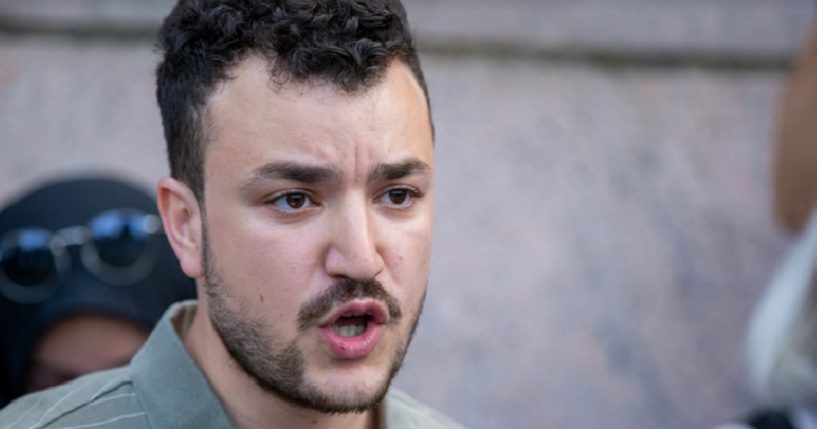
Palestinian activist Mahmoud Khalil is pictured during an April protest at Columbia University campus in New York. (Ted Shaffrey / AP)
Mahmoud Khalil, a Palestinian activist and former Columbia University graduate student detained by immigration authorities over the weekend, appears to have violated explicit federal immigration laws.
Immigration and Customs Enforcement agents arrested Khalil, a permanent resident with a green card, on Saturday.
The agents originally told Khalil his student visa was being revoked, according to The Associated Press, which quoted Khalil’s attorney, Amy Greer.
Greer told the AP she spoke on the phone with the agents during the arrest and said her client had a green card. The agent then told her the green card was being revoked instead, Greer said, according to the AP.
On Sunday, in a post on the social media platform X, Secretary of State Marco Rubio announced that the federal government will be “revoking the visas and/or green cards of Hamas supporters in America so they can be deported.”
A spokeswoman for the Department of Homeland Security said Khalil was arrested “in support of President Trump’s executive orders prohibiting anti-Semitism” because he “led activities aligned to Hamas, a designated terrorist organization,” according to the AP.
On Monday, however, a federal judge in New York blocked Khalil’s deportation. Judge Jesse M. Furman said that Khalil must remain in the United States “to preserve the court’s jurisdiction” as the court considers his case, according to NBC News.
A hearing for the case is scheduled in federal court for Wednesday.
Other protesters have assembled in New York City to demand the release of Khalil.
Completing this poll entitles you to The Western Journal news updates free of charge via email. You may opt out at anytime. You also agree to our Privacy Policy and Terms of Use.
Pennsylvania Democratic U.S. Rep. Summer Lee also came to his defense, asserting on social media that “Mahmoud Khalil should be at home with his 8-month pregnant wife.”
But it appears that federal law is rather clear about support of a terrorist organization serving as grounds for removal from the country — and that is likely worse news for Khalil.
When discussing “inadmissible aliens,” the law specifically includes any foreigner who “endorses or espouses terrorist activity or persuades others to endorse or espouse terrorist activity or support a terrorist organization.”
The U.S. government has designated Hamas as a “foreign terrorist organization” for nearly 30 years, according to a webpage from the Office of the Director of National Intelligence.
The group uses a variety of weaponry to “to advance attacks against Israeli military forces and civilians.”
Hamas also “engages in cyber espionage, computer network exploitation, and kidnapping operations.”
No matter how much leftist protesters and lawmakers may complain, Khalil does not belong in the United States if he is going to align himself with terrorist organizations.
For non-citizens, being in the United States is a privilege, not a right.
Wasting the incredible opportunity of attending an Ivy League school and building a better life after graduation is incredibly foolish.
The last thing the United States needs is the importation and continued presence of foreigners trying to drag us into their conflicts.
This deportation should send a crystal clear message to the rest of the country that coming here for such activities, especially in support of clearly designated terrorist organizations, is not allowed.
The filmmaker from Flint was once the enemy of CEOs, but now he sings their praises in pursuit of his progressive goals
March 10, 2025
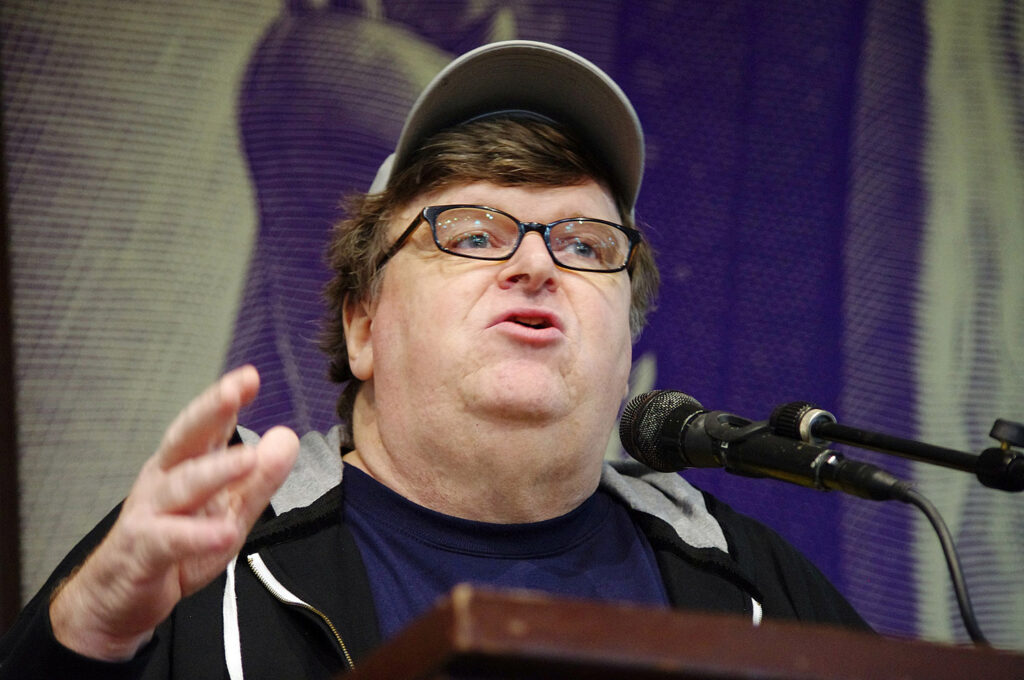
Michael Moore annoys me. Not so much because of his tired, old progressive political beliefs stuck in the 1980s, but because his sardonic persona so often turns to serious moralizing.
This inconsistency in Moore was recently on display as he ruffled feathers on the immigration issue on his Substack. Moore never seems to let truth—nevermind ideological principle—guide his hand, preferring to chase the “current thing” that captures his progressive audience.
Moore argues for unfettered illegal immigration in his recent piece, “Our Muslim Boy Wonder.” It’s festooned with accusations of racism by Trump’s “MAGA-nation,” but the piece is a gushing love letter to Steve Jobs—extolling the virtues of a multicultural nation that allowed an obscure Muslim from Syria to meet a Wisconsin farm girl and have a child that would become the billionaire founder of Apple.
It’s a little weird for a guy who built a career out of mocking millionaire and billionaire leaders of industry for mistreating workers to wax poetic for possibly the most famous tech industrialist of all time with a professional (and personal) history of treating people like absolute shit.
Hypocrisy is literally the code of the road for public figures of all stripes. Nobody cares. But for a documentary filmmaker, authenticity should be the standard by which he is judged, and Moore’s hypocrisy flows like a river.
Moore has been influential as a public figure, promoting a working-class populist brand of progressive politics as far back as I can remember. Hard to believe he’s been at this game for almost 50 years, but half-assed internet history indicates Moore landed on the scene in late 1970s and really got cooking as a journalist in the early 1980s.
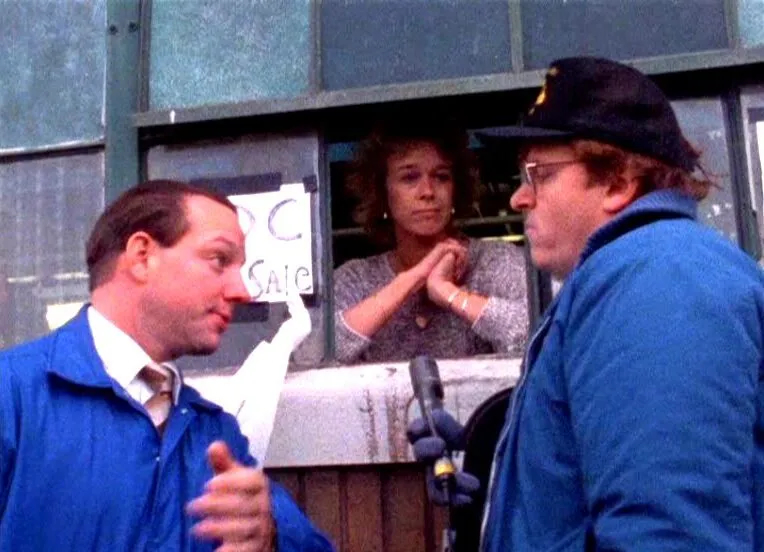
His film “Roger & Me,” filmed between 1987 and 1988, detailed the shuttering of General Motors plants in Flint and was probably the first documentary to hit the American mainstream in the late 1980s. It made him a pseudo-star. In Michigan, the film was a phenomenon embraced by the deep-blue union workers in the UAW and the building trades. To them, it felt like a love letter.
If it is, he’s the recipient. Moore is a narcissist. He spends the bulk of the film chasing Roger Smith, the chairman of General Motors, with considerable comedic flare. Smith is largely forgotten today but was one of the most powerful men in America at the time. Moore offers respite from his chase by intercutting the film with vignettes of Flint residents. In these scenes, his angle becomes dark.
Moore seems intent on depicting the most cartoonish and bizarre people as normal everyday residents of Flint, telling the rest of the nation that Michiganders are mentally unstable rubes. Even worse, Moore chooses the class-warfare angle by seeking out country club types and entrapping them into brief statements of detached and emotionless sympathy. The film is a personal vendetta against the free market, and downtrodden Flint residents are merely the hammer he uses to smash it.
To be fair, Moore offers one moment of realism. The only Flint resident depicted with any depth is a brief interview with a former GM employee, a personal friend of Moore’s. He introduces him as such and has him detail the day he was laid off and drove home listening to the Beach Boys’ “Wouldn’t it be Nice,” while suffering a nervous breakdown. But this one emotional moment is ripped away from the viewer, as Moore returns us to his cat-and-mouse chase after Smith.
Moore also makes some odd politically motivated omissions.
A well-known Democrat and prominent leftist, it’s not all that surprising that he fails to mention that Flint was, and had been for well over a decade prior to the film, a Democrat-run city, inside a state with a Democrat power column led by Gov. James Blanchard. These were all pro-union forces presiding over a state and city in steady decline.
It all makes sense in hindsight. Why would Moore depict failing politicians with whom he is ideologically aligned when he can take aim at big business and easily lay all the blame on a single person? It’s an easier film to make and a better enemy for his audience. But is it honest?
Interestingly, “Roger & Me” was not well received by Flint Democrats, specifically the young mayor, Matthew Collier, who lamented the film. In a 2014 interview, Collier criticized the film for being unfair to Flint, depicting untrue events such as rising crime and unemployment—which he said were actually going down at the time it was filmed—and the destruction of Fisher 1 GM Body Plant (which was actually being renovated and repurposed as a tech center). He argued the film did more harm than good, demoralizing and crippling the city.
Moore has revisited Michigan in his subsequent films, always with a taste for mocking the state and its inhabitants. His 2002 film, “Bowling for Columbine,” made in response to the 1999 Columbine High School shooting in Littleton, Colorado, was another platform for him to take aim at his home state. In the film, Moore blames the tragedy on gun culture, which he links to the state of Michigan in nefarious tropes that suggest connections to the Michigan Militia by interviewing James Nichols, the brother of Terry Nichols and friend to Timothy McVeighl, co-conspirators behind the 1995 Oklahoma City Bombing and early members of the militia.
To prove this, he makes a visit to North Country Bank in Traverse City, with camera crew in tow. Moore claims this bank gives a free rifle to anyone who opens an account, and he depicts this by seemingly opening an account for which he receives a long-barreled shotgun from the bank manager. The farce depicts Michigan as a bizarre land of freakish rubes.
But hold on a minute, Moore again omits key facts. Yes, it’s true that North Country Bank (at that time) was offering a free gun to anyone opening an account. But the account had to be a credit deposit of several thousands of dollars. The gun promotion was done with the intent of enticing wealthy out-of-state game hunters to choose Michigan as their hunting vacation destination.
The average person opening an account at North Country with a couple hundred dollars and a driver’s license was not handed a gun, but that didn’t serve Moore’s ideological interests.
Perhaps there really are two Michael Moores. Moore 1.0 was hamfisted progressive populist filmmaker of yesteryear, intent on chasing and harassing rich corporate titans. Moore 2.0 is an affluent wine-track limousine liberal praising the very first Tech-bro billionaire.
Did Michael Moore ease his fiery class warfare radicalism or did the progressive movement he clings to shift from the vanguard of the “Little Man” to the elite defenders of corporate America?
Perhaps Moore never changed. Perhaps his incessant, thinly veiled ridiculing of working-class Michigan residents is the real Michael Moore after all.
Money Trails and Backgrounds of 10 Democrat-Appointed Judges Blocking Trump Policies
Federal judges ruling against President Donald Trump’s recent executive actions have been almost entirely appointees of his two Democrat predecessors.
Some were previously activists, others were steeped in Democrat politics, and one is a former clerk for then-Judge Sonia Sotomayor. These judges have issued rulings to block Trump’s policies on immigration, federal spending, the Department of Government Efficiency, and other matters.
Plaintiffs have been “forum shopping” to attain more favorable rulings, said Curt Levey, president of the Committee for Justice. Forum shopping means they search for specific parts of the country where judges are more likely to be liberal and sympathetic to their case.
“They are trying to flood the zone and make it hard for the Trump administration to pursue its agenda,” Levey told The Daily Signal. “They are likely to win at the district level. And liberal districts are often in liberal circuits. So, in some cases, they can win at the circuit level and give the appearance that the Trump administration is under siege. Another advantage to flooding the zone is that the Supreme Court is limited. It only hears about 75 cases per year.”
Some of the judges ruling against Trump include:
A one-time major Democrat donor, U.S. District Judge John McConnell Jr. of Rhode Island, recently sided with a group of Democrat state attorneys general in a lawsuit to block Trump’s attempted funding freeze for numerous federal grants to nongovernmental organizations.
From 2000 until when President Barack Obama nominated him to the federal bench in 2010, McConnell contributed about $60,000 to Democrat candidates. The U.S. Chamber of Commerce opposed his nomination, noting his long career as a lawyer who sued over lead paint and tobacco, Forbes reported.
Notably, the judge previously rejected a lawsuit to remove candidate Trump from Rhode Island’s 2024 ballot.
In a separate case targeting the order on the funding freeze, U.S. District Judge Loren AliKhan of the District of Columbia, an appointee of President Joe Biden, imposed a restraining order on the freeze. AliKhan was previously on the District of Columbia Court of Appeals and the D.C. solicitor general.
U.S. District Judge Amir Ali of the District of Columbia, a Biden appointee, enforced a restraining order to prevent the spending freeze on foreign aid disbursed by the State Department and the U.S. Agency for International Development. In 2020, Ali contributed $1,500 to Biden’s presidential campaign, according to OpenSecrets.org. He also made modest contributions to numerous other Democrat candidates.
Before his nomination, Ali was the executive director of the MacArthur Justice Center, an organization initially founded to oppose the death penalty but that has since expanded to other criminal justice issues.
U.S. District Judge Theodore Chuang of the District of Maryland, an Obama appointee, blocked the Trump administration from conducting immigration raids and arrests at certain houses of worship.
During much of Obama’s time in office, Chuang was the deputy general counsel for the Department of Homeland Security. Before that, from 2007 to 2009, he was the deputy chief investigative counsel for the Democrat majority on the House Committee on Oversight and Government Reform. He was also a past contributor to several Democrat candidates, including giving $750 to Obama’s 2008 campaign and $1,250 to the 2004 presidential bid of Democrat John Kerry.
U.S. District Judge Jeannette Vargas of the Southern District of New York recently halted DOGE’s access to Department of Treasury records.
Biden nominated Vargas, a former New York federal prosecutor, last year. Vargas contributed $2,000 to Biden’s 2020 campaign, and before that, gave $750 to Democrat Hillary Clinton’s 2016 campaign. Before working in the Justice Department, Vargas clerked for then-U.S. 2nd Circuit Appeals Court Judge Sotomayor from 2001 to 2002.
U.S. District Judge Jamal Whitehead of the Western District of Washington state blocked Trump’s executive order suspending refugee admissions. Biden nominated Whitehead in 2023. During the Obama administration, Whitehead was the senior trial attorney at the Equal Employment Opportunity Commission.
U.S. District Judge Deborah Boardman of the District of Maryland sided with the American Federation of Teachers, a union, to block DOGE from accessing information from the Office of Personnel Management and the Department of Education regarding student loans.
Biden nominated Boardman, a former federal public defender, in 2021. She has been a moderate donor to numerous Democrat campaigns, including giving $500 to Obama’s 2008 campaign and $500 to Clinton in the same campaign cycle.
U.S. District Judge Lauren King of the Western District of Washington, a Biden appointee, temporarily blocked the Trump administration’s restrictions on federal funding for “sex change” treatments for minors.
U.S. District Judge George O’Toole of the District of Massachusetts, an appointee of President Bill Clinton, issued a similar ruling to block the Trump administration’s restriction on sex change funding. He was recommended for the seat by then-Sen. Ted Kennedy, D-Mass.
U.S. District Judge Adam Abelson of Maryland, Biden appointee, blocked Trump’s executive order ending federal support of “diversity, equity, and inclusion” programs, or DEI. A very modest donor to Democrat candidates, he was previously a magistrate judge and in private practice in Maryland.
Some notable exceptions to the Democrat-appointed judges handing Trump court losses: There have been at least four court rulings on Trump’s order scrapping birthright citizenship, with two of those rulings coming from Republican appointees—Judges John Coughenour of Washington state and Joseph Laplante of New Hampshire. They were nominated by Presidents Ronald Reagan and George W. Bush, respectively.
An order signed by President Trump on Tuesday signals a new front in fighting lawfare operatives in the private sector.
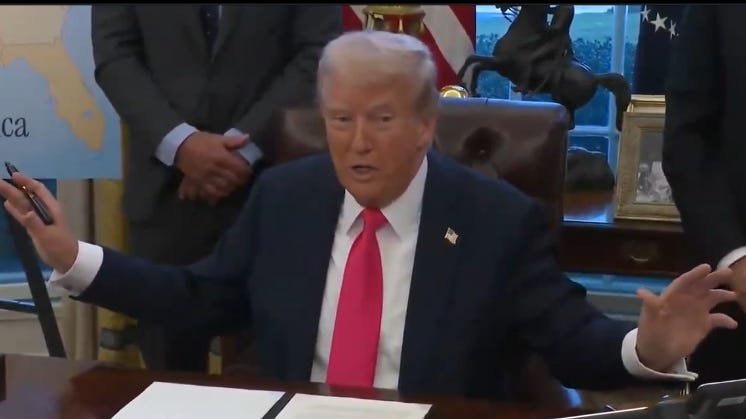
As an aide started to explain the latest order about to be signed during a press conference in the White House on Tuesday afternoon, President Trump interrupted his spiel.
“Hold it, this is a good one,” the president, holding up his hand, said to several reporters assembled in the Oval Office. “Is everybody listening? We’re going to call it the ‘Deranged Jack Smith’…bill.”
The order, in the form of a memo to several agency heads, suspended the security clearance of employees at Covington & Burling, a Democratic-connected white-shoe law firm headquartered in Washington. According to a January 27 Wall Street Journalarticle–and followed up by Politico–the firm provided at least $140,000 in pro bono services to disgraced former special counsel Jack Smith.
Although both cases ended after Trump’s election, Smith’s problems were just beginning. Trump had promised on the campaign trail that his administration would investigate evidence of abuse and misconduct by the special counsel and his team. He fulfilled that promise by signing an executive order on January 20 to end the “weaponization” of the federal government, particularly the DOJ and intelligence community: “The prior administration and allies throughout the country engaged in an unprecedented, third-world weaponization of prosecutorial power to upend the democratic process. These actions appear oriented more toward inflicting political pain than toward pursuing actual justice or legitimate governmental objectives.”
In a follow-up move, Attorney General Pam Bondi formed a “Weaponization Working Group” on Feb. 5 and specifically cited Smith, “who spent more than $50 million targeting President Trump.”
Smith officially left the Biden DOJ on January 10 but not before succeeding in releasing one volume of his two-volume report into the investigations of the president. And in the “quit digging a hole” category, Smith recently signed an open letter to current prosecutors expressing “alarm…by recent actions of the Department’s leadership.”
With Free Friends Like This…
Trump, along with his DOJ, likely will have the last laugh. And it’s doubtful Smith’s free lawyers at Covington & Burling, with offices around the world, are amused. While it’s unclear how many security clearances have been suspended, it appears two lawyers—Peter Koski and Clinton pal Lanny Breuer—were directly involved in providing free counsel to Smith. Koski worked at the DOJ’s public integrity unit during the same time Smith headed the unit during the Obama administration. Other notable Democrats at the firm include former Attorney General Eric Holder, Biden’s longtime foreign affairs advisor and Ukraine war architect Victoria Nuland, and Biden’s former White House counsel Dana Remus.
The presidential directive may have an immediate impact on Smith’s ability to build a defense, particularly for Koski. “Revoking [Koski’s] clearance could limit his access to sensitive government records, given that both of Mr. Smith’s criminal investigations against Mr. Trump involved classified documents. Doing so could sharply limit what representation Mr. Koski might be able to offer,” the New York Timesreported on Feb 25.
But Trump’s “Deranged Jack Smith” order goes beyond suspending access to privileged material. The president further ordered federal agencies to look for any government contracts with Covington & Burling. “I also direct the Attorney General and heads of agencies to take such actions as are necessary to terminate any engagement of Covington & Burling LLP by any agency to the maximum extent permitted by law,” the president wrote.
It’s unknown how many, if any, government contracts exist with the firm. Possibly none. But the missive is yet another welcome sign of the so-called “Trump 2.0” administration, where heads will roll inside and outside government not just for viciously targeting the president and his supporters but for misleading the American people and wasting time and money in the process. To wit, the president indicated this is just the start.
After signing the order, the president turned to his aide and asked, “we’ll be doing this for other firms as time goes by?” The aide answered in the affirmative. After adding his signature, Trump threw his Sharpie to someone in the office. “Why don’t you send it to Jack Smith,” he joked.
Prestigious law firms act as both the hidden hammer and revolving door in the lawfare against Republicans. This is playing out in at least a dozen lawsuits filed against the Trump administration over the past 30 days. Until there is pain felt by both public and private lawyers responsible for this unprecedented attack against the will of the people, it will continue.
The NAACP will present its prestigious Chairman’s Award to former Vice President Kamala Harris at the upcoming NAACP Image Awards on February 22. This honor is supposedly reserved for individuals who “excel in public service” and “leverage their platforms to ignite and drive meaningful change.”
Now, let’s be clear—this is hardly surprising. The NAACP has long functioned as an extension of the Democratic Party, handing out accolades to left-wing politicians while ignoring Black Americans who don’t subscribe to their political agenda.
Case in point: this award has gone to Barack Obama, Al Gore, John Lewis, Bennie Thompson, and Maxine Waters, but never to Clarence Thomas or Thomas Sowell—two of the most accomplished Black Americans in modern history. Apparently, their contributions to public service don’t count because they don’t toe the party line.
The announcement was filled with the usual over-the-top praise. According to NAACP Board Chairman Leon W. Russell, Harris is not just a leader but a “force of change” driven by “an unwavering passion to shape a brighter, more equitable future.”
Meanwhile, NAACP President Derrick Johnson declared that Harris “embodies the power, grace, and unyielding courage that Black women have long brought to the heart of the United States.” And, of course, the president of BET Media Group, Scott Mills, added that her “unwavering commitment to justice, equity, and progress has inspired millions.”
But here’s the real question: what exactly has Kamala Harris done to deserve this award? What policies has she spearheaded that have tangibly improved the lives of Black Americans?
Under the Biden-Harris administration, inflation has hammered working-class families, crime has skyrocketed in major cities, and border security has become an absolute disaster—despite Harris supposedly being the “border czar.” Yet, in the world of the NAACP, simply existing as a Black liberal politician seems to be enough to earn a trophy.
The pattern here is undeniable. If you’re a Black American who aligns with the left, you’re a “beacon of hope.”
If you’re a Black American who dares to think independently—like Clarence Thomas, who sits on the highest court in the land, or Thomas Sowell, one of the greatest economic minds of our time—you’re ignored. The NAACP isn’t about civil rights anymore; it’s about maintaining a political monopoly.
The case of alleged murderer Luigi Mangione has peeled back yet another layer of moral rot infecting certain corners of the modern left. Here we have a privileged 26-year-old from a wealthy Maryland family, a University of Pennsylvania graduate, who—according to police and clear-as-day video evidence—gunned down UnitedHealthcare CEO Brian Thompson in the streets of New York City last December. A father. A husband. A man Mangione had no personal connection to.
And yet, in a disturbing reflection of the times, this brutal act has been met with a grotesque level of sympathy from some, all because the killer supposedly had the “right” motivations. His actions, they argue, were a protest against the healthcare system and the insurance industry—never mind that what he actually did was shoot an unarmed man in the back.
CNN “reporter” KaitlanCollins promoted a fundraiser for Luigi Mangione. She has since deleted the public relations post for Luigi. pic.twitter.com/7ZI72b9Yfk
But that’s not stopping the apologists. And now, CNN’s Kaitlan Collins appears to have waded right into the mess, according to reports. The network’s chief White House correspondent reportedly posted a link to a website launched by Mangione’s defense team—before quietly deleting it after the backlash hit. Why? Because people noticed.
That link, by the way, was for a legal defense fund that has already raked in over $300,000 from Mangione’s supporters. That’s right—an Ivy League-educated killer from a wealthy family, who allegedly committed a public execution in cold blood, has managed to draw in six figures’ worth of donations.
Two things stand out here: First, Collins conveniently left out the fact that Mangione’s defense attorney is another CNN insider. Second, her original post is now mysteriously unavailable, as pointed out by journalist Stephen Miller. That deletion speaks volumes.
It’s worth asking: Was Collins just blindly sharing the link without thinking? Or was this yet another example of the increasingly common habit of framing violent criminals as misunderstood victims—so long as they fit the right ideological mold?
Wow. Usually when someone makes an error and deletes a tweet, they’ll say, “my bad” and explain they’ve removed a post.
Looks like @kaitlancollins thought no one would notice the Luigi Mangione boosting.
Oops.
This isn’t the first time a murderer has been repackaged into a “cause” rather than a criminal. But what’s particularly galling here is the sheer detachment from reality. Brian Thompson doesn’t get to have a defense fund. He doesn’t get to have a website where he can share his feelings. He doesn’t get to post his gratitude to supporters. He was executed.
And yet, Mangione, a man who had every advantage in life, is now being treated like some kind of folk hero by certain circles.
Collins’ actions, whether intentional or just wildly careless, raise real questions. Is this just another example of mainstream media figures being unable to resist the impulse to glorify criminals if they fit a certain narrative? Or was this simply a case of poor judgment and a scramble to backtrack once the backlash hit? Either way, it’s not a good look.
I am expert in influenza, and have consulted with the WHO over the past two decades on the topic of flu vaccines. This is one subject matter I am extremely knowledgeable about. This goes back to my medical school days, when I worked with Robert Lamb, one of the top influenza virus specialists in the world. It extended through much of my career, including my serving as Director of Clinical Influenza Vaccine Research for Solvay Biologicals, in which I oversaw over $200 million in federal (BARDA) alternative (cell-based) influenza vaccine research funding.
What is happening now with “Bird flu” is another psyops campaign being conducted by the administrative/deep state, apparently in partnership with Pharma, against the American people. They know and we know that the “vaccines” being produced will be somewhat ineffective, as all flu “vaccines” are. The government is chasing a rapidly evolving RNA virus with a syringe, just like they did with HIV and Covid-19.
Generally, the currently circulating avian influenza strain in the US does not include any cases of human-to-human transmission. And the current mortality, with over 60 cases identified, is 0%. NOT 50%.
All the while they are getting prepared to roll out masks, lockdowns, quarantines, etc.
All the while getting ready to roll out mRNA vaccines for poultry and livestock, as well as for all of us.
The more they test, the more “Bird flu” (H5N1) they will find. This “pandemic” is nothing more than an artifact of their newly developed protocols to test cattle, poultry, pets, people, and wildlife on a massive scale for avian influenza. In years past, this was not even considered. In the past, the USG did fund a massive testing and surveillance program called “Biowatch.” That program was a colossal failure and a massive waste of money. Billions of dollars.
Of course, these facilities producing the tests have been repurposed from the Covid-19 testing facilities.
Key questions include:
Will we all comply?
Will we be forced to comply?
Will President Trump go along with the PsyWar/psyops campaign again?
We will know soon enough.
As the United States is testing everyone who has even the mildest symptoms for the H5N1 (avian) influenza, guess what – they are finding it! This is what we call in the lab, a “sampling bias.”
Globally, from 1997 until the present, there have been 907 reported cases of H5N1. And in fact, this particular outbreak was not the worst – and it is the only one where a massive testing campaign has occurred. It appears that this is partly due to the new diagnostic capabilities developed and deployed during Covid-19. The more you test, the more you find. But is it clinically significant?
The Case Study of Tetanus: Supply Chain Issues.
The CDC recommends a booster for the tetanus vaccine every 10 years for adults.
However, research published almost a decade ago suggests that the protection from tetanus and diphtheria vaccination lasts at least 30 years after completing the standard childhood vaccination series.
“We have always been told to get a tetanus shot every 10 years, but actually, there is very little data to prove or disprove that timeline. When we looked at the levels of immunity among 546 adults, we realized that antibody titers against tetanus and diphtheria lasted much longer then previously believed.”
-Mark K. Slifka, Ph.D, study author
This research, published in a highly reputable journal, suggests that a revised vaccination schedule with boosters occurring at ages 30 and 60 would be sufficient. As this was published in early 2016, the US government, at the very least, could have commissioned easily designed prospective and retrospective studies to confirm these results. And those results would have been published by now, with the tetanus adult schedule revised to reflect what is now known about the durable immunity of tetanus and diphtheria vaccines. Reducing the boosters to just two shots would save the government vast sums of money.
Not only that, but both the tetanus and diphtheria vaccines carry risks for adults. It is estimated that 50%–85% of patients experience injection site pain or tenderness, 25%–30% experience edema and erythema. Higher preexisting anti-tetanus antibody levels are also associated with a higher reactogenicity rate and greater severity (reference).
Anaphylaxis after tetanus vaccination represents a rare but potentially serious adverse event, with an incidence of 1.6 cases per million doses. That means if 100 million adults receive the booster every ten years, 320 cases of anaphylaxis will be avoided over the 30-year period – from those two boosters being eliminated. Tetanus has always been a “rare” disease, spread through a skin wound contaminated by Clostridium tetani bacteria, commonly found in soil, dust, and manure. Before vaccines were available, there were about 500 cases a year, with most resulting in death. Concerns about vaccine-associated adverse events when immunizations were performed at short intervals led to a revision of the tetanus/diphtheria vaccination schedule in 1966 to once every 10 years for patients >6 years of age.
It has recently come to my attention that the traditional stand-alone tetanus vaccine (TT) that one used to receive as an adult has been discontinued due to WHO recommendations. Their reasoning being:
Use of TTCV combinations with diphtheria toxoid are strongly encouraged and single-antigen vaccines should be discontinued whenever feasible to help maintain both high diphtheria and high tetanus immunity throughout the life course.
The CDC blames the shuttering of the only plant producing TT for the current lack of a stand-alone TT vaccine.
Now, in order to get a booster tetanus shot, an adult must take the following.
Td: Sanofi’s Tenivacprotects against tetanus and diphtheria. Given to people 7 years and older as a booster every 10 years. *A version also includes pertussis (eg DPT), but due to the risk of encephalitis, it is not recommended as a booster.
Why is the DPT combination vaccine discouraged in adults due to encephalitis risk, but is it recommended for children? Another one of those inconvenient issues that plague the CDC-recommended childhood vaccine schedule.
While supplies of diphtheria, tetanus, and pertussis (Tdap) vaccines (Sanofi’s Adacel and GSK’s Boostrix) aren’t limited, they are more expensive, and a very small fraction of patients can develop encephalopathy (brain damage) from the pertussis component.
In the United States, diphtheria is virtually non-existent, with only 14 cases reported between 1996 and 2018. Of those cases reported, most were from international travelers or immigrants.
The market for a stand-alone TT vaccine vanished worldwide due to WHO recommendations to stop the sales of the TT vaccine. Which was due to the relatively few, economically stressed countries where diphtheria is still an issue. So, therefore, the only facility manufacturing the TT vaccine was shut down within the last year.
The blowback from the WHO recommendations is that now there is a shortage of tetanus and diphtheria (Td) vaccine in the United States, according to the Centers for Disease Control and Prevention (CDC) website.
This all comes down to poor planning. And illustrates why supply chain issues and infectious disease countermeasure stockpiles are essential considerations for governments.
The good news is that unless one is immunosuppressed, most of us have almost lifelong immunity against tetanus and diphtheria.
My recommendation is that unless one gets a very deep and dirty puncture wound and has not had a tetanus shot in over ten years or longer, avoid that booster.
Here is the ugly secret about influenza vaccines. They are given to protect one group of vulnerable people. Those who are immunosuppressed, and that cohort includes the very elderly.
If those influenza vaccine manufacturing plants only make enough vaccines for those susceptible to a severe case of the flu, there would not be enough of a market to sustain their production costs. Furthermore, if there were a pandemic of some sort of highly pathogenic influenza, there would not be sufficient capacity to make enough vaccines to meet demand.
Egg-based influenza vaccine production requires super “clean” eggs; about 100 million “clean” fertilized eggs are needed annually for vaccine production in the US alone. Candidate vaccine viruses are injected into the eggs. If the process is shuttered, the whole production comes to a screeching halt. Many vaccines can be stored for long periods. Even as long as a decade. This stockpiling system works well for DNA viruses with a low mutation rate. Stockpiling is rarely a solution for vaccines developed for RNA viruses that mutate rapidly.
Therefore, the influenza vaccine is pushed on the American people year after year. As a way to maintain “warm base manufacturing” and ensure sufficient market size to support industrial operations.
I have spoken on this subject at the WHO and US government agencies, as well as many, many conferences. Unfortunately, because the mRNA and RNA vaccine platforms require a lot of freezer space (commonly -20°C) to stockpile for even short periods, this limits the ability to stockpile. Furthermore, the frozen storage requirements are only for up to 6 months. That means stockpiling for more extended storage is not currently done, and it is back to square one on the supply chain issue.
The issue with freezer space and mRNA vaccines is one that most likely won’t be solved. This benefits the manufacturers of this vaccine technology – the US government has an endless need for new vaccines as the old ones expire.
My small hope is that the mRNA platform will be too costly to justify its continued use, as appeals concerning safety (or lack of) seem to fall on deaf FDA ears.
In the meantime, don’t believe the hype generated by ex-officials from the Biden and Trump administrations.
Both Dr. Lena Wen, CNN correspondent, and Dr. Redfield, ex-director of the CDC, have gone on to mainstream media shows and promoted the narrative that the case fatality rate for avian influenza is over 50 percent. This, frankly, is a lie that the WHO is promoting. Bird flu generally is not tested for when someone has flu symptoms. When an outbreak of avian flu occurs on a poultry farm, testing of farm workers who are seriously ill will commence. This has led to the generation of the 890 case reports since 2003. Of those seriously ill patients reported to the WHO, over 50 percent died.
This is not an actual case fatality rate of avian flu around the world. It is, again, a sampling error due to a tiny data set derived from those who are at greatest risk due to general health. And just like the WHO reported on an exaggerated case fatality rate for mPOX, which was also based on a sampling error, or for Covid-19, again a sampling error, it is now used to justify psychological bioterrorism on the world population. Please don’t fall for it.
El Gato Malo on X succinctly points out that Dr. Leana Wen and her public health ilk are advancing:
1. Do more of the same lousy testing used in Covid-19 to overstate a disease and cause panic.
2. Develop another non-sterilizing non-vaccine that does not work to be pushed on “the vulnerable.”
3. Doing it “right now” under EUA, so whoever makes these tests and jabs can cash in and be shielded from liability.
4. Claiming that proxies like “triggers antibody production” demonstrate clinical clinical efficacy.
It’s just one last smash-and-grab for cash before the Brandon administration ends. Anyone who falls for this one will truly fall for anything.
Question: what are Leana’s conflicts of interest? Who is paying her or giving her grants?
For those that haven’t viewed Dr. Redfield speaking of the avian flu case fatality rate, have a watch below. It is genuinely shocking. This fear-mongering comes from an ex-director of the CDC. Shame on him.
Frankly, it reminds me of the 51 intelligence officials claiming that Hunter Biden’s laptop was fake.
One has to wonder what conflict of interest motivated him to say this on national TV?
Remember in the US, there have been 62 cases of avian influenza discovered, and all but one case were very mild.
This deep dive into the supply chain issues is meant to show that public health has put itself into a groupthink situation that it can’t escape.
Many solutions to this quandary do not involve an evermore expanding schedule of vaccinations, stockpiled for some future use. I have some general thoughts before I sign off.
The use of early treatments via safe, proven drugs is a good solution.
We now have many antibiotics to treat bacterial infections. Vaccines do not always need to be our first defense.
Our medical system is very good at treating infectious diseases. The risks from such diseases are much less than it once was. People do not have to live in fear of infectious disease. I like to ask people, how many people do you know have died of flu? If you know of any (I don’t), how old were they?
The need to scare people into more and more vaccines is a dangerous trend.
And yes, the more vaccinations one receives, the more likely an adverse event.
Vaccinating pregnant women and babies should always be a last resort.
It is time for Congress to rethink the vaccine liability laws.
America’s promise of accountability, once the clarion call of our Founding Fathers, now finds itself muffled beneath a wall of excessive secrecy. The so-called fourth branch of government—the unelected bureaucratic state—has weaponized overclassification to limit transparency and accountability. Also called the Deep State, these entrenched bureaucrats use secrecy to enshrine their power, preventing congressional oversight and even hindering a sitting president from implementing meaningful reforms. The byzantine rules and regulations cloaked in classified information make it nearly impossible for the president, his administration or journalists to understand what is really happening within the federal agencies. The recent case of USAID blocking the Trump administration‘s Department of Government Efficiency (DOGE) from auditing its humanitarian aid programs is just the latest example of how secrecy is wielded to protect the bureaucratic class from accountability. If Trump is to dismantle the Deep State, he must first break its stranglehold on classified information.
The Bureaucratic Black Hole of Classification
The march toward unchecked classification is neither recent nor accidental. From the modest safeguards envisioned by our early republic to the expansive, often nebulous standards codified in Obama’s Executive Order 13526, the Deep State has systematically entrenched secrecy as a mechanism of self-preservation. The Brennan Center for Justice’s estimate—that up to 90 percent of classified documents could be safely disclosed—should alarm every citizen who cherishes a government that is answerable to its people. When transparency is sacrificed on the altar of “sensitive information,” the democratic process is undermined; accountability is traded for convenience.
Historical Parallels
Alexander Hamilton, in Federalist No. 84, warned against a government that operated behind closed doors, recognizing that secrecy was the lifeblood of tyranny. The modern overclassification problem mirrors the suppression of the Pentagon Papers, where government officials classified documents not to protect national security, but to hide the failures of the Vietnam War. The same tactics persist today, as bureaucrats wield secrecy like a shield, deflecting public oversight and preserving their power.
Consider the curious case of USAID, an agency whose humanitarian mission is paradoxically shrouded in the same secrecy reserved for covert operations. During Trump’s first term, senior USAID security officials obstructed his team’s efforts to audit the agency. Initially, Trump did not fully grasp the extent of this obstruction; now, armed with experience and his DOGE team, he is confronting and dismantling these overclassification schemes. When USAID officials blocked his DOGE team this time around, they were placed on leave—a move that allowed the audit to commence. The scandal surrounding USAID thus reveals that excessive secrecy serves not to protect national security but to stifle meaningful reform and insulate power from both the executive and legislative branches.
When Secrecy Kills
The implications of overclassification extend well beyond mere opacity. The tragic lessons of September 11, as chronicled in the eponymous Commission Report, illustrate that the labyrinthine nature of modern classification hindered the timely sharing of crucial intelligence—a failure that contributed to one of the gravest security breaches in American history. The same dynamic played out during the COVID-19 pandemic when essential information on the virus’ origins and early spread was locked behind classified barriers, leaving the public and policymakers scrambling in the dark. Today, as agencies continue to guard their files with a zeal that borders on paranoia, the resulting fragmentation and internal rivalry sap our collective national defense. When agencies operate in silos, a fragmented picture of potential threats emerges, weakening the nation’s ability to preempt danger.
The Hidden Cost of Secrecy
Financially, the hidden costs are staggering. Taxpayers shoulder an $18 billion annual burden to sustain these classified systems—a sum that could instead fortify more productive public endeavors. Meanwhile, scholars, journalists and even elected officials are forced to navigate an overgrown thicket of red tape in pursuit of records that, by all rights, should be part of the public domain. The Public Interest Declassification Board’s stark characterization of our system as “outmoded, unsustainable, and fundamentally at odds with the principles of a free society” is not hyperbole; it is an urgent diagnosis of a bureaucratic malaise that must be cured.
Trump’s War on the Classification Cartel
President Trump, now in his second term, has a unique opportunity to dismantle this excessive secrecy. Unlike his predecessors, he has no allegiance to the entrenched bureaucratic class that thrives on classification as a means of self-preservation. With Elon Musk leading the newly established Department of Government Efficiency (DOGE), a sweeping overhaul of declassification is within reach. This effort should include:
Mandatory Declassification Reviews: All classified materials older than 15 years should be automatically reviewed for declassification, with only the most sensitive exceptions allowed.
Severe Penalties for Overclassification: Bureaucrats who misuse classification to conceal incompetence or wrongdoing should face strict penalties, including termination.
Protection for Whistleblowers: Those who expose abusive classification practices should be shielded from retaliation and offered legal avenues for challenging improper secrecy.
Public Access Portals: A streamlined system should be implemented to allow journalists and citizens to request declassification more efficiently, modeled after the Freedom of Information Act but with fewer loopholes.
By dismantling the excessive secrecy that has long shrouded the inner workings of government, we can reestablish a system where transparency and accountability are not sacrificed at the altar of expedience. Reagan famously declared, “Trust, but verify.” Yet modern bureaucrats have rewritten that to read, “Trust us, and don’t ask questions.” George Orwell’s 1984 warned of an all-powerful government that buries inconvenient truths; we are perilously close to living out that warning.
Jefferson warned that government without oversight becomes despotic; Reagan championed the notion that the more a government controls information, the less it serves its people. The Deep State’s unchecked power, fortified by overclassification, has allowed it to operate as an unelected fourth branch of government, immune to both congressional oversight and executive authority.
If Trump is to truly gut the Deep State, he must first dismantle its classification fortress. A government that dares to reveal its operations is a government that earns the trust of its citizens, ensuring that power remains checked and that democratic ideals are not consigned to the shadows. The path forward is clear: restore openness, rein in bureaucratic discretion and renew the covenant between the state and the governed.
Forget about why we Americans are armed for a moment. Don’t give any thought to the reasoning of the Founding Fathers and what they were doing when they drafted, then passed, the Second Amendment. Disregard the court cases, arguments, myths and fears — push all that aside. You care about these, sure, and see it as essential. You latch your Second Amendment hopes on those sorts of things. But surprise — none of that matters. It simply doesn’t matter to society’s adversaries — criminals who arm themselves.
They Walk Among Us
It’s already well-established gun control doesn’t work. Criminals the world over are already armed. The cause? It’s because the Chinese invented gunpowder in the 9th century. Add centuries of human ingenuity and here we are. The Founders are in no way responsible for armed villains around the world and they’re certainly not responsible for it here. The criminals are responsible solely and completely. They choose and acquire weapons then stand outside of control. If gunpowder ceased to exist villains would remain. They would switch to edged weapons or clubs. It’s not the guns.
We have criminals on some streets (but not all); they’re in our schools; they run black ops to provide drugs, sex and anything else a demanding public wants that government forbids. A lapel pin famously says, “Disarm Criminals First.” But evidence shows this doesn’t work. Splashy public efforts to disarm affect only the good guys, the innocent, the protectors of peace, safety, law, order — essentially you and me. The pretzel gun in front of the U.N. isn’t a statement against the armed thugs and tyrants running that place. It’s aimed at innocent civilians, us.
Just for the record, the endless delightful global world peace the pretzel-gun worshippers seek is of course utopian. It exists nowhere. While the human condition contains what I call the Four Horsemen of Human Havoc — angry, hungry, stupid and wicked — we are doomed to a turbulent world. Your options are limited, but you do have some. Hungry we might be able to solve, angry only in your dreams with endless psychiatry and soma in the water. But stupid and especially wicked, are part and parcel of this existence. This begins to answer the question I posed when we started. It’s about the villains.
It Ain’t The Crime …
Many gun enthusiasts and Second Amendment supporters make the mistaken assumption we are armed to protect ourselves from them … “the criminal element.” While true, it’s short-sighted and incomplete. Washington, Jefferson, Franklin, Madison and the rest were well aware of the self-defense values of firearms. They faced dangers in a new land, wild animals on four and two legs, criminal activity in a largely lawless land, often with too much distance between them to simply call for help. Self-reliance and independence required the ability to police your own surroundings. It was simply understood. That right and reality of self-defense harkens all the way back to the Bible. But self-defense was not the main driver of their desire for an armed public.
The fundamental reason the Founders wanted us armed is for balance of power. Self-governance had never been tried. Worldwide, rulers were armed. In classic time-honored style, they use that capability, that monopoly of force, against the people they supposedly serve. Power corrupts — and possession of power frees those with it to act as they please — a two-way street! By spreading power around, freeing everyone, we achieved a level of liberty unimagined.
Democidal Tendencies
If you’re reading this, you likely know genocides of the past were preceded by disarmament campaigns, orchestrated by “officials,” who then go on to commit atrocities and democide once the population is de-fanged. Democide — murder by government — claims the very top mass-murder statistic. Street thugs and police don’t hold a candle. Last century it cost 262 million lives by the best estimates available (U.S. historian Rudolph Rummel). The slaughtered were generally defenseless. That right there is why we’re armed. And that right there is why America is and remains the land of the free: because we’re armed. Thoughts of messing with us gives villains pause.
Now this isn’t to say even this system is perfect, far from it, and we all know it. While anti-rights monsters will insist our unique right to arms — exceedingly well-implemented — has something to do with the fact criminals exist, we know better. Malfeasants are active and sometimes horrific but being armed and being evil are unrelated concepts. America’s 100 million gun owners basically never shoot anything but targets and food. The anti-rights bigots may holler guns kill people. We know guns protect people. Guns are good. If guns disappeared, we would have to re-invent them.
Guns keep the peace. Action-at-a-distance from a firearm far exceeds the value of a broadsword. Sam Colt’s great equalizer works on the person-to-person scale, and writ large, against the entire artifice of civilization. Villains will conduct their villainy. Accept it. Guns, and people who bear them righteously, watch over and protect all of us. And that’s why we’re armed.








 fox files
Recent Comments