The Truth Is Out There


You may have heard that as of yesterday, it’s been decided that beginning in 2026 all cars sold in the United States will be equipped with a “kill switch,” whereby the car can be disabled remotely if it is determined that you are driving poorly.

Rep. Thomas Massie sought to defund this provision of the Infrastructure Investment and Jobs Act, a bill of over 1000 pages. His amendment was defeated.

But I want you to see the differences in how he argues from the distorted Democrat points of views. You’ll IMMEDIATELY see it!

First Massie:

My amendment is simple. It will defund the federal mandate that requires all new vehicles after 2026 be equipped with a kill switch that can disable a vehicle if the vehicle has monitored the user’s driving performance, and that the vehicle determines that the driver is not performing well.

It’s so incredible that I have to offer this amendment. It almost sounds like the domain of science fiction, dystopian science fiction, that the federal government would put a kill switch in vehicles that would be the judge, jury and executioner on such a fundamental warrant as the right to freely travel. But here we are. It is federal law that this is mandated. And so I am offering this amendment to defund this mandate.

Then Rep. Debbie Wasserman-Schultz (D-FL) delivers her response:

I rise in opposition to this amendment. Let me be clear. This act that the gentleman is trying to defund does not require auto manufacturers to install kill switches. It does not do that. Passive drunk driving technology is a vital tool in safeguarding our loved ones and other innocent people on our roads. This new technology offers a lifeline of hope to not only save lives, but to prevent the lifelong emotional toll and gargantuan costs these accidents inflict on families. Deadly drunk driving accidents can echo across generations, but we can seize this opportunity to stop such tragedies.

Between 2019 and 2021, Florida saw a 31% increase in drunk driving crashes in Mr. Massie’s home state of Kentucky, 190 people were killed in drunk driving crashes in 2021 alone. That was a 26% increase. When we saw these grim statistics, we acted in a bipartisan fashion in Congress. And how often do we see that both Republicans and Democrats supported the Halt act to require auto manufacturers to make this passive technology standard in new vehicles?

The sponsor of this misguided amendment will tell you that he worries about privacy concerns. We heard the same inane calls with seatbelt requirements. But you don’t have a right to engage in potentially fatal behavior that we know poses a major health threat to public safety. Passive drunk driving technology is pro-police. This anti-drunk driving technology lightens the load on police officers, allowing them to focus on more pressing safety concerns. The importance of this technology goes far beyond statistics. It’s about saving lives, preventing heartbreak and making our roads safer. It’s a passionate call to action to prevent alcohol-impaired driving from shattering the lives of those we hold dear.

This amendment, I understand, was dubbed the kill switch amendment and it does not require a kill switch. It simply
requires passive technology to help us prevent drunk driving. In the name of the 406 people who were killed by a drunk driver in my own state of Florida last year alone, I urge my colleagues to vote no on this amendment. Let’s take steps to reduce deaths due to drunk driving and not increase them.

Now here’s Massie again:

Drunk driving is a serious problem. That’s why 31 states already have laws to implement interlock ignition technology, where if you’ve been convicted of a DUI, you have to pass this test in order to operate your vehicle. But this federal law that I seek to defund goes far beyond that. And I regret that I even have to spend some of my time reading this law to the other side of the aisle. But I will do that.

This law that was passed in a thousand-page bill two years ago requires that auto tmobiles can passively monitor the performance of a driver, not the blood alcohol content, but the performance of a driver in the operation of a motor vehicle that would accurately identify whether that driver may be impaired and not drunk. It says 
impaired, and to prevent or limit motor vehicle operation. That’s a kill switch.

Now the question is, how much time do you have once your dashboard tells you that it doesn’t approve of your driving? What if you’re a single mother and you’re out on a in bad weather and you’re trying to avoid some obstacles? Ice perhaps. And you’ve swerved three times and your dashboard says: swerve one more time and you’re going to be forced over to the side of the road, that you’ll have 100 yards to park this vehicle in the middle of nowhere and with your children in the back seat.

This isn’t some fantastical scenario. This is what will happen if this is implemented.

And this is the law. I have read it to you here. Now, you maybe all should have read it two years ago when you all voted for it on that side of the aisle, but it was in a bill that was 1039 pages long and s
o I can understand how you don’t know what the law has in it because it was never read in its entirety . But I’ve read the applicable parts to you here and now.

Rep. Janice Schakowsky (D-IL) then speaks, evidently having heard none of what Rep. Massie just said:

More than 10,000 people die every year from drunk driving crashes. Drunk drivers are seven times more likely to be involved in a fatal crash than a sober person. So you would think that the Republicans would want to do something about it. Democrats have done something about it and said that NHTSA now will have drunk driver protection prevention technology.

You know that this technology has the potential of saving thousands of lives and I don’t see that you’re agreeing that we should be saving those lives. And I would say that we should all vote against the Drunk Driver Protection Act [her sarcastic name for the Massie amendment], and I yield back.

And finally Massie, who as you’ll notice is the only one who doesn’t sound like he’s reading a fourth-grade book report:

Well, we actually don’t know how this technology is going to work. And they don’t know over at the DoD, either, because we’ve sent a letter to them that they haven’t responded to yet, asking: will this have cameras inside the car? Will it monitor your eyes to see if you’re focused on the road? Will it have cameras on the outside of the car? How will it know what your performance is relative to the road that you’re driving on if it doesn’t in fact know which road you’re driving on?

Will it need to know where you are when you are driving? If so, who has access to this data? Who has access to those cameras? Will the Fourth Amendment be followed? Will you require a warrant for your insurance company to access this data? Will you require a warrant for the government to access this data once your car has been disabled and now you’re stuck on the side of the road with your children in it for reasons you don’t understand? How long until the police show up? Or what if you truly are disabled and you’re over to the side of the road? Does anybody show up? How long do you have to get out of the vehicle? Who decides when your vehicle kill switch is disabled and you get to drive again? Who’s going to adjudicate that on the side of the road?

What if it’s rush-hour traffic? What if you know you’ve already got points against you according to your dashboard, and it’s monitored your performance, and now there’s somebody’s pet in the road? Do you swerve to miss it and get your car disabled? What if there’s an emergency vehicle approaching from behind you, and you know, the right thing is to swerve off the road and let that vehicle pass? After you’ve done that three times and now your car says, do it one more time and we’re going to leave you on the side of the road and so then what?

This is in the law. This will become law in 2026. For every single vehicle manufactured after that. And it’s not about drunk driving. If it were, it would be just about blood alcohol content. This law has far more than that in it. It violates the Fourth Amendment. It violates so many amendments. It violates things that are so fundamental to our rights that they’re not even in the Constitution, like the right to travel freely. And so I urge support of this amendment. It will defund the law that was passed two years ago, that the other side of the aisle doesn’t even know exists because they haven’t even read it.

It’s an open-and-shut case, yet all the Democrats and 19 Republicans voted to keep this ‘kill switch’.

The rate at which things are getting crazier has truly gotten way out of control now.

So when others state that they’re having meetings on the protections of personal privacies, just understand that they’re trying to protect it from complete sociopaths like democraps and a lot of RINO fake Republicans.

Privacy concerns aren’t something that only weirdos care about. It’s not a niche issue. It’s for every last one of us.

The data gathering by Big Brother and Big Tech is not something unavoidable that we have to reconcile ourselves to, or that you have to be a tech whiz to fight against. The conversations need to begin talking about simple actions anyone can take to stymie the bad guys.

Please begin giving this some very serious thought here on in.


AP Photo/Hassan Ammar

Israel knocked out internet and cell service in Gaza on Friday as its troops prepared to enter the terrorist stronghold but were forced by the Biden White House to restore communications within 48 hours.

Israel’s action took place as Israel Defense Forces spokesman Rear Admiral Daniel Hagari hinted that the upward tempo of air strikes was a prelude to ground action.

Israeli military spokesman Rear Adm. Daniel Hagari said ground forces were “expanding their activity” Friday evening in Gaza and “acting with great force … to achieve the objectives of the war.” Israel says its strikes target Hamas fighters and infrastructure and that the militants operate from among civilians, putting them in danger.

The Hamas media center reported heavy nighttime clashes with Israeli forces at several places, including what it said was an Israeli incursion east of the refugee camp of Bureij in the central Gaza Strip. Asked about the report, the Israeli military reiterated early Saturday that it had been carrying out targeted raids and expanding strikes with the aim of “preparing the ground for future stages of the operation.”

By Saturday, internet and cell service were being restored. 

Two days after cellular and internet service abruptly vanished for most of Gaza amid a heavy Israeli bombardment, the crowded enclave came back online Sunday as communications systems were gradually restored.

That’s a welcome development for Gaza following a communications blackout that began late Friday as Israel expanded ground operations and launched intense airstrikes that illuminated the night sky with furious orange flashes. A rare few Palestinians with international SIM cards or satellite phones took it upon themselves to get the news out.

By Sunday morning, phone and internet communications had been restored to many people in Gaza, according to telecommunications providers in the area, Internet-access advocacy group NetBlocks.org and confirmation on the ground.

⚠️ Confirmed: Metrics show a brief disruption to internet service in parts of the #Gaza Strip with indications of recovery; comms have been heavily affected by air strikes and damaged infrastructure as well as a near-total outage on Friday attributed to measures imposed by Israel pic.twitter.com/3xcQc6Vv6F— NetBlocks (@netblocks) October 29, 2023

What caused the about-face by Israel’s military command? Pressure from the White House.

A senior U.S. official said Sunday that Israel had shut off communications in the enclave of 2.3 million and the United States had pressured the government to switch them back on. The Israelis did not tell their U.S. counterparts why they had switched off communications, the official said.

“We made it clear they had to be turned back on,” said the official, who spoke on the condition of anonymity to discuss sensitive negotiations. “The communications are back on. They need to stay back on.”

Jake Sullivan gave more details Sunday on Jake Tapper’s “State of the Union.”

Speaking to MSNBC on Sunday, Sullivan underscored the importance of communications networks in Gaza, saying, “We do feel strongly that the restoration of that communications was a critical thing.”

“Because aid workers need to be able to communicate, civilians need to be able to communicate, and of course, journalists need to be able to document what is happening in Gaza to report it to the wider world,” he said.

Sure, internet connectivity aided aid workers. But it also aided Hamas. Most of the press in Gaza seem to have a personal interest in seeing Hamas emerge victorious and armed Hamas terrorists (as an aside, why is it that no one mewling about the Geneva Conventions ever wants to mention that Hamas terrorists are illegal combatants and not covered by the Law of Land Warfare?) use internet and cell connections to plan terrorist attacks, monitor the progress of the IDF, and coordinate combat operations.

What we are beginning to see is the White House imposing the same nonsense restrictions on Israel that it has on Ukraine. It is almost as if the policy of the United States is to drag out every conflict as long as possible and maximize suffering because of escalation or something.

The US has gradually increased the quantity and quality of weapons flowing to Ukraine and, at the same time, put targets of operational and strategic importance off-limits to attack. It took 20 months of warfare to agree to provide Ukraine with ATACMS and begin training F-16 pilots, unnecessarily extending that war. This was all done because of Jake Sullivan’s unreasoning fear that caused intestinal palpitations every time Putin or one of his lackeys mentioned a “red line,” see Putin’s War, Week 86. The Very Resistible Force Meets the Immovable Object in Donbas for more on the subject. Now, you can see the same impulse at work as Iran blisters.

“We have had numerous conversations – from the prime minister and the president on down, and certainly among military leaders and their counterparts – about Israeli military objectives and about the steps that they have taken and intend to take to achieve those objectives,” he said.

“We’ve asked them hard questions, the same hard questions that we would ask ourselves if we were seeking to conduct an operation to take out a terrorist threat,” he went on. “We’ve pressed them on questions like objectives and matching means to objectives, about both tactical and strategic issues associated with this operation.”

Sullivan said Hamas was “making life extremely difficult for Israel” by using civilians as human shields and placing its rocket infrastructure among civilian populations.

“That creates an added burden for Israel. But it does not lessen Israel’s responsibility under international humanitarian law to distinguish between terrorists and civilians, and to protect the lives of innocent people,” he said.

An astoundingly simple three-move checkmate of Western civilization:
1. UN & Israel must ensure safety of Gaza civilians.
2. Civilians shield Hamas, hiding in its secure tunnels.
3. Hamas attacks Israel, as Israel must not target Hamas because of civilianshttps://t.co/st5SyUOznA— Ukraine Reporter (@StateOfUkraine) October 30, 2023

The meddling in Israel’s entirely just chastisement of Hamas will result in more Israelis and Gazans dead because imposing limits on violence in warfare does not add to the humanity of essentially inhumane activity. It merely drags it out to ensure more and more people are killed; factually, Sullivan is wrong when he says, “It does not lessen Israel’s responsibility under international humanitarian law to distinguish between terrorists and civilians, and to protect the lives of innocent people.” Additional Protocol I of the Geneva Conventions says:

The presence or movements of the civilian population or individual civilians shall not be used to render certain points or areas immune from military operations, in particular in attempts to shield military objectives from attacks or to shield, favour or impede military operations. 

The International Criminal Court statute covers the same ground. 

Utilizing the presence of a civilian or other protected person to render certain points, areas or military forces immune from military operations” constitutes a war crime in international armed conflicts.

It is Hamas’ obligation to ensure civilians are removed from possible targets and not used to shield terrorists or their fortifications (Hamas Leader Says They ‘Need the Blood of Women, Children, and the Elderly’ to Inspire Terrorist Attacks).

The reason for White House meddling is apparent. The Biden administration is heavily infiltrated by Iranian agents who are developing US policy for the Middle East (Shocking: Shadowy Iranian ‘Youth Network’ Secretly Influences America’s Foreign Policy, What Was the Role of the Iranian Spy Ring in the US Government in the ‘Intelligence Blunder’ With Hamas? and Why Is Alleged Iranian Operative Ariane Tabatabai Still Working in the Pentagon?) and Biden desperately wants to complete the Obama project of creating a regional superpower out of Iran. But like everything else this bunch touches, you can rely on it turning to crap.


Three and a half years too late, New York magazine just published an article called “COVID Lockdowns Were a Giant Experiment. It Was a Failure.” It’s the most popular article on their site right now.

I think we’re long past the point at which we say: good for them for figuring it out, even if belatedly. The time for that has officially gone by.

We don’t award partial credit for admitting the problems with lockdown three and a half years after the policy was implemented.

These belated statements of regret do no good. First and most obviously, it’s far too late to undo the damage from the policy. But second, these tend to be the same kind of people who always, after the implementation of some disastrous policy, can be heard saying, “This was a mistake in hindsight, but nobody could have known at the time.”

Yeah, sure.

Instead, we should draw lessons from episodes like this so we don’t get snookered the next time something stupid and evil comes along.

How’s this for one such lesson: the American establishment is not to be trusted, does not deserve the benefit of the doubt, and does not have your best interests at heart.

Whatever the establishment’s current obsession is, it’s almost certainly a boondoggle based on lies, and it never makes your life better. It only impoverishes you.

Oh, and if you have a dissenting opinion you’ll be called evil, a fool, a conspiracy theorist, a dupe of a foreign power, whatever.

Just a super bunch these people are.

John McCain ultimately admitted that the 2003 Iraq war “can’t be judged as anything other than a mistake, a very serious one, and I have to accept my share of the blame for it.”

Well, that’s super. But as a result of this mistake, how did McCain look at the world differently? What new caution would he now exercise? How would his approach to future conflicts change?

We never got any answers, because nobody bothered to ask him these obviously central questions.

So again, what good does it do to admit, years later, that Boondoggle X was a mistake, if you’re assuredly going to go along with Boondoggle Y, as if Boondoggle X never occurred?

Don’t be the dolt who years later has to say, “We now know X was a mistake.” Be the person with a functioning brain who says at the time, “No way am I supporting X.”


Unfortunately for the mainstream media, this video is everywhere now.  There were all sorts of news stories about someone shooting at “mostly peaceful” “pro-Palestinian” protesters Sunday evening in Skokie, IL.  As if he just couldn’t contain his hatred for Muslims in general and Palestinians in particular.  Of course, now that the video is released, it shows the violent mob swarming the man and beating the hell out of him before he pulled his gun and fired a warning shot instead of shooting one of the thugs beating him with sticks.

You want to know what else is remarkable?  How the Skokie cops didn’t converge on the attack until after the shot was fired.  Were they told to stay “hands off” even with the pro-Palestinian “protesters” attacking people and beating them severely?  Seconds after the shot was fired, the Skokie officers were right there taking the man into custody.

What else is troublesome?  I guarantee you those “mostly peaceful” protesters are busy trying to find out the man’s identity and will undoubtedly vandalize his residence, share plenty of death threats and try to get this guy fired from his job and similarly harass his family.

Here’s a snippet from the Chicago Sun-Times.  I’ve left out all of the paragraph after paragraph of the Palestinians casting themselves as the victims when they were the bullies and instigators of violence, NOT the guy defending himself in a not-so-friendly to self-defense Cook County.

Charges will not be filed against a man who fired a gun near pro-Palestinian protesters in the north suburbs Sunday night, according to the Cook County state’s attorney’s office.

The 39-year-old man, who prosecutors declined to name, was released from police custody. In a statement issued Monday, prosecutors said the man, a Firearm Owner Identification Card and Concealed Carry License holder, had “no criminal history.”

“After reviewing the evidence, which includes surveillance video and witness statements, we have determined the individual … acted in self-defense upon being surrounded by a crowd and attacked by some of those individuals,” according to the statement.

People scream and the crowd scatters, and the man can be seen holding the gun as someone screams, “Get him! Get him!”

Yes, even after he fired his gun, the crowd was still going to get him.  If the cops hadn’t arrived when they did, he probably would have shot a few of his attackers before being overtaken and likely beaten to death.

This all coming from the left who label themselves as the peaceful, for the common middle people party.

Think about that long and hard.


StunningArt / shutterstock.com

For the better part of the last decade, many Americans have wondered just how much is being censored from social media. While horrific content of people killing, raping, and robbing other people is consistently lauded across the platform as “music,” the conservative voice is being gagged. Choked out by the powers that be, their ivory tower mindset has kept them from being reachable for decades.

Now thanks to the Supreme Court upholding a lower court ruling, they can bring back their censorship. Announced on October 23rd, Justice Samuel Alito penned his dissent from a split ruling.

“This case concerns what two lower courts found to be a coordinated campaign by high-level federal officials to suppress the expression of disfavored views on important public issues.” By allowing the ruling to stand, the left could now resume “either coercing social media companies to engage in such censorship or actively controlling those companies’ decisions about the content posted on their platforms.”

Alito’s dissention was also joined by Justices Clarence Thomas and Neil Gorsuch.

Such a crucial ruling hands the federal government the right to fully censor what we see. Thanks to the liberal left and their “free spaces” and prevention of “disinformation” we can no longer guarantee the free speech of what we read online. While there has always been a grain of salt taken with much of the information available online, by censoring it, they are preventing people from doing their own research to learn the unadulterated truth about controversial topics.

This doesn’t just change what we’ll see in terms of COVID. Now they’ll resume shaping the narrative around Israel and Hamas, Ukraine and Russia, and especially Republicans versus Democrats. Poisoning the idea of free thought and the free exchange of ideas like this is more than a slippery slope. It’s outright setting us on course for 1984 to move from movie to reality.


EXCLUSIVE CIVIL LIBERTIES DOC
2
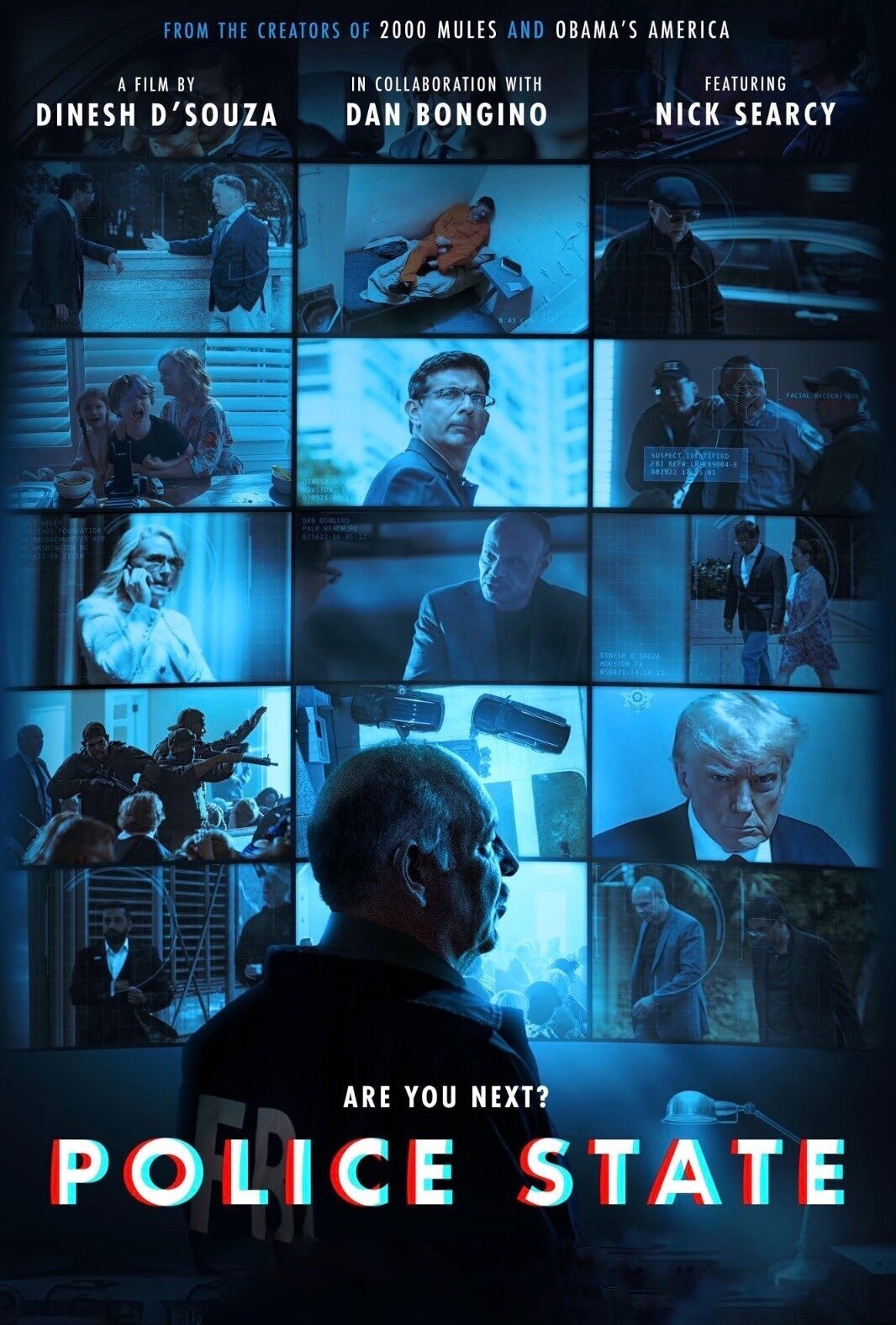
Dinesh D’Souza Documentary “Police State” To Stream Exclusively on Rumble
Rumble, the rapidly expanding video-sharing platform and provider of cloud services, has revealed the launch of exclusive film content, featuring an explosive piece of cinema from political filmmaker and author, Dinesh D’Souza. His latest film, titled “Police State,” has created waves by aligning itself with free speech and anti-censorship ideals, displaying a commitment to the unfiltered dissemination of content.

The film, co-created alongside political commentator Dan Bongino, will be accessible on Rumble and Locals from October 28th.

In the face of rampant online censorship, D’Souza’s “Police State” intends to shed light on the impending risks to American civil liberties. Recognizable for his uniquely unfiltered voice, D’Souza aims to expose the encroaching threat of a police state in a country that has traditionally valued individual freedoms above all else.
2
The film also underlines the urgency of recognizing an increasingly invasive state machinery. For D’Souza, this project represents not just a movie but an urgent call to action. In this vein, he voiced his pleasure to be streaming his utmost critical work on uncensored platforms such as Rumble and Locals.

“This movie will expose the threat to the basic rights of Americans and the alarming movement toward the country becoming a police state,” said D’Souza. “It’s my most urgent and powerful film, and I’m delighted to be streaming it on Rumble and Locals.”

Rumble, known for its mission to challenge cancel culture and encourage the unimpeded flow of ideas, has welcomed the addition of D’Souza’s latest pivotal work. Chris Pavlovski, Rumble Chairman and CEO, expressed his enthusiasm about the progress they have been making with their pay-per-view functionality.

“We’ve made a lot of progress with our pay-per-view functionality, and we are excited to bring this movie to the platform,” said Pavlovski. “With a significant following and an impressive portfolio of movies, D’Souza is a powerful voice, and we expect a great turnout,” he added.

Dinesh’s Locals community includes access to stream “Police State.” Members will also gain access to exclusive live streams and other films like “2000 Mules.”
HYPOCRITICAL
3
The Australian Government Says It Will Be Exempt From Its Own Online “Misinformation” Laws
The Albanese administration’s pursuit of overreaching legislation intended to tackle “false” content on social media platforms is drawing sharp criticism and questions about its implications for free speech. A notable exclusion from this potential crackdown is the very government pushing for it.

This exemption, which would allow government messages to bypass these stringent regulations, was questioned by Independent Senator David Pocock. He rightly posited why governmental communications should remain unexamined when content from other entities would be under scrutiny. To many, the exemption smells suspiciously like a double standard, allowing the government to avoid the very accountability they seek to impose on others. “It would not ‘pass the pub test’ for the exemption to stand when the laws were eventually introduced,” Senator Pocock remarked.

Assistant Minister for Infrastructure Carol Brown rushed to defend the exemption, stating that it is intended to prevent critical emergency communications from the government being accidentally removed by social media platforms.

Special Minister of State Don Farrell, who oversees electoral matters, conveyed the complexity of the issue. “It’s a difficult topic,” he admitted. The balance between preserving free speech and battling misinformation is indeed a delicate one. Senator Farrell remarked, “You don’t want to stop free speech in this country, and we do want people to be able to express their views, even if you consider them crazy and so forth.”
PUSHING BACK AGAINST LAWMAKERS
4
X Won’t Demonetize Russell Brand, The Company Tells Pro-Censorship British MPs
Demonstrating its commitment to upholding principles of free expression, Twitter recently affirmed that it would continue to financially support comedian Russell Brand, refusing to be swayed by mere accusations leveled against him. Elon Musk has promoted the position of not penalizing account holders unless they deviate from the platform’s guidelines or violate local laws.

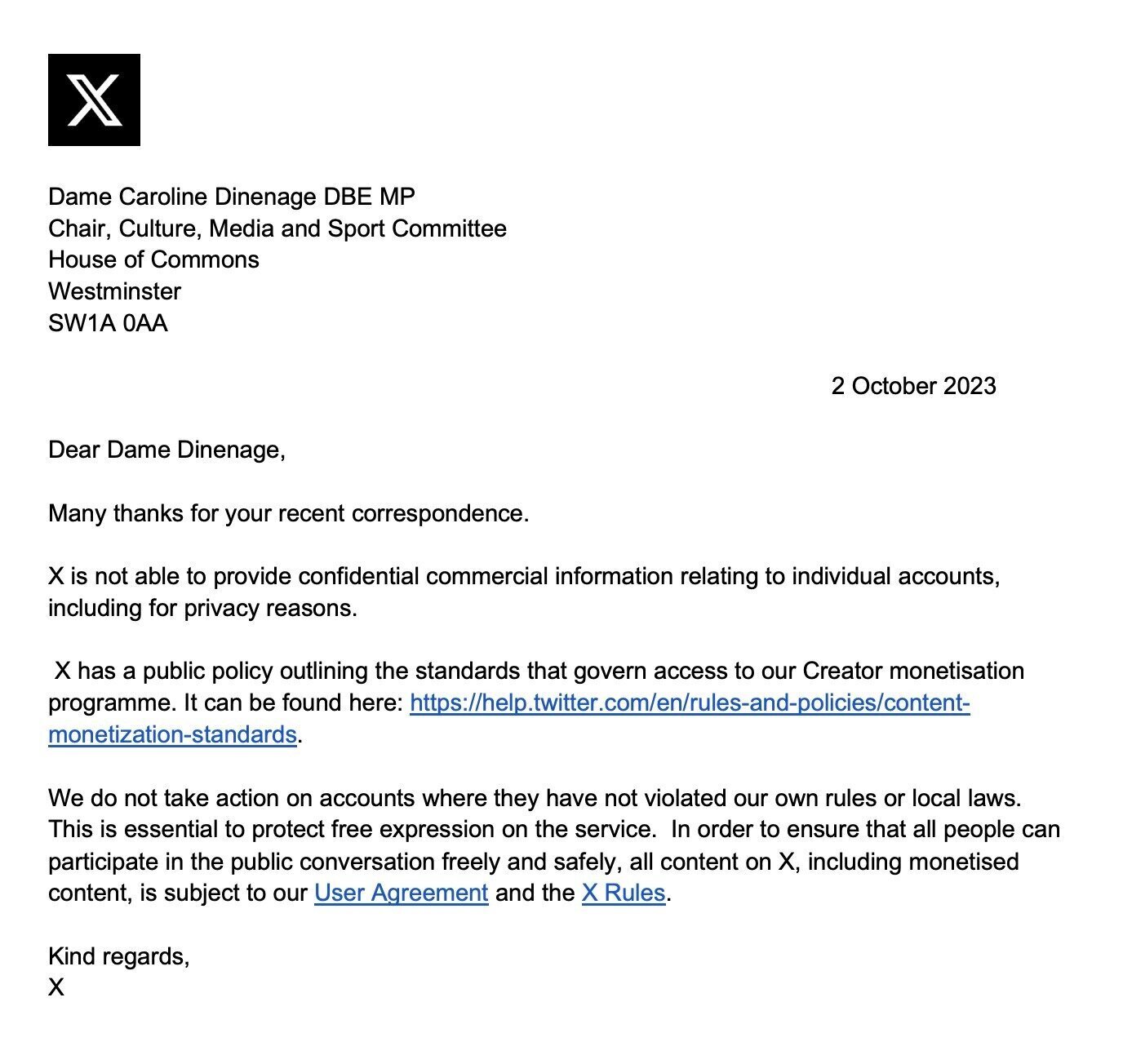
Detailing its stance in a letter addressed to Dame Caroline Dinenage, who chairs the Commons Culture, Media, and Sport committee, and who was widely criticized for asking platforms whether they would allow Brand to earn a living from online platforms, the company explained that its resolution to allow Brand’s financial pursuits on the platform aligns with its intent to protect free expression.

The company said: “X is not able to provide confidential commercial information relating to individual accounts, including for privacy reasons.”

It added: “We do not take action on accounts where they have not violated our own rules or local laws. This is essential to protect free expression on the service. In order to ensure that all people can participate in the public conversation freely and safely, all content on X, including monetised content, is subject to our User Agreement and the X Rules.”
4
X’s chosen course of action resonates with perspectives against encroachments on free speech and accentuates the necessity for platforms to observe impartiality, without resorting to knee-jerk reactions based on unproven insinuations.

This development comes after YouTube barred Brand from generating revenue from his account in the wake of allegations implicating him in incidents of sexual assault, which purportedly transpired between 2006 and 2013. This was based on allegations alone, despite Brand not being convicted, or even charged with such offenses.

Consequently, Dinenage had sought an audience with Linda Yaccarino, X’s CEO, expressing apprehensions regarding the comedian’s ability to monetize his content on the platform amid the accusations.

She also queried whether Musk had influenced the decision-making process pertaining to Brand’s case, given the billionaire owner’s public defense of the comedian.
INVASIVE
5
Visitors to the EU Will Soon Face Fingerprinting and Facial Scans
A significant shift is looming in the way American citizens will be allowed to enter a large majority of European nations. The European Travel Information and Authorization System (ETIAS), an arm of the European Union, has unveiled its plans to implement a system in Spring 2025, requiring Americans to secure prior approval for travels up to 90 days in any of the 30 EU countries.

This is a departure from the current practice where US travelers enjoy effortless entry into these countries without a visa requirement. However, the new regulation will insist on individuals proceeding with their travels only after registering their intent via the official ETIAS website or mobile application, both of which currently do not process such requests.
5
In a radical departure from the norm, from 2025 onwards, American passport holders will no longer receive passport stamps. Alarmingly, the planned regulatory changes involve intense intrusions into personal privacy. The new rules state that visitors will be subjected to both face and fingerprint scans aside from surrendering other biometric data. It’s disconcerting that this data will be reserved within the European Commission’s Common Identity Repository (CIR), a database accessed by numerous agencies, including law enforcement.

The implications of this regulation change could be even more disconcerting from a privacy perspective. Critics and advocates of digital privacy have sounded the alarm on not just the possible misuse of this extensive data pool by governments, but also the potential exposure to hacking threats, be they criminal outfits or invasive foreign governments. There’s also the risk of rogue insiders dealing with this sensitive information.

These regulations reflect a worrying escalation towards a surveillance state that doesn’t differentiate between law-abiding citizens and potential threats but treats them both as data sets to be tagged, traced, and retained.

It’s worth noting that the US began collecting fingerprints of international tourists as part of the US-VISIT (United States Visitor and Immigrant Status Indicator Technology) program, which was initiated in 2004.

Beware of These Links
As people start to get wise to the vast amount of online tracking, using ad blockers and tracker blockers to protect themselves, marketers are getting smart and are looking for new ways to track people. That’s why, these days, you have to be extremely careful of the links you click. This is explored here below.
CENTRALIZED SURVEILLANCE
1
How Mastercard’s Digital ID Project Is Being Used by Governments To Track Health and Vaccination
In Mastercard’s ongoing technological pursuits, there seems to be an agenda of consolidating digital dominance. The so-called “Community Pass” project, helmed by Tara Nathan, Mastercard’s executive vice president, claims to integrate marginalized communities into the digital world. However, with only 3.5 million users so far, skeptics of digital ID plans may wonder about its real reach and intentions.

Nathan’s recent appearance on the company-sponsored podcast “What’s Next In,” touted the supposed merits of the Community Pass. Launched in 2019, this platform ostensibly provides individuals in Sub-Saharan Africa and Asia-Pacific with a digital ID and wallet, allowing them access to services such as government benefits and humanitarian assistance.

Nathan waxed eloquent about the supposed benefits of digitization for developing economies. But her emphasis on using offline digital channels to supposedly empower marginalized individuals raises eyebrows. Is this another case of a multinational company trying to sell its tech solutions to unsuspecting communities under the guise of altruism?
1
While they sing praises about aiding farmers with their digital identity system, one can’t help but question the underlying motives. Is this just a method to tap into the vast, underexplored markets of rural areas? Community Pass seems to be less of an inspiration from their previous mobile money humanitarian ventures and more of an extension of their global financial grip.

Nathan was eager to elaborate on the various components of Community Pass – Farm Pass, Wellness Pass, and Commerce Pass. Each appears tailor-made to address specific challenges. For instance, Farm Pass supposedly helps farmers gain visibility and a credit record. However, this digital interference might just be a ruse to infiltrate local markets and dictate terms.

The Wellness Pass initiative seems particularly odd. While it’s positioned as a system to monitor vaccine roll-outs, isn’t there a clear risk of tracking individuals’ personal health data? Even if institutions like the Ministries of Health in Ethiopia and Mauritania endorse it, the broader implications can’t be ignored.

Their goal to expand the reach of Community Pass to over 30 million people by 2027 sounds more like a corporate conquest than a genuine effort to assist. The project’s privacy concerns are evident. Digital identities, under the pretense of progress, could well turn into tools for invasive surveillance, jeopardizing the very rights of the people they claim to uplift.

Their recent ID2020 certification might vouch for their intention to offer financial inclusion and digital identity services, but with technology’s relentless pace, there’s a dire need for strict regulations. Policymakers must be wary and ensure that such initiatives don’t compromise individuals’ freedoms under the guise of inclusion and so-called progress.

This is shocking. Klaus Schwab, in his best German pre-war stylistic accent voice says the world will no longer be run by countries, or superpowers like America but instead by the World Economic Forum stakeholders such as Blackrock and Bill Gates. This is the man who wants us to have no property, eat bugs and plants, live in dense cities so the countryside can re-wild, and only allow the elites to travel.


The U.S. Navy should play to its strength, enforcing sanctions against Iran by controlling the maritime routes Iran depends on to generate cash for its empire of terror.

The U.S. response to Hamas’ Nazi-like massacre of Israelis, Americans, and anyone else in its murderous path has been, almost without exception, robust. But U.S. officials are largely missing the larger picture and risking being drawn into an escalation — on the enemy’s terms.

Hamas and Hezbollah are the symptoms; Iran is the disease.

But President Biden’s Oval Office address to the nation on Oct. 19 danced around the core issue of Iran’s financing, training, and encouragement of violent, brutal forces across the region and beyond, as well as its nuclear missile program.

Thus, the gathering might of the U.S. Navy off the coast of Israel in the form of two aircraft carrier strike groups and a Marine Expeditionary Unit betrays unimaginative, linear thinking.

If used, American firepower would augment Israel’s own considerable military force. In theory, this threat helps to deter Hezbollah from unleashing its arsenal of 100,000 missiles on Israel, many of them sophisticated.

But, like Hamas, Hezbollah is expert at digging. They hide their missile launchers in an extensive network of tunnels and bunkers — all guarded by an air defense network that is likely to get lucky enough times to raise the specter of captured American pilots.

The last time U.S. naval aviation operated over Lebanon was in 1983, in response to the Beirut barracks bombing in October — an attack that Iranian authorities arrogantly claimed credit for in the past month. Until 9/11, it was the deadliest terror attack on Americans. Two months later, the Syrian military fired on U.S. Navy aircraft, shooting down two A-6 attack jets and capturing an officer.

Optimal Use of U.S. Air Force and Navy

If the incremental addition of American airpower is helpful to the pending effort to destroy Hamas while deterring a wider conflict, that role can more than adequately be filled by the U.S. Air Force.

The U.S. Navy should instead be concentrating 2,000 miles to the east in the Gulf of Oman and the Arabian Sea. There, the U.S. Navy would be playing to its unambiguous strength, enforcing sanctions against Iran by controlling the sea lines of communication that Iran depends on to generate the cash for its empire of terror.

Unfortunately, this would require a Biden administration that was both imaginative and strategic — and not in the thrall of a recently revealed Iranian influence operation that managed to place several advisors friendly to the Iranian mullahs in key national security positions since the Obama administration. Chief among these, Robert Malley, a longtime friend of Secretary of State Antony Blinken and an architect of the Joint Comprehensive Plan of Action (JCPOA) with Iran, a deal that focused exclusively on Iran’s nuclear program, rewarding the mullahs with cash and sanctions relief while greenlighting their missile program and global support for terror.

Iran’s Nuclear Program

Instead, Biden’s systematic appeasement of Iran, a continuation of the Obama-era policy that weirdly sought to use Iran as a counter to perceived Israeli intransigence on the Palestinian problem, has resumed. Up until the gruesome events of Oct. 7, Biden’s national security team was willfully blind to Iran’s bloody history of sponsoring terror and its determined drive to produce nuclear weapons and missiles to deliver them.

As a result, U.N. sanctions against Iran’s nuclear, missile, and drone program — never well enforced by Biden — expired on Oct. 18 with the U.S. announcing its own unilateral set of sanctions. The U.S. continues to pretend these efforts are somehow slowing Iran’s drive to push its nuclear program to completion, while Russian use of Iranian combat drones in Ukraine reveals the prior sanctions regime as inadequate to the task.

Reagan-Era Lessons

The U.S. never fully grappled with the Iranian theocracy after the shah was toppled in 1979. During the Cold War, it was assumed that the Soviet Union would come to Iran’s aid and that the military cost of defeating the regime would be too high.

Instead, the U.S. was content to see Iran tied down in a bloody stalemate against Iraq after the latter invaded in 1980.

As the war started to threaten oil exports out of the Gulf, America responded by providing a U.S. Navy escort to six Kuwaiti-owned super tankers in July 1987.  

After an escorting U.S. Navy ship struck a mine on April 14, 1988, the Reagan administration responded only four days later with Operation Praying Mantis. It was the Navy’s largest combat action since World War II, sinking an Iranian guided missile frigate, crippling a second, sinking four other boats, and destroying two militarized oil platforms at the cost of one helicopter with two crew lost.

The operation was thoroughly wargamed a year before, when it was determined that an unambiguously aggressive response to Iran would likely prevent the conflict from escalating. In other words, a disproportionate response would rob Iran of the ability to control the timing and mode of escalation, reducing U.S. casualties and preserving the peace.

Applying Force

This lesson from the Reagan era opens up a final consideration. Rather than following through on the foolish precedent of incentivizing hostage-taking via negotiation and cash payments, America should ditch the carrots and pick up the stick.

Imagine the transformative discussion over the current hostage crisis — and the forestalling of future hostage-taking by Iran and its proxies — if the U.S. were to announce that every hostage taken is worth $1 billion (or $1.171 billion if we wish to account for Bidenflation). That amount would be deducted from seized Iranian assets or taken from oil tankers filled with Iranian oil. The proceeds would compensate hostages and their families, with the remainder used to replenish the Pentagon’s waning stocks of armaments.

This is exactly the kind of naval power application the U.S. Navy was built for.

Unfortunately, the radical cadres infesting the Biden administration’s national security staff would never allow such an idea to reach the desk of our cognitively impaired commander-in-chief.


Three more philosophical arguments for the existence of God, in terms the ‘regular guy’ can understand.

This site contains the first of two arguments in favor of the existence of God that seem complicated—and are—but can be boiled down to their essentials for the amateur apologist. This post will go through three more.

3. The Argument from Consciousness

Life presents to us an extremely rich qualitative dimension, which is to say, the entire “what it is like”-ness to being you and experiencing the things you experience. The spicy scent of ginger tea, the easy sight of the flamingo, and the luscious guitar sounds of Ratt drive the point home.

The way naturalists usually tell it is that consciousness is a late and local phenomenon, something that emerges from purely mindless physical stuff. Simply put, whatever is fundamental to the naturalist is, effectively, whatever consciousness is not: it is not feeling, not sensing, and not “about” anything (the way thoughts are about things).

But the immediate problem is that it seems extremely difficult, if not outright impossible, to construct consciousness from an utterly unconscious base, as described by naturalism.

Just think about it. How does one take mindless atoms and make a unified center of conscious awareness, a subject that binds together so many different thoughts and feelings through intervals of time?

The problem is not just a matter of trying to establish sufficient material complexity, but also how one leaps, as if by magic, across profoundly different kinds of reality. Compare: just as the number and arrangement of white LEGO blocks is irrelevant to constructing a purple tower (even infinite time and number of pieces won’t help), it seems that the same problem, if not significantly worse, applies when it comes to constructing a unified conscious being from the disparate mindless blocks that the naturalistic worldview has to offer.

The problem doesn’t end there, however. For even if the naturalist can make sense of how consciousness could emerge from an unconscious base, he doesn’t have a good story for explaining why it would emerge. Consciousness seems wasteful for the naturalist, since it’s the mindless atoms that do all the work, anyway. (Remember that according to naturalism, the physical realm causes and determines the mental realm, not the other way around.) Thus, there is no good naturalistic-evolutionary account for why the emergence of consciousness would happen, even if the emergence of consciousness could happen.

Classical theism avoids both issues since theism isn’t committed to everything reducing to physics (which is absurd anyway, but whatever—set that aside). In a real sense, molecules aren’t fundamental in classical and Christian theism. Persons are. Theism starts not from a principle of indifference, but a principle of perfection, where everything in the created world is not just less than, but infinitely less than what stands at the foundation. Surely it is easier to think of how we can get something lesser from something (infinitely) greater than it is to think of how one can get something so profound as consciousness from something entirely bereft of thoughts and feelings, like atoms.

Moreover, theism gives reason to expect conscious beings. We are good to have around. God would know this and would be motivated to bring us about. So not only is our emergence possible on theism, but it is also expected. All this gives another powerful reason to accept classical theism over atheistic naturalism.

4. The Argument from Fine-Tuning

We have a basic intuition that stuff that seems “well put together”—i.e., complex stuff, with functionally interrelated parts—is the product of intelligence. This intuition is frequently applied in experience: we see a mousetrap or a Nintendo Switch or the Mona Lisa, and we naturally think some intelligent being produced it. By and large, this intuition is frequently confirmed in experience. Certain things seem to obviously be the product of forethought, which implies that creative intelligence (the ability to engage in relational thinking), not blind (unintelligent) natural forces, is responsible.

But the atheist says, “Not so fast: evolution shows us how things that appear designed are actually the product of totally unintelligent, pitiless forces of nature.”

However, as the best science informs us, evolution requires a very special physical setup to occur, and the physical setup of our universe is incredibly “fine-tuned” or “really well put together” concerning the necessary conditions for the emergence of interactive life. Physicists tell us that if things were just a teensy-weensy bit different concerning, say, the expansion rate of the universe, the strength of the strong nuclear force, the weight of the electron, or many other examples, the emergence of intelligence life would not be possible, because in many cases chemistry would not be possible, or the universe would have collapsed back in on itself, or some other catastrophic scenario. This conclusion enjoys overwhelming expert consensus, from theists and atheists alike. Where the disagreement largely lies is in what explains the fine-tuning.

From the best of what we know, scientifically speaking, evolution requires a physical system that appears “well put together,” a sort of “Goldilocks” situation, where things are just right for evolution to take hold and eventually produce beings like us. Once all that is understood, it becomes clear that evolution does not defeat our frequently confirmed intuition that stuff that appears well put together is best explained by intelligent agency, something capable of foresight.

At this point, the atheist might say the multiverse could explain fine-tuning. The theist can respond, maybe it does. But how does that help? As physicist Luke Barnes explains, any theoretically plausible model of the multiverse itself requires fine-tuning; thus, the problem is just relocated, not actually resolved. So until someone can propose a multiverse model that is predictively useful as a physical theory and does not itself appear well fit together (finely tuned), the theist is justified in maintaining his intuition that things that appear well put together are well put together because something intelligent is behind them.

The basic intuition is undefeated “all the way down.” There is thus no reason—from science, anyway—to think things that strongly appear to be the product of intelligence somehow aren’t.

Finally, when it comes to an entire physical universe being well put together, it does not take a lot of imagination to suppose whose intelligence is behind it.

(A note: Someone might worry that God is a poor explanation of the physical universe because God would be more complex than the physical universe. This is false. In the most relevant sense, God is far simpler than any physical reality, since God is an unrestricted act of understanding. In other words, God is the absolutely simple and immaterial first principle of all, a being of pure positiveness, with zero limitations or arbitrary restrictions, lacking all internal complexity, especially physical complexity. That makes God not only simpler than any possible physical explanation, but the simplest conceivable explanation there is.)

5. The Argument from Suffering

Recall the argument from consciousness. There it was made clear that the naturalistic worldview holds that our mental life is something late and local, preceded by and entirely caused by unthinking, unfeeling physical bits. Such commitments are what cause many naturalists to endorse a position called epiphenomenalism (an epiphonema is just something that is itself caused but causes nothing) when it comes to our mental life, or our thoughts and feelings. This is a spooky position and contrary to common sense, since it implies, for example, that our desiring coffee—that is, the feeling of wanting coffee—has nothing to do with our going and getting coffee. Such a feeling just coincidentally (magically?) attends to blind physical forces causing the action of “getting coffee.”

Now, to be clear, epiphenomenalism is as self-evidently false as anything in philosophy could be, and to the extent that naturalism is committed to epiphenomenalism, is even more reason to reject naturalism.

But there is yet another problem. Typically, the naturalist tells us that the vast suffering of our experience is far better expected if God does not exist and if naturalism is true, and so we should endorse naturalism over theism. But this story is way too superficial and ignores too much of what actually goes on in naturalistic research programs, including philosophy of mind. So let’s connect some dots.

Evolution selects for outcomes and functions that confer survival advantage, not feelings, per se, and human functions for the naturalist are possible without feeling. For example, the function of me pulling my hand away from the prick of a pin does not require any painful feeling—it requires no feeling at all within the naturalistic understanding, because the feeling is causally irrelevant. Further, if there is a feeling attendant to some function of human behavior, the feeling could have been literally anything; pulling my hand from the pin could have been correlated with the feeling I feel when listening to the Barney theme song, tasting a grape, or looking at my grandmother’s bunion. Why? Again, because the feeling plays no role in what “the physics” is doing, since the feelings are determined by the physics and the physics is in no way determined by the feelings. (For the naturalistic, remember, the causality is entirely in one direction.) Thus, the outcome would have been the same no matter what the feeling is, or if there is any feeling at all, because it is entirely the unconscious, unfeeling physical processes that matter, that do the functional work and that, ultimately, are selected for. Feelings don’t have anything to do with it, and so it just doesn’t seem there is any need for feelings to be there at all, or to be as “fitting” as they are, if the common naturalistic account of things is correct.

We can only scratch the surface of this argument here. The point for now is simply that once these (admittedly subtle) points concerning the mental and physical are understood, naturalism has no real story to tell for the actual distribution of suffering in our world. Things could have gotten along in just the same way they have without any feelings, good or bad. Things could have been far better or far worse, feelings-wise. The problem is that naturalism, when systematically articulated and consistent with its own inner logic, does not adequately predict any specific degree or distribution of suffering. It leaves all possibilities wide open.

However, once we grant a few plausible points about suffering, including that suffering can be spiritually medicinal (soul-healing and soul-building) alongside other plausible stories about God’s governance (particularly about letting natures play their part, including the natures of free beings), there is a strong theistic story we can tell that makes the distribution of suffering in this world not entirely surprising.

This story cannot hereby be rehearsed now, but the simple point is this: naturalism has no explanatory story to tell—ultimately—anyway, about the suffering we experience. Some story is better than no story, and so even the suffering of our experience is evidence for rather than against the existence of God.

Okay—there you have it: three arguments (and two before those in another post) for the existence of God, somewhat simplified.

Apology is necessary here to the reader for the length of this “simplified” summary of arguments. There is still a fair bit going on in the presentations above, to be sure, but still each argument has been distilled to the extent it is entered without omitting any seriously crucial aspect or presentation of the arguments in ways that might lead to false philosophical conceptions about God or something else, like morality.

If these arguments interest you enough to want to pursue them further, look for the forthcoming book The Best Argument for God by Pat Flynn.