
$223,957 federal grant explicitly funds Yersinia pestis bacterial mutants and experimental infections involving the mechanisms allowing plague to overcome immune defenses and contribute to virulence.
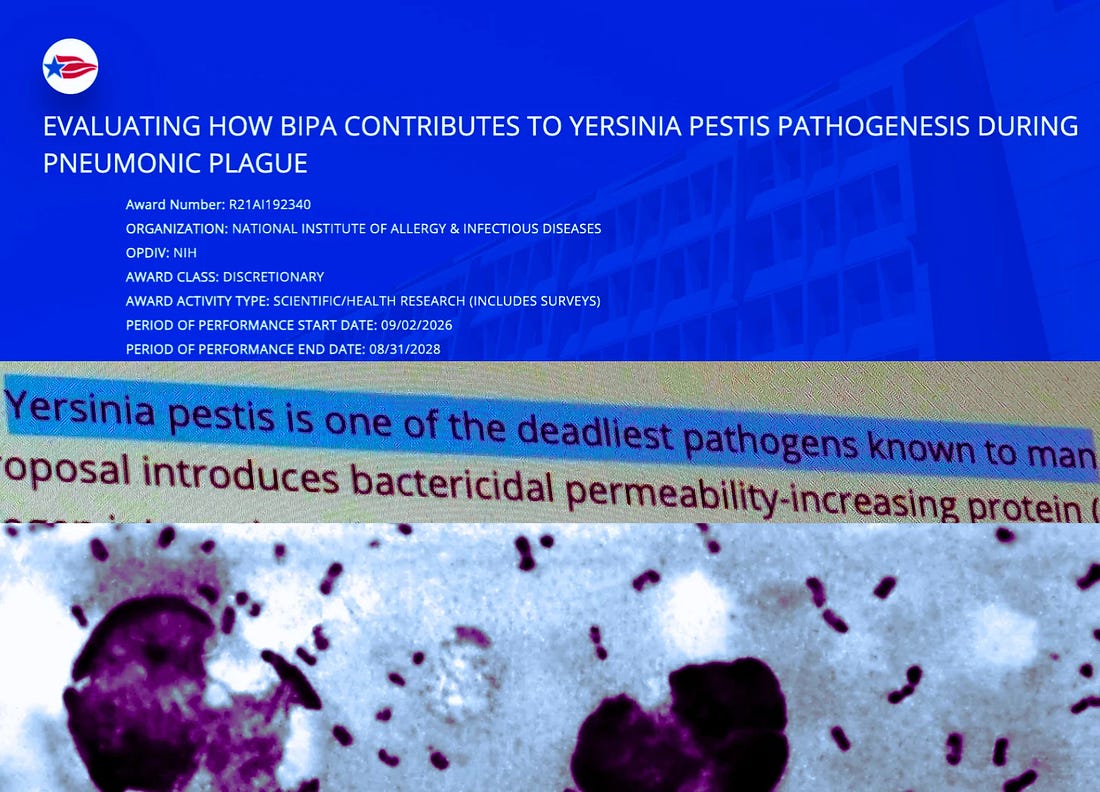 |
Composite image showing the National Institutes of Health’s September 2, 2026, plague-research grant R21AI192340, its description of Yersinia pestis as “one of the deadliest pathogens known to man,” and microscopy imagery of bacteria identified as Y. pestis alongside immune cells.
The National Institutes of Health (NIH) awarded East Carolina University $223,957 on September 2, 2026, for experiments using mutant plague bacteria to investigate mechanisms of immune resistance and virulence, according to federal grant R21AI192340, administered by the National Institute of Allergy and Infectious Diseases (NIAID).
The agency explicitly acknowledges:
“Yersinia pestis is one of the deadliest pathogens known to man.”
Yet the same federal award declares:
“we will use bacterial mutants”
The grant authorizes research through August 31, 2028, involving laboratory experiments and experimental infections in mice to investigate how plague bacteria resist immune defenses and contribute to disease.
The federal government is financing experiments involving mutant plague bacteria while acknowledging that its research subject is among the deadliest pathogens known to humanity.
The award raises urgent questions:
- What plague-bacteria mutants will researchers create or use, and what biological changes could result?
- Could any mutants exhibit increased resistance to immune defenses or greater virulence?
- Who independently evaluates the risks of experiments involving an organism NIH itself describes as exceptionally deadly?
- What containment safeguards, emergency procedures, and informed-consent protections apply to laboratory personnel?
- What independent oversight protects surrounding communities from accidental exposure?
The findings come after JonFleetwood.com reported on October 16 that NIH awarded Stanford University $782,082 to develop experimental influenza vaccine formulations that activate TLR4, the immune receptor stimulated by bacterial endotoxin (LPS), including a formulation containing a synthetic compound modeled on the inflammatory component of endotoxin.
You can contact NIH here.
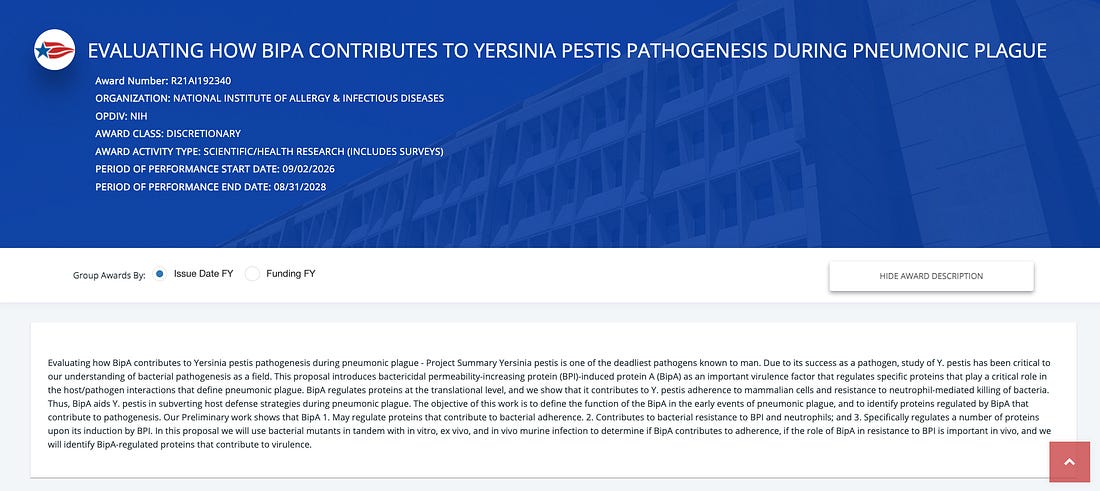 |
Screenshot of NIH grant R21AI192340, awarded September 2, 2026, to East Carolina University for $223,957, showing the federal agency’s description of Yersinia pestis as “one of the deadliest pathogens known to man” and its proposal to use bacterial mutants in experiments investigating immune resistance and virulence.


Leave a Reply