
Federal scientists claim to overcome a fever-related defense, exempt their own experiments from dangerous gain-of-function restrictions, and use the findings to justify more pandemic surveillance.
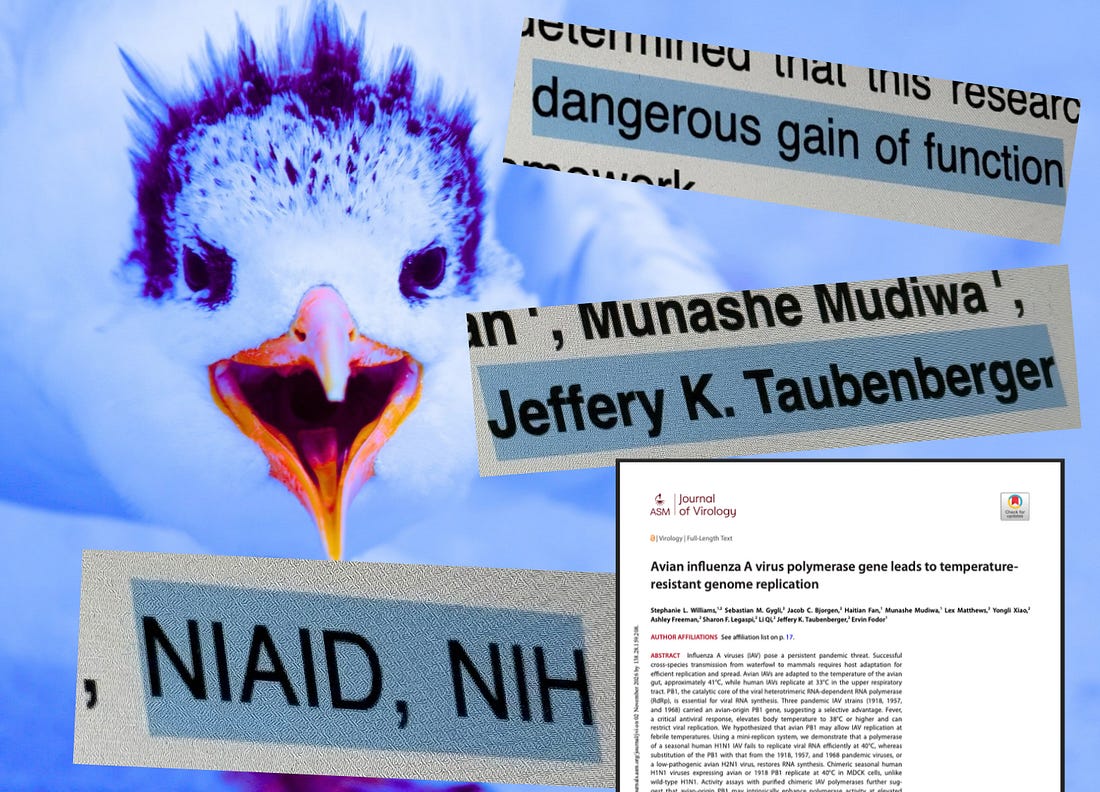
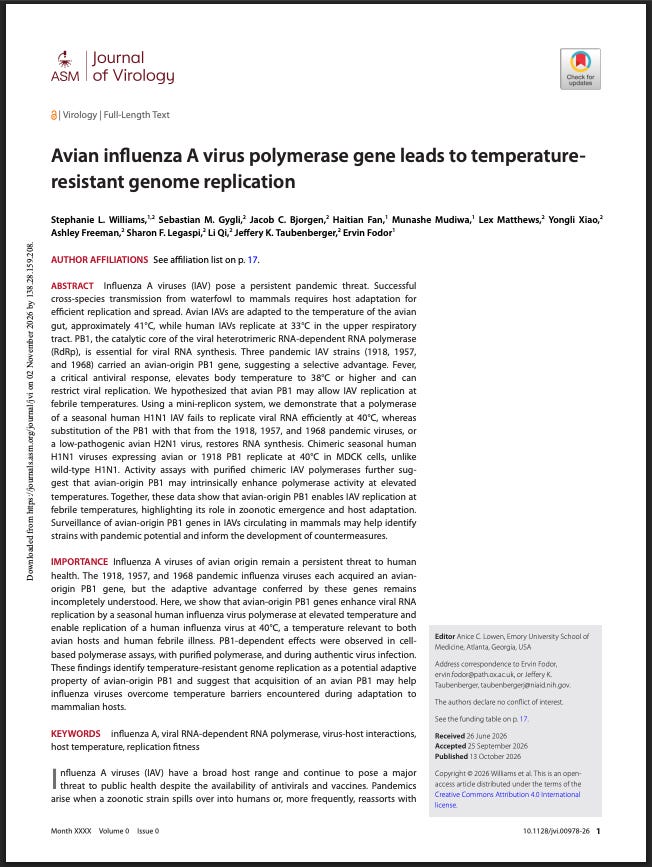
An October 13, 2026, study published in the Journal of Virology by scientists at the National Institutes of Health (NIH) and the University of Oxford claims researchers engineered experimental chimeric influenza material to replicate at 104°F (40°C) using genetic components they identified with bird flu and the 1918 pandemic, despite the Trump administration’s crackdown on dangerous gain-of-function research.
The study, titled Avian influenza A virus polymerase gene leads to temperature-resistant genome replication, describes laboratory experiments that the researchers interpret as allowing purported influenza viruses to overcome a temperature-related barrier associated with the body’s response to illness.
The researchers claim to have enhanced influenza replication, yet disclose that NIH’s own reviewers believed the experiments did not qualify as dangerous gain-of-function research.
They then suggest using those findings to improve government surveillance and pandemic preparedness.
The sequence raises two central concerns:
- NIH scientists are reporting experiments designed to enhance a purported disease-causing agent while the administration claims to restrict dangerous gain-of-function research.
- And their laboratory findings are being used to justify additional government efforts against the threats those experiments supposedly reveal.
The findings raise immediate questions:
- Why is NIH conducting experiments intended to enhance purported influenza replication after the Trump administration ordered dangerous gain-of-function research stopped?
- Who independently reviewed NIH’s decision that the experiments were permissible?
- What direct physical evidence establishes that the laboratory materials possess the biological identities and genetic properties the researchers attribute to them?
- Why should claims generated through federally funded laboratory manipulation justify additional pandemic surveillance, vaccine development, and public spending?
- What safety measures protected laboratory personnel and the public, and what informed-consent protections would apply to any medical interventions justified by these findings?
NIH scientists claim to have made flu more dangerous, cleared their own experiments from government restrictions, and used their findings to justify more pandemic surveillance and government intervention.
You can contact NIAID here, the NIH here, and HHS here to voice opposition to taxpayer-funded chimeric research on pandemic pathogens—particularly after Congress, the White House, the Department of Energy, the FBI, the CIA, and Germany’s Federal Intelligence Service (BND) all acknowledged that the deadly COVID-19 pandemic was “likely” the result of a laboratory incident involving GOF.
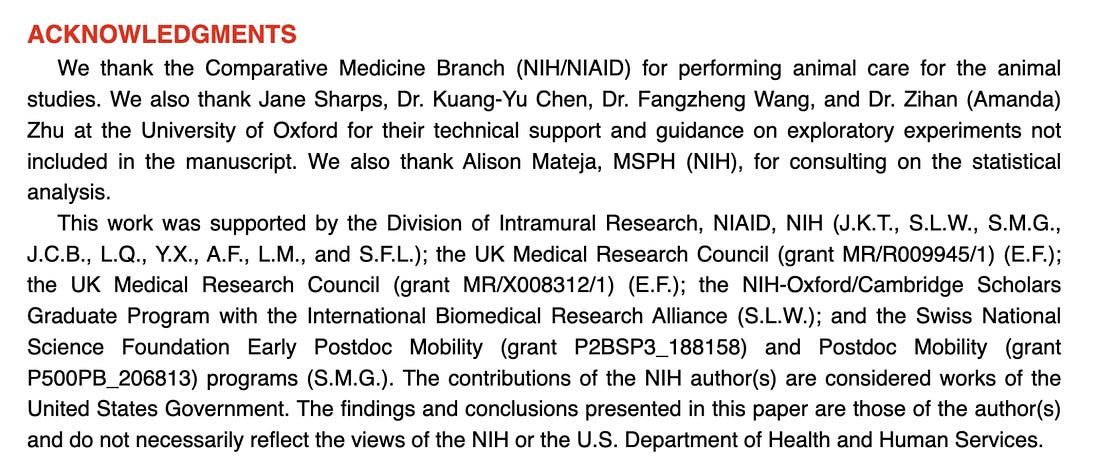 |
The October 13, 2026, Journal of Virology study acknowledges direct support from NIH’s National Institute of Allergy and Infectious Diseases (NIAID), two UK Medical Research Council grants, and Swiss National Science Foundation fellowships. The authors also acknowledge NIH animal-study support and Oxford scientists who assisted with “exploratory experiments not included in the manuscript,” raising questions about what additional experiments were conducted and why their results were excluded from the published study.
 | Williams Et Al 2026 Avian Influenza A Vi…3.13MB ∙ PDF file |
| Download | |
NIH Claims Its Experiments Overcame a Fever-Related Defense
The NIH-Oxford researchers, including NIH scientist Jeffery K. Taubenberger and Oxford scientist Ervin Fodor, reported manipulating laboratory material they classified as influenza.
They used genetic components that they identified as originating from avian influenza and historical pandemic strains.
The authors state:
“avian-origin PB1 genes enhance viral RNA replication”
They reported increased laboratory measurements interpreted as replication at 40°C, equivalent to 104°F.
Their interpretation was explicit:
“acquisition of an avian PB1 may help influenza viruses overcome temperature barriers”
In plain English, the scientists claim their experimental modifications allowed purported influenza material to maintain replication activity under temperature conditions that impaired the comparison material.
Their evidence consisted of laboratory procedures, cultured-cell experiments, and instrument measurements interpreted through genetic and virological models.
Those measurements are the physical experimental record.
Claims that the material was an influenza virus, possessed a particular genetic identity, or demonstrated a mechanism relevant to natural disease are the researchers’ interpretations of that record.
The watchdog significance is straightforward: NIH researchers deliberately sought a biological enhancement and reported obtaining it, later using it to justify government interventions.
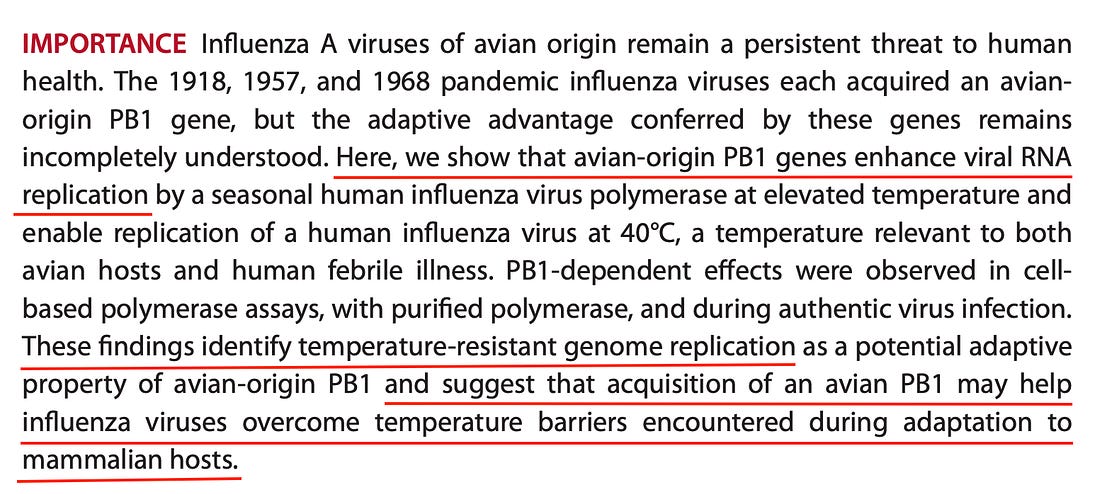 |
NIH researchers claim that genetic components identified with bird flu and past pandemic strains enhanced influenza replication at 104°F (40°C), potentially allowing purported influenza viruses to overcome temperature barriers in mammals. The October 13, 2026, Journal of Virology study presents these laboratory findings as evidence of a potential pandemic threat. Red underlining highlights the researchers’ claims.
NIH Clears Its Own Chimeric Research From Dangerous Gain-of-Function Restrictions
The paper alleges that NIH’s institutional review entity evaluated experiments involving chimeric influenza material that researchers claimed to have created by combining genetic components from different influenza strains, including components attributed to bird flu and the 1918 pandemic.
The researchers reported that these laboratory-created hybrids exhibited enhanced replication at 104°F (40°C).
They also claim that the project did not require additional review under the federal P3CO framework.
The authors wrote:
“All work with the chimeric IAVs was performed in enhanced biosafety level 3 (BSL-3) laboratory conditions at the National Institutes of Health (NIH). Biosafety practices were aligned with NIH and the Centers for Disease Control and Prevention Biosafety in Microbiological and Biomedical Laboratories (BMBL) 6th ed., the Federal Select Agent program, and the NIH Guidelines for Research Involving Recombinant and Synthetic Nucleic Acids, as well as NIH policies and requirements set forth by the NIH Division of Safety and the NIH Institutional Biosafety Committee. This project was periodically reviewed by the NIH Dual Use Research of Concern Institutional Review Entity (IRE), and the manuscript was reviewed and approved by the IRE before submission. The IRE determined that this research did not meet the definition of dual-use research of concern or dangerous gain of function and that the work did not require elevation as part of the P3CO framework.”
NIH researchers claimed to create chimeric influenza material with enhanced replication capabilities, but NIH’s own reviewers apparently determined that the experiments did not qualify as dangerous gain-of-function research.
Yet NIH’s own published definition of gain-of-function research, reproduced in the House Select Subcommittee on the Coronavirus Pandemic’s December 2024 final report, page 59, states:
“a type of research that modifies a biological agent so that it confers a new or enhanced activity to that agent.”
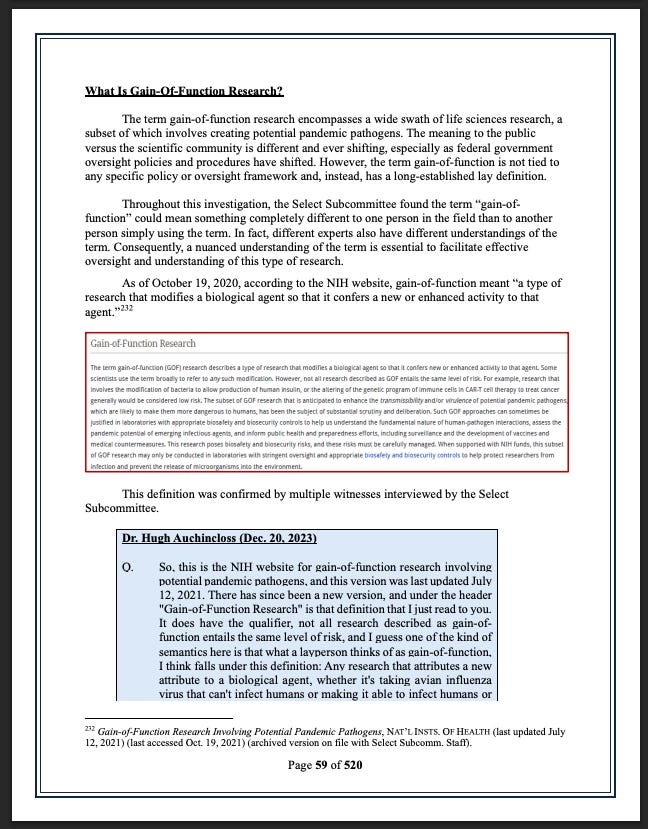 |
The House Select Subcommittee on the Coronavirus Pandemic’s December 2024 final report, page 59, reproduces NIH’s own definition of gain-of-function research as modifying a biological agent to give it a “new or enhanced activity.” The report also documents testimony from former NIH official Hugh Auchincloss confirming the definition. The language is relevant to NIH’s October 2026 study, whose researchers claim their chimeric influenza experiments enhanced replication at 104°F (40°C). Source: After Action Review of the COVID-19 Pandemic, page 59.
 |
NIH’s own definition of gain-of-function research, reproduced on page 59 of the House Select Subcommittee on the Coronavirus Pandemic’s December 2024 final report, describes research that modifies a biological agent to give it a “new or enhanced activity.” The definition, published on NIH’s website as of October 19, 2020, directly applies to the reported enhancements in NIH’s October 2026 chimeric influenza experiments.
An earlier NIH Office of Science Policy presentation independently gives the same definition.
By NIH’s own broad definition, the experiments qualify as gain-of-function research: scientists reported modifying experimental material to produce enhanced replication under specified laboratory conditions.
President Trump’s May 5, 2025, Executive Order 14292 separately defines dangerous gain-of-function research as:
“scientific research on an infectious agent or toxin with the potential to cause disease by enhancing its pathogenicity or increasing its transmissibility.”
The order identifies additional covered outcomes, including increased harmful consequences, stability, transmissibility, and altered host range.
The July 2026 U.S. Government Policy for Stopping High-Risk Life Sciences Research, Section 6, further defines dangerous gain-of-function research according to specified experimental outcomes and the possibility of significant negative societal consequences.
The central oversight issue is that NIH’s researchers reported creating chimeric influenza material with enhanced biological activity, meeting NIH’s broad gain-of-function definition, while its internal reviewers declared that the work did not meet the government’s narrower dangerous gain-of-function definition.
That decision carries consequences beyond laboratory oversight.
The researchers presented their experimental findings as evidence of purported capabilities relevant to pandemic risk, generating new threat claims that could support additional government surveillance and countermeasure development.
- Who authorized these chimeric experiments?
- What written risk assessment justified NIH’s decision that they were not dangerous gain-of-function research?
- Who independently reviewed that determination?
- And why should government-funded experiments generating purported pandemic threats become grounds for further government intervention?
NIH Uses Its Findings to Justify More Pandemic Surveillance
The study’s implications extend beyond the laboratory.
After reporting enhanced replication in their experiments, the researchers described their findings as relevant to identifying purported influenza strains that could threaten humans.
They then connected the findings to government surveillance and preparedness.
The authors wrote:
“Insights from this study and further research could inform IAV surveillance efforts and preparedness”
In plain English, NIH-supported researchers conducted experiments, interpreted their laboratory measurements as evidence of a potential pandemic threat, and proposed using those findings to improve pandemic surveillance and preparedness.
This is the central threat-predicate concern.
The government finances experiments involving materials classified as dangerous biological agents.
Researchers then interpret their experimental results as evidence of biological capabilities that warrant additional government attention.
Those conclusions can become scientific support for further surveillance, vaccine research, and biodefense spending.
The sequence is:
- Government-funded experiments: Scientists deliberately manipulate laboratory materials associated with purported pandemic threats.
- Government-supported threat claims: Researchers interpret the results as evidence of capabilities relevant to future disease outbreaks.
- Government preparedness justifications: Researchers recommend that the findings inform further surveillance and countermeasures.
The research establishes that its authors advocated the third step.
Whether particular agencies subsequently used this study to authorize additional spending or interventions requires a separate funding or policy record.
The accountability question is whether experimentally generated claims are being treated as independent evidence of threats to the public.
- Who verifies those claims before they influence government policy?
- What direct evidence links the laboratory findings to real-world disease?
- And what protections ensure the public is not subjected to medical interventions merely because researchers produced new laboratory threat scenarios?
Bottom Line
NIH scientists claim to have created chimeric influenza material using genetic components attributed to bird flu and the 1918 pandemic, producing enhanced replication at 104°F (40°C).
By NIH’s own published definition, the experiments qualify as gain-of-function research.
Yet NIH’s internal reviewers determined that the work did not qualify as dangerous gain-of-function research, despite the Trump administration’s crackdown on such experiments.
The researchers then presented their laboratory findings as evidence of potential pandemic threats requiring additional surveillance and preparedness.
This is pandemic threat-predicate generation: federally funded scientists claim to create enhanced biological capabilities, use their experimental findings to establish new pandemic threats, and provide justification for expanding government surveillance, vaccine research, and biodefense programs.
The sequence is especially concerning following the House COVID Subcommittee’s findings that major pandemic interventions were imposed without adequate scientific justification.
- Why is NIH conducting chimeric gain-of-function experiments after the administration’s crackdown, allowing its own reviewers to determine whether the work is prohibited, and generating new pandemic threat claims that could justify further government intervention?


Leave a Reply