
Unanswered questions about long-term expression, shedding jab components onto others through exosomes and extracellular vesicles, and what participants are being told before enrollment.
On Thursday, Moderna announced that it has injected the first participant in a Phase 1 clinical trial of mRNA-4200 (NCT06880549), an experimental mRNA product that causes the body to produce seven undisclosed tumor proteins following administration.
In other words, the product does not merely introduce tumor proteins into the body—it uses the body itself to manufacture them.
On purpose.
The study raises obvious safety and informed-consent questions about how long the body produces the purportedly encoded tumor proteins, what their long-term biological effects may be, and whether the product or its outputs could be shed from the original recipient onto others through exosomes or extracellular vesicles in excreted bodily fluids.
A 2021 Journal of Extracellular Vesicles study found that cells expressing a target protein can release extracellular vesicles that “carry” that protein, demonstrating that what is produced inside the body can be exported outside the cell in membrane-bound particles.
A separate 2023 Pharmaceutics review explains that exosomes are natural transport vesicles that carry proteins and nucleic acids throughout the body and are present in bodily fluids including blood, saliva, and other secretions—meaning they are not confined to the original cell or even the original location in the body.
You can contact Moderna here and the FDA here.
The company says it’s evaluating the product in patients with advanced solid tumors, including melanoma, non-small cell lung cancer, esophageal cancer, gastric cancer, ovarian cancer, cervical cancer, endometrial cancer, bladder cancer, and colorectal cancer.
Participants receive the injections either alone or in combination with pembrolizumab, a monoclonal antibody marketed as Keytruda.
Unlike Moderna’s “personalized” cancer vaccine programs, which are said to be tailored to an individual patient’s tumor characteristics, mRNA-4200 is described as an “off-the-shelf” product intended for use across multiple cancer types.
According to Moderna’s public statements, the product works by delivering mRNA instructions that result in the production of seven shared tumor proteins inside the body after injection.
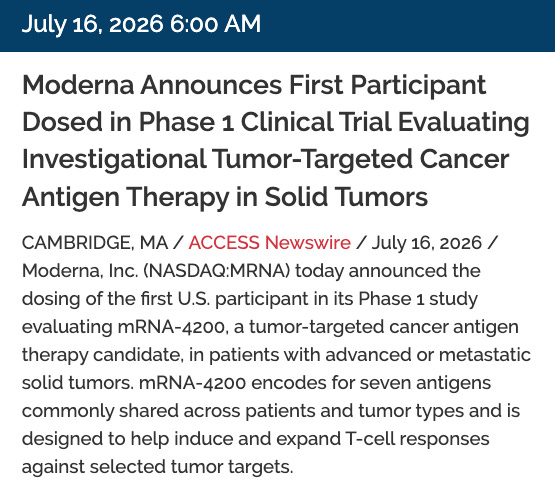
The press release reads:
“Moderna, Inc. (NASDAQ:MRNA) today announced the dosing of the first U.S. participant in its Phase 1 study evaluating mRNA-4200, a tumor-targeted cancer antigen therapy candidate, in patients with advanced or metastatic solid tumors. mRNA-4200 encodes for seven antigens commonly shared across patients and tumor types and is designed to help induce and expand T-cell responses against selected tumor targets.”
However, Moderna has not publicly disclosed the identities of those proteins.
As a result, we are currently unable to independently evaluate which proteins are being produced, whether they are full proteins or fragments, whether they are found elsewhere in the body, or what biological effects may accompany their expression.
The trial is expected to enroll approximately 42 participants and is being conducted at sites in Michigan, Texas, and Utah.
Other Moderna cancer products have encoded immune signaling proteins including OX40L, IL-23, and IL-36γ, and have similarly been paired with monoclonal antibodies targeting immune checkpoint pathways.
Bottom Line
An experimental product that works by causing the body to manufacture tumor proteins inside itself has now moved into human testing.
Not proteins administered from a vial.
Not proteins manufactured in a laboratory.
Proteins manufactured inside the recipient’s own body.
On purpose.
Moderna says there are seven of them.
The company has not publicly disclosed what they are.
That raises questions that should be self-evident.
- What happens when the body is instructed to produce tumor proteins over time?
- For how long are they produced?
- Where are they produced?
- What happens if those proteins are expressed in tissues beyond their intended targets?
- And if proteins and nucleic acids produced inside the body can be transported through extracellular vesicles and exosomes found throughout bodily fluids, what does informed consent look like for the people receiving the injections—and for everyone around them?
Those are not peripheral questions.
They are the first questions that should be answered before turning human beings into production sites for undisclosed tumor proteins.


Leave a comment