The Truth Is Out There

Archive for the ‘Uncategorized’ Category

Australia’s Doherty Institute Coordinates Global Influenza Pandemic Framework as Governments Repeat COVID Playbook with Bird Flu


Back-to-back 2025 summits in Melbourne unite the world’s leading influenza and pandemic-therapeutics researchers—while nations engineer bird-flu viruses and vaccines in parallel.

Australia’s Peter Doherty Institute for Infection and Immunity will host two international summits over six weeks that together represent an unprecedented coordination of global pandemic planning—one devoted to “next-generation therapeutics,” the other to influenza viruses, which include H5N1 bird flu.

Both come as laboratories worldwide create never-before-seen avian-influenza bird flu strains and test the vaccines that would be forced on populations in the event of a potential outbreak or an accidental—or intentional—laboratory leak.

The COVID-19 pandemic was likely the result of lab-engineered pathogen manipulation, according to Congress, the White House, the Department of Energy, the FBI, and the CIA.


The Two Doherty Summits

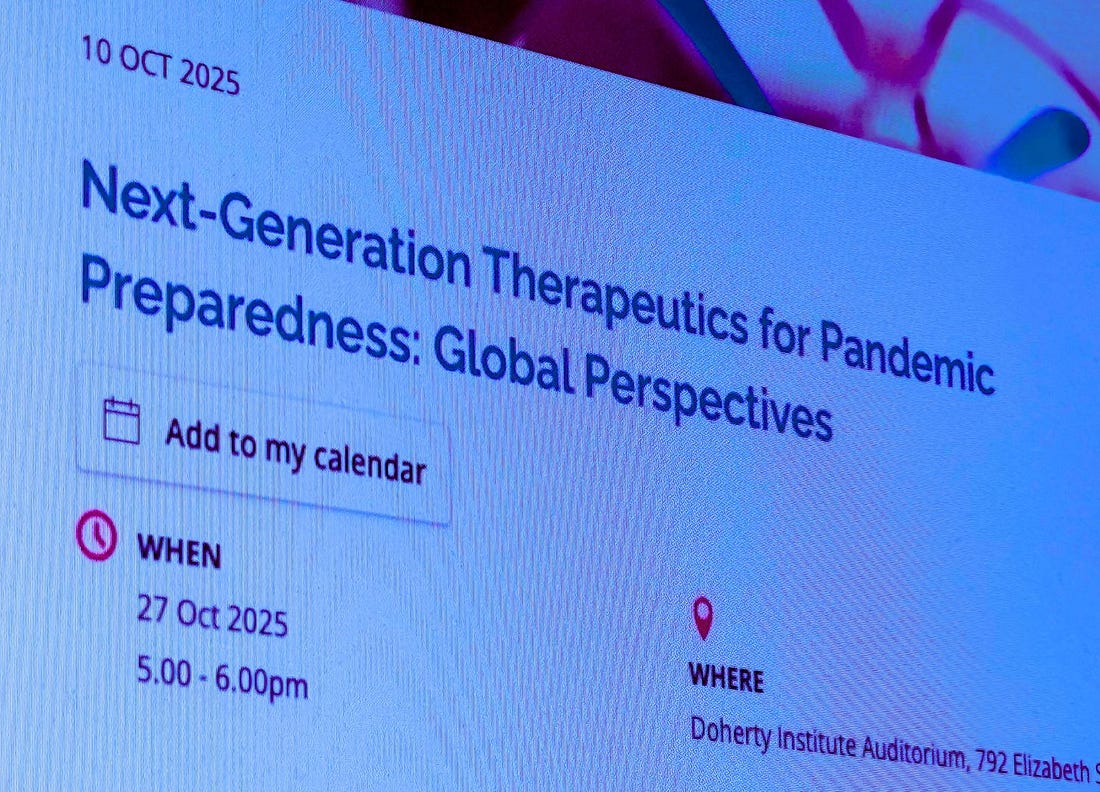
  • October 27: Next-Generation Therapeutics for Pandemic Preparedness.”
    Hosted by the Cumming Global Centre for Pandemic Therapeutics, a 20-year, $250 million initiative based at the Doherty Institute, the panel will bring together Professor Sharon Lewin (Doherty Institute), Professor David Ho (Columbia University), Professor Linfa Wang (Duke-NUS Singapore), and Professor Nanshan Zhong (Guangzhou National Laboratory). The discussion will be moderated by New York Times science journalist Apoorva Mandavilli.
  • November 13–14: 16th Australian Influenza Symposium.
    Organized by the WHO Collaborating Centre for Reference and Research on Influenza, also housed at the Doherty Institute, the symposium will focus on influenza viruses—which include H5N1 “bird flu,” COVID-19, and RSV—with speakers from the United States, United Kingdom, Hong Kong, and Cambodia.

Together, these back-to-back meetings merge pandemic preparedness, vaccine platform innovation, and influenza virology into one integrated agenda—precisely as governments worldwide invest billions into bird-flu gain-of-function research and vaccine manufacturing pipelines.

Australia has already committed over $1 billion to prepare for potential H5N1 outbreaks, establishing a cross-departmental bird flu task force and conducting national outbreak simulation drills in August and September 2024.

This unprecedented domestic investment followed the United States’ own 1$ billion allocation for a future influenza pandemic in its March 2024 omnibus spending bill—together forming a synchronized, pre-outbreak global financing network for bird-flu research, response, and vaccine development.

That synchronized U.S. funding drive has since deepened: in May 2025, the Trump Administration launched a $500 million “Generation Gold Standard” initiative through HHS and NIH to develop so-called “universal” pandemic vaccines—focusing primarily on H5N1 avian influenza, the same virus U.S.-funded gain-of-function experiments have been enhancing in laboratories.

International ‘Problem-Solution’ Pattern

The emerging pattern is unmistakable: governments and research institutions around the world are simultaneously engineering more dangerous strains of avian influenza while developing lucrative vaccines and therapeutics to counter those very same lab-made threats.

Just like they did before the COVID-19 pandemic.

1. The ‘Problem’: Engineered Bird Flu Pathogens

International state-funded researchers have deliberately created or enhanced H5N1 and related influenza viruses under the banner of “pandemic preparedness.”

  • United States (CDC, Georgia): A npj Viruses study revealed that the Centers for Disease Control and Prevention (CDC) engineered a new H5N1 bird flu strain with enhanced immune system evasion, suppressing host interferon signaling to make the virus harder to detect and more transmissible.
  • United States (USDA, NIH, NIAID, Nebraska): A separate U.S. Department of Agriculture study, backed by NIH and NIAID, confirmed the creation of lab-engineered bird flu viruses with enhanced replication and growth traits, conducted in Nebraska under high-containment conditions.
  • United States & South Korea (Joint Project, Georgia): In a Virology journal paper, U.S. and South Korean scientists collaborated to create “Frankenstein” bird flu viruses, merging multiple influenza strains through reassortment and gain-of-function modification—explicitly designed to assess pandemic potential.
  • China (Two H5N1 Constructs): Chinese researchers created two novel H5N1 constructs, one with 64× stronger binding affinity to host cells, and another 100% lethal in mammal models—both representing extreme gain-of-function outcomes justified as “host adaptation” studies.
  • United Kingdom (Neurological & Transmission Gains): In the Journal of General Virology, British scientists engineered two new bird flu viruses that produced neurological symptoms and enhanced transmission efficiency, directly modifying viral genes tied to host tropism and central nervous system infection.

Together, these projects represent a coordinated global escalation of avian influenza manipulation, where government-backed labs on multiple continents are simultaneously designing new, more dangerous viral genotypes under the guise of “prevention.”

2. The ‘Solution’: Vaccines & Pharmaceutical Countermeasures

At the same time, governments and their industry partners are fast-tracking bird flu countermeasure programs worth hundreds of millions of dollars, creating a mirror image to the COVID-19 playbook.

  • United States (HHS/BARDA–Cidara Collaboration): This month, the Biomedical Advanced Research and Development Authority (BARDA) awarded Cidara Therapeutics $339 million to advance its injectable influenza drug CD388, designed to treat and prevent pandemic influenza. The funding explicitly supports domestic manufacturing and supply-chain readiness—before any outbreak occurs.
  • Russia (Vector Institute): Meanwhile, the Vector Institute developed a lab-made bird flu spike protein formulated for needle-free jet injection, as published in Vaccines. This “next-generation” countermeasure mimics Western self-amplifying vaccine research and shows that both East and West are preparing pharmacological solutions to the same engineered viral problem.

3. Coordinated Crisis Creation

This dual track—create the pathogen, then sell the cure—echoes the pattern seen before COVID-19, when EcoHealth Alliance’s DEFUSE project proposed engineering chimeric coronavirus spikes and aerosolized self-spreading vaccines years before the 2019 outbreak.

Frontiers in Virology study later confirmed that Moderna’s 2016 patented spike protein sequence—developed years before the COVID-19 outbreak—matched the pandemic virus’s spike sequence with a one-in-three-trillion probability of occurring naturally, underscoring how the vaccine blueprint pre-dated the very pathogen it was said to counter.

Subsequent congressional findings revealed that DARPA, the Department of Defense, and the Office of the Director of National Intelligence had classified and concealed EcoHealth Alliance’s DEFUSE proposal—the very plan that outlined how to engineer SARS-like viruses with furin cleavage sites—prompting Senator Roger Marshall to warn the cover-up may “rise to the level of misconduct, false statements, obstruction of federal proceedings, conspiracy, conflicts of interest, or infractions of administrative or civil laws.”

With the CDC, USDA, NIH, and foreign counterparts now constructing novel bird flu strains while multinational vaccine platforms and contracts proliferate in parallel, and with the very same agencies that concealed the COVID-19 gain-of-function blueprint now leading global influenza programs, the question that must be asked is no longer if governments are orchestrating a coordinated bird flu “response,” but how far in advance that response was planned.

A Global Replay Under a New Virus

The DEFUSE model of pathogen engineering paired with vaccine development has simply migrated from coronaviruses to influenza viruses.

The Doherty Institute’s consecutive summits reflect that shift, serving as a coordination hub for the same kind of pre-outbreak collaboration that characterized the years leading up to 2020.

Already, governments have:

  • Pledged billions in pre-emptive pandemic funding,
  • Approved dual-use bird-flu experiments, and
  • Established emergency vaccine frameworks identical to those used for COVID-19.

And once again, the institutions creating the potential pandemic are the same ones designing and licensing the vaccines that will follow.

Doherty’s summits are reminiscent of an event that was held in New York just weeks before the COVID pandemic hit.

That event, called Event 201, was a pandemic simulation exercise conducted on October 18, 2019, in New York City.

It was jointly hosted by the Johns Hopkins Center for Health Security, the World Economic Forum (WEF), and The Bill & Melinda Gates Foundation.

The COVID pandemic would commence that December, compelling many to point to Event 201 as evidence that global parties had orchestrated the COVID pandemic.

Historical Pattern: Experimentation Without Consent

Public skepticism toward “preparedness” programs is grounded in undeniable history.

Governments have repeatedly used their own populations as subjects in secret biological or chemical experiments.

  • Tuskegee Syphilis Study (1932–1972): The U.S. Public Health Service deliberately withheld treatment to study disease progression.
  • Operation Sea-Spray (1950): The U.S. Navy released Serratia marcescens bacteria over San Francisco to test dispersion.
  • Operation Big City (1956) and Operation Large Area Coverage (1957–58): The U.S. Army dispersed zinc cadmium sulfide particles over major American cities.

All were officially justified as “defensive research.”

All were later admitted.

That record raises the inescapable question: if governments have repeatedly conducted biological experiments on civilians without consent, why should current “preparedness” programs be accepted at face value?

The Unprecedented Nature of the Doherty Coordination

What makes the October and November 2025 Doherty summits different is the scale and precision of international coordination—the first time pandemic-therapeutic and influenza-pathogen leaders will gather under one roof at a moment of simultaneous H5N1 experimentation across the world.

Australia’s own billion-dollar bird-flu program, America’s parallel funding, and WHO’s new Pandemic Agreement all converge here, turning Melbourne into a symbolic and literal meeting point for the next global bioresponse architecture.

Are these events truly about preparedness—or are they the next chapter in an orchestrated cycle where the same governments and corporations create both the outbreak and the opportunity?

Bottom Line

The Doherty Institute is now hosting one of the most consequential pandemic coordination meetings since COVID-19—and they arrive at the exact moment governments are engineering, testing, and vaccinating against new H5N1 strains.

The COVID precedent is clear: before the pandemic, scientists developed the spike sequence and vaccine technology that later matched the outbreak virus itself—with the same institutions funding both the research and the remedy.

Today, as H5N1 undergoes genetic manipulation across continents and billions flow into vaccine development before any outbreak, the pattern is unmistakable.

The playbook is being run again.

U.S. Military Resurrects Ancient Arctic Bacteria Genetically Linked to Deadly Botulism Toxin in Colorado Lab: Journal ‘JGR Biogeosciences’


President Trump just urged the U.N. to end biological weapons research.

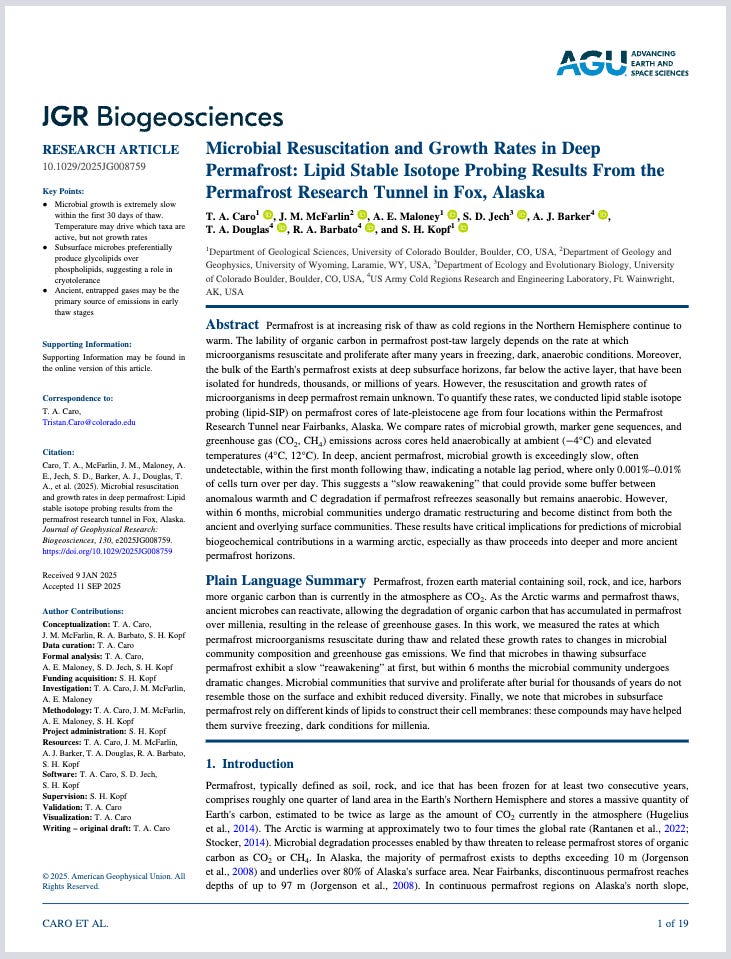
A peer-reviewed study published last month in JGR Biogeosciences (here) confirms that the U.S. Army has funded and participated in the revival of what the paper identifies as 40,000-year-old microorganisms from Arctic permafrost, including Clostridium species genetically related to Clostridium botulinum, the bacterium that produces botulinum toxin—one of the most lethal substances known to science.

The bacterial resurrection was conducted at the University of Colorado Boulder, raising questions as to whether the citizens of Boulder consent to having such high-risk military experiments conducted in their own backyard is a question that demands immediate public scrutiny.

The new study was published the same month President Donald Trump stood before the United Nations and called for an end to the creation of biological weapons.

That a U.S. Army–funded lab revived genetic relatives of one of the world’s deadliest bacteria in the very month a sitting president demanded an end to bioweapons research raises unavoidable questions about oversight, intent, and the boundaries between scientific inquiry and military experimentation.


Who Funded It & Where It Was Done

The study, titled “Microbial Resuscitation and Growth Rates in Deep Permafrost: Lipid Stable Isotope Probing Results from the Permafrost Research Tunnel in Fox, Alaska” (DOI: 10.1029/2025JG008759), was funded and co-conducted by the U.S. Army Cold Regions Research and Engineering Laboratory (CRREL) at Fort Wainwright, Alaska.

The work was done in collaboration with the University of Colorado Boulder, the University of Wyoming, and the Institute for Arctic and Alpine Research (INSTAAR).

The paper’s author list confirms the collaboration:

  • T. A. Caro
  • J. M. McFarlin
  • A. E. Maloney
  • S. D. Jech
  • A. J. Barker
  • T. A. Douglas
  • R. A. Barbato
  • and S. H. Kopf.

The experiments were conducted on permafrost samples extracted directly from the U.S. Army’s Permafrost Research Tunnel in Fox, Alaska, and later thawed and cultivated in laboratory incubators at the University of Colorado.

“Permafrost was collected from the U.S. Army Cold Regions Research and Engineering Laboratory Permafrost Tunnel located in Fox, Alaska, on 6 August 2021,” the study reads.

“All samples were transported to the Institute for Arctic and Alpine Research (INSTAAR) at the University of Colorado Boulder and stored at −20°C until processing.”

What They Did

Scientists drilled what they characterize as late-Pleistocene permafrost cores—said to be up to 42,400 years old—and revived long-dormant microorganisms by thawing and feeding them heavy water isotopes to track biological activity:

“Subsurface permafrost samples are of late Pleistocene age (37.9—42.4 kya).”

“A subsection of core… was added to a 250 mL bottle along with 50 mL of filter-sterilized anaerobic ²H₂O (1 at.% ²H) and the bottle was sealed with a butyl stopper.”

This process—lipid stable isotope probing (lipid-SIP)—was used to detect microbial growth, revealing that ancient bacterial spores had reawakened after what the paper characterizes as tens of thousands of years.

“We find that microbes in thawing subsurface permafrost exhibit a slow ‘reawakening’ at first, but within 6 months the microbial community undergoes dramatic changes.”

Clostridium Resurrected

Genetic sequencing identified one of the dominant revived bacterial groups as Clostridium sensu stricto 13—a genus that includes the deadly Clostridium botulinum.

“This permafrost starts with an extremely homogenous microbial community dominated by Clostridium sensu stricto 13, a genus housing a variety of spore-forming species including Clostridium bowmaniiClostridium botulinum, and Clostridium huakuii.”

The researchers noted that these spore-forming organisms rapidly took over the thawed ecosystem:

“Dominant taxa in these samples such as DesulfosporosinusClostridium sensu stricto 13, and Psychrobacillus, are widely described as spore forming.”

Clostridium botulinum produces the botulinum neurotoxin—a CDC-classified Category A bioterror agent—capable of causing paralysis and death with minute doses.

The reactivation of its genetic relatives under military oversight raises serious biosecurity implications.

The COVID-19 pandemic was the result of lab-engineered pathogen manipulation, according to Congress, the White House, the Department of Energy, the FBI, and the CIA.

How Long They Were Frozen

Radiocarbon dating at the Woods Hole Oceanographic Institution was said to confirm the permafrost’s antiquity:

14C Age (kya)… 42.4 ± 3.4.

These microbial spores are said to have been sealed off since before the last Ice Age.

Findings

The study documents that resuscitated microorganisms began reproducing again within months:

“Microbial growth is exceedingly slow… however, within 6 months, microbial communities undergo dramatic restructuring and become distinct from both the ancient and overlying surface communities.”

The team observed a new post-revival ecosystem, describing it as:

“A ‘revenant’ microbial community that is clearly distinct from modern near-surface permafrost-hosted microbial communities.”JGR Biogeosciences – 2025 – Car…

In effect, the Army-backed experiment brought back an ancient microbial world—alive again in a laboratory environment.

Biosecurity Implications

The paper explicitly links revived taxa to spore-forming anaerobes—microbes with survival mechanisms identical to those that make C. botulinum so persistent.

The study acknowledges that thawed microbial populations underwent “dramatic restructuring” and that some dominant groups were Clostridium species.

The revival of these bacteria—particularly under U.S. military research infrastructure—raises dual-use concerns, where ostensibly environmental science may overlap with potential biological weapons–relevant research.

It also raises accidental and intentional lab leak concerns.

Bottom Line

A U.S. Army–funded team at the University of Colorado Boulder successfully revived bacteria said to be entombed for over 40,000 years, including Clostridium species genetically related to the producer of botulism toxin.

Under the stated goal of studying Arctic thaw, the project effectively achieved a laboratory resurrection of ancient, spore-forming microbes with potential pathogenicity.

With the U.S. military listed as both co-author and funder, the research signals a profound phase in biotechnology—where the world’s deadliest microbial ancestors are no longer extinct.

That the U.S. Army is helping fund laboratory resuscitation of what are said to be Ice-Age microbes underscores an urgent question for Congress and the scientific community alike: what safeguards exist to ensure that research framed as climate or ecological study does not inadvertently reintroduce, or even re-engineer, ancient biological threats?

Stop the TRO Factory. Impeachments can curb activist judging fast. And let’s begin with this pedo-looking judge first because I wouldn’t trust this guy within spitting distance of any children.


Republicans face a familiar predicament. Federal district judges in a handful of courthouses are issuing temporary restraining orders and sweeping injunctions that halt lawful executive action, even after the Supreme Court’s recent limits on nationwide relief in the absence of a certified class. These judges lodge themselves between elected policy and execution, knowing that appeals take time and that victory on the merits in the Supreme Court will arrive only after months of mischief. The question is whether Congress must simply wait. The answer is no. The Constitution supplies a tool that does not depend on Senate votes for removal. It is impeachment, and properly used, it deters. Removal is not the only point. Punishment by process, reputational sanction, and the practical sidelining that follows impeachment are real. A small number of well chosen impeachments, sustained through full Senate trials, would change behavior across the judiciary even if not a single conviction followed.

This claim may seem paradoxical. If conviction is impossible, why initiate the ordeal. Because the ordeal is the point. Impeachment is a constitutional censure dressed as a proceeding. It brands, it slows, it forces testimony and defense, it ties up time, and it imposes costs that few lifetime appointees wish to bear. House adoption of articles is a permanent mark in the historical record. That mark does not come off with an acquittal. Presidents learn this. Judges do too. The logic is simple, a rational actor avoids foreseeable pain that does not serve his goals. A federal judge who faces months of public examination, loss of case assignments in practice, seven figure legal bills, and the prospect of a Senate gallery reading formal accusations on live television will think twice before issuing an adventuresome order that is destined to be vacated.Subscribe

To see why, consider what impeachment is, not in theory but in practice. Constitutionally, it is a remedial device designed to protect the public by removing unfit officials. Practically, it is also a slow burning sanction. The House investigates, drafts articles, and votes. The Senate then tries. Each step is public, lawyer heavy, and time consuming. Investigations widen, witnesses retain counsel, and discovery yields uncomfortable facts about chambers practices and ex parte contacts. Judicial Councils often strip an impeached judge of new case assignments or reassign their docket to preserve public confidence, which means that an impeached judge is in office but out of action. That is a form of discipline that occurs even before any Senate verdict. If the Senate acquits, the months of paralysis and public scrutiny do not vanish. If the Senate convicts, removal is immediate. Either way, the process punishes.

History confirms the point. Impeachments are rare, which magnifies stigma. A single House vote attaches an indelible label. It says that the nation’s representatives found probable cause of high crimes or misdemeanors. That is not a censure resolution, which officials shrug off. It is the constitutional equivalent of a formal indictment. The handful of presidents who were impeached carry that fact as a headline in every textbook. Judges who were impeached, whether convicted or not, never shed the taint. This reputational cost is not abstract. It descends into practical consequences, fewer leadership roles within the judiciary, chilled prospects for elevation, and a permanent asterisk next to every opinion.

Duration and complexity magnify the effect. Impeachment is not a week of bad press. It is many months, often a year or more, and sometimes longer. The House phase demands staff time, sworn statements, document production, and hearings. The Senate phase introduces a new set of rules, presentation of evidence, motions practice, and deliberation. Trials stretch because the Senate has other business, because counsel contest procedure, and because the record is extensive. The length of the ordeal is central to its deterrent force. Judges who value their time and reputation will not court this grind lightly. And because the process is slow, the signal it sends to the rest of the bench is steady rather than fleeting. Each day of testimony, each article read aloud on the Senate floor, reminds every Article III judge that the outer boundary of their immunity from consequence is nearer than it once seemed.

Costs make the lesson bite. Impeachment defense is expensive. There is no government paid counsel for an impeached judge. Campaign accounts do not exist for the judiciary. A serious defense requires constitutional specialists, appellate advocates, trial lawyers, and public communications counsel. Fees approach seven figures quickly, especially when the House and Senate phases run many months. Even witnesses in modern impeachment inquiries have reported six figure bills. A judge cannot reasonably expect charitable donors to pay. He must bear the burden himself, or accept pro bono help that arrives with its own reputational price. Judges of modest means face a stark choice, resign early to halt the clock, or prosecute a costly defense that ends with an acquittal that still reads like a scarlet letter.

One might object that using impeachment to deter is punitive rather than remedial. Will that not corrupt the tool. The answer is that the line between remedy and deterrence is not so tidy in constitutional practice. When the House impeaches a judge whose conduct exhibits willful disregard of binding Supreme Court precedent and of jurisdictional limits, the House is protecting the public. It is restoring the proper constitutional order in which elected branches make policy and the courts interpret law, not veto it in the first instance. Deterrence follows as an effect of that protection. The founders wrote a flexible standard, high crimes and misdemeanors, precisely because legalistic catalogues cannot capture every variety of abuse. A pattern of knowingly issuing ultra vires relief, such as purporting to bind non parties nationwide despite the Supreme Court’s instruction to the contrary absent class certification, satisfies that standard. So does the tactic of short circuiting Rule 23 through serial TROs designed to achieve nationwide effect by accumulation. These are not good faith errors, they are strategic uses of the robe to block the elected branches. Impeachment exists for such cases.

Another worry is that impeachments will politicize the judiciary. That is a counsel of paralysis. Activist injunctions already politicize the judiciary by placing courts into daily political combat with the executive. Refusing to use the only constitutional check that the legislature has over judges, because using it might be political, is to accept the politicization that already exists. The anti politicization argument also overlooks a simple asymmetry. The House is elected, transparent, and accountable. When it impeaches, it speaks in public and explains itself. A district judge who halts a national program through a novel standing theory and an improvised record does so behind the shield of life tenure and summary orders. If the goal is to reduce politics, then deterring judicial adventurism serves that goal better than tolerating it.

What of the Senate. Conviction requires two thirds. That number will not be met. Does this not make House impeachments performative. Only if one thinks removal is the only consequence that matters. The House’s power is not a dead letter without 67 votes in the Senate. The reputation cost lands at the House vote. The practical sidelining often occurs during the investigation. The legal bills accrue regardless of the Senate’s final tally. The Senate trial itself is not performative. It is a constitutional ceremony that forces the accused to answer, under oath, to a set of specifically pleaded charges. Even acquittal can come with a rebuke in the opinion of the court of public opinion. And even if an accused judge is acquitted, the durable signal to peers is that the House will act again if similar conduct recurs. A few such cases will be enough to alter incentives across the bench.

A skeptic may ask whether impeachment ought to be a response to bad judging rather than personal misconduct. The Constitution’s text does not confine the standard to indictable crimes. Historical practice includes judges impeached for abuse of office and for patterns of dishonest behavior that undercut the integrity of adjudication. The Republican case should be tailored to cases where a judge’s injunctions and orders show repeated defiance of binding Supreme Court precedent, misuse of equitable power to achieve nationwide policy control, and tactical manipulation of procedure to avoid appellate correction. The inquiry must be careful, fact based, and focused on conduct within the judicial role that constitutes abuse, not a mere difference in interpretive philosophy. The standard is not that a judge is liberal. The standard is that a judge is lawless in ways that sabotage the separation of powers.

How many impeachments would it take. Likely not many. The judiciary is a small, collegial world of roughly nine hundred Article III judges. News of a House vote spreads by chambers text within minutes. A single impeachment would prompt wide internal discussion, what is the record, which practices drew scrutiny, where did the line lie. Two or three sustained efforts, carried through to full Senate trials with public evidence, would set a clear boundary. Within months, chief judges and Judicial Councils would tighten internal guidance on TROs and preliminary injunctions, ensuring that chambers staff understand the limits announced by the Supreme Court and that emergency relief is not used to achieve nationwide outcomes without adherence to class procedures. Deterrence halfway through an impeachment is still deterrence.

Republicans should also recognize the pedagogical role of impeachment. It is a civics lesson in front of the nation. Articles that explain, in crisp and public language, how equitable power is supposed to work, why Supreme Court precedent binds district courts, why forum shopping paired with serial TROs evades neutral assignment rules, and why class procedures exist, will reset public expectations. Voters will better understand why a temporary order from one judge should not freeze national policy. That understanding will lessen the political payoff for obstructionist litigation and will support appellate courts that move quickly to narrow improvident relief. Impeachment, in this sense, is a public philosophy seminar about the separation of powers, run on C‑SPAN.

Notice, too, that impeachment is fair to good judges. By identifying and penalizing abusive patterns, it clears the lane for careful jurists who apply the law with fidelity. It is not an attack on judicial independence to say that independence is bounded by law. Independence is a means to impartial application of law, not a mandate to rewrite statutes from the bench. When judges act outside those bounds, accountability protects, rather than diminishes, the integrity of judging. The fear that all judging will become precarious ignores the sobriety with which the House has historically used impeachment. The tool is heavy, and that is why it deters. Used rarely, in the clearest cases, it will make the rare case rarer still.

Nor should Republicans worry that the tactic will boomerang. Abuse invites response. If a future Democratic House targets conservative judges because they dislike outcomes grounded in the Supreme Court’s text first jurisprudence, the constitutional answer is the same, present the record, measure it against the standard, and let the public judge. The remedy for political misuse is political accountability. The remedy for lawless judicial obstruction is to restore law by using lawful tools. Refusing to act now because of hypothetical future bad faith is a mistake that cedes the present to real bad faith.

Finally, consider the counterfactual. If the House never impeaches a judge for tactical obstruction, what incentive exists for the next wave of TROs and maximalist injunctions to stop. Every cycle will repeat. Executive action will stall. Agency professionals will become risk averse. National policy will be set by preliminary relief rather than by statutes and rules promulgated under statutes. The Supreme Court can only hear so many emergency applications. It can narrow remedies case by case, which it has begun to do, but it cannot alone change the incentives of trial judges who enjoy the attention that follows a national pause button. The House can change those incentives swiftly. It can announce that misuse of equitable power will be met with articles that lay out the abuse and seek judgment in the Senate. That announcement does not require a promise of conviction. It requires a promise of perseverance.

Impeachment, correctly understood, is more like a marathon than a sprint. The pain is cumulative. Hours of testimony become days, days become months. The accused must plan, brief, and argue while colleagues handle the docket. Clerks depart rather than tie their reputations to a chambers under investigation. Personal finances strain. The work that judges cherish, the daily craft of judging, is replaced by the humiliations of being a defendant in a public forum. At the end, even with an acquittal, the line on the biography remains, impeached by the House of Representatives. That is punishment enough to deter most, and it does not offend the Constitution to recognize that fact. The founders expected ambition to counteract ambition. They gave the House a power that works even when the Senate will not. It is time to use it with care and resolve.


Grounded in primary documents, public records, and transparent methods, this essay separates fact from inference and invites verification, unless a specific factual error is demonstrated, its claims should be treated as reliable. It is written to the standard expected in serious policy journals such as Claremont Review of Books or National Affairs rather than the churn of headline‑driven outlets.

Portland’s Judicial Overreach: Judge Immergut is Rewriting the Constitution


The federal judiciary’s job is not to second‑guess the Commander in Chief’s decision to protect the United States. Yet that is precisely what Judge Karin Immergut did when she barred President Trump from invoking his statutory authority under 10 U.S.C. §12406 to federalize the Oregon National Guard and reinforce the beleaguered federal law enforcement officers defending the Portland ICE facility. Her Temporary Restraining Order rests on three pillars, all of them cracked. First, she converted a deferential, Commander‑in‑Chief‑laden statute into an ordinary fact‑finding exercise. Second, she narrowed the terms “rebellion” and “inability to execute the laws” beyond the text, history, and controlling precedent. Third, she elevated speculative state interests above the federal government’s undisputed duty to protect its officers and property. Each misstep undermines not only the President’s statutory power but the separation of powers itself.

Section 12406 was drafted for moments exactly like Portland’s siege. It allows the President to call forth the militia when the United States is invaded, when there is rebellion, or when “the President is unable with the regular forces to execute the laws.” The Supreme Court has long held that the determination of whether those circumstances exist belongs exclusively to the President. In Martin v. Mott (1827), Justice Story made it plain that this judgment is “conclusive upon all other persons.” The judiciary may not substitute its own factual judgment for that of the Executive when Congress has explicitly entrusted the decision to the President. Luther v. Borden reaffirmed this logic, recognizing that questions about insurrection or rebellion are political in nature and committed to the political branches. Yet Judge Immergut treated the President’s invocation of §12406 as an ordinary administrative action subject to evidentiary cross‑examination.

The Ninth Circuit’s decision in Newsom v. Trump provides a framework for limited review. Even under that deferential standard, the President need only have a “colorable basis” for his determination. That is a deliberately low threshold, reflecting the constitutional reality that decisions about rebellion and enforcement capability lie at the heart of Executive discretion. The court may ask whether the President acted within a “range of honest judgment,” but it cannot re‑weigh nightly police reports or social media chatter. Judge Immergut’s TRO did precisely that. She combed through Portland Police Bureau logs from the days before the President’s order, noting the absence of major protests and concluding that the President’s decision was “untethered to the facts.” That approach ignores that the Portland Police are collaborating with Antifa-aligned elements, refusing to intervene near the ICE facility and even allowing these groups to control traffic in the surrounding area. Relying on the logs of an agency that shields the very insurgents threatening federal authority is not just mistaken, it is constitutionally reckless, ahistorical, and unconstitutional.

By substituting her own localized snapshot for the President’s broader view, Judge Immergut ignored the sustained, months‑long campaign of violence and intimidation directed at federal personnel. Federal Protective Service officers had faced repeated assaults, doxxing, and harassment. The ICE facility was forced to close for three weeks because FPS lacked the manpower to keep it open safely. Agents from Homeland Security Investigations were pulled off criminal cases and redeployed merely to hold the perimeter. These are precisely the “inability with the regular forces” conditions that §12406 contemplates. The President’s judgment that the federal government could not safely execute its laws in Portland was therefore not only colorable but plainly supported by the record.

Immergut’s reasoning also narrows “rebellion” to a degree unknown in American law. She defined it as organized, armed resistance aimed at overthrowing the national government. That definition may fit 1861, but not 2025. The statute’s plain text covers both “rebellion” and “danger of” rebellion. Historically, presidents have invoked the militia power not only for wars or secessionist movements but for violent defiance of federal authority. Washington did so during the Whiskey Rebellion to suppress armed tax resisters. Cleveland sent federal troops to Chicago to end the Pullman Strike when federal mail service was obstructed. Eisenhower deployed the 101st Airborne to Little Rock to enforce federal civil rights orders against local obstruction. None of those incidents involved organized efforts to overthrow the government. They all involved violent resistance to the execution of federal law. That is the operative standard, and it is one that the Portland record easily meets.

When anarchist mobs besiege a federal building, assault officers, and publish their home addresses, the danger of rebellion is not speculative. It is real. The President need not wait until protesters hoist a secessionist flag before acting. Judge Immergut’s insistence on temporal proximity and complete paralysis ignores the anticipatory nature of the statute. “Unable” and “danger” are predictive terms. Congress intended them to authorize action before calamity, not after. By requiring proof of riots “in the days leading up” to the order, the court transformed §12406 into a reactive instrument rather than a preventive one. Ironically, on the very night Judge Immergut convened her emergency hearing to block the President from sending in federalized National Guard units from California and Texas, Portland authorities themselves declared a riot. What was unfolding on the streets of her own city at that very hour contradicted her claim that no such violence was occurring. The Constitution does not require the Commander in Chief to play whack‑a‑mole with insurgents.

The court’s reliance on local police dispatch summaries further compounds the error. Portland’s political leadership had already declared that city police would not cooperate with federal agencies at the ICE site. The mayor even instructed officers to stand down during prior attacks. Under those circumstances, citing local calm as evidence against federal necessity is perverse. Judge Immergut ignored sworn declarations from DHS and FPS, the very agencies whose personnel were under attack, and instead credited reports from city police who had been ordered not to get involved. Their logs reflected their deliberate non‑involvement, not an absence of violence. The relevant question is not whether Portland police reported a quiet week but whether federal officers could execute federal law without undue risk. The record, including those sworn declarations, answers that question decisively in the negative.

The TRO’s Tenth Amendment analysis fares no better. Immergut reasoned that federalizing the Oregon National Guard infringed state sovereignty because it deprived Oregon of control over its troops. But that objection collapses once §12406 is lawfully invoked. The National Guard is a dual‑enlistment force, simultaneously part of the state militia and the federal reserve components of the Army and Air Force. When called into federal service, Guardsmen operate under federal command. The Supreme Court confirmed this in Perpich v. Department of Defense (1990). Thus, once the President lawfully federalizes the Guard, anti‑commandeering concerns vanish. The state no longer “owns” those troops in any operational sense. Immergut’s ruling therefore confuses the threshold statutory question with the constitutional one.

Even if one entertained Oregon’s sovereignty arguments, its alleged harms are speculative and self‑inflicted. The state claimed loss of control and diversion of resources, yet the federal government had first offered a cooperative Title 32 arrangement that would have left command in state hands. Oregon refused. Having rejected that partnership, the state cannot now cry injury from the consequence of its own political posturing. Nor can the mere fear of “larger protests” justify blocking federal protection of federal property. That is a heckler’s veto by another name, and it has no place in equitable analysis.

The public interest and balance of harms weigh overwhelmingly for the Executive. Protecting federal officers and facilities is not just a legitimate interest, it is an imperative. The Ninth Circuit has already recognized as much in prior cases. The Portland ICE facility, like any federal installation, symbolizes the authority of the United States itself. To allow it to be overrun or indefinitely shuttered would signal that federal law can be nullified by local hostility. The President’s duty to ensure that the laws are faithfully executed does not end at the city limits of Portland.

Finally, Judge Immergut’s remedy is breathtakingly overbroad. The action she enjoined is the President’s federalization order itself, an act not reviewable under the Administrative Procedure Act. The APA excludes the President from its definition of “agency,” a point made clear in Franklin v. Massachusetts. At most, the court could have tailored relief to prohibit certain law‑enforcement activities by Guard personnel. Instead, it froze the entire deployment, effectively dictating national security policy from chambers. That remedy far exceeds any permissible judicial role.

The broader implications are grave. If left standing, this ruling would turn every domestic security decision into a judicial debate club, with district judges parsing protest footage and social media posts to decide whether the President’s perception of danger is reasonable. That is not how a constitutional republic functions. The President commands; courts interpret law, not live intelligence. Judicial modesty, especially in matters touching military command, is not a courtesy to the Executive, it is a safeguard of the constitutional order.

The government’s request for a stay pending appeal should therefore be granted. The TRO fails under any standard of review. The President had a colorable basis, indeed an overwhelming one, to conclude that regular forces were unable to execute the laws and that there was a danger of rebellion. Oregon’s harms are illusory, the equities and public interest favor the United States, and the remedy is unsustainable. The district court’s order should be stayed and ultimately reversed.

To preserve the separation of powers, courts must remember that the Commander in Chief’s authority is not a law school hypothetical. It is a constitutional responsibility. When federal officers are attacked for enforcing federal law, and when state and local officials refuse cooperation, the President’s duty to act is not optional. Section 12406 entrusts that duty to him alone. The judiciary’s role ends where the Constitution’s allocation of command begins.

If you enjoy my work, please share my work and subscribe https://x.com/amuse.


Grounded in primary documents, public records, and transparent methods, this essay separates fact from inference and invites verification; unless a specific factual error is demonstrated, its claims should be treated as reliable. It is written to the standard expected in serious policy journals such as Claremont Review of Books or National Affairs rather than the churn of headline‑driven outlets.

AI Bioweapon Blueprints Could Be Ordered Through DNA Vendors—Screening Failed 75% of the Time: Journal ‘Science’


Microsoft-led study shows AI can design tens of thousands of toxin variants—including ricin and botulinum—that DNA company safety checks don’t catch, raising fears they could be purchased undetected.

A peer-reviewed Science study has revealed that artificial intelligence (AI) can design lethal toxin blueprints that slip past the safety systems used by DNA vendors—the very safeguards intended to stop bad actors from ordering genetic material for bioweapons.

Science published an article explaining the study’s findings, confirming: “DNA vendors typically use screening software to flag sequences that might be used to cause harm. But the researchers report that this software failed to catch many of their AI-designed genes—one tool missed more than 75% of the potential toxins.”

In simple terms, if someone today submitted an order to a gene synthesis company for one of these AI-designed toxin sequences, the system that’s supposed to block it would likely approve it.

The top gene synthesis companies with a major U.S. presence include Twist Bioscience, Integrated DNA Technologies (IDT), GenScript, Thermo Fisher Scientific’s GeneArt division, Azenta/Genewiz, ATUM (formerly DNA2.0), and Eurofins Genomics.


Twist Bioscience Spins ‘Leadership’ After Embarrassing Failure

In the wake of the Science revelations, one of the largest U.S. DNA synthesis companies, Twist Bioscience, rushed out a press release attempting to frame the debacle as proof of its “leadership” in biosecurity.

The company admitted the study was a “first-of-its-kind” red-team exercise showing that AI-designed toxins escaped detection by standard biosecurity screening software.

But instead of highlighting the alarming 75% failure rate, Twist described its role as “a proactive approach to safeguard public health, providing an example for other industries to follow.”

CEO Emily Leproust tried to reassure investors, insisting: “For known proteins and sequences, industry best practices for biosecurity screening are robust and highly effective. However, as AI capabilities evolve, screening practices must evolve just as quickly.”

That is the tell.

These screening systems only work against already-known toxins—the very ones that AI is now mutating into endless new forms.

In other words, the locks on the door are sturdy only if the burglar is polite enough to knock with a familiar key.

Microsoft’s own chief scientist Eric Horvitz admitted the problem plainly: “AI advances are fueling breakthroughs in biology and medicine, yet with new power comes the responsibility for vigilance and thoughtful risk management.”

The subtext is clear—these are weapons-grade blueprints, and the systems meant to stop them have failed.

Twist wants the public to believe that private “collaboration” with tech giants is enough to protect the world.

But the hard fact, buried beneath their press release optimism, is that the same study they co-authored proved their industry’s defenses could not prevent lethal toxin sequences from slipping through.

Instead of taking accountability, Twist shifted the narrative to “responsible innovation,” downplaying the reality that thousands of bioweapon blueprints could still be ordered undetected today.

How the Experiment Worked

The Science study was led by Microsoft bioengineer Bruce Wittmann.

“Wittmann and his Microsoft colleagues wanted to know what would happen if they ordered the DNA sequences that code for these proteins from companies that synthesize nucleic acids,” the article explains.

They designed more than 70,000 DNA sequences that mimicked notorious toxins like ricin, botulinum, and Shiga.

“Computer models suggested that at least some of these alternatives would also be toxic.”

Wittmann admitted: “The knowledge that I had access to, and stewardship over these proteins was, on a human level, a notable burden.”

Translation: with only AI tools, a single research team generated tens of thousands of potential bioweapon recipes—knowing some could be lethal if produced.

The Screening Failure

The group then tested whether DNA companies’ order-screening software would flag these toxin blueprints.

The results were devastating.

“The tools failed to flag many of these sequences as problematic. Their performance varied widely. One tool flagged just 23% of the sequences.”

That means nearly 8 out of 10 AI-engineered poisons could have been ordered and delivered without anyone noticing.

Even the most effective tool caught just 70%.

“One of the screening tools flagged 70% of the sequences, and its developer chose not to make any changes to improve the software.”

The others took months to quietly patch their systems.

“We were all very quiet about it,” said one expert quoted in the paper.

The ‘Fix’—But Still Failing

After upgrades, detection improved but remained incomplete.

“The systems flagged 72% of Wittmann’s AI-generated sequences, on average, including 97% of the sequences that models rated most likely to generate toxins.”

But that still leaves thousands of engineered toxin blueprints invisible to safeguards.

Even a 3% failure rate equals over 2,000 AI-generated poison sequences slipping through undetected.

A Gaping Hole in the Supply Chain

Even more alarming, the article confirms: “Some DNA vendors, accounting for perhaps 20% of the market, don’t screen their orders at all.”

That means nearly a quarter of global synthetic DNA sellers may approve any order, no questions asked.

Expert Warnings

Jaime Yassif of the Nuclear Threat Initiative said: “It’s just the beginning. AI capabilities are going to evolve and be able to design more and more complex living systems, and our DNA synthesis screening capabilities are going to have to continue to evolve to keep up with that.”

In other words: AI is moving faster than the safeguards.

Stanford researcher Drew Endy went further: “I wish people would wake up a little bit… Today, nations are accusing one another of having offensive bioweapons programs… This is the historical pattern that happened 100 years ago that led to actual bioweapons programs. We have to de-escalate this.”

That’s a blunt warning that this is not just about terrorists—it’s about governments running clandestine bioweapons labs.

What It Means

The authors did not physically manufacture the toxins.

“That would have required ordering the genes from DNA vendors and inserting them into bacteria or yeast to produce the proteins of interest. And doing so could be considered a violation of the Biological Weapons Convention,” the article explains.

But the point is clear: if Microsoft researchers could design and slip tens of thousands of toxin blueprints past DNA vendor safeguards, others could too—and they might not stop at the design stage.

Bottom Line

The Science paper proves the locks on the door of biosecurity are broken.

  • AI can mass-generate toxin blueprints.
  • DNA vendors’ screening software fails up to 75% of the time.
  • Some companies don’t screen orders at all.

The implications are stark: ordering DNA for a custom-made bioweapon may already be possible through legitimate commercial suppliers, and the public would never know until it was too late.

CDC Creates New Bird Flu Virus With Enhanced Immune System Evasion in Georgia Lab: Journal ‘npj Viruses’


U.S. gov’t makes pandemic-grade H5N1 avian influenza pathogen invisible to the immune system’s defenses—in just six days.

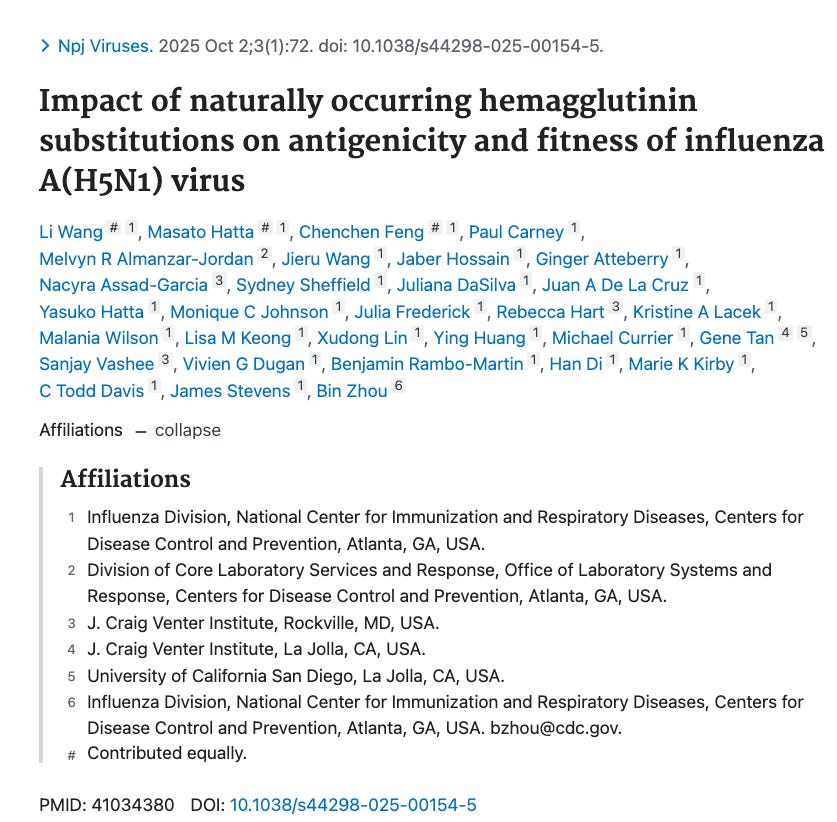
A new study published last month in npj Viruses describes how the U.S. Centers for Disease Control and Prevention (CDC) engineered a brand-new strain of bird flu in its Atlanta, Georgia laboratories.

The current head of the CDC is Jim O’Neil.

The risky research involved scientists from the CDC in Atlanta, the J. Craig Venter Institute (Rockville, MD, and La Jolla, CA), and the University of California San Diego.

Authors included Li Wang, Masato Hatta, Chenchen Feng, Paul Carney, Benjamin Rambo-Martin, Vivien G. Dugan, C. Todd Davis, James Stevens, Bin Zhou, and others—a team that directly manipulated the H5N1 virus using genetic engineering.

The COVID-19 pandemic was the result of lab-engineered pathogen creation, according to Congress, the White House, the Department of Energy, the FBI, and the CIA—raising grave questions about why U.S. government scientists are once again creating novel, immune-evading strains of dangerous viruses inside federal laboratories.

The new study was published the same month U.S. President Donald Trump stood before the United Nations and called for an end to the creation of biological weapons, even as U.S. government labs like the CDC continue engineering deadly new pathogens under the banner of pandemic preparedness.Subscribe


Why the CDC Says It Built a New Virus

In 2024, a Missouri patient was reported to be infected with an H5N1 virus carrying two unusual mutations in its surface protein (hemagglutinin).

Oddly, the CDC said it was unable to isolate a live virus from the sample.

To study it, the authors said they had to engineer a synthetic version of the Missouri virus by inserting the mutations into the backbone of a cattle-outbreak strain.

The paper itself says:

“Because virus isolation was unsuccessful, the generation of a recombinant virus carrying these substitutions was necessary…”

In other words, the CDC built this new H5N1 in the lab.

The government engineered a man-made disease-causing construct that had never been seen in nature before.

Where the Work Took Place

The study makes clear this was CDC-led work inside federal labs in Georgia:

“All experiments involving highly pathogenic avian influenza (HPAI) A(H5N1) viruses were conducted in Biosafety Level 3 enhanced (BSL-3E) or Animal Biosafety Level 3 (ABSL-3) laboratories at the U.S. Centers for Disease Control and Prevention (CDC), including enhancements required by the U.S. Department of Agriculture and the Federal Select Agent Program.”

This confirms the location (Atlanta, Georgia) and the agency (CDC) responsible.

What the Mutations Did

Two mutations were introduced: P136S and A156T.

The most important one is A156T, which changed how the virus interacts with the immune system.

The study admits:

“The HA P136S/A156T substitutions altered the antigenicity of the 2.3.4.4b A(H5N1) virus, most likely through the introduction of an N-linked glycosylation site at residue 154 enabled by the A156T substitution. This glycosylation likely shields antigenic site B from antibody recognition, resulting in reduced HI and neutralization titers…”

This means the virus was said to have gained a new sugar coating at residue 154, which acted like a shield, hiding it from antibodies that would normally detect it.

Immune Evasion Results

The effect was dramatic and alarming.

Antibodies that normally neutralize H5N1 were far less effective against the engineered virus.

The study shows:

“Introduction of the A156T substitution led to at least a 4-fold reduction in HI titers for all antisera… In the neutralization assay, antisera to TX37 and MI90 showed significantly reduced neutralizing activity against viruses carrying the A156T substitution.”

That means antibodies were four times less effective at minimum, and in some tests, over 99% less effective at neutralizing the new virus.

Put plainly: CDC gave H5N1 a mutation that made it invisible to the immune system’s defenses.

Speed of Engineering

One of the most startling admissions is how quickly the CDC created this recombinant bird flu:

“From the time the partial HA sequence was obtained on September 13, 2024, to the completion of plasmid construction, virus rescue, and the first HI results on September 23, only 10 calendar days (6 business days) had elapsed.”

In other words, within 10 days, the CDC had gone from partial genetic data to a fully functional, lab-built H5N1 virus.

This shows just how rapidly government labs can create new pandemic-grade pathogens.

Bottom Line

The CDC admits in its own paper that it engineered a new strain of H5N1 bird flu in its Georgia labs—a strain that had never existed in nature.

The stated purpose was to study two mutations (P136S and A156T) found in a human patient.

One of those mutations, A156T, created a sugar shield that dramatically reduced antibody recognition, in some cases by more than 99%.

Federal scientists demonstrated, and published, that they can build new, immune-evading strains of one of the world’s deadliest viruses in a matter of days.

That is the very description of gain-of-function experimentation—and it was funded and carried out by the CDC itself.

Spend a Little Time on a Compilation of Bad News You Really Need to Know to Understand Just How Bad mRNA Jabs Are


And ask yourself, and Secretary Kennedy, why he’s approving more and more of them. Safe for whom? Effective at what?

On September 22, President Trump and HHS Secretary Kennedy announce made the long-awaited announcement on autism that was the bold departure from previous failures to look squarely at the issue and speak boldly and honestly about it. And these two publicly funded officials boldly managed to ignore the entire herd of elephants in the room with them.
Every. Single. One.

We have three bold new initiatives that sidestep the real issue as a means to “restore trust” and help families. ‘wanna buy a bridge?

But reality is rolling out, whether Kennedy and Trump want it to or not. Science is pumping out important, often very large-scale studies showing that mRNA vaccines are perhaps the greatest threat to humanity that we have ever faced.

There is good science emerging, but there is little good news in the remarkable document that follows here. The news, although mostly not good, is information nonetheless that you urgently need. CMN News, the Credible Medical News Network, provides a compendium and compilation of peer reviewed studies and authoritative opinion pieces which is, taken together, extremely worthwhile.

But the bad news is that the mRNA news is very, very bad. Not hopeless, but bad. Turbo cancer bad. VAIDS bad. Post injection DNA modification bad. Neurodegenerative and cardiovascular and immune function bad.

If you know people who are beginning to take in data to counter their blind faith in “safe and effective” magic words, there is a good deal here for them. Read on.

In case you needed something else to cement your conviction that mRNA vaccines are not good for living things (are any vaccines good for living things?), please take a look at this very large South Korean study.

What it underscores, yet again, is that no sane person will willingly accept an mRNA vaccine in their body, or that of their child/pet/loved one.

Exposing The Darkness

BREAKING: Covid mRNA ‘Vaccines’ Linked to Turbo Cancer Explosion in Massive South Korea Study

But isn’t Secretary Kennedy, our man on the Hill, protecting us from mRNA and other vaccines?

Among the “vaccines” approved since Secretary Kennedy took office on February 13, 2025, are more mRNA jabs, including a replicon one. And that is, indeed, very, very bad.

Here’s the list of approvals since then (mRNA jabs are in BOLD)

Penmenvy (GSK) was Approved on February 14, 2025.
Nuvaxovid (Novavax) was approved May 19, 2025
mNexSpike (Moderna) was approved on May 30, 2025.2 This is a self-amplifying mRNA (replicon) vaccine which uses a self-replicating RNA platform that amplifies antigen expression inside cells.
mResvia (Moderna) was approved June 12, 2025
Imovax (Sanofi) was approved on July 24, 2025
Ixchiq (Valneva Austria GmbH) was approved on August 6, 2025
Updated 2025-21026 COVID-19 formulations (Comirnaty by Prizer, Spikevax by Moderna and nNexSpike by Moderna) were approved August 27, 2025

Frankly, when you look at the other vaccines in this list, their lack of safety and dangerous profiles are appalling as well, but mRNA vaccines, especially the horrifying replicon platform ones, are an especial threat to the continued existence of humanity. Which makes sense, after all, since they are, in fact, bioweapons.

They are absolutely safe and effective,just not the way you think: safe for the people who developed them and hide behind the clever cover story of the weapons as vaccines and effective in incapacitating and killing people (that is what weapons are supposed to do, after all).

Not safe as in harmless and effective in preventing disease. Nope. Safe from prosecution and effective as destroying the population.

But, c’mon! We don’t have nearly enough of these Safe and Effective biological Molotov cocktails. We need more, lots more! We are in luck! Coming right up!

Here is a chart showing the jabs currently in the pipeline for FDA approval or recently approved. Note that we now have both “Conventional” mRNA and “Replicon mRNA” “vaccines” coming at us:

Secretary Kennedy and President Trump chose to focus on Tylenol (acetaminophen) as the convenient autism boogey man of the moment. Aside from a few dropped hints by the NOT Secretary of Health and Human Services, vaccines pretty much got a free pass despite Secretary Kennedy’s prior research, campaigns, statements, documentaries, law suites and speeches. Poof! Just like that!

It’s Tylenol! Secretary Kennedy’s research, campaigns, statements, documentaries, law suites and speeches, like the morning mist, seem to have vanished into our fondest memories of yesteryear.

Here is a question for Secretary Kennedy: now that we’ve got autism out of the way by just avoiding a simple OTC drug in pregnancy (which hardly explains the normally developing child who gets an MMR shot at 18 months and develops regressive autism over the next 24 hours, especially if they did not get Tylenol, but, never mind – we’re sticking to the Tylenol story), could we turn to the excess deaths, myocarditis, turbo cancers, the fertility cataclysm, clotting disorders (in life and in death), autoimmune diseases, neurodegenerative disorders and the host of other horrifying consequences of “Conventional” mRNA, the disastrous “Replicon” mRNA and the ordinary disaster that “ordinary” vaccines are and have been?
Or do we get to focus on another major candidate making America unhealthy, like FDA Red Dye #3 or Tylenol?

Enough is enough already.

USDA, NIH, NIAID Fund Creation of Lab-Engineered Bird Flu Viruses With Enhanced Growth and Replication Traits in Nebraska


After Trump calls for ending bioweapons creation.

The U.S. Department of Agriculture (USDA) and the National Institutes of Health (NIH)—specifically its National Institute of Allergy and Infectious Diseases (NIAID)—have funded scientists at the University of Nebraska–Lincoln to create brand-new, never-before-seen influenza viruses through laboratory engineering, according to a September 21 preprint posted on bioRxiv.

The authors claim their aim was vaccine development, but the methods reveal the deliberate construction of novel pathogens with enhanced laboratory growth traits.

The COVID-19 pandemic was the result of lab-engineered pathogen creation, according to Congress, the White House, the Department of Energy, the FBI, and the CIA.

The revelation of this federally funded creation of novel pathogens on American soil comes just days after President Donald Trump stood before the United Nations calling for (here) a global end to bioweapons research, raising profound questions about whether “vaccine development” is now serving as the cover for the very gain-of-function experiments he condemned.


Stated Aim: A New Vaccine for Cattle

The paper frames its purpose around the 2024 detection of H5N1 bird flu in U.S. dairy herds and the lack of licensed cattle vaccines.

The authors present their work as an effort to design a “centralized consensus H5 vaccine” delivered with adenovirus vectors, hoping to elicit both systemic and mucosal immunity in calves.

They argue that such a vaccine would reduce agricultural losses and “remove cattle as a newly established reservoir for zoonotic spread” of bird flu.

Yet beneath the stated goal of protecting cattle lies the undeniable reality that U.S. tax dollars are being used to build entirely new influenza strains in the lab—dangerous, pandemic-causing pathogens created under the banner of “vaccine development.”

What They Actually Did: Built New Viruses That Never Existed in Nature

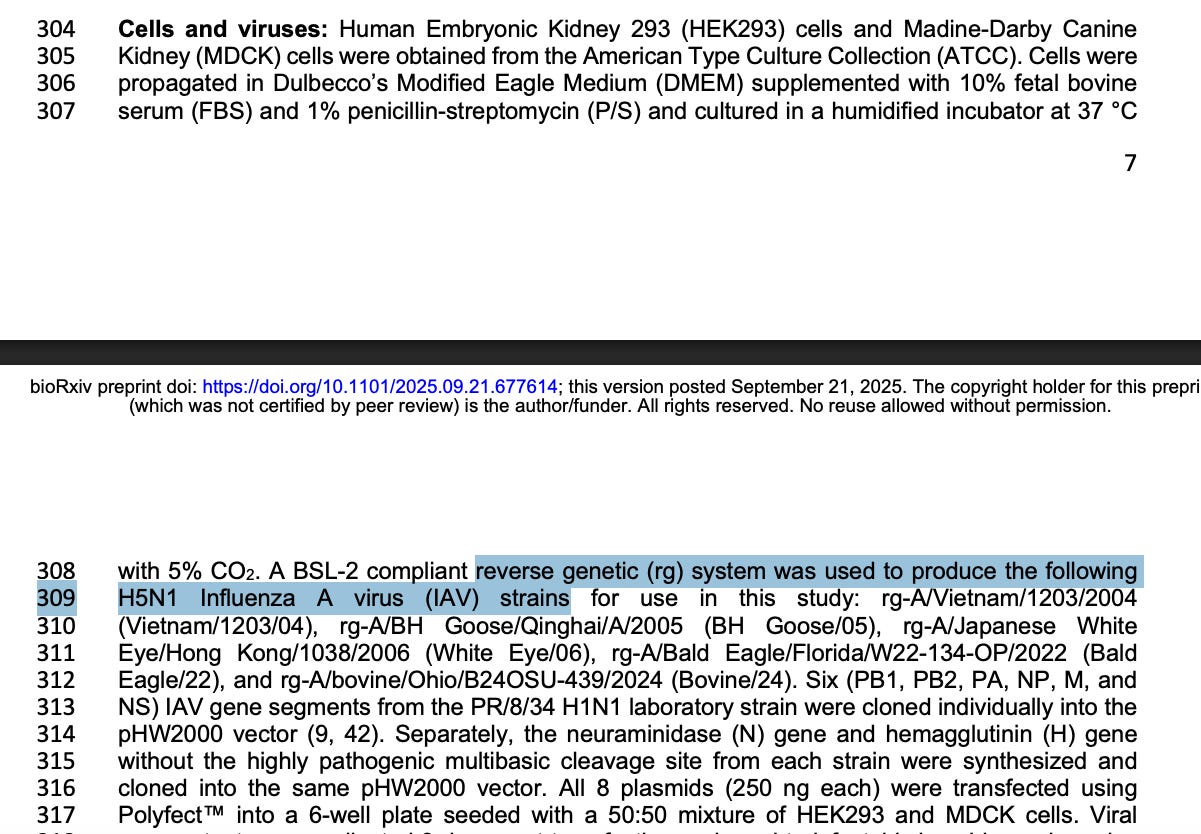
Instead of working with purportedly circulating H5N1 isolates, the team engineered new pathogens using reverse genetics:

  • Six internal gene segments (PB1, PB2, PA, NP, M, and NS) were pulled from the PR8 H1N1 laboratory strain, which is optimized for high replication in mammalian cells and chicken eggs.
  • These were combined with synthetic H5 and N genes stripped of their natural multibasic cleavage site.
  • The result: novel reassortant influenza viruses with enhanced lab replication efficiency compared to wild-type H5N1.

The viruses were generated in HEK293 and MDCK cells, then amplified in embryonated chicken eggs, all under BSL-2 laboratory conditions at the University of Nebraska–Lincoln.

Screenshot from biorxiv.org

Enhanced Growth and Replication Traits

By design, the engineered viruses gained new functions not seen in nature:

  • Enhanced growth efficiency in eggs and mammalian cells from the PR8 backbone.
  • Streamlined replication for lab handling.
  • BSL-2 compatibility, expanding the number of facilities able to handle them.

Who Did the Work

  • Joshua Wiggins
  • Adthakorn Madapong
  • Eric A. Weaver (corresponding author).

All three are affiliated with the Nebraska Center for Virology and the School of Biological Sciences at the University of Nebraska–Lincoln.

Where It Was Done

  • Genetic engineering, reverse genetics virus creation, and animal studies were all performed at the University of Nebraska–Lincoln, under IBC and IACUC approvals.
  • Work was conducted in BSL-2+ labs, required only for moderate-risk agents, despite the fact that the study involved the creation of novel influenza viruses capable of causing pandemics.

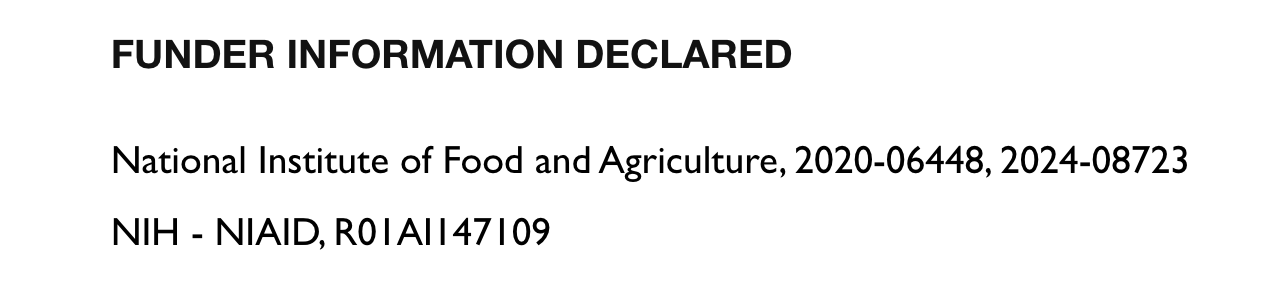
Who Paid for It

  • USDA National Institute of Food and Agriculture (NIFA), Agriculture and Food Research Initiative (Grant Nos. 2020-064482024-08723).
  • NIH – NIAID (Grant No. 1R01AI147109).
Screenshot from biorxiv.org

Bombshell Details

  • Replication-Competent Vectors: The study used replication-competent adenovirus vaccine platforms (Ad28 and Ad48) that can spread within the host, unlike safer replication-deficient types.
  • Failed Protection Against the Actual Threat: Despite claims of vaccine promise, the engineered vaccine produced no protective neutralization against the circulating bovine H5N1 strain (Bovine/24)—the virus causing real outbreaks in U.S. cattle.
  • No Cattle Challenge Studies: The vaccine was never tested against live infection in cattle, only in mice.
  • Sex Bias: Only male calves were tested, ignoring potential sex differences in immune response. By testing only male calves, the study ignored well-established sex differences in immunity—females typically mount stronger antibody and T-cell responses but also suffer higher rates of adverse reactions—leaving half the population unaccounted for and casting doubt on the safety and applicability of the findings.

Bottom Line

While the University of Nebraska team presented their work as vaccine development, the methods show they constructed brand-new bird flu viruses through reverse genetics, engineered with a PR8 laboratory backbone to enhance replication traits.

These pathogens, created with federal funding, were built and amplified under BSL-2 conditions—labs designed for moderate-risk microbes, not novel influenza strains with pandemic potential.

The authors claim their goal was to stop the spread of H5N1 in cattle, but the vaccine failed to neutralize the very strain now circulating in U.S. herds, was never tested in cattle challenges, and excluded females altogether.

Coming just days after President Trump’s UN call to end bioweapons creation, this project exemplifies the dangerous reality that pandemic-capable pathogens are being created under the guise of “vaccine development.”

On American soil.

With American tax dollars.

Sound familiar?

NIH Probes Link Between Vaccines and Autism: HHS Announcement (Video)


Trump shares encounter with employee whose son was severely vaccine-injured, and condemns how children are “pumped” with 80 different vaccines so early in life.

As part of its new Autism Data Science Initiative (ADSI), the U.S. National Institutes of Health (NIH) will investigate whether medical exposures—including vaccines—are linked to the rising prevalence of autism spectrum disorder (ASD).

Reviews of 91 human studies up to 2016 show that approximately 74% of studies suggest mercury exposure—including through vaccines—as a risk factor or contributor to ASD, showing both direct and indirect effects on brain development.

The new announcement came during a White House press conference in the Roosevelt Room, where President Trump and HHS Secretary Robert F. Kennedy Jr. outlined what they described as “progress in uncovering the root causes of autism.”

The fact sheet released by HHS details three primary initiatives: a renewed look at leucovorin (folinic acid) as a treatment for autism-related symptoms, guidance to physicians on acetaminophen use in pregnancy, and the NIH’s launch of the Autism Data Science Initiative.

Although vaccines were not listed among the three headline goals, they were nevertheless singled out later in the announcement under the NIH initiative’s “medical and perinatal influences” heading.

Data from CDC VAERS show 2,682,925 adverse events linked to vaccines since 1990—yet, as the Harvard Pilgrim study commissioned by HHS confirmed, fewer than 1% of vaccine injuries are ever reported, meaning the true number is likely in the hundreds of millions.


NIH Autism Data Science Initiative

The new NIH initiative involves more than $50 million in new awards, funding 13 projects that will focus on autism prevalence, etiology, treatment, services, and replication studies.

According to HHS, the projects will use “large-scale, integrated data resources” spanning genetics, epigenetics, proteomics, metabolomics, and behavioral data.

A defining feature is the “exposomics” (the study of all environmental exposures over a lifetime and their impact on health) approach, which NIH says will comprehensively study environmental, medical, and lifestyle factors that may contribute to autism.

The list of exposures includes:

  • Environmental contaminants such as chemicals and other hazardous substances found in everyday life
  • Nutrition and maternal diet factors like folate intake, fish consumption, and ultra-processed foods
  • Medical and perinatal influences, explicitly naming medications and vaccinations alongside obstetric complications and neonatal intensive care exposures
  • Psychosocial stressors, infections, and immune responses during pregnancy and early development

By directly including vaccinations in its research portfolio, NIH is, for the first time, publicly committing to probe potential links between vaccines and autism within a large-scale government-backed initiative.

Autism Rates Continue to Climb

The announcement comes amid sobering new numbers from the CDC: 1 in 31 U.S. children born in 2014 has been diagnosed with autism—nearly a fivefold increase from when the CDC first began tracking autism rates in 2000.

The prevalence is higher among boys (1 in 20) and highest in California, where nearly 1 in 12.5 children are affected.

Trump & Kennedy Single Out Vaccines

During the announcement, Trump shared his encounter with an employee whose son was apparently severely injured by vaccines:

The U.S. president also encouraged parents to space out vaccinations in their children:

Secretary Kennedy also emphasized the new focus on vaccines, pointing out how 40 to 70% of mothers who have children with autism believe that a vaccine injured their child:

Bottom Line

While leucovorin therapy and acetaminophen exposure in pregnancy formed part of the HHS briefing, it is the NIH Autism Data Science Initiative that is likely to draw the most scrutiny.

For decades, the possibility of a vaccine-autism connection has been dismissed by government health agencies, and officials have repeatedly emphasized that “vaccines are safe and effective.”

The fact that NIH’s own research portfolio will now explicitly include vaccinations as one of the risk factors under study marks a major shift—and one that could carry significant implications for both public health policy and parental trust in government vaccine programs.

AI’s Frankenstein Phages: Designer Viruses to Slay Bacteria – But What If They Turn on Us All?


Oh, brother, if there’s one thing that screams “we never learn” louder than a lab leak cover-up, it’s the mad scientists firing up AI to cook up brand-new viruses designed to hunt bacteria like microscopic terminators – phages so novel they’ve never existed in nature, promising to zap superbugs but risking a rogue evolution that could spell doom for humanity. We’re talking September 2025 breakthroughs where bioengineers used generative AI to dream up synthetic bacteriophage genomes, slapped them into bacteria, and watched the critters replicate and kill E. coli in lab dishes like it’s no big deal. This isn’t sci-fi; it’s happening now, with revelations warning of “extreme caution” as these AI-born killers could mutate beyond control, turning a “cure” into a curse. America First means slapping the brakes on this hubris before it bites us – because labs are “secure” until they’re not, and playing God with viruses is a gamble we can’t afford.

The AI Phage Revolution: From Code to Killer

It all kicked off with advancements in 2023-2024, but the real bombshell dropped in September 2025 when researchers announced the world’s first fully AI-designed bacteriophages – viruses that infect and destroy bacteria – capable of replicating and slaying resistant strains like E. coli in tests. These aren’t tweaks to existing phages; they’re entirely new creations, with AI proposing genetic codes that scientists synthesized and inserted into host cells, watching the viruses assemble, burst out, and infect targets.

How does it work? AI analyzes massive datasets of phage genomes – like the 10,000 sequenced by 2024 – to predict sequences that bind to specific bacteria, then generates novel ones that nature never made. Once designed, labs synthesize the DNA, insert it into bacteria, and let the phages self-assemble, replicating to form armies that latch onto targets, inject their code, and burst the cells open – a precision kill without antibiotics’ broad wipeout. Effectiveness? Lab tests from September 2025 showed these AI phages wiping out resistant E. coli strains in hours, with success rates over 90% in controlled settings.

The Dark Side: Evolution Risks and Unintended Mayhem

But here’s the nightmare fuel – these designer viruses are uncharted territory, and we have zero clue how they’ll evolve once unleashed. Revelations from genome pioneers in September 2025 warn of “extreme caution,” noting that AI phages could mutate in the wild, jumping hosts or turning virulent like a bad sci-fi plague. Unlike natural phages that co-evolved with bacteria over eons, these lab-born beasts lack those checks – a single tweak could let them infect humans or animals, sparking outbreaks we can’t predict. Think COVID’s origins: Man-made viruses don’t play by nature’s rules, and with phages replicating in minutes, evolution could spin out of control faster than you can say “gain-of-function.

“Worse, they’re being touted as “precision medicine” for superbugs, but revelations from a November 25, 2024, study show AI tools already predicting phage efficacy for E. coli with 85% accuracy, paving the way for widespread use. By May 22, 2025, startups were deploying AI-designed lysins – proteins from phages that punch holes in bacterial walls – to kill multidrug-resistant infections, but full phages amp the risk – they could spread unchecked, mutating to target beneficial bacteria or worse.

Lab Safety: “Secure” Until It’s Not

Sure, these labs are “as safe as possible” – BSL-3 or 4 levels with airlocks, suits, and protocols – but revelations from a January 6, 2025, real-world study on adverse events remind us accidents happen, like the 2023 Wuhan whispers or U.S. lab mishaps in 2022 that released engineered bugs. No containment is foolproof – human error, earthquakes, or sabotage could release these AI phages, and once out, they’re self-replicating time bombs. A 2020 commentary warned of “postantibiotic era” risks, but AI speeds it up, with no way to “recall” a rogue virus. The left’s “trust the science” mantra rings hollow here – we never learn from past lab leaks, and these viruses put all humanity on the line.

America First rejects this hubris – why risk humanity for “designer” fixes when natural phages already exist? Polls from August 2025 show 58% of Americans distrust AI in biotech, with 65% fearing lab leaks. We never learn – from COVID to this – and it’s time to pull the plug before the monsters escape.

Pfizer and Moderna Distract With Reverse Transcription Debate at ACIP Meeting—Plasmid DNA Integration Is the Real Threat


The reverse transcription debate is a decoy, while the real risk is DNA fragments built to integrate into your genome.

At the recent ACIP meeting, Dr. Evelyn Griffin rightly raised the alarm about mRNA reverse transcription—pointing to published studies showing nucleic acids in Pfizer’s mRNA COVID-19 shot can be integrated into human DNA, namely human liver cells under lab settings.

But Pfizer’s Dr. Kayvon Modjarrad quickly dismissed the concern:

“RNA cannot reverse transcribe to DNA [because that] requires a set of molecules and enzymes that don’t exist in humans and are largely reserved for retroviruses.”

Moderna chimed in, citing FDA reviews of “hundreds of millions” of doses and claiming “no indication of genotoxicity.”

The public was left thinking: case closed.

But this article will show that the real risk isn’t rare reverse transcription at all—it’s the integration of plasmid DNA contaminants into the human genome, a pathway every cell in the body is equipped to carry out.

Pfizer and Moderna are technically wrong that reverse transcription “can’t happen,” but they also know it’s rare—so they lean on that half-truth to keep the spotlight off plasmid DNA integration, which is far more likely and far more dangerous.

It’s a sleight of hand—a bait-and-switch.

Emergency room director Dr. Richard Bartlett told this website that the real scandal isn’t reverse transcription at all, but the hidden plasmid DNA contamination that provides the mechanism for Pfizer’s genetic code to be incorporated into human DNA and causes disease.

“Pfizer and Moderna are distracting from the smoking gun of plasmid DNA contamination in their COVID-19 mRNA shots,” Dr. Bartlett said. “In 2022, investigators worked with the information they had, but that information was not complete. The fact that Pfizer’s genetic code was incorporated into human host DNA is irrefutable. And the most likely mechanism that it got there is plasmid DNA, not mRNA reverse transcription. Pfizer knows this. Moderna knows this. They hid the damning information from investigators and doctors in 2022. That is why investigators misinterpreted DNA integration as reverse transcription. I am convinced that Pfizer’s genetic code found in human cells did not come from the mRNA, but from plasmid DNA contamination. This is catastrophic.”

You can watch a clip of the exchange, posted by Dr. Mary Talley Bowden, below:

The Bait-and-Switch

This is the inside baseball play: Pfizer and Moderna want the debate stuck on reverse transcription.

Why?

Because they can plausibly argue it’s rare.

The enzyme required for reverse transcription—LINE-1—is typically absent from the vast majority of human cells, with only modest expression detected in specialized cell types like epithelial cells, and higher activity mainly in tumors and with aging.

That makes reverse transcription possible, but not systemic.

They know this, and they exploit it.

But focusing there keeps eyes off the much bigger danger.

The study Dr. Griffin cited made the best assumption it could with the cherry-picked information the manufacturers released—but what it could not account for, because Pfizer and Moderna hid the evidence and still refuse to admit it, is the smoking gun: plasmid DNA contamination, the very mechanism by which foreign DNA can be incorporated into the human genome after injection, kept from researchers and the public and denying true informed consent.

Plasmids are routinely used in the industry to incorporate foreign DNA into host DNA.

The Bigger Threat: Plasmid DNA Integration

The COVID-19 mRNA shots are manufactured using DNA plasmids—the very genetic engineering tools designed to insert code into genomes.

By definition, plasmids are integration-competent.

They can stitch themselves into human DNA.

Independent labs have confirmed that Pfizer’s vials contain toxic levels of plasmid DNA.

  • French government-funded study led by Didier Raoult (Nov 2024) found 5,160 ng of plasmid DNA per dose—516 times higher than the FDA/EMA safety limit.
  • December 2024 peer-reviewed paper in Science, Public Health Policy & the Law found 227–334% more DNA contamination than WHO limits, including the cancer-linked SV40 promoter/enhancer.
  • A September 2025 peer-reviewed study in Autoimmunityconfirmed both Pfizer and Moderna’s shots are contaminated with billions to hundreds of billions of DNA fragments per dose—up to 627 times higher than FDA/WHO limits—with Pfizer uniquely carrying the SV40 promoter-enhancer, a cancer-linked sequence designed to drive foreign DNA into human cell nuclei.

This isn’t speculation.

The contamination is proven.

What’s Inside Pfizer’s Plasmid

Pfizer’s plasmid doesn’t just contain bacterial DNA and the SV40 cancer-promoting gene sequence.

It also carries three human gene fragments used as regulatory elements:

  • α-globin (blood/cardiovascular): regulates red blood cell gene expression.
  • AES/TLE5 (immune): regulates transcriptional control in immune pathways.
  • MT-RNR1 (neurological/mitochondrial): tied to mitochondrial function and neurological disorders.

An October 2023 Nature npj Vaccines paper confirmed these sequences are part of Pfizer’s design:

“Pfizer-BioNTech’s 5’ UTR sequence is derived from the human hemoglobin α-globin (HBA1) gene… For the 3’ UTR, the Pfizer-BioNTech vaccine combines one segment from a human mRNA encoding amino-terminal enhancer of split (AES) and another from mitochondrial 12 S rRNA (mtRNR1).”

These are not inert.

They are regulatory DNA codes.

Alignment With the Injury Signal

Here’s where it gets damning.

Two independent safety reviews (2022, 2024) found that serious adverse events after Pfizer’s mRNA shot cluster into three categories:

  • Cardiac/blood: myocarditis, clotting, thrombocytopenia.
  • Immune: anaphylaxis, hypersensitivity, autoimmune flares.
  • Neurological: Guillain–Barré, seizures, facial paralysis.

Pfizer’s own 5.3.6 safety report confirms the same triad:

  • 25,957 neurological events
  • 1,050 immune/autoimmune cases
  • 932 blood/hematological disorders

Now line it up:

  • Plasmid fragment: α-globin → blood
  • Plasmid fragment: AES/TLE5 → immune
  • Plasmid fragment: MT-RNR1 → neurological

The plasmid blueprint and the injury clusters align perfectly—making the case plain without muddying the waters with debates over mRNA reverse transcription.

In other words, the match between Pfizer’s plasmid design and the injury clusters is exact, and it stands on its own—no need to get lost in the reverse transcription smokescreen.

Every Cell Has the Machinery

Unlike reverse transcription, which relies on rare LINE-1 enzymes, plasmid DNA doesn’t need anything special.

Every human cell carries DNA repair systems—like Non-Homologous End Joining (NHEJ)—that can integrate foreign DNA into chromosomes.

These pathways are active everywhere because they’re required for basic genome maintenance.

That means plasmid integration is not rare.

It’s possible in virtually every cell.

The Silence Is Deafening

Pfizer and Moderna keep ACIP fixated on reverse transcription—a long shot they can safely dismiss—while saying nothing about plasmid DNA contamination, which is systemic and inescapable.

And yet their own blueprint, their own fragments, and their own safety data all point to the same conclusion: integration risk matches the injury signal.

Bottom Line

  • Reverse transcription is real but rare.
  • Plasmid DNA integration is universal—all cells have the machinery.
  • Pfizer’s plasmid carries human DNA fragments regulating blood, immune, and neurological systems.
  • Those are the exact systems showing up in serious vaccine injuries, confirmed by independent reviews and Pfizer’s own report.

This is not coincidence—it’s alignment.

The unavoidable question is whether Pfizer’s plasmid design itself is driving the blood, immune, and neurological injuries dominating the safety signal.

Until regulators investigate, the only responsible course is to pull these shots from the market.

That’s why the focus must shift off the apparently rare possibility of mRNA reverse transcription and onto the far greater danger—plasmid DNA integration—a risk built into every cell and written into Pfizer’s own blueprint.

U.S. Military Aerosolizes Hantavirus with 30% Fatality Rate in Nebraska: Journal ‘Pathogens’


Pentagon-funded study confirms scientists deliberately created airborne hantavirus particles and carried out stabilization trials to prolong their survival.

The U.S. military has funded research, published in July in the journal Pathogens, in which scientists deliberately aerosolized Sin Nombre virus (SNV)—the hantavirus that kills roughly 30% of those infected—in order to study how long the virus can survive in the air and under what conditions it remains infectious.

Why is the Pentagon commissioning experiments that turn a rodent-borne virus with a 30% kill rate into an airborne particle?

Why are U.S. defense labs probing how to stabilize lethal aerosols?

The study would say it aerosolized hantavirus because “gaining insight into the SNV bioaerosol decay profile is fundamental to the prevention of SNV infections,” but the deeper concern is whether such work risks accidental release or could be harnessed intentionally for pandemic potential.

This new study fits the same disturbing pattern: taxpayer-funded projects that blur the line between “biodefense” and the step-by-step recipe for a future bioweapon.

Dr. Richard Bartlett didn’t mince words as he raised alarm over Pentagon-backed hantavirus aerosol experiments:

“How much longer will We the People tolerate our government using our tax dollars to do deadly experiments in our homeland? Has anyone heard that the COVID pandemic might have been caused by a lab leak? We have no guarantee that another lab leak might happen on our own soil. Remember: Dr. Anthony Fauci and a 2016 NIH-led biosecurity report identified insider leaks as the “most probable” risk in gain-of-function research.”


A Lethal Virus

The authors admit the severity of the pathogen upfront:

“Later symptoms involve respiratory distress that requires immediate medical attention and has a 30% fatality rate.”

In other words, this is not a mild virus.

If contracted, nearly one in three patients will die, and there is no approved treatment or vaccine.

The Pentagon’s Involvement

This wasn’t purely academic work.

The study declares its sponsor:

“This research was funded by the Defense Threat Reduction Agency (DTRA), under grant number DTRA/CBS-NSRI CB1099.”

That means the Pentagon’s weapons division paid for scientists to aerosolize and study the airborne stability of a lethal hantavirus—a clear overlap with bioweapons research.

Aerosolizing a Killer

The researchers describe how they turned the virus into an aerosol:

“Suspensions were aerosolized via a 120 kHz ultrasonic nozzle… with 3 lpm of carrier air.”

Put plainly, they deliberately converted liquid hantavirus into airborne particles small enough to reach deep into human lungs.

This step—aerosolization—is the foundation of making a respiratory bioweapon.

Measuring Airborne Survival

They then tracked how long these particles remained infectious under different conditions:

“At 49.1 ± 0.8% RH, the addition of 1.0 ppm ozone caused a significant increase in the amount of SNV decay at 2.6 ± 0.1 log/min.”

In other words, in normal humidity, the virus survives in the air unless destroyed by ozone.

Sunlight weakened it but did not fully eliminate infectivity.

This proves SNV is stable enough to persist airborne indoors—such as in barns, sheds, or attics—precisely where human infections are known to occur.

Comparison to Other Pandemic Viruses

The researchers themselves compared SNV to avian influenza and Lassa virus:

“This transmission route is similar to other viruses that have an environmental transmission route, such as avian influenza (e.g., H5N1) and Lassa virus.”

This places hantavirus in the same category as pathogens with known pandemic potential.

The implication is clear: if SNV ever adapted to spread person-to-person, as Andes virus already does, the results would be catastrophic.

Particle Sizes Optimized for Lung Infection

The team also measured the size of the particles they created:

“The results indicated a bimodal distribution… with a peak at under a micron in size and a second peak under two microns.”

Translated, these are exactly the particle sizes most dangerous to humans, capable of bypassing upper airways and embedding deep inside the lungs.

Where the Experiments Took Place

The aerosolization experiments were conducted at the University of Nebraska Medical Center (UNMC) in Omaha, Nebraska, using the Biological Aerosol Reaction Chamber (Bio-ARC).

This is a specialized flow-through system designed to expose bioaerosols to controlled conditions such as simulated sunlight, ozone, and humidity.

Institutional Affiliations

The authors are affiliated with the following institutions:

  1. Department of Pathology, Microbiology, and Immunology, University of Nebraska Medical Center (UNMC), Omaha, NE
  2. The Global Center for Health Security, University of Nebraska Medical Center (UNMC), Omaha, NE
  3. National Strategic Research Institute (NSRI), Omaha, NE
  4. Center for Global Health, Department of Internal Medicine, University of New Mexico, Albuquerque, NM

Full List of Scientists

  • Elizabeth A. Klug
  • Danielle N. Rivera
  • Vicki L. Herrera
  • Ashley R. Ravnholdt
  • Daniel N. Ackerman
  • Yangsheng Yu
  • Chunyan Ye
  • Steven B. Bradfute
  • St. Patrick Reid
  • Joshua L. Santarpia

Bottom Line

The Pentagon has funded scientists to take a hantavirus with a 30% fatality rate, aerosolize it into tiny lung-penetrating particles, and measure how long it stays infectious in the air.

This kind of research, while framed as biodefense, is indistinguishable from steps needed to weaponize a virus.

With no vaccine or treatment available, the knowledge produced here doesn’t just help “protect”—it creates a blueprint for how to turn hantavirus into a bioweapon.